3.1
PROGRAMMER'S GUIDE
• LANGUAGE STRUCTURE
• CLASS LIBRARIES
• ADVANCED PROGRAMMING TECHNIQUES
Borland
C++
Version 3.1
Programmer's Guide
Copyright © 1991, 1992 by Borland International. All rights reserved. All Borland products are trademarks or registered trademarks of Borland International, Inc. Other brand and product names are trademarks or registered trademarks of their respective holders. Windows, as used in this manual, refers to Microsoft's
c
o
N
T
Introduction 1
What's in this book ... 1
An introduction to the formal definitions. 2 Syntax and terminology ... 3
Chapter 1 Lexical elements 5 Whitespace ... 6
Line splicing with \ ... 6
Comments ... 7
C comments . . . .. 7
Nested comments ... 7
C++ comments ... 8
Comment delimiters and whitespace . 8 Tokens ... 8
Keywords ... 9
Identifiers . . . .. 10
Naming and length restrictions .... 10
Identifiers and case sensitivity ... 10
Uniqueness and scope ... 11
Constants . . . .. 11
Integer constants . . . .. 11
Decimal constants . . . .. 11
Octal constants ... 12
Hexadecimal constants ... 13
Long and unsigned suffixes ... 13
Character constants ... 14
Escape sequences ... 14
Borland C++ special two-character constants ... 15
Signed and unsigned char ... 15
Wide character constants ... 16
Floating-point constants ... 16
Floating-point constants-data types ... 16
Enumeration constants ... 17
String literals ... . . .. 18
E
N
T
s
Constants and internal representation ... 19. Constant expressions .. . . .. 20
Punctuators ... 21
Brackets ... 21
Parentheses ... 21
Braces ... 21
Comma ... 22
Semicolon. . . .. 22
Colon ... 23
Ellipsis ... 23
Asterisk (pointer declaration) ... 23
Equal sign (initializer) ... 23
Pound sign (preprocessor directive) .24 Chapter 2 Language structure 25 Declarations ... 25
Objects ... 25
Lvalues ... 26
Rvalues ... 27
Types and storage classes ... 27
Scope ... 27
Block scope ... 28
Function scope ... 28
Function prototype scope ... 28
File scope ... 28
Class scope (C++) ... 28
Scope and name spaces ... 28
Visibility. . . .. 29
Duration ... 29
Static duration ... 29
Local duration . . . .. 30
Dynamic duration ... 30
Translation units ... 31
Linkage ... 31
Declaration syntax ... 33
Tentative definitions ... 33
Possible declarations ... 34
External declarations and definitions . 36 Type specifiers ... 38
Type taxonomy . . . .. 38
Type void . . . .. 39
The fundamental types ... 39
Integral types ... 40
Floating-point types ... 41
Standard conversions . . . .. 41
Special char, int, and enum conver~ons ... 42
Initialization ... 42
Arrays, structures, and unions ... 43
Simple declarations ... 44
Storage class specifiers . . . .. 45
Use of storage class specifier auto .. 45
Use of storage class specifier extern. 45 Use of storage class specifier register ... 45
Use of storage class specifier static .. 46
Use of storage class specifier typedef ... 46
Modifiers ... 47
The const modifier ... 47
The interrupt function modifier .... 49
The volatile modifier ... 49
The cdecl and pascal modifiers . . . .. 50
pascal ... 50
cdecl ... 50
The pointer modifiers ... 51
Function type modifiers . . . .. 52
Complex declarations and declarators .53 Pointers ... 54
Pointers to objects . . . .. 55
Pointers to functions ... 55
Pointer declarations ... 56
Pointers and constants . . . .. 57
Pointer arithmetic . . . .. 58
Pointer conversions ... 59
C++ reference declarations ... 59
Declarations and definitions ... 60
Declarations and prototypes . . . .. 61
Definitions ... 63
Formal parameter declarations. . . .. 64
Function calls and argument conver~ons ... 64
Structures . . . .. 65
Untagged structures and typedefs .... 66
Structure member declarations ... 66
Structures and functions ... 67
Structure member access . . . .. 67
Structure word alignment . . . .. 69
Structure name spaces ... 69
Incomplete declarations ... 70
Bit fields . . . .. 70
Unions ... 71
Anonymous unions (C++ only) ... 72
Union declarations ... 73
Enumerations ... 73
Expressions ... 75
Expressions and C++ ... 78
Evaluation order ... 78
Errors and overflows ... 79
Operator semantics ... 79
Operator descriptions ... 79
Unary operators ... ,... 81
Binaryoperators ... 81
Additive operators . . . .. 81
Multiplicative operators ... 81
Shift opera tors . . . .. 81
Bitwise operators ... 81
Logical operators ... 81
Assignment operators ... 81
Relational operators ... 82
Equality operators ... 82
Component selection operators .... 82
Class-member operators ... 82
Conditional operator ... 82
Comma operator ... 82
Postfix and prefix operators ... 82
Array subscript operator [ ] ... 82
Structure/union pointer
operator -> ... 83
Postfix increment operator ++ ... 84
Postfix decrement operator - - ... 84
Increment and decrement operators .. 84
Prefix increment operator ... 84
Prefix decrement operator ... -... , 84
Unary operators ... 85
Address operator & ... 85
Indirection operator * ... , 86
Unary plus operator + ... 86
Unary minus operator - ... , 86
Bitwise complement operator ~ .... 86
Logical negation operator! ... 86
The sizeof operator. . . .. 87
Multiplicative operators ... 87
Additive operators ... 88
The addition operator + ... 88
The subtraction operator - ... 89
Bitwise shift operators ... . . . .. 89
Bitwise shift operators
«<
and » ) . 89 Relational operators ... 90The less-than operator < ... 90
The greater-than operator> ... 91
The less-than or equal-to operator <= ... ~ ... 91
The greater-than or equal-to operator >= ... 91
Equalityoperators ... 91
The equal-to operator == ... 91
The inequality operator != ... 92
Bitwise AND operator & ... 92
Bitwise exclusive OR operator /\ ... 93
Bitwise inclusive OR operator I ... 93
Logical AND operator && ... 93
Logical OR operator I I ... 94
Conditional operator? : . . . .. 94
Assignment operators ... 95
The simple assignment operator = .. 95
The compound assignment operators ... 96
Comma operator ... , .. , ... , 96
C++ operators ... 97
Statements ... 97
iii Blocks Labeled statements ... . Expression statements ... . Selection statements ... . if statements ... . switch statements .. , ... . Iteration statements ... . while statements ... . do while statements ... . for statements ... . Jump statements ... . break statements ... . continue statements ... . goto statements ... . return statements ... . 98 98 99 99 99 100 101 101 101 102 103 103 103 103 104 Chapter 3 C++ specifics 105 Referencing ... 105
Simple references ... 106
Reference arguments ... 106
Scope access operator ... , 108
The new and delete operators ... 108
Handling errors ... ,... 109
The operator new with arrays ... 109
The operator delete with arrays .. , .. 109
The ::operator new ... 110
Initializers with the new operator ... 110
Classes ... 111
Class names . . . .. 111
Class types . . . .. 111
Class name scope ... 112
Class objects ... 113
Class member list. . . .. 113
Member functions ... 113
The keyword this ... 113
Inline functions . . . .. 114
Static members ... 115
Member scope . . . .. 116
Nested types ... 117
Member access control. . . .. 118
Base and derived class access ... 120
Virtual base classes ... 122
Friends of classes ... 122
Constructors ... 125
Constructor defaults ... 126
The copy constructor ... , 127
Overloading constructors ... 127
Order of calling constructors ... 128
Class initialization ... 129
Destructors ... 132
When destructors are invoked ... 132
atexit, #pragma exit, and destructors. 133 exit and destructors ... 133
abort and destructors ... 133
Virtual destructors ... 134
Overloaded operators ... 135
Operator functions ... . . . .. 136
Overloaded operators and inheritance ... 136
Overloading new and delete. . . .. 137
Overloading unary operators ... 138
Overloading binary operators ... 139
Overloading the assignment operator
= ...
139Overloading the function call operator
0 ...
140Overloading the subscript operator .. 140
Overloading the class member access operator ... 140
Virtual functions . . . .. 140
Abstract classes . . . .. 142
C++ scope ... 143
Class scope . . . .. 144
Hiding ... 144
C++ scoping rules summary . . . .. 144
Templates ... 145
Function templates . . . .. 146
Overriding a template function .. , 148
Implicit and explicit template functions ... 148
Class templates ... 149
Arguments ... 150
Angle brackets ... 150
Type-safe generic lists ... 151
Eliminating pointers ... 152
Template compiler switches ... 152
Chapter 4 The preprocessor 157 Null directive # . . . .. 159
The #define and #Undef directives . . . .. 159
Simple #define macros ... 159
The #Undef directive ... 160
The -D and -U options ... 161
The Define option . . . .. 161
Keywords and protected words . . . .. 162
Macros with parameters ... 162
File inclusion with #include ... 165
Header file search with <header_name> ... 166
Header file search with "header_name" ... 166
Conditional compilation ... 166
The #if, #elif, #else, and #endif conditional directives ... 167
The operator defined ... 167
The #ifdef and #ifndef conditional directives ... 168
The #line line control directive ... 169
The #error directive ... 170
The #pragma directive . . . .. 171
#pragma argsused ... 171
#pragma exit and #pragma startup .. 171
#pragma hdrfile ... 172
#pragma hdrstop ... 173
#pragma inline ... 173
#pragma intrinsic ... 173
#pragma option . . . .. 173
#pragma saveregs ... 175
#pragma warn . . . .. 175
Predefined macros ... 175
__ BCPLUSPLUS __ ... 175
__ BORLANDC __ ... 176
__ CDECL __ ... 176
__ cplusplus . . . .. 176
__ DATE __ ... 177
__ DLL __ ... 177
__ FILE __ ... 177
__ LINE ... 177
__ MSDOS __ ... 177
__ STDC_ _ 000000 0000000000000000 178 __ TCPLUSPLUS __ 000000000000000 178 __ TEMPLATES __ 00000000·00000000 178 __ TIME __ 00000000000000000000000 178 __ TURBOC 0000000000000000000 179 _Windows 0 0 0 0 0 0 0 0 0 0 0 0 0 0 0 0 0 0 0 0 0 0 0 179
Chapter 5 Using C++ streams 181 What is a stream? 0 0 0 0 0 0 0 0 0 0 0 0 0 0 0 0 0 0 0 181 The iostream library 00000000000000000 182 The streambuf class 000000000000000 182 The ios class 0 0 0 0 0 0 0 0 0 0 0 0 0 0 0 0 0 0 0 0 0 0 182 Output 0000000000000000000000000000 183 Fundamental types 0000000000000000 184 Output formatting 0000000000000000 184 Manipulators 0 0 0 0 0 0 0 0 0 0 0 0 0 0 0 0 0 0 0 0 0 185 Filling and padding 000000000000000 187 Input 000000000000000000000000000000 187 I/O of user-defined types 000000000000 188 Simple file I/O 0 0 0 0 0 0 0 0 0 0 0 0 0 0 0 0 0 0 0 0 0 189 String stream processing 0000000000000 190 Screen output streams 0000.0000000000 192 Stream class reference 0 0 0 0 0 0 0 0 0 0 0 0 0 0 0 193 conbuf 00. 0 0 0 0 0 0 0 0 0 0 0 0 0 0 0 0 0 0 00000000 194 Member functions 0 0 0 0 0 0 0 0 0 0 0 0 0 0 0 0 0 194 constream 0 0 0 0 0 0 0 0 0 0 0 0 0 0 0 0 0 0 0 0 0 0 0 0 0 0 195 Member functions 0 0 0 0 0 0 0 0 0 0 0 0 0 0 0 0 0 195 filebuf 00 0 0 0 0 0 0 0 0 0 000000000000000000 196 Member functions 0 0 0 0 0 0 0 0 0 0 0 0 0 0 0 0 0 196 fstream 0 0 0 0 0 0 0 0 0 0 000000 0 0 0 0 0 0 0 0 0 0 00 197 Member functions 0 0 0 0 0 0 0 0 0 0 0 0 0 0 0 0 0 197 fstreambase 000000000000000000000000 197 Member functions 0 0 0 0 0 0 0 0 0 0 0 0 0 0 0 0 0 198 ifstream 0 0 0 0 0 0 0 0 0 0 0 0 0 0 0 0 0 0 0 0 0 0 0 0 0 0 0 198 Member functions 0 0 0 0 0 0 0 0 0 0 0 0 0 0 0 0 0 199 ios 0 0 0 000000000000000000000000000 00 199 Data members 00000000000000000000 199 Member functions 0 0 0 0 0 0 0 0 0 0 0 0 0 0 0 0 0 200 iostreamo 00000000000000000000000000 202 iostream_withassign 0000000000000000 202 Member functions 0 0 0 0 0 0 0 0 0 0 0 0 0 0 0 0 0 202 istream 0 0 0 0 0 0 0 0 0 0 0 0 0 0 0 0 0 0 0 0 0 0 0 0 0 0 0 0 202 Member functions 0 0 0 0 0 0 0 0 0 0 0 0 0 0 0 0 0 203 istream_ withassign 0 0 0 0 0 0 0 0 0 0 0 0 0 0 0 0 0 0 204
v
Member functions 0 0 0 0 0 0 0 0 0 0 0 0 0 0 0 0 204 istrstream 00000 0 0 0 0 0 0 0 000 0 0 0 0 000 0 0 0 0 204 of stream 0 0 0 0 0 0 0 0 0 0 0 0 : 0 0 0 0 0 0 0 0 0 0 0 0 0 0 205 Member functions 0 0 . 0 0 0 0 0 0 0 0 0 0 0 0 0 205 ostream 0 0 0 0 0 0 0 0 0 0 0 0 0 0 . 0 0 0 0 0 0 0 0 0 0 0 0 0 205 Member functions 0 0 .. 0 .... 0 . . . . .. 206 ostream_withassign .0 .. 00 .... '0, ... 0 206 Member functions ... 206 ostrstream ... 0 ... 0 0 ... 0 206 Member functions ... 0 " 207 streambuf 0 ... 0 0 ... 0 0 .. 0 ... 0 ... o. 207 Member functions ... 0 0 ... 0 .. 0 207 strstreambase 000 0 . 0 0 0 . 0 0 0 . 0 0 0 . 0 0 000 210 Member functions 0 0 . 0 . 0 . 0 0 0 0 0 0 . 0 0 210 strstreambuf 0 0 0 0 0 0 0 0 0 . 0 0 0 . 0 . 0 0 0 0 . 0 0 210 Member functions 0 0 . 0 ... 0 .. 0 0 0 . 0 0 211 strstream 000000 .. 0 0 0 .. 0 0 .. 0 0 0 0 0 0 .. 0 211 Member function 0 0 0 . 0 0 0 0 0 0 . 0 0 0 0 0 0 212
Chapter 6 The container class
libraries 213
Header files ... 230
Tuning an application ... 231
FDS implementation ... 231
ADT implementation . . . .. 235
The class library directory . . . .. 238
The INCLUDE directory ... , ... 238
The SOURCE directory ... 239
The LIB directory ... 239
The EXAMPLES directory . . . .. 240
Preconditions and checks ... 240
Container class reference ... " 241 AbstractArray ... 242
Data members . . . .. 242
Member functions ... " 243 Friends ... 245
Array ... 245
Example ... 245
Member functions. . . .. 246
Arraylterator . . . .. 247
Member functions. . . .. 247
Association ... 248
Member functions. . . .. 248
Example . . . .. 249
Bag ... 250
Member functions. . . .. 250
BaseDate . . . .. 252
Member functions. . . .. 252
BaseTime ... 253
Member functions . . . .. 253
Btree ... 255
Member functions. . . .. 255
Friends ... 257
BtreeIterator ... 257
Member functions. . . .. 257
Collection ... " 258 Member functions. . . .. 259
Container ... . . .. 259
Member functions . . . .. 261
Friends ... 263
ContainerIterator ... 263
Member functions. . . .. 263
Date ... 264
Member functions . . . .. 264
Example . . . .. 265
Member functions ... 266
Dictionary ... 267
Member functions ... 268
DoubleList . . . .. 268
Member functions ... 268
Friends ... " 270 DoubleListIterator ... 270
Member functions ... 270
Error ... 271
Member functions ... 271
HashTable ... 272
Member functions ... 273
Friends ... 274
HashTableIterator ... " 274 Member functions ... 274
List ... '.' ... 275
Member functions ... 275
Friends ... 276
ListIterator . . . .. 276
Member functions ... 276
MemBlocks ... 277
MemStack ... 278
Object ... '" .... , .. , ... 279
Data member. . . .. 279
Member functions ... 279
Friends ... 281
Related functions ... 282
PriorityQueue ... " 282 Member functions ... 283
Queue ... 284
Exam pIe . . . .. 284
Member functions ... 285
Set ... " . " .. 285
Member functions ... 286
Sortable ... 286
Member functions ... 288
Related functions ... 288
SortedArray ... " 289 Stack .. " .... , ... 289
Example . . . .. 290
Member functions ... 291
Example . . . .. 293
Time ... 294
Member functions . . . .. 294
Timer ... 295
Member functions. . . .. 295
TShouldDelete . . . .. 296
Member functions. . . . .. 296
Chapter 7 Converting from Microsoft C 299 Environment and tools ... 299
Paths for .h and .LIB files ... 300
MAKE ... 301
Command-line compiler ... 302
Command-line options and libraries. 306 Linker ... '" ... 306
Source-level compatibility ... , 308
__ MSC macro ... 308
Header files ... 308
Memory models ... 309
Keywords. . . .. 310
Floating-point return values ... , 310
Structures returned by value ... 310
Conversion hints. . . .. 311
Chapter 8 Building a Windows application 313 Compiling and linking within the IDE 314 Understanding resource files ... 315
Understanding module definition files ... 315
Compiling and linking WHELLO ... 315
Using the project manager ... 316
Setting compile and link options .. 317
WinMain ... 318
Compiling and linking from the command line ... 318
Compiling from the command line .. 319
Linking from the command line . . . .. 320
Using a makefile ... 321
Another makefile for Windows ... 322
Prologs and epilogs ... 322
Windows All Functions Exportable (-W) ... 323
vii Windows Explicit Functions Exported (-WE) ... 323
Windows Smart Callbacks (-WS) .... 323
Windows DLL All Functions Exportable (-WD) ... 324
Windows DLL Explicit Functions Exported (-WDE) ... 324
The _export keyword ... , 324
Prologs, epilogs, and exports: a summary ... 325
Memory models ... 326
Module definition files ... 326
A quick example . . . .. 327
Linking for Windows . . . .. 328
Linking in the IDE ... 329
Linking with TLINK ... 329
Linker options . . . .. 329
Linking .OBJ and .LIB files ... 330
Linking .OBJ and .LIB files for DLLs ... 331
Dynamic link libraries ... 332
Compiling and linking a DLL within the IDE ... 332
Compiling and linking a DLL from the command line ... . . . .. 332
Module definition files ... 333
Import libraries ... 333
Creating DLLs ... 333
LibMain and WEP ... 334
Pointers and memory. . . .. 335
Static data in DLLs ... 336
C++ classes and pointers ... 336
Chapter 9 DOS memory manage-ment 339 Running out of memory ... 339
Memory models ... 339
The 8086 registers . . . .. 340
General-purpose registers ... 340
Segment registers ... 341
Special-purpose registers ... 341
The flags register . . . .. 341
Memory segmentation ... 342
Pointers ... 344
Near pointers ... 344
Far pointers ... 344
Huge pointers ... 345
The six memory models. . . .. 346
Mixed-model programming: Addressing modifiers ... 350
Segment pointers ... 351
Declaring far objects ... 352
Declaring functions to be near or far . 352 Declaring pointers to be near, far, or huge ... 353
Pointing to a given segment:offset address ... 355
Using library files ... 355
Linking mixed modules . . . .. 355
Overlays (VROOMM) for DOS. . . .. 357
How overlays work ... 357
Getting the best out of Borland C++ overlays ... 359
Requirements ... 359
Using overlays ... 360
Overlay example ... 360
Overlaying in the IDE ... 361
Overlaid programs . . . .. 361
The far call requirement. . . .. 361
Buffer size ... 362
What not to overlay ... 362
Debugging overlays . . . .. 362
External routines in overlays ... 363
Swapping . . . .. 364
Expanded memory . . . .. 364
Extended memory ... 364
Chapter 10 Math 367 Floating-point options ... 367
Emulating the 80x87 chip ... 368
Using 80x87 code ... 368
No floating-point code ... 368
Fast floating-point option ... " ... 368
The 87 environment variable ... 369
Registers and the 80x87 ... 370
Disabling floating-point exceptions .. 370
Using complex math ... 371
Using BCD math ... 372
Converting BCD numbers . . . .. 373
Number of decimal digits ... 373
Chapter 11 Video functions 375 Some words about video modes ... 375
Some words about windows and viewports ... 376
What is a window? ... 376
What is a viewport? ... 377
Coordinates ... 377
Programming in text mode . . . .. 377
The console I/O functions ... 377
Text output and manipulation .... 377
Window and mode control .. . . . .. 379
Attribute control . . . .. 379
State query ... 380
Cursor shape ... 380
Text windows ... 380
An example ... 381
The text_modes type ... 381
Textcolors ... 382
High-performance output ... 383
Programming in graphics mode. . . .. 384
The graphics library functions ... 385
Graphics system control ... 385
A more detailed discussion . . . .. 387
Drawing and filling ... 387
Manipulating the screen and viewport . . . .. 389
Text output in graphics mode ... 390
Color control . . . .. 392
Pixels and ralettes ... 392
Background and drawing color ... 393
Color control on a CGA . . . .. 393
CGA low resolution ... 393
CGA high resolution ... 394
CGA palette routines ... 395
Color control on the EGA and VGA ... 395
Error handling in graphics mode .. 395
Chapter 12 BASM and inline
assembly 399
Inline assembly language ... 399
BASM ... 400
Inline syntax ... 400
Opcodes ... 402
String instructions ... 403
Prefixes . . . .. 403
Jump instructions ... 403
Assembly directives ... 404
Inline assembly references to data and functions ... 404
ix Inline assembly and register variables . . . .. 404
Inline assembly, offsets, and size overrides ... 404
Using C structure members ... 405
Using jump instructions and labels. 406 Interrupt functions . . . .. 406
Using low-Iev,el practices ... 408
Appendix A ANSI implementation-specific standards 411
T
A
B
L
E
s
1.1: All Borland C++ keywords ... 9 2.13: Borland C++ statements ... 98
1.2: Borland C++ extensions to C ... 9 4.1: Borland C++ preprocessing directives 1.3: Keywords specific to C++ ... 9 syntax ... 158
1.4: Borland C++ register 5.1: Stream manipulators ... 186
pseudovariables ... 10 5.2: File modes ... 190
1.5: Constants-formal definitions ... 12 5.3: Console stream manipulators ... 192
1.6: Borland C++ integer constants without 6.1: ADTs as fundamental data Lor U ... 13 structures ... 226
1.7: Borland C++ escape sequences ... 15 6.2: FDS class templates ... 227
1.8: Borland C++ floating constant sizes and 6.3: Abbreviations in CLASSLIB names .228 ranges ... 17 6.4: ADT class templates ... 228
1.9: Data types, sizes, and ranges ... 19 6.5: Object-based FDS classes ... 229
2.1: Borland C++ declaration syntax ... 35 6.6: Class debugging modes ... 241
2.2: Borland C++ declarator syntax ... 36 7.1: CL and BCC options compared ... 302
2.3: Borland C++ class declarations (C++ 7.2: LINK and TLINK options only) ... 37 compared ... 307
2.4: Declaring types ... 39 8.1: Compiler options and the _export 2.5: Integral types ... 40 keyword ... 325
2.6: Methods used in standard arithmetic 8.2: Startup and library files for DLLs ... 331
conversions; ... 42 9.1: Memory models ... 349
2.7: Borland C++ modifiers ... 47 9.2: Pointer results ... 351
2.8: Complex declarations ... 54 11.1: Graphics mode state query 2.9: External function definitions ... 63 functions ... 397
2.10: Associativity and precedence of 12.1: Opcode mnemonics ... 402
Borland C++ operators ... 76 12.2: String instructions ... 403
2.11: Borland C++ expressions ... 77 12.3: Jump instructions ... 404
F
G
1.1: Internal representations of data types .20 5.1: Class streambuf and its derived
classes ... 182 5.2: Class ios and its derived classes .. , .183 6.1: Class hierarchies in CLASSLIB ... 217 6.2: TShouldDelete hierarchy ... 236 6.3: Class hierarchies in CLASSLIB ... 296 8.1: Compiling and linking
a Windows program ... 314 9.1: 8086 registers ... 340 9.2: Flags register of the 8086 ... 342
u
xi
R
E
s
9.3: Tiny model memory segmentation .. 347 9.4: Small model memory segmentation .347 9.5: Medium model memory
segmentation ... 348 9.6: Compact model memory
N T R
To get an overview of the Borland C++ documentation set, start with the User's Guide. Read the introduction and Chapter 7 in that book for information on how to most effectively use the Borland C++ manuals.
o
Du
c
To
NThis manual contains materials for the advanced programmer. If you already know how to program well (whether in C, C++, or another language), this manual is for you. It provides a language reference, and programming information on C++ streams, object container classes, converting from Microsoft C, Windows applications, memory models, floating point, overlays, video functions, BASM, inline assembly, and ANSI implementation.
Code examples have a main function. EasyWin makes all these examples work in Windows so you don't need Win Main and its complicated parameters.
Typefaces and icons used in these books are described in the User's Guide.
What's in this book
Introduction
Chapters 1 through 4: Lexical elements, Language structure, C++ specifics, and The preprocessor, describe the Borland C++ language. Any extensions to the ANSI C standard are noted in these chapters. These chapters provide a formal language
definition, reference, and syntax for both the C and C++ aspects of Borland C++. Some overall information for Chapters 1 through 4 is included in the next section of this introduction.
Chapter 5: Using C++ streams tells you how to use the C++ version 2.1 stream library.
Chapter 7: Converting from Microsoft C provides some
guidelines on converting your Microsoft C programs to Borland C++.
Chapter 8: Building a Windows application gets you started in Windows programming.
Chapter 9: DOS memory management covers memory models, overlays, and mixed-model programming.
Chapter 10: Math covers floating point and BCD math.
Chapter 11: Video functions is devoted to handling text and graphics in Borland C++.
Chapter 12: BASM and inline assembly tells how to write
assembly language programs so they work well when called from Borland C++ programs. It includes information on the built-in assembler in the IDE.
Appendix A: ANSI implementation-specific standards describes those aspects of the ANSI C standard that have been left loosely defined or undefined by ANSI. This appendix tells how Borland C++ operates in respect to each of these aspects.
An introduction to the formal definitions
Chapters 1 through 4 constitute a formal description of the C and C++ languages as implemented in Borland c++. Together, these chapters describe the Borland C++ language; they provide a formal language definition, reference, and syntax for both the C++ and C aspects of Borland C++. These chapters do not provide a language tutorial. We've used a modified Backus-Naur form notation to indicate syntax, supplemented where necessary by brief explanations and program examples. They are organized in this manner:
• Chapter 1, "Lexical elements," shows how the lexical tokens for Borland C++ are categorized. Lexical elements is concerned with the different categories of word-like units, known as tokens, recognized by a language.
II Chapter 2, "Language structure," explains how to use the
Syntax and
terminology
Introduction
II Chapter 3, "C++ specifics," covers those aspects specific to C++ .
• Chapter 4, "The preprocessor," covers the preprocessor,
including macros, includes, and pragmas, as well as many other easy yet useful items.
Borland C++ is a full implementation of AT&T's C++ version 2.1, the object-oriented superset of C developed by Bjarne Stroustrup of AT&T Bell Laboratories. This manual refers to AT&T's previous version as C++ 2.0. In addition to offering many new features and capabilities, C++ often veers from C by small or large amounts. We've made note of these differences throughout these chapters. All the Borland C++ language features derived from C++ are discussed in greater detail in Chapter 3.
Borland C++ also fully implements the ANSI C standard, with several extensions as indicated in the text. You can set options in the compiler to warn you if any such extensions are encountered. You can also set the compiler to treat the Borland C++ extension keywords as normal identifiers (see Chapter 5, "The command-line compiler," in the User's Guide).
There are also "conforming" extensions provided via the #pragma
directives offered by ANSI C for handling nonstandard, imple-mentation-dependent features.
Syntactic definitions consist of the name of the nonterminal token or symbol being defined, followed by a colon (:). Alternatives usually follow on separate lines, but a single line of alternatives can be used if prefixed by the phrase "one of." For example,
external-definition: function-definition declaration
octal-digit: one of 01234567
Optional elements in a construct are printed within angle brackets:
integer-suffix:
unsigned-suffix <long-suffix>
Throughout these chapters, the word "argument" is used to mean the actual value passed in a call to a function. "Parameter" is used
c
HChapter 7, Lexical elements
A p T E R
1
Lexical elements
This chapter provides a formal definition of the Borland C++ lexical elements. It is concerned with the different categories of word-like units, known as tokens, recognized by a language. By contrast, language structure (covered in Chapter 2) details the legal ways in which tokens can be grouped together to form expressions, statements, and other significant units.
The tokens in Borland C++ are derived from a series of operations performed on your programs by the compiler and its built-in pre-processor.
A Borland C++ program starts life as a sequence of ASCII characters representing the source code, created by keystrokes using a suitable text editor (such as the Borland C++ editor). The basic program unit in Borland C++ is the file. This usually corresponds to a named DOS file located in RAM or on disk and having the extension .C or .CPP.
The preprocessor first scans the program text for special prepro-cessor directives (see page 157). For example, the directive #include
<inc_file> adds (or includes) the contents of the file inc_file to the program before the compilation phase. The preprocessor also expands any macros found in the program and include files.
Whitespace
Line splicing
with \
In the tokenizing phase of compilation, the source code file is parsed (that is, broken down) into tokens and whitespace. White-space is the collective name given to spaces (blanks), horizontal and vertical tabs, newline characters, and comments. Whitespace can serve to indicate where tokens start and end, but beyond this function, any surplus whitespace is discarded. For example, the two sequences
int i; float f; and
int i
float f;
are lexically equivalent and parse identically to give the six tokens:
1. int
2.
3.
4. float
5. f
6. ;
The ASCII characters representing whitespace can occur within literal strings, in which case they are protected from the normal parsing process; in other words, they remain as part of the string:
char narne[] = "Borland International";
parses to seven tokens, including the single literal-string token "Borland International".
A special case occurs if the final newline character encountered is preceded by a backslash (\). The backslash and new line are both discarded, allowing two physical lines of text to be treated as one unit.
Comments
C comments
See page 163 for a description of token pasting.
is parsed as "Borland International" (see page 18, "String literals," for more information).
Comments are pieces of text used to annotate a program. Com-ments are for the programmer's use only; they are stripped from the source text before parsing.
There are two ways to delineate comments: the Cmethod and the C++ method. Both are supported by Borland C++, with an addi-tional, optional extension permitting nested comments. You can mix and match either kind of comment in both C and C++ programs.
A C comment is any sequence of characters placed after the symbol pair 1*. The comment terminates at the first occurrence of the pair */ following the initial/*. The entire sequence, including the four comment delimiter symbols, is replaced by one space after macro expansion. Note that some C implementations remove comments without space replacements.
Borland C++ does not support the nonportable token pasting strategy using 1**/. Token pasting in Borland C++ is performed with the ANSI-specified pair ##, as follows:
#define VAR(i,j) #define VAR(i,j) #define VAR (i, j )
In Borland C++,
(i/**/j) (i##j)
(i ## j)
1* won't work *1 1* OK in Borland ett *1
1* Also OK *1
int 1* declaration *1 1* counter *1; parses as
int
to give the three tokens: int i ;
Nested comments ANSI C doesn't allow nested comments. Attempting to comment out the preceding line with
1* int 1* declaration *1 i 1* counter *1; *1
fails, since the scope of the first 1* ends at the first */. This gives
i ;' * I
which would generate a syntax error.
c++ comments
You can also use / / to create comments in C code. This is specific to Borland C++.
Comment delimiters and whitespace
Tokens
By default, Borland C++ won't allow nested comments, but you can override this with compiler options. You can enable nested comments via the Source Options dialog box (0 I C I Source) in the IDE or with the -C option (for the command-line compiler).
C++ allows a single-line comment using two adjacent slashes
U
I). The comment can start in any position, and extends until the next new line:class X { II this is a comment ... }i
In rare cases, some whitespace before /* and II, and after */, although not syntactically mandatory, can avoid portability problems. For example, this C++ code
int i = jll* divide by k*/ki
tIDi
parses as int i = j tffi; not as
int i = j/ki
tIDi
as expected under the C convention. The more legible
int i = jl 1* divide by k*1 ki
tIDi
avoids this problem.
Borland C++ recognizes six classes of tokens. The formal definition of a token is as follows:
token: keyword identifier constant string-literal operator punctuator
As the source code is parsed, tokens are extracted in such a way that the longest possible token from the character sequence is selected. For example, external would be parsed as a single identifier, rather than as the keyword extern followed by the identifier al.
Keywords
Keywords are words reserved for special purposes and must not be
used as normal identifier names. The following two tables list the Borland C++ keywords. You can use options in the IDE (or command-line compiler options) to select ANSI keywords only, UNIX keywords, and so on; see Chapter 2, "IDE Basics" and Chapter 5, "The command-line compiler," in the User's Guide, for
information on these options.
Table 1.1 _asm All Borland C++ keywords asm
auto break case _cdecl cdecl char class const continue _cs default delete do double
Table 1.2 _cdecl Borland C++ extensions to C cdecl
Table 1.3 Keywords specific to C++
Chapter 7, Lexical elements
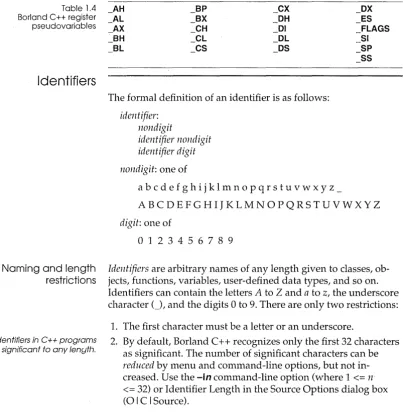
Table 1,4 Borland C++ register pseudovariables
Identifiers
Naming and length restrictions
Identifiers in C++ programs are significant to any lenfjth,
Identifiers and case sensitivity
AH BP CX OX
-
-AL BX -OH ES AX CH 01 FLAGS
-BH -CL OL -SI BL -CS OS -SP
SS
-The formal definition of an identifier is as follows:
identifier: l10ndigit
identifier l10ndigit identifier digit
nondigit: one of
abcdefghijklmnopqrstuvwxyz_
ABC 0 E FG H IJ K L M N 0 P Q RS T U V W X Y Z
digit: one of
o
1 2 3 4 5 6 789Identifiers are arbitrary names of any length given to classes, ob-jects, functions, variables, user-defined data types, and so on. Identifiers can contain the letters A to Z and a to 2, the underscore character <-), and the digits 0 to 9. There are only two restrictions:
1. The first character Inust be a letter or an underscore.
2. By default, Borland C++ recognizes only the first 32 characters as significant. The number of significant characters can be
reduced by Inenu and comlnand-line options, but not in-creased. Use the -in command-line option (where 1 <= n
<= 32) or Identifier Length in the Source Options dialog box (0 I C I Source).
Borland c++ identifiers are case sensitive, so that Sum, sum, and
sliM are distinct identifiers.
[image:25.507.57.461.65.485.2](Options I Linker I Settings), or using the Ie cOll1111and-line switch with TLINK, you can ensure that global identifiers are case insensitive. Under this regime, the globals Slim and sum are
considered identical, resulting in a possible "Duplicate symbol" warning during linking.
An exception to these rules is that identifiers of type pascal are always converted to all uppercase for linking purposes.
Uniqueness and scope Although identifier names are arbit:cary (within the rules stated), errors result if the same name is used for more than one identifier within the same scope and sharing the same name space. Duplicate
names are always legal for different name spaces regardless of
scope. The rules are covered in the discussion on scope starting on page 27.
Constants
Constants are tokens representing fixed numeric or character
values. Borland C++ supports four classes of constants: floating point, integer, enumeration, and character.
The data type of a constant is deduced by the cOlnpiler using such clues as numeric value and the format used in the source code. The formal definition of a constant is shown in Table 1.5.
Integer constants Integer constants can be decimal (base 10), octal (base 8) or hexa-decimal (base 16). In the absence of any overriding suffixes, the data type of an integer constant is derived from its value, as shown in Table 1.6. Note that the rules vary between decilnal and nondecimal constants.
Chapter 7, Lexical elements
Decimal constants
Decimal constants from 0 to 4,294,967,295 are allowed. Constants
exceeding this limit will be truncated. Decin1al constants Inust not use an initial zero. An integer constant that has an initial zero is interpreted as an octal constant. Thus,
int i =
int i =
int i =
10 ; 010; 0;
/*decimal 10 */ /*decimal 8 */
/*decimal 0 = octal 0 */
Table 1.5: Constants-formal definitions constant: floating-constant integer-constant enumeration-constant character-constant floating-constant:
fractional-constant <exponent-part> <floating-suffix>
digit-sequence exponent-part <floating-suffix>
fractional-constant:
<digit-sequence> . digit-sequence digit-sequence .
exponent-part:
e <sign> digit-sequence
E <sign> digit-sequence sign: one of
+
-digit-sequence: digit
digit-sequence digit
floating-SUffix: one of f I F L integer-constant:
decimal-constant <integer-suffix> octal-constant <integer-suffix> hexadecimal-constant <integer-suffix>
decimal-constant: nonzero-digit
decimal-constant digit
octal-constant:
o
octal-constant octal-digit
hexadecimal-constant:
o
x hexadecimal-digitOctal constants
o
X hexadecimal-digithexadecimal-constant hexadecimal-digit
nonzero-digit: one of 1 234 5 6 789 octal-digit: one of
o
1 234 5 6 7 hexadecimal-digit: one ofo
1 234 5 6 789 a b c d e fABCDEF integer-suffix:
unsigned-suffix <long-suffix> long-suffix <unsigned-suffix>
unsigned-suffix: one of uU
long-suffix: one of 1 L enumeration-constant: identifier character-constant: c-char-sequence c-char-sequence: c-char
c-char-sequence c-char
c-char:
Any character in the source character set except the single-quote ('), backslash (\), or newline character escape-sequence.
escape-sequence: one of
\" \' \?
\a \b \f
\0 \00 \000
\t \v \Xh ...
\ \ \n \r \xh ...
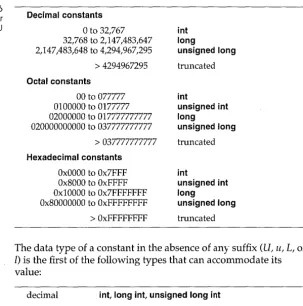
Table 1.6 Borland C++ integer constants without L or U
Chapter 7, Lexical elements
Hexadecimal constants
All constants starting with Ox (or OX) are taken to be hexadecimal. Hexadecimal constants exceeding OxFFFFFFFF will be truncated.
Long and unsigned suffixes
The suffix L (or 1) attached to any constant forces it to be repre-sented as a long. Similarly, the suffix U (or u) forces the constant to be unsigned. It is unsigned long if the value of the number itself is greater than decimal 65,535, regardless of which base is used. You can use both Land U suffixes on the same constant in any order or case: uI, Iu, UL, and so on.
Decimal constants
o
to 32,767 32,768 to 2,147,483,647 2,147,483,648 to 4,294,967,295> 4294967295
Octal constants
00 to 077777 0100000 to 0177777 02000000 to 017777777777 020000000000 to 037777777777
> 037777777777
Hexadecimal constants
OxOOOO to Ox7FFF Ox8000 to OxFFFF Oxl0000 to Ox7FFFFFFF Ox80000000 to OxFFFFFFFF
> OxFFFFFFFF
int long
unsigned long
truncated
int
unsigned int long
unsigned long
truncated
int
unsigned int long
unsigned long
truncated
The data type of a constant in the absence of any suffix (U, U, L, or
1) is the first of the following types that can accommodate its value:
decimal octal hexadecimal
int, long int, unsigned long int
int, unsigned int, long int, unsigned long int
int, unsigned int, long int, unsigned long int
If the constant has a U or u suffix, its data type will be the first of unsigned int, unsigned long int that can accommodate its value.
[image:28.510.162.465.234.539.2]If the constant has an L or I suffix, its data type will be the first of
long int, unsigned long int that can accommodate its value.
If the constant has both u and I suffixes (ul, lu, Ul, IU, uL, Lu, LU, or UL), its data type will be unsigned long int.
Table 1.6 summarizes the representations of integer constants in all three bases. The data types indicated assume no overriding L or U suffix has been used.
Character constants A character constant is one or more characters enclosed in single quotes, such as ' A', ' =' , ' \n' . In C, single character constants have data type int; they are represented internally with 16 bits, with the upper byte zero or sign-extended. In C++, a character constant has type char. Multicharacter constants in both C and C++ have data type int.
Escape sequences
The backslash character (\) is used to introduce an escape sequence, allowing the visual representation of certain nongraphic charac-ters. For example, the constant \n is used for the single newline character.
A backslash is used with octal or hexadecimal numbers to repre-sent the ASCII symbol or control code corresponding to that val-ue; for example, ' \03' for Ctrl-C or ' \x3F' for the question mark. You can use any string of up to three octal or any number of hexadecimal numbers in an escape sequence, provided that the value is within legal range for data type char (0 to Oxff for Borland C++). Larger numbers generate the compiler error, "Numeric con-stant too large." For example, the octal number \777 is larger than the maximum value allowed, \377, and will generate an error. The first nonoctal or nonhexadecimal character encountered in an octal or hexadecimal escape sequence marks the end of the sequence.
Originally, Turbo C allowed only three digits in a hexadecimal escape sequence. The ANSI C rules adopted in Borland C++ might cause problems with old code that assumes only the first three characters are converted. For example, using Turbo C l.x to define a string with a bell (ASCII 7) followed by numeric
characters, a programmer might write:
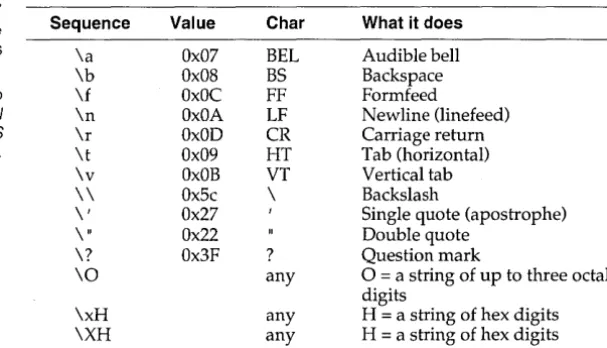
Table 1.7 Borland C++ escape sequences
The \ \ must be used to
represent a real ASCII backslash, as used in DOS paths.
Chapter 7, Lexical elements
This is intended to be interpreted as \x007 and I/2.1A Simple Operating System". However, Borland C++ compiles it as the hexadecimal number \x0072 and the literal string I/.1A Simple Operating System".
To avoid such problems, rewrite your code like this:
printf("\x007" "2.1A Simple Operating System");
Ambiguities may also arise if an octal escape sequence is followed by a nonoctal digit. For example, because 8 and 9 are not legal oc-tal digits, the constant \258 would be interpreted as a two-character constant made up of the two-characters \25 and 8.
The next table shows the available escape sequences.
Sequence Value Char What it does
\a Ox07 BEL Audible bell
\b Ox08 BS Backspace
\f OxOC FF Formfeed
\n OxOA LF Newline (linefeed)
\r OxOD CR Carriage return
\t Ox09 HT Tab (horizontal)
\v OxOB VT Vertical tab
\\ Ox5c \ Backslash
\, Ox27 Single quote (apostrophe)
\" Ox22 Double quote
\? Ox3F ? Question mark
\0 any
o
= a string of up to three octaldigits
\xH any H = a string of hex digits
\XH any H = a string of hex digits
Borland C++ special two-character constants
Borland C++ also supports two-character constants (for example, , An', ' \n \t', and' \007\007'). These constants are represented as 16-bit int values, with the first character in the low-order byte
and the second character in the high-order byte. These constants are not portable to other C compilers.
Signed and unsigned char
In C, one-character constants, such as ' A', ' \ t' , and ' \007' , are also represented as 16-bit int values. In this case, the low-order
byte is sign extended into the high byte; that is, if the value is greater than 127 (base 10), the upper byte is set to -1 (=OxFF). This
[image:30.508.159.463.226.400.2]Floating-point constants
can be disabled by declaring that the default char type is un-signed (use the -K command-line compiler option or choose Unsigned Characters in the Options I Compiler I Code Generation dialog box), which forces the high byte to be zero regardless of the value of the low byte.
Wide character constants
A character constant preceded by an L is a wide-character con-stant of data type wchar_t (an integral type defined in stddef.h). For example,
x = L I A';
A floating constant consists of:
• decimal integer • decimal point • decimal fraction
• e or E and a signed integer exponent (optional) iii type suffix: for For 1 or L (optional)
You can omit either the decimal integer or the decimal fraction (but not both). You can omit either the decimal point or the letter e (or E) and the signed integer exponent (but not both). These rules allow for conventional and scientific (exponent) notations.
Negative floating constants are taken as positive constants with the unary operator minus (-) prefixed.
Examples:
Constant
23.45e6
.0
o.
1. -1.23 2e-5 3E+10 .09E34
Value
23.45 X 10⁶
o
o
1.0 x 100
=
1.0-1.23 2.0 x 10⁻⁵ 3.0 X 10¹⁰
0.09 X 1034
Floating-point constants-data types
In the absence of any suffixes, floating-point constants are of type
Table 1.8 Borland C++ floating constant sizes and ranges
See page 73 for a detailed look at enum dec/a rations.
Chapter 7, Lexical elements
float by adding an
f
or F suffix to the constant. Similarly, the suffix1 or L forces the constant to be data type long double. The next table shows the ranges available for float, double, and long double.
Type Size (bits) Range
float 32 3.4 x 10-38 to 3.4 X 1038
double 64 1.7 x 10-308 to 1.7 X 10308
long double 80 3.4 x 10-4932 to 1.1 X 104932
Enumeration constants
Enumeration constants are identifiers defined in enum type dec-larations. The identifiers are usually chosen as mnemonics to assist legibility. Enumeration constants are integer data types. They can be used in any expression where integer constants are valid. The identifiers used must be unique within the scope of the
enum declaration. Negative initializers are allowed.
The values acquired by enumeration constants depend on the for-mat of the enumeration declaration and the presence of optional initializers. In this example,
enum team { giants, cubs, dodgers };
giants, cubs, and dodgers are enumeration constants of type
team that can be assigned to any variables of type team or to any other variable of integer type. The values acquired by the
enumeration constants are
giants = 0, cubs = 1, dodgers = 2
in the absence of explicit initializers. In the following example,
enum team { giants, cubs=3, dodgers = giants + 1 }; the constants are set as follows:
giants = 0, cubs = 3, dodgers = 1 The constant values need not be unique:
enum team { giants, cubs = 1, dodgers = cubs - 1 };
String literals String literals, also known as string constants, form a special cate-gory of constants used to handle fixed sequences of characters. A string literal is of data type array of char and storage class static,
written as a sequence of any number of characters surrounded by double quotes:
"This is literally a string!"
The null (empty) string is written" ".
The characters inside the double quotes can include escape sequences (see page 14). This code, for example,
"\t\t\"Name\"\\\tAddress\n\n"
prints out like this:
"Name"\ Address
"Name" is preceded by two tabs; Address is preceded by one tab. The line is followed by two new lines. The \" provides interior double quotes.
A literal string is stored internally as the given sequence of char-acters plus a final null character ('\0'). A null string is stored as a single I \0 I character.
Adjacent string literals separated only by whitespace are concate-nated during the parsing phase. In the following example,
#include <stdio.h> int main ()
{
char *p;
p = "This is an example of how Borland Ctt" " will automatically\ndo the concatenation for" " you on very long strings, \nresulting in nicer" " looking programs.";
printf (p) ; return(O) ;
The output of the program is
This is an example of how Borland Ctt will automatically
You can also use the backslash (\) as a continuation character in order to extend a string constant across line boundaries:
puts("This is really \ a one-line string");
Constants and internal representation
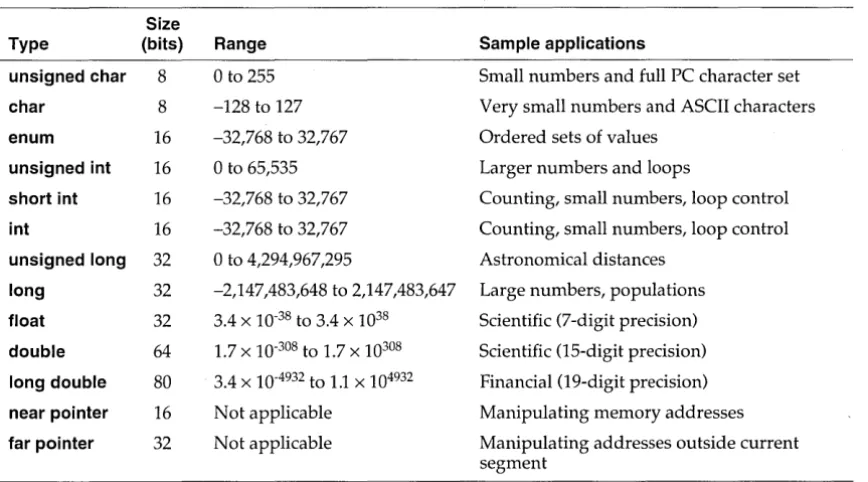
ANSI C acknowledges that the size and numeric range of the basic data types (and their various permutations) are implemen-tation specific and usually derive from the architecture of the host computer. For Borland C++, the target platform is the IBM PC family (and compatibles), so the architecture of the Intel 8088 and 80x86 microprocessors governs the choices of inner represen-tations for the various data types. The next table lists the sizes and resulting ranges of the data types for Borland C++; see page 39 for more information on these data types. Figure 1.1 shows how these types are represented internally.
Table 1.9: Data types, sizes, and ranges
Size
Type (bits) Range Sample applications
unsigned char 8
o
to 255 Small numbers and full PC character setchar 8 -128 to 127 Very small numbers and ASCII characters
enum 16 -32,768 to 32,767 Ordered sets of values
unsigned int 16
o
to 65,535 Larger numbers and loopsshort int 16 -32,768 to 32,767 Counting, small numbers, loop control
int 16 -32,768 to 32,767 Counting, small numbers, loop control
unsigned long 32
o
to 4,294,967,295 Astronomical distanceslong 32 -2,147,483,648 to 2,147,483,647 Large numbers, populations
float 32 3.4 x 10-38 to 3.4 X 1038 Scientific (7 -digit precision)
double 64 1.7 x 10-308 to 1.7 X 10308 Scientific (15-digit precision)
long double 80 3.4 x 10-4932 to 1.1 x 104932 Financial (19-digit precision)
near pointer 16 Not applicable Manipulating memory addresses
far pointer 32 Not applicable Manipulating addresses outside current
segment
[image:34.507.47.481.282.523.2]Figure 1.1 Internal representations of
data types
- Increasing significance
(2's complement)
long int ,:--1
s~l
_ _ _ m_a_g_nit_ud_e _ _ .-.JI (2's complement)31
i1
double
lsi
e~~~sne~nt
I significand63 51
significand
long double
lsi
e~~~s';~nt
1117L9L---~ML6~3---~
s Sign bit (0 = positive, 1 = negative) Position of implicit binary point Integer bit of significand: Stored in long double
Implicit (always 1) in float, double
Exponent bias (normalized values):
float : 127 (7FH)
double : 1023 (3FFH)
long double: 16,383 (3FFFH)
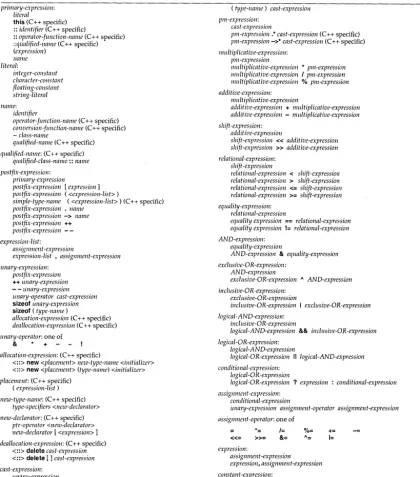
Constant expressions A constant expression is an expression that always evaluates to a constant (and it must evaluate to a constant that is in the range of representable values for its type). Constant expressions are evalu-ated just as regular expressions are. You can use a constant expression anywhere that a constant is legal. The syntax for con-stant expressions is
[image:35.504.132.447.49.434.2]Punctuators
Constant expressions cannot contain any of the following operators, unless the operators are contained within the operand of a sizeof operator:
II assignment III comma III decrement III function call II increment
The punctuators (also known as separators) in Borland C++ are defined as follows:
punctuator: one of
[ ] ( ) { } , ; : ... * = #
Brackets [ ] (open and close brackets) indicate single and multidimensional array subscripts:
char ch, str [l
int mat[3] [4]; ch = str[3];
"Stan" ;
/* 3 x 4 matrix */ /* 4th element */
Parentheses () (open and close parentheses) group expressions, isolate condi-tional expressions, and indicate function calls and function parameters:
Chapter 7, Lexical elements
d = c * (a + b);
if (d == z) ttX;
func (); int (*fptr) () ; fptr = func; void func2(int n);
/* override normal precedence */
/* essential with conditional statement */ /* function call, no args */
/* function pointer declaration */ /* no () means func pointer */ /* function declaration with args */
Parentheses are recommended in macro definitions to avoid po-tential precedence problems during expansion:
#define CUBE (x) ((x) * (x) * (x))
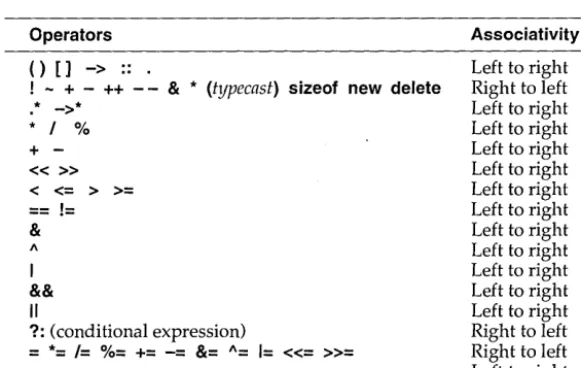
The use of parentheses to alter the normal operator precedence and associativity rules is covered on page 79.
Braces {} (open and close braces) indicate the start and end of a com-pound statement:
if (d == z) {
ttX; func() ;
The closing brace serves as a terminator for the compound state-ment, so a ; (semicolon) is not required after the }, except in structure or class declarations. Often, the semicolon is illegal, as in
if (statement) {}; else
/*illegal semicolon*/
Comma The comma (,) separates the elements of a function argument list:
void func(int n , float f, char ch);
The comma is also used as an operator in comma expressions.
Mixing the two uses of comma is legal, but you must use parentheses to distinguish them:
func (i I j); / * call func wi th two args * /
func ( (expl, exp2) I (exp3 I exp4 I exp5)); / * also calls func
with two args! */
Semicolon The semicolon (;) is a statement terminator. Any legal C or C++ expression (including the empty expression) followed by ; is interpreted as a statement, known as an expression statement. The
expression is evaluated and its value is discarded. If the expres-sion statement has no side effects, Borland C++ may ignore it.
a t b; tta;
/* maybe evaluate a t b, but discard value */ /* side effect on a, but discard value of tta */ /* empty expression = null statement */
Semicolons are often used to create an empty statement: for (i = 0; i < n; itt)
Colon Use the colon (:) to indicate a labeled statement:
start: x=O; goto start; switch (a)
case 1: puts("One"); break; case 2: puts("Two");
break;
default: puts("None of the above!"); break;
Labels are covered on page 98.
Ellipsis Ellipsis (. .. ) are three successive periods with no whitespace inter-vening. Ellipsis are used in the formal argument lists of function prototypes to indicate a variable number of arguments, or argu-ments with varying types:
void func(int n, char ch, ... );
This declaration indicates that func will be defined in such a way that calls must have at least two arguments, an int and a char, but can also have any number of additional arguments.
~ In C++, you can omit the comma preceding the ellipsis.
Asterisk (pointer declaration)
Chapter 7, Lexical elements
The * (asterisk) in a variable declaration denotes the creation of a pointer to a type:
char *char-ptr; /* a pointer to char is declared */
Pointers with multiple levels of indirection can be declared by in-dicating a pertinent number of asterisks:
int **int-ptr; double ***double-ptr;
/* a pointer to a pointer to an int */ /* a pointer to a pointer to a pointer
to doubles */
You can also use the asterisk as an operator to either dereference a pointer or as the multiplication operator:
i = *int-ptr;
a = b * 3.14;
Equal sign (initializer) The
=
(equal sign) separates variable declarations from initiali-zation lists:Pound sign (preprocessor directive)
char array [5] = { 1, 2, 3, 4, 5 }; int x = 5;
In C++, declarations of any type can appear (with some
restrictions) at any point within the code. In a C function, no code can precede any variable declarations.
In a C++ function argument list, the equal sign indicates the default value for a parameter:
int f (int i = 0) { ... } /* parameter i has default value of zero */
The equal sign is also used as the assignment operator in expressions:
a = b + c;
ptr = farmalloc(sizeof(float)*100);
The # (pound sign) indicates a preprocessor directive when it occurs as the first nonwhitespace character on a line. It signifies a compiler action, not necessarily associated with code generation. See page 157 for more on the preprocessor directives.
c
HDeclarations
Scope is discussed starting on page 27; visibility on page 29; duration on page 29; and linkage on page 31.
Objects
A p T E R
2
Language structure
This chapter provides a formal definition of Borland C++'s language structure. It details the legal ways in which tokens can be grouped together to form expressions, statements, and other significant units. By contrast, lexical elements (described in Chapter 1) are concerned with the different categories of word-like units, known as tokens, recognized by a language.
This section briefly reviews concepts related to declarations: objects, types, storage classes, scope, visibility, duration, and linkage. A general knowledge of these is essential before tackling the full declaration syntax. Scope, visibility, duration, and linkage determine those portions of a program that can make legal references to an identifier in order to access its object.
An object is an identifiable region of memory that can hold a fixed or variable value (or set of values). (This use of the word object is not to be confused with the more general term used in object-oriented languages.) Each value has an associated name and type (also known as a data type). The name is used to access the object. This name can be a simple identifier, or it can be a complex expression that uniquely "points" to the object. The type is used
Lvalues
• to determine the correct memory allocation required initially • to interpret the bit patterns found in the object during
subsequent accesses
• in many type-checking situations, to ensure that illegal assignments are trapped
Borland C++ supports many standard (predefined) and user-defined data types, including signed and unsigned integers in various sizes, floating-point numbers in various precisions, structures, unions, arrays, and classes. In addition, pointers to most of these objects can be established and manipulated in various memory models.
The Borland c++ standard libraries and your own program and header files must provide unambiguous identifiers (or expres-sions derived from them) and types so that Borland C++ can consistently access, interpret, and (possibly) change the bit patterns in memory corresponding to each active object in your program.
Declarations establish the necessary mapping between identifiers and objects. Each declaration associates an identifier with a data type. Most declarations, known as defining declarations, also establish the creation (where and when) of the object, that is, the allocation of physical memory and its possible initialization. Other declarations, known as referencing declarations, simply make their identifiers and types known to the compiler. There can be many referencing declarations for the same identifier, especially in a multifile program, but only one defining declaration for that identifier is allowed.
Generally speaking, an identifier cannot be legally used in a program before its declaration point in the source code. Legal exceptions to this rule, known as forward references, are labels, calls to undeclared functions, and class, struct, or union tags.
An lvalue is an object locator: An expression that designates an object. An example of an lvalue expression is *P, where P is any expression evaluating to a nonnull pointer. A modifiable lvalue is an identifier or expression that relates to an object that can be
Rvalues
Types and
storage classes
Scope
Historically, the I stood for "left," meaning that an lvalue could le-gally stand on the left (the receiving end) of an assignment state-ment. Now only modifiable lvalues can legally stand to the left of an assignment statement. For example, if a and bare nonconstant integer identifiers with properly allocated memory storage, they are both modifiable lvalues, and assignments such as a = 1; and b
=
a + b are legal.The expression a + b is not an lvalue: a + b = a is illegal because the expression on the left is not related to an object. Such expressions are often called rvalues (short for right values).
Associating identifiers with objects requires that each identifier has at least two attributes: storage class and type (sometimes referred to as data type). The Borland c++ compiler deduces these attributes from implicit or explicit declarations in the source code.
Storage class dictates the location (data segment, register, heap, or stack) of the object and its duration or lifetime (the entire running time of the program, or during execution of some blocks of code). Storage class can be established by the syntax of the declaration, by its placement in the source code, or by both of these factors.
The type, as explained earlier, determines how much memory is allocated to an object and how the program will interpret the bit patterns found in the object's storage allocation. A given data type can be viewed as the set of values (often implementation-depen-dent) that identifiers of that type can assume, together with the set of operations allowed on those values. The special compile-time operator, sizeof, lets you determine the size in bytes of any standard or user-defined type; see page 87 for more on this operator.
The scope of an identifier is that pa