Aplan FF and Arnold BJ (1991) Flotation. In: Leonard JW (ed.) Coal Preparation, pp. 450}485. Littleton, CO: Society of Mining, Metallurgy, and Exploration, Inc. (SME).
Arnold BJ and Aplan FF. (1989) The hydrophobicity of coal macerals.Fuel68: 651}658.
Bury E. and Bicknell A (1921) PuriRcation of coal by froth Sotation.Colliery Guardian21: 337.
Bury E, Broadbridge W and Hutchinson A (1920) Froth Sotation as applied to the washing of industrial coal. Institute of Mining Engineers60: 243}253.
Chaudhari V and Aplan FF (1992) Pyrite depression during coalSotation}Part I. Inorganic.Mining and Mineral Processing Journal9: 51}56.
Davis DH (1948) FrothSotation of minus 48 mesh bitumi-nous coal slurries.Transactions AIME177: 320}337. Gutierez JA, Purcell RJ and Aplan FF (1984) Estimating the
hydrophobicity of coals.Colloids and Surfaces12: 1}25. Honaker RQ, Patwardhan A, Mohanty MK and Bhaskar K (1999) Fine coal cleaning using the Jamison cell: The North American Experience. In: Parekh BK and Miller JD (eds) Advances in Flotation Technology, pp. 331}341. Littleton, CO: Society of Mining, Metal-lurgy, and Exploration, Inc (SME).
Horsley RM and Smith HG (1951) Principles of coalS ota-tion.Fuel30: 54}63.
Luttrell GH, Venkatraman P and Yoon RH (1998) Re-moval of hazardous air pollutant precursors by ad-vanced coal preparation. Coal Preparation 19: 2243}2255.
Meenan, GF (1999) Modern coalSotation practices. In: Parekh BK and Miller JD (eds)Advances in Flotation Technology, pp. 309}319. Littleton, CO: Society of Mining, Metallurgy, and Exploration. Inc. (SME). Mohanty MK and Honaker RQ (1999) A comparative
evaluation of the leading advancedSotation technolo-gies.Minerals Engineering12(1): 1}13.
Parekh BK, Bland AE and Groppo JG (1990) A para-metric study of columnSotation.Coal Preparation8: 49}60.
Yang DC (1986) Column frothUotation. US Patent No. 4,592,834 (January 1986).
Yoon RH, Luttrell GH, Adel GT and Mankosa MJ (1992) The application of microcell column toRne coal clean-ing.Coal Preparation10: 177}188.
Xu DD and Aplan FF Joint use of metal ion hydroxy compounds and organic polymers to depress pyrite and ash during coalSotation.
COBALT ORES: FLOTATION
See III / NICKEL AND COBALT ORES: FLOTATION
COLLOIDS: FIELD FLOW FRACTIONATION
G. Karaiskakis, University of Patras, Patras, Greece
Copyright^ 2000 Academic Press
Introduction
When dealing with colloidal materials, the para-meters of size and size distributions are needed, because many physicochemical processes, like ag-gregation and deposition on solid surfaces, are
in-Suenced by the size and size distributions of these materials.
For the analysis of submicron or supramicron colloidal particles, a sedimentation process, either under gravity or with centrifugal force, is necessary to sort different diameter particles into classes, and then to obtain an average size and a size distri-bution. Among the successful techniques used for this purpose, are electrophoretic mobility and the methods of size exclusion chromatography,
hydrodynamic chromatography and Reld-Sow frac-tionation (FFF).
FFF is a family of separation methods introduced by Giddings in 1966, but several groups all around the world have contributed signiRcantly to the devel-opment. The various subtechniques of FFF are best suited to the separation and characterization of collo-idal materials and macromolecules, including biolo-gical components ranging in size from proteins to living cells, environmental colloidal particles, as well as industrial polymers and colloids, powders, latexes and emulsions.
Principles of FFF
FFF is aSow elution method with retention achieved by using appliedRelds to drive the solutes into quiet
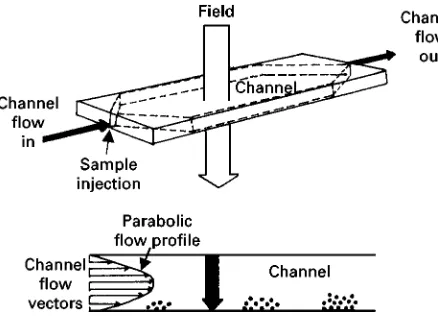
Figure 1 Schematic representation of the FFF channel with the parabolic flow profile in detail. Reproduced with permission from Giddings JC (1979) Field-flow fractionation of polymers: one-phase chromatography.Pure and Applied Chemistry 51: 1459.
the task of separation more gently and with more accurate control than the two-phase distribution for-ces used in chromatography.
Just as its name suggests, fractionation in FFF is the combined effect of an applied cross-Reld and the laminar parabolic Sow proRle of the carrier mobile phase. The separation process in FFF is carried out in a thin, unobstructed, ribbon-like channel with a rectangular cross-section and elongated extremities connected to capillary tubes allowing the continuous
Sow of the carrier liquid (Figure 1). Flow velocity is highest at the middle of the channel and lowest near the two channel walls. As the carrier stream moves through the channel, an external force Reld or gradient is applied perpendicularly to the Sow, which pushes the components of the sample into the slower moving streams near the outer wall, so that they form a thin, steady-state layer against that wall.
The mean thickness of the layer is different for each distinct chemical or particulate species, and depends on the strength of the interaction between the Reld and the species and on the diffusion coefRcient corre-sponding to that species. Larger colloidal species and macromolecules are usually forced more vigorously toward the wall than are smaller ones. This is the basis for selective retention in normal FFF, which produces in general an elution spectrum in which small particles are elutedRrst and large particles last, until steric effects dominate. At this transition point a foldback in elution order occurs, and the larger particles elute from the system before the smaller ones
}a trend opposite to that observed in normal FFF. Steric FFF (StFFF) predominates when the particle radius exceeds the mean layer thickness of the solute,
such that the protrusion of the particle out of the
Sow system is determined by the particle’s size rather than by its Brownian motion.
Sub-techniques of FFF
Among the variousRelds and gradients used to drive species to the channel wall, four speciRc kinds have been most developed, yielding a different subtech-nique of FFF. Among those used are centrifugal or gravitational forces (sedimentation FFF"SdFFF), thermal gradients (thermal FFF"ThFFF), cross-Sow (Sow FFF"FlFFF) and electrical Relds (electrical FFF"ElFFF). All these subtechniques can be worked under the normal mode of operation, in which the concentration distribution along the axis which is perpendicular to the carrier Sow is exponential as a consequence of the balance betweenReld-induced displacements and diffusion, or under the steric mode of operation in which the elution order is inverted relative to that observed for normal FFF. They can also be used in the hyperlayer and potential barrier modes of operation, which will be described in detail later.
Retention Theory
The peak retention in FFF can be expressed by the retention ratio, R, deRned as the ratio of the void volume,Vo, to the component retention volume,
VR:
R"Vo VR
[1]
The retention ratioRin normal FFF is related to the dimensionless retention parameter("l/w, where
l is the mean layer thickness and w is the channel thickness) by the equation:
R"6[coth(1/2)!2]+6 [2]
The last approximation is valid for highly retained components. Eqn [2] is general for all FFF subtech-niques, but as the parametervaries with the applied externalReld or gradient, the experimental parameter
Ris related to different physicochemical quantities of the sample under study, thus leading to the sample’s separation depending on its interactions with the externalReld:
R"6kNATs
MG "
36kT
R" 6T aw(dT/dx)"
6D DTw(dT/dx)
(ThFFF) [4]
R"6DVo VQcw2
(FlFFF) [5]
R"6D
Ew (ElFFF) [6]
R"3d
w (StFFF) [7]
where M is the solute molecular weight, d is the Stokes diameter, "s! is the density differ-ence between the particle (s) and the carrier liquid (),Gis theReld strength expressed in acceler-ation, T is the absolute temperature, k the Boltz-mann’s constant, NA Avogadro’s number, D is the
solute}solvent diffusion coefRcient, DT the coefR
c-ient of thermal diffusion, a the dimensionless thermal diffusion factor, dT/dx is the temperature gradient applied at right angles to Sow, VQ c is the
volumetric cross-Sow rate, is the particle’s electrophoretic mobility, E is the electrical Reld strength, and is a dimensionless factor that accounts for the drag-induced reduction in velocity, and for the increase in velocity due to the activity of lift forces.
The above equations show that the solute para-meters controlling retention, and thus characterized by retention, areM,d andsin SdFFF,DT andain
ThFFF,Danddin FlFFF,andDin ElFFF, andd, in StFFF. As in all FFF techniques, the retention ratio is related to the particle size and the fractionation is based on particle size differences or on the D and
DT coefRcients.
We note that allRvalues in the normal FFF mode are inversely proportional to the strength of theReld or gradient employed:G, dT/dx,VcandE}therefore
making possible the manipulation of the retention ratios by changes in Reld strength. This makes FFF applicable to many different sample types over a wide particle size distribution range. A wide variety of components can be handled within a run by applyingReld programming methodologies in which the Reld strength is gradually reduced during the separation.
In the present work, we focus on sedimentation FFF (centrifugal and gravitational) and Sow FFF, which are the most usable and accurate for the separation and characterization of colloidal materials.
Instrumentation
Sedimentation FFF
The apparatus of SdFFF consists of a channel with highly polished walls and rectangular cross-section which is Rtted to the inside of a centrifuge basket. Solvent is pumped into and out of the system with the aid of special low volume rotor seal and subsequently to a UV detector. The associated parts of the system (e.g. pumps, detectors, recorders, sample injectors) are readily available liquid chromatography compo-nents. At present, the SdFFF rotor can be operated at a maximum speed of 32 000 rpm, which corresponds to an appliedReld of approximately 85 000gfor the common rotors used. With such a rotor, colloidal particles as small as 0.005m can be retained and analysed, when their density is between 1.5 and 3.0 g cm\3. The upper limit of particle size is reached
when the mean layer thickness becomes equal to or less than the particle radius, and steric factors deter-mine the retention ratio.
In gravitational FFF (GrFFF) the earth’s gravi-tational Reld is used and the apparatus consists of a channel formed between two glass plates separated by a Mylar spacer.
Flow FFF
In Sow FFF the external Reld is simply the Sow of a second solute stream perpendicular to the carrier stream. The walls of the FFF channel are constructed of semipermeable membranes, so as to accommodate the cross-Sow and, at the same time, to retain solute particles in the channel. The semipermeable mem-brane material is the limiting factor in the perfor-mance of theSow FFF system.
Applications
SdFFF and FlFFF can be applied to the separation and characterization of spherical or irregular, monodis-perse or polydismonodis-perse colloidal particles. The particle size analysis of colloids can be carried out successfully by working in the four modes of FFF.
Normal SdFFF
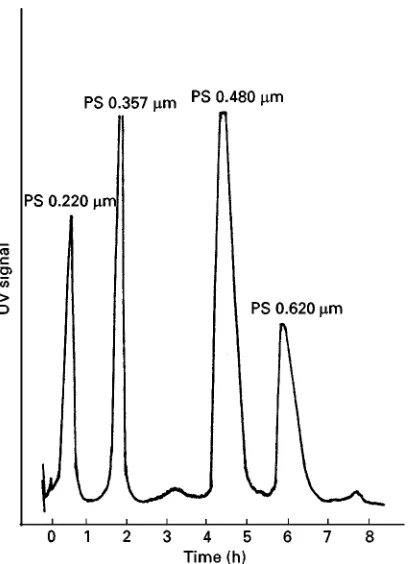
submic-Figure 2 Separation by SdFFF of four polystyrene (PS) latex beads with the diameters indicated in the scheme. The experimental conditions were as follows: field strength 193.7g; flow rate 12 cm3h\1; void volume of the channel 2.0 cm3. Re-produced from Giddings JC, Myers MN, Caldwell KD and Fisher SR (1980) Analysis of biological macromolecules and particles by field-flow fractionation.Methods of Biochemical Analysis 26: 79, with permission from Wiley and Sons, Inc.
ron particles. One of the advantages of SdFFF in characterizing colloids is the fact that they are separ-ated into sharp fractions and that certain properties of each fraction can be deduced by the measurement of the fraction’s retention time. Accurate character-ization is possible without calibration because of the simplicity and theoretical tractability of the SdFFF system (cf. eqn [3]), when interactions between the particles and the channel wall are absent. Particle parameters subject to characterization include mass, density, polydispersity, diffusivity and various par-ticle dimensions (number and weight average dia-meters, differential and cumulative size distribu-tions).
A series of papers relating to colloid characteriza-tion by SdFFF has been published by Giddings. The
Rrst paper showed that relatively monodisperse colloidal populations can be characterized with respect to particle mass, diameter, density and polydispersity. Subsequent papers described methods for obtaining particle size distributions for
polydis-perse colloids and emulsions, and the separation and characterization of narrow populations or sub-sets within a polydisperse population of colloidal particles.
A wide variety of inorganic colloids of industrial importance, including ceramics, carbon black, quartz, clay silica, alumina, titania, haematite and hydroxyapatite, have been separated and character-ized by SdFFF with high resolution in less than 15 min, under optimum conditions. SdFFF also per-mits analytical separations of submilligram quantit-ies, and the separated components are easily collected for subsequent work. SdFFF can be used on a larger scale to separate quantities of the order of a gram of puriRed components. Fractionation and characteriza-tion by SdFFF of the submicron colloidal particles contained in natural waters have also been carried out. With the aid of an on-channel concentration procedure, SdFFF has been shown to be applicable to an area of analysis where the particle system in natu-ral water is complex and the particles are present in much lower concentrations than in samples which can be analysed without the preconcentration pro-cedure. Although particle diameter can be obtained by SdFFF only if the particle density is known, this apparent weakness can be converted into a major strength. By changing the density of the suspending medium, the difference between it and the density of the solute particles can be changed by known increments, and it becomes simple to split up thed parameter andterms of eqn [3]. There-fore, both particle size and density can be found by SdFFF.
Particle size distribution analyses have been carried out on a wide variety of suspended organic and inor-ganic particulates (such as polychloroprene and poly-methyl methacrylate lattices, water-based titania and carbon black dispersions, phthalocyanine blue dyes) using the methodology of time-delayed exponential force-Reld sedimentation Reld-Sow fractionation (TDE-SdFFF). Particle retention time in TDE-SdFFF correlates simply and accurately with the logarithm of particle size (diameter or mass). Relative to con-stant-Reld SdFFF, the TDE-SdFFF method provides the advantages of decreased analysis time and im-proved detection sensitivity, while maintaining ad-equate resolution for accurate differential and cumu-lative particle size distributions.
[image:4.568.65.270.55.337.2]Normal FlFFF
FlFFF has been applied to a variety of species in-cluding silica gel, latex and virus particles, as well as proteins, protein clusters and water-soluble polymers. FlFFF has also been applied to humic materials, pushing the lower molecular weight limit to a few hundred. An asymmetric version of FlFFF has been introduced in which only one wall, the accumulation wall, is permeable to the liquid, whereas the other wall is solid. Thus, the
cross-Sow is generated by the fraction of the inletSow that exists through the membrane. With this asymmetric system, various biological macromolecules and water-soluble polymers have been successfully analysed.
Steric FFF
StFFF represents the upper limit of theReld strength applied. Although any effective Reld may be app-lied to the StFFF mode, the gravitationalReld repres-ents the most practical means of utilizing the principle of StFFF to the analysis of particles in the diameter range 1}100m. The Rrst experimental evidence for the applicability of StFFF was presented in 1978 by Giddings for the fractionation of glass beads having diameters 10}32m. Later the technique was applied to the separation of a mixture of spheri-cal silica beads in the diameter range 5}14m, to the separation of a number of large particle sam-ples, including chromatographic support materials and Rne-ground coals, as well as to useful applica-tions in biochemistry and biology (yeast cells, whole blood).
Recently, the StFFF technique has been applied to particle size analysis (number and weight average particle diameters, as well as differential and cumu-lative particle size distributions) of polydisperse supramicron particles of strengite (FePO4)2H2O with
number average diameter of 3.5m), which is of great signiRcance in natural waters, and mixed
sul-Rdes (CuxZn(1\x)S, 0(x(1, with number average
diameter in the range 5.7}7.6m), which are of paramount importance in industrial chemistry. The particle size distributions, which correspond to the longest axis of the needle-shaped FePO4-2H2O
particles, found under various experimental condi-tions by StFFF, are in good agreement with those obtained by transmission electron microscopy (TEM). This conRrms the feasibility of the StFFF technique for characterizing polydisperse, irregular, inorganic colloids, and veriRes the general features of the theory.
From the variation of the number and weight average diameter of the CuxZn(1\x)S particles
deter-mined by GrFFF with various parameters, such as solution pH and ionic strength, kind of detergent and time, in combination with microelectropho-resis measurements, useful conclusions about the stability and consequently the aggregation and deposition phenomena of these sulRdes can be deduced.
In the normal mode of SdFFF operation the rela-tionship betweenVRandd can be established using
eqn [3], without empirical calibration. In the steric mode of SdFFF (Sd/StFFF), calibration must be established empirically, as the steric correction factor in eqn [7] is unknown, increasing with the Sow velocity and decreasing with the increase of Reld strength. As retention is based on particle density as well as size, a purely size-based calibration is not generally valid. By examining the balance bet-ween driving and lift forces, it is observed that an equal retention ratio is obtained for equal size particles subject to equal driving forces independently of the particle density. Thus, by adjusting the Reld strength G to compensate exactly for the density difference, so that the productGin eqn [3] is the same for the sample and the standard poly-styrene latexes, linear calibration plots of log(reten-tion time) versus log(diameter) for the latexes can be used to characterize the sample under study. This calibration procedure for Sd/StFFF has been success-fully applied to the rapid size separation and measurement of particle size distribution of various starch granules.
Hyperlayer FFF (HyFFF)
The sedimentation hyperlayerReld-Sow fractionation (SdHyFFF) technique differs from conventional FFF methods in that the solute zone is focused into a thin layer by the opposing forces of centrifugal acceleration and buoyancy in a density gradient, which is formed while the carrier isSowing through the channel. So an equilibrium distribution is established by the time theSuid reaches the down-stream injection size. Solutes with low molecular weights require impractically highReld strengths to form substantial gradients, whereas particulate density modiRers establish the gradient both rapidly and effectively. Ideally each particle type in SdHyFFF is focused into a very thin layer at its own characteristic elevation. Here it occupies a thin
Suid layerSowing at aRxed velocity. The difference of SdHyFFF from the normal SdFFF is that it is the only FFF methodology for which each distinct species is narrowly conRned to its own unique velo-city state.
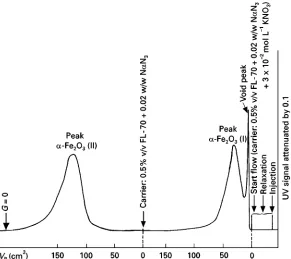
Figure 3 Fractionation of haematite-I ( -Fe2O3(I) with nominal diameter 0.148m) and haematite-II ( -Fe2O3(II) with nominal diameter 0.248m) colloidal particles by the potential barrier SdFFF technique. The experimental conditions, expect for those given in the scheme, were as follows: field strength 15.5g; flow rate 150 cm3h\1; void volume of the channel 2.06 cm3. Reproduced from Koliadima A and Karaiskakis G (1990) Potential-barrier field-flow fractionation, a versatile new separation method. Journal of Chromatography 517: 345, with permission from Elsevier Science.
(human and animal cells). With the introduction of denser particles its effective density range has been extended to silica, thus making the tech-nique applicable to environmental particles. Another application of SdHyFFF technique is the fractionation of coal and limestone par-ticles.
In general, the SdHyFFF method is applicable to larger particles than SdFFF, where (wall-induced) steric effects become important for particle sizes around 1m. The focusing of sample zones at loca-tions removed from the wall in SdHyFFF has the advantage of eliminating interface-related nonideali-ties, such as sample adhesion and zone broadening caused by surface roughness.
Important developments include the so-called hyperlayer Sow FFF, which has extended the app-lications to particles larger than 1m in dia-meter. Also, the introduction of various program-ming procedures has been of importance. A number of reports of the combined use of FlFFF and multi-angle laser light scattering (MALLS) instru-ments have also been published, illustrating the use-fulness of this hyphenated technique in characterizing colloidal particles.
Potential Barrier FFF (PBFFF)
technique consists of changing the ionic strength of the carrier solution from a high value, where only one of the colloidal materials of the binary mixture to be separated totally adheres at the beginning of the FFF channel wall, to a lower value, where all the adhered particles are released.
Figure 3shows the fractionation of two haematite samples ( -Fe2O3(I) with nominal particle diameter
0.148m and -Fe2O3(II) with nominal particle
dia-meter 0.248m) with monodisperse spherical par-ticles, by the PBSdFFF technique. The mixture was introduced into the channel with a carrier solution containing 0.5% v/v detergent FL-70, 0.02% w/w NaN3and 3;10\2mol L\1KNO3. At this high
elec-trolyte concentration all of the -Fe2O3(II) particles
adhered at the beginning of the SdFFF Hastelloy-C channel wall, whereas all of the -Fe2O3(I) particles
were eluted from the channel. The average diameter of the eluted -Fe2O3(I) particles was found from eqn
[3] to be 0.151m, in good agreement with that obtained by normal SdFFF (0.145m) or determined by TEM (0.148m). Variation of the carrier solution to one containing only 0.5% v/v detergent FL-70 and 0.02% w/w NaN3without any KNO3released all the
adhered -Fe2O3(II) particles and gave a particle
dia-meter (0.244m) in good agreement with that found by normal SdFFF (0.237m) or obtained by TEM (0.248m).
A general methodology for the analysis of a collo-idal mixture by PB SdFFF consists of injecting into the column the mixture with a carrier solution in which the ionic strength is too high to ensure total adhesion of all the components of the mixture, except for one with the lower attractive force with the chan-nel wall. Then a programmed variation (decrease) of the ionic strength of the carrier solution is applied to release, in time, the adherent particles according to their size and/or surface characteristics. As the PBSdFFF technique is based on particle}wall interac-tions, its applications can be extended by using differ-ent materials, such as stainless steel, TeSon and polyimide. PBSdFFF is also a convenient and accurate method for the concentration and analysis of dilute colloidal samples. This makes PBSdFFF a highly attractive technique for the characterization of sam-ples where even particles of the same size but of different chemical composition are present in low concentration.
Future Developments
From the detailed description of the FFF techniques presented above, it is concluded that the most usable FFF methods for particle size analysis of colloids are SdFFF and FlFFF. Looking to the future, it
is reasonable to expect serious efforts by the com-panies producing FFF equipments, to improve their resolution and expand the particle size range to lower limits of analysis. As far as FFF applications are concerned, it is believed that future efforts will be focused on the size separation and characterization of polydisperse, irregular colloidal particles, as well as on the aggregation and deposition phenomena of colloids on solid surfaces.
See also: II/Particle Size Separation: Field Flow frac-tionation: Electric Fields; Field Flow Fracfrac-tionation: Ther-mal; Theory and Instrumentation of Field Flow Fractiona-tion. III/Cells and Cell Organelles: Field Flow
Frac-tionation. Colloids: Field Flow FracFrac-tionation. Poly-mers: Fixed Flow Fractionation. Proteins: Field Flow
Fractionation.
Further Reading
Beckett R and Hart BT (1993) Use ofReld-Sow fractiona-tion techniques to characterize aquatic particles, colloids and macromolecules. In: BufSe J and van Leeuwen HP (eds) Environmental Particles, vol. 2, pp. 165}205. Boca Raton, FL: Lewis Publishers.
Dondi F and Guiochon G (eds) (1992) Theoretical Ad-vancements in Chromatography and Related Separation Techniques, vol. 383. NATO ASI series. Dordrecht: Kluwer Academic.
Giddings JC (1966) A new separation concept based on a coupling of concentration andSow nonuniformities. Separation Science1: 123}125.
Giddings JC (1991)UniTed Separation Science. New York: Wiley.
Giddings JC, Martin MN, Moon MH and Barman BN (1991) Particles separation and size characterization by sedimentation Reld-Sow fractionation. In: Provder J (ed.) Particle Size Distribution II: Assessment and Characterization, American Chemical Society, Series no. 472, Ch. 13, pp. 198}216. Washington, DC: ACS Sym-posium.
Hiemenz PC (1977) Principles of Colloid and Surface Chemistry. New York: Marcel Dekker.
Janca J (1988) Field-Flow Fractionation: Analysis of Macromolecules and Particles. New York: Marcel Dekker.
Karaiskakis G and Cazes J (eds) (1997)Journal of Liquid Chromatography&Related Technologies,Special Issue on Field-Flow Fractionation(Vol. 20, Nos 16 & 17). New York: Marcel Dekker.
Lloyd PJ (ed.) (1987) Particle Size Analysis 1985. New York: Wiley.