FM 31-23(ID)
DEPARTMENT OF THE ARMY FIELD MANUAL
SPECIAL FORCES
MOUNTED OPERATIONS
TACTICS, TECHNIQUES,
AND PROCEDURES
PROOFING DRAFT
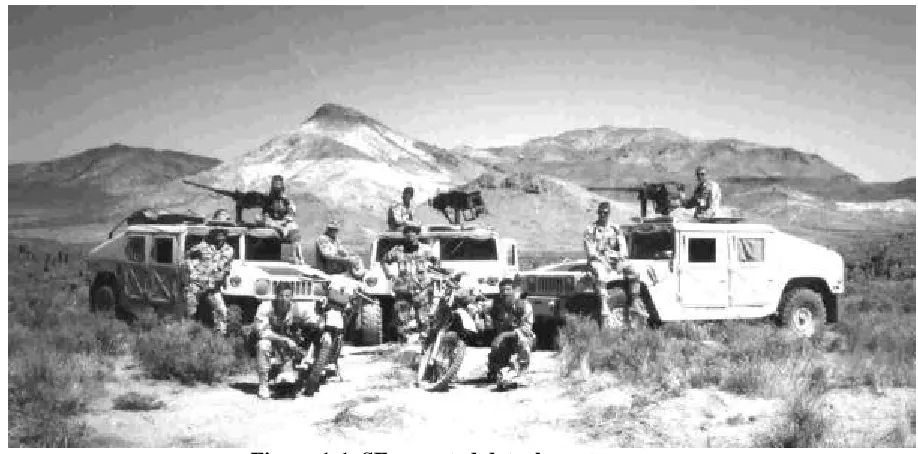
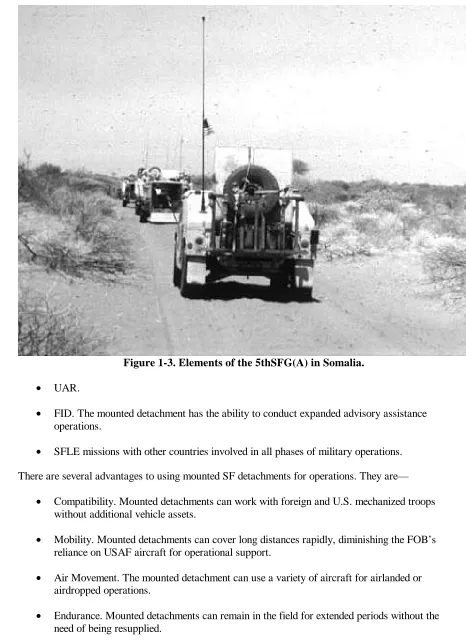
3 March 1998
DISTRIBUTION RESTRICTION
Distribution authorized to US government agencies only to protect technical or operational information from automatic dissemination under the International Exchange Program or by other means. This determination was made on 3 March, 1998. Other requests for this
document will be referred to Commander, US Army John F. Kennedy Special Warfare Center and School, ATTN: ATSU-DT-PDM, Fort Bragg, NC 28307-5000.
DESTRUCTION NOTICE
Destroy by any method that will prevent disclosure of contents or reconstruction of the document.
TABLE OF CONTENTS
1
PREFACE v
2
Chapter 1. Introduction 1-1
3
General 1-1
4
History 1-2
5
Special Forces Mounted Operations 1-3
6
Chapter 2. Mounted Detachment Organization 2-1
7
Desert Vehicle Mobility System 2-1
8
Vehicle Positions and Duties 2-1
9
Chapter 3. Planning Considerations and Preparations 3-1
10
General 3-1
11
Pre-Mission Considerations 3-2
12
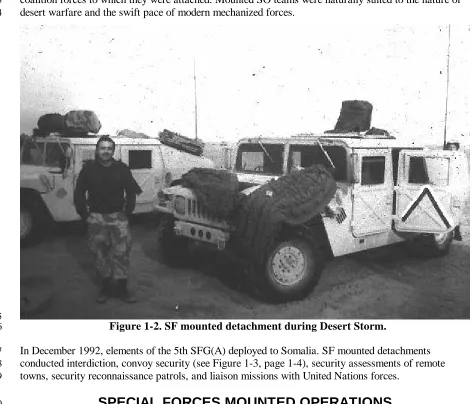
Collective and Individual Training 3-2
13
Vehicle Preparation 3-3
14
Equipment and Personnel Preparation 3-4
15
Chapter 4. Operational Employment 4-1
16
Infiltration and Exfiltration 4-1
17
Movement and Formations 4-3
18
Methods of Travel 4-4
19
Movement Formations 4-4
20
Actions at Halts 4-5
21
Laager Sites 4-6
22
Immediate Action/Reaction Drills 4-8
23
Laager Site Reaction Drill 4-10
24
Patrol Ferry Missions 4-10
25
Communications 4-11
26
Chapter 5. Motorcycle Section Employment 5-1
27
General 5-1
28
Employment Concept 5-2
29
Movement 5-3
30
Reaction Drills 5-3
31
Equipment 5-4
32
Chapter 6. Operations in an NBC Environment 6-1
33
Fundamentals of NBC Defense 6-1
34
Immediate Decon 6-2
35
Operational Decon 6-3
36
Thorough Decon 6-4
37
Nonstandard Operational Decon 6-4
38
Decontaminant Options 6-5
39
Chapter 7. Mounted SFLE Operations 7-1
40
Organization 7-1
41
Equipment and Personnel Preparation 7-1
Chapter 8. Navigational Techniques 8-1
1
Navigator’s Duties 8-1
2
Terrain Association 8-2
3
Dead Reckoning 8-4
4
Vehicle Orienteering 8-4
5
Celestial Navigation 8-7
6
Satellite Navigation 8-8
7
Chapter 9. Camouflage 9-1
8
Camouflage Theory 9-1
9
Camouflage Methods – Concealing Objects 9-2
10
Camouflage in the Desert 9-2
11
Camouflage Considerations 9-3
12
Chapter 10. Maintenance and Recovery 10-1
13
General 10-1
14
Preventive Maintenance Checks and Services 10-2
15
Desert Environmental Effects 10-2
16
Lessons Learned 10-3
17
Off-Road Driving 10-4
18
Recovery 10-5
19
Chapter 11. Logistics 11-1
20
General 11-1
21
Mission Support Site 11-1
22
Five R's 11-2
23
Multiple MSS Concept 11-3
24
Caching 11-4
25
Chapter 12. Military All-Terrain Vehicle 12-1
26
General 12-2
27
Organization 12-2
28
Employment Concept 12-3
29
Air Infiltration 12-3
30
Movement 12-3
31
Reaction Drills 12-3
32
Equipment 12-4
33
Appendix A. M1025A2 (GMV) and M1114 (Armored) HMMWV A-1
34
Appendix B. Mission-Essential Task List B-1
35
Appendix C. Mounted Detachment Training and Evaluation Outline C-1
36
Appendix D. Mounted Detachment Training Program D-1
37
Appendix E. Pre-Mission Checklist E-1
38
Appendix F. Load List F-1
39
Appendix G. Fuel Estimation Formula G-1
Appendix H. Water Estimation Formula H-1
1
Appendix I. CH-47/MH-47 Internal Load Operations I-1
2
Appendix J. Sling Load Operations J-1
3
Appendix K. Motorcycle Training Program K-1
4
Appendix L. Post-Operations Maintenance Procedures L-1
5
Glossary Glossary-1
6
References References-1
PREFACE
1
Until the mid 1980’s, the United States (U.S.) Army did not have a dedicated mounted special operations
2
(SO) capability. Major General Guest (then Colonel), 5th Special Forces Group (Airborne ) (SFG[A]),
3
realized this shortcoming. He understood that traditionally dismounted Special Forces (SF) operations in
4
desert environments were unrealistic. He authorized the formation of two detachment elements in 1984 to
5
develop mounted doctrine and operational techniques. These detachments moved to Fort Bliss, Texas,
6
and in the fall of 1986 started fulfilling this mission.
7
These detachments were equipped, at first, with M880 trucks and M151 jeeps. Later they appraised,
8
evaluated, and accepted the high mobility multipurpose-wheeled vehicle (HMMWV) series vehicle as
9
the interim desert mobility vehicle (DMV).
10
This manual, first printed by Company A, 1st Battalion, 5th SFG(A) in October 1987, was a
11
compendium of lessons learned by this element from 1985 to 1987. Its initial intent was to provide
12
a reference for training and using mounted SF detachments within the 5th SFG(A).
13
Since that time, the 5th SFG(A) updated and revised their Mounted Operations Manual in March
14
1992 and January 1993, incorporating lessons learned and new or improved equipment.
15
Through the years, the manual has remained essentially the same, yet revisions have been necessary
16
to account for latest equipment updates such as the new ground mobility vehicle (GMV) and global
17
positioning system (GPS) devices.
18
This field manual (FM) is a compendium of lessons learned by personnel at Fort Bliss, Fort Campbell,
19
Fort Bragg, and overseas, to include Operations Desert Shield/Desert Storm, Restore Hope, and Provide
20
Democracy. Its purpose is to serve as a reference for training and using mounted SF detachments in the
21
desert on long-term, unassisted operations. Although written primarily for desert operations, the
22
information in this manual also applies to any special operations forces (SOF) long-range vehicular
23
operation.
24
The proponent of this publication is the United States Army John F. Kennedy Special Warfare Center
25
and School (USAJFKSWCS). Reviewers and users of this manual should submit comments and
26
recommended changes on Department of the Army (DA) Form 2028 to Commander, USAJFKSWCS,
27
ATTN: AOJK-DT-SF, Fort Bragg, NC 28307-5000.
Chapter 1
1
Introduction
2
Special Forces Mounted Detachments are prepared to infiltrate and operate in low
3
or medium intensity conflicts over terrain consisting of high deserts with rugged
4
mountains to low deserts with sand dunes and salt marshes. The capability of these
5
detachments to travel unassisted long distances in enemy rear areas gives the Joint
6
Forces Commander/Commander Joint Special Operations Task Force an effective
7
tool. Figure 1-1 shows a 10-man SF mounted detachment task-organized for a
500-8
mile (mi) 5-day direct action mission without resupply.
9
[image:6.612.86.545.232.459.2]10
Figure 1-1. SF mounted detachment.
11
GENERAL
12
In preparing for conflicts in the desert environment, it is assumed that the distance from the forward
13
operational base (FOB) to the area of operations (AO) is too great for dismounted infiltration. The
14
desert-oriented SFG cannot rely solely on limited Air Force Special Operations Wing assets for which
15
to infiltrate operational detachments into their AOs.
16
A major role for these detachments is to conduct direct action (DA), medium to long range special
17
reconnaissance (SR), and unconventional warfare (UW) operations. They can also expect to do area
18
reconnaissance missions and to conduct and support unconventional assisted recovery (UAR).
19
In addition to the previously mentioned standard missions, mounted teams can be used to transport
20
other personnel and/or equipment in or out of their target area.
21
Another important role for these detachments is to conduct coalition support (Special Forces Liaison
22
Element [SFLE]) and/or foreign internal defense (FID) missions with nations possessing extensive
23
mounted capabilities.
To prepare for these roles, mounted detachments must develop the following capabilities:
1
• Operate and communicate over long distances.
2
• Operate effectively and continually in a hostile air environment that may severely limit or
3
prevent air support.
4
• Operate in rugged terrain, both on and off road.
5
• Make site repairs on all equipment using the skills of the detachment members and
on-6
board tools and parts.
7
HISTORY
8
The British Army first used mounted special warfare units in the desert for active patrolling and
9
special missions during World War I. The Libyan Light Car Patrol was used very effectively to
10
suppress the Sanusi rebellion. Colonel T. E. Lawrence, of Lawrence of Arabia fame, made vast use of
11
camel-mounted elements to harass and destroy Ottoman Turkish rail and supply depots in, what is
12
now, Saudi Arabia and Jordan. Later he used vehicular patrols with great success.
13
Between World Wars I and II, John Ball operated throughout the North African deserts with
long-14
range vehicle excursions for mapping and exploring. His data and techniques were later incorporated
15
into a manual for British officers who conducted vehicular patrols in the desert. Most of his
16
navigation techniques are still valid today and in fact are the basis for traversing techniques across
17
desert environments.
18
With the combined knowledge of mounted patrolling and techniques for navigation, the stage was set
19
for the development of a specialized body of troops who could combine this knowledge into useful
20
military operations.
21
The necessity for reliable information in the Western Desert Campaign during World War II brought
22
about the organization of the Long Range Desert Group (LRDG) in 1941. This British-led, New
23
Zealand-manned, U.S.-vehicle-equipped unit was credited as being the most reliable
intelligence-24
gathering tool for General Headquarters Middle East. The LRDG operated out of patrol bases in the
25
deep South Sahara Desert. The LRDG would launch “road watch” surveillance missions and other
26
reconnaissance missions lasting for several weeks.
27
Another Long Range Desert unit operating in the Sahara during World War II was the Special Air
28
Service (SAS). The SAS initially began operations by being ferried into the operational areas by the
29
LRDG. Later, the SAS evolved into a deep penetration, vehicle-equipped unit capable of strike
30
operations hundreds of miles behind enemy lines. The SAS was credited with destroying more
31
aircraft on the ground than the Royal Air Force did in the air.
32
After World War II and up to the present, several countries have expanded the operational concept of
33
using mounted SOF for desert environments. The British SAS and New Zealand SAS maintain
34
mounted desert-oriented elements.
35
During Desert Shield and Desert Storm, U.S. Army SOF used mounted detachments with great
36
success on SR and DA missions behind enemy lines. They also conducted FID and liaison missions
37
(see Figure 1-2, page 1-3) with Kuwaiti and other Arab armor units. More specifically, they
38
conducted terminal guidance for laser-guided munitions, reported on enemy dispositions, and gave
battle damage assessments. They trained with the Kuwaiti armed forces as they rebuilt their army.
1
They also reported “ground truth” (location and condition) to higher headquarters of the Arab
2
coalition forces to which they were attached. Mounted SO teams were naturally suited to the nature of
3
desert warfare and the swift pace of modern mechanized forces.
4
[image:8.612.70.543.104.508.2]5
Figure 1-2. SF mounted detachment during Desert Storm.
6
In December 1992, elements of the 5th SFG(A) deployed to Somalia. SF mounted detachments
7
conducted interdiction, convoy security (see Figure 1-3, page 1-4), security assessments of remote
8
towns, security reconnaissance patrols, and liaison missions with United Nations forces.
9
SPECIAL FORCES MOUNTED OPERATIONS
10
Mounted operations provide relatively rapid and secure operational assets within the theater. Typical
11
SF operations that can be expanded with the mobility of mounted detachments include:
12
• DA.
13
• SR.
14
• Combat support operations to include resupply and cache missions, patrol ferry and
15
exfiltration, communications relay, site security roles, and assistance to evasion nets.
16
• Close air support (CAS) operations supporting United States Air Force (USAF) aircraft (a
17
subset of DA).
18
• Guerrilla warfare (GW) operations.
1
Figure 1-3. Elements of the 5th SFG(A) in Somalia.
2
• UAR.
3
• FID. The mounted detachment has the ability to conduct expanded advisory assistance
4
operations.
5
• SFLE missions with other countries involved in all phases of military operations.
6
There are several advantages to using mounted SF detachments for operations. They are—
7
• Compatibility. Mounted detachments can work with foreign and U.S. mechanized troops
8
without additional vehicle assets.
9
• Mobility. Mounted detachments can cover long distances rapidly, diminishing the FOB’s
10
reliance on USAF aircraft for operational support.
11
• Air Movement. The mounted detachment can use a variety of aircraft for airlanded or
12
airdropped operations.
13
• Endurance. Mounted detachments can remain in the field for extended periods without the
14
need of being resupplied.
• Transportation. Mounted detachments can ferry specialized equipment and dismounted
1
elements into AOs.
2
• Firepower. Mounted detachments can bring considerable firepower to bear on targets of
3
opportunity or preplanned objectives using the weapons systems on their vehicles.
4
There are also some disadvantages to a mounted operational element. These disadvantages include:
5
• Vehicle maintenance. Detachment personnel need to be skilled in maintenance and repair,
6
including depot-level maintenance procedures. Teams require additional tools and parts to
7
sustain extended operations.
8
• Training. Detachment personnel will require additional training including mounted tactics,
9
navigation techniques, maintenance and repair, and vehicle camouflage.
10
• Security. The amount of security offered in the desert declines with the size of the element.
11
The number of vehicles involved in the mission, the tracks they leave, and noise and light
12
discipline will increase the possibility of detection.
Chapter 2
1
Mounted Detachment Organization
2
The SF mounted detachment is organized to maximize the capabilities and flexibility
3
of its equipment and detachment members. Although cross-trained in different vehicle
4
duty positions, it is critical that each detachment member thoroughly understands his
5
primary vehicular duty position so that the detachment can operate effectively and
6
safely as a team.
7
DESERT VEHICLE MOBILITY SYSTEM
8
Mounted detachments are organized around four prime movers. The prime mover is called the GMV.
9
The Desert Mobility Vehicle System (DMVS) consists of—
10
• GMV, modified M1025A2 HMMWV.
11
• Desert operations trailer (DOT).
12
• Desert operations motorcycle (DOM).
13
• GPS that is vehicle-mounted and -powered. It can also be used in a dismounted mode.
14
• Crew-served weapon system, caliber .50 M2 heavy barrel (HB) machine gun (MG) or Mark
15
19 40-mm grenade launcher (GL) MG.
16
• Vehicular radio communications system with frequency hopping and secure capabilities. The
17
system also has a battery box to use the receiver-transmitter (RT) in a dismounted mode.
18
Optimally, a mounted detachment will have 4 GMVs, 2 DOTs, 2 DOMs, 2 M2 HBs, 2 Mark 19s, 4
19
GPSs, 12 night vision goggles (NVGs) (AN/PVS-7), and 4 vehicle-mounted radios.
20
Mounted detachments will modify their vehicles to best suit their missions and standing operating
21
procedures (SOPs) (see Figure 2-1, page 2-2). During military operations other than war (MOOTW)
22
in an urban environment, the mounted detachment may use the M1114 (armored) HMMWV.
23
Appendix A provides the capabilities and comparison of these two vehicles.
24
VEHICLE POSITIONS AND DUTIES
25
The mounted detachment is divided into two sections, each consisting of 2 GMVs, 1 DOT, and 1 DOM.
26
The two sections normally operate together as a full team, but they also move and operate as split teams.
27
Each section has six personnel. The detachment can also operate as four separate elements for a very
28
short time with each vehicle operating independently. Regardless of how many elements the detachment
29
is broken into, three men man each vehicle. The duty positions are driver, navigator, and weapons system
30
operator. Each man has to be well versed in the duties and responsibilities of all duty positions. Personnel
31
configuration of the section will depend upon the individual skills of the detachment members. Below is
32
an example of vehicle positions and primary duties.
1
Figure 2-1. Mounted Detachment with modified GMV at National Training Center (NTC).
2
Vehicle Positions
3
Vehicle #1:
4
• Primary driver: Engineer Supervisor.
5
• Weapons system operator: Weapons Sergeant (SGT).
6
• Navigator: Assistant Operations SGT.
7
Vehicle #2:
8
• Primary driver: Medical Supervisor.*
9
• Weapons system operator: Communications SGT.
10
• Navigator: Detachment Commander.
11
Vehicle #3:
12
• Primary driver: Medical SGT.
13
• Weapons system operator: Weapons Supervisor.*
14
• Navigator: Assistant Detachment Commander.
15
Vehicle #4:
16
• Primary driver: Communications SGT.
17
• Weapons system operator: Engineer SGT.
18
• Navigator: Operations SGT.
19
*DOM-1— Medical Supervisor.
20
*DOM-2— Weapons Supervisor.
Duty Descriptions
1
Primary Driver. He does the preventive maintenance checks and services (PMCS) with assistance
2
from the vehicle crew. He assumes most of the vehicle operating duties. He ensures that the vehicle is
3
topped off with fuel at the end of each night’s movement, and that the vehicle is prepared for the next
4
night’s movement. He also monitors the fuel, water, and rations level for the vehicle. He advises the
5
vehicle command (the navigator) of the situation before the next night’s movement.
6
Weapons System Operator. He is responsible for that vehicle’s onboard weapons system. Standard
7
armament for a mounted detachment is one caliber .50 M2 HB MG and one Mark 19 40-mm GL MG
8
per section (total of 2 M2 HBs and 2 Mark 19s). Usually the Mark 19 GL MGs are positioned on
9
vehicles #2 and #3 and the M2 HBs are on vehicles #1 and #4. The weapons system operator observes
10
for enemy activity in his vehicle’s assigned sector during movement. From his position outside of and
11
on the top of the vehicle, he has the greatest field of view and his vision is unrestricted by windows
12
and doors. He communicates with the navigator and the driver to alert them to any hazards or
13
obstacles in the path of the vehicle or enemy activity. The weapons system operator is accountable for
14
the internal load of the vehicle. He ensures every day at the end of the night’s movement that the
15
internal configuration of the vehicle is squared away, that everything is secured to the vehicle, and
16
that essential equipment is accessible. He advises the vehicle commander daily on the vehicle’s
17
weapons and ammunition status.
18
Navigator (Vehicle Commander). The navigator in vehicle #1 is the primary navigator for the
19
detachment. He should be able to determine position at any time within one hundred meters with a
20
GPS or within one-quarter mile without. The other three vehicle navigators check the primary
21
navigator and help him negotiate obstacles. He does the route planning, to include preparing the
22
route-planning log. He does the PMCS of the vehicle’s communications system. He always makes
23
sure that the correct frequencies and crypto keys are loaded. He ensures spare batteries are accessible
24
in case of battery failure during movement. He maintains the GPS and the vehicle’s compass. The
25
navigator also accounts for all additional equipment that is stored in the vehicle storage bins behind
26
the driver’s seat.
27
Motorcycle Rider. When deployed, the motorcycle riders come from vehicles #2 and #3. Vehicles #2
28
and #3 are the prime movers for the DOMs and act as a “mother ship” for the motorcycles. The
29
motorcycle riders maintain the DOMs with assistance from their vehicles’ crew. When deployed, the
30
motorcycle section, never operating as single DOMs, can scout the tentative route, reconnoiter point
31
or area targets, and act as a forward warning element for the detachment.
Chapter 3
1
Planning Considerations and Preparations
2
Planning and preparation for a mounted mission starts long before the detachment is
3
alerted. Preparations include training and rehearsals needed to prepare the team to
4
move 1,000 mi or 10 days in the desert unassisted.
5
GENERAL
6
The distance from the FOB to the unconventional warfare operational area (UWOA) or operational
7
area or even the staging (launch) site may require other transportation means than the GMV. Various
8
combinations of aircraft, rail line, and/or surface ships may be required to get the mounted
9
detachment positioned to infiltrate an operational area. These combinations may also be used to
10
increase the operational range of the mounted detachment by decreasing the required distance for
11
overland infiltration.
12
When an operation requires both aircraft and surface ships, or other combinations, a rendezvous must
13
take place to transfer the operational element. The method selected should be one that will land or
14
position the element with the least chance of detection as close as possible to its AO and as simply
15
and rapidly as possible. Factors for consideration are—
16
• Security.
17
• Size of the element.
18
• Operational requirements relating to the overt or covert nature of the mission.
19
• Capabilities of personnel and equipment loads.
20
• Availability of transport and delivery capabilities.
21
• Weather, terrain, hydrographic, and astronomical data and conditions in the delivery area.
22
• Enemy and friendly situation in the delivery and operational areas.
23
Operational elements may be delivered into the staging area or the AO using the following modes of
24
transportation:
25
• Surface ships.
26
• Amphibious landing craft.
27
• Fixed- or rotary-wing aircraft.
28
• Rail lines.
29
• Line haul transport.
30
• Any combination of the above.
PRE-MISSION CONSIDERATIONS
1
In planning for a successful infiltration, consider the following factors:
2
Mission. The mission determines what and how much ammunition and demolitions are necessary,
3
including special equipment.
4
Enemy and Friendly Situation. Order of battle affects the routes, communications procedures and
5
capabilities, external exfiltration capabilities, and sources of resupply.
6
Troops Available and Training Level of Detachment Personnel. SF operational detachments are
7
proficient in air infiltration and dismounted operations; however, long-range mounted operations
8
require special training. This special training includes cross-country and night driving with and
9
without night vision aids, vehicle navigation, vehicle maintenance, recovery operations, and mounted
10
weapons system use.
11
Terrain and Weather. Terrain and weather also affect the route planning, personal equipment, and
12
special equipment needs. Light conditions determine the time available for movement with regard to
13
the enemy situation.
14
Time and Distance. These factors primarily affect the amount of required fuel and subsistence for
15
detachment members, since distance and duration are similar.
16
Civilian Populace. Mission planning must consider the local civilians in the AO and what to do in
17
case of mission compromise.
18
Equipment and Supplies. The previous six considerations determine the detachment’s logistical
19
needs. The detachment must plan for the minimum levels of all needed supplies. Mission-essential
20
equipment and supplies will prioritize available space. During planning, the detachment may find that
21
pre-positioned equipment is available in the AO. This equipment can range from fuel and water to a
22
complete GMV with weapons, communications equipment, and prescribed load list (PLL).
Pre-23
positioned supplies greatly reduce the amount of vehicles and equipment the detachment must deploy
24
with overseas and generally speeds up their overall deployment. However, when planning for such
25
equipment, the detachment must allocate time to inspect and prepare the equipment when it arrives in
26
country.
27
COLLECTIVE AND INDIVIDUAL TRAINING
28
Mounted detachments are as specialized as a SCUBA, mountain, special operations techniques
29
(SOT), or high altitude low opening (HALO) detachments. All require specialized training to become
30
proficient.
31
Collective Training. Training required for the mounted detachment includes cross-country and night
32
driving with and without night vision aids, vehicle navigation, vehicle infiltration, mission support
33
site (MSS) and hide site establishment, vehicle maintenance, recovery operations, mounted battle
34
drills, and dismounted crew battle drills. Priority on detachment collective training for the vehicles
35
must always be in maintenance. The team members have only each other to depend on when deep
36
inside enemy territory and they can never know enough about working on their vehicles. See
37
Appendix B, example of a mission-essential task list and Appendix C, example task summaries for a
38
mounted detachment. These two examples provide the commander a tool to evaluate his detachment.
Appendix D provides an example of a mounted detachment’s training program that the 5th SFG(A)
1
used to train elements of the 20th SFG(A) at the NTC.
2
Individual Training. All military occupational specialties (MOSs) require special skills or
3
knowledge to effectively augment the mounted detachment. Detachment members that have a
4
mechanized background are always an asset. The following paragraphs address individual training for
5
the—
6
• Detachment commander— mounted mission planning, detachment mounted training concepts,
7
mounted employment, and battle drills.
8
• Assistant detachment commander— mounted mission planning, long-range training planning,
9
mounted employment, and battle drills.
10
• Operations sergeant— mounted mission planning, short-range training planning and
11
implementation, mounted employment, battle drills, vehicle maintenance, and load planning.
12
• Assistant operations sergeant— mounted mission planning, mounted employment, battle drills,
13
and vehicle maintenance.
14
• Weapon sergeants— mounted employment, battle drills, and specialized weapons.
15
• Engineer sergeants— mounted employment, battle drills, specialized weapons, and load planning.
16
• Communication sergeants— mounted employment, battle drills, specialized electrical wiring
17
techniques, and vehicle maintenance.
18
• Medical sergeants— mounted employment, battle drills, specialized medical techniques, and
19
vehicle maintenance.
20
Cross-Training. Mounted detachment personnel require thorough cross-training. Each vehicle must
21
be able to operate independently for extended periods. Place priority on communications, medical
22
training, basic employment, and maintenance. Skills not practiced are skills lost. Do not wait until
23
isolation to cross-train.
24
VEHICLE PREPARATION
25
Detachment personnel make all preparations necessary for airlanded, paradrop, seaborne, and
26
overland insertions. They must plan for and spend sufficient time to prepare their vehicles for the
27
assigned mission, from infiltration to exfiltration. There are no motor pools in the AO where the
28
detachment can effect repairs; all maintenance and repair operations take place in the field. The GMV
29
is not only a mode of infiltration and exfiltration; it also is a duration and distance enhancement and
30
survival platform for the mounted detachment.
31
Detachment members load each vehicle so that it can act independently during the mission. They
32
must carefully consider weight. Too much equipment is just as bad as not enough. An overloaded
33
vehicle handles poorly, consumes fuel at a higher rate, lacks power, and will experience more
34
maintenance problems. Items having the greatest effect on weight are fuel, water (50 pounds [lb] per
35
5-gallon [gal] container), ammunition by type (including shipping containers), and personal
36
equipment. Try to limit carrying unnecessary equipment. There is a tendency to carry more
37
equipment because there is room. Knowing one’s vehicle greatly enhances mission success and the
crew’s trust in their vehicle. Avoid borrowing or loaning vehicles at the last moment. If you must
1
borrow or loan, allow enough time for detachment members and motor pool personnel to perform
2
pre-mission maintenance. Think of these vehicles as used cars. After buying a used car, you would
3
not immediately go on a 1,000-mi trip without proper maintenance. A common mistake is to assume
4
that all GMVs are the same. Although they may look the same on the outside, each one performs
5
differently based on age, mileage, past maintenance, and hours on the engine.
6
EQUIPMENT AND PERSONNEL PREPARATION
7
An important aspect to pre-mission preparation is vehicle maintenance and keeping all equipment in a
8
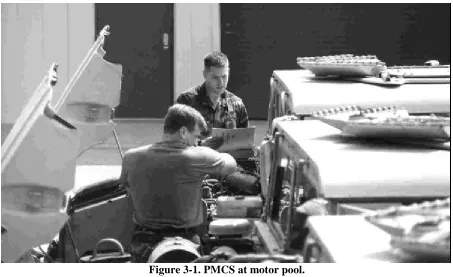
go-to-war status. Members must inspect and exercise their vehicles even while in garrison (see Figure
9
3-1). The detachment operations sergeant is responsible for status of the detachment’s vehicles. The
10
vehicle navigator is responsible for the status of his vehicle.
11
Ensure proper PMCS in garrison by moving all vehicles out of the motor pool monthly to exercise
12
and test the equipment. This test should include on- and off-road operation in all gears. Check for
13
wheel alignment and listen for any unusual noises. A vehicle left alone in the motor pool will break
14
down. The more these vehicles are exercised, the better they will work.
15
[image:17.612.89.542.310.587.2]16
Figure 3-1. PMCS at motor pool.
17
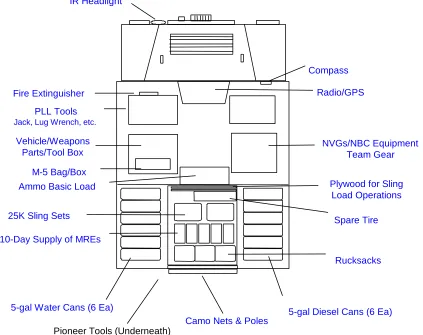
Keep the basic equipment common to each mission on the vehicle at all times (see Figure 3-2, page
18
3-6). This equipment includes tools, petroleum, oils, and lubricants (POL), spare parts, recovery
19
items, tire repair kits, and other miscellaneous items. Such actions will not only save loading time and
20
storage space needed to store these items between missions, but they reduce the chance that these
21
items will be forgotten.
22
Prepare each vehicle using a vehicle loading list. This list is compiled from team SOPs, experience,
23
and mission requirements. Simplicity is the key to success. A good tool is a vehicle loading plan that
standardizes the location of equipment common to all in each vehicle. This plan ensures that anyone
1
assigned to the detachment can go to any vehicle and locate or pack team equipment.
2
Control and assist the preparations after alert using pre-mission checklists (see Appendix E). The
3
detachment operations sergeant ensures the completion of the pre-mission requirements.
4
Conduct inspections to ensure the vehicles are loaded properly. Appendix F contains an example load
5
list without regard to specific mission requirements, other than a planning figure of 10 days or 1,000
6
mi.
7
Upon receipt of a notice to deploy, inspect the detachment vehicles as soon as possible to ensure
8
mechanical reliability. Conduct this inspection at least 30 days before vehicle shipment (or as early as
9
possible) to allow motor pool personnel time to correct deficiencies. Do not inspect the vehicles only
10
per the operator’s manual— conduct a very thorough going-over from top to bottom. A good reference
11
to follow for this inspection is the annual inspection required for the HMMWV. Motor pool personnel
12
will help inexperienced detachment personnel perform this inspection. It is key that the detachment
13
personnel be present at this inspection. Your life may depend on your vehicle. Test-drive each vehicle
14
to ensure mechanical reliability. Make sure this inspection takes the vehicle up to operating
15
temperatures. Also, check climbing ability, winch operation with load, transmission and transfer case
16
performance through all gears on challenging terrain, engine performance, front and rear wheel
17
alignment, and listen for any unusual noises or rattles. After this inspection and test, rate each vehicle
18
by performance. The stronger vehicles should perform the more challenging aspects of the mission.
19
Avoid overloading or hauling trailers with the weaker vehicles. The next inspection should take place
20
3 to 5 days before load out or during isolation. Inspect the items normally kept on the vehicle and all
21
mission-related equipment. A good way to inspect this equipment is to separate the mission-essential
22
equipment by vehicle. Each vehicle team inspects its own equipment to ensure reliability of one’s
23
own equipment and ability to operate the equipment. The last inspection should be the normal final
24
inspection or spot check done during the last few hours before the infiltration or shipment of the
25
equipment.
26
Plan for sufficient fuel supplies. Fuel trucks or fuel points are not available in the mission area.
27
Frequently, it is difficult or impossible to get any kind of resupply. A general planning figure is nine
28
miles per gallon (mpg) for initial estimation of fuel requirements. Use the formula in Appendix G) to
29
plan for fuel usage.
30
Plan for and take adequate water. Minimum water planning figures are four to six quarts per man per
31
day for mounted operations in the desert. Take additional water for dismounted missions within the
32
mounted role. Do not count the water carried on individual load-bearing equipment (LBE) for this
33
requirement. Detachment members use a vehicle water bottle for the crew. They never use the water
34
supplies on their LBE unless separated from the vehicles during dismounted operations or when
35
placed in a survival or evasion situation. As a rule, consume water from the vehicle’s stores first
36
before using personal stores. Use the formula in Appendix H to plan for water usage.
37
Plan for and take adequate food supplies. Remember that food consumption in hot, dry climates is
38
generally less than in other climates. Individuals should pack the majority of their food items in a
39
food bag (ditty bag) instead of their rucksack to limit the extent of unpacking their rucksack when
40
getting meals. A ditty bag ensures they will have a minimal kit of food and survival and evasion items
41
on hand. Construct the ditty bag from a durable bag large enough to hold 3 days of food, minimum
42
sleeping gear, personal escape and resistance gear, first-aid kit, and personal toilet articles. Pack a
43
minimum of three meals in the rucksack, so that the detachment member will have a food supply if
44
required to abandon the vehicle rapidly. If several cases of food are packed on the vehicle, the crew
avoids opening more than one case at a time. This action helps when estimating the duration of
1
remaining food and cuts down the constant shuffling of equipment.
2
IR Headlight
Compass
Radio/GPS Fire Extinguisher
Vehicle/Weapons Parts/Tool Box
NVGs/NBC Equipment Team Gear
Spare Tire
Rucksacks
5-gal Water Cans (6 Ea)
Camo Nets & Poles 5-gal Diesel Cans (6 Ea) 10-Day Supply of MREs
Ammo Basic Load
Pioneer Tools (Underneath) PLL Tools
Jack, Lug Wrench, etc.
M-5 Bag/Box
Plywood for Sling Load Operations
25K Sling Sets
[image:19.612.113.536.173.508.2]3
Figure 3-2. Example vehicle load configuration.
4
Place ammunition where it can be accessed quickly. Secure large ammunition cans or containers to
5
prevent injury in accidents due to shifting loads. Carry a small basic load of demolitions separately to
6
deal with contingencies (duds or mines). Construct and position a vehicle destruction kit for quick
7
accessibility. Each member should have three basic loads of small-arms ammunition: one on the LBE
8
(primary), one in rucksack (alternate), and one in an ammo can positioned in the vehicle
9
(contingency). The ammo can in the vehicle should contain all contingency ammunition for the crew.
10
Position basic signaling ammunitions near the navigator’s position. These would include colored
11
smokes and colored starclusters to aid in identification.
12
Plan for maintenance and repair contingencies based on the mission, the terrain and weather in the
13
operational area, mission duration, and maintenance experience. The mounted detachment normally
carries one general mechanic’s toolbox with metric supplement per section. Additionally, each
1
vehicle carries its own operator vehicle maintenance (OVM) set. Each vehicle also carries a small
2
supply of motor oil (15w-50), Dextron II transmission fluid, and brake fluid for basic maintenance
3
needs. For long-duration missions, the trailer towed by the second and third vehicles carries the
4
majority of the maintenance supplies. Each vehicle should also carry one complete replacement set of
5
fluids, including motor oil, transmission fluid, brake fluid, and antifreeze. Carry basic spare parts such
6
as fan belt, upper and lower radiator hoses, and main fuel tank drain plug. Construct a general repair
7
can to carry such items as tire plug kit, automotive liquid metal, assorted hose clamps, and radiator
8
repair kit. On long-duration missions requiring trailer usage, construct an additional spare parts box to
9
carry such items as starter, alternator, half shafts, glow plugs, and battery. The detachment will
10
normally carry enough POL and PLL to repair or replace any maintenance problem in the field if it is
11
at all possible to repair or replace. See Appendix F for a recommended list of spare parts for a generic
12
mission of 1,000 mi or 10 days.
13
Once everything is packed and ready for deployment, strap down and secure all equipment and
14
supplies against movement inside the vehicle. Cross-country driving makes it essential that all
15
equipment be tied down securely.
Chapter 4
1
Operational Employment
2
The success of the mission and survival of the operational detachment lies in its
3
ability to infiltrate, move, conduct operations, and exfiltrate— all without being
4
detected. In mounted operations, survival depends upon moving solely at night and
5
using proper camouflage measures during the day.
6
INFILTRATION AND EXFILTRATION
7
The threat to each method of infiltration and exfiltration is different. The following paragraphs
8
illustrate typical threats to a mounted detachment when infiltrating by air or by ground.
9
Air Infiltration and Exfiltration
10
Mounted detachments infiltrating and exfiltrating by air must avoid an extensive and integrated
11
enemy air defense system. Such a system provides complete coverage at medium to high altitudes
12
with a high redundancy of coverage in heavily defended areas. Soviet doctrine, currently used by
13
many nations in the Middle East, has made concerted efforts to improve low-altitude detection.
14
Ground Infiltration and Exfiltration
15
Mounted detachments infiltrating and exfiltrating by land must avoid hostile border security forces.
16
These forces employ sensors, minefields, other barriers, patrols, checkpoints, and other populace
17
control measures to detect clandestine movement across closed borders. Once the mounted
18
detachment crosses the border, it still faces rear area security threats.
19
Planning Considerations
20
The following paragraphs address the planning considerations for airborne and ground infiltration.
21
Airborne Infiltration.The mounted detachment can use several platforms to infiltrate its mission
22
area.
23
C-130/MC-130. The C-130 Hercules aircraft has a great deal of advantages as an infiltration platform.
24
Some planning considerations are—
25
• The team can fit two vehicles per aircraft.
26
• Weapons system will be mounted and cleared.
27
• Vehicle will be mission ready with the exception of ammunition in the weapons system.
28
• Everyone will ride on the aircraft.
29
• Fuel tanks have to be half empty on C-130 aircraft, without waiver. MC-130s will normally
30
allow the vehicles on with a full tank but full tanks must be coordinated beforehand.
• Need a C-130 capable dirt strip (916 meters)
1
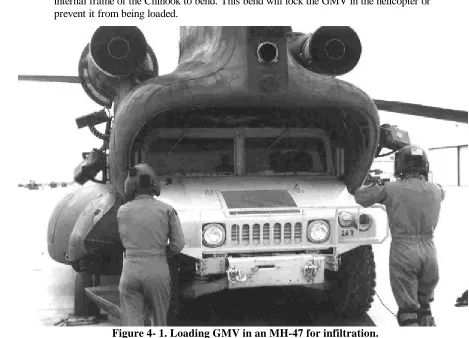
MH-47 Helicopter, Internal Load (see Appendix I). The GMV will fit inside a CH-47 or MH-47
2
helicopter with two inches of clearance around the vehicle (see Figure 4-1). This clearance makes for
3
a very tight fit and must be carefully rehearsed with the aircrew. Planning considerations for this
4
aircraft are—
5
• Rigging the vehicle.
6
• No objects extending from the top or sides of the vehicle.
7
• The weapon system will be stored as one unit.
8
• Cannot load with trailers.
9
• Rehearsal time with driver and aircrew.
10
• Landing zone (LZ) or pickup zone (PZ) must be flat. Any surface undulation will cause the
11
internal frame of the Chinook to bend. This bend will lock the GMV in the helicopter or
12
prevent it from being loaded.
13
[image:22.612.72.541.306.644.2]14
Figure 4- 1. Loading GMV in an MH-47 for infiltration.
15
MH-47 Helicopter, Sling Load (see Appendix J). Using procedures developed with 5th SFG(A) and
16
Task Force 160, the MH-47 can land, hook up the vehicle, and load the vehicle crew on the same
17
aircraft. The procedures for working with an MH-47 are different from conventional sling load
18
operations and require coordination and rehearsals. Planning considerations include—
• Additional sling sets needed.
1
• Rigging the vehicle.
2
• Trailer(s) cannot be sling loaded.
3
• Rehearsal with aircrew required.
4
Ground Infiltration and Exfiltration. The HMMWV leaves a unique vehicle signature that makes it
5
difficult to conceal its tracks. Take extreme care during route selection. Other planning considerations
6
are—
7
• Rigging Vehicle. A common mistake is to take everything except the kitchen sink when using
8
the GMV. Take care to properly load and configure the vehicles for a long distance
9
movement.
10
• Trailer(s). These can be taken for use en route or cached.
11
MOVEMENT AND FORMATIONS
12
When planning and conducting movement, consider the below listed fundamentals of movement to
13
reduce chance of enemy observation and contact.
14
Cover and Concealment
15
Use terrain features and vegetation that offer protection from enemy observation. When using cover
16
and concealment to its full advantage, a trade-off usually exists between security and speed of
17
movement.
18
Skylining
19
Avoid skylining. Select routes that avoid high ground that may silhouette the vehicles.
20
Chokepoints
21
Avoid chokepoints. Chokepoints or areas where the terrain naturally channels routes are often sites
22
for ambushes or areas that the enemy may have under observation. If a chokepoint proves impossible
23
to avoid, then reconnoiter it thoroughly before moving through it.
24
Populated Areas
25
Avoid known or suspected populated areas. In the Middle East, this means all water holes because the
26
populace and therefore the enemy know all water holes. A mounted detachment cannot move covertly
27
if people know they are in the area.
28
Movement Discipline
29
Practice movement discipline. Movement discipline means adhering to your light, noise, litter, and
30
interval rules. It also means keeping your speed slow enough so that you do not leave a large dust
31
signature (usually 10 to 12 miles per hour (mph) on most surfaces at night, slower during the day).
Security
1
Maintain 360-degree security at all times to avoid being taken by surprise. The detachment operations
2
sergeant and/or the unit SOP assigns a sector of fire and observation to each vehicle during movement
3
and at halts.
4
Routes and Contingencies
5
Make sure all detachment members know the route and contingency plans.
6
METHODS OF TRAVEL
7
There are two methods of travel in the operational area. They are either on existing tracks, trails, or
8
roads, or traveling off-road or cross-country. There are advantages and disadvantages to both.
9
Trails/Tracks
10
Advantages are speed of movement, hard packed trails do not easily yield readable prints and signs
11
of passage, quietness of movement, less stress on vehicles and tires, and navigation is sometimes
12
easier.
13
Disadvantages are usually a greater chance of being seen or compromised, natural lanes of
14
observation and fire exist for the enemy, and mechanical and/or manual ambushes are more probable.
15
The U.S. HMMWV (the platform used by the GMV) leaves a distinctive tire trail unlike any other
16
truck. Consider this fact during planning.
17
Cross-Country
18
Advantages in traveling off-road are there is less chance of enemy observation or contact, usually
19
afford more cover and concealment, and there is less chance of an ambush.
20
Disadvantages are slower rates of movement, more noticeable vehicle tracks and signs of passage,
21
tire failure and vehicle stress is greater, and navigation is usually more difficult. Some desert terrain is
22
so rough that even the GMV has trouble traversing it faster than a man can walk. It is vital that the
23
detachment rehearses cross-country movement in terrain as close as possible to that of the target area
24
before deployment.
25
MOVEMENT FORMATIONS
26
The mounted detachment can employ five movement formations to suit the situation. These are—
27
Traveling Column
28
Use this formation when contact is not likely. Use the visibility rule for interval. Illumination
29
conditions, terrain and vegetation, and night vision equipment affect this rule. The driver keeps the
30
vehicle to his front in sight.
31
Traveling Overwatch Column
32
Use this formation when enemy contact is possible but not probable. The driver of the second vehicle
33
increases his interval from the lead vehicle. This action allows the detachment to use the rule of
making contact with the smallest element possible, allowing the remainder of the detachment to fire
1
and move in support of the lead vehicle.
2
Bounding Overwatch
3
Use this formation when enemy contact is expected or used in retrograde when the detachment is
4
breaking contact. Each section bounds as a team, never exceeding half of the onboard weapons
5
system range of the section in overwatch, about 900 to 1,000 meters. The sections in overwatch
6
provides covering fire for the bounding section. The bounding section should attempt to place itself in
7
a position within the line of sight of the section in overwatch.
8
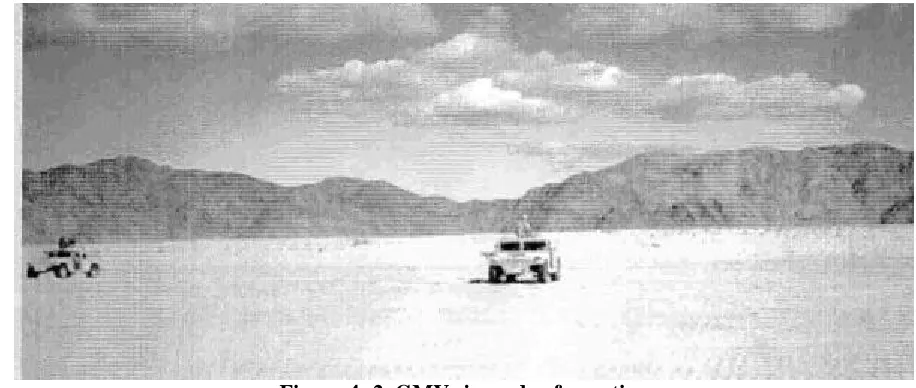
Wedge Formation
9
Use this formation to move through enemy positions by fighting through them when breaking contact
10
is not feasible. This formation can also be used with extremely wide intervals, determined by
11
visibility, to conduct search operations (see Figure 4-2).
12
[image:25.612.83.541.280.474.2]13
Figure 4- 2. GMVs in wedge formation.
14
Diamond Formation
15
Use this formation when crossing extremely large open areas. Each section forms a side of the box
16
when moving forward. Visibility determines the interval between vehicles in each section. The
17
interval between sections should not be greater than 900 to 1,000 meters. This formation is hard to
18
control; therefore the sections plan for and designate rally points before they separate.
19
ACTIONS AT HALTS
20
Any time the detachment conducts a planned halt (short or long), it will conduct a coordinated
21
shutdown of all vehicles. The commander or operations sergeant initiates the shutdown using hand
22
and arm signals. He exits his vehicle and stands where he can be seen by all the vehicles. He then
23
waves his arm in a circle over his head and drops it toward the ground to signal all vehicles to shut
24
down their engines at the same time. He uses the same procedure, when the halt is over, to start their
25
engines at the same time. If it is not possible for the commander or operations sergeant to visually
26
signal all the vehicles at the same time, he can use the radio to indicate engine shutdown or engine on.
Use of the radio should be avoided to lessen the detachment’s radio signature, but it can be conducted
1
safely if done properly.
2
Once the vehicles have been shut down, the detachment conducts a security listening halt before any
3
other functions take place. The length of time for the halts will be established in planning and/or by
4
detachment SOP.
5
Short-duration halts are used to communicate with higher headquarters, make necessary repairs, or
6
establish a position fix. For halts of less than 15 minutes, the detachment does not break travel
7
formation. Personnel man all vehicle weapons, and establish 360-degree security. For halts of longer
8
than 15 minutes, the detachment, if possible, moves off its direction of travel and establishes one of
9
the following positions:
10
• Coil formation. Use this formation when moving in a column formation or along a road/trail.
11
The detachment moves into a partial perimeter along the route of march. Members of each
12
vehicle observe their assigned section of the perimeter. The terrain determines vehicle
13
interval, but it is not usually less than 50 meters. During the halt, necessary tasks will be
14
performed, each man is briefed on the present location, and a contingency plan is issued if
15
contingencies change.
16
• Diamond formation. Use this formation when moving cross-country or in a wedge/diamond
17
formation. The detachment moves into a perimeter. Members of each vehicle observe
one-18
quarter of the perimeter. The terrain determines vehicle interval, but it is not usually less than
19
50 meters. During the halt, necessary tasks will be performed, each man is briefed on the
20
present location, and a contingency plan is issued if contingencies change.
21
LAAGER SITES
22
Laager sites or remain all day (RAD) sites are vehicular patrol bases where mounted detachments can
23
maintain their vehicles, rest their crews, plan missions, and hide during daylight. There are two types
24
of laager sites: short duration (occupied for only one period of daylight) or long duration (occupied
25
for longer than one period of daylight).
26
During route planning, select tentative primary and alternate laager sites on the primary and alternate
27
routes. The detachment should arrive in the general area of the laager sites about two hours before
28
morning nautical twilight. This arrival time will allow enough time for a proper recon of the area and
29
to emplace and camouflage the vehicles before first light.
30
Upon reaching a tentative laager site, or before first light, the motorcycle element or a dismounted
31
element can reconnoiter it. Once selected, the detachment operations sergeant and primary navigator
32
enter the site on foot and direct the incoming vehicles into position. As each vehicle is placed into
33
position, its members are assigned their area of responsibility. After the detachment is in place, it
34
conducts a listening period to determine if there is any activity in the area.
35
Tasks, in order of priority, after the listening period are—
36
• Ensure 100% security.
37
• Launch a dismounted patrol to erase vehicle signs into the laager site for a predetermined
38
distance set by the detachment commander.
• Camouflage vehicles (one per section, the other provides security).
1
• Confirm sectors of fire and prepare range cards as necessary.
2
• Establish observation posts (OPs) or listening posts (LPs), if necessary.
3
• Establish field telephone communications to each vehicle.
4
• Reduce security, refuel, perform maintenance, and attend to personal hygiene.
5
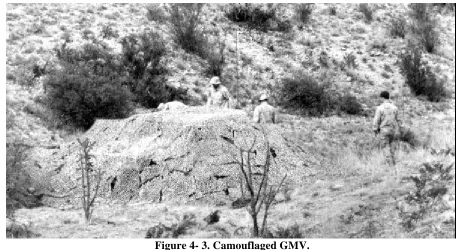
The laager site does not necessarily resemble a circle. The terrain and vegetation play a role in
6
locating each vehicle. All four vehicles may be placed in the perimeter if necessary, but normally the
7
detachment commander’s vehicle (number two) is located in the center of the laager site. This
8
formation resembles a triangle and allows a greater arc of fire if attacked.
9
When selecting and preparing an SF mounted detachment’s laager site, the priority is concealment,
10
remaining undetected, and if compromised, breaking contact rapidly, not to fight the enemy and hold
11
terrain. The detachment camouflages and positions its vehicles with this thought in mind (see Figure
12
4-3).
13
[image:27.612.84.542.321.571.2]14
Figure 4- 3. Camouflaged GMV.
15
The detachment may have to occupy the laager site for more than one period of daylight. Such an
16
occupation is most common when the detachment needs to wait for more advantageous weather or
17
light conditions before moving, has deployed a dismounted element on a mission and must remain in
18
the area, or in a situation where extensive repairs must be made before resuming the mission. When
19
occupied for more than one period of daylight, additional tasks include—
20
• Enhancing early warning measures.
21
• Improving continuously defensive positions (to include defensive minefields as necessary).
• Conducting recons and establishing surveillance of the area.
1
Upon vacating the laager site, the detachment sterilizes the site as much as possible to deny the
2
enemy intelligence on the detachment laager site or its operations.
3
Terrain limitations may not allow positioning of the detachment with multiple bug-out routes and still
4
properly conceal the vehicles. Give priority to concealing the detachment, even if it reduces its
5
potential evacuation routes.
6
IMMEDIATE ACTION/REACTION DRILLS
7
In a worst case scenario, the detachment will find the enemy at a time and place that is most
8
advantageous to the enemy. To counter this threat, the detachment moves at night using routes that
9
will allow the best chance to remain undetected. Despite these precautions, the detachment must be
10
prepared should it make contact with the enemy. It prepares itself for contact by keeping the weapons
11
systems manned, keeping vehicle interval, and maintaining movement discipline. The detachment
12
will rely on making contact with the smallest element (one vehicle). This action allows the rest of the
13
detachment to fire and move in support of the lead vehicle.
14
The detachment can increase its ability to avoid compromise by using vehicle-mounted thermal
15
imagers during halts and individual NVGs during movement. Without stabilizers or gyroscopes, the
16
long-range thermal imagers are normally ineffective during movement. Use infrared (IR) lights only
17
when necessary. More and more countries have IR capabilities and the IR headlight shows up like a
18
spotlight under IR.
19
Making contact at night, even under the best of illumination, makes it difficult to determine the
20
number of enemy involved. During unexpected enemy contact, the detachment seeks to break contact
21
and place as much distance between itself and the enemy as the terrain and light conditions allow.
22
Detachment SOP and experience will establish immediate action drills (IADs). Generally, the most
23
effective way to break contact is to bound away from the enemy in pairs. Other methods include—
24
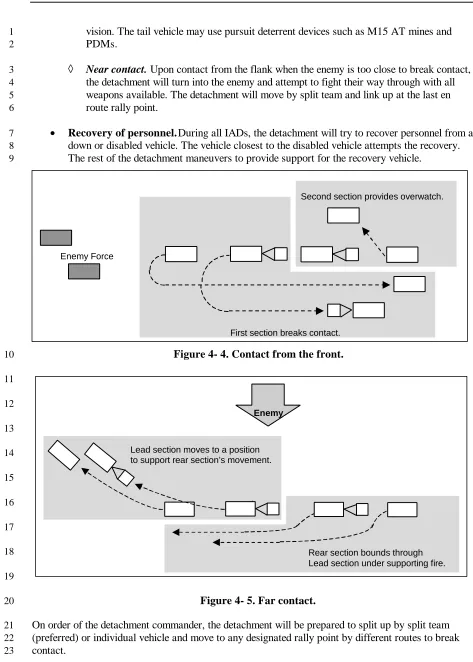
• Contact from the front or rear (Figure 4-4, page 4-9). Normally the lead or tail vehicle will
25
make contact first. The contacting vehicle will immediately engage the enemy; the other three
26
vehicles will move to the sides in the direction of movement and engage the enemy. The
27
contacting vehicle will maneuver in the opposite direction passing through the detachment.
28
As the contacting vehicle moves past, each vehicle will engage the enemy then maneuver and
29
follow; the last vehicle will continue to engage the enemy enhancing the break of contact.
30
The last vehicle will also deploy smoke grenades to hinder the enemy’s night vision. The tail
31
vehicle may employ pursuit deterrent devices such as M15 antitank (AT) mines and pursuit
32
deterrent mines (PDMs).
33
• Contact from the flank near and far. The detachment is not designed to engage in decisive
34
firefights with the enemy, so again breaking contact is desirable. The detachment must use
35
the mobility and speed of the GMV in moving to avoid observation and therefore enemy fire.
36
◊ Far contact. Upon contact from the flank (Figure 4-5, page 4-9), all weapons systems
37
will engage the enemy with as much fire as possible. The vehicle in contact will
38
maneuver in the opposite direction passing through the detachment. As the contacting
39
vehicle moves past the detachment, each vehicle will engage the enemy then maneuver
40
and follow. The last vehicle will continue to engage the enemy enhancing the break of
41
contact. The last vehicle will also deploy smoke grenades to hinder the enemy’s night
vision. The tail vehicle may use pursuit deterrent devices such as M15 AT mines and
1
PDMs.
2
◊ Near contact. Upon contact from the flank when the enemy is too close to break contact,
3
the detachment will turn into the enemy and attempt to fight their way through with all
4
weapons available. The detachment will move by split team and link up at the last en
5
route rally point.
6
• Recovery of personnel. During all IADs, the detachment will try to recover personnel from a
7
down or disabled vehicle. The vehicle closest to the disabled vehicle attempts the recovery.
8
The rest of the detachment maneuvers to provide support for the recovery vehicle.
[image:29.612.58.531.47.709.2]9
Figure 4- 4. Contact from the front.
10 11 12 13 14 15 16 17 18 19
Figure 4- 5. Far contact.
20
On order of the detachment commander, the detachment will be prepared to split up by split team
21
(preferred) or individual vehicle and move to any designated rally point by different routes to break
22
contact.
23
Second section provides overwatch.
First section breaks contact. Enemy Force
Enemy
Rear section bounds through Lead section under supporting fire. Lead section moves to a position
LAAGER SITE REACTION DRILL
1
When initially setting up in a laager site, the detachment ensures that camouflage nets are set up to
2
facilitate rapid takedown or drive away ability. The commander/operations sergeant establish two
3
different directions for emergency evacuation (bug-out), ensure the bug-out routes are at least 120
4
degrees from the laager entry site, and that all personnel are aware of the routes and any bug-out
5
emergency or contingency plans.
6
When the detachment is laagered, it is in its most vulnerable position. Preparing all the vehicles to fire
7
and maneuver rapidly from their positions with little or no loss of equipment must support actions in
8
case of compromise of the laager site.
9
The detachment should be prepared to vacate the laager in a violent but orderly manner at all times.
10
Detachment members always store equipment that is not being used.
11
The diamond formation is the most used method to vacate the laager hastily in case of enemy attack.
12
The lead vehicle chooses the route and leads the other vehicles, while the other three vehicles engage
13
enemy targets.
14
PATROL FERRY MISSIONS
15
Mounted detachments can be used to move personnel and/or equipment in and out of the operational
16
area. After moving the personnel and/or equipment, the mounted detachment can linger in the AO to
17
support the advanced operational base (AOB) or FOB in—
18
• UAR.
19
• Exfiltration.
20
• Airborne operations.
21
• Establishing caches for future operations.
22
Planning considerations for ferry missions include—
23
• Isolating the mounted element with the dismounted element to preclude any difficulties in
24
planning the mission to include routes, procedures, reaction drills, and contingencies.
25
• Giving the mounted element and its navigator deciding authority on routes.
26
• Assigning control over the dismounted element being ferried to the mounted commander.
27
• Ensuring the mounted element does not cross the forward edge of the battle area (FEBA)
28
multiple times with dismounted elements. Such actions increase the chance of detection.
29
• Not tasking the mounted element with DA missions close to the dismounted operation zone
30
when supporting dismounted infiltrations so as not to draw attention.
COMMUNICATIONS
1
When occupying a laager site for an extended period, set up an internal communications net using
2
field telephones. This net reduces the signature of foot movement and radio communications.
3
Use secure frequency modulation (FM), with frequency hopping on low power, communications
4
between vehicles or between mounted and dismounted elements. Such communications will decrease
5
the range of the radio systems used, but they will hinder the enemy’s ability to detect and compromise
6
the detachment.
7
Mounted and dismounted detachments can use short-range, high frequency (HF) transmissions using
8
International Morse Code or burst devices. These transmissions increase the range of
9
communications, but are often difficult to establish or maintain. Again, use codes and maintain
10
brevity to prevent enemy detection.
11
The detachment will need to make long-range communications during its mission. If it must
12
communicate with the FOB at night during movement, it will set up and establish a perimeter as
13
described above and communicate as rapidly as possible. The best time to communicate with the FOB
14
is after the detachment finishes its night movement, establishes a laager site, and camouflages all
15
vehicles.
Chapter 5
1
Motorcycle Section Employment
2
The use of motorcycles in military applications is not new. With the advent of light
3
forces and mounted reconnaissance teams, motorcycles have proved useful as
4
advance scout elements for mounted elements. U.S. SOF, British, and Australian SAS
5
employ motorcycles in their mobility troops (Figure 5-1).
6
[image:32.612.68.541.111.690.2]7
Figure 5-1. 5th SFG(A) Operating motorcycles in Nevada.
8
GENERAL
9
The motorcycle element provides the detachment a highly mobile and rapid capability to do—
10
• Route reconnaissance. It provides early warning and reconnoiters questionable sections of the
11
intended route.
12
• Area reconnaissance. It reconnoiters small or large areas rapidly.
13
• Point reconnaissance. It locates surveillance sites, laager sites, or communications sites.
14
• Surveys of contaminated areas. It determines the extent of nuclear, biological, and chemical
15
(NBC) contamination.
• Transportation tasks. It transports small amounts of equipment or su