A hallmark of the literature base in the fields of organisational behaviour, theory and psychology over the past couple of decades has been the constant stream of publications on change and organisational change – to the extent that more than a million publications had appeared in scientific journals by the mid nineties (Van de Ven & Poole, 1995). On closer inspection it is evident that the bulk of the change literature resides within the so-called “change management” domain – referring to attempts at planning, introducing, facilitating and managing change initiatives or programmes in organisations (Bamford & Forrester, 2003; Van Tonder, 2004). This indicates that attempts to deal with change in organisations, as a topic of interest, have not yet been exhausted. The reason for this is suggested by the dismal success rates2 recorded in respect of planned change initiatives. i.e. attaining the change objectives within established cost parameters and with minimal disruption to operations. Indeed, failure rates of the order of between 65% and 75% are consistently recorded for most forms of major organisational change initiatives (Beer & Nohria, 2000; Grint, 1998; Mourier & Smith, 2001), including reorganisations(Ross, 1997), downsizings (Henkoff, 1990; Skilling, 1996), improvement programmes and initiatives (Pascale, Millemann & Gioya, 1997; Schaffer & Thompson, 1992), mergers and acquisitions (Balmer & Dinnie, 1999, Gilkey, 1991). It is equally widely acknowledged that the cost of institutional transformation or organisational change (regardless of how it is conceptualised) is exceedingly high (cf. Smith 1995) and, while the financial consequences of unsuccessful and poorly planned and executed change initiatives are difficult to calculate, they are commonly accepted as being substantial. Even in those rare instances where change initiatives are likely to be considered more successful, there will still be undesirable side effects or unintended consequences (Applebaum, Henson & Knee, 1999; Schein, 1985) and consequently an inevitable downside to the change (Armenakis & Bedeian, 1999). If we then contrast the reported failure rate of change initiatives with the financial investment in these initiatives, we have little choice but to follow Stuart (1996) and question the value of these initiatives. At the same time it has to be acknowledged that the underlying causes of this disturbingly high failure rate are multifaceted and not easily disentangled from the organisational context.
Part of the dilemma however is to be found in this overriding focus on “change management”. “Change management” both as a phrase and an organisational practice does not adequately recognise and distinguish between (in fact confuses) the objective phenomenon or factual reality of change, the mediating effect of managerial intervention or non-intervention (change managementin the traditional sense) and employees’ subjective experience of the change (which is substantially informed by the latter). It is submitted that the high failure rate of organisational change initiatives is based, to a sizeable degree, on the inability of change agents and managers to adequately acknowledge and differentiate between these phenomena in organisational settings. This distinction (or non-distinction) will directly impact on the manner in which the organisational change is conceptualised during the early stages of the initiative and how it is subsequently planned, implemented, and “managed”. Of course the situation is not remedied by the tendency of managers and practitioners to cling to traditional/established change management views and practices (cf. Collins, 1996; Nortier, 1995). Naturally this will perpetuate the prevailing perspective rather than shifting focus to embrace alternative and more relevant perspectives on change. Research on change, likewise, has not been very helpful in persuading the manager and/or practitioner to shift focus and has been criticised by Pettigrew (1988, 1990) for its remarkable lack of theory, and the absence of a process orientation and a wider contextualism – which essentially indicates very myopic and largely unsubstantiated conceptual perspectives on the phenomenon of change. The treatment of organisations and change is indeed “… surprisingly non-theoretical” (Collins, 1998, p. ix).
Against this context, the questions that prompted this review are concerned with the manner in which organisational change is conceptualised and, secondly, whether this conceptualisation is essentially stable given the continuously evolving temporal context in which it is construed.
The purpose of this paper then is to present a time-based perspective on the conceptualisation of organisational change and to articulate the implications, if any, for organisational change practices. To this end the discussion commences with a consideration of change in terms of the taken-for-granted concept of organisation. This is followed with an account of
CL VAN TONDER
1Department of Human Resources Management Rand Afrikaans University
ABSTRACT
Change and organisational change are some of the most discussed topics of our time. Yet despite this, reported success rates for major organisational change initiatives remain exceptionally poor. Part of the problem is that contemporary change management practices assume a stable, unidimensional concept of organisational change. By contrast an analysis of organisational and systems thinking over the past five decades or so reveals an evolving concept of organisation and consequently invalidates the assumption of organisational change as a stable unidimensional concept. The evolving character of organisational change and its implications for change management practices are briefly indicated.
OPSOMMING
Verandering en organisasieverandering is van die mees besproke onderwerpe van ons tyd. Ten spyte hiervan bly die gerapporteerde sukseskoers vir primêre organisasieveranderingsinisiatiewe buitengewoon swak. Deel van die probleem is daarin geleë dat kontemporêre veranderingsbestuurspraktyke die aanname maak dat organisasieverandering ’n stabiele, een-dimensionele konsep is. In stryd hiermee toon ’n ontleding van organisasie-en sisteemdorganisasie-enke oor die afgelope vyf of so dekades egter ’n ontwikkelorganisasie-ende konsep van organisasie wat gevolglik die aanname van ’n stabiele en een-dimensionele organisasieveranderingskonsep ongeldig verklaar. Die ontwikkelende karakter van organisasieverandering en die implikasies daarvan vir veranderingsbestuurspraktyke word kortliks aangedui.
THE MARCH OF TIME AND THE “EVOLUTION” OF CHANGE
Requests for copies should be addressed to: CL van Tonder, Department of Human Resource Management, RAU University, PO Box 524, Auckland Park, 2006
41
1 The helpful comments of two anonymous reviewers are gratefully acknowledged
change from a systems perspective – in particular as systems thinking has been and still is an influential governing mindset when it comes to theories of organisation. In the final instance the importance of an appropriate and relevant conceptualisation of organisational change in relation to a changing, time-based, macro context is indicated and the implications for organisational change practices that arise from this are highlighted.
Current conceptualisations of change and organisational change
As a point of departure consider for example the manner in which change is conceptualised in the following (random) selection of change definitions, which tend to direct and inform (at least at a scholarly level) the manner in which change is conceptualised.
In what can be considered a classic view, Lewin (1951) equated change to a sequence of activities that emanate from disturbances in the stable force field that surrounds the organisation (or object, situation, or person). More recently change has been described more simplistically as making or becoming different (Eales-White, 1994) or as a phenomenon of time where something over time turns into something else (Ford & Ford, 1994). We could also consider it, as Skilling (1996) does, as something (old) that stops and/or something (new) that starts at a specific point in time or, from Van Tonder’s (2004) perspective, as a dynamic, time-bound, and non-discrete process evident in an empirical differencein the state and/or condition over time, of the entity with or within which it occurs.
While most current conceptualisations of change appear to diverge (somewhat superficially) in terms of where the emphasis is placed (e.g. the motion element of change, its process character, the outcome or end result of change, the role of context, etc.) a significant degree of convergence in terms of content is observed i.e. the process nature of change, the central role of time, and the notion of manifest differences in pre- and post change conditions or states. As general statements of change these definitions are probably equally appropriate to studies of change within organisations (and any other systemic entities).
If we then turn to organisational change, we find that earlier definitions tended to differentiate between different types of organisational change for example Ackerman (1986) who proposed that organisational change could take the form of developmental change, transitional change, and transformational change, or Nadler and Tushman’s (1989) conceptualisation of organisational change in terms of tuning, adaptation, reorientation (also referred to as frame-bending change) and recreation (also referred to as frame-breaking change). Although the fixation on the type of change has been criticised, a great many change typologies emerged from the mid 1970s to 1990s3, but very few of these could be
regarded as organisational change proper, as they did not clearly identif y the organisation as a primary and distinctive context for the change phenomenon. Moreover, while elements of the true character of organisational change could be extracted from the typologies that validly claimed to deal with organisational change per sé, these typologies did not articulate the essential character of organisational change. We consequently find that definitions of organisational change often were no different from general definitions of change (“generic change”). Furthermore, while the vast majority of these concept ualisations (or rather t y pologies) lacked empirical support, “type” change persisted into current perspectives on change (see for example continuous and discontinuous change, radical change, evolutionary and revolutionary change, transformational change, and many more – Van Tonder, 2004). It is noteworthy, however, that where a distinction between change types is the focus of the
definitional effort, that this would t y pically (and unfortunately) occur at the cost of a clear articulation of organisational change proper.
More contemporary perspectives on organisational change describe it, for example, as an initiative that alters critical organisational processes which, in turn, influence individual behaviours, which subsequently impact on organisational outcomes (Porras & Silvers, 1991) or as a dynamic process concerned with the modification of patterned behaviour (Kanter, Stein & Jick, 1992) and again as an empirical observation of difference in the form, quality, or state over time, in an organisational entity (Van de Ven & Poole, 1995). While many more definitions can be extracted from the literature, contemporary definitions of organisational change largely echo the core elements of generic change definitions introduced earlier. The example provided by Van de Ven and Poole (1995) more closely matches these generic definitions but differentiates organisational change with the addition of the term organisation, which immediately contextualises the change. Though these definitions reflect slightly more variation in the manner in which they are articulated, fundamentally, they do not deviate from the core content of generic change definitions referred to earlier.
The observation that changeand organisational changeare more frequently discussed in general rather than specific terms is also not surprising. Change is essentially intangible, invisible, and de facto inferred from the altered state or condition of some object/phenomenon over time (i.e. a process). Our conceptualisation of change is further complicated by the fact that change unfolds at different levels of abstraction – often simultaneously (cf. incremental and deep change – Quinn, 1996; or Alpha versus Beta and Gamma change – Golembiewski, Billingsley & Yaeger, 1976).
The organisation as defining context for change
When we compare definitions of change and organisational change, we observe that organisational change, in character, is no different from change except that the latter is now context ualised by the term “organisation”. The phrase “organisational change” inextricably ties the understanding of change into the pre-existing meaning that the concept “organisation” holds for the reader. It may be a glaring statement of the obvious but it remains a seldom-acknowledged reality that organisational change cannot be adequately conceptualised without first comprehending the phenomenon “organisation”. Indeed, change with and within the organisation is substantially defined by what an organisation is (Van Tonder, 2004). Against the context offered by the brief account of change definitions, it is difficult to conceptualise organisational change as anything other than a difficult-to-reif y phenomenon – despite it regularly being labelled as “organisational structuring” or “organisational downsizing” or “strategic repositioning” and the like. It is precisely herein that the problem lies: organisations, although clearly differentiated by distinctive “labels” and corporate identities, are considered sufficiently similar to validate the phrase “organisational change” and most if not all change practices are construed around this very general conceptualisation of change. The fallacy of this approach is immediately apparent when we are requested to advise on or, even worse, initiate a programme to manage revolutionary change within a large localised utility compared to an international information technolog y company. The definition of revolutionary change for these two institutions will differ markedly in terms of the nat ure of the “revolution”, the speed at which the change is unfolding, the perception of time within which the organisation can act/react, the impact and likely consequences of the revolution, and so forth. For these t wo companies an appropriate response to change would, similarly, have very little in common.
Despite this reasoning and the obvious differences implied by the terminology employed to describe different “types” of organisational change, approaches for effectively dealing with change in organisational settings, inevitably reduce “type” change to the generic expressions organisational change and change management. As a result we are once again back to articulating change in a manner that is aligned with definitions such as those provided earlier i.e. a non-specific process phenomenon that is not time-bound (compare commonalities among definitions formulated at different nodes in time). This holds true also for organisational change. Implicit in views such as these, is the assumption that the organisation (as a context for change) does not change sufficiently to warrant a reconceptualisation of the phenomenon of organisational change. Despite the obvious variance among organisations, there is very little indication that the concept of “organisation” is problematic and that it warrants greater attention. The term organisation is in fact seldom viewed as anything other than a universal “context” for all forms of change occurring within organisations.
When approached from a holistic viewpoint, the organisation as subject is an expansive topic characterised by multiple divergent research perspectives, even within disciplines. Consider, for example, that the term “organisation” was noticeably absent from prominent American sociological journals for a period spanning at least 52 years and only started appearing after 1960 (Aldrich & Marsden, 1988). Our sense of ease with the notion “organisation” is demonstrated by Sandelands and Srivatsan’s (1993) observation that of 85 organisational studies appearing in the Administrative Science Quarterly over the period 1986 to 1990, which contained more than 204 000 references to the term “organisation” only two studies suggested that the notion of “organisation” could be empirically problematic. These observations merely illustrate the widespread, uncritical acceptance of the notion “organisation”, which in turn is anchored in the commonly held yet tacit belief that the concept “organisation” has a universal and rather stable meaning as a construct. It would be reasonable to conclude, as others do (Burrell & Morgan, 1979; Sadler, 1995), that organisations are largely taken for granted. Understandably our concept of organisational change will, similarly, assume a universal character that is seldom subjected to scrutiny - more so in the here-and-now concrete reality where practitioners and line managers engage change while it unfolds. When scholars and practitioners engage the phenomena of organisation and organisational change they do so under the influence of the prevailing temporal and contextual setting. Moreover, when a time-sensitive analysis frame which extends beyond the immediate short-term, is adopted, several indicators of continuous evolution in the meaning of organisation and consequently organisational change, are revealed. The first indicator of such evolutionary shifts in the meaning of the concept organisationis observed at macro scale i.e. in the era-shift from modernism to postmodernism.
Era change
Modernismand postmodernismhave been used as terms to refer to successive aesthetic and intellectual movements (e.g. Giddens, 1990). Modernism took shape around the 1920s, initially as an artistic movement (Hassard, 1993) but later assumed a more pervasive general character. Postmodernism, in turn, has been described as a new phase (Goulding, 2000) or a new paradigm of thought, which followed the age of modernity (Takala, 1999). The shift from modernism to postmodernism has been described more simplistically as a pervasive global and era change that impacts on societies, cultures and organisations (Van Tonder, 2004). The transition from the modern to the postmodern eras seemed to commence around the 1930s and peaked during the 1960s whereafter postmodernism gradually assumed a position of dominance over modernism (Berner &
Van Tonder, 2003). Era change as manifest at the societal level has been described by Van Tonder (1999) as a shift from industrialisation and mechanisation informed by science and economics (modern society) to an information and technology-based society characterised by extensive, rapid and complex change (postmodern society). This transition shows up more visibly in the successive yet distinctly different generations that have emerged over the past seven decades or so (with their different consumption profiles), and the more recent appearance of the so-called “new paradigm” organisations (cf. Berner & Van Tonder, 2003).
“New paradigm” organisations reif y the postmodern organisation and include substantially altered concepts of organisation such as the virtual organisation (cf. Chesborough & Teece, 1996; Nohria & Berkley, 1994), the post-bureaucratic organisation (cf. Hecksher, 1994; Krackhardt, 1994), the 21st
century organisation (cf. Benveniste, 1994), the networked organisation (cf. Biemans, 1996; Galbraith, 1998), and many others. The emergence of these “new paradigm” organisations is perhaps one of the more obvious indicators of the pervasive trickle-down effect of era change. When viewed from within an extended timeframe we witness a transition from the modern organisation, which was essentially characterised by rationality, hierarchical control, efficiency, highly differentiated structures and a view of employees as cost factors (the bureaucracybeing the classic form) to the postmodern organisation some six decades later. The postmodern organisation in turn is characterised by flatter structures, a substantial reduction of hierarchical control in favour of self-management, greater flexibility, informal relations, open access to information and executives, and a view of employees as stakeholders or partners (Berner & Van Tonder, 2003).
Organisational change construed from the perspective of era change clearly conveys an evolving character. The modernist era gave rise to a notion of change that is aligned with Newtonian concepts of the world, science, economic progress, and instit utional development i.e. essentially rational, linear, predictable and consequently controllable (cf. Van Tonder, 2004). The emergence of the postmodern era on the other hand signifies a concept of organisation and organising that emphasises inter-connectivity, interdependence, and consequently complexity, from which a more f luid, intuitive, time-paced and less predictable notion of change emerges. Postmodern change is more nat uralistic and free f lowing and from an organisational perspective an effective response to change would be largely reliant on attempts at creating meaningful order from information “chaos” (sense making) – more often than not, at a preconscious level. Having said this, most organisations are still trapped in a modernist fold which are evidenced in the prominence of modernist marketing and research paradigms (Arias & Acebrón, 2001; Berner & Van Tonder, 2003; Dawes & Brown, 2000) which suggest that contemporary notions of organisation and organisational change are simply a perpetuation of a traditional and stable concept of organisation – in this instance that of the very rational and structured modernist concept of organisation – despite the developing postmodern marketplace and the steadily increasing number of postmodern consumers.
The shifts in the meaning frame of “organisation” over time are in fact finer and more pronounced than may be readily apparent from the rather crude comparison of modern and postmodern eras. Once again, when an expanded time perspective is adopted, clear paradigmatic shifts are also visible in the evolution of managerial and organisational thought.
innovation characterised the evolution of organisation theory. The different emerging schools of thought were, in effect, reactions to the inherent inabilities of the preceding schools.
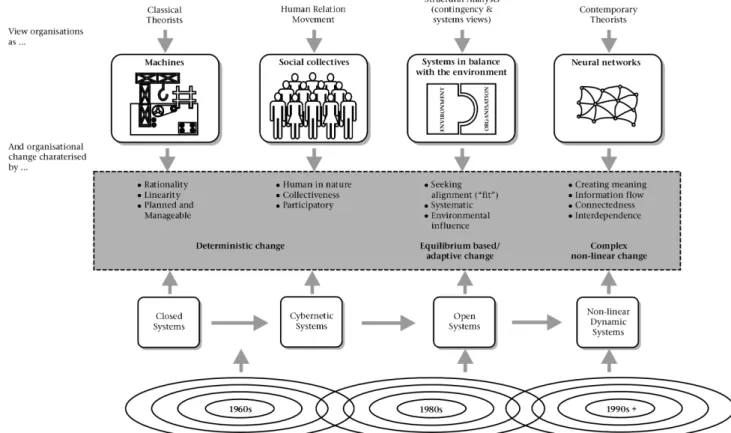
From the Newtonian paradigm of science, which viewed the universe as giant clockwork mechanism that was infinitely predictable, the school of organisational thought referred to as the Classical Theorists, emerged. TheClassical Theorists, generally included Scientific Management, Taylorism, and Max Weber’s Bureaucratic School, and t y pified the organisation as a machine that was capable of acting with precision, speed, and efficiency. A notion of organisational change that is linear and predictable (deterministic) emerged from this period and its substantial and pervasive influence is still evident today in the dominance of planned change initiatives such as strateg y crafting, organisational restructuring, etc. (see Table 1).
For their inability to acknowledge the role of the human factor, the classical theorists’ views were eventually superseded by those of the Human Relations Movement, which incorporated the contributions of Elton Mayo and the Hawthorne studies, Chester Barnard and later Maslow, Lewin, Herzberg, and others. It was largely a reaction to the dehumanising machine concept of organisation. Organisation theories falling within the ambit of this school of thought consequently shifted the emphasis to the importance of addressing the social and psychological needs of employees. With organisations largely conceptualised as social collectives, organisational change from within this perspective was essentially conceptualised as a socially enabled phenomenon i.e. change is fundamentally human and participative, and would occur when the social collective asserted its influence (power). In its simplest sense it would be reasoned that for the “machine” to change, one needed to change the people (the social collective).
With the implicit success formulae of the preceding schools of thought (both subscribing to the functionalist philosophy of one-best-way to organise and manage) proving less effective in the face of an evolving operating environment, the Structural Analysts(also referred to as the Early Modernists) emerged as a dominant school of thought. Included here were those theories that emphasised the importance of the environment and the inability to divest the organisation and its functioning from its operating environment. Proponents argued that there were no single best way of structuring organisations and demonstrated a greater awareness of the interdependencies between the organisation and its environment (for example the systems and contingency approaches). From within this perspective the importance of information, power, and conf lict was recognised. Organisational change, similarly assumed a different character. It was no longer conceived as a rational, planned phenomenon absolutely within the control of the managers of machines, or as a participative phenomenon absolutely controlled by the social collective, but it was now construed as a systemic phenomenon dependent on changes within the larger environmental system, and generally less amenable to control by managers or social constituencies within the organisation.
The structural analysts eventually made way for what could be referred to as the contemporary theorists. Contemporary theorists operated in a timeframe that became known as the period of paradigm proliferation, as it was characterised by the emergence of new and diverse theoretical perspectives on the nature of organisation and a rapid growth in non-traditional approaches (Hassard & Pym, 1990; Turner, 1990). It was largely a reaction and a response to the enduring reign of functionalist thinking and theorising that was evident in the schools of thought leading up to and including the Structural Analysts. The functionalist view of the organisation as a rational, controllable entity (see discussion elsewhere in this paper), was considered outdated (Turner, 1990) and was instrumental in the
rise of the contemporary theorists. At the same time contemporary theorising coincided with, but was also informed and sustained by the rise of postmodern thinking and was characterised by more organic and often more micro models (and metaphors) that attempted to recognise the role of culture, symbolism, conflict, action, organisation identity and more recently, chaos and complexity (non-linear dynamics) which consequently gave rise to the currently popular neural network models of organisation. To a varying degree these perspectives selectively emphasised that organisations were entities that needed to adapt to increasing complexity in operating environments, but in particular also needed to adapt to increasing complexity in their internal dynamics – an aspect somewhat neglected by contingency approaches. Organisations now had to contend with competition, secure scarce resources (while recognising the role of transaction costs and unscrupulous agents), and so forth.
This proliferation of diverse conceptualisations of organisation brought with it a new sense of freedom to study any and all aspects of meaning within and relating to organisations (Stern & Barley, 1996; Turner, 1990). The latter led to, among other, cross-disciplinary forays (for example into evolutionary biology and quantum physics) in search of alternative, more precise and meaningful conceptualisations of change (for example Gersick’s, 1991 comparative study of change in six disciplines). Van de Ven and Poole (1995) for example argued that this quest for understanding the how and why of organisational change was key to understanding management scholars’ borrowing of concepts, theories, metaphors, and perspectives from a variety of disciplines beyond their own.
Organisational change from the perspective of the contemporary theorists consequently shed its dominant, unidimensional character (as per previous periods in the evolution of organisational thought) in favour of multiple alternative concepts of organisational change (Table 1). Several prominent research traditions in respect of organisational change emerged from this diverse array of perspectives on organisational change and, for the scholarly attention that these research traditions commanded, it was argued that they could be considered change paradigms in their own right (Van Tonder, 2004). These change paradigms included conceptualising organisational change as a population or species phenomenon i.e. organisational evolution through variation, natural selection and retention (ecologically-informed organisational change following from the organisation ecology perspective of which Hannan and Freeman, 1977, 1984; were the leading proponents). The locus of control for change was located in the environment and organisations had little or no control over change. The emergence of smaller, more agile and responsive organisational forms and their continued existence in a hyper-competitive environment would for example be interpreted as an illustration of organisational change as evolution (variation, natural selection and retention).
referred to as life cycle-bound change(refer for example to the classical work by Greiner, 1972, 1998; and, for a thorough review of the literature, Van Tonder, 1999). The fourth and currently an exceptionally popular meta-perspective on organisational change, is concerned with naturalistic change that follows from a neural network concept of organisation i.e. organisations change as a result of tacit changes in the development and alteration of collectively held meaning (change in organisational cognitions or schemata referred to as organisation-le vel cognition change). The somewhat impoverished concept of organisational learning (Argyris & Schön, 1996; Dixon, 1999) is central and illustrative of this preconscious form of organisational change but notions of social cognition (Gioia & Sims, 1986) and sense making (Weick, 1995) provide further perspective.
Unlike the preceding schools of thought, no single dominant notion of organisational change can be discerned from the perspective of contemporary theorists, which is understandable as most of these micro-theories on organisation in themselves represent somewhat narrow perspectives that are in need of further elaboration and development (Van Tonder, 1999). An array of often-contradictory change concepts and typologies emerged from this period of prolific theory generation, for example alpha, beta and gamma change, continuous and discontinuous change, incremental and deep change, radical change, first-order and second first-order change, evolutionary and revolutionary change, Type I and Type II change, complex change, dialectic and trialectic change, and many more4.
This proliferation of diverse, micro theories of organisation since the mid 1970s made it increasingly difficult to establish an integrative and coherent perspective on the development of organisation theory. In an effort to simplif y and aid the analysis of this steadily increasing and wide range of social theories Burrell and Morgan (1979) developed a meta-framework consisting of four mutually exclusive sociological paradigms – each with its distinct view of the social world and own set of assumptions with regard to the nature of society, science, and by implication (most importantly) organisations. The authors contended that these four paradigms, when viewed together, provide an adequate context within which to locate all social theorists and therefore organisational theorists. The theories characteristic of the different paradigms view and portray the social world in different ways and, consequently, enable the researcher to see and comprehend the nature of organisation in very different ways (Morgan, 1990). There is obviously merit in the argument that classification in accordance with the four sociological paradigms tends to oversimplif y complexities and ignore the tensions and variations within each of the orientations (Dovey, 1989), but the value of the paradigm framework for purposes of this discussion outweighs these criticisms – particularly as it provides the opportunity to consider the historical ebb and flow of theory development from a different perspective. As a consequence a useful window on the alternate con-cept ualisations of organisation and by implication, organisational change, is opened on this multifaceted period in the development of organisational theory (the contemporary theorists).
TABLE1
DOMINANT CHANGE CONCEPTS EMERGING FROM DIFFERENT TIME-BOUND PERSPECTIVES ON THE NATURE OF ORGANISATION
Schools of thought and their depiction of organisation … Concept of organisational change
CLASSICAL THEORISTS(± 1900-1930)
Depicted organisations as rational systems that operated in as efficient a manner Organisational change is rational and functional. It conforms to known as may be possible. Organisations were mechanistically structured and parameters (is logical and linear) and consequently amenable to analysis and characterised by speed, precision, reliability and efficiency, division of labour, manipulation i.e. predictable and controllable. Contemporary change hierarchical supervision and detailed rules and regulations. management philosophies entrench (are biased towards) this view of change.
HUMAN RELATIONS MOVEMENT(±1930-1960)
Depicted organisations as human co-operative systems or social communities, Organisational change is a social phenomenon i.e. anchored in human which will function optimally if the social needs of employees are integrated in, interactivity and leveraged through participation and democratic processes. Any and satisfied in the work situation. Organisations were consequently construed change is a function of the social collective The prominence of participation as participative and democratic entities that accorded a central role to the and involvement as key stages in contemporary change management employee (which was evident in leadership and work practices). practices reify this view of change.
STRUCTURAL ANALYSTS(±1960-1975)
Depicted organisations as systems embedded in a larger context/environment. Organisational change is an “adaptive” consequence of environmental change, Organisations were viewed as ongoing entities (processes), which had to adapt concerned with “fitting”/aligning organisational structure and complexity with to a changing environment in order to survive. As a consequence it displayed that required by the operating environment to a point where balance differences in form designed to deal more effectively with changing (equilibrium) has been re-established (for example the impact of technology environments. In essence there was no single best way of structuring development or legislative changes).
organisations for success.
CONTEMPORARY THEORISTS(±1975-current)
Depicted organisations in many different ways, for exampleas: Organisational change is, among other, a direct consequence of the prevailing Distinct species whose survival is dependent on the suitability of the circumstances and developments in the organisation’s environment; is gradual,
environment for the specific species (success is only possible for those predetermined, and unfolds as the organisation progresses through different organisations favoured by environmental circumstances) – Population stages in its life cycle; is born from competitive forces and a function of
Ecology perspective. resource munificence; is continuous, natural, non-repetitive, and a function Entities critically dependent on, and in need of resources which they of information flow across multiple interdependent organisational nodes
have to acquire and sustain in the face of competition, in order to survive. and consequently not amenable to control in the absolute sense. As a result of resource scarcity, only the fittest will survive – Resource
Dependence perspective.
Non-discrete entities that are shaped by wider societal norms and consequently develop new forms and relations with their environments to secure legitimacy (remain aligned for survival) – Institutional theory perspective.
Entities engaged in transactional interaction with its environment and continuously exposed to risk (e.g. at the hands of exploitative agents or managers) – Transaction cost and agency perspectives.
Complex systems e.g. networks consisting of a large number of constituting elements that are loosely or tightly coupled (linked), interdependent and for survival critically dependent on the rapid flow and processing of information necessary to remain “competitive” and survive in an increasingly global and “shrinking” operating context – complexity and non-linear systems perspective.
The functionalist approach (or paradigm), which served as the foundation for most theory and research on organisation, embraced the work of the Classical Theorists, the Human Relations movement, and to a lesser extent the Structural Analysts. Theories originating from within this approach effectively dominated the greater part of the history of organisational thought and occupied an untouchable position for virtually a half a century (Hassard, 1993; Power, 1990). Organisations were viewed for a significant period of time as an objective, visible and tangible yet problematic entity that operated in a manner similar to a machine i.e. in a cold, rational, and mechanical manner. The organisation as “machine” was constantly monitored for signs of inefficiency.
The interpretive paradigm, which includes for example organisational cognition and learning (e.g. sense-making) is a relative “newcomer” which, historically, has been relegated to a secondary role in organisational thought and theory, but since the onset of the paradigm proliferationperiod, has rapidly risen to prominence. This development shifted the approach of viewing organisations from a distance as an objectively constructed entity in the functionalist tradition to something that is subjectively constructed by “actors” (e.g. employees, managers, consultants, stakeholders) through the activity in which they engage on a daily basis and which, most importantly, are informed by the manner in which they think of, and experience the organisation. Organisations are now less defined and determined by their function and described more by interpretations of action. In the functionalist tradition the organisation is primarily a “tool”. In the interpretive tradition it is an “intention” of the collective organisational mind. In more exact terminology, organisations are viewed from
within the functionalist paradigm as concrete external realities and from within the interpretive paradigm as subjective personal constructs.
The radical structuraliststend to view the organisation as part of a larger power structure (i.e. an instrument) that is inherently designed to suppress or oppress. This it achieves largely through structure and structural relationships. The radical humanist paradigm, similar to the radical structuralist tradition, views the organisation as an area of conflict, but does so from a human perspective and not from an external and structural view. It argues that it is the social life (and not its structural features) that is prominent in the explanation of conflict and tension observed in organisations. Though offering useful perspectives both these paradigms did not generate the same degree of attention and energy as the functionalist and interpretive paradigms did.
Different philosophies and concepts of organisational change emerge from this paradigmatic framework (refer Table 2). The most obvious differences are visible on two primary axes:
A philosophy of avoiding or embracing change (functionalistand interpretative paradigms versus radical humanist and radical structuralist paradigms). Both the latter perspectives are predisposed to change but promote essentially reactive concepts of change, whereas the former are likely to construe change as proactive and within the organisation’s locus of control.
The fundamental nature and content of change as being human or structural in origin (interpretative and radical humanist paradigms versus functionalist and radical structuralistparadigms). In the former change is essentially subjective and socially constructed whereas the latter views it as an objective and externally constructed phenomenon.
TABLE2
CHANGE CONCEPTS EMBEDDED IN SOCIOLOGICAL PARADIGMS ON THE NATURE OF ORGANISATION
SOCIOLOGICAL PARADIGM VIEW OF ORGANISATION … CONCEPT OF ORGANISATIONAL CHANGE
FUNCTIONALISTparadigm
Concerned with the rational explanation of An organisation is depicted as a formal, empirical Organisational change is something that disrupts phenomena – attempts to understand society in a entity (can generate valid and reliable knowledge); internal order and stability, and consequently to be manner that generates useful knowledge (e.g. a problematic phenomenon; a problem of avoided – indeed to be managed to the point of providing practical solutions to practical effectiveness and efficiency; is structured and re-establishing stability and certainty. The very nature problems). It holds an objectivist point of view controlled to the point of effectiveness and of change is rational, functional and purposeful, and is regarded as the dominant framework and efficiency; can be translated into general principles predictable and consequently controllable and, foundation for the study of organisations and has against which managers and practitioners can generally devoid of human content. informed most theory and research on organisation assess current practice; minimise disruptive change
by creating adaptability, and organised change; focus on the here-and-now (status quo); is a web of ordered relationships, which is predictable and controllable; preoccupied with stability and certainty; views people as tools/resources.
INTERPRETIVEparadigm
Concerned with the world at a subjective level – as An organisation is depicted as activity; shared Organisational change originates from and is it is, and the basis/source of reality. It approaches meaning structures; managed through the perpetuated by human endeavour. The nature the world from the viewpoint of the participant management of meaning; symbolic in nature; a of change is tacit, subjective, and socially (and not that of the observer) and from within the socially constructed reality; more a result of constructed. The dominant change orientation is parameters of individual consciousness and members own actions than they recognise. the pursuit of stability (avoidance of instability
subjectivity. or change).
RADICAL HUMANIST paradigm An organisation is depicted as being constructed Organisational change is constantly embraced and Is concerned with theory that critiques the status by people; constrains human development; the dominant orientation is to depart from stability quo, and the release of the employee from the alienates its employees; must allow for the and order. Change is socially informed, reactive and a constraints brought about by existing social expression of humanness; must pursue the dominant human pursuit anchored in opposition and structures. It represents the inverse of the democratic ideal of restoring power to the resistance to the confines brought on by the functionalist paradigm employee; a manifestation of deep psychic functional nature of organisation. Change is a subtext
processes (as are activities and events); created for of all human endeavours. the people rather than the people created for
organisations; challenges the established order.
RADICAL STRUCTURALISTparadigm Concerned An organisation is depicted as consisting of Organisational change is a self-generated objective with structural relationships within a realist social structures with inherent tensions; is part of a phenomenon, often radical in nature, which is world, radical change and emancipation. It views larger societal context; and can only be understood embedded in the structural features and relations of society as consisting of fundamental conflicts in terms of its role in this context (and the the organisation and its environment. Change is arising out of societal structures and which give underlying contradictions which create tension constant and a preferred state arising from inherent rise to radical change and ultimately change); creates new organisations structural conflicts and contradictions i.e. dialectics is
The shift from a functional to an emerging interpretive paradigm implies that worldviews, theories and views of organisation, and most importantly, the understanding of change within organisations are changing. In essence more and more scholars and practitioners are beginning to view organisations and therefore change less as imposed, objective, structured, rational, and controllable phenomena, and more as fluid and subjective phenomena that are less amenable to manipulation.
The discrete paradigms that regulated scientific thinking about organisations demonstrate how the prevailing timeframe and environment, in which thought leaders were located, clearly influenced scholars and their conceptualisation of the organisation at the time. The environmental influences that shaped the evolution of organisation theory incorporated many “location-specific” factors such as economics and functionalism but in particular professional, cultural and political forces (cf. Shenhav, 1995).
When considered from an extended time-frame perspective, a view of organisation emerges that is not readily apparent from a reading of the specific time bound literature of organisation. If we distil the different conceptualisations of organisation from the preceding brief consideration of the evolution of organisational thought it is clear that an organisation has and can be a rational instrument of production, a social community, a system closely intertwined with the environment, and a distinct species. Yet, at the same time, and from the sociological paradigm perspective, it can also be construed as a formal, empirical, and/or problematic phenomenon, a symbolic structure of activity and meaning, a people institution that constrains human nature, and/or a structural entity characterised by conflict. As is evidenced from the analysis reflected in Tables 1 and 2, the dominant modes of organisational change differ significantly for each of these concepts of organisation.
Contemporary perspectives and the emergence of new, more agile and responsive forms of organisation (the “new paradigm” organisations) more visibly confirm this change in the nature of organisation over time. Evidence of an altered and indeed an evolving concept of organisational change is however also visible from other vantage points, with systems thinking one of the more prominent perspectives in this regard.
The evolution of systems thinking
With systems theory still considered in many quarters as the dominant theoretical framework for comprehending organisational dynamics (Stacey, Griffin & Shaw, 2000), it stands to reason that our understanding of the phenomenon organisationwould be incomplete without a brief comment on the nature of systems and how the application of systems theory aid us in our understanding of organisations as systems, and organisational (systems) change.
For the purpose of refreshing the reader’s perspective recall that an object or entity was thought of as a system when it was viewed in a holistic manner and consisting of parts or subsystems. Virtually all objects and entities were interrelated by virtue of a hierarchy of systems i.e. a system that consisted of subsystems (or parts) in itself formed a subsystem of a larger system which was referred to as a suprasystem. As a result of substantial interaction between the parts or subsystems, which exerted a reciprocal influence on one another, a system was considered to be substantially more than simply the cumulative addition of the various subsystems. It is this reciprocal influence-relationship among subsystems (parts) that elevated an entity to system status and allowed it to be conceived of as a whole – substantially beyond the sum total of its parts or subsystems5.
Systems theory has the advantage that it provides us with a macro level theory on the nature of organisation and a
systemic understanding of organisation-environment and within-organisation relations. If we furthermore consider that systems theory emerged during the early 1930s and is still prevalent some seven decades later, it is clear that it has remained relevant despite the march of time and changing concepts of organisation as evidenced in the evolution of organisational and managerial thought (discussed previously). This in itself suggests a systematic adaptive (and therefore evolutionary) development of systems thinking during this period of time – a fact born out by various accounts of the historical development of systems thinking. In this regard Stacey et al., (2000) for example indicated that the development of systems theory proceeded along the pathways of general systems theor y, cybernetic systems, and systems dynamics. The former focused on and highlighted the general features of systems for example the constant pursuit of equilibrium or homeostasis, the progression towards order and stability and in which the notion of boundaries is an important defining attribute of a system. Cybernetic systems are self regulating adaptive systems that are purposeful in their adaptation to the environment for example temperature control systems such as central heating and in fact most systems that monitor performance in accordance with a set purpose and introduces corrective actions on the basis of feedback. Qualit y management, performance management and reward systems, but also change management and cult ure change programmes are examples of such systems. Systems dynamics in turn views the relationship between the system and its environment as non-linear and recursive and draws on complex mathematical models. Unlike general systems and cybernetic systems, these conceptualisations of a system incorporate both negative and positive feedback, and because of the non-linear nature of the cause-and-effect relationship between the system and organisation it can produce unexpected and unintended outcomes.
Although systems thinking in an absolute sense is not discrete and essentially not confinable to equally discrete time periods, a natural progression in dominant systems concepts of organisation is nonetheless clearly discernable, initially as a closed systems theoryof organisation during the earlier stages of organisational thinking, followed by open systems theoryand more recently complex or non-linear dynamic systems (and chaordic systems– Hock, 1999). It is therefore a truly universal and macro theory that assumes the character of an interpretation frame (a paradigm from Kuhn’s, 1996, perspective), which in effect withstood the test of time by continuously allowing for altered views and concepts of organisation to emerge. It, in particular, enabled a progressively complex incorporation and depiction of the organisation-environmentrelationship
firstly from a “zero” or non existent relationship in a closed or cybernetic systems perspective (e.g. the “machine” concept of organisation or the organisation as “social collective”) to a significant open relationship with extensive interaction and transaction between the organisation and the environment (yet with change still largely controllable by the organisation), and
secondly, from the open transactional view to the more contemporary, all embracing and highly complex and non-linear relationship between organisation and environment (with substantially less control by the organisation).
Systems theory in its different time-based iterations has elevated our understanding of the organisation as an integrated whole yet has simultaneously revealed that the organisation stands in a reciprocal influence relationship with the environment, regardless of whether this is the immediate operating environment, its internal environment or a future strategic environment. The organisation is highly susceptible to the influence of its environment yet at the same time capable of exerting substantial influence on its environment
and in the process equally capable of modif ying it. Systems views of organisation have driven home a few core conclusions about the nature of organisational change such as the systemic character of change, the fact that change is not unidirectional, and the impossibility of divesting organisational change from environmental change.
The explanatory power of contemporary systems views, in particular non-linear dynamic systems, is far superior to earlier systems concepts of the organisation. The dominant feature of non-linear dynamic systems, is the existence of multiple interconnecting and non-linear relationships bet ween system components i.e. the phenomenon of complexity. As a result, multiple patterns of interaction can and do occur, and because of the high degree of interdependence, even minute changes or influences in a section of the system will influence and indeed stimulate or facilitate (activate) other interactions that are as yet unknown, and which in turn may lead to the emergence of new phenomena and other unintended consequences – often of a magnitude far removed from that of the minute “triggering” activity. Behaviour in this system is endlessly unique but is nonetheless ordered. Characteristically, the system is a unified whole (gestalt) emerging from the dynamic arrangement of connections between components.
Viewing organisations as complex systems of course has major implications for how we view change, which is substantially different from that which has been conceived from within the framework of Newtonian science. For one, change is no longer viewed as a gradual, manageable phenomenon that can be “switched on” or “switched off” when key officials or layers within the organisation elect to do so. In non-linear dynamic systems, the system is constantly moving (dynamic) i.e. the organisation is always in a state of change. Apart from change being one of the most prominent characteristics of the system, it is also discontinuous. With the exception of occasional brief periods of relative stability, change is essentially unpredictable and the consequences impossible to anticipate.
It is not our purpose to elaborate on the more detailed perspectives of the chaos paradigm and complexity theory in this discussion, other than to highlight how the conceptualisation of systems has evolved and with that, how organisational theorists and scholars’ conceptualisations of organisation and by implication organisational change have evolved. When we then contrast systems views of organisation with the evolutionary development of organisational and managerial thought distinct parallels are observed which convey a sequential meshing of progressively altered and more complex systems views of organisation over time. Systems theory surfaced most visibly during the Structural Analyst stage in contingency perspectives, which accorded a more pronounced role to the open and dynamic nat ure of organisation-environment relations (the open systems view of organisation – cf. Katz & Kahn, 1978; Schein, 1980). Careful inspection will reveal the tacit presence of a closed systems concept of organisation during the Classical Theorist stage when the (paradigmatic) machine metaphor dominated thinking on organisations. It can similarly be deduced with a reasonable degree of certainty that a cybernetic systemsconcept was prevalent in organisational mindsets during the Human Relations movement which, effectively, still accorded the environment a minimal inf luence in organisational functioning but recognised the importance of engaging (tapping into, and consulting) employees and in so doing creating internal feedback mechanisms to sustain desired levels of organisational performance. Contemporary Theorists, for example their neural network theories of organisation, more pertinently convey a view of organisations as complex, non-linear systems. Researchers in the social sciences were in fact quick to draw the parallel between organisations and complex or non-linear systems and it is now fairly common to view organisations as such (cf. Beeson & Davis, 2000; Dooley & Van de Ven, 1999; Maguire & McKelvey, 1999; Styhre, 2002; Sullivan, 1999).
The changing character of organisational change is perhaps most salient when we contrast the views of classical theorists and the closed systems view of organisation with that of
contemporary theorists and a complex systems view of organisation. Metaphorically speaking, this juxtaposes the organisation as machine in one instance against the organisation as neural network (or brain). In change terms this signifies a quantum leap in conceptualisation from what is termed deterministic change to complex non-linearchange. While deterministic change views organisational change predominantly as gradual, linear and rational, and hence a controllable phenomenon, contemporary perspectives convey a view of organisational change as an increasingly non-linear and consequently unpredictable, spurious, sudden and often a seemingly irrational phenomenon. If we consider these views of organisational change from within a definitional template, earlier views of organisation and organisational change, in an absolute sense, imply that an empirical difference in the condition or state of the organisation can be secured through systematic and consciously planned initiatives on the side of the organisation (what is often referred to as rational-purposive change). Contemporary views on the other hand, in an absolute sense, suggest that such an empirical difference in the condition or state of the organisation can occur without warning and at random i.e. cannot be predicted or controlled by the organisation. In truth organisational change seldom presents in the absolute sense and both deterministic and non-linear change have become stable features of the organisation. Recent examples of the sudden and/or catastrophic “demise” of institutions such as Saambou, Anderson, and Enron do however underscore the increasing frequency with which non-linear change is occurring in organisations.
Consolidation
This paper was introduced with the observation that the organisational change literature was heavily biased towards the very popular notion of change management, an area of scholarly interest driven by the pragmatic needs of day-to-day organisational change practices – in particular the dismal success rates reported in respect of planned/managed change. This is perhaps not too surprising as Pettigrew (1990) and others have observed that change research appeared to be lacking in the areas of theory, process perspective, and contextualisation. It was furthermore submitted that part of the dilemma was that three highly interrelated but nevertheless distinct change phenomena are “effectively” confused i.e. change as objective (empirical) phenomenon, the subjective human experience of change, and “change management” which refers to attempts by organisational representatives (mostly management) to mediate the relationship between “objective” and “subjective” change.
The overwhelming bias towards the management of change is moreover premised on a taken-for-granted notion of organisation that tends to treat it as both a stable and universal construct. More specifically ... the entrenched predisposition towards change management, which is generally concerned with the planning, introduction, facilitation and management of change, assumes a concept of organisational change that is amenable to “management” and by implication linear, rational and controllable. This approach to change management in turn provides strong pointers about the universal but tacit “model” of organisation to which managers and change practitioners subscribe. If these assumptions were valid, then in practice change success rates should be significantly more favourable and the demise of organisations (when they occur) should not be sudden and comprehensive. It is from this platform that an extended timeframe was adopted to establish whether the conceptualisation of organisational change – in particular the enduring assumptions of stability and unidimensionality – is borne out.
An evolving concept of organisational change
The brief analysis of era change, organisational thought, and systems thinking has revealed that organisations, whether
viewed conceptually (paradigmatically or systemically) or empirically, in form and character are neither enduring and stable nor universal. Organisations cannot as a consequence be treated in a taken-for-granted and general manner. If we acknowledge that the character of change processes within the organisation is significantly informed by an evolving concept of organisation, then organisational change itself is changing – more so when organisation development and evolution is viewed from within a broader temporal setting.
At the same time it has to be said that definitions of organisation, and in particular definitions of organisational change, to date have been incapable of conveying the shifting parameters and multifaceted nature of organisational change – feat ures which become clear only when analysis is undertaken from within an extended timeframe. To establish more valid, relevant, and practically useful concepts of organisational change, greater specificity and precision need to be introduced in the conceptualisation and articulation of organisational change.
In reality the assumed contemporary character of organisational change as conveyed by the popular notion of change management (organisational change is linear, rational and predictable) represents a very small facet of an otherwise multifaceted, elaborate and evolving phenomenon. This “evolution” of the organisational change construct conveys a shift in conceptualisation from:
a dominant rational-purposive change paradigm to a multiparadigmatic view of organisational change which systematically elaborated on the former to include life cycle-bound change, ecologically-informed change and, more recently, (tacit) organisational cognition change,
being essentially acontextual to context-bound, and
a narrowly conceived, exclusive and unidimensional concept, to a more inclusive and multifaceted concept as well as attempts to address the transition from one type of change to another (e.g. punctuated equilibrium change and complex change).
A multifaceted construct of organisational change
Successive schools of organisational thought attempted to correct the omissions of preceding paradigms and, similar to the metaphor of a swinging pendulum, tended to elevate the omissions of the preceding school to an absolute level – to the point of virt ually abandoning previous concepts of organisation or inappropriately de-emphasising valid and meaningful organisational features. Evolutionary stages in organisational thought were understood as successive, discrete, and absolute paradigms, but the successive emergence of these schools of thought should be viewed, more appropriately, as compensatory “rightsizing” as each of the various schools of thought, to a greater or lesser extent, still represents a valid perspective on the concept “organisation”. Rather than discardingwhat was previously considered valid realities of organisation life, stage-specific perspectives should be supplemented from the other remaining schools of thought. This argument has an int uitive validit y, as contemporary organisation (e.g. the postmodern, “new paradigm” organisations):
Still displays elements that fit mechanistic and rational models (the notion of planned and managed change i.e. rational-purposive change, is therefore still relevant)