Can a Copycat Effect
be Observed in
Terrorist Suicide
Attacks?
The purpose of this paper is to explore how a copycat effect – established within the field of suicide studies – may manifest itself in terrorist suicide attacks, and takes an exploratory approach in evaluating the prospect of incorporating open-data resources in future counter-terrorism research. This paper explores a possible ‘copycat effect’ in cases of suicide terrorism, which entails a perpetrator being inspired by a preceding attack to carry out a similar attack not long after the original. In the wake of mounting risks of lone wolf terrorist attacks today and due to the general difficulties faced in preventing such attacks, in this paper we explore a potential area of future prevention in media reporting, security and anti-terrorism policies today. Using the START Global Terrorism Database (GTD), this paper investigates terrorist suicide-attack clusters and analyses the relationship between suicide-attacks found within the same cluster. Using a mixed-method approach, our analyses did not uncover clear evidence supporting a copycat effect among the studied attacks. These and other findings have numerous policy and future research implications.
DOI: 10.19165/2017.1.04 ISSN: 2468-0656
ICCT Research Paper March 2017
Authors:
About the Authors
Nicholas Farnham
Nicholas Farnham is an Assistant Analyst at The Hague Centre for Strategic Studies. His research was completed while working as a research assistant to Dr. Marieke Liem at Leiden University. His main areas of interest are Terrorism and Political Violence, Mass Media and Terrorism, Strategic Communications, and Cybersecurity.
Dr. Marieke Liem
Marieke Liem runs the Violence Research Initiative, which combines expertise in violence research to help inform public policy and pave the way for violence prevention. A graduate of the University of Cambridge in the U.K., Marieke completed her PhD in Forensic Psychology at Utrecht University in the Netherlands. She has conducted research on homicide in various countries and is currently chairing the European Homicide Research Group. Her research interests involve interpersonal violence, with specific research projects on domestic homicide, homicide by the mentally ill, mass shootings, the copycat effect in homicide-suicides, the effects of imprisonment on violent offenders and international comparative research in lethal violence.
Her recent research focuses on the effects of long-term imprisonment of homicide offenders. Recent publications on this topic include her book After Life Imprisonment, published by NYU Press, Post-Release Success Among Paroled Lifers in Laws, The Role of Transformation Narratives in Desistance Among Released Lifers in Criminal Justice and Behavior and Criminal Recidivism Among Homicide Offenders in The Journal of Interpersonal Violence. Her article on Recidivism of Homicide Offenders was featured in Aggression and Violent Behavior; and she was quoted in the Harvard Magazine feature on the Prison Problem.
About ICCT
The International Centre for Counter-Terrorism – The Hague (ICCT) is an independent think and do tank providing multidisciplinary policy advice and practical, solution-oriented implementation support on prevention and the rule of law, two vital pillars of effective counter-terrorism.
ICCT’s work focuses on themes at the intersection of countering violent extremism and criminal justice sector responses, as well as human rights-related aspects of counter-terrorism. The major project areas concern countering violent extremism, rule of law, foreign fighters, country and regional analysis, rehabilitation, civil society engagement and victims’ voices.
Introduction
Mass media has an enormous influential power, extending to the power of imitation. A copycat effect has long been established among cases of suicide, linking the influence of mass media reporting on suicide cases to subsequent suicides by its viewers or readers. Also known as the ‘contagion effect’, and referred to along the lines of ‘imitation’, ‘mimesis’ and ‘clusters’, the copycat effect refers to the influential power of mass communication and media to create a wave of similar behaviours amongst a given reader- or viewership. A copycat suicide may incorporate aspects of an original offence into a new suicide case – or in the case of terrorism, into a new suicide attack. The copycat effect was first identified in a landmark study conducted by American sociologist David P. Phillips, who documented a significant rise in the suicide rate after stories of suicides were publicised by the press in both the United States and the United Kingdom.1 While subsequent research has successfully determined that the media’s
publicising of a suicide has a significant effect upon suicidal behaviour amongst its reader- or viewership,2 studies on copycat effects are rarely found within other fields.
To this, the field of counter-terrorism studies is no exception.
So far, it remains unclear to what extent such a copycat effect can be established in suicide terrorism. Given the major suicide component to this type of attack, through this analysis we seek to ascertain whether or not a copycat effect can be observed in terrorist suicide attacks today. According to the START Global Terrorism Database (GTD), suicide attacks accounted for approximately 19 percent of all terrorist attacks occurring between 1970 and 2015, and are rapidly gaining greater strategic importance among terrorist organisations today, with total annual suicide terrorist attacks having increased by 1,679 percent since the beginning of the War on Terror in 2001. As a result, counter-terrorism experts are increasingly seeking out innovative approaches to preventing and dealing with the modern threat of suicide terrorism. Furthermore, modern terrorist organisations such as so-called Islamic State (IS) continue to rely on high-exposure suicide attacks and the greater subsequent international attention they receive in order to capture public attention and inspire terror.3 As a result, a
multidisciplinary approach recognising the role of mass media and its potential effects on suicidal behaviour may shed new light on suicide terrorism and its various drivers, and thus how their associated risks may be mitigated.
Further exploring the imitative effect of mass media may be particularly relevant to counter-terrorist researchers primarily interested in the motivations and conditions that encourage future suicide attacks. Because of the link between media reports on suicide and subsequent suicides, one may question to what extent media reports on suicide terrorism are likewise associated with subsequent attacks.
The Evidence So Far
So far, Phillips’ findings have only scarcely been extended outside the realm of suicide studies, such as in homicide-suicides.4 This can partially be attributed to the low N of
such cases, hampering a quantitative enquiry such as the one employed by Phillips. A search of the existing empirical literature on the copycat effect,5 for example, revealed
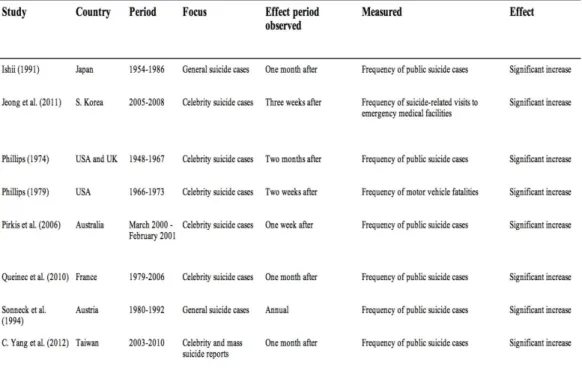
that publication of suicide cases leads to a significant increase in the suicide rate following publication, particularly if a newspaper article is associated with images, gives a detailed description of the suicide method and is glorifying or romanticising in nature (see Figure 1).6
Figure 1: Prior research studies investigating the relationship between media suicide reporting and suicide rates
Evidence for copycat effects outside the realm of suicide is scarce at best. Prior studies on child homicide, and homicide followed by suicide, failed to find evidence pointing towards a copycat effect.7
Given their vast societal impact, school shootings have also been the subject of copycat research. Even though sample sizes of such events are very small, hampering quantitative analyses, there is some anecdotal evidence that imitative behaviour has played a role in several school shootings. In 2013, for example, American teenager Grant Acord was arrested for planning a ‘Columbine-style’ attack at his high school in Oregon. He had in his possession a number of checklists and schematics that used the 1999 shooting spree at the Colorado high school as inspiration.8 The prominent case
of Columbine, the most covered story of 1999 and second-most-covered emergent news event of the 1990s,9 was considered a surpassable goal by Acord. Other students
revealed his intentions to friends that he was going to “pull a Columbine” only weeks prior to the attack itself.10 The student responsible for a school shooting in
Hillsborough, North Carolina in 2006 had sent an email confession to the principle of Columbine High School prior to his attack.11
Modern-day terrorist organisations have increasingly published extremist material online in the form of digital magazines and videos. These materials typically have a value-reinforcing effect that empowers their ideological and strategic narratives and generates a sense of solidarity among ideologically compatible readers.12 As a result,
similar radicalised, at-risk individuals may choose to follow in other terrorists’ footsteps, and may follow a similar process of inspiration and execution as detailed above.
For example, in preparation for the 2016 Nice attack, perpetrator Mohamed Lahouaiej-Bouhlel is said to have researched previous terror attacks such as the June 2016 Orlando shooting, as well as one committed by a local man who purposefully drove his car into a terrace café in Nice, in January earlier that year.13 Instances such as these give
credence to the idea that cases covered by the media can provide individuals with a cultural “script”.14 They may falsely identify with the protagonist (for example, they may
suffer from depression, financial troubles or helplessness), and copy the “solution” (namely, the violent event) presented in the script. Incidents of mass homicide and their links to past media coverage demonstrate a possible area of future prevention that may warrant further exploration by researchers interested in security and violence prevention policy. Phillips’ copycat effect would suggest that the media exposure given to suicide attacks is capable of triggering an individual to imitate such attacks after being exposed to the story. In the case of terrorism, an at-risk reader or viewer of media news reporting on a suicide attack might be triggered, due to their shared risk factors, to replicate attacks and thereby gain a similar position of prestige and sense of reverence and heroism among their extremist peers – a key factor used by terrorist organisations today when recruiting prospective bombers.15
The Copycat Effect and the Leaderless
Resistance Model
In order to systematically assess whether previous suicide attacks may lead to future ones, a distinction needs to be made between (a) attacks attributed to organisations and (b) attacks carried out by unaffiliated individuals. Attacks directly organised by terrorist organisations aim to achieve specific strategic or political goals. For the purpose of this paper, given their organisational focus, individuals carrying out attacks in the name of their organisation are arguably less likely to be influenced by a copycat effect. In contrast, independent perpetrators of suicide attacks theoretically fit the concept of a ‘copycat’ more closely. For independently operating individuals, exposure to media coverage is thought to be more readily linked to a copycat suicide attack, as fewer strategic, political and/or doctrinal factors need to be taken into consideration. Such individuals are a key component of a concept that has become known today as the Leaderless Resistance Model.16 Here, cells of individuals operate outside of vertical
command links or direct communication with a centralised and hierarchical power. To challenge established institutions, their actions range from vandalism to violent terrorism. This is not to say that these individuals operate in a vacuum. Terrorist organisations today such as IS and al Qaeda encourage Western Muslims to commit acts of terror independently, posing a security risk to governments who rely largely upon methods of network analysis to detect and counter terrorism risks within their borders. Because of the individual nature of such attacks, our analysis will largely focus upon interval periods containing suicide attacks committed by independent perpetrators, especially those following suicide attacks committed by terrorist organisations. Whilst acknowledging the often fuzzy or network-like structure of terrorist groups, for the purpose of this study we define independent perpetrators as individuals who were, at the time of the attack, not formally affiliated with terrorist organisations, and whose attacks were not claimed by a terrorist organisation. We define suicide attacks attributed by a terrorist organisation as such, if there is clear evidence that an organisation publicly claimed responsibility for the event. This method of categorisation mirrors that of the GTD, and ensures that our own method and findings remain wholly compatible with the data set itself.
This policy paper seeks to assess whether a copycat effect can be observed in terrorist suicide attacks committed across the world, by determining if (I) suicide attacks occur in regional clusters, and if (II) in these suicide attacks similar methods are employed that fit into a general pattern matching what would be suggested based on Phillips’ suicide copycat effect. We conduct our analysis by global region, as a proxy measure to determine whether perpetrators could have been aware of preceding suicide attacks that appeared in print news media in that particular region. We further take into consideration the Leaderless Resistance Model by focusing on (III) the perpetration of
subsequent independent suicide attacks by individuals not formally affiliated with terrorist organisations.
Methods
The START Global Terrorism Database and Open-Source Data
We obtained our data on suicide attacks from the National Consortium for the Study of Terrorism and Responses to Terrorism’s (START) Global Terrorism Database (GTD). The GTD is an open-source database detailing terrorist events that have been reported by media outlets throughout the world between the years 1970 and 2014. There are numerous advantages of using open-data resources, as they can be updated nearly instantaneously, in some instances making even recent cases available for inclusion in systematic research. Furthermore, it also eliminates the need for researchers to compile their own data, cutting costs and reducing the considerable time investment needed to prepare for analysis. There are, however, numerous disadvantages associated with the use of open-data resources, which will be discussed later in this paper.
Selection Criteria
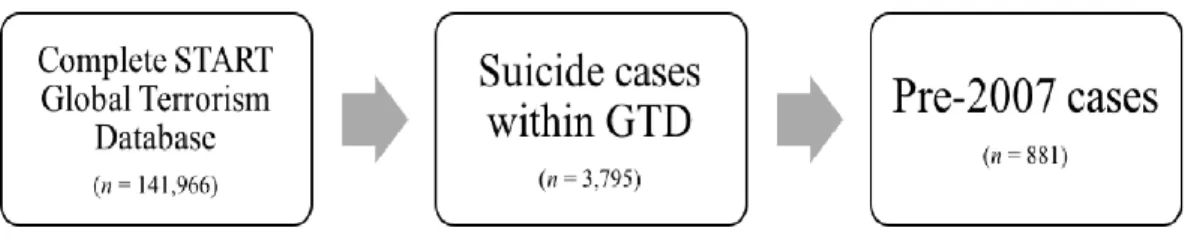
The GTD consists of a systematic set of variables detailing individual terrorist events that have been recorded by media sources from all around the world between 1970 and 2014 (n = 141,966). We narrowed our sample size by selecting only relevant terrorist attack cases associated with the suicide of the perpetrator (where the categorical variable “suicide” is equal to 1, n = 3795).17 We further narrowed this sample
size by selecting only the cases that occurred in the print and broadcast media period, prior to the social media period which took off in 2007 (n = 881).Figure 2 reflects the selection of cases.
Figure 2: Flowchart of case selection process
In this study, we choose to focus on the pre-2007 period and focus on Phillips’ hypothesised effect of print and broadcast media, rather than online media. In order to accurately assess this effect, 2007 was chosen as a cut-off point, as by that year Facebook had been opened for public access, Twitter was formed as an independent company and the Apple iPhone was released. All of these events have had major impacts upon the evolution and growing increase of social media.18 On a more general
note, the growing prevalence of the internet has also increased the availability of extremist material online and today better fosters the growth of “autodidactic extremists”,19 who can not only access a wide range of information regarding attack
methods and targets online, but can also can take inspiration from historical instances of suicide attacks that occurred further in the past and have since been recorded on the internet. In short, to focus our analysis on possible copycat effects by print and broadcast media, we use the year 2007 as a cut-off point.
Modifications to the GTD Data Set
We modified existing variables in the GTD data set. Firstly, we reclassified Afghanistan as a “Middle East” region, instead of belonging to the “South Asia” region, to reflect sociopolitical connections to the region.20 To determine the time interval between two
subsequent attacks, a new variable, daycount, was then created based upon a continuous day scale.21 In his original study, Philips applied a three-day period, after
which a copycat effect may cause an imitative suicide.22 However, due to the
considerably longer planning period a suicide attack requires before its execution, we have chosen to extend our investigation period to a total of 30 days. Our main unit of investigation is thus the attacks falling within 30-day periods, hereafter referred to as intervals.23 Based on the variable daycount, we created a new variable (labelled interval),
classifying cases within 30-day periods in order to group them chronologically. Attacks occurring on the same day were considered by our selection criterion to be ineligible for evaluation of a copycat effect.
Mixed-Method Approach
cluster or regression analyses were considered and explored as potential approaches for our analysis, the nature of the GTD made such prospects unfeasible. This was largely due to low suicide attack frequencies in regions such as North America or Western Europe, which in turn led to small sample sizes. The recording of most attack details as nominal variables also inhibited the prospect of a purely quantitative approach.
Analytical Strategy
First, in order to assess if (I) suicide attacks occurred in regional clusters, we conducted frequency analyses of cases occurring within 30-day periods by region. These regional clusters were used as a proxy measure to establish if perpetrators could have been aware of preceding suicide attacks that appeared in print news media in that particular region. Attacks occurring immediately before or after the interval periods (for example, one or two days outside the 30-day cluster periods) were included in the analysis on a case-by-case basis.24
Second, in order to assess if (II) similar attack methods were employed, a qualitative analysis was applied investigating similar attack methods, targets or other related details (stored within the data set as nominal variables). The qualitative analysis of chronological suicide attack clusters was performed on a regional basis; however, for cases that were deemed noteworthy due to their high exposure or high public impact, our analysis investigated identical attack methods across multiple regions in order to determine whether a copycat effect could be observed elsewhere at the time. An example of this may be suicide terrorist attacks occurring aboard an international flight en route to its destination. While a copycat perpetrator may not attempt to carry out an identical attack within the same region, it is worth investigating whether an attempt was made in other regions at the time.
Once suicide terrorist attack clusters were identified, we applied a qualitative approach on the basis of the degree of likeness exhibited across cases. The evaluation of the degree of likeness across clustered attacks involved the examination of the following elements for each case:
1. Target type (targtype)
a. (detailing information on the victims of the attack, i.e. “Business” or “Tourists”)
2. Weapon type (weaptype)
a. (detailing choice of weapons used in the attack, i.e. “Firearms” or “Explosives/Bombs/Dynamite”)
3. Group name (gname)
a. (detailing the name of the group who carried out the attack, i.e. “Al-Qaeda” or “Individual(s)”)
Findings
Our findings are hereafter examined by region, as they are organised within the GTD. The data is presented first in graphic form through the use of scatter plots and are further visualised in the form of a summary table. The summary tables give an overview of the details across the attacks found within a cluster, but are only compiled if our selection criteria can successfully identify attack clusters within the region. Overall, our findings failed to indicate an apparent manifestation of a copycat effect in suicide terrorist attacks occurring in any region during our observed time period.
North America
Graph 1: North America, 1981–2007
According to our selection criteria, within North America no suicide attack clusters could be identified.25 It should, however, be noted that within the studied time period,
highly publicised cases occurred in which perpetrators ascribed their violent actions to prior actions.
One concerned an attack carried out by American teenager Charles Bishop who, citing sympathy with al Qaeda and Osama bin Laden in a suicide note,26 crashed a stolen civil
utility aircraft into the Bank of America headquarters in Tampa, Florida. Although ……… ……
0 1 2 3 4 5
205 210 215 220 225 230 235 240 245 250
Fre
q
u
en
cy
o
f
Su
ici
d
e At
ta
cks
occurring within a different interval period and thus ineligible for formal analysis due to our selection criteria, the identical attack type, target and an explicit reference to a preceding attack by the perpetrator makes this a case in point.
We also examined attacks following the 1999 Columbine High School massacre, an event which – as noted before – has attracted much attention from perpetrators of copycat incidents of mass homicide. While there are seven other instances of suicide terrorist attacks targeting educational institutions found within the data set that employed similar methods, none fall within the same or adjacent interval periods, and thus do not fit our selection criteria.
Central America and the Caribbean
Graph 2: Central America and the Caribbean, 1981–2007
The Central America and Caribbean region sustained one suicide terrorist attack within our observed time period. On 19 July 1994, the terrorist organisation Ansar Allah27
bombed Alas Chiricanas Flight 901 while on route to Panama City from Colón. While we identified eight other suicide attacks in the database as targeting an airport or aircraft, none were classified within the same or adjacent interval periods. In short, no evidence of a copycat effect could be identified within the region.
……… ……
0 1 2 3
0 20 40 60 80 100 120 140 160 180
Fre
q
u
en
cy
o
f
Su
ici
d
e A
tt
ack
s
South America
Graph 3: South America, 1981–2007
According to our selection criteria, one suicide attack cluster of two attacks could be identified within the South America region.28 Within this cluster, the attacks shared
methods (bombing/explosion) and target type (military). However, these attacks occurred only one day after another. Given the amount of preparation required for such attacks, the likelihood of these attacks resulting from copycat behaviour seems low. With the exception of this single cluster, no other clusters could be identified within the region.
……… 0
1 2 3
0 50 100 150 200 250 300
Fre
q
u
en
cy
o
f
Su
ici
d
e At
ta
cks
Interval Period
Clusters nAttack type Target type Target sub-type Weapon type Weapon sub-type Unknown/Independent?
East Asia
Graph 4: East Asia, 1981–2007
As Graph 4 illustrates, according to our selection criteria no suicide attack clusters could be identified within the region of East Asia within our time period.
South-East Asia
Graph 5: South-East Asia, 1981–2007
As Graph 5 illustrates, according to our selection criteria, no suicide attack clusters could be identified within the region of South-East Asia.29
……… ……
0 1 2 3
0 50 100 150 200 250 300
Fre
q
u
en
cy
o
f
Su
ici
d
e At
ta
cks
Interval Period
0 1 2 3
0 50 100 150 200 250 300 350
Fre
q
u
en
cy
o
f
Su
ici
d
e At
ta
cks
South Asia
Graph 6: South Asia, 1981–2007
0 1 2 3 4 5 6 7
0 50 100 150 200 250 300 350
Fre
q
u
en
cy
o
f
Su
ici
d
e At
ta
cks
Clusters n Attack type Target type Target sub-type Weapon type Weapon sub-type Unknown/Independent ?
I (156/157) 2 Assassination (1/2), Bombing/Explosion (1/2)
Violent Political Party (1/2), M ilitary (1/2)
Party
Official/Candidate/Other Personnel (1/2), Navy (1/2)
Explosives/Bombs/Dynamite (2/2) Unknown explosive type (1/2), Other explosive type (1/2)
NO
II (168) 4 Bombing/Explosion (4/4) M ilitary (3/4) Navy (3/4) Explosives/Bombs/Dynamite (3/4) Unknown Explosive Type (3/4)
NO
III (169) 3 Bombing/Explosion (3/3) M ilitary (2/3) M ilitary
Barracks/Base/Headquarters/C heckpost (2/3)
Explosives/Bombs/Dynamite (3/3) Suicide (carried bodily by human being) (2/3)
NO
IV (170) 3 Bombing/Explosion (2/3) Police (1/3) Police Building (headquarters, station, school) (1/3)
Explosives/Bombs/Dynamite (2/3) Unknown Gun Type (1/3)
NO
V (181/182) 3 Bombing/Explosion (3/3) Police (2/3) Police Patrol (1/2), Police Security Forces (1/2)
Explosives/Bombs/Dynamite (3/3) Unknown Explosive Type (2/3)
NO
VI (192) 3 Bombing/Explosion (3/3) Business (2/3) Hotel/Resort (2/3) Explosives/Bombs/Dynamite (3/3) Vehicle (2/3) NO VII (195/196) 4 Bombing/Explosion (4/4) M ilitary (2/4),
Religious Figures/Institutio ns (2/4)
Navy (1/4) Explosives/Bombs/Dynamite (4/4) Suicide (carried bodily by human being) (1/4)
NO
VIII (197) 4 Bombing/Explosion (4/4) M ilitary (2/4), Transportation (2/4)
Navy (2/4) Explosives/Bombs/Dynamite (4/4) Vehicle (2/4), Suicide (carried bodily by human being) (2/4)
NO
IX (199/200) 3 Bombing/Explosion (3/3) M ilitary (1/3) Army (1/3) Explosives/Bombs/Dynamite (3/3) Suicide (carried bodily by human being) (2/3)
YES
X (214) 4 Bombing/Explosion (4/4) M aritime (1/4) Commercial M aritime (1/4) Explosives/Bombs/Dynamite (4/4) Suicide (carried bodily by human being) (4/4)
NO
XI (215) 2 Assassination (1/2), Bombing/Explosion (1/2)
Government (General) (1/2), M ilitary (1/2)
Navy (1/2), Politician or Political Party M ovement/M eeting/Rally (1/2)
Explosives/Bombs/Dynamite (2/2) Unknown Explosive Type (1/2), Suicide (carried bodily by human being (1/2)
NO
XII (219) 3 Bombing/Explosion (3/3) Government (General) (2/3)
Head of State (1/3) Explosives/Bombs/Dynamite (3/3) Suicide (carried bodily by human being) (3/3)
NO
XIII (223/224) 4 Bombing/Explosion (3/4) M ilitary (3/4) M ilitary
Barracks/Base/Headquarters/C heckpost (1/4)
Explosives/Bombs/Dynamite (3/4) Suicide (carried bodily by human being) (3/4)
NO
XIV (225) 3 Bombing/Explosion (2/3) M ilitary (2/3) Government Personnel (excluding police, military)
Explosives/Bombs/Dynamite (3/3) Suicide (carried bodily by human being) (2/3)
NO
XV (227/228) 4 Bombing/Explosion (4/4) M ilitary (2/4) Army (1/4) Explosives/Bombs/Dynamite (4/4) Suicide (carried bodily by human being) (3/4)
YES
XVI (229/230) 4 Bombing/Explosion (3/4) Government (General) (2/4), M ilitary (2/4)
Politician or Political Party M ovement/M eeting/Rally (2/4)
Explosives/Bombs/Dynamite (4/4) Suicide (carried bodily by human being) (2/4)
NO
XVII (240/241) 3 Bombing/Explosion (2/3) M ilitary (1/3) Navy (1/3) Explosives/Bombs/Dynamite (2/3) Unknown Gun Type (1/3)
NO
XVIII (242) 3 Bombing/Explosion (3/3) M aritime (1/3) Oil tanker (1/3) Explosives/Bombs/Dynamite (3/3) Suicide (carried bodily by human being) (3/3)
NO
XIX (248) 2 Armed Assault (1/2), Bombing/Explosion (1/2)
M ilitary (2/2) M ilitary Personnel (soldiers, troops, officers, forces) (1/2), M ilitary
Barracks/Base/Headquarters/C heckpost (1/2)
Explosives/Bombs/Dynamite (1/2), Firearms (1/2)
Suicide (carried bodily by human being) (1/2), Automatic Weapon (1/2)
NO
XX (263) 2 Bombing/Explosion (2/2) M ilitary (1/2), Business (1/2)
M ilitary
Barracks/Base/Headquarters/C heckpost (1/2), Retail/Grocery/Bakery (1/2)
Explosives/Bombs/Dynamite (2/2) Grenade (1/2), Suicide (carried bodily by human being (1/2)
YES
XXI (271/272) 2 Armed Assault (1/2), Bombing/Explosion (1/2)
Police (1/2), Religious Figures/Institutio ns (1/2)
Police Patrol (including vehicles and convoys) (1/2), Place of Worship (1/2)
Explosives/Bombs/Dynamite (2/2) Automatic weapon (1/2), Suicide (carried bodily by human being) (1/2)
NO
XXII (277) 2 Bombing/Explosion (2/2) Religious Figures/Insitution s (2/2)
Place of Worship (2/2) Explosives/Bombs/Dynamite (2/2) Other Explosive Type (1/2), Suicide (carried bodily by human being (1/2)
YES
XXIII (285) 2 Bombing/Explosion (2/2) Religious Figures/Insitution s (2/2)
Unknown, (1/2) Place of Worship (1/2)
Explosives/Bombs/Dynamite (2/2) Suicide (carried bodily by human being) (2/2)
YES
XXIV (290/291)
7 Bombing/Explosion (7/7) Government (General) (5/7)
Judge/Attorney/Court (5/7) Explosives/Bombs/Dynamite (7/7) Suicide (carried bodily by human being) (3/7)
NO
XXV (294) 2 Bombing/Explosion (2/2) Private Citizens & Property (1/2), Government (Diplomatic) (1/2)
Procession/Gathering (funeral, wedding, birthday, religious) (1/2), Unknown (1/2)
Explosives/Bombs/Dynamite (2/2) Suicide (carried bodily by human being) (1/2), Vehicle (1/2)
NO
XXVI (295/296)
3 Bombing/Explosion (3/3) M ilitary (2/3) Navy (1/3) Explosives/Bombs/Dynamite (3/3) Suicide (carried bodily by human being) (2/3)
NO
XXVII (297) 2 Bombing/Explosion (2/2) M ilitary (2/2) M ilitary Unit/Patrol/Convoy (1/2), M ilitary Personnel (soldiers, troops, officers, forces) (1/2)
Explosives/Bombs/Dynamite (2/2) Vehicle (1/2), Unknown Explosive Type (1/2)
YES
XXVIII (302) 3 Bombing/Explosion (3/3) M ilitary (2/3) M ilitary
Barracks/Base/Headquarters/C heckpost (2/3)
Explosives/Bombs/Dynamite (3/3) Vehicle (3/3) YES
XXIX (303/304)
4 Bombing/Explosion (4/4) Government (2/4) Government Personnel (excluding police, military) (2/4)
Explosives/Bombs/Dynamite (4/4) Suicide (carried bodily by human being) (3/4)
According to our selection criteria, 29 suicide attack clusters were identified within the region of South Asia.30 Of these, eight clusters contain attacks either unattributed to,
or perpetrated by an actor not formally affiliated with, a terrorist organisation. Two of these concerned attacks with identical attack details, as both employed explosives. Due to our primary aim of evaluating the future research possibilities yielded by the GTD as well as the limited amount of detailed information found within it, we could not firmly conclude whether these individuals in fact copied one another and further stress the need for future research on the subject to use media data in order to draw more definitive conclusions on specific instances such as these.
Central Asia
Graph 7: Central Asia, 1981–2007
Clusters n Attack type Target type
Target sub-type Weapon type
Weapon sub-type
Unknown/ Independent ?
I (271) 2 Bombing/Explosion (1/2), Armed Assault (1/2)
Private Citizens & Property (1/2), Police (1/2)
Unnamed
Civilian/Unspecified (1/2), Police Security Forces/Officers (1/2)
Explosives/ Bombs/ Dynamite (2/2)
Suicide (carried bodily by human being) (2/2)
YES
According to our selection criteria, one suicide attack cluster could be identified within the region of Central Asia.31 However, as the table above shows, the details of the
attacks within this cluster varied widely, were aimed at different targets and included different types of attack. Based on these differences, we did not find clear indications for a copycat effect within the region within the studied time span.
……… 0
1 2 3 4 5
271 271 272 272 273 273 274 274 275 275 276
Fre
q
u
en
cy
o
f
Su
ici
d
e At
ta
cks
Western Europe
Graph 8: Western Europe, 1981–2007
According to our selection criteria, one suicide attack cluster can be identified within the region of Western Europe, namely those related to the 7/7 London bombings.32
However, all attacks took place on the same day and, as a result, were not deemed to have been triggered by prior publication of an attack.
……… 0
1 2 3 4 5
0 50 100 150 200 250 300 350
Fre
q
u
en
cy
o
f
Su
ici
d
e At
ta
cks
Eastern Europe
Graph 9: Eastern Europe, 1981–2007
0 1 2 3 4 5 6 7 8 9 10
0 50 100 150 200 250 300 350
Fre
q
u
en
cy
o
f
Su
ici
d
e At
ta
cks
According to our selection criteria, seven suicide attack clusters were identified within the region of Eastern Europe. Of these, one cluster contained attacks either unattributed to, or perpetrated by an actor not formally affiliated with, a terrorist organisation. However, as the summary table reflects, the attacks within this cluster did not share identical attack details, providing no clear evidence of a copycat effect in the region within our studied time period.
Clusters n Attack
type
Target type
Target sub-type
Weapon type Weapon sub-type
Unknown/In dependent?
I (224/224) 9 Bombing/ Explosion (9/9)
M ilitary (8/9) M ilitary Barracks/Base/He adquarters/Check post (4/9)
Explosives/Bombs/ Dynamite (9/9)
Vehicle (6/9) NO
II (231) 2 Bombing/ Explosion (2/2)
Police (2/2) Police Building (headquarters, station, school) (2/2)
Explosives/Bombs/ Dynamite (2/2)
Vehicle (2/2) NO
III (256) 2 Bombing/ Explosion (2/2) Government (General) (1/2), Unknown (1/2) Government Building/Facility/ Office (1/2), Unknown (1/2) Explosives/Bombs/ Dynamite (2/2) Vehicle (1/2), Suicide (carried bodily by human being (1/2) NO
IV (260) 3 Bombing/ Explosion (2/3)
Government (General) (2/3)
Intelligence (1/3) Explosives/Bombs/ Dynamite (3/3) Suicide (carried bodily by human being) (2/3) YES
V (261/262) 3 Bombing/ Explosion (3/3)
M ilitary (1/3) M ilitary Transportation/V ehicle (excluding convoys) (1/3) Explosives/Bombs/ Dynamite (3/3) Suicide (carried bodily by human being) (2/3) NO
VI (267) 2 Bombing/ Explosion (2/2) Transportation (1/2), Business (1/2) Train/Train Tracks/Trolley (1/2), Hotel/Resort Explosives/Bombs/ Dynamite (2/2) Suicide (carried bodily by human being) (2/2) NO
VII (276) 3 Bombing/ Explosion (2/3)
Transportation (2/3)
Middle East and North Africa
Graph 10: Middle East and North Africa
0 5 10 15 20 25 30 35
0 50 100 150 200 250 300 350
Fre
q
u
en
cy
o
f
Su
ici
d
e At
ta
cks
Clusters n Attack type Target type Target sub-type Weapon type Weapon sub-type Unknown/In dependent?
I (43) 3 Bombing/Explosion
(3/3)
Police (2/3) Police Checkpoint (2/3) Explosives/Bo
mbs/Dynamit
Unknown Explosive Type (3/3)
NO
II (45) 4 Bombing/Explosion
(4/4)
Terrorists/Non-State Militia
Non-State Militia (2/4) Explosives/Bo
mbs/Dynamit
Unknown Explosive Type (4/4)
YES
III (158) 2 Bombing/Explosion
(2/2)
Military (2/2) Army (1/2), Military
Transportation/Vehicle (excluding convoys) (1/2)
Unknown (2/2)
Unknown (2/2) YES
IV (172) 3 Bombing/Explosion
(3/3)
Transportation (2/3)
Unknown (1/3) Explosives/Bo
mbs/Dynamit
Unknown Explosive Type (2/3)
NO
V (173) 3 Bombing/Explosion
(3/3)
Transportation (1/3)
Bus (excluding tourists) (1/3) Explosives/Bo
mbs/Dynamit
Unknown Explosive Type (3/3)
NO
VI (205) 2 Bombing/Explosion
(2/2)
Private Citizens & Property (2/2)
Unknown (1/2), Marketplace/Plaza/Square
Explosives/Bo mbs/Dynamit
Vehicle (1/2), Suicide (carried bodily by human
NO
VII (206) 2 Bombing/Explosion
(2/2)
Military (1/2), Business (1/2)
Unknown (1/2), Military Unit/Patrol/Convoy (1/2)
Explosives/Bo mbs/Dynamit
Suicide (carried bodily by human being) (1/2),
YES
VIII (209) 3 Bombing/Explosion
(3/3) Government (General) (2/3) Marketplace/Plaza/Square (1/3) Explosives/Bo mbs/Dynamit
Suicide (carried bodily by human being) (2/3)
YES
IX (210) 6 Bombing/Explosion
(4/6)
Police (2/6) Politician or Political Party
Movement/Meeting/Rally
Explosives/Bo mbs/Dynamit
Suicide (carried bodily by human being) (6/6)
YES
X (215) 2 Bombing/Explosion
(2/2)
Police (1/2), Unknown (1/2)
Police Checkpoint (1/2), Unknown (1/2)
Explosives/Bo mbs/Dynamit e (2/2)
Suicide (carried bodily by human being) (1/2), Unknown Explosive Type
NO
XI (219) 2 Bombing/Explosion
(2/2)
Private Citizens & Property (1/2), Military
Vehicles/Transportation (1/2), Unknown (1/2)
Explosives/Bo mbs/Dynamit e (2/2)
Vehicle (2/2) NO
XII (229) 2 Bombing/Explosion
(2/2)
Military (2/2) Navy (1/2), Military
Barracks/Base/Headquarters/ Checkpost (1/2)
Explosives/Bo mbs/Dynamit e (2/2)
Suicide (carried bodily by human being) (2/2)
NO
XIII (232) 2 Bombing/Explosion
(2/2)
Police (1/2), Private Citizens & Property (1/2)
Police Building (headquarters, station, school) (1/2), Unnamed
Explosives/Bo mbs/Dynamit e (2/2)
Suicide (carried bodily by human being) (2/2)
NO
XIV (234) 3 Bombing/Explosion
(3/3)
Private Citizens & Property (2/3)
Unnamed
Civilian/Unspecified (2/3)
Explosives/Bo mbs/Dynamit
Suicide (carried bodily by human being) (3/3)
NO
XV (236) 4 Bombing/Explosion
(4/4)
Private Citizens & Property (2/4)
Marketplace/Plaza/Square (1/4)
Explosives/Bo mbs/Dynamit
Suicide (carried bodily by human being) (3/4)
YES
XVI (238) 2 Bombing/Explosion
(2/2)
Police (1/2), Transportation (1/2)
Police Building (headquarters, station, school) (1/2), Train/Train Tracks/Trolley
Explosives/Bo mbs/Dynamit e (2/2)
Suicide (carried bodily by human being) (4/4)
NO
XVII (239) 4 Bombing/Explosion
(4/4)
Business (2/4) Bus (excluding tourists) (1/4) Explosives/Bo
mbs/Dynamit
Suicide (carried bodily by human being) (4/4)
YES
XVIII (240) 5 Bombing/Explosion
(5/5)
Private Citizens & Property (1/5)
Unknown (2/5) Explosives/Bo
mbs/Dynamit
Suicide (carried bodily by human being) (5/5)
YES
XIX (241) 2 Bombing/Explosion
(2/2) Private Citizens & Property (1/2), Police Unnamed Civilian/Unspecified (1/2), Military Unit/Patrol/Convoy Explosives/Bo mbs/Dynamit e (2/2)
Suicide (carried bodily by human being) (2/2)
NO
XX (243) 6 Bombing/Explosion
(6/6)
Military (2/6) Military
Barracks/Base/Headquarters/ Checkpost (2/6)
Explosives/Bo mbs/Dynamit e (6/6)
Suicide (carried bodily by human being) (6/6)
YES
XXI (244) 2 Bombing/Explosion
(2/2)
Transportation (1/2), Private Citizens &
Bus Station/Stop (1/2), Unnamed
Civilian/Unspecified (1/2)
Explosives/Bo mbs/Dynamit e (2/2)
Suicide (carried bodily by human being) (2/2)
NO
XXII (245) 8 Bombing/Explosion
(7/8)
Business (3/8) Unknown (3/8) Explosives/Bo
mbs/Dynamit
Suicide (carried bodily by human being) (7/8)
YES
XXIII (246) 11 Bombing/Explosion
(11/11)
Private Citizens & Property
Unknown (2/11) Explosives/Bo
mbs/Dynamit
Suicide (carried bodily by human being) (11/11)
YES
XXIV (247) 9 Bombing/Explosion
(9/9)
Business (3/9) Unknown (3/9) Explosives/Bo
mbs/Dynamit
Suicide (carried bodily by human being) (5/9)
YES
XXV (248) 8 Bombing/Explosion
(8/8)
Private Citizens & Property (4/8)
Entertainment/Cultural/Stadi um/Casino (2/8)
Explosives/Bo mbs/Dynamit
Suicide (carried bodily by human being) (8/8)
YES
XXVI (249) 5 Bombing/Explosion
(5/5)
Private Citizens & Property (2/5)
Unnamed
Civilian/Unspecified (2/5)
Explosives/Bo mbs/Dynamit
Suicide (carried bodily by human being) (3/5)
YES
XXVII (251) 5 Bombing/Explosion
(5/5)
Business (1/5) Restaurant/Bar/Café (1/5) Explosives/Bo
mbs/Dynamit
Unknown Explosive Type (3/5)
YES
XXVIII (252) 3 Bombing/Explosion
(2/3)
Private Citizens & Property (1/3)
Unknown (2/3) Explosives/Bo
mbs/Dynamit
Suicide (carried bodily by human being) (2/3)
NO
XXIX (253) 4 Bombing/Explosion
(4/4)
Maritime (1/4) Oil Tanker (1/4) Explosives/Bo
mbs/Dynamit
Suicide (carried bodily by human being) (3/4)
YES
XXX (254) 4 Bombing/Explosion
(4/4)
Business (1/4) Gas/Oil (1/4) Explosives/Bo
mbs/Dynamit
Suicide (carried bodily by human being) (3/4)
NO
XXXI (255) 2 Bombing/Explosion
(2/2)
Private Citizens & Property (1/2), Military
Public Area (garden, parking lot, garage, beach, public building, camp) (1/2), NATO
Explosives/Bo mbs/Dynamit e (2/2)
Vehicle (1/2), Grenade (1/2) YES
XXXII (256) 2 Bombing/Explosion
(2/2) Private Citizens & Property (1/2), Military Unnamed Civilian/Unspecified (1/2), Navy (1/2) Explosives/Bo mbs/Dynamit e (2/2)
Unknown Explosive Type (1/2), Vehicle (1/2)
NO
XXXIII (257) 2 Bombing/Explosion
(2/2)
Military (1/2), Private Citizens & Property (1/2)
Military Checkpoint (1/2), Village/City/Town/Suburb (1/2)
Explosives/Bo mbs/Dynamit e (2/2)
Unknown Explosive Type (1/2), Suicide (carried bodily by human being) (1/2)
NO
XXXIV (258) 5 Bombing/Explosion
(5/5)
Military (1/5) Military Checkpoint (1/5) Explosives/Bo
mbs/Dynamit
Suicide (carried bodily by human being) (3/5)
YES
XXXV (259) 2 Bombing/Explosion
(2/2)
Military (1/2), Business (1/2)
Marine (1/2), Unknown (1/2) Explosives/Bo
mbs/Dynamit
Suicide (carried bodily by human being) (2/2)
YES
XXXVI (260) 17 Bombing/Explosion
(17/17)
Business (7/17) Unknown (5/17) Explosives/Bo
mbs/Dynamit
Suicide (carried bodily by human being) (17/17)
NO
XXXVII (261) 4 Bombing/Explosion
(4/4)
Military (2/4) Military Personnel (soldiers,
troops, officers, forces) (1/4)
Explosives/Bo mbs/Dynamit
Suicide (carried bodily by human being) (3/4)
Clusters n Attack type Target type Target sub-type Weapon type Weapon sub-type Unknown/In dependent? XXXVIII (263) 4 Bombing/Explosion (4/4) Private Citizens & Property (1/4)
Marketplace/Plaza/Square (1/4)
Explosives/Bo mbs/Dynamit
Suicide (carried bodily by human being) (4/4)
YES
XXXIX (264) 3 Bombing/Explosion
(3/3)
Business (1/3) Restaurant/Bar/Café (1/3) Explosives/Bo
mbs/Dynamit
Suicide (carried bodily by human being) (2/3)
NO
XL (265) 6 Bombing/Explosion
(6/6)
Government (Diplomatic) (1/6)
International Organization (peacekeeper, aid agency, compound) (1/6)
Explosives/Bo mbs/Dynamit e (6/6)
Vehicle (4/6) YES
XLI (266) 8 Bombing/Explosion
(8/8)
Police (3/8) Police Building (headquarters,
station, school) (3/8)
Explosives/Bo mbs/Dynamit
Vehicle (7/8) YES
XLII (267) 5 Bombing/Explosion
(5/5)
Educational Institution (2/5)
School/University/Educationa l Building (2/5)
Explosives/Bo mbs/Dynamit
Suicide (carried bodily by human being) (5/5)
YES
XLIII (268) 5 Bombing/Explosion
(5/5)
Military (2/5) Army (2/5) Explosives/Bo
mbs/Dynamit
Suicide (carried bodily by human being) (3/5)
YES
XLIV (269) 10 Bombing/Explosion
(10/10)
Military (3/10) NATO (2/10) Explosives/Bo
mbs/Dynamit
Vehicle (6/10) YES
XLV (270) 8 Bombing/Explosion
(9/9)
Military (2/9) Military
Barracks/Base/Headquarters/ Checkpost (1/9)
Explosives/Bo mbs/Dynamit e (8/9)
Suicide (carried bodily by human being) (5/8)
YES
XLVI (272) 6 Bombing/Explosion
(6/6)
Police (2/6) Police Building (headquarters,
station, school) (1/6)
Explosives/Bo mbs/Dynamit
Vehicle (4/6) YES
XLVII (273) 4 Bombing/Explosion
(4/4)
Government (General) (2/4)
Government Personnel (excluding police, military)
Explosives/Bo mbs/Dynamit
Suicide (carried bodily by human being) (3/4)
YES
XLVIII (274) 6 Bombing/Explosion
(6/6) Government (General) (2/6) Government Building/Facility/Office (2/6) Explosives/Bo mbs/Dynamit
Vehicle (4/6) YES
XLIX (275) 7 Bombing/Explosion
(6/7)
Police (3/7) Police Building (headquarters,
station, school) (2/7)
Explosives/Bo mbs/Dynamit
Vehicle (6/7) YES
L (276) 4 Bombing/Explosion
(4/4)
Government (General) (2/4), Police (2/4)
Government Personnel (excluding police, military) (1/4)
Explosives/Bo mbs/Dynamit e (4/4)
Suicide (carried bodily by human being) (3/4)
NO
LI (277) 12 Bombing/Explosion
(12/12)
Military (6/12) Military Recruiting
Station/Academy (3/12)
Explosives/Bo mbs/Dynamit
Vehicle (7/12) YES
LII (278) 15 Bombing/Explosion
(15/15)
Government (General) (4/15)
Police Patrol (including vehicles and convoys) (2/15)
Explosives/Bo mbs/Dynamit
Vehicle (13/15) YES
LIII (279) 8 Bombing/Explosion
(8/8)
Police (5/8) Police Building (headquarters,
station, school) (2/8)
Explosives/Bo mbs/Dynamit
Vehicle (6/8) YES
LIV (280) 13 Bombing/Explosion
(13/13)
Military (6/13) Military Unit/Patrol/Convoy
(2/13)
Explosives/Bo mbs/Dynamit
Vehicle (11/13) YES
LV (281) 9 Bombing/Explosion
(9/9)
Military (3/9) Politician or Political Party
Movement/Meeting/Rally
Explosives/Bo mbs/Dynamit
Vehicle (6/9) YES
LVI (282) 16 Bombing/Explosion
(15/16)
Military (5/16) Place of Worship (4/16) Explosives/Bo
mbs/Dynamit
Vehicle (8/16) YES
LVII (283) 10 Bombing/Explosion
(9/10)
Military (5/10) Military Unit/Patrol/Convoy
(2/10)
Explosives/Bo mbs/Dynamit
Vehicle (7/10) YES
LVIII (284) 27 Bombing/Explosion
(27/27)
Military (10/27) Military Unit/Patrol/Convoy
(5/27)
Explosives/Bo mbs/Dynamit
Vehicle (21/27) YES
LIX (285) 13 Bombing/Explosion
(12/13) Government (General) (4/13) Unnamed Civilian/Unspecified (3/13) Explosives/Bo mbs/Dynamit
Vehicle (10/13) YES
LX (286) 18 Bombing/Explosion
(18/18)
Police (6/18) Police Security
Forces/Officers (5/18)
Explosives/Bo mbs/Dynamit
Vehicle (11/18) YES
LXI (287) 31 Bombing/Explosion
(31/31)
Military (10/31) Police Building (headquarters,
station, school) (4/31)
Explosives/Bo mbs/Dynamit
Vehicle (21/31) YES
LXII (288) 5 Bombing/Explosion
(5/5)
Military (2/5) Unnamed
Civilian/Unspecified (1/5)
Explosives/Bo mbs/Dynamit
Suicide (carried bodily by human being) (4/5)
YES
LXIII (289) 18 Bombing/Explosion
(18/18)
Police (5/18) Police Checkpoint (2/18) Explosives/Bo
mbs/Dynamit
Suicide (carried bodily by human being) (9/18)
YES
LXIV (290) 11 Bombing/Explosion
(8/11)
Military (3/11) Government Personnel
(excluding police, military)
Explosives/Bo mbs/Dynamit
Vehicle (6/11) YES
LXV (291) 16 Bombing/Explosion
(16/16)
Business (5/16) Hotel/Resort (3/16) Explosives/Bo
mbs/Dynamit
Vehicle (9/16) YES
LXVI (292) 7 Bombing/Explosion
(7/7)
Police (3/7) Police Security
Forces/Officers (2/7)
Explosives/Bo mbs/Dynamit
Suicide (carried bodily by human being) (3/7)
YES
LXVII (293) 10 Bombing/Explosion
(9/10)
Business (3/10) Military Unit/Patrol/Convoy
(2/10)
Explosives/Bo mbs/Dynamit
Suicide (carried bodily by human being) (6/10)
YES
LXVIII (294) 13 Bombing/Explosion
(13/13)
Police (4/13) Unknown (3/13) Explosives/Bo
mbs/Dynamit
Suicide (carried bodily by human being) (12/13)
YES
LXIX (295) 6 Bombing/Explosion
(6/6)
Military (2/6) Unknown (2/6) Explosives/Bo
mbs/Dynamit
Suicide (carried bodily by human being) (3/6)
YES
LXX (296) 9 Bombing/Explosion
(9/9)
Religious Figures/Instituti ons (2/9)
Place of Worship (2/9) Explosives/Bo
mbs/Dynamit e (9/9)
Suicide (carried bodily by human being) (5/9)
YES
LXXI (297) 15 Bombing/Explosion
(15/15)
Military (4/15) Military Unit/Patrol/Convoy
(2/15)
Explosives/Bo mbs/Dynamit
Vehicle (9/15) YES
LXXII (298) 7 Bombing/Explosion
(7/7)
Military (2/7) Police Patrol (including
vehicles and convoys) (2/7)
Explosives/Bo mbs/Dynamit
Suicide (carried bodily by human being) (5/7)
YES
LXXIII (299) 17 Bombing/Explosion
(17/17)
Private Citizens & Property
Unknown (4/17) Explosives/Bo
mbs/Dynamit
Suicide (carried bodily by human being) (10/17)
YES
LXXIV (300) 11 Bombing/Explosion
(11/11)
Private Citizens & Property
Procession/Gathering (funeral, wedding, birthday,
Explosives/Bo mbs/Dynamit
Vehicle (6/11) YES
LXXV (301) 16 Bombing/Explosion
(16/16)
Police (6/16) Police Security
Forces/Officers (4/16)
Explosives/Bo mbs/Dynamit
Suicide (carried bodily by human being) (8/16),
YES
LXXVI (302) 18 Bombing/Explosion
(18/18)
Police (8/18) Police Building (headquarters,
station, school) (4/18)
Explosives/Bo mbs/Dynamit
Vehicle (9/18), Suicide (carried bodily by human
YES
LXXVII (303) 9 Bombing/Explosion
(9/9)
Private Citizens & Property (4/9)
Unnamed
Civilian/Unspecified (2/9)
Explosives/Bo mbs/Dynamit
Suicide (carried bodily by human being) (5/9)
YES
LXXVIII (304)
16 Bombing/Explosion (16/16)
Police (7/16) Unknown (4/16) Explosives/Bo
mbs/Dynamit
Suicide (carried bodily by human being) (14/16)
According to our selection criteria, 78 suicide attack clusters could be identified within the Middle East and North Africa.33 Of these, 57 clusters contained attacks either
unattributed to, or perpetrated by an actor not formally affiliated with, a terrorist organisation. Twenty-one of these contained attacks that shared identical attack details and are possible candidates for further analysis to determine the likelihood of a copycat effect being present, as due to the limited amount of detailed information in the START database, we were unable to firmly conclude whether these individuals had, in fact, copied one another.
Sub-Saharan Africa
Graph 11: Sub-Saharan Africa, 1981–2007
According to our selection criteria, one suicide attack cluster was identified within the region of Sub-Saharan Africa.34 However, this particular cluster contained attacks that
were perpetrated on the same day and were thus not likely to be the result of prior publication of a preceding attack. With the exception of this cluster, no other suicide attack clusters could be identified within the region.
……… 0
1 2 3
0 50 100 150 200 250 300 350
Fre
q
u
en
cy
o
f
Su
ici
d
e At
ta
cks
Evaluation of Findings
By analysing almost 900 cases of terrorist suicide attacks across the world, using a mixed-method approach, we sought to assess whether a copycat effect could be established among suicide terrorist attacks. In order to tackle this pressing question, we assessed (I) whether suicide attacks occurred in regional clusters, (II) whether attacks occurring in one cluster employed similar methods, and (III) whether these were perpetrated by individuals not formally affiliated with terrorist organisations.
Our mixed-method analyses did identify numerous clusters containing identical attacks occurring within a 30-day period across all regions, demonstrating the potential value of follow-up research on the topic, and especially encourages using rich qualitative (media) data to study single cases identified in this study in greater depth.
What Should Be Next?
Using open-source databases for social science research is not without flaws. As the START GTD is primarily based on media outlets, low-profile or older entries often lack detailed and potentially important information, such as the level of media attention focused on an incident occurring after its perpetration, in what language(s) the incident was covered, by what type(s) of media and to what intensity. Furthermore, as open-source databases rely on media reporting as a primary open-source of information for their entries, potential reporting biases may influence eventual findings. Blackouts imposed by authoritarian regimes may also affect data availability. In the field of counter-terrorism specifically, open-source databases – such as the GTD, in particular – also contain little information on government responses to terrorist attacks. Finally, and most importantly, the START GTD did not contain any information on the degree of publication surrounding suicide attacks. This has inhibited us from assessing the direct influence of media exposure on potential future attacks. Future research should establish some method of indexing, or another form of quantitative valuation of media coverage, when investigating the effect of the media on terrorist violence. A two-part research method, for example taking findings extracted from the database, might conduct a discourse analysis by trawling through a body of media literature in a given region. Such analyses could include the analysis of frequencies of word-schemas against an aggregated database of media sources in order to determine a statistical relationship. This kind of approach would make research findings from the database less speculative, and make research on a potential copycat effect more accurate.
Our analysis focused on the pre-social media period. Future research should also be expanded to the post-2007 period and include social media sites or online news aggregators in the media component of their analysis. The parameters of such a study could also be adapted accordingly, as the expansion and growing availability of online content may change the ways in which individual perpetrators may be exposed to, and triggered by, an inspiring terrorist suicide attack. The use of innovative big-data analytical methods such as systematic algorithm-based searches may also overcome some of the weaknesses of traditional quantitative analysis, such as our own need to include cases falling immediately outside a given interval period on a case-by-case basis. The combination of these rising tools in the future may open up new doors in terms of using media data in (counter-)terrorism research. A more refined approach might also counter the broad classifications of attack details such as weapons or target types whose high frequency might also have affected the validity of our findings.
Our research demonstrates the value of incorporating open-data sources for research in (counter-)terrorism studies and other related social science fields. The inclusion of common big-data research techniques such as algorithmic data mining could also be used to complement future research, providing an innovative set of statistical methods that can provide answers for our most pressing questions – in particular those pertaining to the rise of the Leaderless Resistance Model in modern Islamic extremist terrorism and the challenging prevention limitations it poses for policymakers today. As demonstrated by our research, statistical analysis of today’s open-data sources can yield valuable insights into trends at a surface level, but has a limited capacity to be used for specialised research and, as a result, is most effective when used alongside other sources of data.
Implications
Although our analysis did not provide clear-cut support for a copycat effect among suicide terrorist attacks, we cannot rule out that media does not have any influence in these practices. Our statistical analysis identified a number of clustered attacks containing similar attack details but could not determine the presence of a copycat effect using the data alone. Until further, more detailed analyses can exclude potential contagion effects, we may wish to exercise caution in reporting on these events.
The reasons for such caution are twofold: on the one hand, as Adam Lankford has argued elsewhere,35 individual perpetrators of suicide attacks may primarily be driven
by suicidal ideations, rather than by ideological motivations. Executing a suicide attack may provide a socially approved way of ending their lives.36 In such cases, it may be
argued that these suicidal individuals could be inspired by glorified, romanticised and detailed publications of suicide attacks that may inspire them to carry out a similar attack. Based on this assumption, suicide terrorism would follow the same contagion pathways as “regular” suicides. What follows is that media outlets should adhere to similar reporting guidelines for responsible media reporting.37 These include refraining
example, the perpetrator should not be framed as an at-risk individual who solved his or her frustrations by committing violent suicide. Linking their act of suicide terrorism to an aspect of their background may give future viewers the ability, through social learning, to gain solidarity with the perpetrator and potentially commit an act of suicide terrorism themselves. This point may be particularly important due to the rise of the Leaderless Resistance, and lone wolf models adopted by major terrorist organisations such as IS, whose individual perpetrators of terroristic violence operate outside known terrorist networks and as such fall largely within a blind spot of traditional intelligence systems and practices.
The second reason for exercising caution when it comes to reporting on suicide terrorism takes a moralistic approach, and continues to be a widely debated topic among counter-terrorism experts today.38 Detailed reporting on such attacks provides
terrorist organisations a wider platform for their aims and doctrines. While there is no evidence supporting the suggestion that media coverage of suicide terrorism cases increases their frequency in the same ways as coverage of suicide cases may increase the frequency of individual suicides, research within the field remains largely exploratory and in its early stages. As such, further attention should be directed towards the development and implementation of responsible media-reporting conventions as a largely precautionary measure, as well as to limit the spread of terrorist propaganda.
The issue of the relationship between media coverage and terrorist violence is one of great importance today. Media coverage of suicide terrorism may not only provide terrorist organisations a platform through which their propaganda may be communicated, but can also give rise to further channels for future terrorist violence. Adapting reporting techniques to align with contemporary political information management and crisis communication strategies will deprive terrorist organisations of the media coverage necessary for them to project their power and achieve their strategic goals. Our analysis did not uncover sufficient evidence to classify suicide terrorism as a new form of suicidal behaviour, but rather suggested that it has a different dynamic and is thus characterised by different predictors compared to traditional suicide. As such, future research should investigate suicide terrorism through a lens of warfare or general violence rather than through one of suicide. Despite the clear need for further research to more concretely measure the threat of a copycat effect in instances of suicide terrorism worldwide, it is important for media practices to adjust at as early a point as possible in order to minimise impending security risks.
Conclusion
Bibliography
Brumfield, B., J. Carpenter, and A. Stapleton. "Prosecutor: Oregon teen planned Columbine-style attack at his school”. CNN, 26 May 2013, http://edition.cnn.com/2013/05/26/justice/oregon-teen-bomb-plot/.
Edwards-Stewart, A., J. T. Kinn, J. D. June & N. R. Fullerton. "Military and Civilian Media Coverage of Suicide”. Archives of Suicide Research 15, no. 4 (2011), pp. 304–12.
Fekete, S., and A. Schmidtke. "The Impact of Mass Media Support and Attitudes toward Self-Destruction: Previous Studies and Some New Data from Hungary and Germany". In B. Mishara, ed. The Impact of Suicide, pp. 142–55. New York: Springer Publishing Co., 1995.
Gambhir, H. K. "Dabiq: The Strategic Messaging of the Islamic State”. Institute for the Study of War, 15 August 15 2014.
Gill, P. Lone-Actor Terrorists: A Behavioural Analysis. Abingdon: Routledge, 2015.
Haarhuis, S. and M. Liem. “De Epidemiologie van Kinderdoding in Nederland, 2009– 2014”. Tijdschrift voor Veiligheid 14 (2016), pp. 56–77.
Hancocks, P. and M. Tkachenko. "'Terrorist act' blamed for air crash”. CNN, 28 August 2004,
http://web.archive.org/web/20050307171013/http://www.cnn.com/2004/WORLD/eur ope/08/27/russia.planecrash/index.html.
Ingram, H. J. "An Analysis of Islamic State’s Dabiq Magazine”. Australian Journal of Political Science 51, no. 3 (2016), pp. 458–77.
Ji, N., W. Y. Lee, M. S. Noh and P. S. F. Yip. "The Impact of Indiscriminate Media Coverage of a Celebrity Suicide on a Society with a High Suicide Rate: Epidemiological Findings on Copycat Suicides from South Korea”. Journal of Affective Disorders 156 (2014), pp. 56–61.
Kellner, D. Media Spectacle and the Crisis of Democracy: Terrorism, War, and Election Battles. Abingdon: Routledge, 2015.
Koburger, N., et al. "Celebrity Suicide on the Railway Network: Can One Case Trigger International Effects?". Journal of Affective Disorders 185 (2015), pp. 38–46.
Lankford, A. The Myth of Martyrdom: What Really Drives Suicide Bombers, Rampage Shooters, and other Self-Destructive Killers. New York: Macmillan, 2003.
Larkin, R. W. "The Columbine Legacy Rampage Shootings as Political Acts". American Behavioral Scientist 52, no. 9 (2009), pp. 1309–26.
Liem, M. "The Myth of Martyrdom: What Really Drives Suicide Bombers, Rampage Shooters, and Other Self‐Destructive Killers. A. Lankford. Basingstoke: Palgrave Macmillan (2013) 257pp. £ 16.99 hb ISBN 1‐978‐0‐230‐34213‐2" [book review]. The Howard Journal of Criminal Justice 52, no. 3 (2013), pp. 342–43.
Liem, M., and N. van Keeken. "Doding Gevolgd door Zelfdoding in Nederland". Mens en maatschappij 91, no. 2 (2016), pp. 133–51.
McCarthy, T. "WARNING: Andy Williams here. Unhappy kid. Tired of being picked on". TIME, 11 March 2001,
http://content.time.com/time/magazine/article/0,9171,102077,00.html.
Merari, A. et al. "Personality characteristics of ‘self martyrs’/’suicide bombers’ and organizers of suicide attacks”. Terrorism and Political Violence 22, no. 1 (2009), pp. 87– 101.
Michael, G. “Leaderless Resistance: The New Face of Terrorism”. Defence Studies 12, no. 2 (2012), pp. 257–82.
Muschert, G. W. "Media and Massacre: The Social Construction of the Columbine Story“. University of Colorado, 2002.
Nacos, B. Mass-Mediated Terrorism: Mainstream and Digital Media in Terrorism and Counterterrorism. Lanham, MD: Rowman & Littlefield, 2016.
Nossiter, A., L. Blaise and A. J. Rubin. “Years before truck rampage in Nice, attacker wasn’t ‘living in the real world’”. The New York Times, 24 July 2016,
https://www.nytimes.com/2016/07/25/world/europe/nice-france-bastille-day-attacks.html.
Pantucci, R. “A Typology of Lone Wolves: Preliminary Analysis of Lone Islamist Terrorists”. International Centre for the Study of Radicalisation and Political Violence, March 2011.
Pape, R. A. "The Strategic Logic of Suicide Terrorism”. American Political Science Review 97, no. 3 (2003), pp. 343–61.
Phillips, D. P. "The Influence of Suggestion on Suicide: Substantive and Theoretical Implications of the Werther Effect". American Sociological Review (1974), pp. 340–54.
Roberts, M. "Pragmatic Action and Enchanted Worlds: A Black Tiger Rite of Commemoration”. Social Analysis (2006), pp. 73–102.
Rocha, J. “Castillo won’t be executed”. Raleigh News and Observer, 24 May 2007. Cited by R. Larkin, "The Columbine Legacy Rampage Shootings as Political Acts”.
Ryan, M. W. S. "Dabiq: What Islamic State’s New Magazine Tells Us about Their Strategic Direction, Recruitment Patterns and Guerrilla Doctrine". Terrorism Monitor (The Jamestown Foundation), 1 August 2014.
Shai, S. The Shahids: Islam and Suicide Attacks. Piscataway, NJ: Transaction Publishers, 2004.
Stack, S. "Media Coverage as a Risk Factor in Suicide”. Journal of Epidemiology and Community Health 57, no. 4 (2003), pp. 238–40.
Stern, J., and J. M. Berger. ISIS: The State of Terror. New York: HarperCollins, 2015.
World Health Organization. “Preventing Suicide: A Resource For Media Professionals”. WHO Department of Mental Health (2000),
http://www.who.int/mental_health/media/en/426.pdf.
Yang, A. C. et al. "Suicide and Media Reporting: A Longitudinal and Spatial Analysis”. Social Psychiatry and Psychiatric Epidemiology 48, no. 3 (2013), pp. 427–35.
Can a Copycat Effect be Observed in Terrorist Suicide
Attacks?
Nicholas Farnham and Dr. Marieke Liem March 2017
How to cite: Farnham, N. and M. Liem. “Can a Copycat Effect be Observed in Terrorist Suicide Attacks?”,
The International Centre for Counter-Terrorism – The Hague 8, no. 4 (2017).
About ICCT
The International Centre for Counter-Terrorism – The Hague (ICCT) is an independent think and do tank providing multidisciplinary policy advice and practical, solution-oriented implementation support on prevention and the rule of law, two vital pillars of effective counter-terrorism.
ICCT’s work focuses on themes at the intersection of countering violent extremism and criminal justice sector responses, as well as human rights-related aspects of counter-terrorism. The major project areas concern countering violent extremism, rule of law, foreign fighters, country and regional analysis, rehabilitation, civil society engagement and victims’ voices.
Functioning as a nucleus within the international counter-terrorism network, ICCT connects experts, policymakers, civil society actors and practitioners from different fields by providing a platform for productive collaboration, practical analysis and exchange of experiences and expertise, with the ultimate aim of identifying innovative and comprehensive approaches to preventing and countering terrorism.
Contact ICCT
ICCT
Zeestraat 100 2518 AD The Hague The Netherlands