Queue Length and Mobility aware Routing Protocol
for Mobile Ad hoc Network
Bisengar Ahmed
1, Rziza Mohamed
1, Ouadou Mohamed
11LRIT-CNRST URAC 29, Université Mohammed V-Agdal, Rabat, Morocco
[email protected], [email protected], [email protected]
Abstract: A mobile ad-hoc network (MANET) is different from
other wireless networks in many ways. One of the key differences is that a MANET is a multihop wireless network,i.e., a routing path is composed of intermediate mobile nodes and wireless links connecting them. In this paper, heterogeneous Mobile Ad-hoc Networks (H-MANETs) are considered. H-MANETs are composed of nodes with different transmission range. We propose an improvement of AODV protocol called AMAODV (Adaptative Mobility aware AODV). This protocol is based on new metric combine more routing metrics (distance, relative velocity, queue length and hop count) between each node and one hop neighbor. Which permits to avoid losing route. Through the simulation, it is confirmed that this improvement has higher packet delivery ratio and less average end-to-end delay than basic AODV protocol.
Keywords: On demand distance vector routing, Mobile Ad hoc
networks, Link state, relative velocity, Transmission range.
1.
Introduction
A mobile ad-hoc network (MANET) [1]–[4] is a self-configuring network of wireless links connecting mobile nodes. These nodes may be routers or hosts. Each node in a MANET is free to move independently in any direction, and will therefore changing its links to other nodes frequently. These networks have an important advantage; they do not require any kind of fixed infrastructure or centralized administration. Therefore, they are to find a path between find the path between two end points. The problem is further aggravated because of the nodes mobility as any node may move at any time without notice. Due to the limited transmission range of radio interfaces, multiple hops may be used to exchange data between nodes in the network. So, that is generally used. Another limitation associated with wireless devices is load balancing\cite{queue}. Nodes cooperate with their neighbors to route data packets to their final destinations. As intermediate nodes may fail, routes between sources and destinations need to be determined and adjusted dynamically. Routing protocols for ad-hoc networks typically include mechanisms for route discovery and route maintenance. The most known routing protocol for MANET is the Ad-hoc On-Demand Distance Vector (AODV) [5]. This protocol is a reactive routing algorithm; the routes are created only when they are needed and every intermediate node decides where the routed packet should be forwarded next. AODV uses periodic neighbor detection packets and maintains a routing table at each node. This routing table entry for a destination contains the following fields: a next hop node, a sequence number and a hop count. All packets destined to the destination are sent to the next hop node. The sequence number acts as a form of times tamping, and is a measure of the freshness of a route. The hop count represents
the current distance to the destination node. On the contrary, Dynamic Source Routing (DSR) [14] uses the source routing in which each packet contains the complete route to the destination in its own header and each node maintains multiple routes in its cache. In case of less stressed situation (i.e. smaller number of nodes and lower load and/or mobility), DSR outperforms AODV in delay and throughput but when mobility and traffic increase, AODV outperforms DSR. However, DSR consistently experiences less routing overhead than AODV. Mobility and connectivity metrics are one of the most important research topics on wireless ad-hoc networks.
2.
AODV routing protocol
Ad hoc On Demand Distance Vector (AODV) [5] is designed for use in ad-hoc mobile networks. AODV is a reactive routing protocol; it initiates the route discovery process only when it has data packets to send and it cannot find a route to the destination node. AODV uses sequence numbers to ensure avoidance of routing loops.
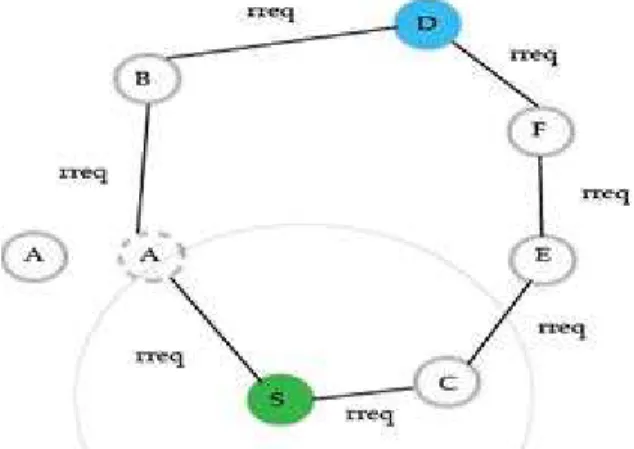
In AODV, route discovery process allows any node in the ad hoc network to dynamically discover a route to other node in the network, either directly within the radio transmission range, or through one or more intermediate nodes. In AODV protocol, the source node broadcasts a RREQ (Route REQuest) packet to its neighbors. If any of the neighbors has a route to the destination, it replies to the request with a RREP(Route REPly) packet; otherwise, the neighbors rebroadcast the RREQ packet.
Finally, some RREQ packets reach the destination as shown in the Figure 1.
At that time, a RREP packet is produced and transmitted tracing back the route traversed by the RREQ packet as in figure 2.
Figure 2. Route Reply Packet Propagation in AODV
Route maintenance is to handle the case in which a route does not exist or RREQ or RREP packets are lost, the source node rebroadcasts the route request packet if no reply is received by the source after a time-out. A route maintenance process is used by AODV to monitor the operation of a route in use and informs the sender of any routing errors. If a source node receives Route Error(RERR) notification of a broken link, it can re-launch the route discovery processes to find a new route to the destination. If a destination or an intermediate node detects a broken route or broken link, it sends RRER message to the originator of the data packet.
3.
Enhanced Ad hoc on Demand Distance
Vector (AODV) Description
The standard AODV [6], [9] protocol always selects the shortest path between source and destination, the shortest path is the easiest broken due to the limited wireless transmission range between neighboring nodes or the intermediate nodes located at the end of the transmission range. Routes failure is caused by the break of the most fragile path[7]. to address this problem, the most effective method is to find most stable path as possible. To reduce the effect of mobility, we propose AMAODV protocol that is based on the AODV protocol for MANETs. AMAODV is reactive routing protocol; no permanent routes are stored in nodes. The paths, in this protocol, are chosen based on the distance, relative velocity, queue length and hop count. This allows selecting stable routes and so, reducing control message overhead.
In present, there are three main radio propagation models: free space model, two-ray ground reflection model and shadowing model. In this paper, two-ray ground model is adopted.
This model [15] considers both the direct path and a ground reflection path. The model gives more accurate prediction at a long distance than the free space model. The received power is predicted by:
2 2
4
P ( )
t t r t r rPG G h h
d
d L
=
(1)Where
Pt is the transmitted signal power.
Gt and Gr are the antenna gains of the transmitter and the receiver respectively.
L is the system loss, d is the distance between transmitter and receiver. ht and hr are the heights of the transmit and receive antennas respectively.
In this paper, we suppose that the transmit range of each node is equivalent.
In AODV protocol, the differences between nodes are not considered, such as distance and relative velocity between nodes sender and receiver, routes founded under this condition are prone to broken.
Figure 3. Link breaks for the mobility of node A
3.1 Heterogeneous mobile Ad hoc Network
Mobile Ad-hoc Networks (MANETs) may be divided into homogeneous and heterogeneous ones. Homogeneous Ad-hoc Networks nodes possess the same transmission range, but in heterogeneous ones possess different transmission range(i.e, networks consisting of different wireless mobile devices such as laptops, PDAs and cell phones).
Routing protocols for MANET assumed that wireless links are bidirectional, nodes have identical transmission ranges. The increasing heterogeneity in MANETs leads to a substantial number of wireless links that are asymmetric due to the variation in transmission ranges of mobile nodes. In this paper, heterogeneous MANET is adopted. Each mobile node A may have its own transmission range RA. then heterogeneous wireless networks are modelled by mutual inclusion graphs(MG):
two nodes can communicate directly only if they are within the transmission range of each other,i.e., it has a link AB.
||
|| min(
A,
B)
iff
AB
≤
R R
(2)As shown in Figure 4. Hereafter, let D(A;RA) be the disk
centered at node u with radius RA.
3.2 Velocity and distance estimation
Estimation of distance and relative velocity between mobile nodes was either based on a localization system, such as the Global Positioning System (GPS) [13], or based on analyzing the characteristics of received signal [7]. The distance d between two mobile nodes A= (x1, y1) and B = (x2, y2) is given by the formula:
2 2
( 2
1)
( 2
1)
d
=
x
−
x
+
y
−
y
(3)We calculate the node relative velocity based on the distance between the sending node and itself through the time difference of the neighboring node. We can easily obtain the estimated relative velocity ∆V between A and B using the following expression:
d
V
t
∆
∆ =
∆
(4)
Where
∆t is the time difference between the former packet receiving (time instant t1) and the next packet receiving (time instant t2) which means ∆t=t2-t1.
∆d is the distance difference between the distance d1 and d2 at, respectively, the time t1 and t2.
3.3 Latency
Latency (delay to deliver data from a source to a destination) is a most important metrics to measure the performance of a networks. In MANETs, intermediate mobiles nodes receive and store packet in their buffers and then forward the packet to an output link if this link is available. If the output link is busy, so, an additional variable delay, then the packet is placed in a queue until the link becomes free.
Let Bimax is the maximal length of buffer in node i and BiL is the number of buffered packets in node i. So, the delay of a packet in the queue is defined as:
max iL iB i
B
T
B
=
(5)AMAODV is reactive routing protocol; no permanent routes are stored in nodes. The source node initiates route discovery procedure by broadcasting. The RREQ message is organized as detailed in Table 1.
Table 1. RREQ message in AMAODV
Type Reserved Hop Count
RREQ ID
Destination IP Address
Destination Sequence Number
source IP Address
cost
The weight function (fm) is the parameter that allows nodes to select the best path. This parameter is defined by:
max
max(
,
, *
)
max
ij ij jL
ij
i ij j
D
Vr
B
fm
Tr
Vr
B
α
β
δ
=
∗
∗
(6)Where
Dij is the distance between node i and node j. Tri is the transmission range of node i.
Vrij is the relative velocity between node i and node j. Vrmaxij is the maximum relative velocity between node i and node j, Vrmax = VAmax + VBmax.
BjL is the number of buffered packets in node j. Bjmax is the maximal length of buffer in node j.
When the source node issues a new RREQ, the fm value in RREQ is initialized to zero. Thus, the source and destination addresses, together with the parameter fm, uniquely identify this RREQ packet. The source node broadcasts the RREQ to all nodes within its transmission range. When neighboring nodes receive the route request message, it will compute the function fmij to their precedent node using equation 6. During the travelling of the RREQ along a path to destination, an intermediate node first checks whether it has received this RREQ before. If yes, it drops the RREQ. Otherwise, it updates the cost field by the value of weight function fm defined in equation (6). The intermediate node then creates a new entry in its routing table to record the previous hop and rebroadcasts the RREQ.
After the destination node receives the first RREQ, it starts to wait for a period of time to receive enough RREQs. Then it selects the route with the smallest cost fm value and sends back a Route Reply (RREP) to the source node via the selected route.
After the destination node receives the first RREQ, it chooses the path whose cost value in RREQ is the least among all paths. The evaluation of the parameter will be made by the destination node at each received RREQ message, and the selected route is that the NRV value is the smallest possible. If there are multiple routes with the same cost the route with the smallest hop count is selected. In other words, let pc be
the chosen path and pa the set of all possible paths. Then the chosen path fulfills:
cos (
)
min max cos (
)
a j
c j
p p
t p
t p
∈
=
cos (
)
cos (
)
| min
(
)
a
a j
j j c
c j c j j
p p p p p p
if
t p
t p ThenP
p
hopcount p
∈
∈ ≠
=
=
Upon receiving the RREP, an intermediate node records the previous hop and relays the packet to the next hop.
Same as AODV, if a node detects a link break during route maintenance phase, it sends a Route Error (RERR) packet to the source node. Upon receiving the RERR, the source node initiates a new round of route discovery.
4.
Simulation environment
To evaluate the performance of the proposed AMAODV protocol, it was tested on NS2 [13], and the simulation result was compared with basic AODV protocol.
(CBR) data flows each node generating 4 packets/seconds with a packet size of 512 bytes are generated. TwoRayGround reflection model was adopted. Nodes positions were generated randomly. Table 2 shows the simulation parameters used in this evaluation.
Table 2. Simulation parameters
Simulator ns-2.31
Network area 1500 m x 1500 m
Number of nodes 15, 25, 30, 35, 40, 45, 50
Mobility model Random Waypoint
MAC Layer Protocol IEEE 802.11
speed 10 m/s
Traffic type CBR (UDP)
Data payload 512 bytes/packet
Packet rate 2 packets/sec
The performance of each routing protocol is compared using the following performance metrics:
• Packet Delivery Ratio (PDR) as a metric to select the
best route, transmission rate or power. PDR is the ratio of the number of number of packets received by the destination to the number of packets sent by the source.
• End-to-end delay is the time it takes a packet to
travel across the network from source to destination.
Figure 6. Packet Delivery Ratio (PDR) comparison
We have analyzed the performance of the proposed algorithms by varying the number of mobile nodes in the network and the heterogeneity ratio between nodes.
Figure 6 shows a comparison between both the routing protocols AODV and AMAODV on the basis of packet delivery ratio using a different number of mobile nodes and the Heterogeneity ratio, , the PDR of AMAODV (α= 0.3, β=0.3, δ= 0.4) is greater to AODV.
Figure 7. Packets delivery Ratio with Heterogeneity
ratio=500/250
Figure 7 shows that packet delivery ratio with Heterogeneity ratio=500/250 of AMAODV is higher than the AODV, by increasing number of nodes brings apparent difference between the two protocols because there are several possible paths and the link unidirectional ignored in AMAODV.
Figure 9. Average end to end delay with heterogeneity
ratio=500/250
In figure 9, shows a comparison between both the routing protocols AODV and AMAODV on the basis of average end-to-end delay using a different number of mobile nodes with heterogeneity ratio=500/250, AMAODV has less average end-to-end delay than the AODV.
Figure 8: Overhead comparison with heterogeneity ratio is
500/250
5.
Conclusion
In this paper, we proposed an efficient mechanism for on demand routing protocols to reduce the effect of mobility of the network through avoiding the stale routes and improving the performance of the network by combining the relative velocity, distance between two mobile nodes and queue length. This mechanism has been applied to AODV routing protocol. Through the simulation, it is confirmed that the AMAODV protocol has higher data package delivery ratio in heterogeneous networks compared to AODV protocol. As future work we will investigate the use of node energy as aggregated metric.
References
[1] Internet Engineering Task Force (IETF), Mobile Ad-hoc Networking (manet) Working Group. http://www.ietf.org/html.charters/manet-charter.html, 2004.
[2] Asis Nasipuri, “Mobile Adhoc Networks”, Department of Electrical & Computer engineering, The University of North Carolina, http://www.ece.uncc.edu/ anasipur/pubs/adhoc.pdf, 2002.
[3] Scott Carsom and Joseph Macker, “Mobile Ad hoc Networking (MANET): Routing Protocol Performance Issues and Evaluation Considerations,” internet draft, January 1999.
[4] C. E. Perkins, Ad Hoc Networking, Addison-Wesley, 2001
[5] C. Perkins, E. Royer, and S. Das, Mobile Ad Hoc Networking (MANET), “Ad-hoc On-Demand Distance Vector (AODV) Routing”, IETF RFC 3561, 1999. [6] Yueh-Ting Wu, Wanjiun Liao, Cheng-Lin Tsao,
Tsung-Nam, “Link Impact of node mobility on link duration in multihop mobile network”, IEEE Transactions on Vehicular Technology, Vol. 58, pp. 2435–2442, 2009 [7] Sayid Mohamed Abdule, Suhaidi Hassan, “Divert
Failure Route Protocol Based on AODV”, IEEE DOI10.1109/NETAPPS, pp. 67-71, 2010.
[8] Amita Rani, Mayank Dave, “Performance Evaluation of Modified AODV for Load Balancing”, Journal of Computer Science, Vol. 3, pp. 863- 868, 2007.
[9] T. Camp, J. Boleng, and V. Davies, “A Survey of Mobility Models for Ad Hoc Network Research”, Wireless Communications and Mobile Computing, Vol. 2, No. 5, pp. 483–502, Aug. 2002.
[10] Li, L. Sung, and E. C. Ifeachor, “Range-based relative velocity estimations for networked mobile devices”, IEEE Transaction on Vehicular. Technologie, Vol. 58, pp 2095 – 2099, 2009.
[11] P. Samar and S. B. Wicker, “On the behavior of communication links of a node in a multi-hop mobile environment”, ACM MobiHoc, June 2004.
[12] Hao Jutao, Zhao Jingjing, Li Minglu,”Energy Level and Link State Aware AODV Route Request Forwarding Mechanism Research”,WSEAS TRANSACTIONS on COMMUNICATIONS , Vol. 8, pp 290-299, February 2009.
[13] Network simulator, http://www.isi.edu/nsnam/ns, 2003 [14] D. Johnson, Y. Hu, D. Maltz, “The Dynamic Source
Routing Protocol (DSR) for Mobile Ad Hoc Networks for IPv4”, RFC 4728, February 2007.
[15] T. S.Rappaport. “Wireless communications”, principles and practice. Prentice Hall, 1996.
[16] A. Bisengar, O. Zytoune, M. Rziza, M. Ouadou, D.Aboutajdine, “Reducing the Effect of Mobility on AODV”, International Review on Computers and Software (IRECOS), Vol. 7, No 5, September 2012. [17] A. Bisengar, O. Zytoune, M. Rziza, M. Ouadou, “A