This paper is a content analysis of archival journal literature from five of the leading journals in the field. Although there have been many similar studies in LIS, few have examined archival literature in particular. The aim of the study was to investigate how research in archival studies was distributed over various topics and which approaches and methods were most popular in the field over the past thirty years. To implement this study, the research articles published in each journal were analyzed for four
representative years. Key hypotheses were that little change over time will be seen in the methods and approaches used by archival researchers but that coverage of standards, functional archival practices and technology would increase over time. The data was gathered and then analyzed to test the predictions and to identify any other trends or notable features of archival discourse.
Headings:
Archivists
Archives—Scholarly publishing
A CONTENT ANALYSIS OF ARCHIVAL JOURNAL LITERATURE
By
Wakefield Harper
A Master’s paper submitted to the faculty of the School of Information and Library Science of the University of North Carolina at Chapel Hill
in partial fulfillment of the requirements for the degree of Master of Science in
Library Science.
Chapel Hill, North Carolina, USA April 2010
Approved by:
1. Introduction
In his recent study of the reading behavior of professional archivists, Cory Nimer urged journal editorial boards to "consider the needs and interests of their readers, refocusing content to address a wide variety of topics while concentrating on practical application." 1 He then quoted another writer in asserting that "the intellectual strength of a profession is measured in the strength of its literature."2 If this last statement is true, there should be some means of evaluating this literature. Of course, every researcher has different criteria for evaluation, and every reader has a different opinion on what is "strong" literature. This is apparent from examining previous studies of library and information science (LIS) journals. However, given Nimer's examination of archival readers and their habits, it seems timely to examine the literature itself and how its characteristics have developed over a period of time.
There are few content analyses of archival or special collections journal literature.
Whitney Berman's is one, but her study examined a narrow range of articles from a single journal, albeit over a long period.3 My broader project, examining the surface
characteristics of articles published in different archival journals, is a good supplement to
1 Cory L. Nimer, "Reading and Publishing within the Archives Community: A Survey" American Archivist 72 (2009): 311-30, 326.
2 Ibid., 326.
3 Whitney Elizabeth Berman, "Archival Literature: Analysis of the Evolution of American Archivist"
her work. As well as archival practitioners, and academics specializing in the study of archives, and anyone with an interest in archival literature, this research paper might also interest those involved with the journals in question by quantifying to a limited extent the trends and changes the research content of each publication has undergone over the years. This study is intended to be a modest contribution to this discourse of what archival science consists of and how knowledge is disseminated within it.
My hypothesis was that archival journal literature will show a tendency toward
humanistic (rather than social-scientific), normative or conceptual methods, and for case studies, conceptual, theoretical or opinion pieces rather than empirical studies; I believed that this would change little over the years. I also predicted that interest in archival standards and archival practices such as arrangement and description, along with examinations of the use and utility of technological developments in archives would become more common in recent decades. In addition, I hypothesized that article topics and (especially) methodologies were likely to be skewed towards certain categories and neglect others. In 2003 Håkon Lövblad advocated that archival science, as a subset of LIS, should draw its methodologies from both the “positivistic” or social science tradition and the “hermeneutic” or interpretive tradition.4 Regarding topics, Cory Nimer argued that archival journals should contain a wide variety spanning both the functions and the theory of archival science and practice. I did not wish to make judgments as to the “quality” of the literature or to make sweeping suggestions as to how it might be improved, but I did test these recommendations on a selection of archival journals over
4 Håkon Lövblad, "Monk, Knight or Artist? The Archivist as a Straddler of a Paradigm" Archival Science
the last thirty years. In addition, my study examined any trends that can be observed in who writes for these journals – academic authors and archival practitioners.
The research questions that guided my study were:
• What subjects and methodologies are used in archival and special collections literature?
2. Literature Review
In 2004, Whitney Berman analyzed eight volumes of the American Archivist, the journal of the Society of American Archivists, with the intention of studying its themes and structure from its inception in 1938.5 Her study was framed as a historical analysis of the journal, outlining its history as viewed through an examination of selected volumes. She paid particular attention to editorial expectations, structure and how the journal fulfilled its initial remit to be "as useful as possible to the members of the profession."6 She concluded that the journal had evolved with the intentions of the editors and the
requirements of the American archival profession - earlier, for instance, it had published a greater number of introductory or instructional articles that drew attention to basic
archival techniques or developments; later authors focused more on historical, theoretical or controversial topics.7 Berman also drew attention to the many editorial pleas for timely and substantial articles, showing the difficulty the journal had in maintaining standards of rigor and quality.8 Her study was entirely qualitative, and was intended to draw broad conclusions rather than produce replicable data. To address these absences, it is necessary to look at previous work from LIS literature as whole.
There have been many content analyses that have analyzed the state of LIS literature as a whole, or aspects thereof. Kalervo Järvelin and Pertti Vakkari examined 833 articles published in a single year (1985) in 37 leading international LIS journals.9 Their
5 Berman, 1-3.
6 Ibid, 1. 7 Ibid., 9-11, 32. 8 Ibid., 10.
grained approach to coding the various aspects of a scholarly article was developed in response to what they regarded as the more basic or deficient schemes of earlier studies.10 By systematically analyzing a smaller subset of the articles, they arrived at 11 main
classes of research topic. Some of these classes were further divided into subtopics. Järvelin and Vakkari were also interested in the "approach" of an article (the "viewpoint on information dissemination" and "societal level") and the method (research strategy, data collection, type of analysis, and type of investigation). The distinction between research published by LIS faculty or researchers and practitioners ("research" and "professional") was also made.
Järvelin’s and Vakkari’s methodology allowed them to make strong and well-supported observations, such as that LIS literature tends to be dominated by quantitative empirical methods (but only a few types, such as surveys), to the detriment of qualitative
approaches and reflection on theory and method. They did not examine any journals in the archival field. Their elaborate methodology, with its different levels of coding and analysis, is a good model, though the amount of literature I examined was much smaller. Other recent studies, like Buttlar's, and Koufogiannakis' and Slater's, presented different schemes that could be used to conduct content analyses of the literature.11 However,
Science," Library and Information Science Research 12 (1990): 395-421.
10 These included Martyvonne M. Nour, “A Quantitative Analysis of the Research Articles Published in Core Library Journals of 1980” Library & Information Science Research 7 (1985): 261-273; and Patricia E. Feehan, W. Lee Gragg II, W. Michael Havener, and Diane D. Kester, “Library and Information Science Research: An Analysis of the 1984 Journal Literature” Library and Information Science Research 9 (1987): 173-185. These earlier studies have less systematic classification schemes
than the articles I profile here.
11 Lois Buttlar, “Analyzing the Library Periodical Literature: Content and Authorship” College & Research Libraries 52, no. 1 (1991): 38-53; Koufogiannakis, Denise, and Linda Slater, "A Content
Järvelin’s and Vakkari’s still stands out as being especially sophisticated, while being readily scalable to smaller sample sizes and topics of study.
Philip Hider's and Bob Pymm's 2008 article was an example of a study that borrowed directly from Järvelin’s and Vakkari’s methodology to examine a narrower topic, empirical research methods used in LIS.12 Hider’s and Pymm’s specific object was to determine how research methods courses at LIS schools should be developed to reflect existing research trends.13 Using the impact factors generated by ISI citation reports, they compiled a list of 20 of the top-ranked 30 journals (the others did not have the full-text available online – essential, Hider and Pymm argued, for accurate coding – or consisted only of review articles); the articles published in 2005 were then coded according to a modified version of the relevant section of Järvelin’s and Vakkari’s scheme. The most interesting section was the comparison of the 2005 results with those of 1975 and 1985, as reported in Kumpulainen's and Järvelin's and Vakkari's studies: although 32% of articles examined did not use empirical methods, among those that did there was a sharp decrease in historical methods and surveys (though the latter was still the highest percentage) and an increase in experimental studies.14 It was interesting in the light of these results to examine archival literature and determine whether some of these trends were reflected or if changes of a different type could be identified over a period of time.
12 Philip Hyder and Bob Pymm, "Empirical Research Methods Reported in High-Profile LIS Journal Literature," Library and Information Science Research 30 (2008): 108-114.
13 An earlier article also examined research methodologies in LIS literature, but was dismissed by Järvelin and Vakkari as having an insufficiently systematic coding scheme (Järvelin and Vakkari, 1990, 396): Bluma C. Peritz, “The Methods of Library Science Research: Some Results from a Bibliometric Survey” Library Research 2 (1981): 251-268.
Like Hider and Pymm, Pettigrew and McKechnie drew from the work of Järvelin and Vakkari and focused on a particular aspect of LIS literature, in their case the use of “theory.”15 Järvelin and Vakkari had noted that LIS had tended to be deficient or
inconsistent in its use of theory, and the authors took this as a challenge to investigate this phenomenon. Defining the concept of “theory,” and ensuring some measure of intercoder reliability on what is rather a slippery idea, were major challenges for this study.
However, the authors developed a list of discrete theories that ranged from the specific (“Bates’s berry picking” or “Marchionini’s information seeking model”) to the general (“Feminist theory”) that they found used in LIS literature. Over a thousand articles were coded from six major journals in the period 1993-1998. The results showed that there appeared to be an increase in the “amount” of theory used by researchers in ILS, though Pettigrew and McKechnie averred that these percentages were higher due to their sample, which was more selective than earlier, broader studies such as Feehan et al. and Järvelin's and Vakkari's, and was comprised solely of articles from prestigious, research-oriented journals.16 Like other content analyses, Pettigrew and McKechnie’s methodology was limited in its ability to focus on how the theory was actually being used in an article, or how different theories were used together. An even smaller, more focused sample size may have allowed this.
An alternative approach to content analysis, made possible by the electronic indexing of LIS journals, was that of González-Alcaide, Castelló-Cogollos, Navarro-Molina,
Aleixandre-Benavent, and Valderrama-Zurián, who examined all the (arbitrated) articles
15 Karen E. Pettigrew and Lynne McKechnie, "The Use of Theory in Information Science Research,"
Journal of the American Society for Information Science and Technology 52, no. 1 (2001): 62-73.
compiled in the Library and Information Science Abstracts (LISA) database in the period 2004-2005.17 Rather than apply a qualitative judgment about the topic and methodology of each article, they searched for descriptors, using a computer algorithm to determine the most popular or relevant words or phrases in over 11 000 articles. In addition, they analyzed the co-occurrence of the descriptors to obtain a set of core LIS domains. ‘World Wide Web’ was the top descriptor that they found, leading to the conclusion that the web has established itself at the heart of many different areas of research in LIS - hardly an unexpected or controversial conclusion.18 The model used by González-Alcaide et al. was appealing for its conceptual simplicity and vast breadth of coverage, but its approach did not go far beyond an examination of the manifest content of the texts it examined. If a smaller section of the literature, or a narrower topic, is to be investigated, it would be advisable to allow qualitative judgments to be made in order that the use and context of the taxonomic categories might be better determined. Although the results attained by González-Alcaide et al. were highly replicable (provided that the state of the LISA database in 2004-2005 could be recovered), they could only derive only the most general conclusions. As there are only a few leading archival journals, it was advisable to take a more finely grained approach that revealed more of the content of the text rather than make a count of the frequency of certain defined descriptors.
Studies that scrutinized the periodical literature of a particular year are useful in obtaining a snapshot of the subjects and methodologies important at a particular time, but did not
17 Gregorio González-Alcaide, Lourdes Castelló-Cogollos, Carolina Navarro-Molina, Rafael Aleixandre-Benavent, and Juan Carlos Valderrama-Zurián, “Library and Information Science Research Areas: Analysis of Journal Articles in LISA” Journal of the American Society for Information Science and Technology, 59,
reveal how the discourse had evolved over a longer period. Järvelin and Vakkari extended their earlier analysis to cover a greater duration, building on the work
undertaken by two other Finnish researchers who examined the years 1965 and 1975.19 They found that the distributions were remarkably similar over the twenty years, and that the main foci of LIS had not changed significantly. However, there were some noticeable changes within subfields (for instance, research in classification and indexing had
decreased, while information retrieval had become more popular as a subject). Järvelin and Vakkari concluded, as they did in 1990, that LIS researchers needed to become more theoretically sophisticated and branch out from their attachments to particular institutions or systems.20 Interestingly, as we saw, Hider and Pymm later found that there were considerable changes observed over twenty years in the area of methodology.
Likewise, Kelly Blessinger and Michele Frasier performed a study that assessed LIS literature over a number of years, in their case the decade 1994-2004.21 The authors took a different tack to the problem of assessing the quality of LIS literature. Rather than assessing the literature as a whole, they identified 28 journals with the highest impact factor of which ten were randomly selected to be included in the study. The 2000+ articles were then coded by subject, author, and citations. Blessinger and Frasier were not as concerned about the intrinsic nature of the LIS literature as, say, Järvelin and Vakkari, but instead intended to identify the most-cited journals and authors in the field
19 Kalervo Järvelin and Pertti Vakkari, "The Evolution of Library and Information Science 1965-1985: A Content Analysis of Journal Articles," Information Processing & Management 29, No. 1 (1993):
129-144.
20 Ibid., 139-140.
21 Blessinger, Kelly, and Michele Frasier. "Analysis of a Decade in Library Literature: 1994-2004."
in order that future researchers might know where to publish their research (i.e. where their research might have the most impact).22 One problem with this method was that only ten of the top 28 journals were actually surveyed, perhaps due to constraints in time or resources. However, their analysis of article subjects is more instructive and reflects substantial changes in LIS discourse over the ten years they examined – as Gonzalez, et al. showed, the impact of new technologies such as the World Wide Web has clearly been felt. In addition, the study showed that the most highly-cited authors tended to be LIS educators rather than practitioners. This theme of faculty members or educators versus practitioners was one that was important in this study.
Geoffrey Crawford examined the narrower area of academic librarianship by studying articles appearing in two leading journals in this field over a period of two years (1996-1997).23 Rather than assessing the subject and methodology of each article, he coded the article structure (presence of a literature review, methodology section, graphs, statistics, etc.). This was an attempt to compare the “quality” of the research published in the two journals, based on previous studies and guidelines set out in the American Psychological Association (APA) Manual. Crawford found that the percentage of “research” articles, defined as those with a higher number of the facets that he examined, was higher in his sample than in previous studies, and that College & Research Libraries had a claim to be the preeminent research journal in academic librarianship (and, coincidentally, the journal
22 Ibid., 155.
23 Geoffrey Crawford, "The Research Literature of Academic Librarianship: A Comparison of College & Research Libraries and Journal of Academic Librarianship" College & Research Libraries 60, no. 3
in which his article was published).24 The key weakness in his study was his assumption that the structure of research article (as defined by the APA) automatically reflects its interest or its worth – it may indicate an awareness of convention, or an attempt to conform to convention, but it is not necessarily an indicator of good or worthwhile research. Differently structured approaches to writing a scholarly article may produce valuable results, something that I kept in mind when devising a coding scheme for archival literature, which tends to be founded in humanistic traditions of scholarly discourse rather than in the social sciences.
Other researchers have performed studies of a particular area of LIS research (though none have specifically examined archival or special collections literature). For example, Andrew Wertheimer assessed the state of research (like Crawford, 1999, his intent was to measure its quality, or “goodness”) in the field of library history and culture by surveying scholarly articles published in its leading journal over four selected years (1967, 1977, 1987, and 1997).25 This was, as the author acknowledged, rather a small sample, but the data showed several trends that could be explored further (Wertheimer clearly elaborated his method). He identified 17 aspects of each of the articles to be coded, ranging from basic metadata such as the author’s name and subject of the article, through the number of citations, the kind of citation (archival collection, monograph), and self-citations. It is notable that even a fairly small sample still generated a substantial amount of data to analyze.
24 Ibid., 229-230.
Wertheimer concluded that the standard of research in library history had indeed risen over thirty years, with a greater use of archival collections, more citations, and fewer self-citations being observed in the articles he examined.26 An overarching issue that he identified was that library history used methods derived from the humanities, as opposed to the social-scientific methods used elsewhere in LIS, and that library history had been gradually marginalized in the LIS discourse in recent years (Wertheimer was firmly of the opinion that modern LIS education tends to be ahistorical, to its detriment).27 As noted earlier, I hypothesized that archival and special collections literature may, like the field of library history and culture, exhibit methods derived from humanistic research more frequently than the systematic methods dominant elsewhere in LIS. In addition, as Wertheimer noted, there is more emphasis on monographic communication in the humanities; this may also be reflected in the archives and special collections field. However, he also averred that empirical methods had something substantial to offer the areas of LIS that operate largely from a humanistic tradition of scholarship.
Content analyses of LIS literature have taken many forms. I believe that studies that have examined it over a period of time (such as Berman's, Järvelin's and Vakkari's, and
Wertheimer's) contain a particularly interesting dimension. Given the lack of a
comparable previous study, I used the studies of Järvelin, Vakkari and their colleagues as my model for an examination of archival literature (see Appendix B). My method took their coding scheme as a model, using subjects and methodologies more pertinent to the
26 Ibid., 278.
3. Method
Content analysis can be very broadly understood: any analysis of text (broadly construed as information captured and transmitted on paper, or on audio or video, or on any other formats or media) can be considered as something of a content analysis. For our purposes, however, content analysis is a research methodology that employs systematic methods for making replicable and valid inferences about texts. Some variants, such as discourse analyses, or studies such as Berman's, tread the boundary between what might be considered a content analysis under this definition. Quantitative and qualitative
methods in content analysis can both be employed, but what is important is the systematic nature of the methods used.
psychology, education, anthropology, and sociology.28 In the early years of the Second World War, Harold Lasswell and colleagues developed a technique for content analysis that used a systematically derived coding scheme to categorize the manifest content of texts.29 After the war, these techniques evolved rapidly with the development of automated technology and linguistic theories of meaning.
Content analysis is useful in examining a body of material for defined characteristics. Researchers can then analyze their data with reference to theory or previous scholarship to obtain conclusions about the nature of a text or set of texts. An officer of the
Inquisition might examine a group of theological works for a less-than-condemnatory mention of a certain heretic or doctrine, while a twentieth-century scholar of journalism could survey a print run of a newspaper for keywords or phrases that denote a particular political position. Social scientists have developed a wide variety of techniques,
quantitative and qualitative, for analyzing a wide range of textual artifacts. The advantages of content analysis include its direct operation on texts of human communication and its relative unobtrusiveness (compared to, say, interviews with human subjects).30 By coding the topic and methodology of a selection of scholarly articles, I hoped to arrive at some conclusions about the field of archival science as it has evolved over the past thirty years.
28 Klaus Krippendorff, Content Analysis: An Introduction to Its Methodology (Beverly Hills, CA: Sage,
2004), 8-11.
29 Roberto Franzosi, Quantitative Narrative Analysis (Thousand Oaks: Sage, 2010), 33-34.
The disadvantages of content analysis are that it can be time-consuming and that it is inherently reductive, particularly when complex texts (such as novels, or scholarly works) are examined. Simply counting words cannot substitute for a real appreciation of a text’s meaning or context; on the other hand, as soon as a degree of interpretation is introduced, the analysis is vulnerable to subjective interpretation and the vagaries of meaning. On the other hand, it allows a large group of texts to be systematically surveyed, and also can be implemented using a variety of approaches (quantitative and qualitative).
In practice, it is important that a content analysis includes a robust coding scheme with clearly defined and mutually exclusive categories. This streamlines the process of coding, and allows results to be interpreted and presented with accuracy. These categories should also be as exhaustive as possible – as I coded articles, the scheme developed to include categories that I had not initially considered.
Content analysis of scholarly literature is a method with a considerable pedigree in LIS, and it has been used to investigate a wide range of issues pertinent to the field. As many writers have noted, any group of print media can form a population of texts to be coded; factors deciding which texts to be analyzed include representativeness, usage, and convenience.31 For this study, the following leading journals in archives were analyzed:
• The American Archivist (USA)
• Archivaria (Canada)
31 Gerlinde Mautner, “Analyzing Newspapers, Magazines and Other Print Media” in Qualitative Discourse Analysis for the Social Sciences ed. Ruth Wodak and Michał Krzyżanowski (Basingstoke:
• Journal of the Society of Archivists (UK) • Archives and Manuscripts (Australia) • Archival Science (International)
These key journals in the field of archives and manuscripts are internationally distributed and are peer-reviewed. Each is currently published twice a year except for Archival Science, which is published four times a year. In order to be consistent, only scholarly
research articles were examined as textual units, as these presented the best evidence of the research and topics of interest of the discipline at the time. Reviews and editorials may be interesting sources of content in themselves, but they are different enough in focus and structure that they would require their own scheme for coding or analysis and are beyond the scope of this study. In addition, my choice of journals could be debated, and ultimately this is a selection based on my judgment of what are the most significant and respected peer-reviewed journals in the field. If nothing else, the results of my study will be able to be generalized internationally across the most high-profile research journals.
The sample for this study is the research articles published in each journal from four selected years: 2008, 1998, 1988, and 1978 for American Archivist, Journal of the Society of Archivists and Archivaria; and 2007, 1997, 1987 and 1977 for Archives and
Manuscripts, as the 2008 volume for this journal was unavailable. All of the chosen
to identify any temporal trends and small enough to be manageable. The process for research was as follows:
1. The volumes for each year were obtained and the articles to be used as units of text for the analysis were identified.
2. The articles from each journal were coded according to the appended scheme. 3. The data was recorded. Some manual analysis was involved, but due to the
relatively small sample, this was not too strenuous for a single person.
4. Trends observed in the topics and methodologies exhibited in archival periodical literature were identified.
Like the coding scheme of Hyder and Pymm, mine was inspired by that of Järvelin and Vakkari.32 The scheme was modified and customized, with many categories removed and added, to fit archival studies as opposed to the broader LIS field (see appendices). In particular, the body of literature to be examined was far smaller, and hence the structure of the scheme reflects the narrower subfield of archival science. The relevant parts of the original scheme have also been considerably simplified and clarified.
It is immediately obvious that although this is a quantitative study, qualitative judgments must be made of each article with respect to the topic, and even in the "type of analysis" and "methodology" categories. Although the classification scheme used indicators that measure manifest features of each textual unit, what it was really coding was the latent content of the text as interpreted and filtered through the mind of the researcher. This
strategy was justified given accepted practice – as Kristina Spurgin and Barbara Wildemuth noted in their examination of content analysis in LIS, carefully chosen
manifest indicators can be used to measure latent content.33 However the validity of such an analysis is reliant on careful selection and use of these manifest indicators, and any conclusions must be framed cautiously, taking into account the broadness of the coding scheme and the limited scope of the analysis. As Weber noted, the best content analyses should have both a qualitative and quantitative element – supposedly antithetical modes of analysis – but the way in which these are combined should be made clear, and the conclusions of such a study should be aware of methodological limitations.34
With this in mind, the coding scheme needs further elaboration. Both the author type and study type (qualitative or quantitative) were fairly straightforward to code, though many quantitative studies also included a qualitative element, and it was often necessary to decide whether the quantitative analysis was primary or whether the qualitative was equally important. The other two categories were more difficult to determine. I decided to allow two topics to be coded, to better capture the scope of the research article. For instance, an article that examined education in preservation would be coded as 1
(education) and 9 (preservation and conservation). Also, many articles were concerned with a specific archival format (such as photographic prints or negatives, or digital documents) or environment (a business archive, or archive in a particular country), and were given separate codes corresponding to these areas. As a large number of articles
33 Kristina Spurgin and Barbara Wildemuth, "Content Analysis" in Applications of Social Research Methods to Questions in Information and Library Science, ed. Wildemuth (Westport: Libraries
examined a special archival environment, collection or format, these codes are strongly represented.
Likewise, the methodology category presented some problems. Following the example of Järvelin and Vakkari, I initially divided "empirical" into sub-categories (comparative, descriptive, explanatory), but this became unworkable.35 As they provided no explanation of their scheme, and these sub-categories seemed vague, I combined these into a single "empirical" category. In any case, a relatively small number of archival articles
employed empirical or social-scientific methods (aside from historical or descriptive methodologies, which could be considered empirical depending on the definition).
The advantage of my methodology was that it captured meaningful, quantifiable information about a large number of texts across three decades without me having to engage with each article in detail. Järvelin’s and Vakkari’s methodology was well established and was easily modified to suit archival journal literature as a subset of LIS journal literature. The availability of their scheme as a model, which Hider and Pymm had used as recently as 2008, was of great benefit.
The disadvantage of my analysis was that it only examined the surface characteristics of each article, without taking into consideration the complexity of each unit of text. To excavate, for instance, theoretical assumptions or the methods by which particular archival concepts were formed and articulated by researchers would have required a deeper analysis of a necessarily smaller selection of archival discourse. As noted above,
my method was also dependent on my qualitative judgment of what the topic,
methodology, and other aspects of each article were deemed to be. The extraordinarily complicated semantics of a text (not to mention its syntactic structures) makes coding problematic, even when multiple coders are used and intercoder reliability tests are performed.36 Many of the categories proved to be fuzzy and difficult to code given the often wide-ranging and subtle nature of scholarly literature. Even given the relative breadth of my coding scheme, is the assumption that the subject and methodology of a research article can be reasonably determined and classified within a set of broad
categories is justified? The resulting data must be interpreted with an appropriate degree of caution.
A second deficiency in this study is its small scale: due to greater time, funding and resources, researchers like Järvelin and Vakkari were able to examine a greater number of articles to a deeper level. In addition, cross-coding was employed to ensure consistent results. The data in this paper must be approached with the caveat that it was collected and interpreted by a single individual with limited time and resources.
4. Results and Analysis
The following table lists the total number of articles coded. It is interesting to note that the total number per year stayed roughly the same, even when the addition of Archival Science in 2008 is noted. The high number of articles in 1978 for American Archivist and
Archivaria can be explained by the presence of special issues that collected a large
number of small articles. Otherwise, apart from the significant growth in the number of articles published in the Journal of the Society of Archivists between 1978 and 1988, there had not been many major changes in the number of articles published per journal per year. However, there was a clear divide between the North American journals and Archival Science, and the British and Australian journals.
Journal 2008(2007*) 1998(1997*) 1988(1987*) 1978(1977*) Total
American Archivist
18 18 15 20 71
Archivaria 13 13 18 24 68
Archives and Manuscripts*
8 9 9 7 33
Journal of the Society of Archivists
10 14 17 6 47
Archival Science
Total 68 54 59 57 238
Table 4.1 Quantity of Journal Articles Analyzed
The following analysis is divided by author type, study type, topic and methodology. Not all the data is presented here; rather, the parts that are most instructive were analyzed.
4.1 Author Type
Author type was coded using the short abstracts in each journal that give the author’s profession and affiliation, when these were available. The analysis of author type showed that there was a clear trend towards more publishing by faculty members (largely those teaching and researching in archival or information studies) in archival journals in the last ten years (Figures 3.1, 3.2):
Figure 4.1.2 Author Type in American Archivist, Archivaria, Journal of the Society of Archivists and Archives and Manuscripts, 1998/1997
In earlier years, publication by professionals dominated to such an extent that graphical representation would be superfluous: in both 1988/1987 and 1978/1977, just seven articles were published by academics in all the journals examined in those years. Before the 1990s, archival literature was written overwhelmingly by practitioners, for
practitioners.
secondarily on everyone else who is professionally interested in archival
information.”37This focus is different from the other journals considered in the pie charts above, which continue to target both faculty and practitioners. However, the trend was observed across all the journals examined. This matches the growth of archival studies programs, associated with the “iSchools” movement – archival studies programs require (and produce) faculty members and graduate students who actively publish research in the field (and often have greater resources and expertise in doing so).38
4.2 Type of Analysis
The “type of analysis,” for the purposes of this study, was the simple measure of whether the research in a given article was primarily quantitative or qualitative in nature. This category, as noted above, could be fuzzy. Many quantitative articles have some
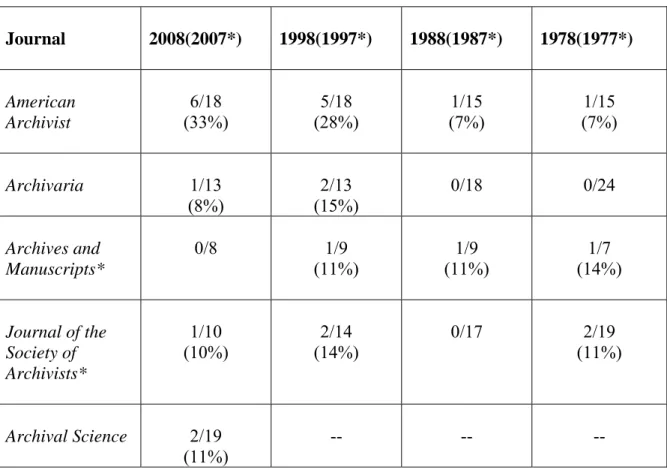
qualitative content, but in these cases I gave the article the “quantitative” code. For the purposes of this study, “qualitative” not only encompassed social-scientific articles that used qualitative methods, but descriptive studies, historical studies, opinion pieces, and conceptual or theoretical studies. Qualitative studies were found to dominate to a large degree in archival journal literature. The graph below shows the number of quantitative articles as a fraction of the total for each issue and year:
37 Peter Horsman, Eric Ketelaar and Theo Thomassen, “Editorial” Archival Science 1 (2001): 1.
38 See the Directory of Archival Education on the Society of American Archivists’ website:
Journal 2008(2007*) 1998(1997*) 1988(1987*) 1978(1977*)
American
Archivist (33%) 6/18 (28%) 5/18 (7%) 1/15 (7%) 1/15
Archivaria 1/13
(8%)
2/13 (15%)
0/18 0/24
Archives and Manuscripts*
0/8 1/9
(11%)
1/9 (11%)
1/7 (14%)
Journal of the Society of Archivists*
1/10
(10%) (14%) 2/14 0/17 (11%) 2/19
Archival Science 2/19
(11%) -- -- --
Table 4.2.1 Number of Quantitative Studies in Each Journal by Year (percentages rounded)
Though the sample was small, it was reasonable to conclude that in the past two decades more attention has been paid to quantitative methods, particularly in the American Archivist. This might be linked the author type results – the development of archival
The “broad church” of methodologies identified by Hider and Pymm in their study of 20 leading journals in LIS literature is not currently present in archival literature, though the American Archivist exhibits the most balance among the journals surveyed.39 As
academics with expertise in quantitative methods continue to work in the archival studies field, we might expect the percentages to become more balanced in time.
4.3Article Topic
The topic, as discussed above was the most difficult category to code given the presence of articles that spanned topics. The graphs below show an initial code (darker color) and an added code (lighter color) for articles that I felt could be coded twice:
Figure 4.3.1 Article Topics 2008/2007: American Archivist, Archivaria, Journal of the Society of Archivists, Archives and Manuscripts, and Archival Science
In the above chart, it is interesting that so few articles deal with archival arrangement and description, particularly given the impact in the last few years of the “more product, less process” philosophy. However, with this exception it can be seen that archival literature exhibits a good range of topics. In contrast to 2008, the 1998 chart above may reflect the work being done on archival description standards such as EAD in the 1990s:
Figure 4.3.3 Article Topics 1988/1987: American Archivist, Archivaria, Journal of the Society of Archivists, and Archives and Manuscripts.
Figure 4.3.4 Article Topics 1978/1977: American Archivist, Archivaria, Journal of the Society of Archivists, and Archives and Manuscripts.
deal with a certain collection or archival context. These were largely purely descriptive pieces that describe a particular project, collection, or archive. In addition, special issues tended to focus on a particular format or environment (for instance, Archivaria ran a special issue on international archives in 1978, which is partly to blame for the enormous spike in the chart for this category). The increased attention paid to special archival formats may be attributed to the electronic records boom, as well as to greater interest over film and photographic collections.
In recent years archival journals have considerably broadened their scope. In particular, there has been growth in articles that focus on ethical and political issues, as well as appraisal and access. It is worth noting that apart from a single category in 1988, all four years had at least 1 article in each category, showing that while earlier issues of archival periodicals tended to be dominated by articles on particular archives or collections (usually descriptive or historical pieces), they did not entirely neglect global issues of the archival profession. However, the last two decades have seen a marked increase in the attention paid to functional areas of archival science such as appraisal and description.
4.4Article Methodology
The methodology category was designed to be more finely-grained than that of type of analysis, distinguishing between historical, conceptual/theoretical, descriptive and empirical (social-scientific) methods.40 Like the topic section, it was often difficult to
code, and there were instances where the historical category was difficult to distinguish from the descriptive/case studies category. In practice, I strove to apply “historical” to only those articles that I felt made some sort of historical argument. Many articles had a historical aspect to them (perhaps unsurprising given many archivists’ historical training and inclinations), but far fewer used analytical methods of historiography that would be common in a history journal. Similarly, the line was fine between conceptual/theoretical articles and historical or descriptive/case study pieces. The results are displayed below:
Table 4.4.1 Article Methodology 2008/2007: American Archivist, Archivaria, Archives and Manuscripts and Archival Science
Table 4.4.2 Article Methodology 1998/1997: American Archivist, Archivaria, Journal of the Society of Archivists and Archives and Manuscripts
Table 4.4.4 Article Methodology 1978/1977: American Archivist, Archivaria, Journal of the Society of Archivists and Archives and Manuscripts
The most apparent finding was that descriptive/case study methods have been
consistently dominant in archival studies for the last three decades, with only the 2008 chart showing a greater number of conceptual or theoretical studies (reflecting, perhaps, the greater number of academic contributions). Recent years, however, have seen the growth of empirical studies, and the more rigorous application of historical
methodologies. This could be a result of methods being imported from other areas of LIS, and the greater involvement of faculty and graduate researchers in the field of
5. Conclusion
Caution should be exercised when drawing conclusions from these results. In a study over time, it is easy to slip into a whiggish, or teleological, mode that looks for or
advocates progressive trends over time, assuming that the present state of affairs is better and more worthy than that of the past. Wertheimer noted that LIS has a tendency to fall into this trap: he argued the decline of historical research in librarianship in favor of quantitative approaches derived from the social sciences has led to an "ahistoricism" in library education - and this is surely far from a positive trend.41 The problems and issues faced by the archival profession thirty years ago are different from what they are now, and if we are wiser today we must also resist condescension to (for instance) the narrower range of methods utilized by past scholars. What is clear, however, is that the library and archival professions today are faced with enormous change, and that the literature of LIS should be able to both explain and address this change. To do so requires both a
historical perspective and a focus on contemporary issues in its journal literature.
Firstly, the data examined here showed that archival journal literature of earlier years tended to be dominated by studies of particular archival environments or collections, although they exhibited a fairly wide range of concerns overall . From the 1990s, examinations of particular functional areas in archives such as appraisal, description and public services became more important. Although this trend may be connected with the rise of academic authorship (see below), it might also be evidence of a greater degree of professionalization, a response to technological and organizational advancement (and
hence change in the way archives are organized, made available and researched), and the influence of other research areas in LIS.
Secondly, academic authors have become far better represented in archival literature since the 1990s. This coincides with the trend of specialized archival programs being offered at LIS schools, and given the increased demand in archival skills in the electronic age (not to mention the need for archivists to process and make accessible the enormous amount of physical and electronic records generated in the twentieth century) this trend is likely to continue. As Richard Cox and Donald Larsen noted in their recent study,
archival studies programs became firmly "embedded" in LIS departments from the 1990s.42 They also argue that archival science has much to offer the emerging "iSchool" movement:
Might it not be the case that the staid (some might say stodgy) discipline known as archival studies might, in fact, provide a window to our future?... Despite the magnitude of the transformation brought about by digital technologies, it is the archivists (and, yes, the librarians), who have made a career out of understanding, whether analog or digital, which it is all information [sic], and there are a set of principles and practices that transcend the medium.43
This assertion of the importance of archives and archival principles to the digital age can only be fulfilled if archival education continues to develop. If this is the case, then the archival literature will continue to be enriched by highly-trained faculty and graduate students who may have access to resources (technological, intellectual and financial) that archival practitioners find difficult to obtain. At the same time, however, it seems likely that practicing archivists will continue to be represented given that they continue to be the main readers of archival journals. Being directly involved in the organization or archives
and the provision of archival services, they are also in a unique position to contribute research that focuses on practical concerns.
Thirdly, the trend toward empirical and quantitative approaches observed by previous authors in LIS has been reflected in archival literature, but to nowhere near the same extent. The strong strain of descriptive and historical content in archival journals, and the persistence of historiographical methods in archival discourse, has been maintained over the last three decades (a trend that Wertheimer, at least, would find encouraging). Notwithstanding Richard Cox’s criticism that historical perspectives in archival studies are often too narrow and provincial, the fact that they continue to be present shows that the field is not blind to insights derived from its own history.44 Despite the increased use of empirical methods (qualitative and quantitative), non-empirical methods still dominate amongst archival practitioners, whether historical, conceptual and theoretical, or
descriptive. I would argue that diversity and balance is to be desired.45 What might be more important is the willingness of journal editorial staff to publish special issues on areas of contemporary importance or interest, such as "Archives, Space and Power" (Archivaria 61), or "Digital Convergence: Libraries, Archives and Museums in the Information Age” (Archival Science 8, no. 4). By examining these topics from different angles (appraisal, description, user services, planning) the archival literature provides the knowledge and tools needed for archivists to more deeply understand the problems and opportunities they face.
44 Richard Cox, Closing an Era: Historical Perspectives on Modern Archives and Records Management
(Westport: Greenwood Press, 2000): 1-14.
Finally, this study revealed some of the advantages and disadvantages of a content analysis of a segment of journal literature. A relatively large amount of archival discourse over a significant time period was analyzed in this paper, but at the cost of depth. The coding system, although derived from a proven model, was imperfect - and, like any such system, had areas of semantic uncertainty. Directions for future research might include refining the present coding scheme and extending the analysis back further (the American Archivist was founded in 1938, and it would be a valuable exercise to track its development over 70 years). Another might be an examination of “other” content (such as book reviews and technical notes) present in LIS journals. A further area of archival discourse that could be examined is that of blogs, open-access publishing, and archive websites.
should remain cognizant of trends in scholarly communication and the needs of their readers, and further research must be constantly performed to examine these topics.46
Bibliography
American Archivist 41
American Archivist 51
American Archivist 61
American Archivist 71
Archival Science 8
Archivaria 6
Archivaria 7
Archivaria 26
Archivaria 27
Archivaria 45
Archivaria 46
Archivaria 65
Archivaria 66
Archives 13
Archives 18
Archives 22
Archives 32
Archives and Manuscripts 15
Archives and Manuscripts 25
Archives and Manuscripts 35
Berman, Whitney E. "Archival Literature: Analysis of the Evolution of American Archivist." MS Thesis, University of North Carolina at Chapel Hill, 2004.
Blessinger, Kelly, and Michele Frasier. "Analysis of a Decade in Library Literature: 1994-2004." College & Research Libraries 68, no. 2 (2007): 155-69.
Buttlar, Lois. “Analyzing the Library Periodical Literature: Content and Authorship.” College & Research Libraries 52, no. 1 (1991): 38-53.
Cox, Richard J. Closing an Era: Historical Perspectives on Modern Archives and Records Management. Westport: Greenwood Press, 2000.
Cox, Richard J., and Ronald L. Larsen. “iSchools and Archival Studies.” Archival Science 8 (2008): 307-326.
Crawford, Gregory A. "The Research Literature of Academic Librarianship: A
Comparison of College & Research Libraries and Journal of Academic Librarianship." College & Research Libraries 60, no. 3 (1999): 224-30.
Feehan, Patricia E., W. Lee Gragg II, W. Michael Havener, and Diane D. Kester,
“Library and Information Science Research: An Analysis of the 1984 Journal Literature” Library and Information Science Research 9 (1987): 173-185.
Franzosi, Roberto. Quantitative Narrative Analysis. Los Angeles: Sage, 2010. González-Alcaide, Gregorio, Lourdes Castelló-Cogollos, Carolina Navarro-Molina, Rafael Aleixandre-Benavent, and Juan Carlos Valderrama-Zurián, “Library and Information Science Research Areas: Analysis of Journal Articles in LISA” Journal of the American Society for Information Science and Technology, 59, no. 1 (2007): 150-154.
Greene, Mark A. "The Power of Archives: Archivists' Values and Value in a Postmodern Age [Presidential Address]." American Archivist 72, no. 1 (2009): 17-41.
Hider, Philip, and Bob Pymm. "Empirical Research Methods Reported in High-Profile Lis Literature." Library & Information Science Research 30 (2008): 108-14.
Järvelin, Kalervo, and Pertti Vakkari. "Content Analysis of Research Articles in Library and Information Science." Library & Information Science Research 12 (1990): 395-421. Järvelin, Kalervo, and Pertti Vakkari. "The Evolution of Library and Information Science 1965-1985: A Content Analysis of Journal Articles." Information Processing &
Management 29, no. 1 (1993): 129-44.
Koufogiannakis, Denise, and Linda Slater. "A Content Analysis of Librarianship Research." Journal of Information Science 30, no. 3 (2004): 227-39.
Krippendorff, Klaus. Content Analysis: An Introduction to Its Methodology. Beverly Hills, CA: Sage, 2004.
Kumpulainen, Sisko. "Library and Information Science Research in 1975: Content Analysis of the Journal Articles." Libri 41, no. 1 (1991): 59-76.
Lövblad, Håkan. "Monk, Knight or Artist? The Archivist as a Straddler of a Paradigm." Archival Science 3 (2003): 131-55.
Nimer, Cory L. "Reading and Publishing within the Archives Community: A Survey." American Archivist 72 (2009): 311-30.
Nour, Martyvonne M. “A Quantitative Analysis of the Research Articles Published in Core Library Journals of 1980” Library & Information Science Research 7 (1985): 261-273
Peritz, Bluma C. “The Methods of Library Science Research: Some Results from a Bibliometric Survey.” Library Research 2 (1981): 251-268.
Pettigrew, Karen E., and Lynne McKechnie. "The Use of Theory in Information Science Research." Journal of the American Society for Information Science and Technology 52, no. 1 (2001): 62-73.
Spurgin, Kristina, and Barbara Wildemuth. "Content Analysis," in Applications of Social Research Methods to Questions in Information and Library Science, ed. Wildemuth. Westport: Libraries Unlimited, 2009.
Appendix A: Coding Scheme
The topic of the article T was classified as follows:
1. Education in archival studies 2. Archival appraisal
3. Archival arrangement/description (includes discussion of processing and provenance)
4. Archival access (user services, instruction, public displays) 5. Administration/planning/management
6. Special archival environments and collections (for instance, archives in a particular country or context)
7. Special archival formats (such as digitally-born materials, microfilm, photographs)
8. Archival ethics, political and legal issues 9. Preservation/conservation
10.Professional issues (for instance, surveys on the archival profession, reflections on the archivist’s role, etc.)
11.Biography
The author type A was classified by:
1. Practitioner 2. Academic 3. Both
4. Unable to be determined
The type of analysis N was coded:
4. Not applicable/unable to be determined
As was the type of investigation I:
1. Historical 2. Empirical
3. Conceptual/Theoretical 4. Methodological
Appendix B: Järvelin’s and Vakkari’s Classification Scheme
The information below is transcribed from pages 418-421 of Kalervo Järvelin and Pertti Vakkari, "Content Analysis of Research Articles in Library and Information Science" Library & Information Science Research 12 (1990): 395-421.
Topic
Library and Information Science Topic
A 01 the professions 02 library history
03 publishing (incl. book history)
10 education in LIS
20 methodology (as the study of research methods)
30 analysis of LIS (both literature based on empirical and theoretical)
40 research on library and information science activities 41 study on circulation or interlibrary loan activities 42 collection study
43 study on information or reference services 44 study on user education
45 study on library buildings or facilities 46 study on administration or planning
47 automation study (except when concerned with some particular activity) 48 study on other library and information service activities
49 study on several interconnected activities 50 research on information storage and retrieval 51 cataloguing study
52 study on classification and indexing 53 study on information retrieval
54 study on bibliographic databases or bibliographies
55 study on other types of databases (factual, textual, numeric…) 60 research on information seeking
61 information dissemination study
62 study on the use or users of channels or sources of information 63 study on the use of library and information services
64 study on information seeking behaviour
65 information use study (whether (and how) information has been used) 66 study on information management, IRM
70 research on scientific and professional communication 71 study on scientific or professional publishing
73 study on other aspects of scientific or professional communication 80 study on other aspects of LIS
90 other study (other discipline) Approaches
Viewpoint on Information Dissemination
P 10 study on several interconnected phases of dissemination 11 information producer’s (originator’s) viewpoint
12 information seller’s (marketer’s) viewpoint 13 intermediary’s viewpoint
14 intermediary organization’s viewpoint 15 end-user’s viewpoint
16 end-user organization’s viewpoint
17 viewpoint of the developer of the process or a service (prefer the alternatives above) 18 LIS educator’s viewpoint
19 other viewpoint
00 no viewpoint on information dissemination Societal Level
S 1 individual 2 organizational 3 societal 4 multi-level 0 not applicable Method
Research Strategy
M 10 empirical research strategy 11 historical method
12 survey method 13 qualitative method 14 evaluation method
15 case or action research method 16 content or protocol analysis 17 citation analysis
18 other bibliometric method 21 secondary analysis
22 experiment
32 concept analysis
40 mathematical or logical method
50 system and software analysis and design 60 literature review
70 discussion paper 80 bibliographic method 90 other method
00 not applicable, no method Data Collection Method
C 1 questionnaire, interview 2 observation
3 thinking aloud 4 content analysis 5 citation analysis
6 historical source analysis 7 several methods of collecting 8 use of data collected earlier 9 other method of collecting 0 not applicable
Type of Analysis
Q 1 qualitative 2 quantitative
0 not applicable (not empirical, not an investigation) Type of Investigation
I 10 empirical 11 descriptive 12 comparative 13 explanatory 20 conceptual 30 theoretical 40 methodological
50 system description (constructive) 90 other type