ASSESSMENT OF SAPRC07 WITH UPDATED ISOPRENE OXIDATION CHEMISTRY AGAINST OUTDOOR CHAMBER EXPERIMENTS
Yuzhi Chen
A Master’s technical report submitted to the faculty of the University of North Carolina at Chapel Hill in partial fulfillment of the requirements for the degree of Master of Science in Environmental Engineering in the department of Environmental Science and Engineering in the Gillings School of Public Health.
Chapel Hill 2014
Approved by: William Vizuete Jason Surratt
ABSTRACT
Yuzhi Chen: Assessment of SAPRC07 with Updated Isoprene Oxidation Chemistry Against Outdoor Chamber Experiments
(Under the direction of William Vizuete)
Isoprene, the most emitted non-methane hydrocarbon, is known to influence ozone (O3) formation in urban areas rich with biogenic emissions. To keep up with the recent advance on isoprene oxidation chemistry including the identification of isoprene epoxydiols (IEPOX) as a precursor to secondary organic aerosol (SOA), Xie et al. (2013) updated the SAPRC (Statewide Air Pollution Research Center)-07 chemical mechanism. It is currently unknown how the Xie modification of SAPRC07T impacts the ability of the model to predict O3. In this project we will evaluate the Xie
mechanism with simulations of 24 isoprene experiments from the UNC gas-phase chamber. Our results suggest that the new mechanism increases NOX (nitrogen oxides) inter-conversion and produces more O3 than SAPRC07 for all experiments. In lower NOX experiments, the new mechanism worsens O3 performance towards the wrong direction, increasing bias from 8.9% to 15.8%. We found increased NOX recycling from NOZ (oxidized NO2) accounts for that. These results underline the importance of further studies on characterizing the NOX recycling rate from isoprene nitrates.
iv
TABLE OF CONTENTS
LIST OF TABLES ... v
LIST OF FIGURES ... vi
LIST OF ABBREVIATIONS ... vii
CHAPTER I: INTRODUCTION ... 1
CHAPTER II: METHODS ... 4
2.1 Modeling ... 5
2.2 Experimental ... 5
CHAPTER III: RESULTS AND DISCUSSION ... 8
3.1 Model Performance ... 8
O3 Peak ... 8
NO-NO2 Crossover ... 9
3.2 Process Analysis ... 11
Case Study ... 11
Sensitivity Runs ... 21
CHAPTER IV: CONCLUSION ... 23
APPENDIX A: XIE MODIFICATION OF SAPRC07T REACTIONS LISTING ... 24
APPENDIX B: UNC AUXILIARY MECHANISM REACTIONS LISTING ... 48
REFERENCES ... 51
LIST OF TABLES
Table 1 Characterization Runs – Initial concentration. ... 5
Table 2 Isoprene Runs – Initial injected species and concentration ... 6
Table 3 Summary of O3 peak model performance statistics ... 9
Table 4 Summary of crossover time statistics ... 10
Table 5 Selected study Cases Initial Condition and O3 peak concentration ... 12
Table 6 The initial steps of isoprene oxidation by OH for the SAPRC07 and Xie mechanisms ... 13
Table 7 OH radical budget for: (Upper Row) JN2381BLUE (High NOX) and (Lower Row) JN2697RED (Lower NOX) experiments. ... 18
Table 8 NO2 production irr (ppb) from NO conversion and recycling from NOZ: (Upper Row) JN2381BLUE (High NOX) and (Lower Row) JN2697RED (Lower NOX) ... 19
Table 9 NO cycle calculation specifics: (Upper Row) JN2381BLUE (High NOX) and (Lower Row) JN2697RED (Lower NOX) ... 20
vi
LIST OF FIGURES
Figure 1 Ozone peak (a) under low ISOP:NOX ratio and (b) under high ISOP:NOX ratio ... 9 Figure 2 NO-NO2 Crossover time ... 10 Figure 3 Ozone and NOX concentration time profile for: (a) JN2381BLUE (High NOx)
and (b) JN2697RED (Lower NOx) ... 12 Figure 4 Isoprene concentration time profile for: (a) JN2381BLUE (High NOX) and
(b) JN2697RED (Lower NOX) ... 13 Figure 5 OH concentration time profile for: (a) JN2381BLUE (High NOX)
and (b) JN2697RED (Lower NOX) ... 14 Figure 6 VOCs and isoprene reaction rate against OH time series for: (a) JN2381BLUE
(High NOX) and (b) JN2697RED (Lower NOX) ... 14 Figure 7 HO2 production rate from aldehyde time series for: (a) JN2381BLUE (High NOX)
and (b) JN2697RED (Lower NOX) ... 14 Figure 8 Comparison of Total OH+VOC reactions IRR: (a) JN2381BLUE (High NOX)
and (b) JN2697RED (Lower NOX) ... 15 Figure 9 Detailed comparison of mass through various VOC+OH reaction
pathways for JN2381BLUE (High NOX) ... 16 Figure 10 Detailed comparison of mass through various VOC+OH reaction
pathways for JN2697RED (Lower NOX) ... 17 Figure 11 Nitrogen loss reaction rate time series through deposition of HNO3
and nitrogen loss (XN): (a) JN2381BLUE (High NOX)
and (b) JN2697RED (Lower NOX). ... 19 Figure 12 NOX recycling rate time series from oxidized form NO2: (a) JN2381BLUE
(High NOX) and (b) JN2697RED (Lower NOX). ... 19 Figure 13 NO2 recycling rate from PANs for JN2697RED (Lower NOX). ... 20 Figure 14 Radical cycle relative difference with regard to initial isoprene:NOX ratios:
LIST OF ABBREVIATIONS
AQM Air Quality Model
CH4 Methane
CMAQ Community Multi-scale Air Quality Model
CO Carbon Monoxide
EPA U.S. Environmental Protection Agency
ETHE Ethene
ETHLN Model Species In The Xie Modification Of SAPRC07T Representing Ethanol Nitrate HCHO Formaldehyde
HO2 Hydroperoxy radical
HOX Radical Family Including OH And HO2 HPALD Hydroperoxy-Aldehydes
IEPOX Isoprene Epoxydiols
ISOP Isoprene
ISOPNB Model Species In The Xie Modification Of SAPRC07T Representing Β-Isoprene Nitrates ISOPND Model Species In The Xie Modification Of SAPRC07T Representing Δ-Isoprene Nitrates ISOPO2 Model Species In The Xie Modification Of SAPRC07T Representing Isoprene Peroxy
radicals From Isoprene + OH
MACR Model Species In SAPRC07 Representing Acroleins And Methacrolein
MACRN Model Species In The Xie Modification Of SAPRC07T Representing Methacrolein Nitrate MAE Methacrylic Acid Epoxide
MEO2 Model Species In SAPRC07 Representing Methyl Peroxy Radicals MECO3 Model Species In SAPRC07 Representing Acetyl Peroxy Radicals MVK Model species in SAPRC07 representing methyl vinyl ketone
MVKN Model species in the Xie modification of SAPRC07T representing methyl vinyl ketone nitrate
NAAQS National Ambient Air Quality Standards
viii
NISOPOOH Model species in the Xie modification of SAPRC07T representing C5-nitrooxyhydroperoxide
NIT1 Model species in the Xie modification of SAPRC07T representing C5-nitrooxycarbonyl
NO Nitric Oxide
NO2 Nitrogen dioxide NO3 Nitrate Radical
NOX Nitrogen oxides including NO and NO2
O3 Ozone
OH Hydroxyl Radical PAN Peroxy Acyl Nitrates
PM Particulate Matter or aerosol
PM2.5 Particulate Matter with aerodynamic diameter less than 2.5 micrometers
PROPNN Model Species in Xie modification of SAPRC07T representing propanone nitrate RNO3 Model Species in SAPRC07 representing lumped organic nitrates
RNO3I Model Species in Xie modification of SAPRC07T representing lumped organic nitrates from isoprene
RO2C Peroxy Radical operator in SAPRC07 representing NO to NO2 and NO3 to NO2
conversions, and the effects of peroxy radical reactions on acyl peroxy and other peroxy radicals
SAPRC07 Statewide Air Pollution Research Center 2007 chemical mechanism SO2 Sulfur Dioxide
CHAPTER I: INTRODUCTION
Isoprene (2-methyl-1, 3-butadiene, C5H8) is the most abundant non-methane hydrocarbon emitted from vegetation [1] and has a significant impact on atmospheric chemistry. Isoprene is known to influence ground-level ozone (O3) formation in urban areas rich with biogenic emissions [2],[3]. In recent years new discoveries have been made concerning isoprene oxidation chemistry leading to SOA or PM formation [4]–[12]. By combining organic synthesis, computational calculations, smog chamber studies, and field measurements researchers have recently characterized reactive epoxides that are produced from the photochemical oxidation of isoprene and are significant for SOA formation [8]-[11]. These gas-phase oxidation products include MAE and IEPOX. From recent work it is clear that anthropogenic pollutants, such as NOX and SO2, significantly enhance these isoprene-derived epoxides as a source of PM2.5 [8]-[12]. This is of great public health and regulatory importance since isoprene is primarily emitted from terrestrial vegetation, and thus, is not controllable, whereas anthropogenic emissions (e.g., NOX, SO2, or pre-existing primary aerosol) are controllable.
The chemical mechanisms in current regulatory models, however, do not have the gas-phase chemistry needed to predict isoprene-based SOA precursors. Isoprene gas phase oxidation chemistry is currently represented in AQMs in a condensed form. It is designed to represent the chemical formation of O3 while incorporating simplification and approximation for computational efficiency. To evaluate future control strategies, new gas and particle phase isoprene chemistry must be incorporated in air quality models (AQMs) to study the importance of isoprene emissions on both ground level O3 and SOA formation.
2
ISOP + OH ----> 0.986*RO2C + 0.093*RO2XC + 0.093*zRNO3 + 0.907*xHO2
+ 0.624*xHCHO+ 0.23*xMACR + 0.32*xMVK + 0.357*xIPRD
+ yR6OOH + 0.167*XC (R 1) In the Xie modification, bulk hydroxyl-peroxy isoprene radicals (ISOPO2) is formed (R 2), which in turn produces MACR and MVK by reaction with other species, namely, NO, HO2, MEO2, RO2C, MECO3 and ISOPO2 itself (Reactions in Appendix A).
ISOP + OH ----> ISOPO2 + ISOPRXN (R 2)
In the original SAPRC07 mechanism, reaction with NO3 does not yield either MACR or MVK, but in the Xie modification the product NISOPO2 is created (R 3).
ISOP + NO3 → NISOPO2 (R 3) NISOPO2, like its non-nitrated analogue, reacts with NO3, NO, MEO2, RO2C, and MECO3 to give small yields of MACR and MVK (Reactions in Appendix A). Other reactions of isoprene, with O3 and Cl radicals, are unchanged in the Xie modification. Isoprene-derived nitrates are treated explicitly. First generation isoprene nitrates include ISOPN (= ISOPND + ISOPNB), NIT1, and NISOPOOH. ISOPND and ISOPNB are produced in the Xie mechanism instead of RNO3 in the standard SAPRC07. ISOPN reacts an order of magnitude faster with OH and has almost 100% higher recycling of NO2 than RNO3 does. NIT1— formed in NISOPO2 + NO/NO3/RO2 reactions—reacts with OH and NO3 and forms respective peroxy radical species, which react with other radicals similarly as the initially formed peroxy radical species (ISOPO2/NISOPO2) to yield little NOX and other products. Xie also assumes 70% NOX recycling efficiency from NIT1 + O3 oxidation. NISOPOOH is the product of NISOPO2 + HO2 reaction. The OH oxidation of the above first-generation nitrates forms secondary isoprene nitrates including: short-lived MVKN, MACRN, ETHLN, RNO3I, and longer-lived PROPNN. These products can either react with OH or photolyze to give NO2 back. In the Xie mechanism, isoprene oxidation chemistry under low NOX
conditions was updated. These updates includes IEPOX formation from ISOPO2 + HO2 channel (R 4) and HPALD formation from ISOPO2 isomerization (R 5). HOX is produced in subsequent reactions of products from both reactions.
Xie et al. integrated the updated SAPRC07T chemical mechanism into the CMAQ model version 4.7 and simulated from 1 July to 16 August 2004 across the entire continental US and a portion of Canada and Mexico [13]. These additions to the CMAQ model allow for explicit predictions of OH reformation from isoprene peroxy radicals, NO2 recycling from isoprene nitrates and IEPOX-SOA tracers (and thus total SOA mass from isoprene oxidation). Current AQMs estimate that isoprene contributes 27% [16] ~ 48% [17] to the global burden of SOA [18], yet under predict summertime isoprene SOA especially in areas like southeastern U.S. [19]. Xie et al. found that, compared to the base case simulation with SAPRC07T [20], their updated mechanism improves the simulation of aircraft measurement for gas phase compounds including NOx (bias from -7% to 1%), O3 (increases 1-2 ppbtv with bias still within ± 5%), HCHO (bias from -12% to -9%) and isoprene (bias from 26% to 4%). Xie also reported biogenic SOA increased by 15% compared to the base case.
4
CHAPTER II: METHODS
2.1 Modeling
Two mechanisms compared in this study, standard SAPRC07 [14], [15] and Xie, were
implemented in the Morpho Photochemical Reaction Simulation System [23]. The SAPRC07 source code was created based on Dr. Carter’s report [14], [15]. The Xie mechanism was contained in the CMAQ files provided by Dr. Xie, and converted to the Morpho format [24]. The UNC Auxiliary Mechanism (version-aadg) was used to account for chamber dependent wall effects. The principal and auxiliary mechanism reactions specifics are provided in the Appendix B.
2.2 Experimental
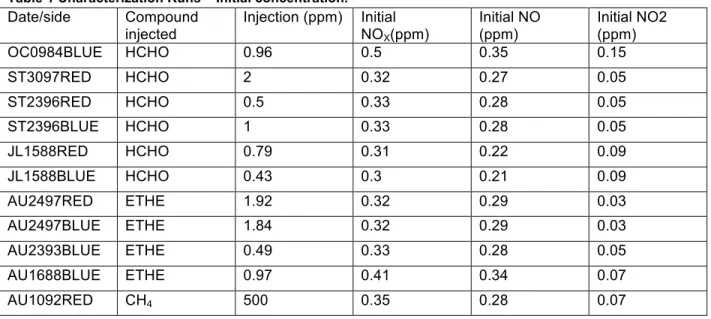
Overall, 40 experiments (16 characterization runs and 24 isoprene runs) were conducted in the UNC Dual gas-phase chamber (Pittsboro,NC). Sixteen characterization runs were chosen to evaluate the light model and wall chemistry parameters represented in the auxiliary mechanism [25]. Species in these runs include carbon monoxide (CO), methane (CH4), ethene (C2H4) and formaldehyde (HCHO). These are explicit species in the chemical mechanism and whose kinetic information is well quantified. These runs are outlined in Table 1.
Table 1 Characterization Runs – Initial concentration.
Date/side Compound injected
Injection (ppm) Initial NOX(ppm)
Initial NO (ppm)
Initial NO2 (ppm)
OC0984BLUE HCHO 0.96 0.5 0.35 0.15
ST3097RED HCHO 2 0.32 0.27 0.05
ST2396RED HCHO 0.5 0.33 0.28 0.05
ST2396BLUE HCHO 1 0.33 0.28 0.05
JL1588RED HCHO 0.79 0.31 0.22 0.09
JL1588BLUE HCHO 0.43 0.3 0.21 0.09
AU2497RED ETHE 1.92 0.32 0.29 0.03
AU2497BLUE ETHE 1.84 0.32 0.29 0.03
AU2393BLUE ETHE 0.49 0.33 0.28 0.05
AU1688BLUE ETHE 0.97 0.41 0.34 0.07
6
AU1092BLUE CH4 250 0.35 0.28 0.07
AU0197RED CH4 500 0.35 0.3 0.05
AU0197BLUE CH4 250 0.34 0.29 0.05
ST3097BLUE CO 250 0.33 0.28 0.05
AU3093BLUE CO 100 0.32 0.28 0.04
Note: Dates/sides trailing code ‘RED ‘ and ‘BLUE’ denote the side of Dual chamber where the experiment was operated.
Twenty-four isoprene photo-oxidation experiments were also used and shown in Table 2. In this study, runs in which the isoprene:NOx concentrations have a ratio less than 1.25 (ppm/ppm) were
arbitrarily classified as having a low VOC:NOX ratio or a high NOX experiment, while those over 1.25 were considered to have a high VOC:NOX ratio or a lower NOX experiment.
Table 2 Isoprene Runs – Initial injected species and concentration
Date/Side ISOP:NOX (ppm/ppm)
initial ISOP (ppm)
initial NOX (ppm)
initial NO (ppm)
initial NO2 (ppm)
JN1793BLUE 0.18 0.1 0.54 0.47 0.07
JN1793RED 0.35 0.19 0.54 0.47 0.07
JL1780RED 0.44 0.2 0.46 0.36 0.1
JN2381BLUE 0.58 0.26 0.45 0.32 0.13
JL2381RED 0.65 0.28 0.43 0.35 0.08
JN2381RED 1.04 0.46 0.44 0.31 0.13
JL1780BLUE 1.11 0.52 0.47 0.36 0.11
JN2697BLUE 1.13 0.38 0.34 0.27 0.07
JN2592RED 1.61 0.58 0.36 0.31 0.05
OC1596BLUE 1.78 0.58 0.33 0.29 0.04
OC1596RED* 1.84 0.6 0.33 0.28 0.04
AU0897RED 1.89 1.28 0.68 0.59 0.09
AU1597BLUE 1.9 1.58 0.83 0.78 0.06
JN0298BLUE 2.13 1.5 0.7 0.58 0.12
ST0799BLUE 2.31 1.62 0.7 0.69 0.01
ST1199BLUE 2.47 1.5 0.61 0.6 0.01
JN2996RED 2.53 1.02 0.4 0.33 0.07
AU1196BLUE 2.91 0.98 0.34 0.29 0.04
JN2996BLUE 3.12 1.26 0.4 0.34 0.07
ST2496RED 3.2 2.06 0.64 0.57 0.07
JN2592BLUE 3.33 1.2 0.36 0.32 0.04
JN2697RED 3.73 1.29 0.35 0.28 0.07
OC0697RED 4.85 3.12 0.64 0.56 0.08
CHAPTER III: RESULTS AND DISCUSSION
3.1 Model Performance
Simulations of with SAPRC07 and the Xie mechanism were statistically compared with
observational data in terms of peak O3 concentration and NO-NO2 crossover time derived from temporal concentration profiles of NO, NO2, O3 (Figure 3 and Figure 4). The NO-NO2 crossover time implies how fast a mechanism is converting NO to NO2 and propagating the autocatalytic process of O3 production. Ozone peak/maximum value is a direct indicator of regulatory interest as reflected by 8-hour ozone standard in NAAQS. Both indicators are reported in the form of normalized mean bias (NMB) computed using Eqn. 1.
𝑁𝑀𝐵=1
n∑
𝑠𝑖𝑚𝑢𝑙𝑎𝑡𝑖𝑜𝑛−𝑜𝑏𝑠𝑒𝑟𝑣𝑎𝑡𝑖𝑜𝑛
𝑜𝑏𝑠𝑒𝑟𝑣𝑎𝑡𝑖𝑜𝑛 × 100%
(1)
O3 Peak
Figure 1 Ozone peak (a) under low ISOP:NOX ratio and (b) under high ISOP:NOX ratio
Note: Each point (circle or cross) represents the crossover time of an experiment, with the predicted value on the y axis and measured value on the x axis. The diagonal line suggests perfect modeling agreement with the observation. Red Circle stands for ozone concentration simulated by SAPRC07 and blue cross stands for predictions by the Xie mechanism. The area enclosed by two dashed lines at ±25% is the acceptable range of bias.
Table 3 Summary of O3 peak model performance statistics
Experiment Condition Mechanism NMB (%) R2 P value
N=8 High NOX SAPRC07 Xie -9.79 0.58 0.13 0.14 0.38 0.36 N=16 Low NOX SAPRC07 Xie 8.91 15.84 0.84 0.74 5.74e-07 1.78e-05
NO-NO2 Crossover
10
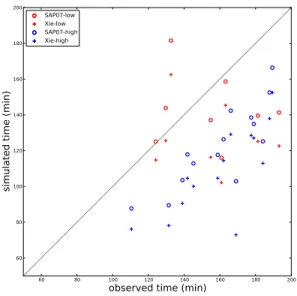
Figure 2 NO-NO2 Crossover time
Note: Circle stands for crossover time simulated by SAPRC07 and cross stands for times predicted by the Xie mechanism. Each point (circle or cross) represents the crossover time of an experiment, with the predicted value on the y axis and measured value on the x axis. The diagonal line suggests perfect modeling agreement with the
observation. Red indicates the experiments with low initial ISOP:NOX and blue for high ISOP:NOX. Note that the time
shown here is the crossover time relative to the start of the experiment.
Table 4 Summary of crossover time statistics
Experiment Condition Mechanism NMB (%) R2
N=8 High NOX SAPRC07 Xie -16.0 -5.4 0.022 0.032
3.2 Process Analysis
In the following analysis, our focus shifts from model-to-observation comparison to mechanism inter-comparison under different initial ISOP:NOX ratios. Chemical reaction process analysis is applied in this step using PERMM (Python-based Environment for Reaction Mechanisms/Mathematics) [26]. Process analysis is based on the concepts of integrated reaction rate (IRR) analysis[27],[28]. The IRR over each time step of each reaction in the mechanism is outputted to .irr file and the IRR over the course of the simulation and its corresponding reaction is outputted to .irrmg file by MORPHO. PERMM reads in these MORPHO outputs and provides an interface to obtain net reactions and quantify radical and NOx budgets. To account for the pattern observed in model performance assessment, we conducted reaction process analysis on two selected cases -- one high NOx case and one lower NOx case (Table 5). The difference between SAPRC07 and Xie is reported in the form of relative difference (RD) using Eqn. 2. In this case, a positive RD value would suggest Xie has a higher cycle number, vice versa.
𝑅𝐷=𝑋𝑖𝑒−𝑆𝐴𝑃𝑅𝐶07
𝑆𝐴𝑃𝑅𝐶07 ×100%
(2)
Case Study
12
Table 5 Selected study Cases Initial Condition and O3 peak concentration
Experiment
Initial ISOP:NOX (ppm/ppm)
Initial isoprene (ppm)
Initial NOX (ppm)
O3 peak (ppm)
O3 max (ppm)
JN2381BLUE 0.58 0.26 0.45 0.85 0.85
JN2697RED 3.73 1.29 0.35 0.57 0.75
Note: Here only the measured values of the first ozone peak are shown.
For JN2381BLUE (high NOX), both mechanisms under-predict the NO-NO2 crossover time and maximum O3 concentration. Neither mechanism is able to predict the actual O3 peak around 5 pm. The Xie mechanism had a result closer to the measurement. For JN2697RED (lower NOX), both mechanisms over-predict the NO-NO2 crossover time and under-predict the morning O3 peak to a similar extent. The Xie mechanism, however, produces O3 faster in the afternoon increasing final O3 concentrations by 0.21 ppb and 0.35 ppb compared to the observation and SAPRC07. Regardless of the difference of the ability to reproduce observations the Xie mechanism predicts an earlier crossover time and a higher O3 peak concentration and is visually represented in Figure 3. Table 6 lists the reactions for the OH reaction with
Figure 3 Ozone and NOX concentration time profile for: (a) JN2381BLUE (High NOx) and (b) JN2697RED
(Lower NOx)
Note: Observation values are plotted in black with measured data points. Simulation by SAPRC07 is plotted in red and Xie in blue. “SAP07” stands for SAPRC07 and “Obs” stands for observation.
aldehyde converts NO to NO2 and produces a OH radical. This OH will participate in a new round of VOC oxidation and propagation reactions, thus amplifying the entire chain. Accordingly, more OH is predicted by the Xie mechanism as shown in Figure 5. The increased OH production permits the Xie mechanism to continue to oxidize VOCs until the end of the experiment (Figure 6).
Table 6 The initial steps of isoprene oxidation by OH for the SAPRC07 and Xie mechanisms
Note: Rate constant IDs are provided here and their values can be found in Appendix X.
Figure 4 Isoprene concentration time profile for: (a) JN2381BLUE (High NOX) and (b) JN2697RED (Lower NOX)
Note: Observation values are plotted in black with measured data points. Simulation by SAPRC07 is plotted in red and Xie in blue.
Mechanism Reactions Rate
SAPRC07 ISOP + OH = 0.986*RO2C + 0.093*RO2XC + 0.093*zRNO3 + 0.907*xHO2 + 0.624*xHCHO+ 0.23*xMACR + 0.32*xMVK + 0.357*xIPRD + yR6OOH + 0.167*XC
k[BE06]
xHO2 + NO = HO2 + NO k[BR07]
RO2C + NO ----> NO2 k[BR07]
Xie ISOP + OH = ISOPO2 + ISOPRXN k[BE06]
ISOPO2 + NO = 0.40*MVK + 0.26*MACR + 0.883*NO2 +
0.07*ISOPND + 0.047*ISOPNB + 0.66*HCHO + 0.10*HC5 + 0.043*ARO2 + 0.08*DIBOO + 0.803*HO2
14
Figure 5 OH concentration time profile for: (a) JN2381BLUE (High NOX) and (b) JN2697RED (Lower NOX)
Figure 6 VOCs and isoprene reaction rate against OH time series for: (a) JN2381BLUE (High NOX) and (b)
JN2697RED (Lower NOX)
Note: VOCs reaction rate is plotted in solid steps and isoprene reaction rate is plotted in dashed steps. Values of SAPRC07 are drawn in red and those of Xie are drawn in blue.
Figure 7 HO2 production rate from aldehyde time series for: (a) JN2381BLUE (High NOX) and (b) JN2697RED
(Lower NOX)
Note: For SAPRC07 aldehyde includes formaldehyde (HCHO), acetaldehyde (CCHO) and lumped aldehyde (RCHO). Except for those three aldehyde species in SAPRC07, another two are added in Xie mechanism: glycoaldehyde (HOCCHO) and hydroperoxy aldehydes (HPALD).
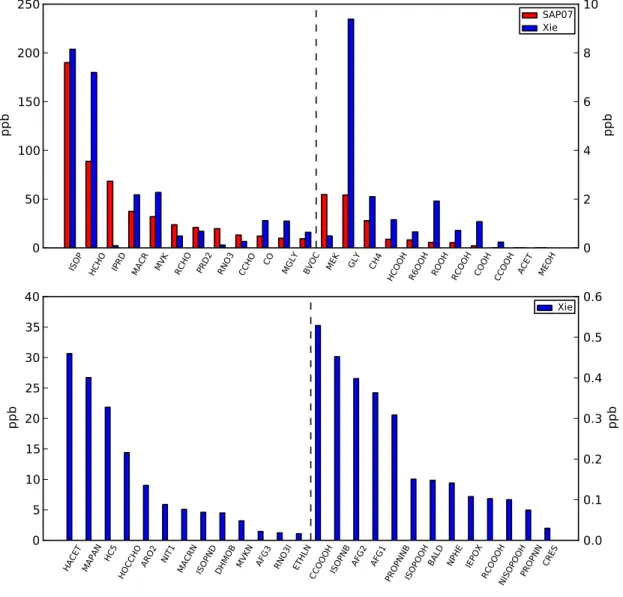
and the increased reaction of existing species. A complete lists of VOCs reacted with OH are shown in their own identities in
Figure 9. Note that there is a mass shift within certain species because of changed pathways in Xie mechanism. For example, RNO3 are now represented by species including ISOPND, ISOPNB, NIT1, NISOP2OOH, MACRN, MVKN, and ETHLN, RNO3I and itself in the Xie mechanism. So part of the OH radicals that used to react with RNO3 are now distributed to reaction with each of those species.
Figure 8 Comparison of Total OH+VOC reactions IRR: (a) JN2381BLUE (High NOX) and (b) JN2697RED (Lower
NOX)
16
Figure 9 Detailed comparison of mass through various VOC+OH reaction pathways for JN2381BLUE (High NOX)
Figure 10 Detailed comparison of mass through various VOC+OH reaction pathways for JN2697RED (Lower NOX)
18
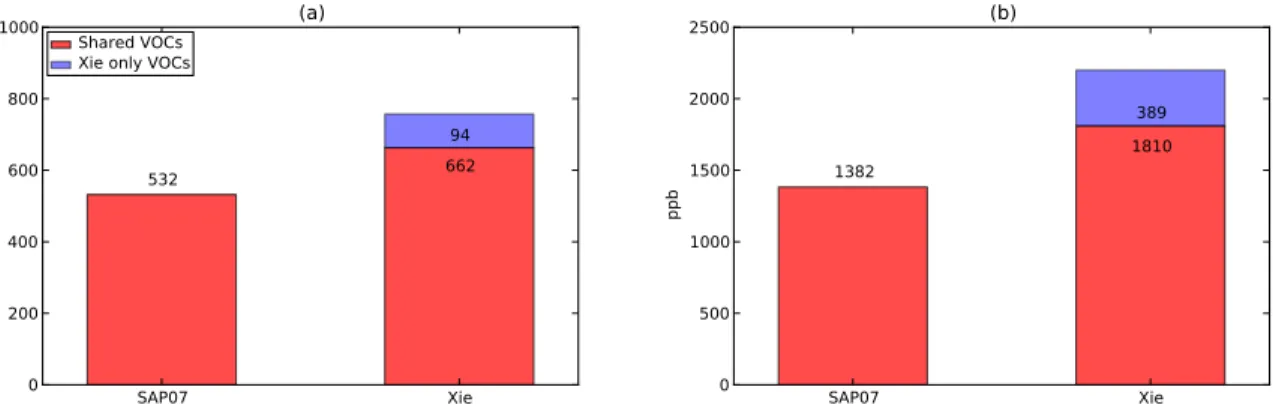
A summary of the OH radical budget is tabulated in Table 7. This OH cycle number is an indication of the efficiency of the system in using OH radicals. In the simulations by the Xie mechanism, OH cycle is about -29.3% different in the high NOX case, but 8% different in the lower NOX case. In the high NOX case, the Xie mechanism was less efficient in use of OH even though it produced twice the amount of new OH (Table 7). The increased OH concentration in this experiment, coupled with higher NO2 concentrations, increased the competition of OH through termination reaction (R 6) instead of VOC + OH reactions. For the lower NOX case, this termination pathway is not as significant so the difference in OH cycle for the two mechanisms is less.
NO2 + OH à HNO3 (R 6)
Table 7 OH radical budget for: (Upper Row) JN2381BLUE (High NOX) and (Lower Row) JN2697RED (Lower
NOX) experiments.
Experiment Mechanism New OH (ppb) OH + VOC (ppb) OH + NO2 (ppb) OH cycle (unitless) Inorganic Organic Total
JN2381BLUE SAPRC07 29.4 56.2 85.5 532 140.9 8.2 SAPRC07Xie 34.3 136.8 171.2 756 210.3 5.8
JN2697RED SAPRC07 46.5 476.2 522.7 1382 13.9 2.5 SAPRC07Xie 67.6 670.4 738 2199 30.8 2.7
The photolysis of NO2 is the dominant pathway to make O3 in the troposphere. Table 8 shows that the reactions of NO with XO2 and NOZ account for over 50% of NO2 production in the Xie mechanism compared to 35% in SAPRC07. The remaining 49% of NO2 comes from reaction of NO with O3 in the Xie mechanism, compared to 65% in SAPRC07. Therefore, the Xie mechanism is able to produce more O3. For the lower NOX case, there is 59% difference for the second peak O3 concentration. Table 8 shows that about 50% more NO2 is recycled from NOZ in the Xie mechanism than in SAPRC07, causing this increase in ozone production. Table 9 shows the NO cycles for both experiments. In high NOX
increasing O3 concentrations shown in Figure 3. The consistency remains for experiments having higher ISOP:NOX ratios, of which the second peak differences between two mechanisms are even larger.
Figure 11 Nitrogen loss reaction rate time series through deposition of HNO3 and nitrogen loss (XN): (a)
JN2381BLUE (High NOX) and (b) JN2697RED (Lower NOX).
Figure 12 NOX recycling rate time series from oxidized form NO2: (a) JN2381BLUE (High NOX) and (b)
JN2697RED (Lower NOX).
Table 8 NO2 production irr (ppb) from NO conversion and recycling from NOZ: (Upper Row) JN2381BLUE
(High NOX) and (Lower Row) JN2697RED (Lower NOX)
Experiment Mechanism
NO->NO2 (ppb) NO
Z -> NO2
(ppb) Total NO(ppb) 2 NO+XO2 NO+NO3 NO+O3 Total
JN2381 BLUE
SAP07 1191 1442 27575 30208 12061 42269
Xie 1449 1479 20991 23920 18301 42221
JN2697 RED
SAP07 2138 93 4537 6721 9686 16407
Xie 2790 336 5901 8860 17180 26040
20
Table 9 NO cycle calculation specifics: (Upper Row) JN2381BLUE (High NOX) and (Lower Row) JN2697RED
(Lower NOX)
Experiment Mechanism Injection New NO (ppb) HONO WHNO3 NO -> NO2 (ppb) NO cycle (unitless) Total
JN2381BLUE SAPRC07 445 8 4 457 30208 66.1 SAPRC07Xie 445 8 4 457 23920 52.4
JN2697RED SAPRC07 342 1 0 343 6721 19.6 SAPRC07Xie 342 1 0 343 8860 25.9
Note: NO cycle number = amount of NO to NO2 conversion/new NO.
We found that the majority of NO2 recycling increase comes from PANs (Figure 13). Xie mechanism predicts 64% more NO2 from PANs (PAN, MAPAN & PAN2) than SAPRC07 and that
increase accounts for 85% of the total increase in NO2 recycling. This is due to increased first-generation VOCs products and NO2 concentration, thus more PANs being made. The Xie mechanism has changed the radical balance of SAPRC07 and directed more NOX to its temporary reservoir species instead of terminating it through XN (Figure 11b).
Figure 14 shows the percent difference between the two mechanisms of the OH and NO cycle for the entire experimental set. In the high NOX experiments, the difference in OH cycle is smaller than that in the lower NOX experiments. When the experimental conditions are at lower NOX concentrations, the Xie mechanism tends to have a higher OH cycle. A similar trend is observed in NO cycle difference (Figure 14b). The Xie mechanism has the ability to produce more OH attack on VOCs and convert more NO to NO2 than the SAPRAC07 mechanism. Under high NOX conditions, this results in higher NO2 and OH concentrations and thus increased termination reactions. Although more NO2 and ultimately O3 are produced, the OH and NO cycle are lowered. In the lower NOX experiments, the termination reactions are not as large and the recycled NO2 late in the day accounts for the differences in the cycle numbers with the SAPRAC07 mechanism.
Figure 14 Radical cycle relative difference with regard to initial isoprene:NOX ratios: (L) OH cycle (R) NO
cycle
Note: Each blue point stands for an experiment. The vertical red dashed lines separate the high NOX on the left and low NOX experiments on the right. The dashed green trendlines are for visual aids only. A positive value means Xie mechanism has a higher cycle number, vice versa.
Sensitivity Runs
Model performance results under lower NOX conditions prompted several sensitivity runs exploring low NOX chemistry and NO2 recycling. Again, the lower NOX experiment selected for process analysis JN2697RED will be used as our testing case. Recent chamber experimental work by Fuchs et al. (2013) confirmed OH regeneration from HPALD produced in ISOPO2 unimolecular reactions (1,6-H shift) but the rate constant k1,6-isom= 8.5 × 10⁸ exp(-5930/T) cm3/s in Leuven isoprene mechanism (LIM) [29] is too large. They evaluated against isoprene photo-oxidation experiments the values of k1,6-isom and
22
rate coefficient value for 1,5-H shift isomerization of ISOPO2 and additional recycling of unknown peroxy radicals. Xie used 4.07 × 10⁸ exp(-7694/T) cm3/s [31],[32]. Here we simulated with a value of 2.35 × 10⁸ exp(-7694/T) cm3/s. The second analysis will focus on changing the isoprene nitrates (ISOPN) yield. The original value used in Xie et al.’s paper (2013) is 12%. The value in the CMAQ files Dr. Xie provided was reduced to 6% and we used this value in our simulations so far. Here we zeroed it out to evaluate its effect on NO2 recycling of the lower NOX case. The sensitivity parameters and their values are summarized in Table 10.
Table 10 Parameters for sensitivity analysis
Case Description ISOPO2 isomerization rate constant ISOPN yields
Run BASE K* 0.06
Run A Lower k1,6-isom 0.5K 0.06
Run B Zero ISOPN yield K 0
*K = 4.07 × 10⁸ exp(-7694/T) cm3/s. BASE is run
In Run A, halved ISOPO2 isomerization rate constant has no impact on NO-NO2 crossover time and ozone maximum concentration (1.0% less). In Run B, the shut-off of ISOPN yield from ISOPO2 + NO pathway reduced ozone maximum by 5.5%. This confirms the key role of PANs has played in NO2
Chapter IV: Conclusion
We evaluated the CMAQ version of SAPRC07 mechanism with improved isoprene oxidation pathways by Xie et al. (2013) against outdoor chamber experiments and the base mechanism SAPRC07. Our model performance results suggest that the Xie mechanism produces more O3 and predicts a faster NO to NO2 crossover time than SAPRAC07 for all experiments. Under lower NOX conditions, both mechanisms over predict observations and the Xie mechanism worsens performance and increases the bias from 8.9% to 15.8%. The Xie mechanism reacts more VOCs due to the increased explicit
representation of isoprene oxidation products and subsequent OH formation. This increased rate of VOC reactions results in more NO to NO2 conversions by peroxy radicals and more production of aldehyde. The Xie mechanism also increases NO2 recycling from NOZ species, which accounts for the increase in O3 concentrations in the afternoon for lower NOX experiments. The increase in NO2 recycling from PANs accounts for 85% of the total increase in NO2 recycling. Attempts to improve ozone model performance at lower NOX experiments showed limited influence to the isoprene nitrates yields from ISOPO2 + OH/NO pathway. A shut-off of ISOPN yield merely resulted in a 5% decrease in ozone maximum concentrations. This confirms that changes in NO2 recycling efficiency should be attributed to increased PANs production, which is a result of increased initial VOC + OH reactions and NO2 production. These results underline the importance of further efforts in refining the stoichiometry of isoprene oxidation pathways within a
24
APPENDIX A: XIE MODIFICATION OF SAPRC07T REACTIONS LISTING
// ********************************************************************************* // * Modified SAPRC07C Principal Mechanism by Ying Xie at EPA, * // * in Morpho format by Harshal Parikh * // * Units in: cm^3_molecule^-1_s^-1 * // ********************************************************************************* //
// Created By:
// William P. L. Carter // CE-CERT
// University of California Riverside // Riverside CA 92521
// (909) 781-5797, FAX (909) 781-5790 // [email protected]
//
// SAPRC-07 (version C) As used or documented in the following // reports or publications:
//
// Carter, W. P. L. (2010):
// "Development of the SAPRC-07 Chemical Mechanism and Updated // Ozone Reactivity Scales," final report to California Air
// Resources Board Contracts No. 03-318, 06-408, and 07-730, // January 27, 2010
// (This report can be downloaded via
// http://www.engr.ucr.edu/~carter/SAPRC/saprc07.pdf) //
// UNC CHANGES //
// Last modified 9/03/10 Harshal, cvt from Carter’s text.
// Last modified November 27, 2010 HEJ re-order rxns, rename JRates
// Last modified 2/17/12 REJ from mech_SAPRC07TC_AE5_AQ_isoprene_v4_Sep_11.txt // Last modified 3/12/14 YC add R[IS137]back; @100*j[MACR_to_RO2]
// Last modified 3/17/14 YC add jrates of HPALD and NOA //
// Notes:
// 1. Changed photolysis rate names to `UNC STD` for use with JTableConfig.yaml //
// Needed photolysis rates: // NO2_to_O3P
// O3_to_O3P // O3_to_O1D // NO3_to_NO // NO3_to_NO2 // xxxx N2O5_to_NO2 // HONO_to_OH // HNO3_to_OH // PNA_to_HO2 // H2O2_to_OH //
// ACRO_to_RO2 // MACR_to_RO2 // BzCO_to_NR //
// COC_to_RO2 // MEK_to_RO2 // MVK_to_RO2 //
// GLY_to_HO2 // GLY_to_CO // MGLY_to_HO2 // CCOCOC_to_RO2 // AFG1_to_RO2 //
// COOH_to_HO2 //
// IC3ONO2_to_NO2 // PAN_to_NO2 //
// HPALD_to_Prds // NOA_to_Prds //
// 2. Need to implement Carter’s `computed rates` for the large number of xPROD // See pdf page 170 of SAPRAC07 report (labeled page 155).
// NAMES
IgnSpcIDs += { XC, XN } ; NAMES
PhotoRateIDs += {NO2_to_O3P};
R[I1]= NO2 -hv-> NO + O3P @ j[NO2_to_O3P] ;
// Absorption coefficients and quantum yields based on NASA06
R[I2]= O3P + O2 + M ----> O3 @ 5.68e-34*(T_300)^-2.60 ; // IUPAC06 R[I3]= O3P + O3 ----> @ 8.00e-12*EXP(-2060.0/TK) ;
R[I4]= O3P + NO ----> NO2 @ TROE( 9.00e-32*(T_300)^-1.50, 3.00e-11, b[M],0.60) ; R[I5]= O3P + NO2 ----> NO @ 5.50e-12*EXP(188.0/TK) ;
R[I6]= O3P + NO2 ----> NO3 @ TROE( 2.50e-31*(T_300)^-1.80, 2.20e-11*(T_300)^-0.70, b[M],0.60) ; R[I7]= O3 + NO ----> NO2 @ 3.00e-12*EXP(-1500.0/TK) ;
R[I8]= O3 + NO2 ----> NO3 @ 1.40e-13*EXP(-2470.0/TK) ; R[I9]= NO + NO3 ----> 2*NO2 @ 1.80e-11*EXP(110.0/TK) ; R[I10]= NO + NO + O2 ----> 2*NO2 @ 3.30e-39*EXP(530.0/TK) ;
R[I11]= NO2 + NO3 ----> N2O5 @ TROE( 3.60e-30*(T_300)^-4.10, 1.90e-12*(T_300)^0.20, b[M],0.35) ; R[I12]= N2O5 ----> NO2 + NO3 @ TROE( 1.30e-03*(T_300)^-3.50*EXP(-11000.0/TK),
9.70e+14*(T_300)^0.10*EXP(-11080.0/TK), b[M],0.35) ; R[I13]= N2O5 + H2O ----> 2*HNO3 @ 2.50e-22 ; R[I14]= N2O5 + H2O + H2O ----> 2*HNO3 @ 1.80e-39 ;
R[I15]= NO2 + NO3 ----> NO + NO2 @ 4.50e-14*EXP(-1260.0/TK) ; NAMES
PhotoRateIDs += { NO3_to_NO, NO3_to_NO2 };
R[I16]= NO3 -hv-> NO @ j[NO3_to_NO] ;
26 NAMES
PhotoRateIDs += {O3_to_O1D};
R[I18]= O3 -hv-> O1D @ j[O3_to_O1D] ; NAMES
PhotoRateIDs += {O3_to_O3P};
R[I19]= O3 -hv-> O3P @ j[O3_to_O3P] ;
R[I20]= O1D + H2O ----> 2*OH @ 1.63e-10*EXP(60.0/TK) ; R[I21]= O1D + M ----> O3P @ 2.38e-11*EXP(96.0/TK) ;
R[I22]= OH + NO ----> HONO @ TROE( 7.00e-31*(T_300)^-2.60, 3.60e-11*(T_300)^-0.10, b[M],0.60) ; NAMES
PhotoRateIDs += {HONO_to_OH};
R[I23]= HONO -hv-> OH + NO @ j[HONO_to_OH] ;
R[I24]= OH + HONO ----> NO2 @ 2.50e-12*EXP(260.0/TK) ; R[I25]= OH + NO2 ----> HNO3
#if _KHNO3MOLL_
// Using rate expression from recent Mollner (2010) paper @ TROE( 1.48E-30*T_300^-3.0, 2.58E-11,
b[M],0.60) ; #else
// Using original rate expression from SAPRC07
@ TROE( 1.80e-30*T_300^-3.00, 2.80e-11,
b[M],0.60) ; #end
R[I26]= OH + NO3 ----> HO2 + NO2 @ 2.00e-11 ;
R[I27]= OH + HNO3 ----> NO3 @ 2.40e-14*EXP(460.0/TK) + LMHW( 6.50e-34*EXP(1335.0/TK), 2.70e-17*EXP(2199.0/TK), b[M]) ;
NAMES
PhotoRateIDs += {HNO3_to_OH};
R[I28]= HNO3 -hv-> OH + NO2 @ j[HNO3_to_OH] ;
R[I29]= OH + CO ----> HO2 + CO2 @ ( 1.44e-13*EXP(-0.0/TK) + 3.43e-33*EXP(-0.0/TK)*b[M]) ; R[I30]= OH + O3 ----> HO2 @ 1.70e-12*EXP(-940.0/TK) ;
R[I31]= HO2 + NO ----> OH + NO2 @ 3.60e-12*EXP(270.0/TK) ;
R[I32]= HO2 + NO2 ----> HNO4 @ TROE( 2.00e-31*(T_300)^-3.40, 2.90e-12*(T_300)^-1.10, b[M],0.60) ;
R[I33]= HNO4 ----> HO2 + NO2 @ TROE( 3.72e-05*(T_300)^-2.40*EXP(-10650.0/TK), 5.42e+15*(T_300)^-2.30*EXP(-11170.0/TK), b[M],0.60) ;
NAMES
PhotoRateIDs += {PNA_to_HO2};
R[I34]= HNO4 -hv-> 0.61*HO2 + 0.61*NO2 + 0.39*OH + 0.39*NO3 @ j[PNA_to_HO2] ; R[I35]= HNO4 + OH ----> NO2 @ 1.30e-12*EXP(380.0/TK) ;
R[I36]= HO2 + O3 ----> OH @ 2.03e-16*(T_300)^4.57*EXP(693.0/TK) ;
R[I37]= HO2 + HO2 ----> HO2H @ ( 2.20e-13*EXP(600.0/TK) + 1.90e-33*EXP(980.0/TK)*b[M]) ; R[I38]= HO2 + HO2 + H2O ----> HO2H @ ( 3.08e-34*EXP(2800.0/TK) +
2.66e-54*EXP(3180.0/TK)*b[M]) ;
R[I40]= NO3 + NO3 ----> 2*NO2 @ 8.50e-13*EXP(-2450.0/TK) ; NAMES
PhotoRateIDs += {H2O2_to_OH};
R[I41]= HO2H -hv-> 2*OH @ j[H2O2_to_OH] ; R[I42]= HO2H + OH ----> HO2 @ 1.80e-12 ;
R[I43]= OH + HO2 ----> @ 4.80e-11*EXP(250.0/TK) ;
R[I44]= OH + SO2 ----> HO2 + SULF + SULRXN @ TROE( 3.30e-31*(T_300)^-4.30, 1.60e-12, b[M],0.60) ;
R[I45]= OH + H2 ----> HO2 @ 7.70e-12*EXP(-2100.0/TK) ;
R[BR01]= MEO2 + NO ----> NO2 + HCHO + HO2 @ 2.30e-12*EXP(360.0/TK) ; R[BR02]= MEO2 + HO2 ----> COOH @ 3.46e-13*(T_300)^0.36*EXP(780.0/TK) ; R[BR03]= MEO2 + HO2 ----> HCHO @ 3.34e-14*(T_300)^-3.53*EXP(780.0/TK) ; R[BR04]= MEO2 + NO3 ----> HCHO + HO2 + NO2 @ 1.30e-12 ;
R[BR05]= MEO2 + MEO2 ----> MEOH + HCHO @ 6.39e-14*(T_300)^-1.80*EXP(365.0/TK) ; R[BR06]= MEO2 + MEO2 ----> 2*HCHO + 2*HO2 @ 7.40e-13*EXP(-520.0/TK) ;
R[BR07]= RO2C + NO ----> NO2 @ 2.60e-12*EXP(380.0/TK) ; R[BR08]= RO2C + HO2 ----> @ 3.80e-13*EXP(900.0/TK) ; R[BR09]= RO2C + NO3 ----> NO2 @ 2.30e-12 ;
R[BR10]= RO2C + MEO2 ----> 0.5*HO2 + 0.75*HCHO + 0.25*MEOH @ 2.00e-13 ; R[BR11]= RO2C + RO2C ----> @ 3.50e-14 ;
R[BR12]= RO2XC + NO ----> XN @ k[BR07] *1.0; R[BR13]= RO2XC + HO2 ----> @ k[BR08] *1.0; R[BR14]= RO2XC + NO3 ----> NO2 @ k[BR09] *1.0;
R[BR15]= RO2XC + MEO2 ----> 0.5*HO2 + 0.75*HCHO + 0.25*MEOH @ k[BR10] *1.0; R[BR16]= RO2XC + RO2C ----> @ k[BR11] *1.0;
R[BR17]= RO2XC + RO2XC ----> @ k[BR11] *1.0;
R[BR18]= MECO3 + NO2 ----> PAN @ TROE( 2.70e-28*(T_300)^-7.10, 1.21e-11*(T_300)^-0.90, b[M],0.30) ;
R[BR19]= PAN ----> MECO3 + NO2 @ TROE( 4.90e-03*EXP(-12100.0/TK), 4.00e+16*EXP(-13600.0/TK), b[M],0.30) ;
NAMES
PhotoRateIDs += {PAN_to_NO2};
R[BR20]= PAN -hv-> 0.6*MECO3 + 0.6*NO2 + 0.4*MEO2 + 0.4*CO2 + 0.4*NO3 @ j[PAN_to_NO2] ; R[BR21]= MECO3 + NO ----> MEO2 + CO2 + NO2 @ 7.50e-12*EXP(290.0/TK) ;
R[BR22]= MECO3 + HO2 ----> 0.7*CCOOOH + 0.3*CCOOH + 0.3*O3 @ 5.20e-13*EXP(980.0/TK) ; R[BR23]= MECO3 + NO3 ----> MEO2 + CO2 + NO2 @ k[BR09] *1.0;
R[BR24]= MECO3 + MEO2 ----> 0.1*CCOOH + 0.1*HCHO + 0.9*HCHO + 0.9*HO2 + 0.9*MEO2 + 0.9*CO2 @ 2.00e-12*EXP(500.0/TK) ;
R[BR25]= MECO3 + RO2C ----> MEO2 + CO2 @ 4.40e-13*EXP(1070.0/TK) ; R[BR26]= MECO3 + RO2XC ----> MEO2 + CO2 @ k[BR25] *1.0;
R[BR27]= MECO3 + MECO3 ----> 2*MEO2 + 2*CO2 @ 2.90e-12*EXP(500.0/TK) ; R[BR28]= RCO3 + NO2 ----> PAN2 @ 1.21e-11*(T_300)^-1.07*EXP(-0.0/TK) ; R[BR29]= PAN2 ----> RCO3 + NO2 @ 8.30e+16*EXP(-13940.0/TK) ;
R[BR30]= PAN2 -hv-> 0.6*RCO3 + 0.6*NO2 + 0.4*RO2C + 0.4*xHO2 + 0.4*yROOH + 0.4*xCCHO + 0.4*CO2 + 0.4*NO3 @ j[PAN_to_NO2] ;
R[BR31]= RCO3 + NO ----> NO2 + RO2C + xHO2 + yROOH + xCCHO + CO2 @ 6.70e-12*EXP(340.0/TK) ;
R[BR32]= RCO3 + HO2 ----> 0.75*RCOOOH + 0.25*RCOOH + 0.25*O3 @ k[BR22] *1.0; R[BR33]= RCO3 + NO3 ----> NO2 + RO2C + xHO2 + yROOH + xCCHO + CO2 @ k[BR09] *1.0; R[BR34]= RCO3 + MEO2 ----> HCHO + HO2 + RO2C + xHO2 + xCCHO + yROOH + CO2 @ k[BR24] *1.0;
R[BR35]= RCO3 + RO2C ----> RO2C + xHO2 + xCCHO + yROOH + CO2 @ k[BR25] *1.0; R[BR36]= RCO3 + RO2XC ----> RO2C + xHO2 + xCCHO + yROOH + CO2 @ k[BR25] *1.0;
28
R[BR40]= PBZN ----> BZCO3 + NO2 @ 7.90e+16*EXP(-14000.0/TK) ;
R[BR41]= PBZN -hv-> 0.6*BZCO3 + 0.6*NO2 + 0.4*CO2 + 0.4*BZO + 0.4*RO2C + 0.4*NO3 @ j[PAN_to_NO2] ;
R[BR42]= BZCO3 + NO ----> NO2 + CO2 + BZO + RO2C @ k[BR31] *1.0;
R[BR43]= BZCO3 + HO2 ----> 0.75*RCOOOH + 0.25*RCOOH + 0.25*O3 + 4*XC @ k[BR22] *1.0; R[BR44]= BZCO3 + NO3 ----> NO2 + CO2 + BZO + RO2C @ k[BR09] *1.0;
R[BR45]= BZCO3 + MEO2 ----> HCHO + HO2 + RO2C + BZO + CO2 @ k[BR24] *1.0; R[BR46]= BZCO3 + RO2C ----> RO2C + BZO + CO2 @ k[BR25] *1.0;
R[BR47]= BZCO3 + RO2XC ----> RO2C + BZO + CO2 @ k[BR25] *1.0;
R[BR48]= BZCO3 + MECO3 ----> 2*CO2 + MEO2 + BZO + RO2C @ k[BR27] *1.0;
R[BR49]= BZCO3 + RCO3 ----> 2*CO2 + RO2C + xHO2 + yROOH + xCCHO + BZO + RO2C @ k[BR27] *1.0;
R[BR50]= BZCO3 + BZCO3 ----> 2*BZO + 2*RO2C + 2*CO2 @ k[BR27] *1.0; R[BR51]= MACO3 + NO2 ----> MAPAN @ k[BR28] *1.0;
R[BR52]= MAPAN ----> MACO3 + NO2 @ 1.60e+16*EXP(-13486.0/TK) ;
R[BR53]= MAPAN -hv-> 0.6*MACO3 + 0.6*NO2 + 0.4*CO2 + 0.4*HCHO + 0.4*MECO3 + 0.4*NO3 @ j[PAN_to_NO2] ;
R[BR64]= TBUO + NO2 ----> RNO3 + 0.0*XC @ 2.40e-11 ;
R[BR65]= TBUO ----> ACETONE + MEO2 @ 7.50e+14*EXP(-8152.0/TK) ; R[BR66]= BZO + NO2 ----> NPHE @ 2.30e-11*EXP(150.0/TK) ;
R[BR67]= BZO + HO2 ----> CRES + 0.0*XC @ k[BR08] *1.0; R[BR68]= BZO ----> CRES + RO2C + xHO2 + 0.0*XC @ 1.00e-03 ; R[R019]= xHO2 + NO ----> NO + HO2 @ k[BR07] *1.0;
R[R020]= xHO2 + HO2 ----> HO2 @ k[BR08] *1.0; R[R021]= xHO2 + NO3 ----> NO3 + HO2 @ k[BR09] *1.0; R[R022]= xHO2 + MEO2 ----> MEO2 + 0.5*HO2 @ k[BR10] *1.0; R[R023]= xHO2 + RO2C ----> RO2C + 0.5*HO2 @ k[BR11] *1.0; R[R024]= xHO2 + RO2XC ----> RO2XC + 0.5*HO2 @ k[BR11] *1.0; R[R025]= xHO2 + MECO3 ----> MECO3 + HO2 @ k[BR25] *1.0; R[R026]= xHO2 + RCO3 ----> RCO3 + HO2 @ k[BR25] *1.0; R[R027]= xHO2 + BZCO3 ----> BZCO3 + HO2 @ k[BR25] *1.0; R[R028]= xHO2 + MACO3 ----> MACO3 + HO2 @ k[BR25] *1.0; R[R029]= xOH + NO ----> NO + OH @ k[BR07] *1.0;
R[R030]= xOH + HO2 ----> HO2 @ k[BR08] *1.0; R[R031]= xOH + NO3 ----> NO3 + OH @ k[BR09] *1.0; R[R032]= xOH + MEO2 ----> MEO2 + 0.5*OH @ k[BR10] *1.0; R[R033]= xOH + RO2C ----> RO2C + 0.5*OH @ k[BR11] *1.0; R[R034]= xOH + RO2XC ----> RO2XC + 0.5*OH @ k[BR11] *1.0; R[R035]= xOH + MECO3 ----> MECO3 + OH @ k[BR25] *1.0; R[R036]= xOH + RCO3 ----> RCO3 + OH @ k[BR25] *1.0; R[R037]= xOH + BZCO3 ----> BZCO3 + OH @ k[BR25] *1.0; R[R038]= xOH + MACO3 ----> MACO3 + OH @ k[BR25] *1.0; R[R039]= xNO2 + NO ----> NO + NO2 @ k[BR07] *1.0; R[R040]= xNO2 + HO2 ----> HO2 + XN @ k[BR08] *1.0; R[R041]= xNO2 + NO3 ----> NO3 + NO2 @ k[BR09] *1.0;
R[R042]= xNO2 + MEO2 ----> MEO2 + 0.5*NO2 + 0.5*XN @ k[BR10] *1.0; R[R043]= xNO2 + RO2C ----> RO2C + 0.5*NO2 + 0.5*XN @ k[BR11] *1.0; R[R044]= xNO2 + RO2XC ----> RO2XC + 0.5*NO2 + 0.5*XN @ k[BR11] *1.0; R[R045]= xNO2 + MECO3 ----> MECO3 + NO2 @ k[BR25] *1.0;
R[R046]= xNO2 + RCO3 ----> RCO3 + NO2 @ k[BR25] *1.0; R[R047]= xNO2 + BZCO3 ----> BZCO3 + NO2 @ k[BR25] *1.0; R[R048]= xNO2 + MACO3 ----> MACO3 + NO2 @ k[BR25] *1.0; R[R049]= xMEO2 + NO ----> NO + MEO2 @ k[BR07] *1.0; R[R050]= xMEO2 + HO2 ----> HO2 + XC @ k[BR08] *1.0; R[R051]= xMEO2 + NO3 ----> NO3 + MEO2 @ k[BR09] *1.0;
R[R053]= xMEO2 + RO2C ----> RO2C + 0.5*MEO2 + 0.5*XC @ k[BR11] *1.0; R[R054]= xMEO2 + RO2XC ----> RO2XC + 0.5*MEO2 + 0.5*XC @ k[BR11] *1.0; R[R055]= xMEO2 + MECO3 ----> MECO3 + MEO2 @ k[BR25] *1.0;
R[R056]= xMEO2 + RCO3 ----> RCO3 + MEO2 @ k[BR25] *1.0; R[R057]= xMEO2 + BZCO3 ----> BZCO3 + MEO2 @ k[BR25] *1.0; R[R058]= xMEO2 + MACO3 ----> MACO3 + MEO2 @ k[BR25] *1.0; R[R059]= xMECO3 + NO ----> NO + MECO3 @ k[BR07] *1.0; R[R060]= xMECO3 + HO2 ----> HO2 + 2*XC @ k[BR08] *1.0; R[R061]= xMECO3 + NO3 ----> NO3 + MECO3 @ k[BR09] *1.0;
R[R062]= xMECO3 + MEO2 ----> MEO2 + 0.5*MECO3 + XC @ k[BR10] *1.0; R[R063]= xMECO3 + RO2C ----> RO2C + 0.5*MECO3 + XC @ k[BR11] *1.0; R[R064]= xMECO3 + RO2XC ----> RO2XC + 0.5*MECO3 + XC @ k[BR11] *1.0; R[R065]= xMECO3 + MECO3 ----> MECO3 + MECO3 @ k[BR25] *1.0;
R[R066]= xMECO3 + RCO3 ----> RCO3 + MECO3 @ k[BR25] *1.0; R[R067]= xMECO3 + BZCO3 ----> BZCO3 + MECO3 @ k[BR25] *1.0; R[R068]= xMECO3 + MACO3 ----> MACO3 + MECO3 @ k[BR25] *1.0; R[R069]= xRCO3 + NO ----> NO + RCO3 @ k[BR07] *1.0;
R[R070]= xRCO3 + HO2 ----> HO2 + 3*XC @ k[BR08] *1.0; R[R071]= xRCO3 + NO3 ----> NO3 + RCO3 @ k[BR09] *1.0;
R[R072]= xRCO3 + MEO2 ----> MEO2 + 0.5*RCO3 + 1.5*XC @ k[BR10] *1.0; R[R073]= xRCO3 + RO2C ----> RO2C + 0.5*RCO3 + 1.5*XC @ k[BR11] *1.0; R[R074]= xRCO3 + RO2XC ----> RO2XC + 0.5*RCO3 + 1.5*XC @ k[BR11] *1.0; R[R075]= xRCO3 + MECO3 ----> MECO3 + RCO3 @ k[BR25] *1.0;
R[R076]= xRCO3 + RCO3 ----> RCO3 + RCO3 @ k[BR25] *1.0; R[R077]= xRCO3 + BZCO3 ----> BZCO3 + RCO3 @ k[BR25] *1.0; R[R078]= xRCO3 + MACO3 ----> MACO3 + RCO3 @ k[BR25] *1.0; R[R079]= xMACO3 + NO ----> NO + MACO3 @ k[BR07] *1.0; R[R080]= xMACO3 + HO2 ----> HO2 + 4*XC @ k[BR08] *1.0; R[R081]= xMACO3 + NO3 ----> NO3 + MACO3 @ k[BR09] *1.0;
R[R082]= xMACO3 + MEO2 ----> MEO2 + 0.5*MACO3 + 2*XC @ k[BR10] *1.0; R[R083]= xMACO3 + RO2C ----> RO2C + 0.5*MACO3 + 2*XC @ k[BR11] *1.0; R[R084]= xMACO3 + RO2XC ----> RO2XC + 0.5*MACO3 + 2*XC @ k[BR11] *1.0; R[R085]= xMACO3 + MECO3 ----> MECO3 + MACO3 @ k[BR25] *1.0;
R[R086]= xMACO3 + RCO3 ----> RCO3 + MACO3 @ k[BR25] *1.0; R[R087]= xMACO3 + BZCO3 ----> BZCO3 + MACO3 @ k[BR25] *1.0; R[R088]= xMACO3 + MACO3 ----> MACO3 + MACO3 @ k[BR25] *1.0; R[R089]= xTBUO + NO ----> NO + TBUO @ k[BR07] *1.0;
R[R090]= xTBUO + HO2 ----> HO2 + 4*XC @ k[BR08] *1.0; R[R091]= xTBUO + NO3 ----> NO3 + TBUO @ k[BR09] *1.0;
R[R092]= xTBUO + MEO2 ----> MEO2 + 0.5*TBUO + 2*XC @ k[BR10] *1.0; R[R093]= xTBUO + RO2C ----> RO2C + 0.5*TBUO + 2*XC @ k[BR11] *1.0; R[R094]= xTBUO + RO2XC ----> RO2XC + 0.5*TBUO + 2*XC @ k[BR11] *1.0; R[R095]= xTBUO + MECO3 ----> MECO3 + TBUO @ k[BR25] *1.0;
R[R096]= xTBUO + RCO3 ----> RCO3 + TBUO @ k[BR25] *1.0; R[R097]= xTBUO + BZCO3 ----> BZCO3 + TBUO @ k[BR25] *1.0; R[R098]= xTBUO + MACO3 ----> MACO3 + TBUO @ k[BR25] *1.0; R[R099]= xCO + NO ----> NO + CO @ k[BR07] *1.0;
R[R100]= xCO + HO2 ----> HO2 + XC @ k[BR08] *1.0; R[R101]= xCO + NO3 ----> NO3 + CO @ k[BR09] *1.0;
R[R102]= xCO + MEO2 ----> MEO2 + 0.5*CO + 0.5*XC @ k[BR10] *1.0; R[R103]= xCO + RO2C ----> RO2C + 0.5*CO + 0.5*XC @ k[BR11] *1.0; R[R104]= xCO + RO2XC ----> RO2XC + 0.5*CO + 0.5*XC @ k[BR11] *1.0; R[R105]= xCO + MECO3 ----> MECO3 + CO @ k[BR25] *1.0;
30 NAMES
PhotoRateIDs += {HCHO_to_HO2, HCHO_to_H2};
R[BP01]= HCHO -hv-> 2*HO2 + CO @ j[HCHO_to_HO2] ; R[BP02]= HCHO -hv-> CO @ j[HCHO_to_H2] ;
R[BP03]= HCHO + OH ----> HO2 + CO @ 5.40e-12*EXP(135.0/TK) ;
R[BP07]= HCHO + NO3 ----> HNO3 + HO2 + CO @ 2.00e-12*EXP(-2431.0/TK) ; R[BP08]= CCHO + OH ----> MECO3 @ 4.40e-12*EXP(365.0/TK) ;
NAMES
PhotoRateIDs += {CCHO_to_HO2};
R[BP09]= CCHO -hv-> CO + HO2 + MEO2 @ j[CCHO_to_HO2] ;
R[BP10]= CCHO + NO3 ----> HNO3 + MECO3 @ 1.40e-12*EXP(-1860.0/TK) ;
R[BP11]= RCHO + OH ----> 0.965*RCO3 + 0.035*RO2C + 0.035*xHO2 + 0.035*xCO + 0.035*xCCHO + 0.035*yROOH @ 5.10e-12*EXP(405.0/TK) ;
NAMES
PhotoRateIDs += {C2CHO_to_HO2};
R[BP12]= RCHO -hv-> RO2C + xHO2 + yROOH + xCCHO + CO + HO2 @ j[C2CHO_to_HO2] ; R[BP13]= RCHO + NO3 ----> HNO3 + RCO3 @ 1.40e-12*EXP(-1601.0/TK) ;
R[BP14]= ACETONE + OH ----> RO2C + xMECO3 + xHCHO + yROOH @ 4.56e-14*(T_300)^3.65*EXP(429.0/TK) ;
NAMES
PhotoRateIDs += {COC_to_RO2};
R[BP15]= ACETONE -hv-> 0.62*MECO3 + 1.38*MEO2 + 0.38*CO @5.00e-1 * j[COC_to_RO2] ; R[BP16]= MEK + OH ----> 0.967*RO2C + 0.039*RO2XC + 0.039*zRNO3 + 0.376*xHO2 + 0.51*xMECO3 + 0.074*xRCO3 + 0.088*xHCHO + 0.504*xCCHO + 0.376*xRCHO + yROOH + 0.3*XC @ 1.30e-12*(T_300)^2.00*EXP(-25.0/TK) ;
NAMES
PhotoRateIDs += {C2COC_to_RO2};
R[BP17]= MEK -hv-> MECO3 + RO2C + xHO2 + xCCHO + yROOH @1.75e-1 * j[C2COC_to_RO2] ; R[BP18]= MEOH + OH ----> HCHO + HO2 @ 2.85e-12*EXP(-345.0/TK) ;
R[BP19]= HCOOH + OH ----> HO2 + CO2 @ 4.50e-13 ;
R[BP20]= CCOOH + OH ----> 0.509*MEO2 + 0.491*RO2C + 0.509*CO2 + 0.491*xHO2 + 0.491*xMGLY + 0.491*yROOH + 0.0*XC @ 4.20e-14*EXP(855.0/TK) ;
R[BP21]= RCOOH + OH ----> RO2C + xHO2 + 0.143*CO2 + 0.142*xCCHO + 0.4*xRCHO + 0.457*xBACL + yROOH + 0.0*XC @ 1.20e-12 ;
R[BP22]= COOH + OH ----> 0.3*HCHO + 0.3*OH + 0.7*MEO2 @ 3.80e-12*EXP(200.0/TK) ; NAMES
PhotoRateIDs += { COOH_to_HO2 };
R[BP23]= COOH -hv-> HCHO + HO2 + OH @ j[COOH_to_HO2] ;
R[BP24]= ROOH + OH ----> 0.744*OH + 0.251*RO2C + 0.004*RO2XC + 0.004*zRNO3 + 0.744*RCHO + 0.239*xHO2 + 0.012*xOH + 0.012*xHCHO + 0.012*xCCHO + 0.205*xRCHO + 0.034*xPROD2 +
0.256*yROOH + 0.0*XC @ 2.50e-11 ;
R[BP25]= ROOH -hv-> RCHO + HO2 + OH @ j[COOH_to_HO2] ;
R[BP26]= R6OOH + OH ----> 0.84*OH + 0.222*RO2C + 0.029*RO2XC + 0.029*zRNO3 + 0.84*PRD2 + 0.09*xHO2 + 0.041*xOH + 0.02*xCCHO + 0.075*xRCHO + 0.084*xPROD2 + 0.16*yROOH + 0.02*XC @ 5.60e-11 ;
R[BP27]= R6OOH -hv-> OH + 0.142*HO2 + 0.782*RO2C + 0.077*RO2XC + 0.077*zRNO3 + 0.085*RCHO + 0.142*PRD2 + 0.782*xHO2 + 0.026*xCCHO + 0.058*xRCHO + 0.698*xPROD2 + 0.858*yR6OOH + 0.017*XC @ j[COOH_to_HO2] ;
NAMES
PhotoRateIDs += {GLY_to_HO2, GLY_to_CO};
R[BP30]= GLY -hv-> 2*CO + 2*HO2 @ j[GLY_to_HO2] ; R[BP31]= GLY -hv-> HCHO + CO @ j[GLY_to_CO] ;
R[BP32]= GLY + OH ----> 0.63*HO2 + 1.26*CO + 0.37*RCO3 + 0.0*XC @ 1.10e-11 ;
R[BP33]= GLY + NO3 ----> HNO3 + 0.63*HO2 + 1.26*CO + 0.37*RCO3 + 0.0*XC @ 2.80e-12*EXP(-2376.0/TK) ;
NAMES
PhotoRateIDs += {MGLY_to_HO2};
R[BP34]= MGLY -hv-> HO2 + CO + MECO3 @ j[MGLY_to_HO2] ; R[BP35]= MGLY + OH ----> CO + MECO3 @ 1.50e-11 ;
R[BP36]= MGLY + NO3 ----> HNO3 + CO + MECO3 @ 1.40e-12*EXP(-1895.0/TK) ; NAMES
PhotoRateIDs += {CCOCOC_to_RO2};
R[BP37]= BACL -hv-> 2*MECO3 @ j[CCOCOC_to_RO2] ;
R[BP38]= CRES + OH ----> 0.2*BZO + 0.8*RO2C + 0.8*xHO2 + 0.8*yR6OOH + 0.25*xMGLY + 5.05*XC @ 1.70e-12*EXP(950.0/TK) ;
R[BP39]= CRES + NO3 ----> HNO3 + BZO + XC @ 1.40e-11 ; R[BP40]= NPHE + OH ----> BZO + XN @ 3.50e-12 ;
R[BP41]= NPHE -hv-> HONO + 6*XC @1.50e-3 * j[NO2_to_O3P] ; R[BP42]= NPHE -hv-> 6*XC + XN @1.50e-2 * j[NO2_to_O3P] ; R[BP43]= BALD + OH ----> BZCO3 @ 1.20e-11 ;
NAMES
PhotoRateIDs += {BzCO_to_NR};
R[BP44]= BALD -hv-> 7*XC @6.00e-2 * j[BzCO_to_NR] ;
R[BP45]= BALD + NO3 ----> HNO3 + BZCO3 @ 1.34e-12*EXP(-1860.0/TK) ;
R[BP46]= AFG1 + OH ----> 0.217*MACO3 + 0.723*RO2C + 0.06*RO2XC + 0.06*zRNO3 + 0.521*xHO2 + 0.201*xMECO3 + 0.334*xCO + 0.407*xRCHO + 0.129*xMEK + 0.107*xGLY + 0.267*xMGLY +
0.783*yR6OOH + 0.284*XC @ 7.40e-11 ;
R[BP47]= AFG1 + O3 ----> 0.826*OH + 0.522*HO2 + 0.652*RO2C + 0.522*CO + 0.174*CO2 +
0.432*GLY + 0.568*MGLY + 0.652*xRCO3 + 0.652*xHCHO + 0.652*yR6OOH + 0.0*XC @ 9.66e-18 ; NAMES
PhotoRateIDs += {AFG1_to_RO2};
R[BP48]= AFG1 -hv-> 1.023*HO2 + 0.173*MEO2 + 0.305*MECO3 + 0.5*MACO3 + 0.695*CO + 0.195*GLY + 0.305*MGLY + 0.217*XC @ j[AFG1_to_RO2] ;
R[BP49]= AFG2 + OH ----> 0.217*MACO3 + 0.723*RO2C + 0.06*RO2XC + 0.06*zRNO3 + 0.521*xHO2 + 0.201*xMECO3 + 0.334*xCO + 0.407*xRCHO + 0.129*xMEK + 0.107*xGLY + 0.267*xMGLY +
0.783*yR6OOH + 0.284*XC @ 7.40e-11 ;
R[BP50]= AFG2 + O3 ----> 0.826*OH + 0.522*HO2 + 0.652*RO2C + 0.522*CO + 0.174*CO2 +
0.432*GLY + 0.568*MGLY + 0.652*xRCO3 + 0.652*xHCHO + 0.652*yR6OOH + 0.0*XC @ 9.66e-18 ; R[BP51]= AFG2 -hv-> PRD2 + 0.0*XC @ j[AFG1_to_RO2] ;
R[BP52]= AFG3 + OH ----> 0.206*MACO3 + 0.733*RO2C + 0.117*RO2XC + 0.117*zRNO3 + 0.561*xHO2 + 0.117*xMECO3 + 0.114*xCO + 0.274*xGLY + 0.153*xMGLY + 0.019*xBACL + 0.195*xAFG1 + 0.195*xAFG2 + 0.231*xIPRD + 0.794*yR6OOH + 0.938*XC @ 9.35e-11 ;
R[BP53a]= AFG3 + O3 ----> 0.471*OH + 0.554*HO2 + 0.013*MECO3 + 0.258*RO2C + 0.007*RO2XC + 0.007*zRNO3 + 0.58*CO + 0.19*CO2 + 0.366*GLY + 0.184*MGLY +
32
R[BP55]= MACR + O3 ----> 0.208*OH + 0.108*HO2 + 0.1*RO2C + 0.45*CO + 0.117*CO2 + 0.1*HCHO + 0.9*MGLY + 0.333*HCOOH + 0.1*xRCO3 + 0.1*xHCHO + 0.1*yROOH + 0.0*XC @ 1.40e-15*EXP(-2100.0/TK) ;
R[BP56]= MACR + NO3 ----> 0.5*MACO3 + 0.5*RO2C + 0.5*HNO3 + 0.5*xHO2 + 0.5*xCO + 0.5*yROOH + 1.5*XC + 0.5*XN @ 1.50e-12*EXP(-1815.0/TK) ;
R[BP57]= MACR + O3P ----> RCHO + XC @ 6.34e-12 ; NAMES
PhotoRateIDs += {MACR_to_RO2};
R[BP58]= MACR -hv-> 0.33*OH + 0.67*HO2 + 0.34*MECO3 + 0.33*MACO3 + 0.33*RO2C + 0.67*CO + 0.34*HCHO + 0.33*xMECO3 + 0.33*xHCHO + 0.33*yROOH @ j[MACR_to_RO2] ;
R[BP60]= MVK + O3 ----> 0.164*OH + 0.064*HO2 + 0.05*RO2C + 0.05*xHO2 + 0.475*CO + 0.124*CO2 + 0.05*HCHO + 0.95*MGLY + 0.351*HCOOH + 0.05*xRCO3 + 0.05*xHCHO + 0.05*yROOH + 0.0*XC @ 8.50e-16*EXP(-1520.0/TK) ;
R[BP62]= MVK + O3P ----> 0.45*RCHO + 0.55*MEK + 0.45*XC @ 4.32e-12 ; NAMES
PhotoRateIDs += {MVK_to_RO2};
R[BP63]= MVK -hv-> 0.4*MEO2 + 0.6*CO + 0.6*PRD2 + 0.4*MACO3 + 0.0*XC @ j[MVK_to_RO2] ; R[BP64]= IPRD + OH ----> 0.289*MACO3 + 0.67*RO2C + 0.67*xHO2 + 0.041*RO2XC + 0.041*zRNO3 + 0.336*xCO + 0.055*xHCHO + 0.129*xHOCCHO + 0.013*xRCHO + 0.15*xMEK + 0.332*xPROD2 + 0.15*xGLY + 0.174*xMGLY + 0.0*XC + 0.711*yR6OOH @ 6.19e-11 ;
R[BP65]= IPRD + O3 ----> 0.285*OH + 0.4*HO2 + 0.048*RO2C + 0.048*xRCO3 + 0.498*CO + 0.14*CO2 + 0.124*HCHO + 0.21*MEK + 0.023*GLY + 0.742*MGLY + 0.1*HCOOH + 0.372*RCOOH +
0.047*xHOCCHO + 0.001*xHCHO + 0.048*yR6OOH + 0.0*XC @ 4.18e-18 ;
R[BP66]= IPRD + NO3 ----> 0.15*MACO3 + 0.15*HNO3 + 0.799*RO2C + 0.799*xHO2 + 0.051*RO2XC + 0.051*zRNO3 + 0.572*xCO + 0.227*xHCHO + 0.218*xRCHO + 0.008*xMGLY + 0.572*xRNO3 +
0.85*yR6OOH + 0.278*XN + 0.0*XC @ 1.00e-13 ;
R[BP67]= IPRD -hv-> 1.233*HO2 + 0.467*MECO3 + 0.3*RCO3 + 1.233*CO + 0.3*HCHO + 0.467*HOCCHO + 0.233*MEK + 0.0*XC @ j[MACR_to_RO2] ;
R[BP68]= PRD2 + OH ----> 0.472*HO2 + 0.379*xHO2 + 0.029*xMECO3 + 0.049*xRCO3 + 0.473*RO2C + 0.071*RO2XC + 0.071*zRNO3 + 0.002*HCHO + 0.211*xHCHO + 0.001*CCHO + 0.083*xCCHO + 0.143*RCHO + 0.402*xRCHO + 0.115*xMEK + 0.329*PRD2 + 0.007*xPROD2 + 0.528*yR6OOH + 0.877*XC @ 1.55e-11 ;
R[BP69]= PRD2 -hv-> 0.913*xHO2 + 0.4*MECO3 + 0.6*RCO3 + 1.59*RO2C + 0.087*RO2XC + 0.087*zRNO3 + 0.303*xHCHO + 0.163*xCCHO + 0.78*xRCHO + yR6OOH + 0.0*XC @4.86e-3 * j[MVK_to_RO2] ;
R[BP70a]= RNO3 + OH ----> 0.189*HO2 + 0.305*xHO2 + 0.019*NO2 + 0.313*xNO2 + 0.976*RO2C + 0.175*(RO2XC + zRNO3) + 0.011*xHCHO + 0.429*xCCHO +
0.001*RCHO + 0.036*xRCHO + 0.004*xACET + 0.01*MEK + 0.17*xMEK @ 7.20e-12 ; R[BP70b]= RNO3 + OH ----> 0.008*PRD2 + 0.031*xPROD2 + 0.189*RNO3 + 0.305*xRNO3 +
0.157*yROOH + 0.636*yR6OOH + 0.174*XN + 0.04*XC @ 7.20e-12 ; NAMES
PhotoRateIDs += {IC3ONO2_to_NO2};
R[BP71]= RNO3 -hv-> 0.344*HO2 + 0.554*xHO2 + NO2 + 0.721*RO2C + 0.102*RO2XC + 0.102*zRNO3 + 0.074*HCHO + 0.061*xHCHO + 0.214*CCHO + 0.23*xCCHO + 0.074*RCHO + 0.063*xRCHO + 0.008*xACETONE + 0.124*MEK + 0.083*xMEK + 0.19*PRD2 + 0.261*xPROD2 + 0.066*yROOH + 0.591*yR6OOH + 0.396*XC @ j[IC3ONO2_to_NO2] ;
R[BP73]= HOCCHO -hv-> CO + 2*HO2 + HCHO @ j[GLY_to_HO2] ; //R[BP73b]= HOCCHO -hv-> CO + HCHO @ j[GLY_to_CO] ;
R[BP74]= HOCCHO + NO3 ----> HNO3 + MECO3 @ k[BP10] *1.0;
R[BP75]= ACROLEIN + OH ----> 0.25*xHO2 + 0.75*MACO3 + 0.25*RO2C + 0.167*xCO + 0.083*xHCHO + 0.167*xCCHO + 0.083*xGLY + 0.25*yROOH + 0.0*XC @ 1.99e-11 ;
R[BP77]= ACROLEIN + NO3 ----> 0.031*xHO2 + 0.967*MACO3 + 0.031*RO2C + 0.002*RO2XC + 0.002*zRNO3 + 0.967*HNO3 + 0.031*xCO + 0.031*xRNO3 + 0.033*yROOH + 0.002*XN + 0.0*XC @ 1.18e-15 ;
R[BP78]= ACROLEIN + O3P ----> RCHO @ 2.37e-12 ;
R[BP79]= ACROLEIN -hv-> 1.066*HO2 + 0.178*OH + 0.234*MEO2 + 0.33*MACO3 + 1.188*CO + 0.102*CO2 + 0.34*HCHO + 0.05*CCOOH + 0.0*XC @ j[MACR_to_RO2] ;
R[BP80]= CCOOOH + OH ----> 0.98*MECO3 + 0.02*RO2C + 0.02*CO2 + 0.02*xOH + 0.02*xHCHO + 0.02*yROOH @ 5.28e-12 ;
R[BP81]= CCOOOH -hv-> MEO2 + CO2 + OH @ j[COOH_to_HO2] ;
R[BP82]= RCOOOH + OH ----> 0.806*RCO3 + 0.194*RO2C + 0.194*yROOH + 0.11*CO2 + 0.11*xOH + 0.11*xCCHO + 0.084*xHO2 + 0.084*xRCHO @ 6.42e-12 ;
R[BP83]= RCOOOH -hv-> xHO2 + xCCHO + yROOH + CO2 + OH @ j[COOH_to_HO2] ; R[P001]= xHCHO + NO ----> NO + HCHO @ k[BR07] *1.0;
R[P002]= xHCHO + HO2 ----> HO2 + XC @ k[BR08] *1.0; R[P003]= xHCHO + NO3 ----> NO3 + HCHO @ k[BR09] *1.0;
R[P004]= xHCHO + MEO2 ----> MEO2 + 0.5*HCHO + 0.5*XC @ k[BR10] *1.0; R[P005]= xHCHO + RO2C ----> RO2C + 0.5*HCHO + 0.5*XC @ k[BR11] *1.0; R[P006]= xHCHO + RO2XC ----> RO2XC + 0.5*HCHO + 0.5*XC @ k[BR11] *1.0; R[P007]= xHCHO + MECO3 ----> MECO3 + HCHO @ k[BR25] *1.0;
R[P008]= xHCHO + RCO3 ----> RCO3 + HCHO @ k[BR25] *1.0; R[P009]= xHCHO + BZCO3 ----> BZCO3 + HCHO @ k[BR25] *1.0; R[P010]= xHCHO + MACO3 ----> MACO3 + HCHO @ k[BR25] *1.0; R[P011]= xCCHO + NO ----> NO + CCHO @ k[BR07] *1.0;
R[P012]= xCCHO + HO2 ----> HO2 + 2*XC @ k[BR08] *1.0; R[P013]= xCCHO + NO3 ----> NO3 + CCHO @ k[BR09] *1.0;
R[P014]= xCCHO + MEO2 ----> MEO2 + 0.5*CCHO + XC @ k[BR10] *1.0; R[P015]= xCCHO + RO2C ----> RO2C + 0.5*CCHO + XC @ k[BR11] *1.0; R[P016]= xCCHO + RO2XC ----> RO2XC + 0.5*CCHO + XC @ k[BR11] *1.0; R[P017]= xCCHO + MECO3 ----> MECO3 + CCHO @ k[BR25] *1.0;
R[P018]= xCCHO + RCO3 ----> RCO3 + CCHO @ k[BR25] *1.0; R[P019]= xCCHO + BZCO3 ----> BZCO3 + CCHO @ k[BR25] *1.0; R[P020]= xCCHO + MACO3 ----> MACO3 + CCHO @ k[BR25] *1.0; R[P021]= xRCHO + NO ----> NO + RCHO @ k[BR07] *1.0;
R[P022]= xRCHO + HO2 ----> HO2 + 3*XC @ k[BR08] *1.0; R[P023]= xRCHO + NO3 ----> NO3 + RCHO @ k[BR09] *1.0;
R[P024]= xRCHO + MEO2 ----> MEO2 + 0.5*RCHO + 1.5*XC @ k[BR10] *1.0; R[P025]= xRCHO + RO2C ----> RO2C + 0.5*RCHO + 1.5*XC @ k[BR11] *1.0; R[P026]= xRCHO + RO2XC ----> RO2XC + 0.5*RCHO + 1.5*XC @ k[BR11] *1.0; R[P027]= xRCHO + MECO3 ----> MECO3 + RCHO @ k[BR25] *1.0;
R[P028]= xRCHO + RCO3 ----> RCO3 + RCHO @ k[BR25] *1.0; R[P029]= xRCHO + BZCO3 ----> BZCO3 + RCHO @ k[BR25] *1.0; R[P030]= xRCHO + MACO3 ----> MACO3 + RCHO @ k[BR25] *1.0; R[P031]= xACETONE + NO ----> NO + ACETONE @ k[BR07] *1.0; R[P032]= xACETONE + HO2 ----> HO2 + 3*XC @ k[BR08] *1.0; R[P033]= xACETONE + NO3 ----> NO3 + ACETONE @ k[BR09] *1.0;
R[P034]= xACETONE + MEO2 ----> MEO2 + 0.5*ACETONE + 1.5*XC @ k[BR10] *1.0; R[P035]= xACETONE + RO2C ----> RO2C + 0.5*ACETONE + 1.5*XC @ k[BR11] *1.0; R[P036]= xACETONE + RO2XC ----> RO2XC + 0.5*ACETONE + 1.5*XC @ k[BR11] *1.0; R[P037]= xACETONE + MECO3 ----> MECO3 + ACETONE @ k[BR25] *1.0;
R[P038]= xACETONE + RCO3 ----> RCO3 + ACETONE @ k[BR25] *1.0; R[P039]= xACETONE + BZCO3 ----> BZCO3 + ACETONE @ k[BR25] *1.0; R[P040]= xACETONE + MACO3 ----> MACO3 + ACETONE @ k[BR25] *1.0; R[P041]= xMEK + NO ----> NO + MEK @ k[BR07] *1.0;
34 R[P043]= xMEK + NO3 ----> NO3 + MEK @ k[BR09] *1.0;
R[P044]= xMEK + MEO2 ----> MEO2 + 0.5*MEK + 2*XC @ k[BR10] *1.0; R[P045]= xMEK + RO2C ----> RO2C + 0.5*MEK + 2*XC @ k[BR11] *1.0; R[P046]= xMEK + RO2XC ----> RO2XC + 0.5*MEK + 2*XC @ k[BR11] *1.0; R[P047]= xMEK + MECO3 ----> MECO3 + MEK @ k[BR25] *1.0;
R[P048]= xMEK + RCO3 ----> RCO3 + MEK @ k[BR25] *1.0; R[P049]= xMEK + BZCO3 ----> BZCO3 + MEK @ k[BR25] *1.0; R[P050]= xMEK + MACO3 ----> MACO3 + MEK @ k[BR25] *1.0; R[P051]= xPROD2 + NO ----> NO + PRD2 @ k[BR07] *1.0; R[P052]= xPROD2 + HO2 ----> HO2 + 6*XC @ k[BR08] *1.0; R[P053]= xPROD2 + NO3 ----> NO3 + PRD2 @ k[BR09] *1.0;
R[P054]= xPROD2 + MEO2 ----> MEO2 + 0.5*PRD2 + 3*XC @ k[BR10] *1.0; R[P055]= xPROD2 + RO2C ----> RO2C + 0.5*PRD2 + 3*XC @ k[BR11] *1.0; R[P056]= xPROD2 + RO2XC ----> RO2XC + 0.5*PRD2 + 3*XC @ k[BR11] *1.0; R[P057]= xPROD2 + MECO3 ----> MECO3 + PRD2 @ k[BR25] *1.0;
R[P058]= xPROD2 + RCO3 ----> RCO3 + PRD2 @ k[BR25] *1.0; R[P059]= xPROD2 + BZCO3 ----> BZCO3 + PRD2 @ k[BR25] *1.0; R[P060]= xPROD2 + MACO3 ----> MACO3 + PRD2 @ k[BR25] *1.0; R[P061]= xGLY + NO ----> NO + GLY @ k[BR07] *1.0;
R[P062]= xGLY + HO2 ----> HO2 + 2*XC @ k[BR08] *1.0; R[P063]= xGLY + NO3 ----> NO3 + GLY @ k[BR09] *1.0;
R[P064]= xGLY + MEO2 ----> MEO2 + 0.5*GLY + XC @ k[BR10] *1.0; R[P065]= xGLY + RO2C ----> RO2C + 0.5*GLY + XC @ k[BR11] *1.0; R[P066]= xGLY + RO2XC ----> RO2XC + 0.5*GLY + XC @ k[BR11] *1.0; R[P067]= xGLY + MECO3 ----> MECO3 + GLY @ k[BR25] *1.0;
R[P068]= xGLY + RCO3 ----> RCO3 + GLY @ k[BR25] *1.0; R[P069]= xGLY + BZCO3 ----> BZCO3 + GLY @ k[BR25] *1.0; R[P070]= xGLY + MACO3 ----> MACO3 + GLY @ k[BR25] *1.0; R[P071]= xMGLY + NO ----> NO + MGLY @ k[BR07] *1.0; R[P072]= xMGLY + HO2 ----> HO2 + 3*XC @ k[BR08] *1.0; R[P073]= xMGLY + NO3 ----> NO3 + MGLY @ k[BR09] *1.0;
R[P074]= xMGLY + MEO2 ----> MEO2 + 0.5*MGLY + 1.5*XC @ k[BR10] *1.0; R[P075]= xMGLY + RO2C ----> RO2C + 0.5*MGLY + 1.5*XC @ k[BR11] *1.0; R[P076]= xMGLY + RO2XC ----> RO2XC + 0.5*MGLY + 1.5*XC @ k[BR11] *1.0; R[P077]= xMGLY + MECO3 ----> MECO3 + MGLY @ k[BR25] *1.0;
R[P078]= xMGLY + RCO3 ----> RCO3 + MGLY @ k[BR25] *1.0; R[P079]= xMGLY + BZCO3 ----> BZCO3 + MGLY @ k[BR25] *1.0; R[P080]= xMGLY + MACO3 ----> MACO3 + MGLY @ k[BR25] *1.0; R[P081]= xBACL + NO ----> NO + BACL @ k[BR07] *1.0;
R[P082]= xBACL + HO2 ----> HO2 + 4*XC @ k[BR08] *1.0; R[P083]= xBACL + NO3 ----> NO3 + BACL @ k[BR09] *1.0;
R[P084]= xBACL + MEO2 ----> MEO2 + 0.5*BACL + 2*XC @ k[BR10] *1.0; R[P085]= xBACL + RO2C ----> RO2C + 0.5*BACL + 2*XC @ k[BR11] *1.0; R[P086]= xBACL + RO2XC ----> RO2XC + 0.5*BACL + 2*XC @ k[BR11] *1.0; R[P087]= xBACL + MECO3 ----> MECO3 + BACL @ k[BR25] *1.0;
R[P088]= xBACL + RCO3 ----> RCO3 + BACL @ k[BR25] *1.0; R[P089]= xBACL + BZCO3 ----> BZCO3 + BACL @ k[BR25] *1.0; R[P090]= xBACL + MACO3 ----> MACO3 + BACL @ k[BR25] *1.0; R[P091]= xBALD + NO ----> NO + BALD @ k[BR07] *1.0;
R[P092]= xBALD + HO2 ----> HO2 + 7*XC @ k[BR08] *1.0; R[P093]= xBALD + NO3 ----> NO3 + BALD @ k[BR09] *1.0;
R[P094]= xBALD + MEO2 ----> MEO2 + 0.5*BALD + 3.5*XC @ k[BR10] *1.0; R[P095]= xBALD + RO2C ----> RO2C + 0.5*BALD + 3.5*XC @ k[BR11] *1.0; R[P096]= xBALD + RO2XC ----> RO2XC + 0.5*BALD + 3.5*XC @ k[BR11] *1.0; R[P097]= xBALD + MECO3 ----> MECO3 + BALD @ k[BR25] *1.0;
R[P099]= xBALD + BZCO3 ----> BZCO3 + BALD @ k[BR25] *1.0; R[P100]= xBALD + MACO3 ----> MACO3 + BALD @ k[BR25] *1.0; R[P101]= xAFG1 + NO ----> NO + AFG1 @ k[BR07] *1.0;
R[P102]= xAFG1 + HO2 ----> HO2 + 5*XC @ k[BR08] *1.0; R[P103]= xAFG1 + NO3 ----> NO3 + AFG1 @ k[BR09] *1.0;
R[P104]= xAFG1 + MEO2 ----> MEO2 + 0.5*AFG1 + 2.5*XC @ k[BR10] *1.0; R[P105]= xAFG1 + RO2C ----> RO2C + 0.5*AFG1 + 2.5*XC @ k[BR11] *1.0; R[P106]= xAFG1 + RO2XC ----> RO2XC + 0.5*AFG1 + 2.5*XC @ k[BR11] *1.0; R[P107]= xAFG1 + MECO3 ----> MECO3 + AFG1 @ k[BR25] *1.0;
R[P108]= xAFG1 + RCO3 ----> RCO3 + AFG1 @ k[BR25] *1.0; R[P109]= xAFG1 + BZCO3 ----> BZCO3 + AFG1 @ k[BR25] *1.0; R[P110]= xAFG1 + MACO3 ----> MACO3 + AFG1 @ k[BR25] *1.0; R[P111]= xAFG2 + NO ----> NO + AFG2 @ k[BR07] *1.0;
R[P112]= xAFG2 + HO2 ----> HO2 + 5*XC @ k[BR08] *1.0; R[P113]= xAFG2 + NO3 ----> NO3 + AFG2 @ k[BR09] *1.0;
R[P114]= xAFG2 + MEO2 ----> MEO2 + 0.5*AFG2 + 2.5*XC @ k[BR10] *1.0; R[P115]= xAFG2 + RO2C ----> RO2C + 0.5*AFG2 + 2.5*XC @ k[BR11] *1.0; R[P116]= xAFG2 + RO2XC ----> RO2XC + 0.5*AFG2 + 2.5*XC @ k[BR11] *1.0; R[P117]= xAFG2 + MECO3 ----> MECO3 + AFG2 @ k[BR25] *1.0;
R[P118]= xAFG2 + RCO3 ----> RCO3 + AFG2 @ k[BR25] *1.0; R[P119]= xAFG2 + BZCO3 ----> BZCO3 + AFG2 @ k[BR25] *1.0; R[P120]= xAFG2 + MACO3 ----> MACO3 + AFG2 @ k[BR25] *1.0; R[P121]= xAFG3 + NO ----> NO + AFG3 @ k[BR07] *1.0;
R[P122]= xAFG3 + HO2 ----> HO2 + 7*XC @ k[BR08] *1.0; R[P123]= xAFG3 + NO3 ----> NO3 + AFG3 @ k[BR09] *1.0;
R[P124]= xAFG3 + MEO2 ----> MEO2 + 0.5*AFG3 + 3.5*XC @ k[BR10] *1.0; R[P125]= xAFG3 + RO2C ----> RO2C + 0.5*AFG3 + 3.5*XC @ k[BR11] *1.0; R[P126]= xAFG3 + RO2XC ----> RO2XC + 0.5*AFG3 + 3.5*XC @ k[BR11] *1.0; R[P127]= xAFG3 + MECO3 ----> MECO3 + AFG3 @ k[BR25] *1.0;
R[P128]= xAFG3 + RCO3 ----> RCO3 + AFG3 @ k[BR25] *1.0; R[P129]= xAFG3 + BZCO3 ----> BZCO3 + AFG3 @ k[BR25] *1.0; R[P130]= xAFG3 + MACO3 ----> MACO3 + AFG3 @ k[BR25] *1.0; R[P131]= xMACR + NO ----> NO + MACR @ k[BR07] *1.0;
R[P132]= xMACR + HO2 ----> HO2 + 4*XC @ k[BR08] *1.0; R[P133]= xMACR + NO3 ----> NO3 + MACR @ k[BR09] *1.0;
R[P134]= xMACR + MEO2 ----> MEO2 + 0.5*MACR + 2*XC @ k[BR10] *1.0; R[P135]= xMACR + RO2C ----> RO2C + 0.5*MACR + 2*XC @ k[BR11] *1.0; R[P136]= xMACR + RO2XC ----> RO2XC + 0.5*MACR + 2*XC @ k[BR11] *1.0; R[P137]= xMACR + MECO3 ----> MECO3 + MACR @ k[BR25] *1.0;
R[P138]= xMACR + RCO3 ----> RCO3 + MACR @ k[BR25] *1.0; R[P139]= xMACR + BZCO3 ----> BZCO3 + MACR @ k[BR25] *1.0; R[P140]= xMACR + MACO3 ----> MACO3 + MACR @ k[BR25] *1.0; R[P141]= xMVK + NO ----> NO + MVK @ k[BR07] *1.0;
R[P142]= xMVK + HO2 ----> HO2 + 4*XC @ k[BR08] *1.0; R[P143]= xMVK + NO3 ----> NO3 + MVK @ k[BR09] *1.0;
R[P144]= xMVK + MEO2 ----> MEO2 + 0.5*MVK + 2*XC @ k[BR10] *1.0; R[P145]= xMVK + RO2C ----> RO2C + 0.5*MVK + 2*XC @ k[BR11] *1.0; R[P146]= xMVK + RO2XC ----> RO2XC + 0.5*MVK + 2*XC @ k[BR11] *1.0; R[P147]= xMVK + MECO3 ----> MECO3 + MVK @ k[BR25] *1.0;
R[P148]= xMVK + RCO3 ----> RCO3 + MVK @ k[BR25] *1.0; R[P149]= xMVK + BZCO3 ----> BZCO3 + MVK @ k[BR25] *1.0; R[P150]= xMVK + MACO3 ----> MACO3 + MVK @ k[BR25] *1.0; R[P151]= xIPRD + NO ----> NO + IPRD @ k[BR07] *1.0;
R[P152]= xIPRD + HO2 ----> HO2 + 5*XC @ k[BR08] *1.0; R[P153]= xIPRD + NO3 ----> NO3 + IPRD @ k[BR09] *1.0;