Alex S. Japha. Digital Preservation and Access of Three Dimensional (3D) Resources in Cultural Heritage Organizations. A Master’s Paper for the M.S. in L.S degree. April, 2016. 58 pages. Advisor: Helen Tibbo
This study describes a series of interviews with individuals at seven cultural heritage organizations that work with 3D digital objects. It examines the resources, preservation policies, storage, file formats, software, metadata, and access methods employed by these virtual heritage organizations.
Headings:
PRESERVATION AND ACCESS OF THREE DIMENSIONAL (3D) RESOURCES IN CULTURAL HERITAGE ORGANIZATIONS
by Alex S. Japha
A Msaster’s paper submitted to the faculty of the School of Information and Library Science of the University of North Carolina at Chapel Hill
in partial fulfillment of the requirements for the degree of Master of Science in
Library Science.
Chapel Hill, North Carolina April 2016
Approved by
Table of Contents
Introduction ... 2
Literature Review... 5
1.1 Overview ... 5
1.2 Metadata ... 7
1.3 Preservation ... 9
1.4 Access... 12
1.5 Summary ... 14
Methodology ... 15
2.1 Procedure ... 15
2.2 Participants ... 18
2.2.1 John Fillwalk – Institute for Digital Intermedia Arts (IDIA LAB) ... 18
2.2.2 Bernard Frischer – Virtual World Heritage Lab (VWHL) ... 18
2.2.3 Chance Coughenour – Project Mosul/Rekrei ... 19
2.2.4 Jon Phillips – #NEWPALMYRA ... 20
2.2.5 Nicolas Guinebretière – Sketchfab ... 21
2.2.6 Bernard K. Means – the Virtual Curation Laboratory ... 21
2.2.7 Maurizio Forte – Digital Digging Laboratory (Dig@Lab) ... 22
Findings... 23
3.1 Resources ... 23
3.2 Preservation Policies ... 26
3.3 Storage ... 30
3.4 File Formats... 32
3.5 Software ... 34
3.6 Metadata ... 37
3.7 Access... 39
Discussion ... 42
Conclusion ... 45
References ... 47
Appendix A - Recruitment Email ... 54
Introduction
Digital preservation has been a major area of research and experimentation for several decades. With the 1996 release of the Preserving Digital Information report by The Commission on Preservation and Access and The Research Libraries Group, the theoretical framework and broad questions concerning digital preservation were clearly explicated. Despite advances in software and hardware, the fundamental issues such as corruption of data, refreshing media, migration of data, and emulation of data as
established in the mid-1990s continue to be relevant. With the advent of 3D information objects being used in scholarly and cultural heritage institutions, these preservation issues must be addressed in a new context. The key factors which defines such 3D resources are how people visualize the data and how they interact with it in a computerized
environment.
information resources. As this is a relatively nascent field of computer technology, there is not yet any universal de facto standard or system in place, though a number of de jure standards have been proposed by different authorities. Establishing the types of
programs, resources, and metadata that institutions actively use can assist in forecasting how the field of cultural heritage will continue to develop and how preexisting digital preservation strategies will need to adapt. Taking a proactive approach to understanding the contemporary technological landscape could decrease the amount of time, effort, and money that would be required to retroactively address the preservation of 3D resources.
Cultural heritage is defined by the UNESCO office in Cairo as, “the legacy of physical artefacts and intangible attributes of a group or society that are inherited from past generations, maintained in the present and bestowed for the benefit of future generations” (UNESCO). Since 3D digital objects in cultural heritage are based on physical counterparts, the area of research can be resolved in greater detail as tangible heritage, which “includes buildings and historic places, monuments, artifacts, etc., which
are considered worthy of preservation for the future. These include objects significant to the archaeology, architecture, science or technology of a specific culture” (UNESCO). UNESCO released its Charter on the Preservation of Digital Heritage in 2003, which proclaimed twelve articles detailing its reasoning and goals. This charter defined digital heritage as consisting of “unique resources of human knowledge and expression. It
The application of 3D resources in the domain of cultural heritage is included in the sub-domain of virtual heritage. This field uses information technology to “capture or represent the data studied by archaeologists and historians of art and architecture,” which includes the data used to construct three-dimensional objects (Koller, Frischer, and Humphreys, 2009, p. 2). For the purpose of this research paper, virtual heritage can be expanded to also include libraries and other scholarly institutions.
The capture and creation of 3D digital objects to preserve cultural heritage
resources also occur outside of traditional scholarly institutions. With the recent unrest in the Middle East, the preservation of tangible cultural resources has become an
increasingly pressing issue. The destruction and looting of cultural heritage sites in Syria and Iraq, particularly by the self-described Islamic State, has resulted in permanent and irreplaceable losses. With the Syrian government recently recapturing the ancient city of Palmyra, it is possible to document the scope and scale of lost cultural heritagein greater detail (Almukhtar, 2016; Leigh, 2016). These circumstances have in turn led to “a
growing number of digitally savvy academics, artists and preservationists worldwide who are turning to computer imaging in response to the terrorists’ campaign to obliterate history” (Nodjimbadem, 2016). While the creation of 3D digital objects and their
preservation evolve in conjunction with technological advances, the context within which virtual heritage is conducted changes unpredictably due to societal forces such as the Syrian Civil War.
Literature Review
1.1
Overview
The digitization of three-dimensional objects is a growing field with new research and technologies being actively developed. However, there has yet to emerge a
widespread and coherent standard for the preservation of such digital 3D resources. The Reference Model for an Open Archival Information System (OAIS) provides
recommendations for how a generic digital preservation archive should be established. The OAIS standard establishes the use of Submission Information Packages (SIP) to transfer information between entities, Archival Information Packages (AIP) to ingest and store content and associated metadata, and Dissemination Information Packages (DIP) for access to content (Consultative Committee for Space Data Systems, 2012). However, OAIS does not provide details as to how to implement such a digital archive as it is a reference model. To date, there remains a need to construct such a system specifically designed for 3D resources that is OAIS compliant (Doyle, Viktor & Paquet, 2009). Likewise, the OAIS model broadly covers semantic information but only provides a high-level overview of metadata frameworks, which then requires more specific standards for the implementation of a full metadata framework (Doyle, Viktor & Paquet, 2010).
heritage: 1) the lack of preservation plans, 2) the lack of discovery tools to determine what objects have already been digitally captured, 3) a lack of peer review and
recognition, and 4) difficulty in end user access (p. 3). Koller et al. (2009) recommend the creation of “one or more central services, following the general models of a scholarly press and a photographic archive,” (p. 3) based on a survey of the virtual heritage
community to determine its perceived need for review, publication, and storage service. This survey found that of those individuals questioned, 94% saw the need for long-term preservation, 90% for a central repository or distributor, 80% for a peer review system, and 82% for interoperability (Koller et al., 2009, p. 4-5).
Berndt, Buchgraber, Havemann, Settgast, and Fellner (2010) argue that the lack of quality 3D content and research is primarily due to technological shortcomings. Berndt et al. (2010) identify problems such as high labor costs, technical difficulties in storing large datasets, an inability to integrate with other media types, and a lack of standardized formats and viewers, especially with archival quality in mind. To overcome these
problems, Berndt et al. (2010) propose research into identifying an appropriate file format, linking digital artifacts and web resources, metadata creation, archiving, and institutional deployment.
consortium has also spun-off a non-profit organization, the Virtual Competence Centre for 3D in cultural heritage, whose core mission is “to help and advise individuals and organisations make objects and collections available digitally to a wider audience using 3D technologies” (VCC-3D). While the 3D-COFORM project operated from 2008 to
2012, the VCC-3D was created with the intention of facilitating research and
collaborative work on the preservation of 3D cultural heritage resources into the future.
1.2
Metadata
There have been several attempts at developing metadata schemas and systems that effectively describe 3D objects. While metadata is important for two dimensional resources, it is of critical importance to understanding 3D resources, which amount to a combination of computer programs and structured geometric shapes. Even in situations where the initial dataset is unchanged, metadata can be leveraged to enhance digital resources through improvements in post-processing (Doyle et al., 2010). One potential metadata framework, developed for anthropometric resources, uses the Web Ontology Language (OWL), designed specifically for the Semantic Web, to encode the complex data associated with 3D objects (Doyle et al., 2010). OWL has the benefit of being both machine and human readable as well as being an XML-based W3C standard, which should aid in long-term preservation efforts.
Another metadata framework using the International Council of Museum’s
relationships, analogies, same-as, references, and classifications (Doerr, et al., 2010). Berndt et al. (2010) propose a metadata system that is embedded within the 3D resource itself, in this case a PDF/A-2 file. This method uses the COLLADA schema, “an
extensible XML format for 3D scenes, annotations, and metadata” (Berndt et al., 2010, p.
168). COLLADA is a file format currently managed by the Khronos Group, which is a non-profit, member-funded consortium that supports open standards and is designed to
“make it easy to transport 3D assets between applications” (COLLADA).
A popular method for incorporating metadata into 3D resources is through
annotation. By using location data relative to 3D mappings of objects, users can add
textual information to relevant parts of the captured resources. In response to what was
determined to be the lack of a robust solution for annotating 3D shapes, Serna, Schmedt,
Ritz, and Stork (2012) propose a full semantic enrichment pipeline based on the
CIDOC-CRM model. This process allows users to define areas on top of the 3D model with
which two different types of metadata, comments and relations, can be associated (Serna
et al., 2012). Comments include fields such as labels, classifications, and free text, while
relations are links to other areas or other media objects (Serna et al., 2012). Michaelis,
Jung, and Behr (2012) use X3D, an open ISO standard file format based on XML, to add
an unlimited number of annotations to a 3D model. X3D is the successor to the Virtual
Reality Markup Language, which was specified in 1994 and 1997 and is an alternative to
the previously mentioned COLLADA (Web 3D Consortium). These annotations, which
appear as green markers on the rendered object, are capable of holding fields “like author,
creation date, text and a link to external resources such as Wikipedia,” as well as audio
2012, p. 115). Serna et al. (2012) use a similar green circle to mark the location of an
annotation. Likewise, the annotation system implemented in Berndt et al. (2010) utilizes
anchors, “visualized as spheres in the 3D view,” to which, “an arbitrary number of URLs can be attached to each annotation” (p. 173). The prevailing trend for enriching 3D
resources with metadata appears to be adding annotations containing relevant text or hypermedia to significant locations in the model.
Paradata is another types of metadata that has been employed in virtual heritage. Paradata is defined by The London Charter for the Computer-based Visualisation of Cultural Heritage as,
Information about human processes of understanding and interpretation of data objects. Examples of paradata include descriptions stored within a structured dataset of how evidence was used to interpret an artefact, or a comment on methodological premises within a research publication. It is closely related, but somewhat different in emphasis, to "contextual metadata", which tend to communicate interpretations of an artefact or collection, rather than the process through which one or more artefacts were processed or interpreted. (London Charter - Glossary, 2009)
The London Charter is a document written by leaders in the virtual heritage field to provide guiding objectives and principles to be applied in the computer-based
visualization of cultural heritage (Denard, Bentkowska-Kafel, & Baker, 2012). The use of paradata in virtual archaeology provides an additional level of semantic description about the circumstances through which data is interpreted.
1.3
Preservation
are subject to constant change. This rapid rate of technological change is most apparent in Computer Assisted Design (CAD) products that are used to create 3D objects. Koller et al. (2009) estimate that updated versions of CAD software are released every 18 months, which makes it difficult or impossible to guarantee full-future usability of the data. There have been numerous attempts to design a repository suited for the unique challenges presented by 3D media.
One such archive system, as described in Hess et al. (2009), uses the Storage Resource Broker (SRB) to facilitate making large and complicated 3D datasets available. The SRB, which is an earlier incarnation of the Integrated Rule-Oriented Data System (iRODS), is middleware that adds namespaces, metadata, and querying on top of preexisting database and storage software, and “has features to support object
management and collaborative (and controlled) sharing, publication, replication, transfer, and preservation of distributed data collection” (Hess et al., 2009, p. 6). A web interface was then constructed to interact with this system, which “provides both browsing support
for examining the collection hierarchy, and analysis tools for manipulating both 2D and 3D coloured point clouds” (Hess et al., 2009, p. 6). While Hess et al. (2009) propose the use of preexisting e-science products, more novel approaches have also been suggested.
Doerr et al. (2010) set out to design a repository that incorporates preexisting archival goals such as safety, long-term preservation, confidentiality, and provenance metadata while adding features targeted at complex 3D objects such as annotation and co-reference mechanisms. This repository consists of three main parts, the object repository that stores the dataset and metadata, the metadata repository that stores
et al. 2010). By storing the metadata and the object together, their integrity is simpler to ensure, compared to using two separate data management systems. Interestingly, Doerr et al. (2010) choose to index the 3D objects based on their materials and shapes. Like the repository system described in Hess et al. (2009), users interact with this repository as a Web-service. This repository design was implemented by the 3D-COFORM project, which also sponsored this research (Doerr et al. 2010).
As 3D objects may be dependent on the software with which they were originally created, it is necessary for long-term preservation to consider how this software can be used in the future. Doyle et al. (2009) propose a repository framework that is divided between emulation and metadata in order to “ensure the authenticity and usability, respectively, of the preserved digital object” (p. 34). To accomplish this, Doyle et al. (2009) build on the OAIS reference model, with the 3D object being “preserved alongside its original software environment” (p. 26). The metadata that is stored in the complementary framework is then used to bootstrap access to the archived objects. As this process involves emulation, an extra step in the form of a virtualized computer is necessary for such a preservation framework to be feasible.
four versions: the original proprietary model, a standards based version from the original software, a simpler standard based format that is less functional but less prone to
translation errors, and a web accessible version like 3D PDF (Smith, 2008, p. 102-3). This project also examined the possibility of using software emulation but determined that it would be a significant challenge in the near future due to software licensing protections (Smith 2008, p. 103). While not focused specifically on virtual heritage, this project provides an example of how preexisting repository frameworks, in this case D-Space, can be adapted to suit the unique needs of preserving 3D objects.
1.4
Access
Once 3D digital objects have been effectively preserved, they need to be made accessible to a relevant user population. The identity of this population will vary depending on the type of the institution and the type of materials being preserved. The European Commission-funded 3D-ICONS project focused on making 3D objects
available through Europeana. This project identified five groups of target users and their associated motivations for access. These groups were broken down into 1) members of the general public, tourists and students 2) Europeana users 3) cultural institutions that control important monuments and buildings 4) UNESCO and cultural institutions and 5) content providers and creative industry businesses (D'Andrea, Niccolucci, Bassett, & Fernie, 2012, p. 517-518). These broad user groups encompass much of the traditional cultural heritage audience as well as potential new users interested specifically in 3D objects. With regard to access, the 3D-ICONS project recommends a “user-friendly format such as 3D-PDF” and “envisages free access for personal and ‘fair’ use”
Architecture in Europeana (CARARE) project, which set out to “put in place an
infrastructure that will continue to increase the archaeological and architectural content available to Europeana” with the additional goal of making “3D content accessible to Europeana’s users” (Fernie, 2013, p. 3).
Access to 3D digital objects through the web has become simplified with the advent of HTML 5, WebGL, and other web standards. In an overview of information management systems specifically related to the preservation of digital heritage data, Richards, Niven, and Jeffrey (2013) note that, “The recent introduction of HTML 5 and WebGL makes it possible to use 3D models on web pages and to distribute those representations on the Internet” (p. 315-16) and deems these technologies to be mature resources because of the high quality representations they are capable of producing. The ability to provide users access to 3D digital objects through the web is demonstrated by Michaelis et al. (2012), which documents the creation of a streaming web view tool using
web standards such as X3D, HMTL, and Javascript. Barrettara (2013) provides an
overview of several publically available 3D model web viewers including the Unity Web Player and the WebGL-powered Cyark and Sketchfab. Barrettara (2013) notes that, “This powerful sharing platform” referring to Sketchfab, “has not escaped the notice of digital heritage professionals” (p. 9). The Unity Web Player is based on the Unity game engine, which according to Merlo, Dalcò, and Fantini (2012)
1.5
Summary
Methodology
2.1 Procedure
The present study employed qualitative analysis of semi-structured interviews with employees of organizations and institutions actively participating in the virtual heritage field. Interview content was used to identify the software, services, and unique workflows involved in the creation, management, access, and preservation of 3D
resources. Identification of an interview sampling population frame began with searching scholarly publications relating to virtual heritage. However, most of these publications were produced by grant funded projects rather than cultural heritage organizations. To broaden the sample, web searches were conducted to identify organizations with current and active web presences. These web searches utilized combinations of the terms “3D,” “cultural,” “heritage,” “digital,” “preservation,” “curation,” and “virtual.” As relatively few institutions work with digital 3D objects, it was necessary to build a purposive sample. The primary criteria used to select among potential organizations were that they be engaged in cultural heritage activities and be actively creating or providing access to 3D digital objects. Size, location, or source of funding were not considered in the selection of participants.
general areas of research as being digital preservation, institutional policies, best practices, workflows, software, file formats, and metadata concerning 3D objects. This message also asked for referrals to relevant research participants, which aided in locating the correct point of contact within the organizations though it did not result in any
additional research participants. Of the ten organizations initially contacted, five
responded, with two of the respondents belonging to one organization. An additional two email participation requests were sent after the initial ten based on two referrals during interviews. Another contact request was sent after the relevant organization was
discovered in an interview with one of the referrals. Numerous optimal sample sizes have been proposed for qualitative research, ranging between 2 to 25 participants (SAGE Publications & Beitin, 2012). While this sample is towards the low end of the recommended range, at seven participants, “researchers have shifted from a clearly defined, predetermined number of participants to a focus on the research process as informing the ultimate number of participant” (SAGE Publications & Beitin, 2012). The
seven participants enabled saturation of the behaviors being analyzed as indicated by the prevalence of recurring themes and responses.
approach was chosen due to offering “opportunities for real-time responses from participants as well as a high level of participant involvement” (SAGE Publications, James, & Busher, 2012). As noted by SAGE Publications et al. (2012), synchronous interviews are complicated due to requiring appropriate software, such as Skype, and the need “to accommodate time zone differences at the time of scheduling and throughout the interview (Kazmer & Xie, 2008).” It was necessary to take time zones into account as participants were interviewed in Hong Kong, France, Germany, and the United States. (Luo & Wildemuth, 2009)
Semi-structured interviews employ predetermined questions, with the ability to modify their order and wording, provide explanation, or omit those that seem
2.2 Participants
2.2.1 John Fillwalk – Institute for Digital Intermedia Arts (IDIA LAB)
The Institute for Digital Intermedia Arts (IDIA Lab) is an independently operated lab functioning under the auspices of Ball State University. While the Lab officially works in conjunction with Ball State University, its practice of accepting outside
contracts means that it operates like a for profit design company rather than a non-profit academic institution. The mission of the organization is to
engage artists, scholars, designers, educators, scientists, and technicians in the exploration of the intersections between the arts, science and technology. Scholarly, creative and pedagogical projects investigate virtual reality, HCI, visualization and 3D simulation. The labs develop projects in partnership with international client staff and students in this studio initiative investigating the forefront of discourse in emergent media design and learning. (IDIA LAB - info) The IDIA Lab has been in operation and dealing with 3D digital objects for ten years (J. Fillwalk, personal communication, February 12, 2016). Professor John Fillwalk is the founder and director of IDIA Lab and is an Associate Professor of Electronic Art at Ball State University (IDIA LAB - People). In this role, Professor Fillwalk oversees all of the Lab’s projects, which includes setting the research agenda for internal projects and working with new and existing external clients on their projects (J. Fillwalk, personal communication, February 12, 2016). Professor Fillwalk has been interacting with 3D digital objects through digital technology and art since 1985.
2.2.2 Bernard Frischer – Virtual World Heritage Lab (VWHL)
where it currently operates within the School of Informatics and Computing. The mission of the VWHL is to apply new 3D technologies,
not only as interactive illustrations but also as heuristic instruments of discovery. The scope of our interests – as implied by the phrase “World Heritage” – includes the entire human record. The focus of our investigations, as is suggested by the phrase “Virtual World” – is the 3D scientific simulation and how it can make possible experiences and experiments that – short of time travel – would otherwise not be possible. (VWHL - About)
Professor Frischer is a Professor of Informatics at Indiana University and acts as the Director of the VWHL, where he is responsible for management, budget, fundraising, hiring, training, supervising, choosing and managing projects (B. Frischer, personal communication, February 15, 2016). Professor Frischer is also the founding editor of the journal, Digital Applications in Archaeology and Cultural Heritage, and he has been dealing with 3D digital objects since the mid-1990s.
2.2.3 Chance Coughenour – Project Mosul/Rekrei
“the art, science, and technology of obtaining reliable information about physical objects and the environment through the processes of recording, measuring and interpreting photographic images and patterns of electromagnetic radiant energy and other
phenomena” (Michaels, 2014). For the purpose of this study, photogrammetry can be
understood as the process of creating three dimensional objects from a set of two dimensional photographs.
2.2.4 Jon Phillips – #NEWPALMYRA
The #NEWPALMYRA project was founded by Bassel Khartabil, a Syrian
software developer who, “began photographing the ruins of the city in 2005 to capture its
topography for computer renderings that portrayed it as it might have looked millennia ago” (Nodjimbadem, 2016). Following Khartabil’s arrest by the Syrian government, #NEWPALMYRA has been led by Interim Director Barry Threw. #NEWPALMYRA has been an active community for around four years and was publicly launched in Fall 2015 (J. Phillips, personal communication, March 3, 2016). In relation to virtual heritage, #NEWPALYMRA defines itself as,
A Digital Archaeology project, collecting data from international partners,
analyzing it, creating a reconstruction of Palmyra in virtual space, and sharing the models and data in the public domain. We are using digital tools to preserve the heritage sites being actively deleted by ISIS. (#NEWPALMYRA.)
objects but his “background is in Creative Commons and freeing information” (J. Phillips, personal communication, March 3, 2016).
2.2.5 Nicolas Guinebretière – Sketchfab
Sketchfab is a for-profit company, founded in 2012, dedicated to building a “platform to publish and find the best 3D content, anywhere online,” and describes itself as the YouTube of 3D content (Sketchfab - About.). With regard to cultural heritage, Sketchfab explains,
With the ease and popularity of 3D scanning, we're seeing more and more cultural artifacts appearing on Sketchfab. They come from future-thinking institutions like the British Museum, or from people all over the world who are helping
crowdsource digital heritage reconstruction. We're firm believers that the easier it is to share, the easier it is to learn about our shared cultural heritage and roots. (Sketchfab for Museums and Cultural Heritage.)
Since joining Sketchfab in 2015, Nicolas Guinebretière has worked on business
development and growth, focusing on the development of cultural heritage contents by reaching out to and developing long-term partnerships with museums and cultural heritage institutions (N. Guinebretière, personal communication, March 8, 2016).
Guinebretière does not have any experience working with 3D digital objects and worked at UNESCO prior to Sketchfab.
2.2.6 Bernard K. Means – the Virtual Curation Laboratory
The Virtual Curation Laboratory at Virginia Commonwealth University (VCU) was created in August 2011 by Professor Bernard K. Means, who teaches in the
virtual artifact curation that will be applicable for a wide range of archaeological objects” (The Virtual Curation Laboratory - About.). The lab is currently working with the DoD’s Legacy Program to use 3D scanners in order to analyze and conserve American Indian and other historic artifacts (The Virtual Curation Laboratory - About.).
2.2.7 Maurizio Forte – Digital Digging Laboratory (Dig@Lab)
The Dig@Lab was founded at Duke University in 2013 by Maurizio Forte, who is a William and Sue Gross Professor of Classical Studies Art, Art History, and Visual Studies. Professor Forte has been dealing with 3D digital objects and virtual heritage since the 1980s. Professor Forte’s responsibilities with the Dig@Lab are the coordination and supervision of all digital projects. The stated goal of the lab is “digging for
information,” which means
looking for new interpretations at the intersection of archaeology,
cybernetics, heritage, computer science, neuroscience, cognitive science, art and history. More specifically, we are interested in investigating how the information is shaped, elaborated, stored and then culturally transmitted by different societies, with a focus on ancient civilizations. We like to say that the past cannot be
Findings
Findings will be discussed in groupings derived from the general topics initially established in the interview guide. First, the different types of institutions, their sources of funding, and policies will be established. Following this institutional analysis, the
technical details concerning the 3D digital objects, software, files formats, metadata, and access will be examined. Responses from each participant will be compared and
contrasted within each section.
3.1
Resources
affiliated with a humanities department, instead being housed within the School of Informatics and Computing.
As with the variable organizational structure, the style of funding also differs significantly between organizations. The VWHL is entirely supported by Indiana
University, which enables the lab to hire students who work for credit. The VWHL hosts four such Ph.D students who work directly with 3D digital objects. The costs for
hardware and software come out of a startup package that the University provided Professor Frischer upon his moving to the University. This includes licenses for 3D design programs that would otherwise be prohibitively expensive. As Professor Frischer noted, this lab is only "possible because costs have come down" on the required
technology (B. Frischer, personal communication, February 15, 2016). While the IDIA Lab is a non-profit organization, it is a sustainable unit and “all of [its] funding… comes from the contracts” so it is essentially run like a business (J. Fillwalk, personal
communication, February 12, 2016). Fillwalk did note that being part of the University does offer certain amenities, among which is housing the lab. (J. Fillwalk, personal communication, February 12, 2016).
project in their free time (C. Coughenour, personal communication, February 13, 2016). New Palmyra is funded through a combination of “private sponsors and some public institutions,” though they haven’t publicly announced any of these benefactors (J. Phillips, personal communication, March 3, 2016). While New Palmyra is not operated on a purely volunteer basis like Project Mosul, it does employ crowdsourced volunteers to help create and improve upon the 3D models. New Palmyra also features a host of partner and advisory institutions, but these do not necessarily represent sources of funding.
VCU’s Virtual Curation Lab is funded by a combination of grants, external
projects, and institutional support. The partnership with the DoD has continued since the Lab’s founding, as the Lab has received two grants from the government. As part of Virginia Commonwealth University, the Lab has been able to employ one paid undergraduate worker, though the funding for this employee will be soon be lost. The Lab also has several unpaid undergraduate interns, who primarily deal with 3D printing replicas of cultural heritage objects.
death. In terms of resources, Professor Forte stated that he wants to spend the greatest portion on personnel. However, he estimated that purchasing new technology, both hardware and software, accounts for about 30% of the Lab’s budget.
Distinct from these other organizations is Sketchfab, which is a for profit business. Sketchfab is a venture capital funded startup with five investment firms listed on its web page (Sketchfab - About.), the most important of which is FirstMark Capital (N.
Guinebretière, personal communication, March 8, 2016). Sketchfab operates on a “freemium business model, meaning that the platform is free to use, but you can pay to get a pro or business accounts,” which enables a greater number or more advanced features (N. Guinebretière, personal communication, March 8, 2016). Looking to new sources of funding in the future, Guinebretière mentioned virtual reality based revenue streams such as pay-per-view or live 3D streaming (N. Guinebretière, personal
communication, March 8, 2016). While virtual reality has long been a goal of digital cultural heritage (Virtual reality in archaeology, 2000), Sketchfab refers to specific virtual reality headset technologies such as Google Cardboard and Oculus Rift (Denoyel, 2016).
3.2
Preservation Policies
repository (Consultative Committee for Space Data Systems, 2011), these participating institutions have developed a panoply of preservation alternatives.
The IDIA Lab doesn’t “have a policy, [they] have a practice” and “try to be best practice about” digital preservation (J. Fillwalk, personal communication, February 12, 2016). This seems to be primarily due to the belief that digital preservation is in flux and requires constant evolution for which a written policy might not be well suited. Professor Fillwalk mentioned the ongoing creation of a new section, the Digital Scholarship Lab, which will be housed in the University Library, and should lead to working with their archive and database functions (J. Fillwalk, personal communication, February 12, 2016).
The VHWL also lacks a written policy but supports multiple other avenues for preservation. In a past grant, Professor Frischer worked on the Serving and Archiving Virtual Environments project, which determined that a peer-reviewed journal was the best way to “preserve 3D digital CH models and to provide access to them for the scholarly public” (Serving and Archiving Virtual Environments (SAVE)). This project
February 15, 2016). As not all models will ultimately be published in a peer reviewed journal, the VHWL tries to observe the Lots of Copies Keeps Stuff Safe (LOCKSS) principle. This is embodied in making regular backups to external hard drives and depositing these hard drives in safety deposit boxes. Much like the IDIA Lab, Frischer mentioned that the VHWL could potentially work with the University Library on information storage and preservation in the future.
Coughenour acknowledges that Project Mosul didn’t have a preservation policy in its initial founding, but that it was “on our minds from the very beginning” (C.
Coughenour, personal communication, February 13, 2016). As the founders of the project were part of the European Union funded ITN-DCH, this influenced their perceptions of digital preservation practices. In addition to backing up data to prevent loss, Coughenour would also like to preserve the “semantic story of the project and how the data is
managed built over time” (C. Coughenour, personal communication, February 13, 2016). While not an internal preservation solution, Project Mosul is working with Cyark as an archiving partner and has “developed an Api so that Cyark can in essence pull and download all of the information, the entire platform, the code […]and the data of the digital assets” used and created as part of Project Mosul (C. Coughenour, personal communication, February 13, 2016).
The New Palmyra project hopes to ensure long-term digital preservation by making the 3D digital objects accessible freely and as widely as possible. This freedom is
effected through the Creative Commons CC0 license, by which content creators dedicate their work, “to the public domain by waiving all of his or her rights to the work
allowed by law” (CC0 1.0 Universal). Phillips believes that involving partner institutions
with different skills in building the Palmyra dataset and then, “giving it away completely is the best preservation strategy” (J. Phillips, personal communication, March 3, 2016). Like Professor Frischer’s interpretation of LOCKSS, Phillips’ goal in making all of the
data freely available is preservation through widespread duplication. The Dig@Lab takes a similar approach to preservation, as Professor Forte believes that dissemination of information easily and freely on the Internet quickly gets researchers engaged. Widely circulating the models means that the research objective that led to their creation can be continued by disparate groups.
VCU’s Virtual Curation Lab does not have a digital preservation policy and is more concerned with how the files are made accessible. This is related to the Lab’s absence of its own collection, instead relying on collaboration with other institutions. Without being dedicated to a single, specific collection, the Lab is focused on facilitating the digitization process of cultural heritage objects for outside groups. Professor Means described that it is the decision of these third-party groups, and not the Virtual Curation Lab, that
determines how the 3D digital objects are ultimately made accessible and how they should be preserved.
The Dig@Lab does not have a set policy for how 3D digital objects should be preserved or accessed. Professor Forte mentioned ongoing discussions with the Duke University Library to develop a digital repository specialized for 3D material, but he was not hopeful that a single institution could develop a comprehensive preservation solution in isolation. Professor Forte had been researching potential digital repositories around the world but was disappointed by the current options.
3.3
Storage
The two most common methods of data storage employed by participant
The IDIA Lab uses what Professor Fillwalk described as a tiered storage solution. The primary means of storage are networked-attached storage (NAS) systems produced by Drobo, which are something of a hybrid between external hard drives and a dedicated server. This system provides for multiple redundancies and functions as what Professor Fillwalk calls a “working archive” in which older Drobo systems are used to store inactive work while new systems are used to store active work. (J. Fillwalk, personal communication, February 12, 2016). This storage system is accessible over the Internet but is secured to restrict access. Changes made to a 3D object on a local device are pushed to the Local Area Network (LAN) within the Lab, which is where version control occurs. The IDIA Lab also uses the Unity game engine, which has its own asset manager that pushes changes to a server. Finally, the Lab uses cloud storage provided by Box as a “holding tank” for transferring big files (J. Fillwalk, personal communication, February 12, 2016).
3.4
File Formats
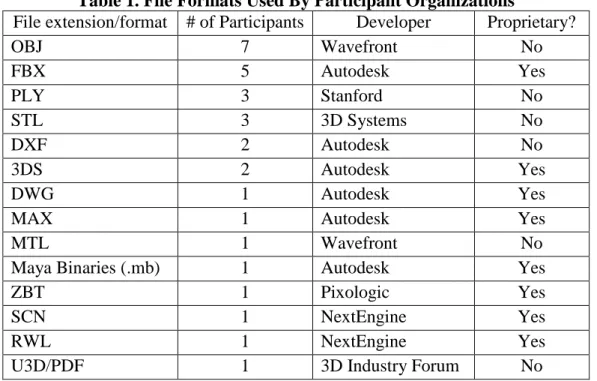
Table 1. File Formats Used By Participant Organizations
File extension/format # of Participants Developer Proprietary?
OBJ 7 Wavefront No
FBX 5 Autodesk Yes
PLY 3 Stanford No
STL 3 3D Systems No
DXF 2 Autodesk No
3DS 2 Autodesk Yes
DWG 1 Autodesk Yes
MAX 1 Autodesk Yes
MTL 1 Wavefront No
Maya Binaries (.mb) 1 Autodesk Yes
ZBT 1 Pixologic Yes
SCN 1 NextEngine Yes
RWL 1 NextEngine Yes
U3D/PDF 1 3D Industry Forum No
The most common file formats used by the organizations in the study are
Autodesk’s FBX and Wavefront’s OBJ. Six of the fourteen file formats that participants reported using are developed by Autodesk and are all proprietary, which means that they are “not subject to modification and redistribution by users. The license for proprietary software ensures that only the company or original software developer has the legal right to see and modify the software's source code” (Open-Source Software, 2007). Despite its proprietary nature, Autodesk does provide a FBX format software development kit (SDK), “a free, easy-to-use, C++ software development platform and API toolkit that allows application and content vendors to transfer existing content into the FBX format
with minimal effort” (Autodesk - FBX Software Development Kit). This makes the FBX
an interchange format capable of being opened and edited by a variety of different
In contrast to FBX, the OBJ format is completely open, being composed of
geometric data stored in ASCII text (Wavefront OBJ File Format Summary.). The MTL
file format, also known as the Material Library File, is a companion to the OBJ format
that stores information about the color and texture of surfaces and is also encoded in
ASCII. The OBJ file format is not a de jure standard approved by any standards body. However, this format appears to be a de facto standard among virtual heritage
organizations, being used by all seven participating organizations. As Professor Forte explained, OBJ is “the most trustable, stable, and standardized format,” which makes it “completely usable and exportable” (M. Forte, personal communication, March 24,
2016). It is for these reasons that the Dig@Lab has chosen OBJ as its file format of choice to which it normalizes all other formats. This popularity and its advantageous traits have developed over the lifetime of the OBJ format, as it has been in regular use since the 1980s.
The plethora of different file types are largely determined by the specific software
program with which they are associated. The DWG format is associated with Autodesk’s
AutoCAD and is licensed for use by other CAD programs. Autodesk’s Drawing
Interchange Format (DXF) is also associated with AutoCAD, but was designed for
exporting data to other programs as its name implies. Autodesk now publishes the DXF
specifications, making it open and more accessible to users. Autodesk also licenses the
3DS and MAX file types, which are associated with its 3ds MAX program that
specializes in the modeling, animation, and rendering of 3D digital objects. Autodesk
also produces Maya, which is another 3D animation program that has its own proprietary
The NextEngine 3D laser scanner and complimentary software employed by the
Virtual Curation Lab uses two proprietary files formats for 3D objects, SCN and RWL.
These file types are used primarily within the proprietary NextEngine software, which
supports the conversion of these file types to more popular formats such as STL, OBJ,
and PLY. The STL format is of particular relevance to the IDIA Lab since it is the
standard most commonly used for 3D printing, an activity in which that the Lab regularly
engages. The Virtual Curation Lab was also the only organization to report using the
Universal 3D (U3D) file format. U3D is an Ecma International standard that is designed
“to provide a reliable, easy to use, easy to implement file format that supports the
streaming, progressive transmission, of 3D mesh, level of detail, and free-form surface information in a standard way” (Standard ECMA-363: Universal 3D file format, 2007). The Virtual Curation Lab uses this format to embed 3D digital objects in PDF
documents.
As Sketchfab does not produce 3D digital objects, it is difficult to measure its use
of file formats and software. Sketchfab claims to provide a universal 3D viewer that
supports the upload of 26 different file formats and the direct export of 3D digital objects
from 21 different programs (Sketchfab - Features.). To account for this, Sketchfab has
been counted in the format table if it supports the upload of a file format that another
participant also reported using.
3.5
Software
be used by more than three participants. This profusion of programs can be broadly grouped into three categories: capture, creation and editing, and output.
The preferred method of capturing tangible cultural heritage objects is
photogrammetry. The most common photogrammetric software, used by the VWHL and Project Mosul, is Agisoft Photoscan. Autodesk also makes a photogrammetry program called Recap that the VHWL uses. Project Mosul uses three other photogrammetric programs, SURE by nFrames, Zephyr by 3DFlow, and VisualSFM, which is available for free and is open source. IDIA Lab also uses RADAN, a specialized piece of software for capturing and processing ground penetrating radar data. The Virtual Curation Lab uses a 3D laser scanner produced by NextEngine to capture cultural heritage objects.
NextEngine produces three pieces of proprietary software with which to operate the 3D scanner and manipulate the resulting digital objects. According to Professor Means, NextEngine’s ProScan program is most important for creating the scan model (B. Means, personal communication, March 21, 2016).
Autodesk’s Maya and 3ds Max, which is used by three participants. Blender, which is an open source modeling program, was utilized by the Dig@Lab and New Palmyra, which used it to clean up and export a model initially built in Maya. The Virtual Curation Lab uses NextEngine’s other two programs, ScanStudio and Rapidworks, for editing captured models and refining the 3D models with better color fidelity, respectively. Both The Virtual Curation Lab and Dig@Lab reported using Meshlab, “an open source, portable, and extensible system for the processing and editing of unstructured 3D triangular
meshes” (MeshLab - Home.). Another free software used by the Virtual Curation Lab for editing and cleaning up 3D models is Autodesk’s Meshmixer.
Many of the modeling programs are also capable of outputting and rendering the 3D models, but some institutions also employ separate programs to accomplish this task. The most popular of these programs is the game engine Unity, which is used by the IDIA Lab, VHWL, and Dig@Lab. IDIA Lab also uses the game engine Cryengine developed by Crytek, which is available free for personal use and gives users access to the source code (CRYENGINE - Get Cryengine.). The Virtual Curation Lab uses Adobe Acrobat to embed 3D objects in the U3D format into PDF files.
whatever tool they are most comfortable with” (J. Phillips, personal communication, March 3, 2016). As New Palmyra is a crowd sourced project that relies on the individual output of a varied community, its solution for making models available regardless of software differences is to shift towards open tools. As Phillips noted, from a digital preservation aspect, “tools are important to be open so they last a long time” (J. Phillips, personal communication, March 3, 2016). Most of the software that the participants employ in the production of digital 3D objects are proprietary with the exception of GIMP, Blender, VisualSFM, and Meshlab.
As with file formats, Sketchfab requires special consideration because of the large number of software programs it supports. Sketchfab does not provide its own dedicated software program, instead providing plug-ins for exporting 3D objects from 44 third-party programs, including many of those used by the participant organizations.
3.6
Metadata
No single metadata schema was used consistently across all of the institutions. The IDIA Lab and Virtual Curation Lab reported relying on collaborators to determine the type and implementation of metadata. New Palmyra does not currently provide metadata for its digital objects, but Jon Phillips would consider its implementation given a larger amount of data or models.
context about the archeological or art history of a model (B. Frischer, personal communication, February 15, 2016). The Dig@Lab also provides explanation and documentation about the sources of the 3D digital objects. However, the Dig@Lab also uses archaeological metadata created during field work to describe the digital surrogate.
Project Mosul does not yet systematically employ any metadata schemas beyond user tagging as enabled by Sketchfab. However, Coughenour expressed an interest in implementing a CIDOC-CRM based system that would be capable of capturing information about the different steps necessary for creating a 3D digital object.
Coughenour described this system as “creating a story for each of those objects,” which bears a striking resemblance to paradata (C. Coughenour, personal communication, February 13, 2016). This system is further complicated by Project Mosul’s use of crowdsourced information and processing, which would require keeping track of and recording the different users and their variable creative processes in some logically structured manner. This crowdsourcing effort, which includes using Flickr’s api to access relevant images for photogrammetry, relies on metadata such as geo-location and license type to effectively function. While Project Mosul does not yet have a schema with which to structure metadata, it would like to collect data such as usernames, geolocations, EXIF data, how an image was masked, and what software was used for photogrammetric reconstruction. All of this data would contribute to detailing the individual decisions that different users made and help construct a coherent story about a 3D digital object.
which to organize 3D digital objects. Sketchfab does not provide a full ontology of all of the possible categories. Sketchfab also embraces folksonomies by incorporating user generated descriptive tags. Each individual 3D object on Sketchfab features the following metadata fields: uploading user, an about section where users can enter additional
descriptive metadata, time since publication, categories and tags, and the numbers of faces and vertices used to create the object. If the uploader has chosen to make the object downloadable, additional metadata fields are provided for the cost, file type and size, and creative commons license type. Sketchfab also enables the creation of annotations located at user determined points on the 3D objects. As Sketchfab also preserves the original uploaded file and provides the option to make it downloadable by users, any metadata that is embedded within such an object should be maintained.
3.7
Access
objects by making its viewer embeddable in custom websites as well as a host of web platforms and social networks like Facebook, LinkedIn, and Tumblr (Sketchfab - Embed on Web Platforms).
In addition to Sketchfab, New Palmyra also makes its models available directly to its community through Github. Git is a popular free and open-source version control software that enables collaborative work between remote individuals, and “GitHub, on the other hand, is a private company that facilitates sharing code via the Git system” (Davis, 2015, p. 162). New Palmyra chose to use Github as an access portal because of the user community, as Phillips determined that other code and information sharing services did not have the same reach. While Github is not a viable long-term
preservation, relying on a private business and proprietary software, it still “provides a well-structured place to post code and lightweight data used in a scholarly endeavor, encouraging reproduction of results and reuse in other projects” (Davis, 2015, p. 163). As New Palmyra makes all of its material available under the CC0 license, it is this
reproduction and reuse that is of primary importance. Additionally, New Palmyra has been working with Github to create and implement new open-source tools such as Git Large File Storage (LFS) that helps Git better support large files, which Phillips
identified as an issue relevant to managing 3D digital objects. Phillips also noted that one of the major user groups of New Palmyra’s digital objects, artists, do not like to use Git.
Discussion
The interview results reveal that standardized digital preservation policies are not a priority among the participating organizations. While the Virtual World Heritage Lab has embraced the LOCKSS philosophy, keeping all of the copies of 3D digital objects on a single type of media and storing them all in the same geographic area negates many of the benefits offered by this preservation strategy. LOCKSS was designed as a method for the distributed digital preservation of web published journals through a large network of institutional servers, not external hard drives (Maniatis, Roussopoulos, Giuli, Rosenthal, & Baker, 2005). Using redundant external hard drives also neglects LOCKSS’ ability to prevent corruption of data by checking individual copies of digital objects against one another. While many of the interviewed organizations understand the importance of long-term digital preservation, it doesn’t seem to be a high priority.
Indiana University, a ContentDM repository at Ball State University, a Hydra repository at Duke University, and a bepress repository at Virginia Commonwealth University.
One of the most significant challenges to the digital preservation of 3D objects appears to be in the file types with which they are encoded. There seemed to be a general consensus that the most popular formats won’t become obsolete in the near future, but this seems to negate the preexisting obsolescence and fragmentation of file formats. From the interviews, there are two different file formats that 3DS Max uses, MAX and 3DS, and two different file formats that AutoCAD uses, DXF and DWG. This is further complicated by Autodesk seeming to dominate the file formats and software programs most commonly used by the participant organizations in creating 3D digital objects. Wavefront Technologies, the creator of the popular OBJ format, was ultimately
purchased by Autodesk. Despite the variability in file types, it seems like consolidation around the FBX and OBJ formats as de facto standards has begun to occur. Compared to a 2008 examination of 3D object file types, it appears that OBJ remains popular and FBX has risen drastically in popularity (McHenry & Bajcsy, 2008).
metadata for virtual heritage, as it provides an ontology dedicated to cultural heritage and associated institutions such as museums.
While access is not the same as preservation, the tools and services that the participating cultural heritage institutions have chosen to make their 3D digital objects available to the public have interesting implications. The universal viewer created by Sketchfab provides an alternative to migration and emulation. If a browser based
technology is capable of accurately displaying past, present, and future 3D digital objects then the problem of obsolete or incompatible file formats could be reduced. New
Conclusion
Future research into this topic would benefit from a more systematic sampling of organizations belonging to a specific, well defined population. Controlling for variables such as size of the organization or academic affiliation would result in more easily generalizable results. Identifying study participants through snowball sampling would likely yield productive results as the field of virtual heritage is relatively small and interconnected. As such a heterogeneous group of organizations is currently engaged in the preservation of 3D digital objects, a larger and more representative sample would help ensure thorough research saturation. Alternatively, a more in depth case study of a single institution would provide for a detailed workflow analysis.
uses and programs, but the OBJ and FBX types were the most prominent and widely used. Similarly, the software programs used to create, edit, and make accessible these 3D resources were highly variable. It seems that the determining factor in what software each organization uses is the type and area of interest of the consumers. Regardless of the file formats or software, metadata was employed inconsistently. Common metadata standards like Dublin Core and CIDOC-CRM can be adapted to 3D digital objects, but more
common was the use of paradata to describe the process of creating 3D resources. The variety of access methods mirrors the diversity of digital preservation options. User access to 3D digital objects can be accomplished with as little as a WebGL enabled browser and a mobile device or as much as virtual reality headsets and a high end desktop computer.
Interest in the digital preservation of cultural heritage resources is likely to grow with further technological advances and near constant global threats. As more of this material is produced, ensuring that it will remain accessible into future will become increasingly important. For the creation of 3D digital objects to be a viable means of preserving cultural heritage, the long-term digital preservation of these resources must be also be considered. While the ruins of Palmyra can be lost through war and looting, the virtual recreations of cultural heritage objects can also be lost through obsolescence, loss and destruction of media, and digital corruption. The current lack of preservation policies and practices among virtual heritage organizations indicates that digital heritage objects are at risk of becoming inaccessible in the future.
References
#newpalmyra. Retrieved from http://www.newpalmyra.org/
3d-coform. Retrieved from http://www.3d-coform.eu/index.php
Almukhtar, S. (2016). The strategy behind the islamic state’s destruction of ancient sites. The New York Times Retrieved
from http://www.nytimes.com/interactive/2015/06/29/world/middleeast/isis-historic-sites-control.html
Autodesk - FBX software development kit. Retrieved
from http://usa.autodesk.com/adsk/servlet/pc/item?id=24746731
Barrettara, M. (2013). New methods for sharing and exhibiting 3D archaeology. The Post Hole, (31), 8-13. Retrieved from http://www.theposthole.org/read/article/218
Berndt, R., Buchgraber, G., Havemann, S., Settgast, V., & Fellner, D. (2010). A publishing workflow for cultural heritage artifacts from 3D-reconstruction to internet presentation. In M. Ioannides, D. Fellner, A. Georgopoulos & D.
Hadjimitsis (Eds.), (pp. 166-178) Springer Berlin Heidelberg. doi:10.1007/978-3-642-16873-4_13
CC0 1.0 universal. Retrieved from https://creativecommons.org/publicdomain/zero/1.0/
Charter on the preservation of digital heritage: UNESCO, 42, 32ndCong. (2003). Collada. Retrieved from https://www.khronos.org/collada/
Magenta book). Washington, D.C.: CCSDS. Retrieved
from http://public.ccsds.org/publications/archive/652x0m1.pdf
Consultative Committee for Space Data Systems. (2012). Reference model for an open archival information system (OAIS): Recommended practice (CCSDS 650.0-M-2:
Magenta book). Washington. D.C.: CCSDS Secretariat.
CRYENGINE - get cryengine. Retrieved from https://www.cryengine.com/get-cryengine
D'Andrea, A., Niccolucci, F., Bassett, S., & Fernie, K. (2012). 3D-ICONS: World heritage sites for europeana: Making complex 3D models available to
everyone. Virtual Systems and Multimedia (VSMM), 2012 18th International Conference On, 517-520. doi:10.1109/VSMM.2012.6365966
Davis, R. C. (2015). Git and GitHub for librarians. Behavioral & Social Sciences Librarian, 34(3), 158-164. doi:10.1080/01639269.2015.1062586
Denard, H., Bentkowska-Kafel, A., & Baker, D. (2012). Paradata and transparency in virtual heritage. Farnham, GB: Ashgate.
Denoyel, A. (2016, January 12). Sketchfab goes VR. Retrieved
from http://blog.sketchfab.com/post/137150461689/sketchfab-goes-vr
Dig@Lab - about. Retrieved from http://diglab.org/homepage/info/
Doerr, M., Tzompanaki, K., Theodoridou, M., Georgis, C., Axaridou, A., & Havemann, S. (2010). A repository for 3D model production and interpretation in culture and beyond. Vast, 97-104.
Doyle, J., Viktor, H. L., & Pacquet, E. (2010). A metadata framework for long term digital preservation of 3D data. Retrieved
A_Metadata_Framework_for_Long_Term_Digital_Preservation_of_3D_Data/lin
ks/0fcfd506d976646664000000.pdf
Doyle, J., Viktor, H., & Paquet, E. (2009). Long-term digital preservation: Preserving authenticity and usability of 3-D data
Fernie, K. (2013). CARARE final report.
Hess, M., Were, G., Brown, I., MacDonald, S., Robson, S., & Millar, F. S. (2009). E-curator: A 3D web-based archive for conservators and curators. Ariadne, (60) IDIA LAB - info. Retrieved from http://idialab.org/info/
IDIA LAB - people. Retrieved from http://idialab.org/people/
ITN-DCH - about-us. Retrieved from http://www.itn-dch.eu/index.php/about-us/
Koller, D., Frischer, B., & Humphreys, G. (2009). Research challenges for digital archives of 3D cultural heritage models. Journal on Computing and Cultural Heritage, 2(3), 1-17. Retrieved
from http://portal.acm.org/citation.cfm?doid=1658346http://portal.acm.org/citatio n.cfm?doid=1658346.1658347
Leigh, K. (2016, April 5). Hope for palmyra’s future. Wall Street Journal Retrieved from http://www.wsj.com/articles/hope-for-palmyras-future-1459807486
London charter - glossary. (2009). Retrieved
from http://www.londoncharter.org/glossary.html
Maniatis, P., Roussopoulos, M., Giuli, T. J., Rosenthal, D. S. H., & Baker, M. (2005). The LOCKSS peer-to-peer digital preservation system. ACM
Trans.Comput.Syst., 23(1), 2-50. doi:10.1145/1047915.1047917
McHenry, K., & Bajcsy, P. (2008). An overview of 3d data content, file formats and viewers. National Center for Supercomputing Applications, 1205
Merlo, A., Dalcò, L., & Fantini, F. (2012). Game engine for cultural heritage: New opportunities in the relation between simplified models and database. Paper presented at the 623-628. doi:10.1109/VSMM.2012.6365993
MeshLab - home. Retrieved from http://meshlab.sourceforge.net/
Michaelis, N., Jung, Y., & Behr, J. (2012). Virtual heritage to go. Proceedings of the 17th International Conference on 3D Web Technology, 113-116.
Michaels, P. V. (2014). Photogrammetry. In K. L. Lerner, & B. W. Lerner (Eds.), The gale encyclopedia of science (5th ed.). Farmington Hills, MI: Gale.
Nodjimbadem, K. (2016, March). The heroic effort to digitally reconstruct lost monuments. Smithsonian Magazine, Retrieved
from http://www.smithsonianmag.com/history/heroic-effort-digitally-reconstruct-lost-monuments-180958098/
Open-source software. (2007). World of computer science, Gale.
Pitzalis, D., Kaminski, J., & Niccolucci, F. (2011). 3D-COFORM: Making 3D documentation and everyday choice for the cultural heritage sector. Virtual Archaeology Review, 2(4), 145-146. Retrieved
Rekrei - about. Retrieved from http://rekrei.org/about
Richards, J. D., Niven, K., & Jeffrey, S. (2013). Preserving our digital heritage: Information systems for data management and preservation. In E. Ch'ng, V. Gaffney & H. Chapman (Eds.), Visual heritage in the digital age (pp. 311-326). London: Springer London. doi:10.1007/978-1-4471-5535-5_16
SAGE Publications, I., & Beitin, B. K. (2012). Interview and sampling: How many and whom. the SAGE handbook of interview research: The complexity of the craft. SAGE publications, inc. Retrieved
from http://dx.doi.org/10.4135/9781452218403
SAGE Publications, I., James, N. & Busher, H. (2012). Internet interviewing. the SAGE handbook of interview research: The complexity of the craft. SAGE publications, inc. Retrieved from http://dx.doi.org/10.4135/9781452218403
Serna, S. P., Schmedt, H., Ritz, M., & Stork, A. (2012). Interactive semantic enrichment of 3D cultural heritage collections. The 13th International Symposium on Virtual Reality, Archaeology and Cultural Heritage VAST, Retrieved
from https://leanppd.culturalinformatics.org.uk/files/papers/InteractiveSemanticE nrichment2012.pdf
Serving and archiving virtual environments (SAVE). Retrieved from http://vwhl.clas.virginia.edu/save.html
Sketchfab - about. Retrieved from https://sketchfab.com/about
Sketchfab - embed on web platforms. Retrieved from http://help.sketchfab.com/hc/en-us/articles/203509977-Embed-on-Web-Platforms
Sketchfab - features. Retrieved from https://sketchfab.com/features
Sketchfab for museums and cultural heritage. Retrieved from https://sketchfab.com/museums
Smith, M. (2009). Curating architectural 3D CAD models. International Journal of Digital Curation, 4(1), 98-106. doi:10.2218/ijdc.v4i1.81
Standard ECMA-363: Universal 3D file format (2007). (4th ed.) Retrieved
from http://www.ecma-international.org/publications/files/ECMA-ST/ECMA-363%204th%20Edition.pdf
UNESCO.Tangible cultural heritage. Retrieved
from http://www.unesco.org/new/en/cairo/culture/tangible-cultural-heritage/
VCC-3D home. Retrieved from http://www.vcc-3d.com/
The virtual curation laboratory - about. Retrieved
from https://vcuarchaeology3d.wordpress.com/about/
Virtual reality in archaeology (2000). In Barceló J. A., Forte M. and Sanders D. H. (Eds.), Oxford, England: Archaeopress.
VWHL - about. Retrieved from http://www.indiana.edu/~vwhl/about/
Waters, D., & Garrett, J. (1996). Preserving digital information, report of the task force on archiving of digital information. Council on Library and Information
Resources.
Wavefront OBJ file format summary. Retrieved
Web 3D Consortium.What is X3D | Web3D consortium. Retrieved from http://www.web3d.org/x3d/what-x3d
Wu, Y., Kropcznyski, J., Prates, R., & Carroll, J. M. (2015). The rise of curation on GitHub. Paper presented at the Retrieved
Appendix A - Recruitment Email
Dear [Contact],
I am in my second and final year as a graduate student at the University of North Carolina at Chapel Hill School of Information and Library Science. For my master's paper, I have chosen to research the digital preservation of 3D objects, such as scans and models. As your organization works with such digital material, I would like to conduct an interview with you to identify the practices involved in its preservation. This interview would take approximately one hour and could be conducted over the phone or similar computer applications. The interview would address topics related to the digital preservation of 3D objects such as institutional policies, best practices, workflows, software, file formats, and metadata. Your input on this subject would provide insight into the current state of how 3D resources are being preserved. If you are interested in participating in my master's paper research, I would appreciate your letting me know how it would be most convenient for you to do so. If you are unable to be a part of this project and are aware of someone else who might be able to assist me, please advise me of their name and contact information. Thank you for your time and consideration and I look forward to hearing from you.