PROGRAMMING FOR
THE COLLEGIATE
ORCHESTRA
BY
KATHERINE GORA COMBS
SENIOR HONORS THESIS
MUSIC
UNIVERSITY OF NORTH CAROLINA AT CHAPEL HILL
MARCH 29, 2019
Approved:
________________________________________
Tonu Kalam, Thesis Advisor
Evan Feldman, Reader
CHAPTER 1
THE ART OF COLLEGIATE PROGRAMMING
–
Programming for the modern American orchestra is a process deeply rooted in tradition.
As Washington Performing Arts president Jenny Bilfield has explained, orchestras use their
programming to establish their “identity” within their community and to “connect to audiences”.1
Yet, this tradition also includes the necessity to adjust as the orchestra’s target audiences change
over time.
From the Colonial era to the present, American orchestras have seen a shift in
programming styles. In the mid-1700s, performances typically lacked a cohesive program; they
often offered a mix of vocal, instrumental, solo, and ensemble pieces.2 The ensembles
themselves were also much less formalized, with performers ranging from professional-level
musicians to community amateurs.3 At the turn of the 19th century, the nascent ensembles of the
Colonial era transformed into more permanent ensembles.4 Performances of these newly
established permanent orchestras were built around audience satisfaction and educating the
public about classical music. Additionally, emphasis was placed on creating a spectacle and
featuring visiting artists or talented individuals from the community5, which led to larger-scale
performances and organized travel.
As orchestras moved toward this permanent model which greatly influenced their
programming choices, orchestral education was also rapidly developing. Before 1900,
instrumental music was rarely taught in public schools, though in 1857 records describe the first
school band appearing in Boston.6 Harvard University would officially establish the first collegiate
orchestra, now called the Harvard-Radcliffe Orchestra, around 1900. This orchestra began as the
1SHIFT Festival, “How Programming Can Create a Distinctive Orchestra.” Medium. April 17, 2017.
https://medium.com/the-kennedy-center/how-programming-can-create-a-distinctive-orchestra-239778d419fb.
2 John Henry Mueller, The American Symphony Orchestra: a Social History of Musical Taste (Bloomington: Indiana
University Press, 1951), 19.
3 Ibid, 20. 4 Ibid, 36.
5 Mueller, The American Symphony Orchestra, 39.
Pierian Sodality of 1808, an informal organization dedicated to instrumental music, and over the
next century grew to be the largest college orchestra in America, developing an international
reputation.7 Soon after, more universities began to place emphasis on educational ensembles
and conservatories allowed students to focus their studies on performance.
With the establishment of the collegiate orchestra came a shift in the prioritization of
programming for these ensembles. In contrast to the programming of the permanent orchestra,
concerts were no longer fashioned purely for audience satisfaction and to boost ticket sales, but
rather were crafted to educate the next generation of music lovers and permanent orchestra
members. In order to provide these budding artists with a comprehensive orchestral experience,
programs were constructed with a great deal of variety, both in composers and era. An emphasis
was also placed on programming new music, welcoming soloists, and performing with guest
conductors. The methodology of programming entered a new realm with the aim of educating
students by providing a wide-ranging look at orchestral repertoire and developing necessary skill
sets over their time participating in the ensemble.
What exactly defines a good educational orchestral program? The answer to this question
is quite subjective. One conductor might place weight on presenting mostly classics, like
Beethoven’s 5th Symphony. Others might enjoy allowing their students to explore lesser known
works. Still others might prefer a mix of the two. Elements such as a limited budget for music,
obligations to include faculty or student soloists, and available rehearsal time might also be
considered. Programming methodology varies considerably between conductors, schools, and
student populations. Yet, some commonality remains.
The remainder of this thesis will explore orchestral programming for the collegiate
ensemble through the lens of six collegiate conductors from across the United States: Emily
Freeman Brown from Bowling Green State University, John Koshak from Chapman University,
Andrew Levin from Clemson University, Mark Cedel from the University of Georgia, Tonu Kalam
from the University of North Carolina at Chapel Hill, and Michael Griffith from the University of
Wyoming. First, using results from a qualitative survey, Chapter Two will examine how collegiate
conductors develop their programming. Similarities and differences across programs will be
highlighted as well as variations due to differing school demographics. Next, Chapter Three will
explore the student perspective of orchestral programming, delving into the priorities of students
who play in orchestras and their thoughts about programming decisions. Chapters Four through
Nine will present quantitative tabulations of various programming criteria for five collegiate
orchestra case studies. Finally, Chapters Ten and Eleven will provide an analysis of the case
CHAPTER 2
Conductors of educational ensembles consider many factors when choosing the literature
for their organizations’ concert seasons. Some of these criteria are influenced by the
demographics of the ensemble, such as the skill and experience level of the orchestral personnel
and the percentage of music majors as compared to non-majors. However, among all the different
characteristics of orchestral programs lie several common themes for constructing a successful
season.
This chapter presents data collected from six conductors across the United States: Emily
Freeman Brown from Bowling Green State University, John Koshak from Chapman University,
Andrew Levin from Clemson University, Mark Cedel from the University of Georgia, Tonu Kalam
from the University of North Carolina at Chapel Hill, and Michael Griffith from the University of
Wyoming. Each conductor provided demographic information about their program as well as
explained their methodology of programming. First, each school’s program will be analyzed
separately, and then all six schools will be compared and commonalities will be addressed.
Bowling Green State University (BGSU), Bowling Green, OH – Emily Freeman Brown
Bowling Green State University’s Philharmonia, an ensemble housed in the College of
Musical Arts at BGSU, has been led by Emily Freeman Brown for the last 30 years. A full-size
orchestra of around 85 players, the group presents eight performances a year, two of which are
fully staged operas. Each performance is preceded by nine to twelve 90-minute rehearsals. The
ensemble is made up primarily of music majors and music graduate students. The Philharmonia
has opportunities to perform with student conductors, student and faculty soloists, guest soloists,
and choral ensembles every year. Additionally, the ensemble performs works by faculty
composers, but it rarely commissions works. Music acquisition is restricted to a fixed annual
budget, though the University provides additional funding when needed, which eliminates some
Brown describes programming for her orchestra as “one of the most complex tasks [she
has]”.8 She lists the players’ ability as a big consideration when choosing literature. Since her
orchestra is primarily made of up of music majors and graduate students, Brown can discern their
level prior to the beginning of the year by consulting with faculty about incoming student auditions.
The Philharmonia’s most interesting programming feature is their participation in the University’s
annual New Music Festival. This Festival, which lasts four days each year, features performances
of new music by BGSU faculty and students. Other community members can also submit scores
for consideration. For the orchestra’s performance during the Festival, the music is not chosen by
Brown, but rather by BGSU’s Mid-American Center for Contemporary Music staff and faculty
committee. Through participation in the Festival as well as other more traditional programming,
Brown hopes to provide students with a wide variety of experiences and to expose her students
to as many styles as possible. Brown hopes that her students “leave with a good sense of classical
style especially and a good approach and a positive attitude to new music”.9
Chapman University, Orange, CA – John Koshak (retired)
John Koshak served as conductor of the Chapman University orchestra for 32 years
before his retirement in 2003. The ensemble, about 85 players in size, is almost exclusively
comprised of undergraduate music majors, with the remaining members coming from the
community. Performing three concerts a year, the orchestra collaborates with guest conductors,
student and faculty soloists, and choral ensembles each season. The University offers a
conducting degree for undergraduates, which allows the musicians an opportunity to perform
under their peers in the concert setting. Additionally, the undergraduate conductors lead the
orchestra during tours which occur for several weeks over their winter Interterm. The Chapman
Orchestra is not the only orchestral ensemble in the University; there is also a Chamber Orchestra
which performs equally challenging music.
Koshak highlighted several elements of importance when choosing his repertoire:
difficulty, appropriateness, variety and balance of historical periods, audience and orchestra
appeal, and amount of rehearsal time before the performance. In order to choose music which
was appropriate and of proper difficulty, Koshak considered “all continuing and expected new
students in the planning”.10 Since most of the members of the orchestra are undergraduate
majors, there exists a certain level of consistency from year to year. “I tended to spend the majority
of summer break selecting music,” said Koshak.11 Though Koshak was the only person directly
involved in picking the music for the group, he called upon members of the orchestra to provide
feedback about what they liked and did not like to perform through an annual survey.
Clemson University, Clemson, SC – Andrew Levin
Clemson University’s Symphony Orchestra, a modest-sized ensemble of around 65
players, has been directed by Andrew Levin for the last 25 years. The ensemble performs two full
programs a year, one smaller children’s program, and participates in one department-wide pops
concert. The University only offers a major in Production Studies in Performing Arts, not a music
performance degree. Therefore, most of the ensemble members are non-music undergraduates.
The ensemble hosts an annual concerto competition which is open to the University and local
high school students. Other than presenting the winners of this competition, the orchestra only
rarely collaborates with guest soloists, choral ensembles, or guest conductors. However, they
participate annually in outreach initiatives, mainly through their children’s concert for local public
school students. The symphony orchestra’s budget allows Levin to pay for additional members
when needed, as well as new instruments and new music.
Levin describes his programming style as an “ongoing process”.12 In addition to consulting
other colleagues, Levin draws from previously performed repertoire and suggestions from current
students. He begins to narrow down his music selections during the fall before the start of the
season, though he admits that programming for the Clemson Symphony Orchestra is somewhat
of a “crap shoot”.13 Since the University does not offer a performance degree, it is difficult for Levin
to predict the talent of the ensemble for the upcoming year. For this reason, the programming is
sometimes altered during the semester to adjust for the personnel’s abilities. Levin hopes to
“challenge the musicians”14 while also supplementing with music that is easier to play. He works
to choose music from a variety of different nationalities, mixing together shorter and longer works.
Additionally, his programs often include a pops element with music from movies and musicals.
Even though the best wind players often perform in the band, the winds are still the strongest
section in the orchestra, which dictates some of the programming. Despite his programming
challenges, Levin states that his “goal is that students who play four years will get a wide variety
of music”.15
University of Georgia (UGA), Athens, GA – Mark Cedel
The University of Georgia Symphony Orchestra, an orchestra of about 85 players, is one
of many ensembles housed in the Hugh Hodgson School of Music. Mark Cedel, director of the
orchestra for the last 25 years, conducts the group, which is comprised mainly of undergraduate
music majors and music graduate students. The orchestra presents eight performances a year
and collaborates with student soloists, faculty soloists, chorus, and opera annually. The
Symphony Orchestra is the most advanced orchestral ensemble in the school, with the University
12 Andrew Levin, questionnaire emailed to author, October 13, 2018. 13 Ibid.
Philharmonia primarily serving non-majors. The UGA Symphony Orchestra does not commission
works or tour, and they do not have a fixed annual budget.
Cedel considers many angles when choosing music for a concert season. He places
strong emphasis on the level of both the current players and incoming students. This information,
combined with his assessment of available rehearsal time, dictates much of the repertoire
selection. Additionally, for major works such as Mahler symphonies, which he specifically
mentioned, Cedel makes sure to offer sectional rehearsals. Musical friends and colleagues also
serve as consultants throughout the programming process.
University of North Carolina at Chapel Hill (UNC-CH), Chapel Hill, NC – Tonu Kalam
The University of North Carolina at Chapel Hill Symphony Orchestra, a relatively large
orchestra of 90 members, is directed by Tonu Kalam. Kalam, who has been in the conductor
position for 30 years, leads an orchestra that is fairly evenly split between undergraduate music
majors and undergraduate non-music students. The orchestra performs annually with student and
faculty soloists and collaborates with guest soloists, guest conductors, and choral ensembles
every two to three years. Four concerts make up the orchestra’s typical concert season with about
twelve rehearsals devoted to each. The most advanced wind players participate in the orchestra,
though some also perform with the wind ensemble. Additionally, there is no fixed annual music
budget, due to private donations which allow some financial flexibility.
Kalam begins to plan his programming for the following year in the late spring, after
collecting data on who will be returning in the fall semester. This, along with information from
incoming student auditions, allows him to pick music appropriate for the instrumentation for the
coming year. Special attention is given to the likely personnel for the wind and brass sections.
When programming for the orchestra, Kalam says that “it is a delicate balancing act”.16 He must
make sure that the programs are balanced in length of pieces and difficulty. He aims to challenge
the players, but not to choose music so difficult that non-music majors are driven away from the
ensemble. “It’s important to have a mixture of standard repertoire, including warhorses, and newer
or less familiar works on each concert,” says Kalam of his programming goals.17 He often begins
by choosing the major work for each concert and then fills in the rest of the program. In order to
provide the orchestra with a broad experience, Kalam tries not to program two major pieces from
the same composer in consecutive years. In addition, each season features a concert that is
all-orchestral with no soloists. Unique to UNC-CH’s program is its opportunity for collaborations with
Carolina Performing Arts, the official performing arts presenter of the University. Some examples
of recent collaborations include the orchestra’s performances with violinist Gil Shaham in the
Tchaikovsky Violin Concerto, with stars from the Metropolitan Opera in Britten’s War Requiem, and a featured performance in the “Glass at 80” Philip Glass Festival. The repertoire for these
collaborations is usually dictated by Carolina Performing Arts, who provides the funding and the
opportunity to feature major guest artists with the school’s orchestra.
University of Wyoming (UWYO), Laramie, WY – Michael Griffith
The University of Wyoming Symphony Orchestra, housed within the University’s
Department of Music, features personnel who are mostly undergraduate music majors and
non-music students, though it also includes a small number of non-music graduate students. Conducted
by Michael Griffith since 1989, the 70- to 90-member ensemble performs five concerts each year,
one of which might be a repeated program. The orchestra hosts a concerto competition every
other year that crowns one winner. The ensemble also features two faculty soloists each season.
In addition to their regular concert schedule, the orchestra performs with choral ensembles for
their Christmas concert and presents The Nutcracker every four years with the Dance
Department. There is also a Chamber Orchestra at the University, but their level of repertoire is
not very different. The orchestra operates with a generous fixed annual budget which allows the
ensemble to commission works occasionally and tour regionally every year. One unique element
of Griffith’s program is his frequent podium exchanges. Griffith invites conductors from across the
country to come to UWYO and conduct one of his concerts during the year. In turn, he will visit
the visitor’s home university and conduct one of their concerts. This provides his students with
wonderful opportunities to work with guest conductors from strong music programs all across the
United States.
For Griffith, programming is an ongoing process. “I’m always thinking about repertoire”18,
says Griffith, who has a running “future programming”19 file on his computer. Specifics of the
program are chosen in the spring before the next season begins. Griffith considers incoming and
continuing students when choosing the repertoire, selecting music that highlights his best players.
In addition to personnel, Griffith considers technical difficulty, stylistic variety, instrumentation,
budget, preparation time, and audience appeal. Furthermore, he tries to choose music that
appeals to him and that he looks forward to conducting. When the orchestra collaborates with the
chorus, opera, or theater groups, Griffith consults with the leaders of those ensembles to pick the
literature. However, for the primary programming “the choices are [his] alone”.20
Comparison of All Orchestra Programs
When comparing the responses of all six conductors, thirteen elements emerged as
common considerations when selecting music for their orchestra programs.
18 Michael Griffith, questionnaire emailed to author, September 29, 2018. 19 Ibid.
Five of the six schools mentioned:
• Appropriateness/Instrumentation • Incoming and continuing personnel
Four of the six directors mentioned:
• Difficulty of repertoire
Three of the six schools included:
• Amount of rehearsal time • Inclusion of a variety of styles
Two of the six mentioned:
• Variety and balance of historical periods • Audience appeal
• Orchestra members appeal • Variety of composer nationalities • Length of pieces
• Conductor preference of literature • Budget
Interestingly, two of the criteria highlighted dissimilarities among the schools. Audience appeal
was listed as a strong consideration for two schools and not of major importance for two of the
other programs. Additionally, budget was listed as an element of consideration for two of the
schools and one school noted that budget is not of significance.
Results of this comparison show that, though commonalities exist between the
programming approaches of various collegiate ensembles, there is still a significant amount of
variation in what conductors prioritize when choosing music for their orchestra. It appears that
many of these differences can be attributed to the differences in the demographics of the
CHAPTER 3
Students participate in collegiate orchestral ensembles for a variety of reasons. For some,
membership in the ensemble is purely for pleasure. For others, it is a requirement for their degree.
In addition, some students hope to pursue further musical education or a career in music and thus
need the experience. This variety of motivation can make programming difficult for the conductor,
as it is a challenge to satisfy the desires and needs of all students in the ensemble. To better
understand what students hope to gain from their orchestral experience, twenty-eight students
were surveyed anonymously from the University of North Carolina at Chapel Hill Symphony
Orchestra. Surveyed students were members of the ensemble during the Spring 2019 semester.
They ranged from first-time members in the orchestra to seniors who have participated every
semester of their college years. The survey questions can be found in Appendix A.2.
First, students were asked to describe their “orchestra bucket list”. Many students listed
pieces or composers that they hoped to perform before they left the ensemble. Some of the most
popular responses included: any work by Mahler, Dvořák’s 9th Symphony, Holst’s The Planets, Beethoven’s 5th Symphony, Respighi’s Pines of Rome, and any Wagner overture.21 Other students desired experiences that would enhance their orchestral education, such as: performing
pieces common on audition repertoire lists, performing with a choir, or performing a section from
an opera.22 Some responses were more self-serving. One student hopes to “perform as a soloist
for the concerto competition”.23 Another student wants to “move up in seating each semester”.24
Still others mentioned goals of performing as a principal player on a piece, discovering a new
favorite composer, or accompanying a famous musician.25 The variety of responses to this
question demonstrates that students approach their participation in the ensemble through
different lenses. For many, their responses included pieces or experiences that they would find
21 Survey submitted by anonymous student, February 2019. 22 Ibid.
enjoyable and musically satisfying; for others, their goals were more calculated toward being
better prepared for their musical future.
The next question asked the students to list composers that they believe they should have
experience performing before leaving the ensemble. Table 3.1 lists all thirty-two of the composers
mentioned by name. Seven composers were mentioned by between 20% and 32% of the
participants: Beethoven, Brahms, Dvořák, Mahler, Mozart, Stravinsky, and Tchaikovsky. These
seven composers are unsurprisingly some of the most popular composers in classical music,
making up 23% of the 2017 ClassicFM Hall of Fame.26
Students also expressed that they hoped to perform repertoire by “well-known
composers”27 in order to be prepared to continue to perform after college. One student mentioned
eight composers and explained, “These composers are standard in the repertoire performed by
nearly every major orchestra around the world and their music is something we absolutely must
know how to perform before entering the musical marketplace”.28 Others expressed their hope to
not only experience the standard composers but also to “be exposed to many different styles and
eras of composition”29 as well as variety of the region of the composer’s birthplace.30
The next question on the survey asked students to list specific works or types of works
that they thought they should have experience performing before leaving the orchestra. The
responses included many categories of works that were also highlighted as important by the
conductors in Chapter 2. Many students conveyed the importance of performing a large Romantic
symphony, an opera, a ballet, or collaborating with choir. Another theme that emerged in this
question was the desire of students to have the opportunity to perform modern and atonal works,
as well as works from areas of the world other than Europe and the United States.
Table 3.1 COMPOSERS MENTIONED BY SURVEYED STUDENTS (N=28)
Composer Last Name Frequency
Bach 2
Beethoven 9
Berlioz 1
Brahms 7
Bruckner 2
Cage 1
Copland 2
Debussy 4
Dvořák 6
Glass 1
Haydn 1
Holst 2
Korngold 1
Mahler 7
Maslanka 1
Mendelssohn 1
Mozart 8
Navarro 1
Rachmaninoff 1
Ravel 1
Respighi 2
Rimsky-Korsakov 1
Saint-Saëns 1
Schubert 1
Schumann 2
Shostakovich 4
Sibelius 2
Strauss 1
Stravinsky 6
Tchaikovsky 8
Vivaldi 1
Overall, it seems that students appreciate experiencing a wide variety of styles in the
orchestra’s programming. As one student described, “I would advocate to program a great variety
of work types. I think a spread of most types of works are [sic] important for becoming a better
musician and learning to have a full appreciation for various musical styles.”31
UNC-CH records allow for some comparison of programming attitudes across time.
Orchestra course evaluations submitted from Fall 2006 to Spring 2010 asked students to answer,
“Are there any specific compositions or kinds of repertoire that you would like the ensemble to
perform?” Interestingly, the results parallel those from the 2019 survey. Students expressed a
desire to focus on standard symphonic repertoire as well as to perform more modern
compositions. Others mentioned that they hoped to have more repertoire with prominent brass
parts. Additionally, students listed a variety of eras and composers as important elements of their
orchestral education.32 One popular element that was unique in the earlier course evaluations
was the mention of performing modern selections that audience members would recognize. This
was not mentioned by anyone in the 2019 survey, which might suggest a slight shift in
programming attitudes.
The final question on the 2019 survey asked specifically about the students’ thoughts on
the programming of UNC-CH’s orchestra conductor, Tonu Kalam. These responses were
predictably mixed. Several students expressed a bit of frustration with a lack of challenging parts
for their instrument. Others stated that they were pleased with the difficulty and that they did not
think the ensemble could handle anything more difficult. Though the survey was anonymous,
some students revealed their section within the ensemble, which provided interesting
comparisons. The wind and brass players seemed to view the repertoire selections as “hit or miss”
for their instruments, whereas the string players enjoyed the works, saying that they have neither
31 Ibid.
“been too difficult or too easy”.33 One student mentioned that the repertoire “tend[s] toward music
which is lyrically/dynamically challenging rather than challenging technically”. However, despite
some frustrations, many students expressed their appreciation for the variety of composers,
styles, and time periods that Kalam programs. As one of the respondents stated, “I appreciate
that [Kalam] chooses works that are representative of the overall repertoire for classical symphony
orchestras”.34
The results from both the course evaluations from 2006-2010 and the 2019 survey indicate
that student attitudes toward programming vary widely across instrumental groups and between
individuals. For example, eight students from the 2019 survey mentioned that they wanted to
perform works by Mozart. However, these works do not include parts for the low brass, a group
in the ensemble that was very vocal about their desire to play more difficult parts. This reinforces
Kalam’s mention of programming as a “balancing act”.35 If Kalam were to program all pieces that
include a full low brass section, the group would never play music by Haydn, Mozart,
Mendelssohn, and many others. However, if he does program music by such earlier composers,
the low brass becomes frustrated with a lack of rewarding parts. Despite these inconsistencies,
some commonality remains. The theme that consistently emerged throughout all the questions
was an emphasis on the necessity of having variety in the programming, including composer
variety, era variety, and region of composition variety.
33 Survey submitted by anonymous student, February, 2019. 34 Ibid.
A NOTE ABOUT THE FOLLOWING
CHAPTERS
The following six chapters present statistics regarding orchestral programming. Conductors at
each of the included universities were asked to provide comprehensive programming histories of
their university. The length and detail of available records varied greatly among programs.
Additionally, John Koshak, whose programming methods were analyzed in Chapter Two, was
unable to provide any records since he is no longer director at Chapman University. Therefore,
A NOTE ABOUT TERMINOLOGY
The following six chapters present statistics regarding orchestral programming. For the purposes of this thesis, several universal definitions were established in order to create consistency between the case studies of each school. Below are detailed definitions of the key variables that will be presented.
Composer Country of Origin is defined as the country of birth of the composer.
Composition Era is defined by the author. Each composer was given a distinct era (i.e., the era does not change depending on the date of the piece). The composition eras were split into seven categories.
Baroque Classical Romantic Late Romantic
Post-Great War/Neoclassicism 20th-Century Nationalism
Contemporary
Faculty Soloist is defined as a faculty member of the home university of the case study.
Full Performance is defined as the entire composition.
Guest Conductor is defined as any individual who is not the orchestra’s principal conductor. Other Soloist is defined as a guest soloist not associated with the home university.
Popularity of Composition is defined in three parts:
On ClassicFM list is defined as a work appearing on the 2017 ClassicFM Hall of Fame top 300.36
Famous Composer is defined as a work not appearing on the 2017 ClassicFM Hall of Fame, but the composer of the work appearing at least five times.
Other is defined as a work not appearing on the 2017 ClassicFM Hall of Fame and the composer appearing on the list fewer than five times.
Selection is defined as an excerpt or portion of a composition.
Soloist is defined as a student, faculty, or guest soloist.
Student Conductor is defined as an undergraduate, graduate, or continuing education student.
Student Soloist is defined as a student (undergraduate or graduate) from the home university of the case study.
For the following tables, the column labeled “Percentage” represents the percentage of the total number of pieces included in that chapter.
CHAPTER 4
COLLEGIATE PROGRAMMING:
AN OVERVIEW
SCHOOLS INCLUDED IN ANALYSIS
Bowling Green State University
Clemson University
University of Georgia
University of North Carolina at Chapel Hill
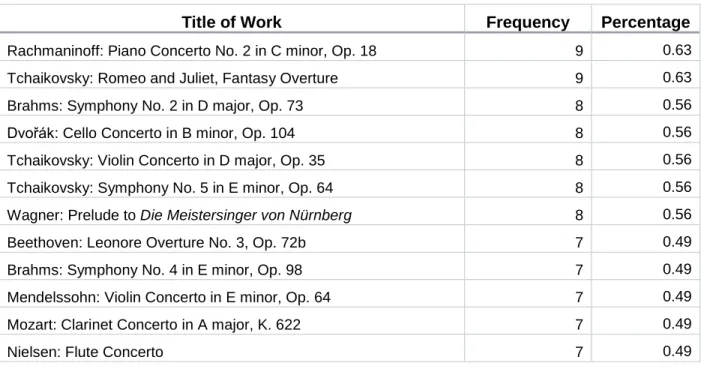
TABLE 4.1 TOP 12 MOST PLAYED WORKS
Title of Work Frequency Percentage
Rachmaninoff: Piano Concerto No. 2 in C minor, Op. 18 9 0.63
Tchaikovsky: Romeo and Juliet, Fantasy Overture 9 0.63
Brahms: Symphony No. 2 in D major, Op. 73 8 0.56
Dvořák: Cello Concerto in B minor, Op. 104 8 0.56
Tchaikovsky: Violin Concerto in D major, Op. 35 8 0.56
Tchaikovsky: Symphony No. 5 in E minor, Op. 64 8 0.56
Wagner: Prelude to Die Meistersinger von Nürnberg 8 0.56
Beethoven: Leonore Overture No. 3, Op. 72b 7 0.49
Brahms: Symphony No. 4 in E minor, Op. 98 7 0.49
Mendelssohn: Violin Concerto in E minor, Op. 64 7 0.49
Mozart: Clarinet Concerto in A major, K. 622 7 0.49
Nielsen: Flute Concerto 7 0.49
TABLE 4.2 TOP 5 MOST PLAYED COMPOSERS
Composer Frequency Percentage
Mozart 88 6.15
Beethoven 72 5.03
Tchaikovsky 57 3.98
Brahms 54 3.77
Dvořák 34 2.38
TABLE 4.3 DISTRIBUTION BY ERA
Era Frequency Percentage
Baroque 61 4.26
Classical 188 13.12
Romantic 449 31.33
Late Romantic 206 14.38
Post-Great War/Neoclassicism 211 14.72
20th-Century Nationalism 92 6.42
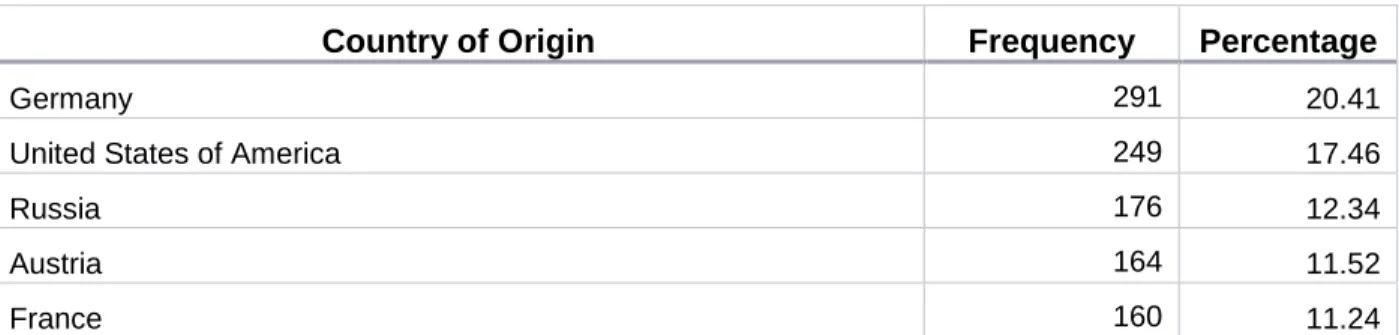
TABLE 4.4 TOP 5 COMPOSER COUNTRIES OF ORIGIN
Country of Origin Frequency Percentage
Germany 291 20.41
United States of America 249 17.46
Russia 176 12.34
Austria 164 11.52
France 160 11.24
TABLE 4.5 DISTRIBUTION OF POPULARITY OF COMPOSITION
Popularity of Composition Percentage
On ClassicFM list 31.68
Famous Composer 14.24
Other 54.08
TABLE 4.6 DISTRIBUTION OF FULL PERFORMANCE OR SELECTION
Full Performance or Selection Percentage
Full Performance 87.58
Selection 12.42
TABLE 4.7 PERCENTAGE PERFORMED WITH GUEST CONDUCTOR
Guest Conductor Percentage
With Guest Conductor 6.56
With Principal Conductor 93.44
TABLE 4.8 PERCENTAGE PERFORMED WITH STUDENT CONDUCTOR
TABLE 4.9 PERCENTAGE PERFORMED WITH SOLOIST
Soloist Percentage
With Soloist 38.31
Without Soloist 61.69
TABLE 4.10 DISTRIBUTION OF TYPE OF SOLOIST
Soloist Type Percentage
Student Soloist37 21.77
Faculty Soloist 5.51
Other Soloist 1.81
None 61.69
Missing38 9.21
TABLE 4.11 PERCENTAGE PERFORMED WITH CHOIR
Performance Type Percentage
With Choir 3.00
Without Choir 97.00
TABLE 4.12 PERCENTAGE PERFORMED WITH OPERA OR MUSICAL THEATRE
Performance Type Percentage
With Opera or Musical Theatre 2.58
Without Opera or Musical Theatre 97.42
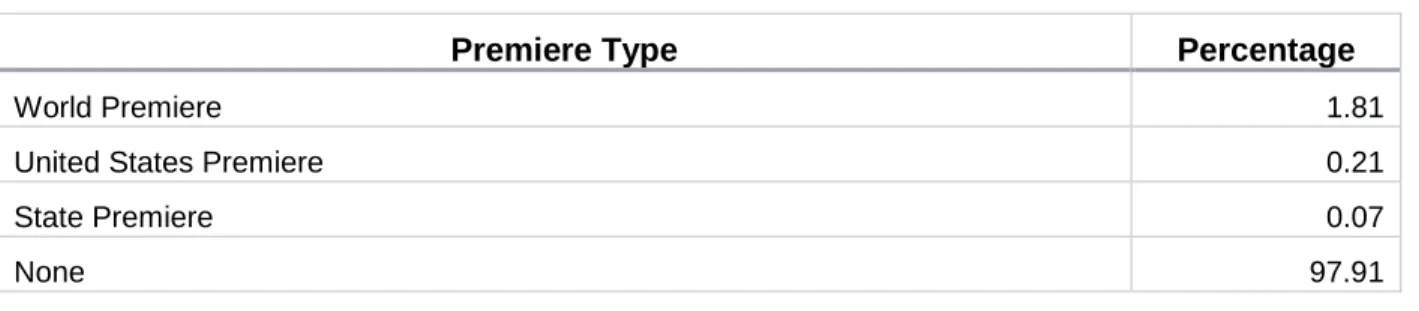
TABLE 4.13 DISTRIBUTION OF PREMIERED WORKS
Premiere Type Percentage
World Premiere 1.81
United States Premiere 0.21
State Premiere 0.07
None 97.91
CHAPTER 5
COLLEGIATE PROGRAMMING:
SCHOOL
PROFILE: BOWLING GREEN STATE
UNIVERSITY
CONDUCTOR INFORMATION
Conductor name: Emily Freeman Brown
Number of years as orchestra conductor at Bowling Green State University: 30 years
ORCHESTRA PERSONNEL INFORMATION
Number of players in orchestra: 85
Percentage of
undergraduate music majors: 45%
undergraduate music minors: 15%
undergraduate non-music students: 5%
music graduate students: 35%
non-music graduate students: 0%
community members: 0%
REHEARSAL INFORMATION
Number of rehearsals held per week: 3
Length of each rehearsal: 1.5 hours
Sectional rehearsals held (Y/N): Yes
Frequency of sectional rehearsals: 2-3 sectionals per concert
PERFORMANCE INFORMAT ION
Number of concerts per year: 8 (2 of which are staged operas)
Frequency of performance with
Guest conductors: Several times per year (student conductors only)
Student soloists: 1 annual concert with student concerto competition winners
Faculty soloists: 1-2 per year
Guest soloists: 1-2 per year
Choral ensembles: 1-2 per year
Opera or Musical Theatre: 1-2 per year
Other: N/A
OTHER
School or Department of Music: School of Music
Annual student concerto competition offered (Y/N): Yes
Player auditions (Y/N): Yes
Frequency of auditions: Annually in August
Re-audition required (Y/N): Occasionally as needed
Other orchestras that exist at the school: None
TABLE 5.1 TOP 3 MOST PLAYED WORKS
Title of Work Frequency Percentage
Anderson, Leroy: Sleigh Ride 2 1.46
Hindemith: Symphonic Metamorphosis after Themes by Carl Maria
von Weber 2
1.46
Wagner: Prelude to Die Meistersinger von Nürnberg 2 1.46
TABLE 5.2 TOP 6 MOST PLAYED COMPOSERS
Composer Frequency Percentage
Mozart 7 5.15
Wagner 7 5.15
Beethoven 6 4.41
Tchaikovsky 6 4.41
Bach, Johann Sebastian 5 3.68
Brahms 5 3.68
TABLE 5.3 DISTRIBUTION BY ERA
Era Frequency Percentage
Baroque 11 8.03
Classical 18 13.14
Romantic 34 24.82
Late Romantic 18 13.14
Post-Great War/Neoclassicism 21 15.33
20th-Century Nationalism 5 3.65
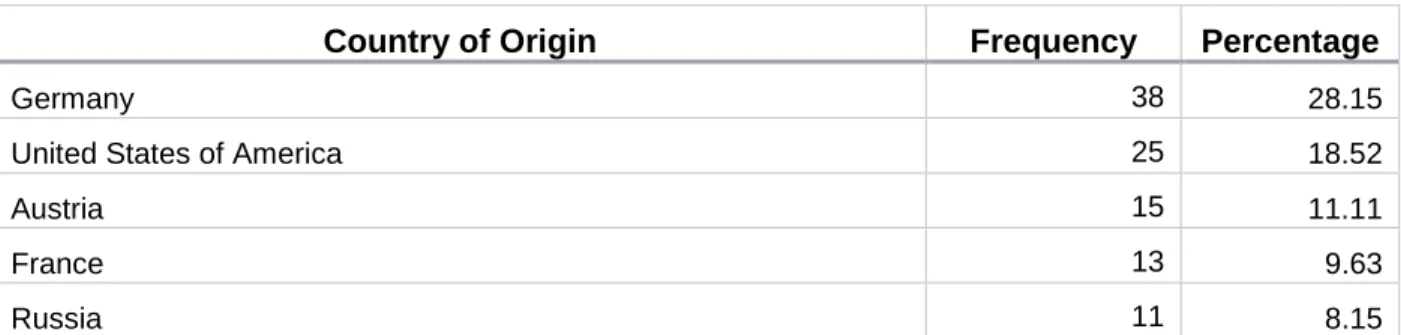
TABLE 5.4 TOP 5 COMPOSER COUNTRIES OF ORIGIN
Country of Origin Frequency Percentage
Germany 38 28.15
United States of America 25 18.52
Austria 15 11.11
France 13 9.63
Russia 11 8.15
TABLE 5.5 DISTRIBUTION OF POPULARITY OF COMPOSITION
Popularity of Composition Percentage
On ClassicFM list 33.58
Famous Composer 12.41
Other 54.01
TABLE 5.6 DISTRIBUTION OF FULL PERFORMANCE OR SELECTION
Full Performance or Selection Percentage
Full Performance 92.70
Selection 7.30
TABLE 5.7 PERCENTAGE PERFORMED WITH GUEST CONDUCTOR
Guest Conductor Percentage
With Guest Conductor 21.17
With Principal Conductor 78.83
TABLE 5.8 PERCENTAGE PERFORMED WITH STUDENT CONDUCTOR
Student Conductor Percentage
With Student Conductor 21.17
TABLE 5.9 PERCENTAGE PERFORMED WITH SOLOIST
Soloist Percentage
With Soloist 33.58
Without Soloist 66.42
TABLE 5.10 DISTRIBUTION OF TYPE OF SOLOIST
Soloist Type Percentage
Student Soloist 16.06
Faculty Soloist 13.14
Other Soloist 0.73
None 66.42
Missing39 3.65
TABLE 5.11 PERCENTAGE PERFORMED WITH CHOIR
Performance Type Percentage
With Choir 6.57
Without Choir 93.43
TABLE 5.12 PERCENTAGE PERFORMED WITH OPERA OR MUSICAL THEATRE
Performance Type Percentage
With Opera or Musical Theatre 8.03
Without Opera or Musical Theatre 91.97
TABLE 5.13 DISTRIBUTION OF PREMIERED WORKS
Premiere Type Percentage
World Premiere 2.92
United States Premiere 0
State Premiere 0
None 97.08
CHAPTER 6
COLLEGIATE PROGRAMMING:
CLEMSON UNIVERSITY
SCHOOL
PROFILE: CLEMSON UNIVERSITY
CONDUCTOR INFORMATION
Conductor name: Andrew Levin
Number of years as orchestra conductor at Clemson University: 25 years
ORCHESTRA PERSONNEL INFORMATION40
Number of players in orchestra: 65
Percentage of
undergraduate music majors: 5%
undergraduate music minors: Unknown
undergraduate non-music students: 80%
music graduate students: 0%
non-music graduate students: 3%
community members: 12%
REHEARSAL INFORMATION
Number of rehearsals held per week: 2
Length of each rehearsal: 1.5 hours and 2 hours
Sectional rehearsals held (Y/N): Yes
Frequency of sectional rehearsals: 1-2 times per semester
PERFORMANCE INFORMATION
Number of concerts per year: 2
Frequency of performance with
Guest conductors: Every few years
Student soloists: Fall concert with student concerto competition winner
Faculty soloists: Rarely
Guest soloists: Sometimes during spring concert
Choral ensembles: Rarely
Opera or Musical Theatre: Rarely
Other: N/A
OTHER
School or Department of Music: Music Concentration within the Department of Performing Arts
Annual student concerto competition offered (Y/N): Yes
Player auditions (Y/N): Yes
Frequency of auditions: First week of each semester
Re-audition required (Y/N): Yes, each semester
Other orchestras that exist at the school: None
Number of years of programs submitted for analysis: 25 years
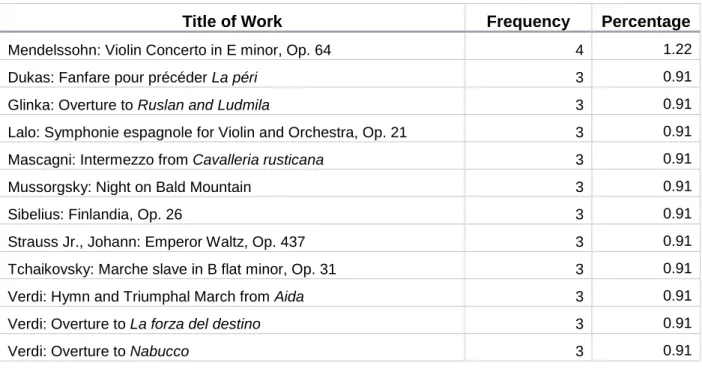
TABLE 6.1 TOP 12 MOST PLAYED WORKS
Title of Work Frequency Percentage
Mendelssohn: Violin Concerto in E minor, Op. 64 4 1.22
Dukas: Fanfare pour précéder La péri 3 0.91
Glinka: Overture to Ruslan and Ludmila 3 0.91
Lalo: Symphonie espagnole for Violin and Orchestra, Op. 21 3 0.91
Mascagni: Intermezzo from Cavalleria rusticana 3 0.91
Mussorgsky: Night on Bald Mountain 3 0.91
Sibelius: Finlandia, Op. 26 3 0.91
Strauss Jr., Johann: Emperor Waltz, Op. 437 3 0.91
Tchaikovsky: Marche slave in B flat minor, Op. 31 3 0.91
Verdi: Hymn and Triumphal March from Aida 3 0.91
Verdi: Overture to La forza del destino 3 0.91
Verdi: Overture to Nabucco 3 0.91
TABLE 6.2 TOP 5 MOST PLAYED COMPOSERS
Composer Frequency Percentage
Mozart 17 5.18
Tchaikovsky 12 3.66
Verdi 12 3.66
Saint-Saëns 9 2.74
Vaughan Williams 9 2.74
TABLE 6.3 DISTRIBUTION BY ERA
Era Frequency Percentage
Baroque 24 7.32
Classical 32 9.76
Romantic 111 33.84
Late Romantic 45 13.72
Post-Great War/Neoclassicism 28 8.54
20th-Century Nationalism 19 5.79
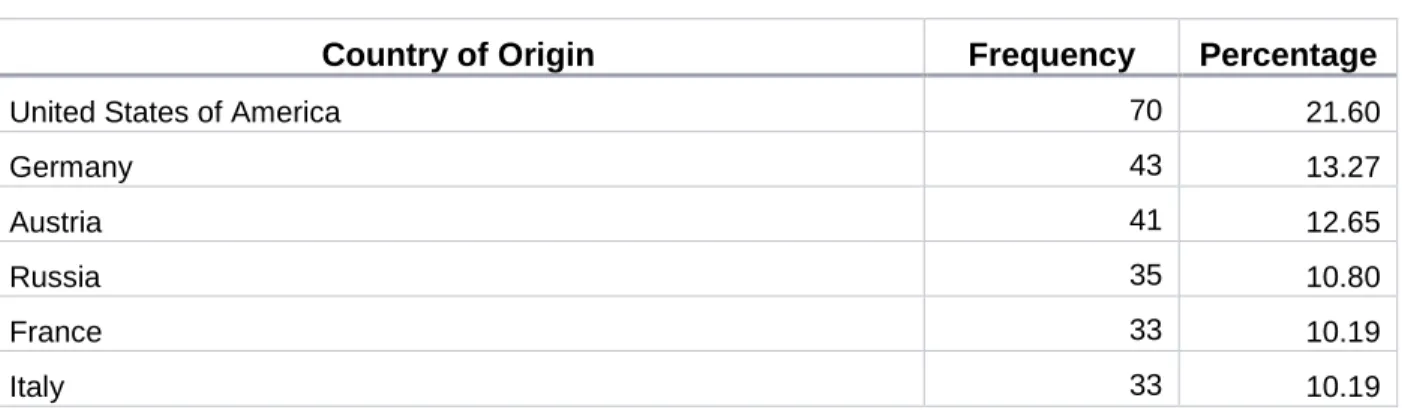
TABLE 6.4 TOP 6 COMPOSER COUNTRIES OF ORIGIN
Country of Origin Frequency Percentage
United States of America 70 21.60
Germany 43 13.27
Austria 41 12.65
Russia 35 10.80
France 33 10.19
Italy 33 10.19
TABLE 6.5 DISTRIBUTION OF POPULARITY OF COMPOSITION
Popularity of Composition Percentage
On ClassicFM list 29.48
Famous Composer 13.37
Other 57.14
TABLE 6.6 DISTRIBUTION OF FULL PERFORMANCE OR SELECTION
Full Performance or Selection Percentage
Full Performance 85.71
Selection 14.29
TABLE 6.7 PERCENTAGE PERFORMED WITH GUEST CONDUCTOR
Guest Conductor Percentage
With Guest Conductor 0.91
With Principal Conductor 99.09
TABLE 6.8 PERCENTAGE PERFORMED WITH STUDENT CONDUCTOR
TABLE 6.9 PERCENTAGE PERFORMED WITH SOLOIST
Soloist Percentage
With Soloist 24.32
Without Soloist 75.68
TABLE 6.10 DISTRIBUTION OF TYPE OF SOLOIST
Soloist Type Percentage
Student Soloist 11.25
Faculty Soloist 0
Other Soloist 0
None 75.68
Missing41 13.07
TABLE 6.11 PERCENTAGE PERFORMED WITH CHOIR
Performance Type Percentage
With Choir 0.91
Without Choir 99.09
TABLE 6.12 PERCENTAGE PERFORMED WITH OPERA OR MUSICAL THEATRE
Performance Type Percentage
With Opera or Musical Theatre 1.52
Without Opera or Musical Theatre 98.48
TABLE 6.13 DISTRIBUTION OF PREMIERED WORKS
Premiere Type Percentage
World Premiere 1.52
United States Premiere 0
State Premiere 0
None 98.48
CHAPTER 7
COLLEGIATE PROGRAMMING:
UNIVERSITY OF GEORGIA
SCHOOL
PROFILE: UNIVERSITY OF GEORGIA
CONDUCTOR INFORMATION
Conductor name: Mark Cedel
Number of years as orchestra conductor at University of Georgia: 25 years
ORCHESTRA PERSONNEL INFORMATION
Number of players in orchestra: 85
Percentage of
undergraduate music majors: 55%
undergraduate music minors: 5%
undergraduate non-music students: 0%
music graduate students: 40%
non-music graduate students: 0%
community members: 0%
REHEARSAL INFORMATION
Number of rehearsals held per week: 2
Length of each rehearsal: 2.5 hours
Sectional rehearsals held (Y/N): Yes
Frequency of sectional rehearsals: When performing large Mahler works
PERFORMANCE INFORMAT ION
Number of concerts per year: 8
Frequency of performance with
Guest conductors: Every few years
Student soloists: Yearly
Faculty soloists: Yearly
Guest soloists: Rarely
Choral ensembles: Yearly
Opera or Musical Theatre: Yearly
Other: N/A
OTHER
School or Department of Music: School of Music
Annual student concerto competition offered (Y/N): Yes
Player auditions (Y/N): Yes
Frequency of auditions: First week of each semester
Re-audition required (Y/N): Yes, each semester
Other orchestras that exist at the school: University Philharmonia for non-majors
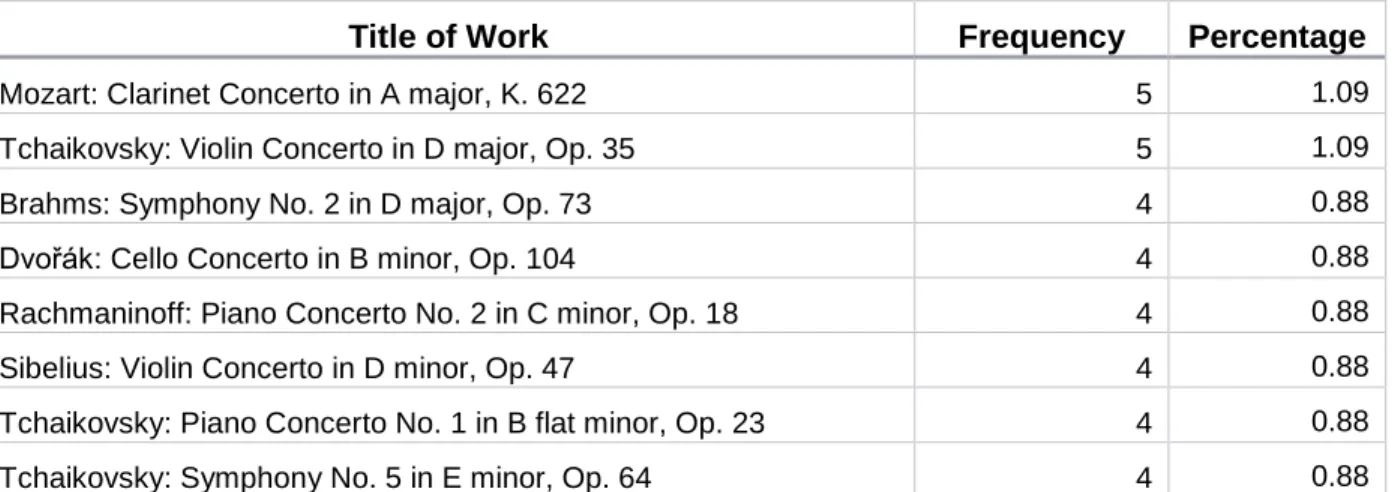
TABLE 7.1 TOP 8 MOST PLAYED WORKS
Title of Work Frequency Percentage
Mozart: Clarinet Concerto in A major, K. 622 5 1.09
Tchaikovsky: Violin Concerto in D major, Op. 35 5 1.09
Brahms: Symphony No. 2 in D major, Op. 73 4 0.88
Dvořák: Cello Concerto in B minor, Op. 104 4 0.88
Rachmaninoff: Piano Concerto No. 2 in C minor, Op. 18 4 0.88
Sibelius: Violin Concerto in D minor, Op. 47 4 0.88
Tchaikovsky: Piano Concerto No. 1 in B flat minor, Op. 23 4 0.88
Tchaikovsky: Symphony No. 5 in E minor, Op. 64 4 0.88
TABLE 7.2 TOP 5 MOST PLAYED COMPOSERS
Composer Frequency Percentage
Mozart 39 8.53
Beethoven 29 6.35
Brahms 25 5.47
Tchaikovsky 22 4.81
Rachmaninoff 12 2.63
TABLE 7.3 DISTRIBUTION BY ERA
Era Frequency Percentage
Baroque 7 1.53
Classical 79 17.29
Romantic 144 31.51
Late Romantic 74 16.19
Post-Great War/Neoclassicism 73 15.97
20th-Century Nationalism 35 7.66
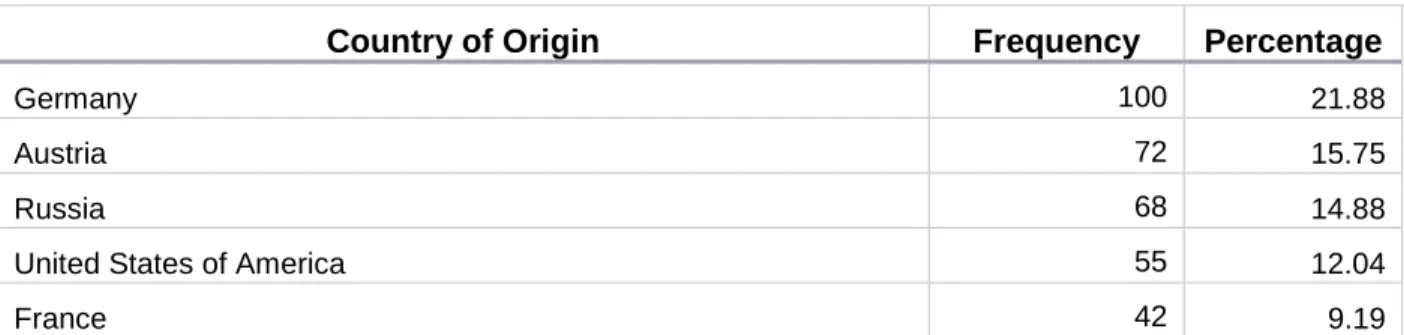
TABLE 7.4 TOP 5 COMPOSER COUNTRIES OF ORIGIN
Country of Origin Frequency Percentage
Germany 100 21.88
Austria 72 15.75
Russia 68 14.88
United States of America 55 12.04
France 42 9.19
TABLE 7.5 DISTRIBUTION OF POPULARITY OF COMPOSITION
Popularity of Composition Percentage
On ClassicFM list 36.98
Famous Composer 15.54
Other 47.48
TABLE 7.6 DISTRIBUTION OF FULL PERFORMANCE OR SELECTION
Full Performance or Selection Percentage
Full Performance 84.46
Selection 15.54
TABLE 7.7 PERCENTAGE PERFORMED WITH GUEST CONDUCTOR
Guest Conductor Percentage
With Guest Conductor 3.50
With Principal Conductor 96.50
TABLE 7.8 PERCENTAGE PERFORMED WITH STUDENT CONDUCTOR
TABLE 7.9 PERCENTAGE PERFORMED WITH SOLOIST
Soloist Percentage
With Soloist 46.83
Without Soloist 53.17
TABLE 7.10 DISTRIBUTION OF TYPE OF SOLOIST
Soloist Type Percentage
Student Soloist 26.54
Faculty Soloist 0
Other Soloist 2.19
None 53.17
Missing42 18.10
TABLE 7.11 PERCENTAGE PERFORMED WITH CHOIR
Performance Type Percentage
With Choir 2.84
Without Choir 97.16
TABLE 7.12 PERCENTAGE PERFORMED WITH OPERA OR MUSICAL THEATRE
Performance Type Percentage
With Opera or Musical Theatre 3.28
Without Opera or Musical Theatre 96.72
TABLE 7.13 DISTRIBUTION OF PREMIERED WORKS
Premiere Type Percentage
World Premiere 1.53
United States Premiere 0.44
State Premiere 0
None 98.03
CHAPTER 8
COLLEGIATE PROGRAMMING:
UNIVERSITY OF NORTH CAROLINA AT
CHAPEL HILL
SCHOOL
PROFILE: UNIVERSITY OF NORTH
CAROLINA AT CHAPEL HILL
CONDUCTOR INFORMATION
Conductor name: Tonu Kalam
Number of years as orchestra conductor at UNC-Chapel Hill: 30 years
ORCHESTRA PERSONNEL INFORMATION43
Number of players in orchestra: 90
Percentage of
undergraduate music majors: 40%
undergraduate music minors: Unknown
undergraduate non-music students: 47%
music graduate students: 0%
non-music graduate students: 5%
community members: 8%
REHEARSAL INFORMATION
Number of rehearsals held per week: 2
Length of each rehearsal: 2.25 hours
Sectional rehearsals held (Y/N): Yes
Frequency of sectional rehearsals: 1 sectional per concert
PERFORMANCE INFORMAT ION
Number of concerts per year: 4
Frequency of performance with
Guest conductors: Every 2-3 years
Student soloists: 1 annual concert with student concerto competition winners
Faculty soloists: 1-2 per year
Guest soloists: Every few years
Choral ensembles: Every 2-3 years
Opera or Musical Theatre: Rarely
Other: N/A
OTHER
School or Department of Music: Department of Music
Annual student concerto competition offered (Y/N): Yes
Player auditions (Y/N): Yes
Frequency of auditions: Annually in August
Re-audition required (Y/N): Yes
Other orchestras that exist at the school: None
Number of years of programs submitted for analysis: 30 years
TABLE 8.1 TOP 5 MOST PLAYED WORKS
Title of Work Frequency Percentage
Berlioz: Selections from The Damnation of Faust, Op. 24 4 0.93
Elgar: Pomp and Circumstance March No. 4 in G major, Op. 39,
No. 4 4
0.93
Nielsen: Flute Concerto 4 0.93
Tchaikovsky: Romeo and Juliet, Fantasy Overture 4 0.93
Wagner: Prelude to Die Meistersinger von Nürnberg 4 0.93
TABLE 8.2 TOP 5 MOST PLAYED COMPOSERS
Composer Frequency Percentage
Beethoven 26 6.02
Mozart 19 4.40
Brahms 18 4.17
Tchaikovsky 16 3.70
Ravel 15 3.47
TABLE 8.3 DISTRIBUTION BY ERA
Era Frequency Percentage
Baroque 16 3.68
Classical 48 11.03
Romantic 144 33.10
Late Romantic 61 14.02
Post-Great War/Neoclassicism 80 18.39
20th-Century Nationalism 27 6.21
TABLE 8.4 TOP 5 COMPOSER COUNTRIES OF ORIGIN
Country of Origin Frequency Percentage
Germany 100 22.99
United States of America 78 17.93
France 68 15.63
Russia 55 12.64
England 29 6.67
TABLE 8.5 DISTRIBUTION OF POPULARITY OF COMPOSITION
Popularity of Composition Percentage
On ClassicFM list 29.20
Famous Composer 14.02
Other 56.78
TABLE 8.6 DISTRIBUTION OF FULL PERFORMANCE OR SELECTION
Full Performance or Selection Percentage
Full Performance 88.74
Selection 11.26
TABLE 8.7 PERCENTAGE PERFORMED WITH GUEST CONDUCTOR
Guest Conductor Percentage
With Guest Conductor 8.51
With Principal Conductor 91.49
TABLE 8.8 PERCENTAGE PERFORMED WITH STUDENT CONDUCTOR
Student Conductor Percentage
With Student Conductor 6.21
TABLE 8.9 PERCENTAGE PERFORMED WITH SOLOIST
Soloist Percentage
With Soloist 42.30
Without Soloist 57.70
TABLE 8.10 DISTRIBUTION OF TYPE OF SOLOIST
Soloist Type Percentage
Student Soloist 29.89
Faculty Soloist 10.80
Other Soloist 1.61
None 57.70
TABLE 8.11 PERCENTAGE PERFORMED WITH CHOIR
Performance Type Percentage
With Choir 3.68
Without Choir 96.32
TABLE 8.12 PERCENTAGE PERFORMED WITH OPERA OR MUSICAL THEATRE
Performance Type Percentage
With Opera or Musical Theatre 0.69
Without Opera or Musical Theatre 99.31
TABLE 8.13 DISTRIBUTION OF PREMIERED WORKS
Premiere Type Percentage
World Premiere 2.31
United States Premiere 0
State Premiere 0.23
CHAPTER 9
COLLEGIATE PROGRAMMING:
UNIVERSITY OF WYOMING
SCHOOL
PROFILE: UNIVERSITY OF WYOMING
CONDUCTOR INFORMATION
Conductor name: Michael Griffith
Number of years as orchestra conductor at University of Wyoming: 30 years
ORCHESTRA PERSONNEL INFORMATION
Number of players in orchestra: 70-90
Percentage of
undergraduate music majors: 50%
undergraduate music minors: 0%
undergraduate non-music students: 25%
music graduate students: 10%
non-music graduate students: 5%
community members: 10%
REHEARSAL INFORMATION
Number of rehearsals held per week: 2
Length of each rehearsal: 2.5 hours and 2 hours
Sectional rehearsals held (Y/N): Yes
Frequency of sectional rehearsals: 3 sectionals per concert
PERFORMANCE INFORMAT ION
Number of concerts per year: 5
Frequency of performance with Guest conductors: Yearly
Student soloists: Every other year
Faculty soloists: 2 per year
Guest soloists: Yearly
Choral ensembles: Every other year
Opera or Musical Theatre: Every 2-3 years
Other: Fully staged ballet every four years
OTHER
School or Department of Music: Department of Music
Annual student concerto competition offered (Y/N): Yes (every other year)
Player auditions (Y/N): Yes
Frequency of auditions: Annually in August
Re-audition required (Y/N): Yes (winds, brass, and percussion only)
Other orchestras that exist at the school: Chamber Orchestra
TABLE 9.1 TOP 2 MOST PLAYED WORKS
Title of Work Frequency Percentage
Copland: Suite from The Tender Land 2 2.67
Mozart: Sinfonia concertante in E flat major for Four Winds and
Orchestra, K. 297b 2
2.67
TABLE 9.2 TOP 6 MOST PLAYED COMPOSERS
Composer Frequency Percentage
Mozart 6 8.00
Bernstein 5 6.67
Copland 4 5.33
Beethoven 3 4.00
Brahms 3 4.00
Dvořák 3 4.00
TABLE 9.3 DISTRIBUTION BY ERA
Era Frequency Percentage
Baroque 3 4.00
Classical 11 14.67
Romantic 16 21.33
Late Romantic 8 10.67
Post-Great War/Neoclassicism 9 12.00
20th-Century Nationalism 6 8.00
TABLE 9.4 TOP 5 COMPOSER COUNTRIES OF ORIGIN
Country of Origin Frequency Percentage
United States of America 21 28.00
Germany 10 13.33
Austria 9 12.00
Italy 7 9.33
Russia 7 9.33
TABLE 9.5 DISTRIBUTION OF POPULARITY OF COMPOSITION
Popularity of Composition Percentage
On ClassicFM list 20.00
Famous Composer 14.67
Other 65.33
TABLE 9.6 DISTRIBUTION OF FULL PERFORMANCE OR SELECTION
Full Performance or Selection Percentage
Full Performance 98.67
Selection 1.33
TABLE 9.7 PERCENTAGE PERFORMED WITH GUEST CONDUCTOR
Guest Conductor Percentage
With Guest Conductor 12.00
With Principal Conductor 88.00
TABLE 9.8 PERCENTAGE PERFORMED WITH STUDENT CONDUCTOR
TABLE 9.9 PERCENTAGE PERFORMED WITH SOLOIST
Soloist Percentage
With Soloist 33.33
Without Soloist 66.67
TABLE 9.10 DISTRIBUTION OF TYPE OF SOLOIST
Soloist Type Percentage
Student Soloist44 N/A
Faculty Soloist 18.67
Other Soloist 10.67
None 66.67
Missing45 4.00
TABLE 9.11 PERCENTAGE PERFORMED WITH CHOIR
Performance Type Percentage
With Choir 2.67
Without Choir 97.33
TABLE 9.12 PERCENTAGE PERFORMED WITH OPERA OR MUSICAL THEATRE
Performance Type Percentage
With Opera or Musical Theatre 4.00
Without Opera or Musical Theatre 96.00
TABLE 9.13 DISTRIBUTION OF PREMIERED WORKS
Premiere Type Percentage
World Premiere 0
United States Premiere 1.33
State Premiere 0
None 98.67
CHAPTER 10
The results from the five case studies presented above allow for an interesting view of
collegiate programming. By comparing the results, common themes can be examined and
noteworthy features of individual academic programs are highlighted. For the purposes of
analysis, each question will be examined individually, pointing out similarities and differences
between the collected data. Several questions will not be included in the comparative analysis
due to the lack of consistency between submitted school records, but all will be addressed in the
order that they appear.
Top Most Played Works
Due to the lack of consistency between the schools in the number of years of programs
submitted for analysis, this question cannot be comparatively analyzed with any accuracy.
Top Most Played Composers
Due to the lack of consistency between the schools in the number of years of programs
submitted for analysis, this question cannot be comparatively analyzed in great detail. It is
interesting to note, however, that Mozart appears at the top of the list for all but one of the
schools—for the University of North Carolina at Chapel Hill, he is the second most popular.
Additionally, Beethoven appears in the top four for four of the schools analyzed.
Distribution by Era
The distribution of era between the programs analyzed produced some patterns, but also
provided mixed results. The Romantic era was the most prevalent in all but one of the schools.
The University of Wyoming had the Contemporary era as more prevalent, followed by the
Romantic era. Additionally, Baroque and 20th-Century Nationalism were the least popular among
War/Neoclassicism, Late Romantic, and Classical was different among programs; however, for
the majority of the schools, these categories fell in the middle of their prevalence rankings.
Top Composer Countries of Origin
Due to the lack of consistency between the schools in the number of years of programs
submitted for analysis, this question cannot be comparatively analyzed in great detail. However,
it is interesting to note that the United States, Germany, and Russia appear in the top five of all
the programs submitted. Additionally, Bowling Green State University, Clemson University, and
the University of Georgia have identical top lists. Those countries include the United States,
Germany, Austria, Russia, and France; however, the order of these varied from school to school.
Distribution of Popularity of Composition
For all programs analyzed, the most prevalent category was “other,” which was defined
as a work not appearing on the 2017 ClassicFM Hall of Fame and the composer appearing on
the list fewer than five times. “Other” was followed by “On ClassicFM list,” which was defined as
a work appearing on the 2017 ClassicFM Hall of Fame top 300. This suggests that all the schools
provide their students with both standard orchestral works as well as a good number of lesser
known pieces.
Distribution of Full Performance or Selection
All schools performed most of their works in their entirety as opposed to selections. The
percentage of full performances ranged from about 85% to over 98%.
Percentage Performed with Guest Conductor
Bowling Green State University had the highest percentage of performances with a guest
University had under 1% of its performances with a guest conductor, the University of Georgia
had 3.5%, the University of North Carolina had about 8.5%, and the University of Wyoming had
12%. The University of Wyoming’s high percentage can be explained by Michael Griffith’s initiative
to create frequent podium exchanges, described above in Chapter Two. Additionally, as shown
below, the Bowling Green Philharmonia frequently performs with student conductors, which
explains their guest conductor percentage.
Percentage Performed with Student Conductor
Data for this section was only available from Bowling Green State University and the
University of North Carolina at Chapel Hill. Bowling Green’s Philharmonia featured the most
student conductors, at just over 20% of their performed works. The University of North Carolina
at Chapel Hill Symphony Orchestra performed with student conductors about 6% of the time.
Percentage Performed with Soloist
The percentage of works performed with a soloist varied widely among the schools.
Clemson University saw the lowest percentage at about 24%. Both Bowling Green State
University and the University of Wyoming had the next highest, at about 33%. The University of
North Carolina at Chapel Hill performed with a soloist about 42% of the time and the University of
Georgia performed most frequently with a soloist, at about 47% of the time.
Distribution of Type of Soloist
Due to differences in record detail, the type of soloist (student, faculty, etc.) could not be
determined at many of the schools. Therefore, this question cannot be comparatively analyzed
Percentage Performed with Choir
The percentage performed with choir ranged from just under 1% at Clemson University to
about 6.5% at Bowling Green State University. The other programs performed with choir about
3-4% of the time.
Percentage Performed with Opera or Musical Theatre
The University of North Carolina at Chapel Hill performed the least with opera or musical
theatre (under 1%). The highest percentage was found at Bowling Green State University at about
8%.
Distribution of Premiered Works
The results of the distribution of premiered works was very similar among the schools.
Only 1-3% of the repertoire from all the programs was some type of premiere (world premiere,
United States premiere, or state premiere).
Strengths and Limitations of this Analysis
The limitations of these case studies cannot be overlooked. As previously stated, the
availability of comprehensive records and the detail in which records were kept varied widely
between collegiate programs. For this reason, some variables were unable to be analyzed for
certain schools and direct comparisons between their programs cannot always be interpreted as
statistical fact. Also, since the results encompass the total results from each of the schools, it is
impossible to know if students during any given four-year period experienced an equal variety of
repertoire. Furthermore, the variables chosen for analysis are just some of the many factors that
determine orchestral programming, and the programs surveyed represent a small subset of
orchestral programs in the nation. Therefore, the results cannot be seen as all-encompassing.
quantitative analysis of collegiate programming. The results presented serve as a beginning