Abstract
Amorphous carbon (aC) thin films are chemically stable films that can be functionalized through the formation of carbon-carbon or carbon-heteroatom bonds. Unlike other materials whose surface chemistries are labile under aqueous conditions, carbon surfaces are able to retain their functional groups when exposed to acidic or basic environments. The inherent stability of carbon materials, and the chemistries used to modify their surfaces, are ideal for generating functional materials such as supports for the attachment of photocatalysts. We present here an approach to terminate these films with azides. Utilizing copper-catalyzed azide-alkyne
cycloaddition click chemistry, we demonstrate an approach for the selective and stable covalent attachment of a redox active complex, ferrocene, to the surface of these thin films. This reaction provides an efficient and flexible means for attaching a variety of alkyne-containing molecules to the surface of a thin film. XPS and electrochemical analyses confirm the presence of these
Introduction
The field of catalyst development has garnered much interest in recent decades. For example, CO2 reduction catalysts allow for the reduction of atmospheric CO2 into CO, which can be used as a feedstock to generate fuels.1 Ideally, these catalysts can be anchored to a surface, and light can then be used to initiate the redox-mediated catalytic process on the surface, a process known as photo-catalysis. Currently, metal oxides are popular surface materials for photo-catalysis due to their attractive semiconducting properties.1 However, the attachment strategies currently used to anchor catalysts to these surfaces rely on self-assembling monolayers of oxygen-rich functional groups such as silanes, carboxylic acids, or phosphonic acids. These covalent bonds are inherently labile and are unstable upon electrochemical cycling2 or when exposed to acidic or basic conditions. There exists a need for the development of stable surface chemistries that can be used to covalently attach catalysts and promote their stability upon electrochemical cycling.
Amorphous carbon thin films are semiconducting materials that are stable at atmospheric conditions.3 These films contain a mixture of sp2 and sp3 hybridized carbon and, like silicon, can be readily functionalized using a variety of methods such as UV-mediated alkylation via an alkene and chlorination followed by an organometallic reaction.3 The amorphous carbon films are also able to eject electrons upon illumination with UV light, making them a potentially useful platform for photo-catalysis.1
photo-patterning and the avoidance of harsh chemical conditions, several faults exist with this approach. Surface-bound sulfur atoms readily oxidize under any conditions and therefore must be used immediately.4 Despite the specificity of the thiol-ene reactions in solution, the alkene-containing molecules also attach to hydrogen-terminated films when illuminated with UV-light. UV-initiated side-reactions, most likely promoted by the presence of the carbon surface, make controlling the specificity of this approach difficult.4
The copper-catalyzed azide-alkyne cycloaddition (CuAAC) click reaction is an alternative to our thiol-ene method for installing new functional groups. The copper catalyst eliminates the need for UV light, increasing selectivity by reducing the possibility of unwanted side reactions. Surface-bound azides react with an alkyne-containing molecule to form a 1,2,3-triazole linker.5 Any compatible, alkyne-containing molecule can therefore be attached to the surface via this highly efficient and selective reaction.
Methods for the azidation and later alkyne-coupling of a number of silicon and carbon substrates have been previously reported. Examples include the azidation of glassy carbon via gas-phase chemistry and silicon nitride via wet-chemical methods.6,7 A common theme in these azidation reactions is the preliminary attachment of another group to the surface—such as hydrogen, amines, or alcohols—which is subsequently replaced by the azide functional group.6–8
azide-alkyne cycloaddition reaction. These experiments show that our method could feasibly be adapted for the attachment of alkyne-containing photo-catalysts.
Experimental Details
Reagents and Materials. All reagents were used as received. Ethanol (200 proof) was purchased from Fisher Scientific. Acetonitrile, anhydrous benzene, benzoyl peroxide, copper sulfate pentahydrate, 15-crown-5, anhydrous N-N-dimethyl formamide (DMF), ethynyl
ferrocene, phosphorus pentachloride, sodium ascorbate, and sodium azide were purchased from Sigma-Aldrich. Tetrabutylammonium hexafluorophosphate (Oakwood Chemical, 98%) was
recrystallized from absolute ethanol and dried in vacuo. The recrystallized electrolyte was acquired from the Dempsey lab at UNC. Reverse osmosis purified water (RO water, 18 M) was used for all experiments.
Amorphous carbon deposition. Silicon (100) substrates were cleaned prior to use in piranha solution (3:1, 96.3% H2SO4:30% H2O2) at 160 ℃ for 20 min (caution: piranha solution should be handled with great care, as it can react violently with organic materials). Amorphous carbon thin films (25 nm in thickness) were deposited onto the freshly cleaned substrates via dc magnetron sputtering (Kurt Lesker PVD 75) of a graphite target (Plasmaterials). The deposition chamber was kept under argon at a base pressure of 5×10⁻⁵ Torr and a deposition pressure of 3×10⁻³ Torr.
min). Films were rinsed three times with ethanol, dried under a stream of nitrogen, and stored in a desiccator under vacuum until needed.
Azide termination. In our optimized reaction setup, chlorine-terminated aC films were submerged in an anhydrous DMF solution containing 50 mM sodium (rt, 24 h) in a nitrogen-purged reaction vessel. Various reaction conditions were tested and compared (Table 1). Films were rinsed three times with ethanol and dried under a stream of nitrogen. Upon azidation, samples were immediately loaded into the XPS for analysis or stored in a desiccator under vacuum until future use.
Azide-alkyne cycloaddition. Azide-terminated thin films were submerged in a 1:2 ethanol:water (v/v) solution containing 100 "M copper sulfate, 150 "M sodium ascorbate, and 2
mM ethynyl ferrocene in a (rt, 48 h) in a nitrogen-purged reaction vessel. To clean, films were sonicated in water followed by ethanol for 5 minutes each, dried under a stream of nitrogen, and immediately loaded into the XPS for analysis.
XPS characterization. X-ray photoelectron spectroscopy (XPS) measurements were performed in an ultrahigh-vacuum system (Kratos Axis Ultra DLD) with a base pressure of 5×10⁻⁹ Torr, a monochromatic Al K$ source, and a hemispherical analyzer.
It should be noted that it is possible for azide groups to degrade upon exposure to x-rays. To circumvent this issue, nitrogen scans during XPS analysis were run first to ensure that data concerning the azide groups was accurate. Furthermore, any electrochemical analysis of the surface was specifically performed upon an area of the surface which had not been directly exposed to the x-rays during XPS analysis.10
to make an ohmic connection to the aC working electrodes (electrode area = 1.4 cm2). The auxiliary electrode was a platinum coil and the reference electrode was a silver wire (0.25 M tetrabutylammonium hexafluorophosphate in acetonitrile, which was also used as the supporting electrolyte).
Results
Hydrogen and Chlorine Modification. As shown in our previous study, the hydrogen-termination reaction followed by the chlorine-hydrogen-termination reaction typically results in 0.52 ±
0.10 monolayers of chlorine atoms on the thin film surface.4 The peak present at a Cl 2p electron binding energy of 200.0 eV confirms the existence of chlorine-carbon bonds.4
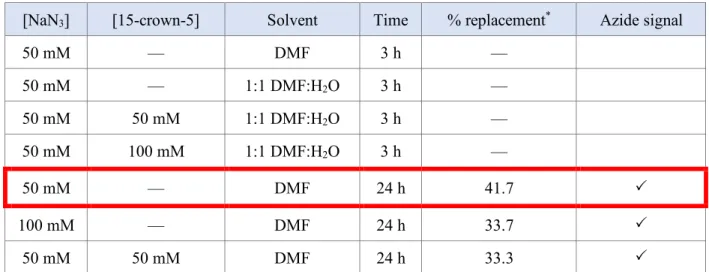
Azide Modification. Several conditions were tested in order to optimize the azidation reaction on the amorphous carbon thin films. Chlorine-terminated thin films were exposed to the reaction conditions summarized in Table 1 and then analyzed with XPS. The most optimized azide-termination reaction is highlighted with a red box in Table 1. Percent replacement refers to the amount of chlorine functional groups replaced by an azide function group, and azide signal refers to the presence of indicative azide-specific peaks with 2:1 peak area ratios at
Table 1. Summary of Azide-Termination Reaction Conditions
[NaN3] [15-crown-5] Solvent Time % replacement* Azide signal
50 mM — DMF 3 h —
50 mM — 1:1 DMF:H2O 3 h —
50 mM 50 mM 1:1 DMF:H2O 3 h —
50 mM 100 mM 1:1 DMF:H2O 3 h —
50 mM — DMF 24 h 41.7 P
100 mM — DMF 24 h 33.7 P
50 mM 50 mM DMF 24 h 33.3 P
*Percent replacement values were only calculated when the azide signal was observed.
Figure 1. High-resolution XP spectrum of N 1s electrons for a representative N3-aC surface produced via our optimized reaction scheme.
Fe 2p XP spectra for both azide-terminated and hydrogen-terminated aC thin films after exposure to CuAAC reaction conditions for 48 h.
Figure 2. High-resolution XP spectrum of Fe 2p electrons for (a) an azide-terminated surface and (b) a hydrogen-terminated surface both of which have been exposed to CuAAC reaction
conditions.
Electrochemical detection of ferrocene. Cyclic voltammetry (Figure 3) was performed on a ferrocene-functionalized amorphous carbon film, and the reductive peak for the ferrocene couple was observed at 0.324 V. These preliminary results indicate that the ferrocene on the surface is undergoing reduction but the oxidation peak is not observed.
Figure 3. Cyclic voltammogram at 10 mV/s of a ferrocene-terminated aC on Si film obtained in 0.25 M tetrabutylammonium hexafluorophosphate in acetonitrile. Potentials are reported in reference to a pseudo-reference silver wire electrode. A platinum coil was used as the auxiliary
Discussion
Azide modification approaches. A variety of reaction conditions were tested during the optimization of a scheme for the azidation of the surfaces. These included variations in the solvent used, the concentration of NaN3 reagent, the presence or absence of 15-crown-5, and the reaction time (summarized in Table 1). Use of a 1:1 ratio of DMF:H2O as the solvent did not yield the azide-specific peak at 404.8 eV during XPS analysis. This indicated that while a large amount of nitrogen was present on the surface, it was not in the form of an azide.
Increasing the concentration of NaN3 from 50 mM to 100 mM did not improve the amount of chlorine replacement, probably because 100 mM exceeds the solubility limit of NaN3 in DMF; therefore, 50 mM of NaN3 was chosen. In one study, addition of an oxo-crown
increased the reactivity of the azide groups towards replacement of chlorine by chelating the Na+ ions present in the solution and increasing the nucleophilicity of the azides.7 Lange et al. chose to use 18-crown-6 for this purpose in their study, but we attempted a similar scheme with
15-crown-5, as it generally binds Na+ more effectively than 18-crown-6.13 However, we found that the addition of 15-crown-5 to the reaction mixture actually decreased replacement or did not lead to the detection of the azide-specific peak at 404.8 eV.
The effect of kinetics on this reaction was investigated and increasing the reaction time from 3 to 24 hours resulted in the appearance of the azide-specific peak at 404.8 eV upon XPS
catalysis). This approach proved successful upon our first attempt with 100% replacement, and therefore it was not necessary to optimize the reaction further.
To determine the selectivity of the click reaction with the azide-terminated aC surface, we also attempted to attach ethynyl ferrocene to a hydrogen-terminated film. The XP spectra in Figure 2 highlight the importance of the azide group for the success of the reaction. The
hydrogen-terminated aC thin film shows no iron signal after the click reaction, while the azide-terminated aC thin film has two prominent iron peaks in its Fe 2p spectrum. This demonstration of specificity serves to emphasize the efficiency and utility of the CuAAC reaction as a means for the attachment of a wide variety of alkyne-containing molecules to a surface. The Fe 2p spectrum for the azide-terminated surface displays a single doublet at 708 and 721 eV which corresponds to iron in its +2 oxidation state. This has been previously reported for ferrocene.14
Analysis of the full XP spectrum of a successfully ethynyl-ferrocene clicked aC thin film shows the presence of Cu 2p on the surface. This could be due to the adsorption of the Cu catalyst itself or another intermediate to the surface which was not removed during rinsing.
observed prior to electrochemical analysis disappeared, indicating that the copper was not surface-bound. Upon optimization of the electrochemical analysis, the peak currents will be obtained as a function of scan rate in order to assess the surface-bound electron transfer to the ferrocene redox couple.
Conclusion
In this work, we describe an optimized reaction scheme to prepare azide-terminated aC thin films. We also show the utility of these azide groups by reacting them with
alkyne-containing ethynyl ferrocene via the copper-catalyzed azide-alkyne cycloaddition (CuAAC) reaction. XPS data confirms that the azide group reacts completely and specifically with the terminal alkyne present on ethynyl ferrocene to form a triazole linker. We further confirm the presence of the ferrocene by performing cyclic voltammetry. Future studies will work to uncover the oxidation peak of the ferrocene couple from the water oxidation onset.
The selectivity of the CuAAC reaction makes it a very attractive means of modifying carbon surfaces and also shows that it can be adapted for the attachment of photo-catalysts to aC thin films, such as one that reduces CO2 to CO. Future directions for this project will include attaching a ruthenium-based CO2 reduction catalyst and assessing its photocatalytic efficiency.
Acknowledgements
References
(1) Kang, P.; Chen, Z.; Brookhart, M.; Meyer, T. J. Electrocatalytic Reduction of Carbon Dioxide: Let the Molecules Do the Work. Top. Catal.2015, 58 (1), 30–45.
(2) Hyde, J. T.; Hanson, K.; Vannucci, A. K.; Lapides, A. M.; Alibabaei, L.; Norris, M. R.; Meyer, T. J.; Harrison, D. P. Electrochemical Instability of Phosphonate-Derivatized, ruthenium(III) Polypyridyl Complexes on Metal Oxide Surfaces. ACS Appl. Mater. Interfaces2015, 7 (18), 9554–9562.
(3) Lockett, M. R.; Smith, L. M. Carbon Substrates: A Stable Foundation for Biomolecular Arrays. Annu. Rev. Anal. Chem.2015, 8, 263–285.
(4) McKenas, C. G.; Fehr, J. M.; Donley, C. L.; Lockett, M. R. Thiol-Ene Modified Amorphous Carbon Substrates: Surface Patterning and Chemically Modified Electrode Preparation. Langmuir2016, 32 (41), 10529–10536.
(5) Tornøe, C. W.; Christensen, C.; Meldal, M. Peptidotriazoles on Solid Phase: [1,2,3]-Triazoles by Regiospecific copper(I)-Catalyzed 1,3-Dipolar Cycloadditions of Terminal Alkynes to Azides. J. Org. Chem. 2002, 67 (9), 3057–3064.
(6) Stenehjem, E. D.; Ziatdinov, V. R.; Stack, T. D. P.; Chidsey, C. E. D. Gas-Phase Azide Functionalization of Carbon. J. Am. Chem. Soc.2013, 135 (3), 1110–1116.
(7) Lange, N.; Dietrich, P. M.; Lippitz, A.; Kulak, N.; Unger, W. E. S. New Azidation
Methods for the Functionalization of Silicon Nitride and Application in Copper-Catalyzed Azide-Alkyne Cycloaddition (CuAAC). Surf. Interface Anal.2016, 48 (7), 621–625. (8) Ruther, R. E.; Cui, Q.; Hamers, R. J. Conformational Disorder Enhances Electron Transfer
through Alkyl Monolayers: Ferrocene on Conductive Diamond. J. Am. Chem. Soc.2013,
(9) Cao, P.; Xu, K.; Heath, J. R. Azidation of Silicon ( 111 ) Surfaces as a Potential Method for Protecting the Silicon Surface from. J. Am. Chem. Soc.2008, 130 (111), 14910–14911. (10) Daugaard, A. E.; Hvilsted, S.; V, B. P.; Lyngby, D.-K.; Hansen, T. S.; Larsen, N. B.
Conductive Polymer Functionalization by Click Chemistry. 2008, 2, 4321–4327. (11) Darlatt, E.; Traulsen, C. H. H.; Poppenberg, J.; Richter, S.; Kühn, J.; Schalley, C. A.;
Unger, W. E. S. Evidence of Click and Coordination Reactions on a Self-Assembled Monolayer by Synchrotron Radiation Based XPS and NEXAFS. J. Electron Spectros. Relat. Phenomena2012, 185 (3–4), 85–89.
(12) Das, M. R.; Wang, M.; Szunerits, S.; Gengembre, L.; Boukherroub, R. Clicking Ferrocene Groups to Boron-Doped Diamond Electrodes. Chem. Commun. 2009, No. 19, 2753. (13) Bruice, P. Y. Organic Chemistry, 7th ed.; Pearson: Boston, 2014.