Structure and Outcomes of Innovation Tools to Solve Challenges in Public Health: An Exploratory Multiple Case Study Evaluation
By Erika Ferguson
Honors Essay
Health Policy and Management University of North Carolina
4/24/2014
Approved:
Problem Statement
In recent decades, public health and health carehave experienced an abundance of
innovation and entrepreneurship. This innovation has improved life expectancy, quality of life,
diagnostic and treatment options, as well as increased the efficacy and cost effectiveness of the
healthcare system.1 Despite these advances, many challenges remain unresolved at the hospital,
national and global levels. These challenges have not been solved through existing strategies and
need creative solutions.
In past decades, healthcare organizations, government institutions and non-governmental
organizations generated ideas through a closed innovation model.2 This model followed the logic
that successful innovation should remain internal and requires control. Further, this model asserts
that an organization’s leadership includes the best and brightest minds and is the most equipped
to discover the greatest ideas for improvement. The organization’s leaders would work
individually to try to solve their organization’s problems. However, as challenges in healthcare
become more widespread, complicated and intertwined, this closed-door method of innovation
became obsolete. As a result, a new model of open innovation was created in which healthcare
organizations leverage innovative ideas from the masses through various types of funding
instruments.
Research prizes, grants and innovation tournaments are three tools used by both public
and private agencies to stimulate research and innovation. Henceforth, this study uses the general
term “innovation tools” to refer to all such mechanisms. Prizes are an example of a “pull”
“push” mechanisms that reduce the cost or risk to developers. Prizes are especially effective in
healthcare technology R&D because they do not require sponsors to choose among the many
developers. Rather, sponsors must define their goal product and leave the door open for all
interested developers. This model has the potential to bring new minds and ideas to difficult
problems.3 Research prizes pay for results and require the researcher to take on a significant
amount of risk.
Research grants are different from prizes in that they pay out based on the idea and
generally do not require the researcher to take on a significant amount of risk. Grants take many
different forms but usually refer to research funding obtained through a competitive process, in
which potential research projects are evaluated and the most promising receive funding.4
A third and relatively new approach for creating advanced solutions to the most critical
public health problems is innovation tournaments. Innovation tournaments are defined as the
process of creating, selecting, and developing opportunities such that exceptionally promising
opportunities are identified.5 A number of innovation tournaments have been performed over the
last few years in many industries, from energy to entertainment. For example, General Electric
created a competition to find a breakthrough idea to create cleaner, more efficient and
economically viable grid technologies, and to accelerate the adoption of smart-grid
technologies.6 Other companies such as Netflix7 and Dow Chemicals,8 as well as social
organizations such as Ashoka,9 have created innovation tournaments to foster new ideas.
A number of studies have been completed, mostly within the field of economics, which
describe the theoretical basis of these innovation tools.10,11,12,13,14 These studies detail how to
entries and award effective prizes.15 However, most of the existing literature does not put the
theories into context, or evaluate the lessons learned from recent innovation tools in public
health.
This study will examine three recent cases in which innovation tools were used in three
different sectors of public health: healthcare/hospital, national and global in order to understand
their design, how they solicit entries, moderate the tournament, evaluate ideas, award winners
and encourage participation.
The objective of this mixed methods study is to examine existing models for innovation
through competition that have been implemented by notable health care organizations in order to
answer the following questions:
1. In what circumstance was each innovation tool used, and how did this influence how it
was conducted?
2. How was each innovation tool structured, and how did this format influence innovative
ideas produced?
3. What insights and lessons may be learned from each of the three case studies, and how
can these be applied to other health-related innovation challenges?
Literature Review
In recent decades, innovation has been widespread in public health. This innovation has
improved life expectancy, quality of life, diagnostic and treatment options and the efficacy and
cost effectiveness of the healthcare system. For example, in 2003, the National Human Genome
human genome, allowing doctors to test a patient’s predisposition to diseases and scientists to
develop a deeper understanding of disease processes to produce biotechnological advances.16 In
addition, health care delivery systems have also been revolutionized through innovations such as
the Accountable Care Organization (ACO), a provider-led organization with a mission to
manage the full continuum of care and to be accountable for the overall costs and quality of care
for a defined population.17 Evidence suggests that ACOs provide higher-quality, more efficient
care than other care delivery systems.18
Despite these and other revolutions in public health, many challenges still remain
unsolved at the hospital, national and global levels. Hospitals and their partners look for new
ways to improve the patient experience of care, improve the health of populations and reduce the
per capita cost of health care, collectively known as the “Triple Aim.”19 The United States
government is searching for novel ways to extend healthcare coverage to 34 million Americans,
address insurance industry abuses, decrease healthcare spending, improve healthcare through
health information technology (HIT), curb waste, fraud and abuse in Medicare, Medicaid and
other health care programs and establish a new public-private partnership to improve quality,
safety, and affordability of healthcare for all Americans.20 In addition, global health experts
search for ways to improve and create new vaccines, control insect vectors that spread disease,
improve nutrition, limit drug resistance and cure infection in the world’s most vulnerable
populations.21
With so many challenges facing the public health and healthcare industry at all levels, it
is important that innovative strategies are created. Innovation is defined as “a new match
between a need and a solution.”22 As previously mentioned, health care innovation can come
from organizational leadership in a top-down approach, while innovation in medical technology
(drugs, vaccines, diagnostics, medical equipment, etc.) is usually created through research and
development (R&D). Neither of these strategies alone, however, is equipped to handle the
expansive challenges in health care. Research indicates that ideas initiated through leadership
alone are less inventive than ideas created by those in the field.23 In addition, exploration into the
financial return of research shows higher R&D spending does not correlate with higher
innovation.24
While innovation often seems serendipitous or out of control, many organizations have
turned to many different innovation tools to deliberately manage the innovation process.25
Different innovation tools are being used in a number of industries to generate new ideas,
products and practices. For example, the professional services organization Deloitte conducts an
annual innovation tournament called “Innovation Quest” to identify innovative ideas seen at
client sites and bring them back to Deloitte so that more clients can benefit from them. In the
first phase, all of Deloitte’s 43,000 employees are invited to submit ideas. Subject-matter experts
review submissions and choose those to move on to the second round. The second round is
focused on collaboration; those who submitted ideas build a diverse team to give feedback on the
idea. In the final round, all Deloitte employees vote for the winner. To date, more than 90 ideas
have been chosen, with the winners receiving monetary rewards and exposure to senior
leadership.26 Other companies such as General Electric,27 Netflix28 and Dow Chemical29 put on
Tools to Promote Innovation in Public Health and Healthcare
This study will examine three innovation tools. This section describes those three tools.
Gates Grand Challenges Explorations
The Bill and Melinda Gates Foundation sponsors several initiatives that champion
scientific creativity and support novel ways to fight diseases plaguing the world’s poor. One such
initiative, the Gates Grand Challenges Explorations, aims to solicit bold, unorthodox ideas
around chosen topic areas in global health. It targets leading thinkers from various disciplines,
including those who have not traditionally been involved in health research, to work on solutions
to important problems in the developing world. Grand Challenges Explorations was created in
2007 and has since awarded 850 $100,000 Phase 1 grants in 57 countries.30 The grant proposal is
only a two-page explanation of the idea with no supporting data required. To accentuate the
emphasis on the idea itself, reviewers are blinded to the name, profession and nationality of the
applicant. In addition, the grants are reviewed not by experts in the field, but instead by
individuals in science, engineering, business and other fields with strong track records in
high-risk research.31
Center for Medicare and Medicaid Innovation (CMMI)
To lower health care spending while improving quality of health care, the Patient
Protection and Affordable Care Act of 2010 (ACA) broadened the powers of the Centers for
Medicare & Medicaid Services (CMS) to include a range of cost cutting and quality-enhancing
tools, the most significant being the Center for Medicare and Medicaid Innovation (Innovation
Center). The Innovation Center was created primarily to test new payment and delivery systems.
the most important, innovative and influential solutions to cost cutting and quality improvement,
the Innovation Center created the Innovation Challenge, which awards between $1 million and
$30 million in grants to applicants who propose “compelling new models of service
delivery/payment improvements that hold the promise of delivering the three-part aim of better
health, better health care, and lower costs through improved quality for Medicare, Medicaid and
Children’s Health Insurance Program (CHIP) enrollees.”33
To receive an Innovation Challenge grant, participants must complete an application that
includes standard forms and a cover letter, project abstract, project narrative, budget and budget
narrative. A team consisting of staff from Health and Human Services (HHS) and other outside
experts review all applications. The team evaluates applications based on recommendations from
the review panel; the geographic diversity of the awardees; the range of service delivery and
payment methods proposed; reviews for programmatic and grants management compliance; the
reasonableness of the estimated cost to the government and anticipated results; and the likelihood
that the proposal project will result in the benefit expected.34
To date, the Innovation Challenge has completed two rounds of grants, awarding 26
first-round grants on May 8, 2012, and 81 second-first-round grants on June 25, 2012. A total of 107
grants were awarded in the first year of the Innovation Challenge out of the nearly 3,000
submissions from all sectors of the health care industry. In total, the awardees will receive
approximately $895 million to implement their proposals. Individual awards vary from $1.1
Penn Medicine Innovation Tournament
Hospitals have also used innovation tournaments to find ways to improve clinical care.
Penn Medicine is one of the world’s leading academic medical centers, consisting of the
Raymond and Ruth Perelman School of Medicine at the University of Pennsylvania and the
University of Pennsylvania Health System. Together, Penn Medicine is a $4.3 billion business.36
Penn Medicine aspires to create innovative ideas to significantly improve the patient experience.
Often these ideas are created by physicians and leadership alone, but because many aspects of
the care delivery process involve nurses, administrators and patient transporters, Penn Medicine
finds it important to include these groups in the ideation process. In November 2011, Penn
Medicine created an innovation tournament with the goal of engaging the entire Penn Medicine
staff to identify and select new ideas that generate value for the patients of the health system. The
tournament aimed to leverage the ideas and experiences of the Penn Medicine employees to
come up with new ideas that would significantly improve the patient experience. There was no
monetary prize for winning, because leadership felt that it would not increase submission
creativity and that large cash prizes may hinder the free and open sharing of ideas.
In its implementation, the tournament was broken down into three phases. Phase 1
focused on gaining a large number of submissions from a diversity of groups within the health
system. Employees were informed of the tournament through a communication campaign
consisting of flyers, posters and a strong online presence. A website was created that allowed
employees to submit ideas, view ideas, and rate ideas on a scale of 1-5. A total of 1739 ideas
were submitted and over 5000 employees participated by commenting and rating ideas. The
submissions were evaluated by a combination of a panel of 29 experts from various parts of the
improve patient experience and if it could be implemented in six months. Ideas moved on for
having a high mean score or by having significant high percentage scored (many 4s and 5s). Two
hundred ideas were chosen to move to Phase 2.
In Phase 2, the 200 ideas were split into five workshops. Participants were asked to pitch
their ideas using a poster and a 90-second pitch. After the pitches, participants voted on the best
submissions and groups of five were created around the best ideas. After that, the best 6-10 ideas
were presented again. The best two submissions from each workshop were selected to move on
to Phase 3.
In Phase 3, the top 10 ideas were presented to an audience of about 200 Penn Medicine
employees and a judging panel of 15, which included the CEO, CMO and other executive
leadership. The final ten ideas were evaluated on two questions: “How new or novel is this idea
for public health care delivery?” and “What is the potential for this idea to improve the patient
experience at Penn Medicine?” Two winning ideas were selected for implementation.37
Methods
Research Design
This analysis used a multiple-case study design involving three cases: Gates Explorations,
the Center for Medicare and Medicaid Innovation and the Penn Medicine Innovation
Tournament. Cases were selected because they were prominent examples of methods to elicit
innovation in three distinct levels of public health: healthcare/hospital, public/national
tournaments and how they are used to advance innovation in health. As discussed in the
Introduction, this study will address the following research questions:
1. In what circumstance was each innovation tool used, and how did this influence how it
was conducted?
2. How is each innovation tool structured, and how does this format influence innovative
ideas produced?
3. What insights and lessons may be learned from each of the three case studies, and how
can these be applied to other health-related innovation challenges?
The three case studies will be analyzed with respect how each case navigates the six-part
process framework designed by Wooten (2013, p. 4).39
1. Defining Challenge—What does the contest look like?
2. Soliciting entries—Who can participate?
3. Moderating—What is the in-process feedback/information loop?
4. Evaluating—How are entries judged?
5. Awarding—What prize is at stake for the winner(s)?
6. Participating—How does an agent (person/team entering the contest) choose to engage
Data Collection Methods
This study will use two methods: (1) semi-structured telephone interviews with key
informants and (2) review of key documents about the innovation tournaments, including annual
reports and data on grants awarded. Three public health innovation tournaments were selected as
the case studies.
Interviews
Within each case study, the subjects for interviews will be purposefully sampled.40 A
total of 10 people will be interviewed: one person from the leadership of each innovation
tournament and another three winners from each tournament (with the exception of Penn
Medicine where one winner will be interviewed due to the small number).
In each case study, I will interview one person who is both in a director position over the
innovation events and also on the board overseeing its creation. The names and positions of the
interviewees will not disclosed in order to maintain the anonymity of the evaluations of the three
cases.
In addition to interviewing the leaders, I will interview three winners from each event.
Penn Medicine has only completed one innovation tournament with two winners, so one will be
randomly chosen for the study. Because Centers for Medicare and Medicaid Innovation and the
Gates Foundation Explorations have large numbers of recipients, I will purposely choose three
Document Review
The study will also examine organizations’ annual reports, through published data on the
winning projects, and any other important documents related to the tournaments. Interviewees
applications will also be reviewed.
Data Analysis
Within-Case Analysis
This study will first design a within-case analysis for each case using both interview data
and all documents collected. A codebook will be created based on the six-part process
framework as coding categories: defining challenge, soliciting entries, moderating, evaluating,
awarding and participating. Within these broad categories, codes will be created.41 First, readers
will complete initial coding by generating numerous category codes as responses are read,
labeling notes and listing relationships and trends. Then readers will use focused coding to
eliminate, combine, or subdivide coding categories.
Two researchers – the main researcher and a colleague -- will create hard copies of all
documents collected from each case and take notes. The same two readers will review the
transcribed notes from the interviews. The data from each interview will be coded using the same
codebook and coding strategy.
Within-case analyses will examine how each innovation tournament conducts each of the
six phases described by Wooten (2013).42 In addition, the within-case analyses will portray how
the context of the tournament (healthcare/hospital, public/government, global) appears to be
lessons learned from each tournament and how these lessons could be applied to future health
tournaments.
Cross-Case Analysis
Subsequently, the cross-case analysis will compare and contrast how each of the
innovation tournaments conducts each of the six phases described by Wooten (2013)43 and how
these strategies influence tournament results.
Results
The results are organized by the research aims previously discussed in the following
order: (1) the circumstance in which each innovation tool was used and how this influenced how
it was conducted; (2) how each innovation tool was used and how this format influenced the
innovative ideas produced; and (3) what insights and lessons can be learned and applied to other
healthcare-related innovation challenges.
Circumstances of innovation tool
Gates Grand Challenge Explorations
The Bill and Melinda Gates Foundation is one of the largest private foundations in the
world. One if its primary aims is to enhance healthcare and reduce extreme poverty globally. To
further this aim, the Gates Foundation and other partners collaborated in 2003 to create the
Grand Challenges in Global Health Initiative, which was a half a billion-dollar initiative. The
Foundation brought together stakeholders from around the world to identified the largest
challenges in global health and then solicited proposals from leading healthcare and development
multi-millions of dollars. This grant was thought to be successful, but the Foundation began
thinking that another type of grant model might prove successful results as well. One leader from
the Gates Foundation said,
The idea was that really anybody can have a great idea, it doesn’t have to be someone
who is at Harvard or the London School of Tropical Medicine, it can be anyone from
anywhere. It could be a graduate student, it could be a guy in his garage, it could be a car
mechanic, so that was the motivation for starting the Grand Challenges exploration which
has a lower barrier to entry and a much lower price tag associated, rather than the original
multi-million grant.
Grand Challenge Exploration grants come from the idea that sometimes the most creative
ideas emerge from unlikely sources. Another leader from the Global Health Discovery Program
at the Gates Foundation discussed how the Grand Challenge Explorations reflect a fundamental
value of “thinking critically and not being satisfied with the status quo.” Because the Gates
Foundation already had more traditional and less risky grant models in place, the Grand
Challenge Exploration was seen by Gates leadership to provide an outlet to test high risk, high
reward ideas.
Center for Medicare and Medicaid Innovation
The Patient Protection and Affordable Care Act created the Center for Medicare and
Medicaid Innovation in 2010 in order to test innovative payment and delivery system models to
improve quality while decreasing the cost of care in Medicare, Medicaid and the Children’s
Health Insurance Program (CHIP). One of the leaders of CMMI said that at first CMMI was
were eager to “have a vehicle to cast new models for delivering and paying for care.” The CMMI
team saw that there was a lot of great work that was going on across the country in terms of
innovation in healthcare delivery and financing and they were eager to find a way to tap into that
work. As a result, she led a team to put $1 billion aside from the CMMI budget to create a broad
funnel grant solicitation that would not only further innovative solutions to healthcare challenges
but also “partner the organization with innovators in the field” to accelerate transformation.
Because the Innovation Award is run through the Center for Medicaid and Medicare
(CMS), a part of the Department of Health and Human Services (HHS), the Innovation Award
had to follow HHS grant guidelines. These guidelines did not dictate the scope or topic of the
award, but they did create guidelines for how grants were solicited, the application requirements
and other important components.
Penn Medicine Innovation Tournament
Penn Medicine is “committed to remain a world-leading institution in three equally
valued and inter-related missions of patient care, education and research.”44 Because healthcare
is changing so dramatically due to the healthcare reform bill as well as other changes in
healthcare delivery, Penn Medicine wished to create a way to leverage all of the talents and
expertise from its frontline workers and develop innovative ways to improve care. At the same
time, two professors from the Wharton School of Business at the University of Pennsylvania
were writing a book called Innovation Tournaments about an innovative approach to solving problems, not just in healthcare, but also in multiple types of organizations.
The leader from Penn Medicine discussed how the health system was using a top-down
group that basically you can apply to get awarded a process improvement grant to follow these
things forward but for the most part it has to happen organically in their departments.” The
leadership of Penn Medicine was looking for a more systematic way to enable their staff,
employees and clinicians to have more input into the process of healthcare delivery innovation
and want to do so through an innovation tournament.
Structures of Innovation Tools
The structure of the innovation tools were organized by the six-part process framework:
1. Defining Challenge—What does the contest look like?
2. Soliciting entries—Who can participate?
3. Moderating—What is the in-process feedback/information loop?
4. Evaluating—How are entries judged?
5. Awarding—What prize is at stake for the winner(s)?
6. Participating—How does an agent (person/team entering the contest) choose to engage
(effort, strategy, etc.)?
The structure of each innovation tournament according to this framework is broadly described in
Table 1. Structure of three innovation tools used to solve public health challenges.
Gates Grand Challenges Exploration
Center for Medicare and Medicaid Innovation Award
Penn Medicine Innovation Tournament
Defining Challenge Specific Broad Broad
Soliciting Entries Open to the public Open to public Closed to public. Open to all Penn employees
Moderating No feedback No feedback Feedback in each of 3 rounds
Evaluating Blind, external & internal review
Not blind, external review
Not blind, internal review by employees and leadership Awarding $100,000 each Based on the project’s
budget, with $1 billion total being awarded over the two rounds.
No monetary award
Participating Little engagement between participants or between participants and organization Some engagement between participants and between participants and organization.
Employee participation was key in all three phases of
tournament.
Defining Challenge
Gates Grand Challenge Exploration
Each round has 4-6 specifically defined topic areas. Each topic area has a one-page
description of the topic, as well as examples of types of work they will and will not fund. The
topic areas are based on foundation priorities and chosen internally. Foundation teams come to
the Grand Challenge Exploration leadership when they have a problem they do not have an
answer to but know that through this innovation tool they could get some answers. In the
be stagnant that they want to expand interest in.” One GCE winner found the process of priority
setting to be unclear however. He said,
I think the process of priority saying needs more transparency for how the priorities are
set, against some global strategy whether the MDGs or identified global burden of
disease associated priorities. For the most part, they tend to be in that space but once in a
while you have a couple of categories where clearly they’re looking for very out of the
box ideas that might not be useful right now.
Center for Medicare and Medicaid Innovation
The Health Care Innovation Awards were divided into two rounds. The first round was
looking broadly at innovative ideas to test new payment and service delivery models to deliver
better care and lower costs. The second round sought proposals focusing on four different
categories: (1) models that are specifically designed to rapidly reduce Medicare, Medicaid,
and/or CHIP costs in outpatient and/ or post-acute settings, (2)models that improve care for
populations with specialized needs, (3) models that test approaches for specific types of
providers to transform their financial and clinical models, and (4) models that improve the health
of populations. The leader I interviewed from CMMI said that “we wanted to solicit the best
ideas around the country, so we decided to write a very open-ended or broad funnel approach.”
Penn Medicine Innovation Tournament
The Penn Medicine Innovation Tournament was looking for ideas relating to reducing
include all departments and employees of the hospital. The tournament leader said, however, that
if he could make a change to the tournament,
I think I’d have a more narrow theme. I think if it is too broad you get a lot of diverse and
different ideas but they’re all in different realms. The benefit of these types of
tournaments is to identify a very narrow theme instead of improving patient experience
which is very broad, something like how do you reduce readmissions for heart failure or
all sorts of specific things. That’s what you see in all these other innovation tournaments,
that’s one thing.
Soliciting Entries
Gates Grand Challenge Explorations
The Gates Grand Challenge Explorations were open to the public. Applicants from all
different disciplines and geographic areas were encouraged to apply. Both leaders I spoke to
expressed a deep commitment to geographical diversity, so the Foundation staff has done a
significant amount of geographic focused marketing and reported significant increases in
applications from these regions as a result.
The Foundation also works to create few barriers to entry, so that people from many
different backgrounds and parts of the world feel encouraged to apply. First, the foundation
reviews all applications blind, so that only the idea is evaluated rather than the work history of
the applicant or her affiliations. In addition, the application is only two pages, which does not
require a significant time commitment. This small application also aims to reward good ideas,
One winner of the GHE found fault in the commitment to engage non-traditional public
health researchers in this model. He said, “The space of public health innovation is actually very
complex and it takes more than just a great idea to transform the way global health activities
operate.”
Center for Medicare and Medicaid Innovation
The Innovation Awards are open to anyone who has developed innovations that will
drive improvement in population health, quality of care and total cost of care. Applications
involve a financial plan, operational plan, actuarial review and executive overview. Because the
Innovation Award is run according to HHS guidelines, the solicitation of grant proposals is a
very formal procedure. There is a formal release of the applications done at the Secretary level.
All participants in this study heard about the award through their organization’s leadership and
were encouraged to apply.
Penn Medicine Innovation Tournament
The Penn Medicine Innovation Tournament was closed to the public but all Penn
employees were encouraged to participate. The leader from Penn Medicine described the
approach taken by the Penn Medicine leadership to encourage applications:
So we had a sort of multi-modal campaign. So one aspect was obviously email—so we
sent emails to everybody through the listserv. Another way was through our website, so
our main Internet portal which had a lot of traffic on it. Another was posters throughout
the institution to advertise for it a little bit. And the final, which was very important, was
from different department to get their staff to participate, so we think that that was
important as well.
Overall a total of 1700 Penn Medicine employees participated in the Innovation
Tournament by submitting ideas and even more participated by evaluating ideas in Phase 1.
Moderating
Gates Grand Challenge Explorations
Due to the high-quantity of applications, no feedback is given to applicants that were not
chosen.
Center for Medicare and Medicaid Innovation
Due to the high-quantity of applications no feedback given to applicants that were not
chosen.
Penn Medicine Innovation Tournaments
Feedback is a vital part of the innovation tournament model. Feedback is given at each
phase of the tournament. In phase 1, all employees are encouraged to rank the 1,700 proposed
ideas on a 1-5 scale. This system allowed employees who did not necessarily have a good idea to
propose in the tournament to still participate. In phase 2, ideas were presented in a workshop in
which other participants gave feedback to each project. Teams were also put together based on
shared interested discovered in Phase 2, so constant feedback and improvement of the idea
Evaluating
Gates Grand Challenge Explorations
The GCE entries go through three phases of evaluation. Each round receives anywhere
from 1,500- 3,000 applications. These entries first go through an initial screening process that
looks at the responsiveness to the call. One of the leaders recalled that about 30-70% of the
proposals make it through this initial round into the two different types of reviews. The reviews
are done concurrently. One of the two reviews is conducted by the Innovation Panel, which
consists of people that are “experts in innovation.” These are people who have a proven track
record in innovation in their field of work and are not directly involved with that area of
research. The Innovation Panel judges each get one “Gold Pick,” which automatically make
move on to the awarding stage, and two “Silver Picks,” which move on to the internal review.
While the proposals are passing through the Innovation Panel, they also move through the
Parallel Panel. The Parallel Panel is made up of topic-specific researchers. This panel does not
choose whether a proposal is awarded; they simply comment on each proposal so that the
internal reviewers can make an educated decision on the proposal. Finally, the “Silver Picks” are
brought back to the internal reviewers, staff that work for the Gates Foundation, with the
comments from the Parallel Panel for final awarding decisions.
One of the reviewers on a GHE panel commented that the evaluation is particularly
difficult due to the short application:
I’ve reviewed submissions and it really is hard to assess something in two pages. So
that’s the down side of it. It is hard to tell in two pages what’s a good solid idea and
providing enough information for someone else to assess it and score it. That’s the
capacity or anything else because you don’t have that information. Is this a viable
possibility; is this something that could lead to something bigger or more sustainable? So
what you are judging is only the concept.
Center for Medicare and Medicaid Innovation
Grant policy dictates that the Healthcare Innovation Awards program itself cannot be
involved in the reviewing. Reviewers who are external to the innovation center in order to ensure
objectivity and independence do the reviewing. The leader from CMMI elaborates,
So in the case of the innovation awards, our grants office, the office of acquisitions and
grants management, that’s the grants office for CMS, they maintain contracts with
organizations that can convene review panels, they sign conflict of interest statements,
etc. and that is administered by contact from the CMS grants office.
Penn Medicine Innovation Tournament
The evaluation techniques used by the innovation tournament further the concept of
bottom-up innovation. The leader from Penn Medicine said,
We think the executives probably have a lot of influence, if not too much influence over
all the decisions to get made anyway, so if you allow the executives to select these you
are missing out on the opportunity to select things that perhaps they have not thought
about, so that’s one thing because you fly it through the same lens as every other decision
you’re not going to generate new ideas.
In phase 1 of the tournament, both fellow employees, as well as judges from the
moved on to phase 2. Of the 1,700 ideas submitted, 200 moved on to phase 2. Phase 2 was
divided into two workshops, each with 100 participants. Each participant presented their idea and
then all the participants voted on the best ideas. At this point, participants who had not moved on
to phase 3 were encouraged to join the team of those that did move on. The top 10 ideas from
phase 2 moved on to phase 3. Phase 3 consisted of both crowd voting, in which the members of
the crowd could text in to different teams to express their interest, as well as final voting by a
group of executives. It is important to include executives of Penn Medicine because their buy-in
is essential to move forward with the projects. The leader said, “If they’re more excited about it
then there is more of a chance of these projects happening, so there is a sort of balance.”
Awarding
Gates Grand Challenge Explorations
The GCE is broken down into two rounds, phase 1 and phase 2. In Phase 1, applicants
must submit a two-page application with no data. These awards are purely based on the idea that
is explained in the short application and can be used to test a hypothesis or collect preliminary
data. Winners of the GHE are awarded $100,000. One winner of a GHE noted one benefit of this
aware: said,
I think that phase 1 is just to get some proof of concept data of your idea, that’s what
phase 1 is about, so this money that they give for phase 1 is really good to test an idea,
test an hypothesis, and the way the proposal is, not needing primary data, is different than
other grants, but to get the primary data you need a bit of money. And the way the Gates
Foundation works, they give you a good way to do that. Give people who don’t have the
minimum of a preliminary data and I am talking about federal money and federal
agencies like NSF, NIH or USDA. They all require a minimum of preliminary data.
Other winners, however, stated some concerns with the model. For example, one winner
was concerned with scalability: Another winner is skeptical of the value of the award. He argued,
We are very sort of skeptical and a little bit annoyed by this use of pool of innovation
funding and I think because in my area of expertise, we complain that nothing is put to
scale, what is partly to blame for that is that the seed funding that goes into the building
of a lot of these systems is so small that nothing is actually built to scale, so you are
building for demonstration and inspiration and not sustainability. They are good enough
to demonstrate something and that’s it, they’re not made to extend or expand over
hundred of thousands of subscribers. It is a very different thing to build a prototype, like a
Wright Brother flyer, versus a Boeing 747. There is a big difference and you can extend
that analogy to health systems. And what it also does is that what you are trying to say
that we are stimulating innovation but really what you’re doing is the concern of
pilot-itus.
In addition, this winner explained that small grants such as the GHE might actually have
negative consequences on the global health field. He said,
Very often what these small grants do is that they end up taxing other resources, so you
have funding to do other things that is being diverted to sustain this underfunded activity.
So let’s say its $100,000 innovation award, you can’t do very much with that money
implementation prices go up through the roof. You have to hire people, etc. so you end
up taking money away from other projects to sustain this concept.
A third winner also commented on the challenges associated with a small award amount.
He discussed how unlike a traditional grant that would cover all of his costs, the GCE requires
that he has to take on some of the risk himself:
You have to figure out how to successfully conduct the research in a remote part of the
DRC, which requires travel and a lot of other infrastructure issues. It is not something
that someone would normally do, especially a for-profit institution, and expect your costs
to be covered. We certainly will be investing a lot of our own resources in this. The
$100,000 doesn’t cover the total costs, but it is a good incentive.
Center for Medicare and Medicaid Innovation
In the application for the Healthcare Innovation Award, a budget is submitted. Once the
application is highly ranked by the external review and recommended for funding, it would come
back to the Office of Grants Management who would look at the budget. The Office of Grants
Management would then take a look at the budget and make sure all the expense are consistent
with HHS grant policy and that all expenses are truly necessary to achieve the goals of the grant.
One applicant said that once he submitted his application, “the first real communication that I
had [with CMMI] was when they called me and asked me if I could take 20% out of my budget.”
The award amount is based on the proposed budget and any changes made thereafter. Over the
Penn Medicine Innovation Tournament
The Penn Medicine Innovation Tournament was a process to create an innovative idea
rather than pilot it or put it into practice. As a result, there was no money needed to carry out the
project in prize or grant form. In addition, the tournament had no monetary prizes associated
with it. The leader from Penn said that, “In general, when you apply monetary prizes to things
you’ll actually disincentive innovation in some ways and people end up doing it for different
reasons.”
Participating
Gates Grand Challenge Exploration
The GCE had little engagement between participants or between the participants and the
organization. One researcher said that once the GCE grants are awarded,
It is up to the researcher. They don’t really follow-up on how the research is going. You
have to write or report a financial report and a scientific report after 18 months from the
starting date of the project but they don’t really follow-up.
Center for Medicare and Medicaid Innovation
In CMMI, here is some engagement between participants through quarterly meetings
based on topic area and the website. There is also interaction with CMMI staff through the
project manager and the financial officer. The leader from CMMI said that,
Once the award is made, if the grant type is a cooperative agreement, and the healthcare
innovation award is a cooperative agreement, then there is lots of dialogue between the
awardee or the design of the intervention and that is ongoing in a cooperative agreement.
That’s the difference between a straight grant and a cooperative agreement; a cooperative
agreement is a special type of grant where we cooperate to get the best possible outcome.
One of the winners of the Innovation Award discussed the various ways that CMMI set
up collaborative and helpful spaces. He said,
They set up regular meetings and webinars. They set up groups—I was just on a call
today, a quarterly meeting with the other awardees on acute and critical care. So they are
very helpful in that respect.
Penn Medicine Innovation Tournament
Employee participation in all three phases of the tournament was key to its success. Not
only did participants evaluate each other in each phase of the tournament, but following the
workshop in phase 2 they were encouraged to combine into teams. One of the winners of the
tournament discussed how helpful it was to create teams in building the idea:
Having other people’s spin on the matter thought of other ways to use my idea beyond
what I thought of. That’s how it evolved. My initial idea was that the kiosk could do
check in and check out at the front desk. It could collect co-pays and do everything a
human does. You could swipe your credit card. Well some other people thought of you
could use these kiosks to do patient education, patient surveys, also make it speak in
foreign languages for people who don’t speak English. It could speak in Spanish and
using kiosks to some of these other things. So the idea did evolve beyond my initial
concept when other people brought in their ideas.
New Model for Organizations to Choose the Optimal Innovation Tool
Each of the three cases studied used different innovation tools in order to meet the
challenges they wished to solve. When deciding what innovation tool to use, each organization
thought through their goals, as well as the potential participants and the amount of risk necessary
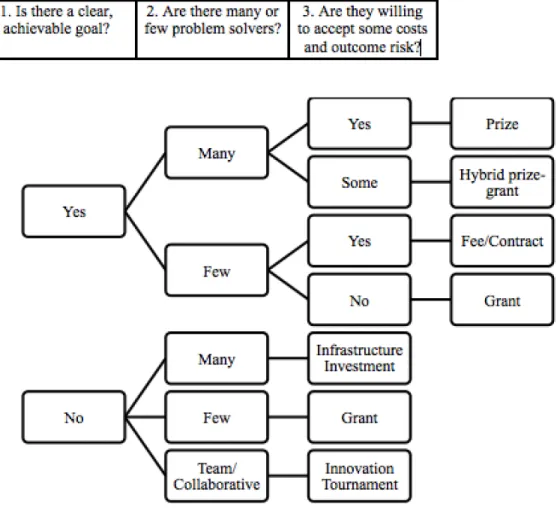
to achieve the desired result.45 Figure 1 shows a flow chart for deciding the type of innovation
tool to use in different circumstances.
If an organization were to use the flow chart to decide which innovation tool to use, the
leadership would ask the three questions at the top of the chart. First, does the organization have
a clear, achievable goal in mind? If the organization is looking to solve a very specific challenge,
like creation a new diagnostic tool for malaria, then it would answer “yes” and follow along the
top section of the chart. If, however, the organization was looking at a more broad topic like
quality improvement in hospitals, it would answer “no” and follow the lower section of the chart.
Next, the leadership would have to decide if there were many of few problem solvers in the field
they are working in. If it were a very specialized challenge with few researchers involved in the
area, then the answer would be few. Conversely, if there were many researchers in the chosen
field, the organization would choose “many.” Finally, the organization must understand whether
the participants they are working to attract are willing to accept some costs and outcomes risk.
Based on these three criteria, organizations can predict the best innovation tool to solve their
Figure 1. Flow Chart for deciding the optimal innovation tool to use in order to solve public
health challenge.
Gates Grand Challenge Explorations
As previously mentioned, the Gates Foundation already had traditional grants aimed at
solving global health challenges in its portfolio. However, the Foundation believed that it is not
only the highest caliber public health researchers from the top universities that have great ideas
that could revolutionize this field. With that idea in mind, the Global Health Discovery Team
decided to create another grant model. First, they recognized that they had clear goals in mind
Grand Challenges, the team wished to leverage ideas from many different problem solvers from
many different fields and geographic locations. Finally, in order to get the best ideas back, the
Foundation team decided to take on some risk. The Foundation reads applications completely
blind without any proof of concept or preliminary data needed and judge solely the idea
expressed in the proposal accepting that many of the ideas might not succeed.
Because of these circumstances, the Gates Foundation created the Gates Grand Challenge
Exploration to work as a prize-grant hybrid. The GCE defines a goal narrowly according to 4-6
needs designed by the Foundation. It then judges based on only the idea itself, rather than how
likely the idea is to accomplish. The Foundation awards USD $100,000 to the winning proposals
in a grant format. This award is small enough that it forces researchers to take on some of the
financial burden of the research project in hopes of finding proof of concept data or creating a
replicable pilot that would earn them the larger prize of USD $1 million in phase 2. Because of
this design, the GCE has many characteristics of a grant but also the incentive structure of a
prize.
Center for Medicare and Medicaid Innovation
The CMMI Award is very different from the Gates Grand Challenge Exploration in both
its goals and model. The CMMI Award has a very broadly defined challenge rather than a
specific, achievable goal. Further, the award searches for proven innovators in the fields of
provider groups, health systems, payers and other private sector organizations, faith-based
organizations, states, local governments, public-private partnerships and for-profit organizations.
Because the Award is targeting those that have already developed innovations that will drive
small audience for the call. Because of these two circumstances, the CMMI Innovation Award
created a traditional grant.
Penn Medicine Innovation Tournament
Penn Medicine had a broadly defined aim and wanted to create an innovation tool that
would properly leverage its large employee base and create a collaborative environment. Penn
worked with two professors from the Wharton School of Business to create a new model for
innovation called innovation tournaments. Tournaments, as previously mentioned, are defined as
the process of creating, selecting and developing opportunities such that exceptionally promising
opportunities are identified.
Discussion
This study compared three tools to foster innovative solutions to public health challenges.
The study analyzed the environments and goals of each organization to better understand how
and why each innovation tool was conducted. Next it examined the structure of each innovation
tool according to the process framework discussed earlier in the paper. The cases were then
compared and contrasted to recognize how the processes of each case reflected the goals of the
organization that conducted them.
Based on the environment and goals of the organization, an organization can choose the
best innovation tool to fit their needs. This study first analyzes the benefits and challenges of
different methods of creating an innovation tool at each stage of the process model. At the
“defining challenge” stage, the leader from Penn Medicine said that if he could change one thing
rather than leaving it broad. Conversely, the leader from CMMI applauded the grant’s use of a
broadly defined challenge as a way to get many different players and ideas centered around the
same general goal of increasing healthcare quality while decreasing cost working together.
Further, the cases provided an interesting insight into the soliciting entries phase of an
innovation tool. The Gates Grand Challenge Exploration solicits entries from all types of people,
not just traditional public health researchers, from all corners of the globe in their effort to solve
global health challenges. The Gates Foundation looks to examples of innovations coming from
unlikely sources like the Argentine car mechanic who created a device to ease births of babies
who are stuck in the birth canal. 46 However, some winners of the GCE point out that the space
of public health innovation is very complex and that it takes more than just a great idea to
transform the way global health activities operate. Like Gates, CMMI has created an innovation
tool that was open to the public, however it applied only to those whom had developed
innovations or pilots that are shown to drive improvement in population health, quality of care
and total cost of care. This excludes all those who are not working in traditional healthcare
settings that have a record of success. Penn Medicine’s Innovation Tournament is not open to the
public and targets only Penn Medicine employees to participate. This was successful at
leveraging employees’ insight into the daily challenges of the hospital but excluded the unique
perspectives of patients and the public.
At the moderating stage, Penn Medicine’s Innovation Tournament excelled in providing
valuable feedback at each stage of the tournament that, according to participants and leadership,
led to significant positive change in the quality of ideas presented. Neither the CMMI
any applicants in order for them to improve their projects due to the large quantity of
applications.
The evaluating stage was also done differently for each stage based on their objectives.
The Grand Challenge Explorations evaluated the proposals blindly in order to lower the barrier
to entry. The proposals were then subject to an external review by innovation experts and subject
matter experts and then internally reviewed to make sure they were meeting the needs of the
Gates Foundation. The Penn Medicine Innovation Tournament was not evaluated blindly and
was reviewed internally by other employees and the leadership in order to, like the Gates
Foundation, find the innovative ideas that best met the needs of the organization. CMMI
evaluated its proposals through an external review in order to keep the process as objective as
possible.
The awarding phase was were the differences between the three innovation tools was
most apparent. This was also the phase that correlated the most with the goals of the tournament.
The CMMI Innovation Award was a traditional grant and therefore was interested in funding the
winning projects according to the project’s budget. The Innovation Award does not require the
winner to take on any of the financing and therefore none of the risk, but in return requires strict
stewardship of the money overseen by a financial officer. Conversely, the Gates Grand
Challenge Exploration funds winners $100,000 is phase 1, which is, in most cases, not enough to
fully fund the proposed project. This prize-grant hybrid requires the winner to take on some of
the risk at the onset of the project in order to have the opportunity to win a larger amount of
money, $1 million, in phase 2. Gates awards small increments because it funds very
out-of-the-box, risky projects that, according to a leader from the Gates Foundation, are “almost certain to
successful in phase 1 have the opportunity to get more funding in phase 2 to continue with the
project. The Penn Medicine Innovation Tournament is a completely different model in that it
crowd sources ideas but does not provide seed funding to materialize these ideas. The winners
received not prize money and instead, the hospital took of the costs of creating the innovations
itself.
Finally, the three cases encourage participation in different ways. The Penn Medicine
Innovation Tournament greatly valued employee participation throughout the competition. The
tournament received 1,700 proposals from employees but 5,000 employees participated by
ranking ideas or joining teams of ideas that moved on in the process. Employee participation and
crowd sourcing was the backbone of the innovation tournament model. The Gates Grand
Challenge Explorations and the CMMI Innovation Awards demanded less participation
throughout the process. In fact, neither of the innovation tools gave feedback throughout the
process or allowed revisions or improvements of proposals once they were submitted. Once the
winners were selected, there was some participation and collaboration for winners but it was
underutilized. For the most part, winners from the GCE and the Innovation Awards worked
independently from other winners and applicants.
This is the first research study that comparatively analyzes different innovation tools to
understand the mechanisms that decide what model an organization should use to foster public
health innovation. By interviewing leadership and winners from three different types of
innovation tools, this study was able to understand the logic for choosing innovation tools as well
as the pros and cons of each innovation tool. This study first sought to understand the
circumstance and goals of each innovation tool and then broke down the process of each tool to
was able to generate a flow chart to help organizations decide which innovation tool is most
appropriate to fit their challenges.
The leadership from each of the three case studies, as well as many of the winners
interviewed expressed interest in the topic and earnest for the need for more research to be done
on financing mechanism for public health research. As the flow chart in Figure 1 shows, not
every health care innovation challenge is best solved by traditional health grants like the NIH
study sections. Rather there are many different innovation tools to fit the needs of an
organization such as contracts, grants, prizes and innovation tournaments. There is limited
research on the types of innovation tools and even less research on comparing them. As there are
a growing number of challenges in healthcare, more research is needed in this area to help
organizations decide on the best innovation tool to meet their needs.
This study design sought to sample a variety of innovation tools used at three different
levels of public health: global, national and organizational. The study’s sample size was too
small to cover all types of innovation tools. In addition, it only analyzed one of each type of tool,
which allows for some bias. It is unknown whether the cases studied were “typical” grants,
prizes and innovation tournaments. Finally, the study also focused on different innovation tools
that focused on three different levels of public health. It is possible that the challenges at the
three different levels of public health are so different that the innovation tools to solve them
would vary significantly.
This exploratory study is the first step in understanding the different types of tools used
to solve challenges in public health and healthcare. Further studies will be required to build upon
1 Omachonu, V., & Einspruch, N. (n.d.). Innovation in healthcare delivery systems: A conceptual
framework. The Innovation Journal: The Public Sector Innovation Journal , 15(1),
2 Mayle, D. (2006). Managing innovation and change. (3rd ed.). London, England: Sage Publications
3 Wilson , P., & Palriwala, A. (2011). Prizes for global health technologies. Results for Development
Insititute ,
4 Hanson, R. (1998). Patterns of patronage: Why grants won over prizes in science. University of
California, Berkeley, Berkeley, California.
5 Terwiesch, Christian, and Karl Ulrich. Innovation Tournaments: Creating and Selecting Exceptional
Opportunities. Boston: Harvard Business School, 2009.
6 GE: ecomagination, "How It Works." Last modified 2012. Accessed October 1, 2013.
http://challenge.ecomagination.com/ct/g.bix?c=ideas.
7 Netflix prize. (2009). Retrieved from http://www.netflixprize.com/
8 Innovation. (n.d.). Retrieved from http://www.dow.com/innovation/
9 Changemakers. (2013). Retrieved from http://www.changemakers.com/citizenmedia
10 Wooten, J., & Ulrich, K. (2013). The impact of visibility in innovation tournaments: Evidence from
field experiments . Unpublished manuscript, The Wharton School, University of Pennsylvania ,
Philadelphia.
11 Ales, L., Cho, S., & Korpeoglu, E. (2013). Innovation tournaments with multiple contributors.
12 Clemons , E., Fazil Pac, M., & Savin, S. (2010).Designing innovation tournaments to maximize their
value: An economic perspective. Informally published manuscript, The Wharton School , University of
Pennsylvania , Philadelphia.
13 Schottner, A. (2008). Fixed-prize tournaments versus first-price auctions in innovation
contests. Economic Theory, (35), 57-71.
14 Girotra, K., Terwiesch, C., & Ulrich, K. (2010). Idea generation and the quality of the best
idea.Management Science, 56(4), 591-605.
15 Wooten, J. (2013). Innovation tournaments: Improving ideas through process models. (Doctoral
dissertation). University of Pennsylvania.
16 International human genome sequencing consortium describes finished human genome sequence.
(2004, October 20). NIH News Release. Retrieved from http://www.genome.gov/12513430
17 Rittenhouse, D., Shortell, S., & Fisher, E. (2009). Primary care and accountable care — two essential
elements of delivery-system reform. The New England Journal of Medicine, (361), 2301-2303.
18 Tollen L. Physician organization in relation to quality and efficiency of care: a synthesis of recent
literature. New York: The Commonwealth Fund, April 2008.
19 Institute for Healthcare Improvement, "The IHI Triple Aim ." Last modified 2013. Accessed November
13, 2013. http://www.ihi.org/offerings/Initiatives/TripleAIM/Pages/default.aspx.
20 The White House, " Deficit-Reducing Health Care Reform ." Accessed November 13, 2013.
http://www.whitehouse.gov/economy/reform/deficit-reducing-health-care-reform.
21 Grand Challenges in Global Health , "The Initiative ." Last modified 2013. Accessed November 13,
22 Terwiesch, Christian, and Karl Ulrich. Innovation Tournaments: Creating and Selecting Exceptional
Opportunities. Boston: Harvard Business School , 2009.
23 Terwiesch, Christian, and Karl Ulrich. Innovation Tournaments: Creating and Selecting Exceptional
Opportunities. Boston: Harvard Business School , 2009.
24 Terewiesch , Christian, and Christoph Loch. "When Product Development Makes a Difference: A
Statistical Analysis in the Electronics Industry." Journal of Product Innovation Management. (1998).
25 Terwiesch, Christian, and Karl Ulrich. Innovation Tournaments: Creating and Selecting Exceptional
Opportunities. Boston: Harvard Business School , 2009.
26 Terwiesch, Christian, and Karl Ulrich. Innovation Tournaments: Creating and Selecting Exceptional
Opportunities. Boston: Harvard Business School , 2009.
27 GE: ecomagination, "How It Works." Last modified 2012. Accessed October 1, 2013.
http://challenge.ecomagination.com/ct/g.bix?c=ideas.
28 Netflix, "Netflix Prize." Last modified 2009. Accessed October 1, 2013. http://www.netflixprize.com/.
29 Dow, "Innovation." Last modified 2013. Accessed October 1, 2013. http://www.dow.com/innovation/.
30 Bill & Melinda Gates Foundation, "Grand Challenges Explorations: Fall 2013 Report." Last modified
2013. Accessed November 13, 2013.
31 "A risk worth taking." Nature. (2008): 1150.
32 Berenson, Robert, and Nicole Cafarella. "The Center for Medicare and Medicaid Innovation: Activity
33 Federal funding alert. (2011, November 23). Retrieved from
http://www.nursefamilypartnership.org/assets/PDF/Policy/NFP_Funding_Alert_11-23-11.aspx
34 U.S. Department of Health and Human Services, Centers for Medicare & Medicaid Services.
(2011). Health care innovation challenge
35 U.S. Department of Health and Human Services, Centers for Medicare & Medicaid Services.
(2012).Health care innovation award project profiles. Retrieved from website:
http://innovation.cms.gov/Files/x/HCIA-Project-Profiles.pdf
36 Two penn medicine innovation tournament winners selected for interactive improvements to patient
scheduling and navigation. (2012, May 24). Penn Medicine. Retrieved from
http://www.uphs.upenn.edu/news/News_Releases/2012/05/big/
37 Terwiesch, C., Mehta, S., & Volpp, K. (2013). Innovating in health delivery: The Penn Medicine
innovation tournament. Healthcare, 1(1-2), 37-41.
38 Yin, R. (2009). Case study researchl design and methods. (4th ed.). Thousand Oaks: Sage Publications.
39 Wooten, J. (2013). Innovation tournaments: Improving ideas through process models. (Doctoral
dissertation).
40 Bogdan, R., & Knopp Biklen, S. (1992). Qualitative research for education: An introduction to theory
and methods. (2nd ed.). Needham Heights: Allyn and Bacon.
41 Miles, M., & Huberman, A. (1994). Qualitative data analysis: An expanded sourcebook. (2nd ed.).
Thousand Oaks: Sage Publications.
42 Wooten, J. (2013). Innovation tournaments: Improving ideas through process models. (Doctoral
43 Wooten, J. (2013). Innovation tournaments: Improving ideas through process models. (Doctoral
dissertation).
44 Mission and Vision of Penn Medicine. (n.d.). Mission & Vision. Retrieved April 24, 2014, from
http://www.pennmedicine.org/health-system/about/organization/mission-vision.html
45 Using prizes to spur innovation. (n.d.). McKinsey & Company. Retrieved April 25, 2014, from
http://www.mckinsey.com/insights/innovation/using_prizes_to_spur_innovation
46 Mcneil, D. (2013, November 13). Car Mechanic Dreams Up a Tool to Ease Births. The New York
Times. Retrieved April 24, 2014, from
http://www.nytimes.com/2013/11/14/health/new-tool-to-ease-difficult-births-a-plastic-bag.html?_r=0