ORIGINAL ARTICLE
Principles of sustainable spatial nonequilibrium
A. A. Kaganovich, S. P. Prisyazhnyuk, A. S. Prisyazhnyuk, A.A. PetrovSaint Petersburg National Research University of Information Technologies, Mechanics and Optics University ITMO, Kronkv erskyProspekt 49, Saint Petersburg, Russian Federation 197101.
Abstract:On the basis of ongoing research and development the authors substantiate the need to improve the theoretical and methodological foundations of self-development processes for equilibrium and non-equilibrium economic multi-level systems. Particular attention is paid to the analysis of the functioning of the so-called microscopic open nonequilibrium systems.
In the article, the economic system is viewed from the point of view of synergy - as dual entities consisting of a continuous and discrete sphere. Classification of possible evolutionary changes in the kinetic and constitutional spheres in the process of self-development for economic equilibrium and nonequilibrium systems.Particular attention is paid to the continuous self-organization of microscopic open systems.
Keywords:Spatial economics; synergetics; cyclicity; development; self-development; system; sustainability; complex approach; external system; internal system; openness; environment; organization; the organization; methodology
1. Relevance
Some dissertational works, monographs, and scientific articles are devoted to the study of the problem of the stability of spatial nonequilibrium systems.In economic studies, both the concept of sustainability of the economic system and its determining factors, classification and forms of manifestationare considered.
However, in order to define a unified approach to the theoretical description of micro- and macroeconomic territorial systems, it is first necessary to determine the relationship of these categories with other concepts.
The stability of nonequilibrium systems has many modifications (ship stability, weather conditions, aircraftsetc.). The study of natural stable states is devoted to the branches of mathematics (the theory of differential equations), theoretical mechanics.
In general, the stability of objects is understood as their ability to maintain the current state in the presence of external influences. In this case stability and instability are distinguished according to M.Y. Lyapunov, linear and asymptotic.
With regard to natural phenomena and the economic system, sustainability and instability can be regarded as antipodes. In the economic theory the concept of stability of the economy and economic entities is very multifaceted.
In economic encyclopedias and dictionaries, options are given for the application of the concept of sustainability to various phenomena: the stability of prices, enterprises, monetary circulation, etc. In other words, stability is considered as a sign and characteristic of different objects.
Copyright © 2018 A. A. Kaganovichet al.
doi: 10.18686/fm.v3i2.1094
This is an open-access article distributed under the terms of the Creative Commons Attribution Unported License
(http://creativecommons.org/licenses/by-nc/4.0/), which permits unrestricted use, distribution, and reproduction in any medium, provided the original work is properly cited.
2. Research Objectives
2.1 Systematize knowledge of nonequilibrium geographic and economic systems in order to
create an effective mechanism for their management.
2.2 To consider methodical approaches to the creation of a system for managing
territories based on knowledge of nonequilibrium geographic and economic systems.
2.3 Conduct system analysis of the subject area, define a tree of goals, functions and design
management of non-equilibrium territorial-economic systems.
3. Methods of Research
As a methodological tool for the study, general scientific methods of cognition were used: analysis and synthesis, dialectical, abstract-logical, system analysis of the development of territorial processes, as well as methods of program-targeted planning, structural analysis, methods of economic analysis - analogies, groupings, comparisons, generalizations, typology and rating.
The object of research are theoretical, methodological and applied aspects of the process of self-development of equilibrium and nonequilibrium macro, micro and microscopic open economies.
4. Results of the Study
Internal processes occurring in economic systems of different types and levels of development are characterized by a certain time and spatial arrangement of cycles. The study of cyclicity reveals previously unknown properties of systems, especially those related to the nature of their functioning, stability and cognition.
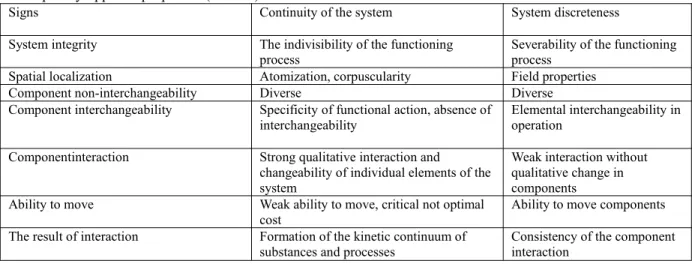
Economic spatial systems are dual in nature. On the one hand, these systems are closed spatial organizations (they exhibit certain circularity), on the other hand, these systems are «transitory». Proceeding from this it follows that we are dealing with two conjugate but non-intersecting regions of one system that functions in a continual and discrete process projection[1].The first area is the carrier of the material factors of the spatial production structures, the second area reflects the financial side of the given spatial system. It can be argued that these areas are different entities, since they have completely opposite properties (Table 1).
Signs Continuity of the system System discreteness
System integrity The indivisibility of the functioning
process Severability of the functioningprocess Spatial localization Atomization, corpuscularity Field properties
Component non-interchangeability Diverse Diverse
Component interchangeability Specificity of functional action, absence of
interchangeability Elemental interchangeability inoperation Componentinteraction Strong qualitative interaction and
changeability of individual elements of the system
Weak interaction without qualitative change in components Ability to move Weak ability to move, critical not optimal
cost Ability to move components
The result of interaction Formation of the kinetic continuum of
substances and processes Consistency of the componentinteraction Table 1.Signs of continuity and discreteness of spatial economic systems
A prime example of the aforementioned spheres spatial economy analogue is the ratio between the terms current and voltage. These physical entities do not exist separately in nature, however, these are two related areas of a higher level of the system - the electromagnetic system. Within the framework of this system it is impossible to reduce these two areas to each other. We observe the operation of such a system every day. Having closed the chain from a certain number of elements, we will be convinced that, that the current will move along a single so-called «closed circuit» (unified system), while the voltage will perform certain cyclical fluctuations under the influence of both internal and external sources.
In microeconomics, the area of continuity is a sphere that indicates the general state of a spatio-economic object. This sphere is characterized by closedness and circularity of functioning. The external environment and external factors play the role of initiators of spatial-organizational economic changes, they determine the dynamics of the state of the entire economic system. Spatial microeconomics certainly takes part in this process, but throughout its life cycle it keeps the system closed and its circularity. Spatial microeconomics is a holistic continuum that encompasses all the kinetic potential of the life cycle - material and energy resources and the so-called fundamental potential - buildings and structures, equipment and machinery. Analysis of the activities of subjects spatial microeconomics shows that the impact on them of the external environment, forces these entities to respond to them through changes in the kinetic and fundamental fields. The microeconomic enterprises strive to remain stable under these conditions, and their reaction to the challenges of the external environment is aimed at preserving their dynamic functioning.
As the results of earlier studies show, with external influences, in spatial microeconomics only two types of structural changes are possible:
To the first kind we refer changes that affect only the so-called kinetic region. Changes in this case come from the impact on the production entity of environmental factors. After the termination of the external impact on this entity, the enterprise returns to its previous state. An example of such a factor impact may be the failure of supplies of primary raw materials to production, etc.
The second type of change can be attributed to changes occurring in the «fundamental» area of the system. Such influences include the replacement of equipment in production, the re-equipment of production for the production of a new type of product, etc. Reversible changes in the fundamental area of the system can lead the production entity to irreversible consequences until the end of its existence. These irreversible processes in the fundamental domain can be characterized as bifurcation. If, after the transition of the fundamental area to a new quality, the system changes also in the kinetic region, then it can be concluded that the production subject (system) has evolved to a higher level of evolution.
Evolutionary development of the system is a process of a certain selection, and this evolution combines both reversible and irreversible processes in various spatial spheres. This process certainly does not go beyond the existing in the system adaptive capabilities. By their nature, these adaptive capabilities of the system are immanent, since they reflect the immanence of the spatial production environment, and it means that the adaptive capabilities determine the properties of the system by means of which the process of development of the entire spatial system is carried out. However, as the studies conducted by us show, these opportunities are manifested exclusively when interacting with external environmental factors. In other words, the immanent possibilities of the system can not be manifested if there is no contact with the external environment at the microlevels.
The evolutionary possibilities of self-development of spatial systems can be divided into two groups:
The first group – Long evolutionary chains. In this group the evolutionary possibilities of self-development are realized for a sufficiently long period. This period is represented by a large number of «chains of local self-development», which are immersed in the kinetically continuum environment.
The second group – Evolutionary forces of self-development. In the presented group there are so-called driving forces of the evolution of the system, with the help of which it is possible to determine the degree of progression, i.e. to develop certain criteria for the evolution of the process of self-development of the system.
A content analysis of the first group shows that it is formed on the basis of at least four principles that can be defined as phenomenological. It should be noted that all these principles are based on the properties of self-development of micro-level format systems. Based on the analysis of the possibilities inherent in the foundation of the second group, the so-called principle of progressive evolution is formed also at the micro level of self-development of spatial economic systems.
We found out that such spheres as kinetic and continuum has planned characteristics, and therefore are fairly predictable. However, the probabilistic factors that are dictated by the external environment are predicted very poorly. It
is for this reason that the spatial production entities tend to build a predictable environment in order to exclude as much as possible the uncertainty factors.
Studies indicate that, at the level of a single spatial production subject, it is most often possible to create the so-called nontrivial mechanism of self-development. The process of operation of such a mechanism shows that at the exit of the specified process the result remains unchanged even when external forces are exerted on it[2]. The reason for this is the lack of a financial component in the in-production spatial system. But this applies exclusively to systems of a lower order. When moving to a higher system level, the financial component is built in into the spatial-production system. In the course of this process, a simple linear formula - «Goods - Money - Goods» does not take into account many aspects. But if we manage to «close» this spatial-production cycle through the productive component, then it becomes possible to control this entire spatial construction. This is made possible by the fact that even an «accidental» external impact, passing through the entire production cycle in a spatial environment, will give a non-random response. In other words, in this process of self-development, there is a combination of being and due. This is the main purpose of production cycles, working in space and in turn influencing the self-development of the system.
In this case, we are dealing with a cyclic process, which is typical for closed systems. With the operation of such a mechanism, all links of the spatial production system are balanced due to core repayment of the production and financial (added value) components of the system. These «nodal» connections create a relative economic equilibrium of nonequilibrium spatial systems in their structure. An example in this case is the so-called «balance-space-economic models.
We believe that the space-economic cycle is characterized primarily by continuous continual parameters, that reflect the indices of the material activity of a given system in space.
Spatial-economic system with the help of these parameters can describe well enough in conventional units such categories as space, time, energy and based on cause-effect relations to answer satisfactorily the question what processes are taking place in the system.
These processes are relatively non-stationary. The main reason for this phenomenon lies in the so-called regime with causal cyclic variability»[3]. An example of this phenomenon is an example of the spread of a flame in any combustible medium. Observations of this process indicate that the flame in the combustion process reaches the so-called exacerbation point, after which it is localized in view of the fact that it pulls in the surrounding resources. The process of localization is characterized exclusively by the internal properties of the regimes flowing in it. Each of the modes has an aggravation point. This is one of the paradoxes of an open nonlinear medium. The paradoxical nature of studies of open nonlinear media on the example of the combustion process is that this process can develop near another similar process (the flame exists separately but next to another fire and competes with it for combustion resources), and each of these processes can absorb its competitor, and maybe a self-sustaining system of a certain equilibrium.
Proceeding from the above, it can be concluded that the localization effect in any medium is possible only if there are three factors:
the environment must be open, it must receive energy, which compensates for the loss of the environment (scattering, damping, dissipation);
the environment must be non-linear, that is, have some connections between the harmonics (components), whose function is to establish a selective relationship between themselves;
in the environment there should be elements with the function of eating out the extra kinds of intrasystem movement, that is, those kinds of movement that are not supported by the environment because of its nonlinearity.
Non-linear environments (systems) include the regional economy. In view of the fact that the process of economic development takes place in space and, in turn, space is an open environment, we have the right to allocate a discrete area of the economy that directly interacts with the external environment. This interaction is represented by certain communication channels. Universal means of communication, through which the interaction of the environment under consideration with the external environment is the subject of production activities, on the functioning of which depends
the socio-economic stability of the territories. The process of interaction arising between media through the interaction of the subjects of productive activity gives rise to communication networks. Analysis of these networks indicates that they are divided into two groups of chains - a group of «open» circuits and a group of closed circuits. This is indirectly confirmed by other studies[4].Each open chain is designed to connect two nodes - one of the subjects of production activity entering into the environment with one of the social and economic subjects of the external environment. The point of connection of media is a boundary inter-median stripe.
A closed chain is a chain that connects intra-industrial and social actors. This chain is designed to "transform" the functions of internal production and social entities in order to balance the internal state of the environment with the force of external forces acting on it. This is confirmed by studies of various European and American scientific schools[5,6].
In a sustainable spatial socio-economic development, such parameters are territorial production entities. These subjects are the elements (parameters) of management and act (may act) and as a result of the development of the territories. Proceeding from the fact that in space stability these elements occupy a priority place, the entire spatial system is essentially non-stationary. Such a self-organizing, non-equilibrium spatial and economic system is the basis for territorial development. In the case of a non-equilibrium ordering of the spatial system, the degree of disequilibrium increases, since production costs are constantly increasing.This is necessary to maintain the existing degree (level) of disequilibrium of the entire spatial and economic system. With the equilibrium ordering of the spatial system, the degree of disequilibrium decreases, and the role of production costs is reduced solely to the temporary filling of the cyclical «discontinuities» formed in the system[7]. This is a complex spatial and economic phenomenon, in which both processes are interrelated. Spatio-economic equilibrium and nonequilibrium structures and flows are not isolated and are able to move from a state of equilibrium to a state of disequilibrium. In other words, these structures and flows have the ability to transform into each other as a result of cyclic and noncyclic processes. Nonequilibrium systems can exist only for a while, and equilibrium systems can function indefinitely and turn into a nonequilibrium structure under the condition of external influences not it.
We agree with the conclusions of the scientists[8,9] who argue that when moving from a local space-economic system to a higher-ranking spatial-economic system, there are not necessarily signs that microsystems are endowed. For this, in our opinion, it is necessary to perform the so-called coherent self-organization[10]. One of the necessary conditions for this process is the state of instability for a nonlinear medium. This means that the nonlinear medium is sensitive to small fluctuations.
In the state of instability, there is always a phenomenon that indicates the connection between micro- and macro-scale systems. It is under these conditions that small perturbations can determine the macro-picture of the event, the kind of spatial-economic macrostructure, and the small and random has a direct exit into the macrospace.
Proceeding from this, we certainly deal with two interrelated and complementary types of economic systems. Both these systems are ordered by the equilibrium and non-equilibrium elements of the economic process. Each type of system, due to the presence of objects (small to large), forms certain interrelated pairs - individual (rather small objects) and collective (individual objects). In the economic process, these types of systems can potentially be both useful and very dangerous for maintaining stable disequilibrium in space. It depends on the internal «interconnection» that function in the systems. Let us consider this statement in more detail.
For most biological-grade systems, the answer has already been received a long time ago. This became possible only in nonlinear dynamics. A vivid example of this is the results obtained in the analysis of pre-evolutionary evolution. The consideration of processes, individual elements of these systems of positive result did not give in view of the fact that it is necessary to investigate not the elements themselves but the cyclicity of their functioning that manifests itself in a sequence of chemical reactions during which the product of the last reaction is the basic element for the first reaction. This demonstrates a kind of «competition» between the ongoing cycles, which Manfred Eigen[11] called hypercycles.
The emerging competition multiplies the speed of the ongoing evolutionary processes.
In fact, we are dealing with a certain hypercycle of the second order. This is confirmed by the fact that we observe the process of circular[12] interaction of a large number of micro-level objects connected by cyclicity[13] links. In this case, a «cycle» of the first order is each microobject. The first cycle is designed to perform two functions: to maintain its own multiple reproduction and to be the primary cause (exciter) for reproducing from the available resources of the system other «chains» of microobjects.
Due to the fact that there is a shortage of resources in the environment, we observe resource competition between micro-objects that are part of the system hypercycle and micro-objects that are not included in it. There is also a struggle for the existence of some hypercycles with others. An exception occurs only if these hypercycles do not form a system of higher order[14].
A hypercycle is a kind of mechanism that unites self-reproducing microobjects into a single integrating system capable of coordinating the evolutionary process of development of the entire uneven system. This becomes possible as a result of the fact that in the process of combining microobjects into a single system, the advantages of one microobject become available for all other microobjects of the system. Conversely, each self-reproducing micro-object, when entering a single hypercyclic system, receives obvious advantages inherent in this hypercycle.
We can state that we are dealing with the continuum, continuous and syncretic type of self-organization of non-uniform systems.
The concept of continual self-organization originally had to do with chemical catalysis, but this conceptual approach enriches economic approaches to the study of various types of geographic and economic objects[15].
Stability of nonequilibrium systems is possible only at the level of microsystems, the bright manifestation of which are hypercycles. From nonequilibrium macrosystems with coherent self-organization, one can expect only the manifestation of the so-called linear evolution[16], as a result of which new qualities of nonequilibrium systems do not form, and hence the stability mechanism does not start.
5. Conclusion
The unification of nonequilibrium microobjects into coordinated cycles is the most interesting type of self-organizing stability of geographically-economic systems, in which microobjects act as nonequilibrium microscopic systems of an open type capable of independent evolution, i.e. sustainability and further development. Ignoring the self-organization of non-equilibrium systems of the continual type in general studies of coherent self-organization makes the latter incomplete and not productive. It is for this reason, until now, there is no single approach to the theoretical description of micro- and macroeconomic territorial systems.
Reference
1. Popkov VV. Conceptual and theoretical basis of economic constructivism. Journal of Economic Theory 2010; 4 (25): 56-70.
2. Amson J. Catastrophe theory: a contribution to the study of urban problems? Environ. Plan B 2 1975, 177–221. 3. Florida R. The great reset: how the post-crash economy will change the way we live and work. Harper, NewYork,
2010.
4. White R, Engelen G, Uljee I. Modeling cities and regions as complex systems: from theory to planning applications. MIT, Cambridge, MA 2015.
5. Wilson A. Boltzmann. Lotka, volterra and spatial structural evolution: an integrated methodology for some dynamical systems. J. R. Soc. Interface 2008; 5(25): 865–871.
6. Prigogine I. The end of certainty: time, chaos and the new laws of nature. Free Press, New York, 1997. 7. Garreau J. Edge city: life on the new frontier. Anchor Books, New York, 1992.
8. Allen PM. Cities and Regions as Self-Organizing Systems. Routledge, London, 1997. 9. Batty M. Pseudo-dynamic urban models. Ph.D. Thesis, University of Wales, Cardiff , 1984. 10. Haken HS. Verlag berlin heidelberg. Springer, New York, 1982.
11. Eigen M. Methods for investigation of ionic reactions in aqueous solutions with half times as short as 10–9 sec.: Application to neutralization and hydrolysis reactions / Discussions of the Faraday Soc. 1954. V. 17;
Elektrochemie. 1955. V. 59. (with J.Schoen).
12. Asiama KO., Bennett RM., Zevenbergen JA. Participatory land administration on customary lands: a practical VGI experiment in Nanton, Ghana. Journal of Geo-Information 2017; 6: seven-article no. 186, 22 p.
13. Bakker S, Contreras KD., Kappiantari M, et al. Low-carbon transport policy in four ASEAN countries: developments in Indonesia, the Philippines, Thailand and Vietnam. In: Sustainability: open access, 2017; 9: seven-article no. 1217, 17 p.
14. Luo XH, Bennett RM., Koeva MN., Et al. Investigating semi-automated cadastral boundaries extraction from airborne laser scanned data. In: Land: open access, 2017; 6: three-article no. 60, 23 p.
15. Potts KE., Rajabifard A, Bennett RM. Supporting the risk management process with land information: a case study of Australia. In: Disasters, 2017; 41: two pp. 352-364.
16. Ramadhan SA., Bennett RM., Nex FC. Exploring UAV in Indonesian cadastral boundary data acquisition. In: Earth science informatics, 2017, IN PRESS 18 p.