OVERNIGHT 5% LIDOCAINE THERAPY FOR TREATMENT OF VULVAR VESTIBULITIS
By
Denniz Zolnoun, MD
A Master's Paper submitted to the faculty of the University of North Carolina at Chapel Hill
in partial fulfillment of the requirement for the degree of Master of Public Health in
the Public Health Leadership Program
Summer Session II, 2002
Introduction:
Since its description some 100 years ago by Skene, vulvar vestibulitis has been an elusive disorder with poorly understood etiology, pathophysiology, and treatment 1. After an 80
year hiatus in the literature, in 1987 Friedrich proposed the first clinical diagnostic criteria for vulvar vestibulitis: 1) Severe pain on vestibular touch and entry dyspareunia, 2) tenderness to pressure localized within the vestibule, and 3) physical findings limited to erythema of various degrees 2• 3. The pain may be present only during attempted coitus,
or may be troublesome during other daily activities. The population prevalence of vulvar vestibulitis is unknown. In a private practice setting, Goetsch reported 15% of210 consecutively evaluated patients over 6 months met criteria for vestibulitis 4
Despite the reported high prevalence of this disorder, randomized trials evaluating medical treatments for vulvar vestibulitis (VVS) are limited to two negative studies 25.
Nyirjesy eta! reported similar response to topical Cromolyn cream (38%) vs. placebo (46%) over 3 months of therapy. Similarly, long term treatment with fluconazole, low oxalate diet and calcium produced improvement equivalent to low oxalate diet alone 5•
Several investigators have compared cognitive behavioral therapy and surgery with
conflicting results. In a randomize trail involving I 4 women Schultz at el showed no
additional benefit of surgery above cognitive behavioral therapy alone10. In another
randomized trial, Bergeron et a! found that vestibuloplasty, cognitive-behavioral therapy,
and surface electromyographic biofeedback all produced improvement at 6 months
follow up, with vestibuloplasty producing the best result. He, however, cautioned against
the apparent superiority of vestibuloplasty since 7 women assigned to this arm did not L
proceed with the treatment 11. Bomstein et a! conducted a randomized trial assessing the
optimal surgical approach. He concluded that complete resection of the tissue
(perineoplasty) results in full resolution of the symptoms (9/1 1 women) while vestibular
undercutting failed to result in any improvement (10 women)12.
In uncontrolled clinical series, the surgical approach to treatment of vulvar vestibulitis
seems to have the highest reported success rate. For example, McCormack reported 80%
5-year success rate, while the review of literature by Masheb et a! showed a 60-89%
improvement at 6 months; 10% were worse with surgery 13•14. In contrast, laser treatment
for VVS as an alternative to vestibuloplasty has had disappointing results; in most cases it
results in worsening symptoms and poor healing 13•
Over the past five years, on the basis of clinical and histopathologic data vulvar
women demonstrate anodynia to touch, and respond variably to treatment, perhaps based on the severity of the nerve injury 19. A greater than expected proportion of women with
VVS also suffer from interstitial cystitis, a disorder widely held to be neuro inflammatory in nature 20' 21 •
Boham-Starke's works suggests that in the case ofVVS, initial nerve injury provokes sensitization of nociceptors and release of neuropeptides that maintain an inflammatory process 16• 18. In case ofPHN, subgroup with mechanical anodynia responds to prolong
topical treatment with local anesthetics, Lidoderm patch®22•
Vulvar vestibulitis is clinicany similar to PHN in that it appears to have variable degrees of severity. Similar to PHN, majority of women with VVS have touch-invoked anodynia. As such, one might see a similar reduction in pain ofVVS using established treatments for PHN with touch invoked anodynia. The objective of this study was to assess the response of women with VVS to treatment with prolong local anesthetics, 5% lidocaine ointment.
Material and Methods:
Between Nov. 1999 and March of2001, an women referred to the University of North Carolina (UN C) Pelvic Pain Clinic for management of vulvar pain were evaluated for eligibility for enrollment. This study (case series) was approved by the Institutional Review Board. An patients referred for evaluation of vulvar pain underwent a standard history and physical examination. After completion of the history, they were asked to rate
'
o--their discomfort level on daily activity and intercourse using a Visual Analog Scale (VAS).
We performed comprehensive physical examinations on all women. We used cotton tipped applicator to touch labia major, labia minor and the vestibule, and we recorded presence or absence of allodynia (perception of pinprick when touched with the applicator), sensory loss, and any visible inflammatory changes.
A diagnosis ofvulvarvestibulitis was made (or confirmed) using Friedrich's criteria: presence of exquisite tenderness at the vestibule, vestibular fourchette, and vestibulo-hymenal junction with or without corresponding visual changes of erythema in the absence of known pathology. A diagnosis ofvulvodynia was made based on presence of daily-generalized pain/discomfort over vulva in the absence of any dermatologic or recognizable pathologic processes.
Women with dermatologic conditions (lichen sclerosis, lichen planus), chronic recurrent infectious disorders (e.g. chronic candida infections), vulvar intraepithelial neoplasia (VIN), and atrophic and ectopic dermatitis were excluded from the study unless they had concomitant VVB or vulvodynia. Women with a diagnosis of vulvar vestibulitis and generalized vulvodynia were offered the treatment. Additionally, women with clinically suspected diagnosis of vulvar vestibulitis, and generalized vulvodynia with other
women with diagnosis of vulvar vestibulitis, vulvodynia, and mixed diagnosis were
~--offered enrollment in the study.
After the diagnosis was made, study participants were instructed in the treatment
procedure. Using a mirror, the anatomy of the involved area was reviewed with the
patient. Patients were instructed to apply at bedtime a copious amount of 5% Xylocaine®
ointment to the affected area at vestibulo-hymenaljunction. Next, they were asked to
place cotton ball soaked in 5% Xylocaine in the vestibule to assure constant application.
Patients were instructed to use the treatment nightly, for 8 hours each night. They were
also instructed to refrain from intercourse for the first 4 weeks of the treatment. A week
prior to their follow-up appointment, they were instructed to resume sexual activity.
During the initial phase of the study it became clear that most patients responded within
6-8 weeks of starting the therapy; hence, resumption of sexual activity was commonly
delayed until at least 6 weeks of nightly therapy.
A repeat VAS score was obtained for daily activity and intercourse related discomfort in
the follow up visit. Patients were also asked about the ability to have intercourse in both
initial and follow up visits. Patients were reported as being able to have intercourse if
they were able to tolerate intercourse during a given month, regardless of frequency or
degree of discomfort. Those who were functionally celibate due to severity of symptoms
were reported as not being able to have intercourse. Regardless of the patients'
compliance with treatment or subsequent additional diagnoses the data for all the patients
A combination of chart review, telephone interview and direct interview was used to obtain additional demographics on the patients. Long-term response to treatment was assessed by sending a follow up questionnaire and VAS rating a minimum of 6 months after the initiation of treatment.
The primary outcome was a change in overall and intercourse related VAS with treatment. We also assessed patients for a 'clinic'illy significant reduction in pain' by looking at their ability to have intercourse, and a 50% reduction in intercourse related pain post treatment.
Statistical analysis was performed using STAT A software (college station, TX). Univariant descriptive tabulations were followed by bivariante analysis. Paired t -tests were used to assess changes in continuous outcomes; Pearson's
x
2 and Fisher exact tests were used for categorical data.Results:
A total of 7 4 patients were offered the treatment. Of the 7 4 patients, 2 patient declined treatment, 1 patient was spontaneously pain free within in a week of the visit and did not use the treatment, 7 patients did not show up after the first visit with no available follow up/demographic data. The reported data is based on the remaining cohort of 64 patients.
L
t-'
f
t
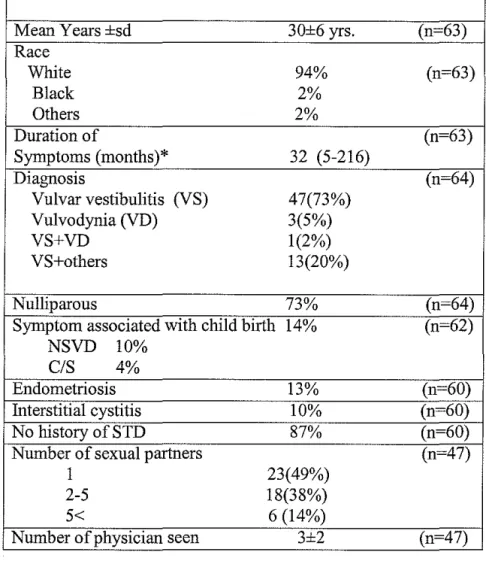
Demographic data is shown in table I. Patients' mean age was 30±6 years, and 95% of
patients had seen at least one physician with an average of 3±2 physicians in 32 months
(5-216) prior to their visit to our clinics. The primary diagnosis was vestibulitis in 47
women (73%) and vulvodynia in 4 (7%) women; 13 (20%) women had the other
concomitant diagnosis (vaginismus, 4; culture proven chronic recurrent yeast infection, 3;
recurrent herpes,!; lichen sclerosis, 1; proctalgia fugax, I; obsessive compulsive disorder
involving genital cleansing, 1; post episiotomy perineoplasty pain, 2). The majority of the
women were nulliparous. Forty-nine percent reported having had only one partner.
Thirteen percent of women had a known diagnosis of endometriosis, but endometriosis
was not the primary cause of dyspareunia in the majority. The majority of women had
various other treatments as reported in table 2. Women who had a trial oflidocaine
(before our evaluation) had used it prior to intercourse and on as needed basis.
There was no association between prior use oflidocaine and response to the treatment
regimen. On average, it took 7±3 weeks of nightly therapy to see any significant
improvement. A significantly higher proportion of women using the treatment reported
ability to have intercourse post-treatment compared to pre-treatruent, 73% vs. 40%
(P=O.OOI). Overall, the pain rating post-treatment was 12.40 (5.20,19.58) points lower
that pre-treatment pain ratings, p=O.OOl. Intercourse related pain score was 39.53 (30.84,
Clinically meaningful response to treatment was defined as a 50% or more declines in pain score with treatment. Neither the number of months with symptoms, presence of endometriosis or symptom onset associated with childbirth was related to response to treatment. Women with intersitial cystitis were 6.31 (1.18,32.90) less likely to respond to treatment than those without IC. Women with vulvar surgery also tended to be less likely to respond to treatment but the difference did not reach statistical significance. There was no statistically significant difference in improvement based on route of delivery or
number of sexual partners. Women with other vulvar diseases were less likely than
~-women with VS and VD to respond to treatment (p=0.009).
Forty-seven percent (30/64) of women responded to the 6 month follow up questionnaire.
I
'
Women who responded to the questionnaire were 1.58(1.09-2.28) times more likely to have reported a 50% improvement on their initial treatment. On average, respondents were in treatment for 8± 5 months. Seventy percent of those responding to the follow-up assessment reported on-going use of 5% Xylocaine® ointment. Within this subset, 17% (N=S) reported nightly applications, 23% (N=7) reported application several times a week, and 27% (N =8) reported using the treatment several times a month. The mean VAS on 6 month follow up was 21±23, down 13 points from pre-treatment daily
Discussion
Most patients with post-herpetic neuralgia describe one of three types of pain: 1) spontaneous, constant burning, throbbing, aching pain; 2) intermittent sharp, stabbing, shooting, lancinating pain, which may also be spontaneous; and 3) dysesthetic pain provided by light tactile stimulation (allodynia), which usually lasts well beyond the duration of the stimulus (hyperpathia). When patients with post-herpetic neuralgia are carefully examined, the involved skin almost always shows pigment changes, scarring, and variety of sensory abnormalities (Wallace, 1997). The majority of the patients with VVS similarly complain of dysesthetic pain with few complaining of constant burning pam.
i
F
Studies of subgroups with distinct pain characteristics show different patterns of nerve injury, making post-herpetic neuralgia patients a heterogeneous population with different responses to various treatments. The three subtypes are: 1) an "irritable nociceptor" group with minimal deafferentation and touch-invoked allodynia due to peripheral nociceptor input, 2) a deafferentation group with both marked sensory loss and no allodynia, and 3) a deafferentation group with both sensory loss and allodynia due to central reorganization (Rowbotham, 1998). VVS patients appear to fall primarily into the "irritable nociceptor" group.
by diminished threshold for punctate mechanical stimulation, cold, heat, and vibratory stimuli over the posterior vestibule. Furthermore, in some women she noted evidence of somatosensory abnormalities over the anterior vestibular mucosa. Coupled with
morphological studies showing proliferation of c-fibers and presence of calcitonin gene-related peptide, documented somatosensory dysfunction in VVS suggest a neuropathic process similar to what is documented in PHN. Bohm-Starke suggested that any treatment should be directed at destroying superficial nociceptor nerve endings (i.e.
)_
surgery) or reduction of neuronal hyperexcitability by ion channel blockers (something we choose to investigate, lidocaine). Lidocaine is a sodium channel blocker that prevents nerve conduction of sensory impulses. The small uumyelinated nerve fibers (C-fibers) which conduct pain, temperature, and autonomic activity are most sensitive to action of local anesthetics (Harvey, 1992). Lidocaine has a slow onset of action with moderate duration which makes it an ideal compound for chronic pain disorder such as post-herpetic neuralgia and vestibulitis. Continuous exposure to lidocaine inhibits "irritable nociceptors" and is the purported mechanism by which it provides benefit in treatment of chronic pain.
PHN patients with touch-evoked allodynia, and relatively preserved sensation often obtain marked relief from topical application of local anesthetic (Fields, 1998). Topical and injected local anesthetics have been found effective in both controlled and
uncontrolled studies23' 24. Some patients using topical anesthetics attain sustained
treatment that significantly relieves their pain. In such patients, tolerance to lidocaine patch therapy does not occur nor do adverse events with several years of chronic daily application (Galer, 1999).
We patterned our regimen after the initial trial done by Rowbotham using 5% lidocaine under a dressing for a 12 hour period. Given the anatomic difficulty of covering the vestibular region, we began using a medication-coated cotton ball over the 8 hours of sleep. Our experience is that the cotton ball remains in place without any difficulty and is well tolerated.
The documented success of biofeedback is also consistent with the hypothesis of
nociceptor hypersensitivity. Damaged c-fibers, unlike intact neurons, are not affected by sympathetic outflow (Field, 1998). After a nerve injury surviving cutaneous afferents develop noradrenergic sensitivity (Chahal, 1992). Foster eta!, documented increased uretheral pressure profile in women with vestibulitis. He hypothesized that there is an additional functional component to the pain experienced with vestibulitis that is "sympathetically mediated." (Foster, 1993).
In our clinical experience, patients with interstitial cystitis invariably tend to have
involvement of anterior vestibule, characterized by exquisite allodynia. Furthermore, 2 of the 6 women with IC reported numbness (these two had severe IC for many years), or limited perception of touch on the labia minora. Patients with IC were significantly less likely to respond to our treatment regimen than those without IC. We noted clinically
1
women with severe allodynia over the anterior vestibule tended to not respond as well to
~-the treatment. Those with prior surgery responded favorably to ~-the treatment as long as
the area of allodynia and tenderness was limited to the posterior vestibule.
We recognize that this preliminary work is limited by several factors: the umnasked
nature of the medication use, limited long term follow up, limited follow up response
rate, and our patients' desire to provide a socially desirable responses. It is unlikely that
the patient and physician related factors could fully explain the noted improvement in L
women at the most sever end of the symptom spectrum. Most of these women have
suffered for a long time. Thus it is unlikely that patients' desire to provide a socially
desirable outcome have a major impact on our results. Inherent limitation of this study is
voluntary reliance on patients' response. Those who responded to our 6 months follow up
questionnaire were more likely to have had an improvement in their symptoms.
Assuming absence of any long -term benefit in non-responder the efficacy of this
treatment regimen will be limited. However, we feel that even a 50% percent response
rate in the severely affected population of women presents a viable alternative to a
definite surgical intervention.
We are encouraged by the relatively rapid and sustained improvement among those who
L
experienced benefit. The observed responses in women who are at the most severe end of
the symptom spectrum is among many reasons that a randomized trial must be conducted
Table 1. Characteristics of patient population
Women on treatment with overnight 5% Xylocaine
Mean Years ±sd 30±6 yrs. (n-63)
Race
White 94% (n=63)
Black 2%
Others 2%
Duration of (n-63)
Symptoms (months)* 32 (5-216)
Diagnosis (n-64)
Vulvar vestibulitis (VS) 47(73%)
Vu1vodynia (VD) 3(5%)
VS+VD 1(2%)
VS+others 13(20%)
Nulliparous 73% (n-64)
Symptom associated with child birth 14% (n-62) NSVD 10%
CIS 4%
Endometriosis 13% (n-60)
Interstitial cystitis 10% (n-60)
No history of STD 87% (n-60)
Number of sexual partners (n-47)
1 23(49%)
2-5 18(38%)
5< 6 (14%)
Number of physician seen 3±2 (n-47)
Table 2. Treatments used prior to overnight use of 5% Xylocaine®
Used Lidocaine 23(39%) (n-59)
Used Elavil® 24(44%) (n-55)
Used topical estrogen cream 41(69%) (n-59)
Used Herbal remedies 12(20%) (n-59)
TCA application 10(17%) (n-58)
Topical steroids 32(54%) (n-59)
Metronidazole gel 26(45%) (n-58)
Antifungal cream 35(59%) (n-59)
Surgical procedure for treatment ' 6(10%) (n-63) *Values are given as median values and ranges
'Laser ablation, revision of episiotomy, vestibuloplasty, etc
Table 3. Result of treatment with 5% Xylocaine
Before treatment After treatment
Ability to have 40% 78% Pearson
i
= 11; P=O.OOlintercourse
Before treatment After treatment Mean difference (95% CI)
Overall VAS 28.77 16.38 12.40 (5.20,19.58)*
score
Intercourse 75.20 35.67 39.53 (30.84,48.27)'
VAS score
Bibliography:
1. MARINOFF SC, TURNER ML. Vulvar vestibulitis syndrome: an overview. Am J
Obstet Gynecoll991;165:1228-33.
2. BAGGISH MS, MIKLos JR. Vulvar pain syndrome: a review. Obstet Gynecol Surv
1995;50:618-27.
3. FRIEDRICH EG, JR. Vulvar vestibulitis syndrome. J Reprod Med 1987;32:110-4.
4. GoETSCH MF. Vulvar vestibulitis: prevalence and historic features in a general
gynecologic practice population. Am J Obstet Gynecoll991; 164: 1609-14;
discussion 1614-6.
5. BORNSTEIN J, LIVNAT G, STOLARZ, ABRAMOVICI H. Pure versus complicated
vulvar vestibulitis: a randomized trial of fluconazole treatment. Gynecologic &
Obstetric Investigation 2000;50: 194-7.
6. KENT HL, WISNIEWSKI PM. Interferon for vulvar vestibulitis. J Reprod Med
1990;35:1138-40.
7. MANN MS, KAUFMAN RH, BROWN D, JR., ADAM E. Vulvar vestibulitis:
significant clinical variables and treatment outcome. Obstet Gynecol
1992;79: 122-5.
8. MARINOFF SC, TURNER ML, HIRSCH RP, RICHARD G. Intralesional alpha
interferon. Cost-effective therapy for vulvar vestibulitis syndrome. J Reprod Med
1993;38:19-24.
9. UMPIERRE SA, KAUFMAN RH, ADAME, WOODS KV, ADLER-STORTHZ K. Human
papillomavirus DNA in tissue biopsy specimens of vulvar vestibulitis patients
10. WEIJMAR-SCHUL TZ WC, GIANOTTEN WL, CHADHA S, DROGENDIJK AC.
Behavioral approach with or without surgical intervention to the vulvar
vestibulitis syndrome: a prospective randomized and non-randomized study.
J-Psychosom-Obstet-Gynaecoll996; 17:143-8.
11. BERGERON S, BINIK YM, KHALIFE S, et al. A randomized comparison of group
cognitive--behavioral therapy, surface electromyographic biofeedback, and
vestibulectomy in the treatment of dyspareunia resulting from vulvar vestibulitis.
Pain 2001;91:297-306.
12. BORNSTEIN J, ZARFATI D, GOLDIK Z, ABRAMOVICI H. Perineoplasty compared with vestibuloplasty for severe vulvar vestibulitis [see comments]. Br J Obstet Gynaecoll995;102:652-5.
13. MASHEB RM, NASH JM, BRONDOLO E, KERNS RD. Vulvodynia: an introduction and critical review of a chronic pain condition. Pain 2000;86:3-1 0.
14. McCORMACK WM, SPENCE MR. Evaluation of the surgical treatment of vulvar
vestibulitis. Eur J Obstet Gynecol Reprod Bioll999;86:135-8.
15. BOHM-STARKE N, HILLIGES M, BLOMGREN B, FALCONER C, RYLANDER E.
Increased blood flow and erythema in the posterior vestibular mucosa in vulvar
vestibulitis(l). Obstetrics & Gynecology 2001;98:1067-74.
16. BOHM-STARKE N, HILLIGES M, BRODDA-JANSEN G, RYLANDER E, TOREBJORK E.
Psychophysical evidence of nociceptor sensitization in vulvar vestibulitis
syndrome. Pain 2001;94:177-83.
j
L
r---17. BOHM-STARKE N, HILLIGES M, FALCONER C, RYLANDER E. Increased
intraepithelial innervation in women with vulvar vestibu1itis syndrome. Gynecol
Obstet Invest 1998;46:256-60.
18. BOHM-STARKE N, HILLIGES M, FALCONER C, RYLANDER E. Neurochemical
characterization of the vestibular nerves in women with vulvar vestibulitis
syndrome. Gynecol Obstet Invest 1999;48:270-5.
19. FIELDS HL, ROWBOTHAM M, BARON R. Postherpetic neuralgia: irritable nociceptors and deafferentation. Neurobiology of Disease 1998;5:209-27.
20. STEWART EG, BERGER BM. Parallel pathologies? Vulvar vestibulitis and
interstitial cystitis. J Reprod Med 1997;42:131-4.
21. PARSONS CL, BULLENM, KAHNBS, STANFORDEJ, WILLEMS JJ. Gynecologic
presentation of interstitial cystitis as detected by intravesical potassium
sensitivity. Obstetrics & Gynecology 2001;98:127-32.
22. GALER BS, ROWBOTHAM MC, PERANDER J, FRIEDMAN E. Topical lidocaine patch
relieves postherpetic neuralgia more effectively than a vehicle topical patch:
results of an enriched enrollment study. Pain 1999;80:533-8.
23. RowBOTHAM MC, FIELDS HL. Topical lidocaine reduces pain in post-herpetic
neuralgia. Pain 1989;38:297-301.
24. ROWBOTHAM MC, DAVIES PS, VERKEMPINCK C, GALER BS. Lidocaine patch:
double-blind controlled study of a new treatment method for post-herpetic
neuralgia. Pain 1996;65:39-44.
25. The Cochrane Controlled Trials Register (Central/CCTR). In: The Cochrane