Health Shocks and Retirement Timing in Latin America
By
Laura Sale
Honors Thesis
Economics Department
The University of North Carolina at Chapel Hill
March 2016
Approved:
_______________________________
Abstract:
In this paper, I analyze the health and demographic factors that influence the timing of
retrirement. I use pooled data from six Latin American countries and investigate cross-country
variations in retirement age and response to health shocks. I examine the effects of heart attacks,
strokes, and cancer as well as two measures of overall health status on the population as a whole,
divided based on demographic characteristics, and before and after nationwide pension reforms. I
make use of childhood events and characteristics as instrumental variables to attempt to control
for the endogeneity of health shocks in my model. I find that heart attacks, strokes, and cancer
diagnoses have a strong effect on the retirement hazard that varies little across demographic
Acknowledgements
I would like to thank Dr. David Guilkey, my excellent advisor, and Dr. Klara Peter for
the help and encouragement they have provided throughout this process. I could not have
completed this process without Dr. Guilkey’s guidance in developing and reworking my research
question, his knowledge, support and patience. I am grateful to Dr. Peter for the skills she taught
I. Introduction
The age of retirement is a matter of growing concern in Latin America. A recent article in
the New York Times1 reported that early workforce exit is quickly becoming a crisis in Brazil, a country in which the average age of retirement is 54. The combination of early retirement,
generous benefits—Brazilian public officials often receive pensions totaling over $100,000 per
year—and increasing lifespans is draining public funds and spurring intense political debate. The
problem is particularly troublesome in Brazil, one of the few remaining Latin American
countries with a pay-as-you-go public pension scheme, but funding early retirement is an issue
that extends to much of Latin America and the Caribbean, where the population has been aging
and labor force participation has been declining among older age groups since the middle of the
20th century.2
Latin America’s declining rates of labor force participation among older individuals
mirrors trends that have occurred in developed countries including the United States in the later
part of the 20th century. While the trends have been similar, residents of most Latin American
and Caribbean countries retire earlier than their counterparts in other regions. The average age at
which retired respondents in the database I am using, the Survey on Health, Well-being, and
Aging in Latin America and the Caribbean (SABE), left the workforce was 55. For comparison,
the current average age of retirement in the US is 62, although it has varied over the years,
dropping as low as 57 in the period 1991-1993.3 It is important to understand the early average
age of retirement Latin America, a regional phenomenon that has not received very much
attention in the economics literature and could have serious consequences for the growth of these
economies. Additionally, the distributions of the retirement age in many of these countries are
quite broad: there are significant numbers of people who continue working until advanced ages
as well as a large number who retire very early in life.
In response to fiscal difficulties posed by aging populations and early retirement as well
as the precarious financial situations of elderly populations, many Latin American countries
implemented pension reforms in the 1980s and 1990s. The most significant of these changes
involved a transition from pay-as-you-go funding of retirement pensions to individual retirement
accounts. The impact of these reforms is uncertain, but expected to help relieve the states’
financial troubles and potentially reduce the level of economic security retirees can expect to
attain. The countries in my dataset that replaced their pay-as-you-go system with individual
retirement accounts are Argentina, Chile, Mexico, and Uruguay. These developments have the
potential to alter the incentives involved in retirement, and therefore could impact the timing of
workforce exit. I attempt to assess the effect that Latin American pension reform has had on
retirement.
The remainder of this paper is divided into five sections. I begin with a review of
literature in the health and retirement fields as it pertains to my research. In the third section, I
explain the theoretical model of health and retirement that I use as the basis of my understanding.
Next I discuss the dataset I am using that comes from responses to the Survey on Health,
Well-being, and Aging in Latin America and the Caribbean. In section four, I describe my empirical
II. Literature Review
There has been substantial research done on the financial incentives that impact
retirement decisions including salary and expected income from social security and pensions.
van Erp, et al.found that non-financial determinants including social norms, default options, and
reference-dependent utility are also significant.4 Existing research on the relationship between
health and retirement has found that poor health tends to reduce the age at which people retire.
Kuhn, et al. hypothesized that health influences the timing of workforce exit through its effects
on morbidity and on the disutility of work. Having better health implies that an individual has a
later expected time of death, necessitating the accumulation of more savings before retirement.
Additionally, worse health increases the disutility of work, making retirement a more attractive
option. The authors conclude that, in general, poor health should reduce individuals’ age of
retirement.5
Research on health and retirement in Latin America is fairly limited. Barrientos, whose
research studies Chileans over the age of 55, found that many people continue working until an
advanced age. He attributed this to the high degree of financial vulnerability experienced by
households headed by older individuals, making labor income a necessary form of
diversification, and to the high degree of income wealth and income inequality among people
over the age of 55. He predicted that Chile’s 1980 pension reform, which moved from a
pay-as-you-go system to individual retirement accounts would increase this vulnerability since the
individual accounts will be more susceptible to labor market fluctuations and will involve less
wealth redistribution. He concluded that these reforms would likely force those who are already
working until advanced ages to remain in the labor force even longer.
4 Van Erp, et al. “Non-financial Determinants of Retirement.”
The evidence from other Latin American countries on the effects of pension reform is
conflicting. A review of the work in this area reveals evidence of divergent effects between
countries. In 1995, Uruguay introduced pension reform which reduced the incentives to retire
early by expanding the range of benefits awarded and tying benefits more closely to
contributions and years in the workforce. Forteza and Sanroman found that the new policy had
little effect on retirement decisions6. Very few people elected to remain in the labor force longer.
Other studies, however, find that generosity of pension schemes does play an important role in
retirement decisions. Aguila concluded that the financial incentives to retire at an early age
created by the Mexican social security program are important contributors to retirement choices,
especially among members of the lower portion of the income distribution7.
There is a fascinating body of research on the relationship between subjective and
objective measurements of health. Atlas and Skinner found evidence that education and
economic factors have an impact on the perception of and likelihood of reporting pain. The
authors also noted that social norms may play a role in pain perception and that there exist data
suggesting that pain perception increases in response to generous disability programs8. In
contrast, Benitez-Silva et al. found that self-reported measures of health are fairly unbiased in the
context of disability insurance9. Waidmann et al. described the presence of psychological factors
that affect self-reported health, suggesting that the decline in self-reported health among
Americans over the age of 60 in the 1970s could be a result of improvements in disability
programs. The authors attribute this effect to justification bias and the potential for employment
to change individuals’ perception of their own health. Waidmann et al. also hypothesized that the
6
Forteza and Sanroman, “Social Security and Retirement in Uruguay.”
7 Aguila, “Male Labor Force Participation and Social Security in Mexico.” 8 Atlas and Skinner, “Education and the Prevalence of Pain.”
increase in prevalence of poor self-reported health could have been due to the increase in
screenings and early diagnoses, causing people to adopt a more negative attitude toward their
health status10.
The effects described are important because perceived health is believed to be an
important factor in the decision of whether or not to remain in the labor force. Bound found that
subjective measures of health are a stronger predictor of retirement than are certain objective
measures, which may not be a good measurement of work-capacity11. My data includes
subjective, self-assessed health as well as a composite health score based on a variety of tests and
questions.
In addition to the effect of health on workforce exit, there is also evidence for a causal
relationship running in the opposite direction. Eibich found that retirement can have a positive
effect on health status and mental health. Eibich attributed this change to a reduction of
job-related stress and an increase in hours devoted to sleep and exercise12. The timing of changes in
health status and retirement are important since an improvement in health resulting from
retirement creates reverse causality. This makes it difficult to estimate the effect of health on
retirement without panel data. I incorporate incidences of heart attacks, strokes, and cancer as
time-variant health variables in my hazard model to help overcome this problem.
10 Waidmann, et al. “The Illusion of Failure.”
III. Theoretical Model
My theoretical model is a lifetime utility maximization model based on Mitchell and
Fields’s model of retirement.13
The present value of lifetime income can be represented by the
following equation:
𝐼𝑖 = ∑ 𝑤𝑖,𝑡𝛿𝑡+ 𝑅
𝑡=0
∑ 𝑝𝑖,𝑡𝛿𝑡 𝑇
𝑡=𝑅
Here, 𝑤𝑡 is the wage earned in period t, 𝑝𝑡 is the value of income received as transfers from
pension plans and social security payments. 𝑅 is the time of retirement and the primary choice
variable. 𝑇 is the time of death, which is determined by the law of motion of the stock of health
described below, following Grossman’s (1972) model. 𝛿 is a discount factor to account for the
fact that people tend to value future income and expenditures as less highly than present income
and expenditures.
We then have that lifetime utility is a function of the present value of lifetime income,
leisure defined as the number of years between exiting the workforce and death (𝑇 − 𝑅), and
health, which individuals value for its effect on enjoyment of leisure time as well as good
health’s positive effect on income.
𝑈𝑖 = 𝑓1(𝐼𝑖, 𝑇 − 𝑅, 𝐻𝑖,𝑡 )
Individuals choose the age at which they will retire, 𝑅, in order to maximize lifetime
utility. The optimal value of 𝑅 can increase or decrease with wage earned depending on the
relative magnitudes of the disutility of labor and the utility of consumption, and decreases with
the quantity of income expected from retirement plans.
An individual’s health stock, 𝐻𝑡, follows the law of motion
𝐻𝑡 = (1 − 𝛿𝑡)𝐻𝑡−1+ 𝑓2(𝑀𝑡−1, 𝐸) + 𝜀𝑡
The model can accommodate a constant rate of depreciation of health or one that varies over
time. 𝑀𝑡 represents the per period investment made in health-improving activities or care. 𝑓2 is a
function describing the improvement made to health which takes as its inputs health care
investments and the individual’s education, 𝐸, which is assumed to improve the efficiency with
which an individual produces health. Shocks to health, such as disease or injury, enter the health
function through the error term, 𝜀𝑡. The individual dies when 𝐻𝑡 = 0, by construction at time 𝑇.
It is expected that declining health increases the hazard of retirement. Poor health both
reduces the average number of days an individual can work, thereby reducing the return to being
employed (the wage) and increases the disutility of working. Therefore, we would expect to find
a negative relationship between health and age of retirement.
IV. Data
The data set that I am using for this project is The Survey on Health, Well-being, and
Aging in Latin America and the Caribbean (SABE). It is supported by the Inter-university
Consortium for Political and Social Research. Interviews of 11,226 individuals aged 60 and older
were conducted between 1999 and 2000 in Brazil, Argentina, Cuba, Chile, Barbados, Mexico,
and Uruguay. All respondents were residents of urban areas. Respondents were asked a series of
questions pertaining to their health, living situation, childhood illnesses and living situation,
employment or reason for not being employed, medical history, difficulty performing daily
living activities, income from work and other sources, etc. In addition, respondents’ cognitive
and physical capabilities were assessed through a number of tests. If a respondent was deemed
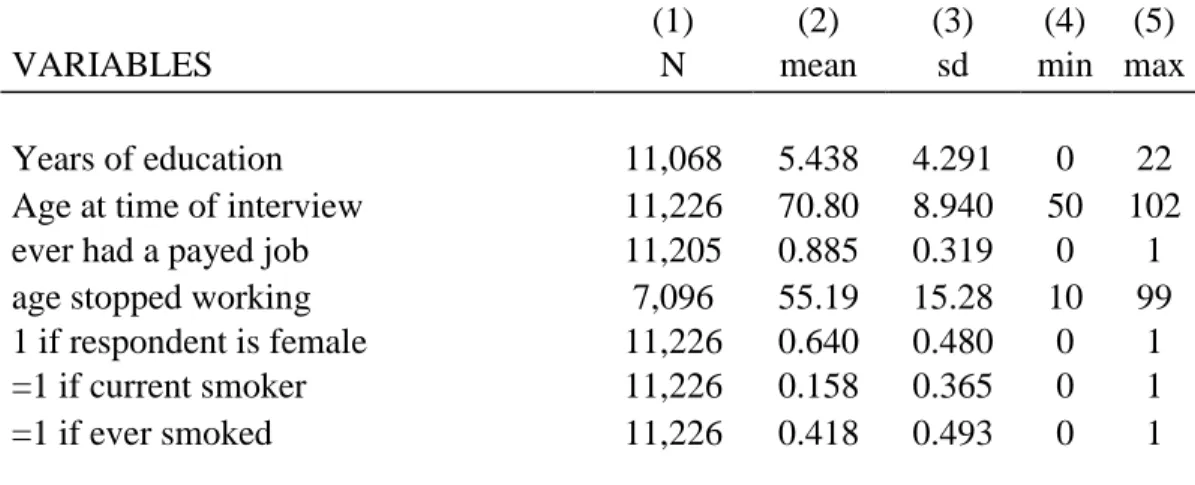
summary statistics for key variables. I supplemented the SABE dataset with a variable,
individuals’ composite health score, from the RELATE data set14
that McEniry, another
researcher working with SABE as a subset of her data. This variable is based on the Short-Form
12, an overall measure of functional health and well-being widely regarded as valid and
consistent. The SF-12 is comprised of 12 questions assessing self-reported health, BMI, frailty,
and functionality. McEniry’s version, modified to include only the objective measures of health,
drops self-reported health from the calculation and re-weights the output using only the questions
that assess the remaining factors. Additionally, I merge this data set with information on the
pension and social security reforms obtained from the United States Social Security
Administration.
Figure 1 depicts the age of retirement by country. For all countries except Barbados, the
median age of retirement is 60 or younger. Across the countries surveyed the average age of
retirement is 55.19. It should be noted, however, that 2,503 of the 11,226 respondents had not
retired at the time of the survey. The average age of those remaining in the labor force is 65, so
the mean retirement age of 55.19 in my sample is biased downwards from the true population
value. Nonetheless, residents of the countries in my sample are retiring earlier than their
counterparts in other countries. The average retirement age for Americans in the period
1995-2000 was 62.15 Additionally, a sizeable portion of the population retires at a very young age.
10% leave the workforce at or before the age of 29. People who stop working at such a young
age likely leave the workforce for reasons that are very different than those who leave the
workforce later in life. I consider this to be a different decision from the one that I am attempting
to analyze, and so in my estimation, I include only respondents who remained in the workforce
until at least age 35.
There are disparities in retirement age across demographic groups. Self-assessed health,
gender, country of residence, type of employment, race, household size, and other factors likely
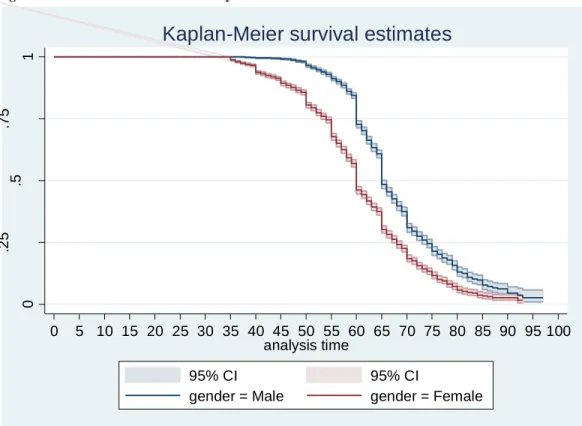
affect the age at which people choose to leave the workforce. Figure 2 shows the differences in
retirement patterns between men and women. Women have a significantly higher hazard of
retirement (a lower probability of survival) at every age than men do. For the countries in my
dataset, the official retirement age for women is 60 and 65 for men. This explains the drops in
survival hazards that occur at age 60 and 65 for women and men, respectively. The other, smaller
drops at five year intervals may suggest that there is some rounding error in respondents’ reports
of the age at which they retired.
Figure 3 gives the survival hazard compared among three countries, Brazil, Cuba, and
Mexico. There are significant differences in retirement patterns between these countries. On
average, Cubans retire earlier than their Brazilian and Mexican counterparts. The retirement age
in Brazil and Mexico has a larger variance, possibly due to unequal access to pensions and social
assistance. Pension payments in Brazil, in particular, are highly unequal across employment
sectors, with government officials receiving far higher pensions than private sector workers.
Figure 4 demonstrates that there is some difference in retirement patterns dependent upon
the educational level attained by a worker.
In order to estimate my model, I transformed the cross-sectional data into survival
format. The data I work with is a person-age dataset with an observation for each person who
held a job every year from the age of 35 to the time of retirement. This allows me to analyze the
V. Empirical Model
I use data in the panel format discussed in the previous section in order to estimate the
hazard of retiring at each age. Based on self-reported age at workforce exit, I create a dummy
variable, 𝑅𝑖,𝑡 representing retirement in year t conditional upon not retiring in year t-1.
𝑅𝑖,𝑡 = {0 𝑖𝑓 𝑖 𝑑𝑖𝑑 𝑛𝑜𝑡 𝑟𝑒𝑡𝑖𝑟𝑒 𝑖𝑛 𝑦𝑒𝑎𝑟 𝑡1 𝑖𝑓 𝑖 𝑑𝑖𝑑 𝑟𝑒𝑡𝑖𝑟𝑒 𝑖𝑛 𝑦𝑒𝑎𝑟 𝑡 . 𝑟𝑒𝑡𝑖𝑟𝑒 is the variable of interest. A small number of
individuals (approximately 1%) reported retiring at an age older than their age at the time of the
survey. I have excluded these observations from my estimation.
My base empirical model is a single spell discrete time hazard model in which the
outcome of interest is probability of retirement. In order to predict the probability that an
individual i will retire in period t, I use logit estimation on an equation of the form
(1) 𝑙𝑛 [𝑃(𝑅𝑖,𝑡=1|𝑅𝑖,𝑡−1=0)
𝑃(𝑅𝑖,𝑡=0|𝑅𝑖,𝑡−1=0)] = 𝛽𝑋𝑖,𝑡+ 𝛼1𝑠𝑟. ℎ𝑒𝑎𝑙𝑡ℎ𝑖 + 𝛼2𝑜𝑏𝑗. ℎ𝑒𝑎𝑙𝑡ℎ𝑖 + 𝛼2𝑐𝑜𝑢𝑛𝑡𝑟𝑦𝑖 +
𝛼3ℎ𝑒𝑎𝑙𝑡ℎ𝑠ℎ𝑜𝑐𝑘𝑖,𝑡+ 𝛼4𝑡𝑖. ℎ𝑒𝑎𝑙𝑡ℎ𝑠ℎ𝑜𝑐𝑘𝑖,𝑡 + 𝜇𝑖
Here, the dependent variable is the log odds that individual i will in year t conditional on i
having not retired prior to year t. 𝑋𝑖,𝑡 is the vector of time-specific controls, including age, age
squared, race, years of education, and whether or not individual i smokes. Since all individuals
are observed from the age of 35, including age in my regression accounts for duration
dependence. irepresents time-invariant unobservable characteristics that affect an individual’s
timing of the retirement decision. Such factors could include motivation, job satisfaction, and
other preferences.
My key variables of interest are health factors: 𝑠𝑟. ℎ𝑒𝑎𝑙𝑡ℎ𝑖, 𝑜𝑏𝑗. ℎ𝑒𝑎𝑙𝑡ℎ𝑖, ℎ𝑒𝑎𝑙𝑡ℎ𝑠ℎ𝑜𝑐𝑘𝑖,𝑡,
and 𝑡𝑖. ℎ𝑒𝑎𝑙𝑡ℎ𝑠ℎ𝑜𝑐𝑘𝑖,𝑡. 𝑜𝑏𝑗. ℎ𝑒𝑎𝑙𝑡ℎ𝑖 is the composite health score, an objective measure of
Survey participants rated their health as either poor, fair, good, very good, or excellent. The
variable ℎ𝑒𝑎𝑙𝑡ℎ𝑠ℎ𝑜𝑐𝑘𝑖,𝑡 represents three categories of shocks to an individual’s health: heart
attacks, stroke, and cancer.
Based on my theoretical model, I expect to find that measurements of health are inversely
related to probability of retirement while health shocks have a positive effect on the hazard of
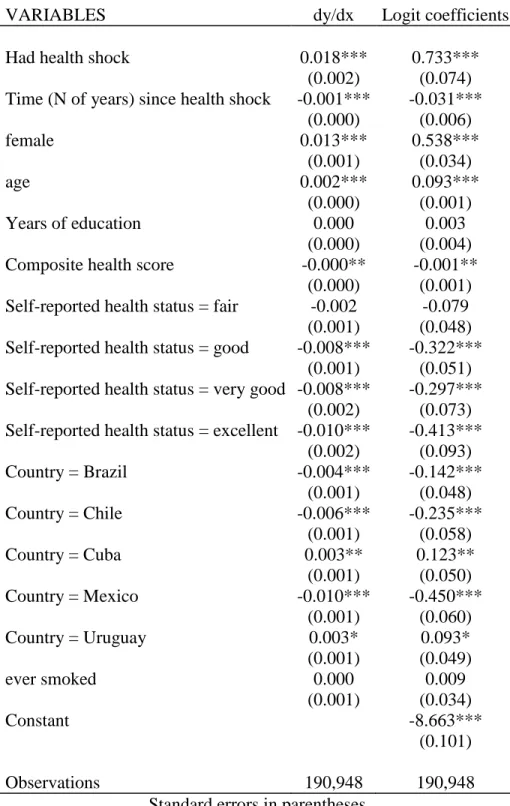
retirement. Results from the base regression are reported in Table 2.
The variable with the largest impact on workforce exit is health shocks, with a highly
significant marginal effect of .018, implying that experiencing a heart attack, stroke, or receiving
a cancer diagnosis increases one’s likelihood of retiring by 1.8% at the mean. The negative
coefficient on years since a health shock implies that over time, the effect of a health shock on
the probability of retiring gradually dissipates. Additionally, self-reported health appears to be
stronger predictor of retirement than does the objective measure, which does not have a
statistically significant marginal effect.
Country of residence also affects age-specific probability of retirement. Brazilians and
Chileans are likely to retire later than workers in the other countries in the dataset. The base
category for race is white. People who identify as mestizo, mulatto, or black tend to retire at a
later age than workers identifying as other races. Women tend to retire at an earlier age than
men, most likely as a result of the asymmetric official retirement ages and possibly of cultural
norms in Latin America and the Caribbean.
Pension Reform
An important factor that is not accounted for in my base regression is the availability of
security regulations, I included a pension policy dummy variable, indicating a national switch
from a pay-as-you-go funding scheme to individual retirement accounts. The results of this
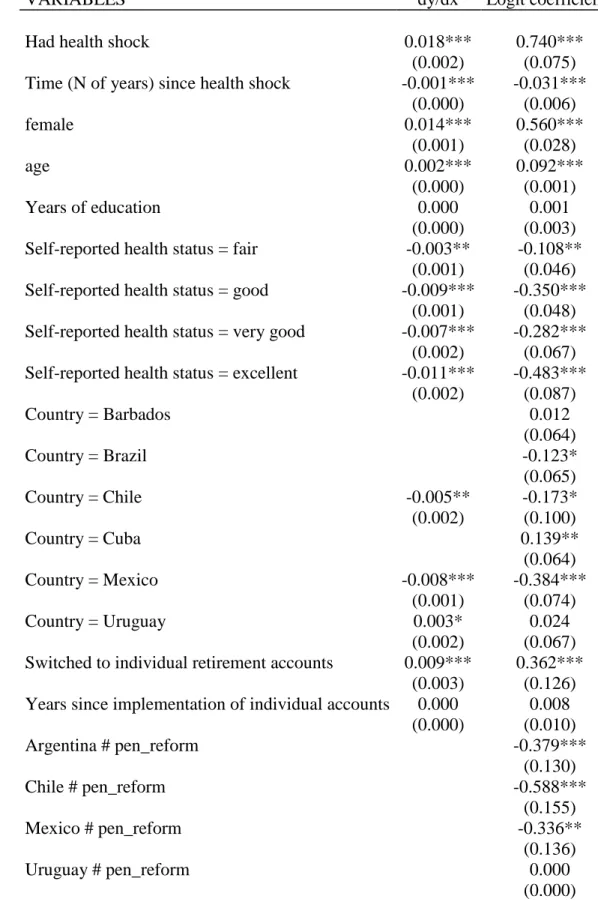
regression are found in Table 3. I find that pension reform has a significant effect on propensity
to retire. On average, the introduction of individual retirement accounts as a replacement for
pay-as-you-go funded pensions increased the hazard of workforce exit by .9%. Additionally, I
included an interaction term between health shocks and pension reform. I do not find that reform
had a significant impact on propensity to retire in the face of a health shock. People seem to
respond similarly to heart attacks, strokes, and cancer no matter the structure of their pension
plans.
That pension reform increased the hazard of retirement is a surprising result. Barrientos
(2000) wrote that Chile’s 1980 pension reform, which mirrors the changes made in the other
countries in my sample, would have the effect of making retirement riskier16. The individual
retirement accounts would involve risky investments and would have less of a redistributive
effect on wealth. Accordingly, potential retirees would be forced to remain in the labor force
longer as labor income would become a more important source of risk diversification. My results
suggest that people tend to retire earlier once individual retirement accounts are established. This
suggests that the reforms may have reduced the risk raced by workers considering retirement.
That people are retiring earlier however, may mean that the changes will not bring about the
intended effect on state budgets and economic growth.
Differences by Demographic Characteristics
A second area of interest is the relationship between health shocks and certain
demographic characteristics. My third regression includes interaction terms between education
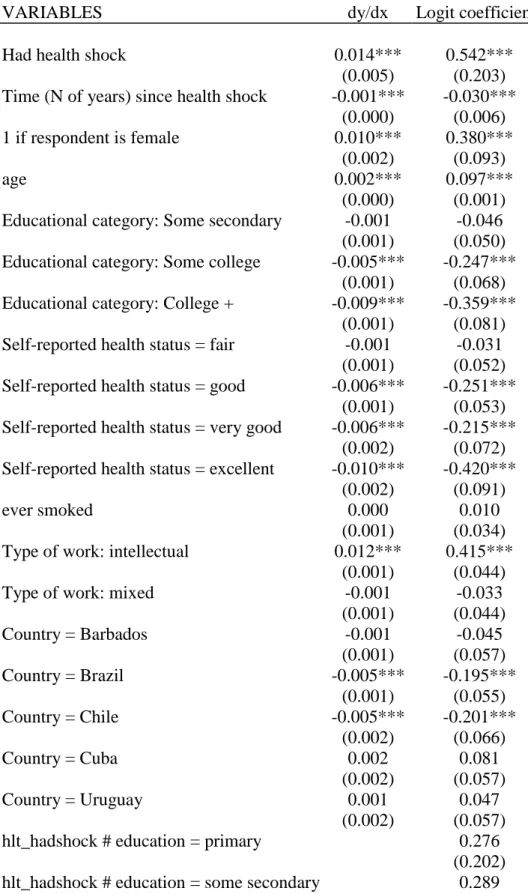
and health shocks and between gender and health shocks. Table 4 reports the results of this
estimation. The negative coefficients associated with having at least some college education
indicate that more educated workers are likely to retire later than less educated workers. Further,
I find that college-educated workers are more likely to retire in response to a health shock than
are workers with less education. This suggests that while more educated workers are willing or
able to continue working until more advanced ages, they may have the luxury of being able to
leave the workforce if they experience a physical decline brought on by a heart attack, stroke, or
cancer diagnosis. The effect of education on response to a health shock does not become
significant until a worker has attended college. My estimation also suggests that health shocks
have differing effects on men and women. Women are more likely to respond to a health shock
by retiring than are men.
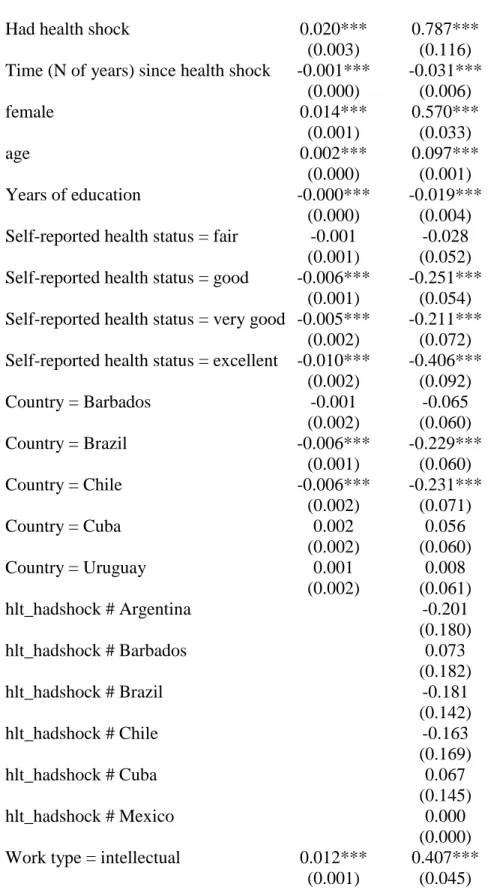
Since country of residence was shown to be important to the timing of retirement, I also
examined the interaction of country of residence and health shocks. The regression output is
found in Table 5. None of these coefficients however were statistically significant in the
specification that I used. Country of residence impacts retirement decisions, but I could not
conclude that it has an additional impact on retirement when a health shock has occurred. Health
shocks have fairly symmetric effects across countries and pension schemes, possibly because
their effect on retirement timing is strong enough to nearly override other considerations in most
cases.
Based on this regression, we can see that the type of work done also impacts the decision
to retire. The base category used for labor type is manual. The regression coefficient on
intellectual labor is positive, meaning that people employed in jobs in which the work is
requiring manual labor. This is puzzling since the coefficient on years of education is negative:
increased education tends to increase the number of years a person will remain in the labor force.
One would expect that increased education and employment in an intellectual job would have
similar effects.
Instrumenting for Health Shocks
An issue with the previous estimates is the potential for bias due to the endogeneity of
heart attacks, cancer and strokes. Many lifestyle characteristics and demographic variables affect
onset of these illnesses, ability to work independent of the occurrence of a particular shock, and
employment opportunities. To attempt to correct for the endogeneity of health shocks, I
employed the instrumental variables technique, using various childhood environmental and
health conditions to predict the probability of a health shock occurring at each age. The
two-stage linear probability regression I used took the form
(2) ℎ𝑒𝑎𝑙𝑡ℎ𝑠ℎ𝑜𝑐𝑘𝑖,𝑡 = 𝛼1𝑎𝑔𝑒𝑖 + 𝛼2𝑐ℎ𝑙𝑑. 𝑤𝑒𝑎𝑙𝑡ℎ𝑖+ 𝛼3𝑐ℎ𝑙𝑑. ℎ𝑒𝑎𝑙𝑡ℎ𝑖 + 𝛼4𝑐ℎ𝑙𝑑. ℎ𝑢𝑛𝑔𝑒𝑟𝑖 +
𝛼15𝑍𝑖 + 𝜀𝑖
(3) 𝑅𝑖,𝑡 = 𝛽𝑋𝑖,𝑡+ 𝛼1𝑐𝑜𝑢𝑛𝑡𝑟𝑦𝑖 + 𝛼2ℎ𝑒𝑎𝑙𝑡ℎ𝑠ℎ𝑜𝑐𝑘𝑖,𝑡 + 𝜀𝑖,𝑡
In (2), 𝑐ℎ𝑙𝑑. 𝑤𝑒𝑎𝑙𝑡ℎ𝑖 is a categorical variable indicating whether the respondent’s
family’s economic situation was good, average, or poor during the respondent’s first 15 years of
life. Similarly, 𝑐ℎ𝑙𝑑. ℎ𝑒𝑎𝑙𝑡ℎ𝑖 is a categorical assessment of the respondent’s childhood health
and 𝑐ℎ𝑙𝑑. ℎ𝑢𝑛𝑔𝑒𝑟𝑖 is a dummy variable indicating whether or not the respondent experienced
hunger as a child. 𝑍𝑖 is a vector of dummy variables indicating whether or not the respondent
suffered from health conditions or illnesses including measles, bronchitis, kidney disease,
describing a causal relationship between health shocks and retirement, I make the assumption
that these childhood variables are independent of factors influencing future employment aside
from their effect on likelihood of experiencing a health shock.
In the second stage regression, given by equation (3), 𝑋𝑖,𝑡 is, as before, a vector of
time-variant individual characteristics. For this regression I excluded both measurements of health
status—self-reported and objective—as well as whether or not the respondent smokes as these
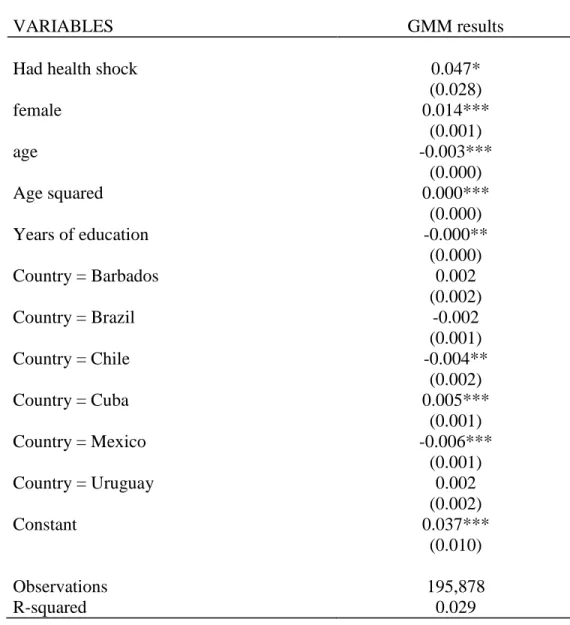
are endogenous as well. Tab1e 6 reports the results of the second stage equation. Post estimation
tests indicate that my instrument is valid. My first stage regression has an F statistic of 0.000,
indicating a strong instrument and the model is not overidentified. The test of endogeneity failed
to reject the null hypothesis that health shocks are endogenous. However, the test has been
demonstrated to perform poorly when the variable being instrumented is binary.17
I find that health shocks could have a much larger effect that my initial estimates
suggested. A health shock increases the hazard of retirement by 4.7%, an effect over twice as
large as the marginal effect of 1.8% calculated in my base regression. However, since I have
omitted other measurements of health from this regression due to their likely endogeneity, health
shocks in this regression encompass all health-related information and this likely explains some
of the reason for the large increase in importance. Consistent throughout, however, is the
conclusion that serious health conditions exert strong influences on the timing of retirement. The
instrumental variables regression also indicates that country of residence has a significant impact
on the timing of workforce exit.
VI. Conclusion
Among the variables examined in this paper, health shocks in the form of heart attacks,
strokes, and cancer are prominent in terms of impact on workforce exit. The effect of these
shocks seems to vary somewhat across educational groups and gender, but largely affect people
in the seven Latin American countries sampled similarly, regardless of the country of residence
or pension scheme differences. It would be interesting to compare the effects health shocks
across more diverse countries with stronger and weaker welfare systems to determine whether or
not this relationship holds outside of South America. With only data from these South American
and Caribbean countries, however, I am unable to conclude that social security schemes have a
significant impact on how people respond to health shocks.
Measurable health variables such as health shocks however, are not the only factor that
can influence the timing of retirement. My data suggests that self-assessed health is a stronger
predictor of retirement than is the objective composite measure that was available.
Non-measurable components of health and perceived health are important as well.
Differences across countries appear to affect the age at which people retire in the absence
of a health shock. Interestingly given Brazil’s budgetary problems resulting from long
retirements during which people draw on generous pensions, Brazilians had a lower hazard of
retiring when health status, health shocks, and other factors were controlled for than did any of
the countries except Chile. From this data, we cannot determine whether these cross-country
differences are due to cultural norms, population health, social security policies, or other factors.
However, economic theory and the literature indicate that social security generosity does affect
retirement decisions and my analysis suggests that at least some of the social security reforms
reforms tended to increase the retirement hazard, thereby reducing the average age of retirement.
This result suggests that the reforms may have been a boon to older workers who wanted to retire
Bibliography
Aguila, Emma. “Male Labor Force Participation and Social Security in Mexico.” Journal of
Pension Economics and Finance Vol. 3, Issue 2: 145-171 (2014).
Atlas, Steven J. and Jonathan S. Skinner. “Education and the Prevalence of Pain.” National
Bureau of Economic Research (May 2009), Accessed October 17, 2015. doi: 10.3386/w14964
Barrientos, Armando. “Work, Retirement, and Vulnerability of Older Persons in Latin America:
What are the Lessons for Pension Design?” Journal of International Development (May
2000), 12: 495-506 (2000).
Benitez-Silva, Hugo, Moshe Buchinshy, Hiu Man Chan, Sofia Cheidvasser, and John Rust.
“How Large is the Bias in Self-Reported Disability?” Journal of Applied Econometrics
19: 649-670 (2004).
Bound, John. “Self-Reported versus Objective Measures of Health in Retirement Models.” The
Journal of Human Resources Vol. 26, No. 1: 106-138 (1991).
Case, Anne and Angus Deaton. “Broken Down by Work and Sex: How Our Health Declines.”
Analyses in the Economics of Aging (2005).
Cooper, Richard S., Joan F Kennelly, and Pedro Orduñex-Garcia. “Health in Cuba.”
International Journal of Epidemiology Vol. 35, Issue 4: 817-824 (2006). Eibich, Peter. “Understanding the Effect of Retirement on Health.” Journal of Health
Economics, Vol. 43: 1-12 (2015).
Gendell, Murray. “Retirement Age Declines Again in 1990s.” Monthly Labor Review, October
2001.
Grossman, Michael. “On the Concept of Health Capital and the Demand for Health,” Journal of
Political Economy, Vol. 80, No. 2: 223-255 (1972).
Guilkey, David K., and Peter M. Lance. “Program Impact Estimation with Binary Outcome
Variables: Monte Carlo Results for Alternative Estimators and Empirical Examples.” In
Festschrift in Honor of Peter Schmidt: Econonometric Methods and Applications, Edited by Robin Sickles and William Horrace, 5-46. New York: Springer, 2014.
Gupta, Nabanita D., and Mona Larsen. “The Impact of Health on Individual Retirement Plans:
Self-Reported Versus Diagnostic Measures.” Health Economics, Vol. 19: 792-813 (2010).
Kuhn, Michael, Stefan Wrzaczek, Alexia Prskawetz, and Gustav Feichtinger. “Optimal Choice
of Health and Retirement in a Life-Cycle Model.” Journal of Economic Theory 158: 186-212 (2015).
Laun, Tobias and Johanna Wallenius. “A Life Cycle Model of Health and Retirement: The case
of Swedish Pension Reform.” Journal of Public Economics 127: 127-136 (2015). McEniry, Mary. “Research on Early Live and Aging Trends and Effects (RELATE): A
Cross-National Study.” Ann Arbor, MI: Inter-university Consortium for Political and Social
Research [distributor], May 7, 2015. http://doi.org/10.3886/ICPSR34241 .v2
Mitchell, Olivia S. and Gary S. Fields. “The Economics of Retirement Behavior.” Journal of
Pelaez, Martha, Alberto Palloni, Cecilia Albala, Juan C. Alfonso, Roberto Ham-Chande, Anselm
Hennis, Maria Lucia Lebrao, Esther Lesn-Diaz, Edith Pantelides, and Omar Prats.
“SABE - SURVEY ON HEALTH, WELL-BEING, AND AGING IN LATIN AMERICA
AND THE CARIBBEAN, 2000 [Computer file].” ICPSR version. Washington, D.C.:
Pan American Health Organization/World Health Organization (PAHO/WHO)
[producers], 2004. Ann Arbor, MI: Inter-university Consortium for Political and Social
Research [distributor], 2005.
Riffkin, Rebecca. “Average US Retirement Age Rises to 62.” Gallup, last modified April 28,
2014. Accessed December 2, 2015.
http://www.gallup.com/poll/168707/average-retirement-age-rises.aspx
Riphahn, Regina. “Disability Retirement and Unemployment—Substitute Pathways for Labour
Force Exit? An Empirical Test for the Case of Germany.” Applied Economics 29 (5):
551-561 (1997).
Romero, Simon. “An Exploding Pension Crisis Feeds Brazil’s Political Turmoil.” The New York
Times, October 20, 2015. Accessed December 1, 2015.
http://www.nytimes.com/2015/10/21/world/americas/brazil-pension-crisis-mounts-as-more-retire-earlier-then-pass-benefits-on.html
van Erp, Frank, Niels Vermeer, and Daniel van Vuuren. “Non-financial Determinants of
Retirement: A Literature Review.” De Economist 162 (2): 167-191 (2014).
Waidmann, Timothy, John Bound, and Michael Schoenbaum. “The Illusion of Failure: Trends in
Appendix
Table 1: Summary Statistics
(1) (2) (3) (4) (5)
VARIABLES N mean sd min max
Years of education 11,068 5.438 4.291 0 22
Age at time of interview 11,226 70.80 8.940 50 102
ever had a payed job 11,205 0.885 0.319 0 1
age stopped working 7,096 55.19 15.28 10 99
1 if respondent is female 11,226 0.640 0.480 0 1
=1 if current smoker 11,226 0.158 0.365 0 1
=1 if ever smoked 11,226 0.418 0.493 0 1
Notes: Summary of all observations in original data set. Age stopped working has fewer
Table 2: Base Logit Regression and Marginal Effects
VARIABLES dy/dx Logit coefficients
Had health shock 0.018*** 0.733***
(0.002) (0.074)
Time (N of years) since health shock -0.001*** -0.031***
(0.000) (0.006)
female 0.013*** 0.538***
(0.001) (0.034)
age 0.002*** 0.093***
(0.000) (0.001)
Years of education 0.000 0.003
(0.000) (0.004)
Composite health score -0.000** -0.001**
(0.000) (0.001)
Self-reported health status = fair -0.002 -0.079
(0.001) (0.048)
Self-reported health status = good -0.008*** -0.322***
(0.001) (0.051)
Self-reported health status = very good -0.008*** -0.297***
(0.002) (0.073)
Self-reported health status = excellent -0.010*** -0.413***
(0.002) (0.093)
Country = Brazil -0.004*** -0.142***
(0.001) (0.048)
Country = Chile -0.006*** -0.235***
(0.001) (0.058)
Country = Cuba 0.003** 0.123**
(0.001) (0.050)
Country = Mexico -0.010*** -0.450***
(0.001) (0.060)
Country = Uruguay 0.003* 0.093*
(0.001) (0.049)
ever smoked 0.000 0.009
(0.001) (0.034)
Constant -8.663***
(0.101)
Observations 190,948 190,948
Standard errors in parentheses *** p<0.01, ** p<0.05, * p<0.1
Table 3: Regression with Policy Variables
VARIABLES dy/dx Logit coefficients
Had health shock 0.018*** 0.740***
(0.002) (0.075)
Time (N of years) since health shock -0.001*** -0.031***
(0.000) (0.006)
female 0.014*** 0.560***
(0.001) (0.028)
age 0.002*** 0.092***
(0.000) (0.001)
Years of education 0.000 0.001
(0.000) (0.003)
Self-reported health status = fair -0.003** -0.108**
(0.001) (0.046)
Self-reported health status = good -0.009*** -0.350***
(0.001) (0.048)
Self-reported health status = very good -0.007*** -0.282***
(0.002) (0.067)
Self-reported health status = excellent -0.011*** -0.483***
(0.002) (0.087)
Country = Barbados 0.012
(0.064)
Country = Brazil -0.123*
(0.065)
Country = Chile -0.005** -0.173*
(0.002) (0.100)
Country = Cuba 0.139**
(0.064)
Country = Mexico -0.008*** -0.384***
(0.001) (0.074)
Country = Uruguay 0.003* 0.024
(0.002) (0.067)
Switched to individual retirement accounts 0.009*** 0.362***
(0.003) (0.126)
Years since implementation of individual accounts 0.000 0.008
(0.000) (0.010)
Argentina # pen_reform -0.379***
(0.130)
Chile # pen_reform -0.588***
(0.155)
Mexico # pen_reform -0.336**
(0.136)
Uruguay # pen_reform 0.000
hlt_hadshock # pen_reform 0.111 (0.107)
Observations 219,124 219,124
Standard errors in parentheses *** p<0.01, ** p<0.05, * p<0.1
Table 4: Education and Gender Interactions
VARIABLES dy/dx Logit coefficients
Had health shock 0.014*** 0.542***
(0.005) (0.203)
Time (N of years) since health shock -0.001*** -0.030***
(0.000) (0.006)
1 if respondent is female 0.010*** 0.380***
(0.002) (0.093)
age 0.002*** 0.097***
(0.000) (0.001)
Educational category: Some secondary -0.001 -0.046
(0.001) (0.050)
Educational category: Some college -0.005*** -0.247***
(0.001) (0.068)
Educational category: College + -0.009*** -0.359***
(0.001) (0.081)
Self-reported health status = fair -0.001 -0.031
(0.001) (0.052)
Self-reported health status = good -0.006*** -0.251***
(0.001) (0.053)
Self-reported health status = very good -0.006*** -0.215***
(0.002) (0.072)
Self-reported health status = excellent -0.010*** -0.420***
(0.002) (0.091)
ever smoked 0.000 0.010
(0.001) (0.034)
Type of work: intellectual 0.012*** 0.415***
(0.001) (0.044)
Type of work: mixed -0.001 -0.033
(0.001) (0.044)
Country = Barbados -0.001 -0.045
(0.001) (0.057)
Country = Brazil -0.005*** -0.195***
(0.001) (0.055)
Country = Chile -0.005*** -0.201***
(0.002) (0.066)
Country = Cuba 0.002 0.081
(0.002) (0.057)
Country = Uruguay 0.001 0.047
(0.002) (0.057)
hlt_hadshock # education = primary 0.276
(0.202)
(0.226)
hlt_hadshock # education = some college 0.413*
(0.241)
hlt_hadshock # education = college + 0.000
(0.000)
hlt_hadshock # female 0.212**
(0.097)
Constant -9.059***
(0.105)
Observations 186,619 186,619
Standard errors in parentheses *** p<0.01, ** p<0.05, * p<0.1
Table 5: Country Interactions and Marginal Effects
VARIABLES dy/dx Logit coefficients
Had health shock 0.020*** 0.787***
(0.003) (0.116)
Time (N of years) since health shock -0.001*** -0.031***
(0.000) (0.006)
female 0.014*** 0.570***
(0.001) (0.033)
age 0.002*** 0.097***
(0.000) (0.001)
Years of education -0.000*** -0.019***
(0.000) (0.004)
Self-reported health status = fair -0.001 -0.028
(0.001) (0.052)
Self-reported health status = good -0.006*** -0.251***
(0.001) (0.054)
Self-reported health status = very good -0.005*** -0.211***
(0.002) (0.072)
Self-reported health status = excellent -0.010*** -0.406***
(0.002) (0.092)
Country = Barbados -0.001 -0.065
(0.002) (0.060)
Country = Brazil -0.006*** -0.229***
(0.001) (0.060)
Country = Chile -0.006*** -0.231***
(0.002) (0.071)
Country = Cuba 0.002 0.056
(0.002) (0.060)
Country = Uruguay 0.001 0.008
(0.002) (0.061)
hlt_hadshock # Argentina -0.201
(0.180)
hlt_hadshock # Barbados 0.073
(0.182)
hlt_hadshock # Brazil -0.181
(0.142)
hlt_hadshock # Chile -0.163
(0.169)
hlt_hadshock # Cuba 0.067
(0.145)
hlt_hadshock # Mexico 0.000
(0.000)
Work type = intellectual 0.012*** 0.407***
Work type = mixed -0.000 -0.017
(0.001) (0.044)
ever smoked 0.000 0.008
(0.001) (0.034)
Constant -8.944***
(0.107)
Observations 184,274 184,274
Standard errors in parentheses *** p<0.01, ** p<0.05, * p<0.1
Table 6: Instrumenting for Health Shocks
VARIABLES GMM results
Had health shock 0.047*
(0.028)
female 0.014***
(0.001)
age -0.003***
(0.000)
Age squared 0.000***
(0.000)
Years of education -0.000**
(0.000)
Country = Barbados 0.002
(0.002)
Country = Brazil -0.002
(0.001)
Country = Chile -0.004**
(0.002)
Country = Cuba 0.005***
(0.001)
Country = Mexico -0.006***
(0.001)
Country = Uruguay 0.002
(0.002)
Constant 0.037***
(0.010)
Observations 195,878
R-squared 0.029
Robust standard errors in parentheses *** p<0.01, ** p<0.05, * p<0.1
Figure 1: Retirement Age by Country
Notes: Middle quartiles and median retirement age for each country are denoted by the vertical rectangles and the lines dividing the rectangles, respectively. Points represent outliers.
0
20
40
60
80
1
0
0
a
g
e
st
o
p
p
e
d
w
o
rki
n
g
Figure 2: Workforce Survival Hazard by Gender
Notes: Lines indicate the likelihood of an individual remaining in the workforce at each age. Probability of remaining in the workforce is 1 before the age of 35 as I have excluded individuals retiring before that age from my estimation sample.
0
.2
5
.5
.7
5
1
0 5 10 15 20 25 30 35 40 45 50 55 60 65 70 75 80 85 90 95 100
analysis time
95% CI 95% CI
gender = Male gender = Female
Figure 3
Notes: Sample is respondents from Brazil, Cuba, and Mexico. Lines indicate the probability of remaining in the workforce at each age. As in figure 2, individuals who left the workforce before the age of 35 are excluded.
0
.2
5
.5
.7
5
1
0 5 10 15 20 25 30 35 40 45 50 55 60 65 70 75 80 85 90 95 100
analysis time
95% CI 95% CI 95% CI
Brazil Cuba Mexico
Figure 4
Notes: Lines indicate the likelihood of an individual remaining in the workforce at each age. Probability of remaining in the workforce is 1 before the age of 35 as I have excluded individuals retiring before that age from my estimation sample.
0
.2
5
.5
.7
5
1
0 5 10 15 20 25 30 35 40 45 50 55 60 65 70 75 80 85 90 95 100
analysis time
95% CI 95% CI
edu_cat = Less than primary edu_cat = College +