Perceptions of Health, Weight, and Body Image among Afro-Caribbean Women in the US Virgin Islands
by
Laura Renee Greenhow
A paper submitted to the faculty of the University of North Carolina at Chapel Hill in partial fulfillment of the requirements for the degree of Master of Public Health
in the Department of Nutrition
Chapel Hill
November 30, 2012
Approved by:
____________________________________
Introduction
The United States Virgin Islands (USVI) are located between the Atlantic Ocean and the
Caribbean Sea, southeast of the southern tip of Florida, and directly east of Puerto Rico. The
USVI is comprised of four main islands: St. Thomas, St. Croix, St. John, and Water Island. The
demographics of the 105,000 people in the USVI are 78% black, 10% white, and 12% other [1].
The majority (81%) of Virgin Islanders are of West Indian descent, with 49% born in the Virgin
Islands and the remaining 32% with birthplaces on other Caribbean Islands [1]. In the United
States, nearly two-thirds of adults are overweight or obese with similar trends in the USVI
(66.2%) [2]. African American (AA) women have the highest rates of overweight and obesity
compared to other groups in the United States, with four out of five AA women being
overweight or obese [3]. In 2010, AA women were 70% more likely to be obese than
non-Hispanic White women [3]. AA women are 1.8 times as likely to be diagnosed with diabetes, 1.4
times as likely to die of heart disease, and 1.4 times as likely to suffer a stroke as non-Hispanic
white women [4, 5]. Data from Puerto Rico, Guam, and Latin America is often combined with
data gathered in the USVI, making it difficult to pinpoint the rates of chronic disease specific to
this area. BRFSS data is available for some years and some chronic diseases; however, less than
70% of Virgin Islanders have a main phone line to participate in this survey [6]. Additionally,
this data is not divided into prevalence rates specific to gender or racial/ethnic groups.
The relationship between body image and body mass index (BMI) is not well understood,
especially among ethnic minorities [7]. Perceived body image varies by ethnicity and may be
indicative of awareness of weight and health risks [7]. There is evidence that AA women have
heavier body image ideals than white women and that AA women are more likely to perceive
themselves as normal weight when they are actually overweight [8]. Several studies suggest that
research shows that AA women have a definition of health that incorporates the mind-body-spirit
connection and encompasses body type and the need to maintain equilibrium [9]. In gauging
attractiveness, AA women describe shapeliness and the fit of clothing and appear more
concerned with their public image of “looking good” involving their general presentation when
dressed [10]. In a study by Ristovki-Slijepcevic et al. (2010), AA women were far more likely
than white women, and all men, to express resistance towards obesity discourse and the equation
between thinness and healthiness, emphasizing the value of having “meat on one’s bones” [11].
In another study, AA participants espoused self-acceptance and nurturance, rejecting mainstream
cultural pressures [12].
Previous research has neglected to incorporate health behaviors, such as healthy eating and
physical activity, which may influence body image perceptions and contribute to obesity [7].
Fresh fruits and vegetables and low-fat foods have been included in definitions of a healthful diet
among AAs [13]. A study by Lynch et al. (2012) found that fruits and vegetables were
considered most healthful and starchy foods were considered least healthful among low-income
AA women [14]. Starchy foods were considered unhealthful mostly due to the belief that starch
was high in fat and contributed to weight gain [14]. Rowe’s study (2010) of AA women found
fruits, vegetables, and low-fat foods as well as whole grains, brown rice, cereal, oatmeal, and
popcorn to be considered healthy [9]. Perceived unhealthy foods contained high fat, salt and/or
sugar like ribs, hamburger, fried foods, processed foods, lunchmeat, cakes, and cookies [9].
Despite having mainstream knowledge of healthy foods, AA women are less likely to consume
healthy diets [15]. Additionally, in 2009, AAs had the highest median percentage of physical
inactivity with AA women leading in physical inactivity statistics in almost all communities in
There is conflicting research about a link between obesity and chronic disease among AA
women. Some research has linked obesity among AA women to higher mortality and incidence
rates of coronary heart disease, hypertension, diabetes, and certain cancers [15]. Other research
has failed to find a direct relationship between the prevalence of obesity and obesity-related
diseases in AA women [17]. Psychologic factors such as weight-related quality of life (QOL)
may play a role in the discrepancy between obesity and obesity-related diseases among AA
women as AA women report less impairment than white women in their weight-related QOL
[18]. Normally, as BMI increases, QOL decreases. However, AA women report higher QOL
compared to white women of similar BMIs [18].
While previous research has examined health beliefs and behaviors among AA women, few
studies have focused on Afro-Caribbean (AC) women, and we were unable to identify research
specific to the USVI. Therefore, the primary objective of this pilot study was to qualitatively
examine the relationships among health, weight, and body image among Afro-Caribbean women
in the USVI.
Methods
Participants
We recruited 16 women age 18 or above who self-identified as AC on the islands of St. Thomas
(15) and St. Croix (1). A convenience sample was obtained via personal contacts of the research
team with a subsequent snowballing effect from word of mouth of participants. Efforts were
made to include women of varying age ranges and education levels. Demographic information
was obtained via a self-administered survey including length of residence in the USVI, birthplace
if outside the USVI, age category, marital status, highest level of education, occupation, and
self-reported height and weight (Appendix 1). BMI, measured in kg/m2, was calculated using
Semi-structured group and individual interviews
Small group interviews, lasting 45 to 90 minutes, or one-on-one interviews, lasting 15 to 45
minutes were led by a trained interviewer. The interviews were conducted at the Caribbean
Exploratory Research Center, University of the Virgin Islands Cooperative Extension Office, or
at participants’ homes. The sessions involved a semi-structured interview guide adapted from the
guide used in research conducted by Tang and colleagues [19].The interview guide was
comprised of open-ended questions to ascertain the participants’ health beliefs and health
practices as well as characteristics of food consumption (Appendix 2).
All interviews were audio-recorded. Detailed interview notes were taken and sorted by question.
Themes were determined using an inductive approach (Table 2).
Perceptions of silhouettes
The participants were shown a series of 8 culturally appropriate female silhouettes, developed by
E.C. Jones of Cornell University (Appendix 3). The women were asked to identify the figures
which most closely represented their current body type (SELF), their significant other’s
preference (SIG), their own body image ideal (IDEAL), and the best silhouette to prevent or
delay health problems (HEALTH). The participants were also asked about their ideal weight
range and their opinion of their current weight. This technique was used to explore perceptions
of body size in relation to body image and health beliefs.
Results
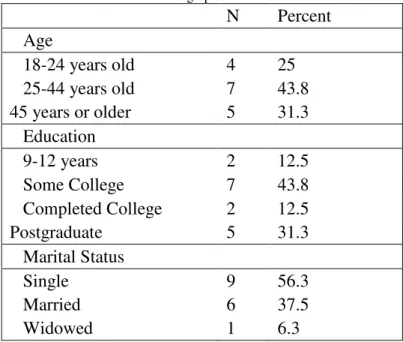
In total, 16 women took part in this study conducted between September and October 2012. Most
participants were between 25 and 44 years of age, single, completed some college, and were born
in the USVI. Other places of origin included St. Kitts, Nevis, Tortola, Grenada, and Haiti.
According to BMI determined by self-reported weight and height and using BMI cutoffs of 27.3
kg/m2 for overweight and 32.3 kg/m2 for obese, half of the women were of normal weight and
half were overweight or obese. Younger participants were more likely to be of normal weight.
Table 1. Demographic information.
N Percent
Age
18-24 years old 4 25
25-44 years old 7 43.8
45 years or older 5 31.3
Education
9-12 years 2 12.5
Some College 7 43.8
Completed College 2 12.5
Postgraduate 5 31.3
Marital Status
Single 9 56.3
Married 6 37.5
Widowed 1 6.3
Perceptions of health
The women described health in terms of feelings and behaviors. Most of the women described
health as well-being, happiness, mental health, and being free of disease while also indicating
that health includes behaviors such as proper nutrition and exercise. One woman describes health
as something that “has to be maintained and constantly worked at or it’s lost.” When asked to
rate their own health on a 5-point scale, with 1 being poor health and 5 being perfect health,
normal weight women ranked themselves lower (mean = 3.44) than overweight/obese women
(mean = 4.06). Regardless of the selected ranking, most justifications were because she is not
“perfect”, could do “more”, or could “improve” in some way. Some of the overweight women
ranked themselves as being in better health than the normal weight women despite citing the
women was that one woman ranked her health as 2.5 and another as 2.0. The 2.5 ranking was
because she “drinks, smokes, parties, doesn’t like vegetables,” and the 2.0 ranking was because
she has “problems breathing and allergies.”
The majority of the women felt that a person’s health could not be determined by appearance,
although some indicated that being overweight or obese was not healthy. This theme is
represented by one woman with a BMI of 31.6 kg/m2 saying that healthy is, “Your physical
build, how you look in your weight. Because obesity, if someone is obese, they’re not healthy.”
The women also acknowledged that “skinny” people can be unhealthy while “thick” people can
be healthy. One woman said, “People think skinny equals healthy but some skinny people have
high blood pressure and high cholesterol.” Another woman said, “Even when I was slim, I
wasn’t healthy.” Other women described the appearance of unhealthy people as emaciated or
unable to perform daily tasks and gave examples of people suffering from cancer or HIV/AIDS.
Two women said that healthy people have nice skin which was the only physical attribute
described for this question not related to weight. One woman stated that having a healthy
appearance includes “the way you carry yourself” and “the way you project yourself into the
world.” Another woman said that “you have to keep yourself well groomed, well kept. You
know, weight has nothing to do with how we keep ourselves. People may say they’re big but
they look healthy.”
Overweight/obese women were more likely than normal weight women to fear diseases such as
diabetes, cancer, and STDs. The major motivations for health fears came from family history,
and many participants recounted stories of health battles of specific relatives. Other justifications
for health fears included knowledge of higher disease rates in AA populations as well as fears of
health lowest on the 5-point scale, one said that she fears, “every health condition that is known
to man…” and the other said that she fears, “All…Don’t want none of it.”
In describing what they currently do for their health, the participants indicated many health
behaviors they attempt to include in their lives such as physical activity, doctors’ visits, inclusion
of healthy food choices, and avoidance of poor food choices. However, upon further
investigation, the behaviors that these women try to include do not actually occur that often. One
participant indicated that sometimes she exercises for her health but later states that she has not
exercised for some months. Another said that she tries to eat healthfully by sticking to fruits and
vegetables but actually only consumes one serving of either fruit or vegetable in a day if she has
any at all. Although many women indicated some form of mental and spiritual health and
happiness as a dimension of health, few indicated any health behaviors they engaged in to
preserve their mental and spiritual health without being prompted. When asked, they indicated
reading the Bible, journaling, listening to music, and having boundaries at work. One woman
stated that she tries to be “as balanced as possible regardless of societal norms.”
There was no consensus on barriers to healthy decision making but reasons given included
schedule, lack of motivation, economics, and upbringing.
Perceptions of body size
To determine how well the body image silhouettes were able to relate subjective measures of
body size preferences, the body image scores representing the women’s perceptions of their
current body size were compared to their BMI values. Silhouettes lettered a through h were
converted to corresponding numbers 1 through 8. If a participant made a selection that was
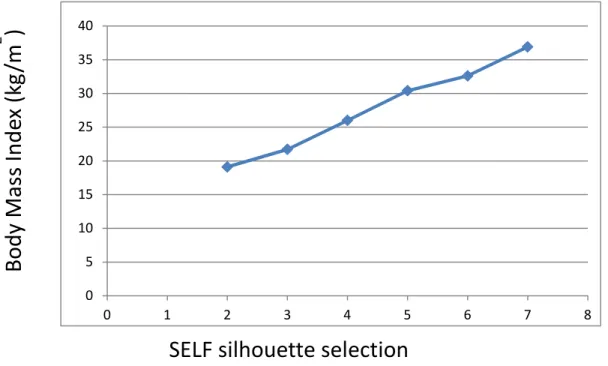
Spearman’s rank correlation between silhouette selection and BMI values was 0.87. The
distributions of mean BMI values by current body size silhouettes are plotted in Figure 1.
Figure 1. Current body size silhouette selection by mean BMI.
In evaluating discrepancies between subjective measures of SELF, SIG, IDEAL, and HEALTH,
the difference was taken between corresponding numbered silhouettes. For example, when
determining the difference between current body size and perception of significant other’s
preference, we used the equation SIG – SELF to determine the discrepancy. A positive number
represents a preference for a larger silhouette and a negative number represents a preference for a
smaller silhouette. If a participant made a selection that was between two silhouettes or a range
of silhouettes, the average of the corresponding numerical values was used.
The mean silhouette discordance between SIG and SELF was -0.03 overall. Many answers were
justified because the chosen silhouettes were not ‘too thick’ and not ‘too skinny’. Normal weight
women were more likely to choose silhouettes based on qualities they think their partners would
prefer that they did not necessarily have stating that their partner likes “boobs and butt” or wants
them to “tighten up a little bit” (mean = 0.5). Overweight/obese women were more likely to pick 0 5 10 15 20 25 30 35 40
0 1 2 3 4 5 6 7 8
SELF silhouette selection
silhouettes based on their current size or what they looked like when they met their partner
(mean = -0.56).
The mean silhouette discordance between IDEAL and SELF was -0.22 overall. Normal weight
women said they felt good about their weight or indicated a desire to be slightly heavier than
they are currently (mean = 0.75). Two normal weight women desired to be larger so clothes
would fit them better and another said, “I want hips and booty because that’s how it is for us, I
just don’t like being skinny.” Overweight/obese women wanted to be “in the middle”, “go down
a little bit”, “tone up”, or get back to a smaller size that they were before (mean = -1.19).
Although there was disagreement between IDEAL and SELF (mean of -0.22 overall, 0.75
normal, and -1.19 overweight/obese), the mean between SIG and IDEAL was also -0.03 overall,
0.5 for normal weight, and -0.56 for overweight/obese.
All normal weight women chose ideal weight ranges within a healthy BMI category. Six of
eight overweight/obese women chose ideal weight ranges within overweight/obese BMI
categories. One overweight/obese woman chose a healthy BMI for her ideal (25.5 kg/m2) and
one overweight/obese woman stated that she uses how she feels and how her clothes fit as a
gauge for her ideal instead of looking at the scale. Two overweight women, both with a height
of 62 inches, stated that they should weigh 150 pounds according to BMI standards, which
equates to a BMI of 27.4 kg/m2 (just above the overweight cutoff). However, both women agree
that this weight is too low for them.
The mean silhouette discordance between HEALTH and SELF was -0.38 overall. Most women
picked silhouettes in the middle of the spectrum, stating that they did not want to be “too thick”
but also not be “too skinny.” The women used the words “anorexic”, “skinny bone”, and “on the
specific or consistent terminology for the larger silhouettes. A few women indicated that the
right proportions were an indication of health. Additionally, some women depicted silhouettes
with a “belly”, “bulge”, or “carrying too much in the middle” as indicators of a higher likelihood
of health problems.
Table 3. Mean discrepancy scores.
SIG-SELFa IDEAL-SELFb HEALTH-SELFc SIG-IDEALd HEALTH-IDEALe
All -0.03 -0.22 -0.37 -0.03 -0.19
Normal 0.5 0.75 0.87 0.5 0.19
Overweight/Obese -0.56 -1.19 -1.62 -0.56 0.44
a. Difference between the silhouette women chose to represent their significant other’s preference and the silhouette chosen to represent their current body size.
b. Difference between the silhouette women chose to represent their ideal body size and the silhouette chosen to represent their current body size.
c. Difference between the silhouette women thought would prevent or delay health problems and the silhouette chosen to represent their current body size.
d. Difference between the silhouette women chose to represent their significant other’s preference and the silhouette chosen to represent their ideal body size.
e. Difference between the silhouette women thought would prevent or delay health problems and the silhouette chosen to represent their ideal body size.
Eating Habits
When asked about which foods are good for health, most participants listed fruits, vegetables,
and low-fat foods. It also seemed that fresh foods were thought to be healthier than processed
foods. Foods with high fat, salt, and sugar, fried foods, and red meats were considered bad for
health and avoidance of these foods/nutrients was considered good for health. When describing
foods that were good and bad for health, the participants spoke in terms of foods they eat and
foods they try to avoid. There was an underlying assumption when answering these questions
that their diets were good for health. Most of the study participants indicated a need to reduce or
“watch” carbohydrate/starch intake, listing rice, ground provisions (yams, potatoes, cassava,
plantain, dasheen, etc.), and macaroni as common foods in the culture. Health, taste, cost, and
Discussion
Themes were identified from interviews with 16 AC women and characterized in terms of health
beliefs and health behaviors. The majority of these beliefs and behaviors paralleled those of AA
women. AC women shared similar definitions of health with AA women, including components
of balance, maintenance, and the mind-body-spirit connection. Desired body preference was to
not be “too skinny” or “too thick”, with more aversion to being too skinny. Although AC women
preferred shape and curves, obese body types were not described as healthy or beautiful as in
previous research among AA women. Most AC women agreed that a healthy person could not be
identified by their outside appearance and that unhealthy and healthy people came in every body
size, rejecting the mainstream notion of congruence between thinness and healthiness. Consistent
with literature on AA women, the fit of clothing, looking good, and general presentation were
also important to AC women.
As with AA women, AC women considered eating diets low in fat and high in fruits and
vegetables as good for health. Although carbohydrates were not demonized, many AC women
described an overabundance of carbohydrates in their diets throughout their lives as a result of
their culture and believed that good health required a limitation of carbohydrates/starches. While
AA women’s characterization of starch as an unhealthful food stemmed from their belief that
starch was high in fat and caused weight gain, AC women viewed the need for carbohydrate
moderation to avoid the development of diabetes. AC women were in agreement with AA
women in their identification of foods high in fat, salt, and sugar as bad for health.
This study had some important limitations. With limited resources, this study used self-reported
height and weight to calculate BMI. This could be a limitation since women have been shown to
Despite our efforts, the cohort had obtained a higher level of education than would be
representative of the general population of the USVI. The small sample size and high level of
education limit generalizability of the results. As normal weight women were also more likely to
be younger, it is difficult to determine if the responses were indicative of weight status or age.
Absence of data on health status of participants may also be a limitation as health status may
play a role in health beliefs and health behaviors [21].
Despite its limitations, this pilot study can be used to inform future research. Being the second
study to use this culturally appropriate set of silhouettes with a Spearman’s correlation above
0.80, consistent use of these silhouettes in future body image research among AA women and
AC women could provide the ability to compare results across studies. Gaining a clear
understanding of body image can help us develop future interventions geared towards reducing
obesity and/or chronic diseases. Additionally, a better understanding of body image as a
potential protective factor against chronic disease in this population could help tailor future
interventions. In our results, the positive silhouette discrepancies among normal weight women
and the negative silhouette discrepancies among overweight/obese women had a cancelling
effect. In the future, a larger sample size may provide the ability to evaluate the significance of
discordance among the subjective measures of body size perceptions. Future studies should also
consider specifically exploring perceptions of overweight and obesity in addition to general
health, since some opinions of overweight and obesity that emerged during this study were
inconsistent with clinical definitions.
The last important suggestion we have for future research is to explore a deeper understanding of
barriers to healthy decision making among AC women. Since there is agreement between AA
healthful/unhealthful food choices, there may be an opportunity to translate evidence-based
Table 2. Examples of quotes relevant to themes.
Theme Quotes
No specific "look" to healthy
People think skinny equals healthy but some skinny people have high blood pressure and high cholesterol.
I don’t think you can base it on looks alone.
Hard to describe because there are those who are thin and unhealthy and those who are heavy and healthy. So, you can't really look at someone at all times and tell their health status.
To me a healthy person doesn’t really have a standard to me. You could be healthy and be thick or healthy and be skinny.
Healthy people don't really have a look but you can see if someone isn't healthy because they're overweight.
I don't believe healthy has a look also but to mean healthy means you can engage in physical activity and it not be like strenuous to your body.
Mind, Body & Spirit
When I think of health, I think of your whole body and your soul of your body, your spirit. Being in a place of wholeness.
It's the physical and mental state of wellbeing.
Body and mind. Body fat, body weight, height, etcetera. Mind in terms of what's really going on.
I think the mind and body can affect spiritual health. God-fearing or whatever your ideologies are, the other two affect the third.
The last thing you want to think about when you're not emotionally healthy is working out and dieting and stuff.
…also looking at mental and emotional health, not just physical.
If you are physically fit and feel happy inside, that will reflect on the outside. The emotional state of mind should be a healthy one and it will come out on the outside.
Emotional, mental, and physical. The three-in-one. Not too skinny, not too thick It's not too skinny not too fat, just normal.
He doesn't like thick and he doesn't like too skinny.
Because it's almost right in the middle. Not too skinny not too fat. Not too skinny, not too big. Proportioned.
I don't want to be skinny. I want to be healthy but not skinny. I don't like to be too skinny.
Her body structure looks firm and healthy according to healthy standards. Not too thick. Not on the starving side.
Limiting carbohydrates/starches When I say carbs, I mean in moderation.
…I think carbs are good but I think they're good in moderation…
Starch is bad because isn't that what contributes to diabetes and those things? Like carbs and stuff.
Before, I'd eat a bunch of starches and stuff. But after finding out diabetes, cancer and cholesterol is rampant in my family, I started to go back to more vegetables, less starch, less red meat.
But with eating habits, I'm not sure because my mother is crazy on starch. Rice, potato, macaroni, every single day of the week.
My guilty pleasure is rice and macaroni. The starches. Those are dangerous. I try to cut down on my portions of starch intake to balance it out since I don't do as many vegetables as I should.
We eat a lot of starch from young growing up. Rice, macaroni and cheese, all on one plate. Fruit & vegetables I try for lots of fruits and vegetables…eight to ten servings of fruits and vegetables a day.
I try to eat correct things like fruits and vegetables. I have a day's worth of fruit in the morning. For lunch and dinner, I have a bowl of salad with whatever I eat.
I stick to fruits and vegetables. If I have, it's once a day. One of either a fruit or vegetable. Definitely fruits and vegetables. Vegetables I think mostly.
Fruits and veggies. Fruits are easier to get locally. Fruits. Vegetables. Salads.
Appendix 1
1. How long have you lived in the USVI? ____ years.
2. If you were not born in the Virgin Islands, please tell me where you were born.
3. Please select your age category from the list below:
18-24
25-44
45-64
65+
4. Marital status: Single Married Divorced Widowed 5. Highest level of education:
1-8 years of school 9-12 years (high school) Some college
Completed college Postgraduate 6. What is your occupation? 7. Weight:
Appendix 2
Virgin Islands
Interview Guide
Procedures:
1. The interviewer will greet individuals as they enter the room. 2. Interviewer will have participant complete a demographic survey.
3. The interviewer will provide an explanation of the purpose of the interview and introduce herself.
Thank you for being here. My name is Laura Greenhow and I am a graduate student visiting from the University of North Carolina studying Public Health Nutrition. This fall, I am working with Dr. Gloria Callwood at the Caribbean Exploratory Research Center at UVI. I have been involved with the health, fitness, and weight management industry for 8 years. During my 3 month visit to St. Thomas, I am interested in learning more about how the cultures of the Caribbean shape health beliefs and health practices. The purpose of this interview is for you to be the expert and hopefully share with me your thoughts and opinions about health, food, and your body. I am planning to interview 12-16 women from the US Virgin Islands to gain a better understanding of how the culture and life experiences here influence health, weight, and body image.
You should feel free to make any sort of comments – positive or negative – about what we are talking about today. There are no right or wrong answers. Please be assured that your identity will be protected in the presentation of findings from this study. If you choose to continue with the interview, your participation will imply consent.
Do you have any questions for me?
Ok, great. First, I would like to gather a small amount of information from you so that I am able to describe the group of women that I interview. Would you mind completing this small demographic form before we get started?
(START THE RECORDER) Introductory Questions
Let’s begin by talking about “health.”
When I say the word “health” what comes to mind?
On a scale of 1 to 5, with 1 being poor health and 5 being perfect health, which number would you say best represents your health? What made you choose number ___?
What does it mean to you to be healthy?
Probes: What does a healthy person look like? What are the qualities of a healthy person?
What health conditions or diseases do you fear? What reasons?
What types of things do you do right now to take care of your health?
If you wanted to prevent or delay getting the conditions or diseases that you just mentioned, what would you do?
Thinking about all the things you could do to keep from getting (these) diseases, what would you say keeps you from doing some of these things?
If you found out that you had one of these conditions or diseases, what do you think would motivate you to make a change?
For the next few questions, I would like you to refer to these silhouettes.(give silhouette page)
Which figure do you think most closely fits your body type?
a b c d e f g h
Which figure do you think your “significant other” (or would-be significant other if you don’t already have one) would find most attractive?
a b c d e f g h
What made you choose letter ___?
Which figure do you desire your body to be like?
a b c d e f g h
What made you choose letter ___?
Which figure do you think is the best if you want to prevent or delay health problems?
a b c d e f g h
What made you choose letter ___?
These questions about the foods you eat. Remember, there are no right or wrong answers.
In a usual day, how may meals would you say you eat at home? How much of this food is prepared at home? PROBE: By whom?
How often would you say that you go out to eat?
What types of foods are considered “good for your health”? Bad for your health? What makes them good? Bad?
What would you say are the reasons you choose the foods that you eat?
Probe: culture, religion, health reasons. What are your main reasons for avoiding certain foods?
Closing
What else do you feel we did not cover but is important that I know?
Appendix 3
References
1. Virgin Islands People. 2012 [cited 2012 October 01]; Available from:
http://www.vinow.com/general_usvi/culture/people.php.
2. Behavioral Risk Factor Surveillance System - Prevalence and Trends Data. Overweight and
Obesity (BMI) 2010 [cited 2012 October 01]; Available from:
http://apps.nccd.cdc.gov/brfss/display.asp?cat=OB&yr=2010&qkey=4409&state=VI.
3. Obesity and African Americans. 2012 06 September 2012 [cited 2012 October 01]; Available
from: http://minorityhealth.hhs.gov/templates/content.aspx?ID=6456.
4. Murphy, S.L., J. Xu, and K.D. Kochanek, National Vital Statistics Reports. National Vital Statistics Reports, 2012. 60(4): p. 1.
5. Schiller, J., et al., Summary health statistics for US adults: National Health Interview Survey,
2010. Vital and health statistics. Series 10, Data from the National Health Survey, 2012(252): p.
1.
6. United States Virgin Islands Country Profile. 2012 [cited 2012 October 01]; Available from:
http://data.un.org/CountryProfile.aspx?crName=United%20States%20Virgin%20Islands.
7. Mama, S.K., et al., Body image and physical activity among Latina and African American women.
Ethnicity and Disease, 2011. 21(3): p. 281.
8. Fitzgibbon, M.L., L.R. Blackman, and M.E. Avellone, The relationship between body image
discrepancy and body mass index across ethnic groups. Obesity Research, 2012. 8(8): p. 582-589.
9. Rowe, J., Voices From the Inside: African American Women’s Perspectives on Healthy Lifestyles.
Health Education & Behavior, 2010. 37(6): p. 789-800.
10. Allan, J.D., K. Mayo, and Y. Michel, Body size values of white and black women. Research in
Nursing & Health, 1993. 16(5): p. 323-333.
11. Ristovski-Slijepcevic, S., et al., Being'thick'indicates you are eating, you are healthy and you have
an attractive body shape: Perspectives on fatness and food choice amongst Black and White men
and women in Canada. Health Sociology Review, 2010. 19(3): p. 317-329.
12. Rubin, L.R., M.L. Fitts, and A.E. Becker, “Whatever feels good in my soul”: Body ethics and
aesthetics among African American and Latina women. Culture, medicine and psychiatry, 2003.
27(1): p. 49-75.
13. Lake, A.A., et al., Healthy eating: perceptions and practice (the ASH30 study). Appetite, 2007.
48(2): p. 176-182.
14. Lynch, E.B., et al., Concepts of healthful food among low-income African American women.
Journal of Nutrition Education and Behavior, 2011.
15. Befort, C.A., et al., Perceptions and beliefs about body size, weight, and weight loss among obese
African American women: a qualitative inquiry. Health Education & Behavior, 2008. 35(3): p.
410-426.
16. Minority Health Surveillance - REACH U.S. 2009. 2009 15 November 2012 [cited 2012 October
01]; Available from: http://www.cdc.gov/features/dsreachus/.
17. Kumanyika, S., Obesity in black women. Epidemiologic Reviews, 1987. 9: p. 31.
18. Cox, T.L., et al., Body image as a mediator of the relationship between body mass index and
weight-related quality of life in black women. Journal of Women's Health, 2011. 20(10): p.
1573-1578.
19. Tang, J.W., et al., South Asian American Perspectives on Overweight, Obesity, and the
Relationship Between Weight and Health. Preventing Chronic Disease, 2012. 9: p. 11_0284.
20. Merrill, R.M. and J.S. Richardson, Peer Reviewed: Validity of Self-Reported Height, Weight, and
Body Mass Index: Findings from the National Health and Nutrition Examination Survey,
21. Stringhini, S., et al., Association of socioeconomic position with health behaviors and mortality.