Corey A Harper. Functional Requirements for Application Profiles: A Step Towards Increased Semantic Interoperability for Metadata. A Master’s paper for the M.S. in L.S. degree. April, 2002. 39 pages. Advisor: Jane Greenberg.
Application profiles are a tool to describe metadata element sets that are combined for robust resource description. These profiles are often expressed in either human readable and/or machine-understandable formats and stored in metadata registries.
This is a two-phase study. Phase one is an analysis of nineteen application profiles contained within two registries. The analysis was conducted to determine the kinds of information about element usage included in registered versions of application profiles. Phase two is an analysis of profile documentation published by authorized organizations responsible for profile development and maintenance. This phase of the study gathers additional information about usage. The research identifies four types of changes that profiles are applying to elements: data type, obligation, definition/name, and scheme. Details of these four categories are discussed and conclusions are drawn regarding their significance to metadata interoperability on the web.
Headings:
A STEP TOWARDS INCREASED SEMANTIC INTEROPERABILITY FOR METADATA
by Corey A Harper
A Master’s paper submitted to the faculty of the School of Information and Library Science of the University of North Carolina at Chapel Hill
in partial fulfillment of the requirements for the degree of Master of Science in
Library Science
Chapel Hill, North Carolina April, 2002
Approved by:
_______________________
− Introduction... 1
− Literature Review ... 2
Metadata Interoperability... 2
Application Profiles and Namespaces ... 4
The SCHEMAS and DESIRE Projects... 5
− Research Objectives... 7
− Methodology ... 7
Definitions... 8
Phase I: Registry Statistics... 9
Phase II: Registration Authorities... 11
− Results ... 12
Phase I: Registry Statistics... 12
Phase II: Profile Authorities... 14
− Discussion... 15
Registries... 15
Profile Authorities... 18
Globally Relevant Information ... 18
Specifically Local Details ... 20
Minor Details ... 21
Namespace and Scheme Complications ... 22
− Conclusion ... 25
− References... 27
− Appendix A:... 30
Application profiles included in each data set ... 30
− Appendix B:... 32
Namespaces used by profiles in Phase I ... 32
− Appendix C:... 33
Application Profile Composition by elements per namespace ... 33
− Appendix D... 34
Details of ‘Obligation’ Changes in Phase I... 34
− Appendix E ... 35
Details of ‘Scheme’ Changes in Phase I ... 35
− Appendix F ... 36
Introduction
Over the past few years, there has been increased attention paid to problems related to resource discovery. This has led to the development of a large number of metadata formats and standards, ranging from the exceedingly resource specific, such as the Federal Geospatial Data Commission’s (FGDC) Content Standard for Geospatial Metadata or MPEG-4 and MPEG-7 for audio and visual materials, to those that are quite general. Among the more generally applicable standards, there is a significant range in level of complexity, from the extremely rigorous, such as the Text Encoding Initiative (TEI), to the very, very simple, like Dublin Core (DC) for resource discovery, or ‘Interoperability of Data in E-Commerce Systems’ (INDECS) for rights management. (Hudgins, Agnew and Brown, 1999) (Bearman, Miller, Rust, Trant, and Weibel, 1999).
frequently, these are expressed as text tables describing an element set, in some cases there has been work done toward expressing application profiles as Extensible Markup Language (XML) schema.
As element sets and application profiles begin to proliferate, registries come about in an attempt at providing a forum for the exchange and sharing of metadata element sets. The purpose of a registry is to manage the evolution of metadata vocabularies. This is accomplished by providing a sort of warehouse where vocabularies can be deposited and offering a variety of searching and browsing views so that organizations looking to implement a metadata project can identify existing elements and not have to re-invent the wheel. (Heery, 2001)
Literature Review
Metadata Interoperability
much smaller DC element set, enabling cross platform discovery of resources described using different standards.
This brings up the question of interoperability among and between various
metadata standards. Lagoze (2000) points out that the types of online objects, documents and items for which metadata is most often needed are quite dynamic and in some ways chaotic. The Web lacks the structure of a library catalog or a database management system, instead being an environment “where boundaries of control and use of information are blurred or non-existent.” (Lagoze, 2000, p.2) The fluidity of this
environment requires that the metadata standards developed to describe it be flexible and malleable.
In order to achieve this flexibility, it was desirable to develop “a container architecture, known as the Warwick Framework … a mechanism for aggregating
logically, and perhaps physically, distinct packages of metadata.” (Lagoze, 1996, para. 6) This container architecture provides a framework for organizing metadata into logical collections, where individual metadata items are packaged together. The use of such a modularizing framework results in a situation where groups can be responsible for their own context specific vocabularies, which can be as structurally detailed or as minimal and loosely defined as seems appropriate to the context, and can in other ways reflect the specific needs that are specific to the individual domain.
an extremely time consuming process, and although extremely useful for widely used standards, it does not scale to the sheer volume of more specific standards that continue to appear.
Application Profiles and Namespaces
It seems that the DC concept of an application profile is still loose in its
definition. The Dublin Core Metadata Initiative (DCMI) has published mechanisms for integrating elements from diverse metadata element sets right in the resource descriptions and has provided a means for identifying entirely new elements via namespace schemas. Policies and best practices for these processes are clearly defined in documents
describing how to best express both qualified and non-qualified DC in the (Resource Description Framework (RDF) expressed in XML and a carefully described namespace policy (Powell and Wagner, 2001) (Kokkelink and Schwänzl, 2001) (Beckett, Miller and Brickely, 2001). RDF is a data model designed by the World Wide Web Consortium (W3C) to provide a foundation for processing metadata by allowing for interoperability between applications that exchange machine-understandable information. (Brickley and Guha, 1999) (Lassila and Swick, 2000).
defining a new element is excessive. All that is needed is a means of altering, refining or augmenting existing elements so that they serve a new role in a new context.
This need for documents to define peculiarities of a specific application’s usage of one or more element sets is the basis for the existence of application profiles. As the number of metadata standards, element sets and application profiles continues to increase, along with the refinements and controlled vocabularies that dictate their use, metadata registries begin to appear to keep an account of the many complicated relationships between them. Two of the most comprehensive registries that have been developed are part of the SCHEMAS and DESIRE projects.
The SCHEMAS and DESIRE Projects
The Development of a European Service for Information on Research in Education (DESIRE) was a massive collaborative project between ten institutions representing four countries, which ran from July 1998 to June 2000 (www.desire.org). As part of this elaborate project, there was work on developing a framework for metadata registries and designing a prototype registry. Although the project recognized the need for documents in the registry to be available in both machine-understandable and human readable form, time and resource constraints limited the prototype to human readable displays (Heery, Gardner, Day, Patel, 2000).
element usage constraints and allowed schemes, both in the context of the original element set and for other application that want to incorporate elements from the various registered namespaces. To this end the project includes an application profile registry containing sixteen such profiles.
As the DESIRE project would down, work commenced on a subsequent project, SCHEMAS, also centered in Europe, designed to create guidelines informing
implementers of metadata schemas of the tools and standards available to them
(www.schmas-forum.org). Work on the SCHEMAS project began in February 2001, and has continued until the present. As part of this project, a metadata registry was created based on the model provided by the DESIRE project, but not limited to educational materials. This second registry also includes an application profile section containing an additional twelve profiles, although three duplicate profiles contained within the DESIRE registry. In addition to addressing the human readable component, the SCHEMAS project has making a first pass at serializing four of these profiles, as well as namespaces for their unique elements, in RDF/XML. The namespace serialization adheres fairly closely to the DCMI namespace policy, but the application profiles represent uncharted territory. This project has generated a significant amount of debate between various members of the metadata community as to best practices for serializing application profiles. Since publishing these RDF/XML documents, SCHEMAS has posted a
disclaimer stating that “Please note that these encodings need to be revised in the light of recent discussions in various forums. Follow them at your peril!” (SCHEMAS, 2001a)
registers educational materials, and only a subset of the profiles it contains use the Dublin Core element set, there is ample opportunity to use these two projects as a basis for identifying the components of an application profile.
Research Objectives
The primary goal of this research is to further delineate the role of application profiles from the roles of their sister documents, the namespace and the direct
instantiation of modular metadata records from modular element sets.
This research has been carried out to identify a standard set of usage constraints or alterations that a given context may wish to apply to their heterogeneous set of metadata elements. To the question “What terms does your metadata use?” (Baker, Dekkers, Heery, Patel and Salokhe, 2001), we should add a qualifier that asks “and how are these terms being used?”
An initial indication of this may be available by analyzing the information about element usage in the versions of application profiles registered at the DESIRE and SCHEMAS registries. In addition to this, a second research goal is to determine if there is additional information regarding usage in the documentation provided by authorities responsible for maintaining these profiles.
Methodology
utilized more than one namespace. Profiles representing simple and qualified Dublin Core were also included to provide an analysis of the effect of altering a single element set by applying an additional set of qualifiers. The first phase of this research involved the analysis of the registered versions of each profile. A second phase was designed, using a selective subset of the first sample and looking at documentation published by organizations responsible for maintenance of the profiles, in order to identify information about the elements’ usage in addition to what is included in the registries.
Definitions
One serious problem that seems to be recurring throughout analysis of the literature is the marked discrepancies between various definitions. This can likely be attributed to the fact that the various documents and publications consulted were created over a span of several years, during a time when many of these concepts were still being conceived. This problem can be expected to permeate the result of this research, since the sources of data span a similar time frame. However, now that some agreement has been reached concerning the various components that go into describing a unique element set that draws on components from a series of other pre-defined sets, it is necessary that these definitions be operationalized and disseminated throughout the implementation community. As a step toward this end a non-exhaustive glossary of terms used in this discussion is included.
Element: A data element, a name/value pair for which explicit attributes can be defined for definition, label and applicable value schemes.
Term: Broad category which can include elements, qualifiers or terms from a scheme.
Qualifier: A term that narrows or refines the semantics of an element. This is also sometimes used to include schemes.
Namespace: A collection of terms defined uniquely in the context of an application. Identified by a URI to prevent the collision of semantics between element or qualifier sets.
Obligation: Whether a term’s inclusion in a resource description is mandatory or optional according to the chosen standard.
“Application profile : An application profile is a term declaration describing a set of terms used by a particular application, implementation or 'sector'. These terms will have already been identified by a unique namespace[,] which may or may not be a DCMI namespace. These terms will be selected from already existing schema as optimal for use within a particular implementa[t]ion or sector e.g. educational applications, library applications or even a particular project application.” (Wagner and Heery, 2002)
Phase I: Registry Statistics
Between the DESIRE and SCHEMAS projects, there are a total of 28 application profiles registered. In the case of the three that are duplicated across registries and in the context of the purpose of the present research, it has been assumed that the version in SCHEMAS (the more recent of the two registries) represents the more up to date and accurate information. For this reason, the versions of these profiles found in DESIRE are not included in the analysis.
the Instructional Management Systems Learning Resource Metadata (IMS-LRM) element set, and the other two were based solely on Resource Organisation And Discovery in Subject-based services (ROADS) metadata. These six were deemed irrelevant because this research is written from the perspective of implementers of the Dublin Core element set. Appendix A shows the full list of twenty-eight application profiles and indicates whether they were included in either Phase I or Phase II of the data collection
For each of the 19 profiles in the sample, data was collected concerning the reuse of elements drawn upon in the profiles. This data included how many elements each contained, how many namespaces each drew from, whether there were any usage constraints peculiar to the application and how many of the elements required the its values to be drawn from specific controlled vocabularies, or schemes. Additional information was kept regarding the following data:
− how many elements each profile drew from each of its constituent namespaces, − the nature of any usage constraints prescribed by the application profile,
− the source namespace of elements having usage constraints, − the source namespace of elements requiring use of a scheme and − whether that scheme is required in the context of the source namespace.
in the dataset. An additional 156 elements, taken from all twelve of the application profiles in SCHEMAS were included. These 156 were selected based on one of two criteria:
− they were included in at least one application profile maintained by an
organization other than the one responsible for the element’s parent namespace
OR
− in translation from the namespace to the application profile maintained by the
same organization they underwent some change in usage.
For the purpose of this analysis, the import of existing DC qualifiers by
application profiles was not a focal point. What is considered more significant, although still somewhat tangential to the immediate research goals as defined, is the creation of new qualifiers for existing elements. This is why DC qualifiers are absent from the analysis, while qualifiers maintained outside of the Dublin Core Qualifiers namespace are present.
Phase II: Registration Authorities
Additionally, for each of these application profiles, publications of the
The sample for phase II was reduced from nineteen to nine, primarily due to the level of detail provided by the authorities in question, and the relative significance of differences between the profiles. Aside from looking for descriptions of element sets, instructions to implementers, or definitions of terms or schemes in use, this second phase was very open ended. Little was assumed concerning the data being sought, and the intentions were only to determine the degree to which these local descriptions correlated to those found in the registries.
Results
Phase I: Registry Statistics
Appendix B shows the namespaces utilized by the nineteen application profiles from DESIRE and SCHEMAS included in the present analysis. Along with the listing of namespaces, there is an identification of the number of application profiles in the registry that use each namespace. This information provides an idea of the distribution of
namespaces across each registry. Appendix C provides an alternate view of the
information summarized here, arranged by application profile with an indication of how many elements of each is drawn from its constituent namespaces.
This information demonstrates that the application profiles in each registry were heavily weighted toward the Dublin Core element set and the qualifiers explicitly defined by the DCMI for their elements. However, it is significant that there are sixteen
Even more significant is that six of these namespaces are used by application profiles other than those of their maintaining institutions!
For the purpose of analysis usage changes fall into four categories: change in name or definition, change in obligation, change in data type (only applicable in the SCHEMAS registry) and addition of removal of a scheme or schemes governing an element’s value. The SCHEMAS registry also has a field for adding information regarding maximum occurrence of an element, but as of yet it is not utilized.
Table 1 identifies the frequency with which each of these types of change are applied in the 312 usage instances surveyed for this research, the number in parentheses in column 1 indicates how many instances are included in that row. It is important to note that these changes are not mutually exclusive, and that there may be significant overlap among the elements that have undergone some indicated changes. Arguably, information about changes in scheme should be tallied separately, since the values for this column are compiled using the SCHEMAS data in its entirety, rather than only including the 156 instances for which the other three categories are used. To account for this discrepancy, the values when limiting data to these 156 elements are added in parentheses.
Table 1: Element usage changes seen in registered versions of application profiles
Name/Definition Obligation Data type Scheme
Total (312) 67 (21%) 84 (27%) 65 (21%) 110 [74 (24%)]
DESIRE (156) 23 (15%) 21 (13%) - 25 (16%)
SCHEMAS (156) 44 (28%) 63 (40%) 65 (42%) 85 [49 ( 31% )]
− to mandatory, − to optional,
− conditionally to mandatory, − to mandatory if applicable, − to recommended and,
− to recommended if applicable.
For each application profile discussed, the table for information regarding scheme indicates total schemes being used, how many of these are derived from the parent
element’s namespace, how many are native to the application profile itself, and how many schemes derived from the parent element’s namespace are dropped by the profile.
Phase II: Profile Authorities
The second aspect of application profiles this research was designed to compare the versions of profiles registered in the registries with descriptions of the profiles
contained on the web pages of authoritative bodies responsible for each element set. This aspect of the evaluation required locating local representations and descriptions on the web space of, or in publications attributed to, members of each application profile’s governing organization.
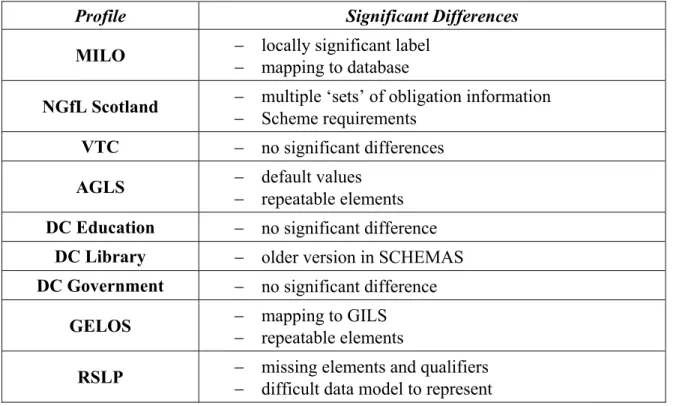
comparing the published application profile with documentation at the VTC and DCMI web sites.
Table 2: Differences between registered version and official version of application profiles
Profile Significant Differences
MILO − locally significant label
− mapping to database
NGfL Scotland − multiple ‘sets’ of obligation information
− Scheme requirements
VTC − no significant differences
AGLS − − default values
repeatable elements
DC Education − no significant difference
DC Library − older version in SCHEMAS
DC Government − no significant difference
GELOS − − mapping to GILS
repeatable elements
RSLP − − missing elements and qualifiers
difficult data model to represent
These differences and some related issues are discussed in the following sections. The segment on profile authorities also includes the relevant citations to documents consulted in compiling Table 2.
Discussion
Registries
purpose. The sixteen namespaces represented in this study occur sixty-five times across the nineteen application profiles. This results in an average of 3.4 namespaces used in each profile, demonstrating that the goal of combining element sets from diverse projects in unique and meaningful ways is well on it’s way to being accomplished. As registries such as SCHEMAS continue to grow, more namespaces will be registered and the tools available to implementers will becomes even more powerful. Profiles will likely continue to become considerably more robust as the pool of elements to draw on grows even larger.
Equally significant is the degree to which implementers are changing the usage of the elements included in profiles. On average, each of the four broad categories of change studied for this research were altered in some way about twenty-five percent of the time. Table 1 demonstrates that of the 312 instances of element usage surveyed in this study, at least sixty-five underwent some change in each category.
The data type changes, normally representing a shift from ‘string’ to ‘character string’, were generally inconsequential and will not be covered at length in this
discussion. Suffice to say, a few instances had more meaningful changes, such as ‘string’ altered to ‘date/time’. One could envision using this category to enforce an integer data type, even with a requisite number of decimal places. However, an argument could be made that such content restrictions are more appropriately placed in the scheme category.
analysis is that, in the progression from the DESIRE registry to the SCHEMAS registry the variety of types of change doubled from four to eight, and began including such statements as ‘to recommended’ and ‘to mandatory if applicable’. The idea of expressing good practice in an application profile, without being prescriptive, fits well with the general DCMI principle of eliminating barriers to implementation.
The most interesting aspect of changes in obligation is the increased appearance of conditional forms of obligation. In the present study, such conditional statements were broken into two categories: the ‘if applicable’ group and the more explicit conditional group. The first of these requires a judgment call on the part of the user, as the concept of applicability is a relatively subjective thing, and was not explicitly defined in any of the cases where the phrase was used. The second form of condition is perhaps the most interesting finding of this segment of the study. The ‘condition’ described is generally the presence, absence, or value given to another element within the description. Examples of these conditions from the sample include:
− dc.date.available becomes mandatory when dc.type = event
− availability mandatory for offline resources (no id element defined) − function mandatory if no dc.subject element defined
− dc.identifier mandatory if no availability element defined
− dc.publisher mandatory for information resources (non-services) − dc.subject mandatory if no function element defined
often difficult to understand when expressed in human readable form and even more challenging to encode as machine-understandable statements.
The practice of defining new controlled vocabularies germane to a specific application or environment is also becoming fairly common. Over thirty percent of the 312 element usage instances surveyed involved adding (and in a few cases removing) schemes from the original element definition, as described in the source namespace. Of the nineteen application profiles in the sample, all but two made some alteration to the use of schemes in at least element and six of these added schemes to five or more of their constituent elements. This is another mechanism by which application profiles are adding considerable value to the element sets they draw from, beyond simply combining them in unique and specific ways.
Profile Authorities
The second phase of this research took a subset of the nineteen application profiles surveyed and explored pertinent documentation to determine if there were any additional specifications regarding usage that was not included in the registries. Although the differences observed are documented in table 2, the complexity of the situation warrants a more detailed explanation of some of the issues encountered.
Globally Relevant Information
Some of the changes seen in this research have exceeding potential for global significance. Types of information defined locally that are currently absent in the registries studied include indications of:
− repeatability,
− potential changes in obligation applied to individual elements or entire profiles − and definitions of a scheme’s components or possible values.
These types of changes have an immediate effect on semantic interoperability between the domains governed by each profile, and the absence of this information in registries is extremely significant.
Documentation of the Australian Government Locator Service (AGLS) profile demonstrates that many elements have default values. The registries in question contain no field for relating this information. Including such information would require the definition of a subclass of RDF Label in order to be communicated in an application profile schema in RDF/XML. Additionally, the local AGLS document declares all AGLS elements to be repeatable, but the field for repeatability in the SCHEMAS registry is unpopulated. (National Archives of Australia, 2000, ch. 4) The original description of the element set described by the GELOS application profile in the report of the
Metainformation Topic Working Group for the G-7 Environment and Natural Resources Project (1997) also includes indications of repeatability for many elements.
The registries section of the present research included a discussion of obligation changes present in registered application profiles, and identified the frequency of rules for conditional obligation as one of the more interesting trends encountered. The
representation registered with DESIRE corresponds with the version for NGfL Scotland content. This example represents another application for conditional obligation and would affect ten elements in this set, five switching from optional to mandatory and five others not being used at all. Presumably the determining factor would be the value of the format element, or some qualified version thereof.
The Virtual Teach Centre (VTC) specifications and manuals provide extensive documentation regarding the usage of this element set. There is no additional
information about the elements per se that is unavailable at the DESIRE registry, with the exception that the registry only indicates that schemes are required for each of the seven VTC specific elements, and provides the name of the controlled vocabulary in use. There is no indication of what values are associated with these schemes, although this
information is readily available in the VTC documentation. Additionally, there is a VTC RDF implementation guide, which essentially follows the RDF usage rules for expressing simple Dublin Core, applied to the set of National Curriculum (NC) and VTC elements. (Kruger and Zambonini, 2001)
Specifically Local Details
One example of information that is potentially useful to readers of application profiles, whether they be human or machine, is information regarding the local usage of an element. The Metadata and Information for Learning Opportunities (MILO)
application profile includes a MILO specific label and a mapping to a field in the
this practice would be useful becoming more common as experimental metadata
implementation projects continue to proliferate. Local labels, instructions, mappings to databases and relationships to other types of local practice will be a useful addition to the information that registries keep about application profiles. Another example of mapping is found in the Australian Government Locator Service (AGLS) which maps all of its elements to both Dublin Core and the Government Information Locater System (GILS) whenever possible. (National Archives of Australia, 2000, ch. 4) It would make sense for registries to document mappings when available, since they provide the framework for the development of crosswalks.
Minor Details
There were a few additional details that were inconsistent between the versions of application profiles studied. Any conclusions drawn from some of these minor usage peculiarities are tenuous at best. This is especially true of information not included in the DESIRE representation, since many of the sites consulted in Phase II of this research were updated after the culmination of the DESIRE project. This caveat is also applicable to SCHEMAS, and any other registry, due to the dynamic nature of metadata standards. The concept of metadata is a recent enough topic that attempts to finalize the guidelines for usage are only beginning to occur. This is discussed further at the end of this section, and in the conclusion.
included. There is an indication in the profile that Author/Creator field should be written ‘Surname first’, but no means of including this type of information is available in either DESIRE or SCHEMAS.
Namespace and Scheme Complications
The DC Education Working Group presents a situation with interesting implications for a registry. An application profile exists, and is published in both SCHEMAS and DESIRE, but there is no official description of the profile in the DCMI documentation. The profile draws upon 5 namespaces, including two that are defined by the Education Working Group. These two namespaces are divided between elements and qualified elements (or qualifiers for elements). This practice is consistent with the
division between the DC and DC Qualifiers namespaces, but the distinction breaks down in cases where other groups, or authorities external to the DCMI begin declaring their namespaces. The DC namespace policy (Powell and Wagner, 2001) does not address this concern or identify any best practice to resolve it.
Although the newest version of the Library Application Profile on the DCMI site is from April 16, 2002 the SCHEMAS registry’s last modification for this profile
should be subsumed under Contributor, with appropriate qualifiers proposed as being optionally available to identify the role (i.e. publisher or contributor). In the most
updated version of the profile, this implementation decision is left to the discretion of the application. (Guenther, 2002) This seems like the type of information that it is
appropriate and even essential for registered versions of application profiles to contain, so that implementers can have a centralized resource for understanding usage criteria for a variety of potential element sets and profiles that combine elements in unique and original ways.
Like the government profile, the library profile relies on its own namespace that has been registered in the namespaces portion of the schemas registry, but is yet to be included in the DCMI namespace registry. However, the application profile
documentation on the DCMI site identifies two namespaces, one for elements, and a second for qualifiers. This is consistent with the approach taken by the education working group, but the SCHEMAS registry provides a single namespace combing both elements and qualifier.
element set, but would probably be more accurately referred to as DC Government Qualifiers.
A similar problem is sometimes encountered regarding schemes and their relationship to namespaces and application profiles. The Resource Support Libraries Programme Collection Description Project (RSLP-CLD) provides a particularly interesting example of this. This profile would almost be better expressed as three separate element sets, the interactions between which are governed by a fairly complex data model. The data model sets out to describe collections, but also to maintain information regarding the location where the collection is held and to describe various people and organizations that are involved. The aim is to document relationships
between these three entities. (Powell, 2000) Location metadata includes an isLocationOf element to identify collections held. Likewise, collection metadata has a set of
associated agents elements that identify creators and owners.
This is dealt with in a very interesting way in the SCHEMAS registry. The concept of location is not included in the registered representation of this element set. The concept of agent is addressed by enforcing a scheme for creator and owner elements. The scheme is made up of components, which correspond to the elements in the agent description set and refer to the appropriate namespaces: DC, vCard, and rslp-cld.
Conclusion
The development of centralized registries is a convenience for implementers looking to obtain a summary of a variety of element sets and the variety of uses to which they are put. It saves the user the trouble of visiting numerous sites and documents in an attempt to synthesize the vast quantity of information available. However, there is a distinct problem, most notable in regard to the DCMI based profiles. As standards are developed and evolve, is it possible for registries to stay up to date? How can registries deal with version control? Waiting until a profile or namespace reaches a final form can prove to be a serious detriment to implementation, since it is often years before
documents are finalized, providing a ‘final’ form is even possible. Once the mechanics of writing machine readable encodings of application profiles become agreed upon and formalized, the process of updating registries can be automated, but as we have seen, this goal is still fairly distant. In the meantime, it seems as though a distributed model may be more appropriate, with registries serving as portals to one another and to other distributed resources.
The development of machine-understandable encodings of application profiles is likely to be among the more interesting research to be done in the coming years. The biggest significance of the present study is in the impact it could have on the
development of best practices for designing these RDF/XML encodings. By identifying the components of an application profile, as well as the functionality that one is intended to carry, this research has identified the content which RDF/XML has to be enriched or extended to be able to carry. Once a suitable set of mechanisms is available for
the process of developing standards for encoding this information in a machine readable manner can begin, resulting in a set of recommendations similar to those the Dublin Core publishes for namespaces. (Powell and Wagner, 2001)
This type of ‘rule-based’ requirements provides extremely rich possibilities for metadata usage and application profile authoring. However, it is exceedingly difficult at the present time to encode these statements in a machine-readable format. RDF alone has no mechanism for expressing any notion of cardinality, so descriptions of obligation or repeatability require the use of separate XML documents that correlate to the RDF
encodings (Hunter and Lagoze, 2001), or the use of a some extension of RDF, such as the DARPA Agent Markup Language + Ontology Inference Layer (DAML+OIL), which enables much greater functionality then the relatively thin set of operations available to RDF. (Ouellet and Ogbuji)
Among the most interesting findings of this study involves the development of rule-based statements of conditional obligation. This is another function that is extremely difficult to express using RDF alone. To effectively express obligation statements of this sort requires a facility for logical inference within the framework of RDF, or some extension of that framework. This need coincides nicely with the W3C vision of a semantic web (Berners-Lee, Hendler and Lassila, 2001), and the area of defining
intersections between RDF, the Dublin Core, application profiles and this conceptual new view of semantically interoperable web content is ripe for further exploration and
References
Baker, T., Dekkers, M., Heery, R., Patel, M. & Salokhe, G. (2001). What Terms Does Your Metadata Use? Application Profiles as Machine-Understandable Narratives. Journal of Digital Information. 2(2), Retrieved November 20, 2001, from
http://jodi.ecs.soton.ac.uk/Ariticles/v02/i02/Baker/
Bearman, D., Miller, E., Rust, G., Trant, J. & Weibel, S. (1999). A Common Model to Support Interoperable Metadata. D-Lib Magazine 5(1), Retrieved March 26, 2002 from http://www.dlib.org/dlib/january99/bearman/01bearman.html
Beckett, D., Miller, E. & Brickley, D. (2001). Expressing Simple Dublin Core in RDF/XML. Retrieved January 10, 2002, from the Dublin Core Metadata Initiative Web Site: http://dublincore.org/documents/dcmes-xml/
Berners-Lee, T., Hendler, J. & Lassila, O. (2001, May). The Semantic Web. Scientific American. p. 28-37.
Brickley, D. & Guha, R.V. (2000). Resource Description Framework (RDF) Schema Specification: W3C Candidate Recommendation. Retrieved September, 2001 from the World Wide Web Consortium Web Site: http://www.w3.org/TR/2000/CR-rdf-schema-20000327/
Brickley, D., Hunter, J. & Lagoze, C. (1999). ABC: A Logical Model for Metadata Interoperability. Retrieved March 26, 2002 from:
http://www.ilrt.bris.ac.uk/discover/harmony/docs/abc/abc_draft.html
Cummings, M., Wilson, A. & Aagaard, P. (2001) DC-GOV Application Profile. Retrieved April 1, 2002 from the Dublin Core Metadata Initiative Web Site:
http://dublincore.org/groups/government/profile-200202.shtml
Guenther, R. (2002). Library Application Profile. Retrieved April 18, 2002 from the Dublin Core Metadata Initiative Web Site:
http://dublincore.org/documents/2002/04/16/library-application-profile/
Heery, R. (2001). Draft DCMI Open Metadata Registry Functional Requirements. Retrieved January 25, 2002 from the Dublin Core Metadata Initiative Web Site:
http://dublincore.org/groups/registry/fun_req_ph1-20011031.shtml
Heery, R., Gardner, T., Day, M. & Patel, M. (2000). DESIRE Metadata Registry Framework. Retrieved February 21, 2002 from:
Heery, R & Patel, M. (2000). Application profiles: mixing and matching metadata schemes. Ariadne 25, Retrieved November 25, 2001 from:
http://www.ariadne.ac.uk/issue25/app-profiles/
Hudgins, J., Agnew, G. & Brown, E. (1999). Getting Mileage out of Metadata: Applications for the Library. Chicago: American Library Association.
Hunter, J. & Lagoze, C. (2001). Combining RDF and XML Schemas to Enhance Interoperability Between Metadata Application Profiles. Retrieved October 12, 2001 from the Tenth International World Wide Web Conference Web Site:
http://www10.org/cdrom/papers/572/index.html
Kokkelink, S. & Schwänzl, R. (2001). Expressing Qualified Dublin Core in RDF / XML. Retrieved February 24, 2002 from the Dublin Core Metadata Initiative Web Site: http://dublincore.org/documents/2002/04/14/dcq-rdf-xml/
Kruger, B. & Zambonini, D. (2001). VTC Metadata Schema. Retrieved April 4, 2002 from: http://vtc.ngfl.gov.uk/metadata/
Lagoze, C. (1996, July/August). The Warwick Framework: A Container
Architecture for Diverse Sets of Metadata. D-Lib Magazine 7, Retrieved September 30, 2002 from http://www.dlib.org/dlib/july96/lagoze/07lagoze.html
Lagoze, C. (2000). Accommodating Simplicity and Complexity in metadata: Lessons from the Dublin Core Experience. Retrieved December 21, 2001 from: http://www.cs.cornell.edu/lagoze/Papers/dc.pdf
Lassila, O. & Swick R. (1999). Resource Description Framework: (RDF) Model and Syntax Specification. W3C Proposed Recommendation. Retrieved September, 2001 from the World Wide Web Consortium Web Site: http://www.w3.org/TR/PR-rdf-syntax-19990222/
Metainformation Topic Working Group. (1997). Standard Element Set for GELOS Records. Retrieved April 19, 2002 from: http://www.iszp.sk/katalog/gelos.html
National Archives of Australia. (2000). Australian Government Locator Service: User Manual 1.2. Retrieved April 19, 2002 from:
http://www.naa.gov.au/recordkeeping/gov_online/agls/user_manual/intro.html
National Grid for Learning Scotland. (2000). NGfL Scotland Metadata Standards. Retrieved April 19, 2002 from:
www.ngflscotland.gov.uk/ngflfocus/keypub/ngflmetadata.asp
Ouellet, R. & Ogbuji, U. (2002). Introduction to DAML: Part I. Retrieved February 5, 2002 from http://xml.com/lpt/a/2002/01/30/daml1.html
Powell, A. (2000). RSLP Collection Description: Collection Description Schema. Retrieved April 19, 2002 from http://www.ukoln.ac.uk/metadata/rslp/schema/
Powell, A. & Wagner, H. (2001). Namespace Policy for the Dublin Core
Metadata Initiative (DCMI). Retrieved February 12, 2002 from the Dublin Core Metadata Initiative Web Site: http://dublincore.org/documents/2001/10/26/dcmi-namespace/
Appendix A:
Application profiles included in each data set
Profile from DESIRE Inclusion in
Phase I
Inclusion in Phase II
ADL SCORM Content Metadata Not Included Not Included
ADL SCORM Course Metadata Not Included Not Included
ADL SCORM Raw Media Metadata Not Included Not Included
BIBLINK Core Included Not Included
eLib Collection Level Description Included Not Included DC Education Working Group proposal Not included Not Included
Dublin Core Qualified Included Not Included
EASEL DCMES Not included Not Included
IMS Learning Resource Metadata Core Not included Not Included
MILO Included Included
National Curriculum Metadata Standard Included Not Included
NGfL Scotland Metadata Included Included
ROADS/IAFA DOCUMENT Template Not included Not Included ROADS/IAFA SERVICE Template Not included Not Included
RSLP Collection Description Included Not Included
Profiles (from SCHEMAS) Inclusion in Phase I
Inclusion in Phase II
Australian Government Locator Service Included Included
DC Education Working Group Proposal Included Included
DC Government Application Profile Included Included
DC Library Application Profile Included Included
DC Simple Included Not Included
EASEL DCED Included Not Included
EASEL South Bank University Application Profile
Included Not Included
European Treasury Browser Collection Level Description Application Profile
Included Not Included
European Treasury Browser Resource Level Application Profile
Included Not Included
FAO Metadata Framework proposal Included Not Included
Global Environmental Locator System
Appendix B:
Namespaces used by profiles in Phase I
Namespace Number of Profiles in
DESIRE
Number of Profiles in SCHEMAS
Dublin Core 7 12
Collection Development
Description 1 2
DC Education 1 6
DC Ed. Qualifiers 1 2
DC Qualifiers 2 10
U.K. National Curriculum 2 -
European Schoolnet (EUN) 1 -
Biblink 1 -
Virtual Teacher Centre 1 -
Australian Government
Locator Service - 1
DC Relation Qualifier Set - 2
IEEE Learning Object
Metadata - 3
DC Government - 1
DC Libraries - 1
Educator Access to Services in
the Electronic Landscape - 2
European Treasury Browser - 2
United Nations Food and
Agriculture Association - 1
Global Environmental Locator
Appendix C:
Application Profile Composition by elements per namespace
Application Profile (from DESIRE)
Total # Elements
# Namespaces (# elements for each)
BIBLINK Core 22 2 (biblink10, dc12)
eLib Collection Level Description 17 2 (cld6, dc11)
DC Qualified 39 2 (dc15, dcq24)
MILO 17
6 (dc-ed1, dc-edq2, dc7, dcq3, iee-lom3, milo1)
National Curriculum Metadata Standard 30 2 (dc15, nc15)
NGfL Scotland Metadata 16 2 (dc14, eun2)
Virtual Teacher Centre Metadata Standard 37 3 (dc15, nc15, vtc7)
Application Profile (from SCHEMAS)
Total # Elements
# Namespaces (# elements for each)
Australian Government Locator Service 51
4 (13agls, 15dc, 2dcq-rqs, 21dcq)
DC Education Working Group Proposal 48 5 (2dc-ed, 4dc-edq, 15dc, 24dcq, 3ieee-lom)
DC Government Application Profile 42 3 (dc:14, dcq:21, dc-gmes:11)
DC Library Application Profile 48 4 (1dc-ed, 14dc-lmes, 13dc, 20dcq)
DC Simple 15 1(dc)
EASEL DCED 28 6(2dced, 3dcedq, 15dc, 4dcq, 1easel, 3ieeelom)
EASEL South Bank University Application
Profile 46
6(5dced, 15dc, 2dcqrqs, 21dcq, 1easel, 3ieeelom)
European Treasury Browser Collection Level
Description Application Profile 12 4(1dc-ed, 7dc, 3etb-mes, 1rslp-cld)
European Treasury Browser Resource Level
Application Profile 29 4(1dc-ed, 9dc, 21 dcq,7etb-mes)
FAO Metadata Framework proposal 47 3(6dc, 11dcq, 30fao (2e, 18q)) Global Environmental Locator System
Application Profile 22 3(39dc, 5dcq, 8gelos-mes)
Appendix D
Details of ‘Obligation’ Changes in Phase I
DESIRE # DESIRE % SCHEMAS # SCHEMAS %
to optional 3 14% 11 17%
to mandatory 17 81% 29 47%
conditionally to
mandatory 1 5% 5 8%
to mandatory if
applicable - - 11 17%
to recommended - - 5 8%
to recommended if applicable
- - 1 1.5%
to recommended ? - - 1 1.5%
Appendix E
Details of ‘Scheme’ Changes in Phase I
Application Profile (from
DESIRE) # Schemes #new (%) #deleted
BIBLINK Core 4 4 (100%) -
eLib Collection Level Description 1 1 (100%) -
DC Qualified 27 7 (26%) 5
MILO 7 3 (42%) -
National Curriculum Metadata
Standard 17 4 (24%) -
NGfL Scotland Metadata 4 3 (75%) -
Virtual Teacher Centre Metadata
Standard 24 3 (21%) -
Application Profile (from
SCHEMAS) # Schemes #new (%) #deleted
Australian Government Locator
Service 38 32 (84%)
DC Education Working Group
Proposal 31 -
DC Government Application
Profile 31 10 (32%) 1
DC Library Application Profile 32 5 (16%)
DC Simple - - 8
EASEL DCED 15 7 (17%)
EASEL South Bank University
Application Profile 30 12 (40%)
European Treasury Browser Collection Level Description
Application Profile 9 5 (56%)
European Treasury Browser Resource Level Application
Profile 28 4 (14%)
FAO Metadata Framework
proposal 16 3 (19%)
Global Environmental Locator
System Application Profile 10 4 (40%) 2
Appendix F
Glossary of Acronyms
Bib: Biblink
DC: Dublin Core
CLD: Resource Support Libraries Programme Collection Description Project ED: Dublin Core Education Element Set
EDQ: Dublin Core Education Qualifiers DCQ: Dublin Core Qualifiers
NC: National Curriculum (UK)
EUN: European Multimedia Schoolnet VTC: Virtual Teacher Center
AGLS: Australian Government Locator Service
RQS: Dublin Core Relation Qualifiers Set (proposed, not included in DCQ) LOM: Institute of Electrical & Electronics Engineers Learning Object Metadata DC-G: Dublin Core Government Element Set
DC-L: Dublin Core Library Element Set
EASEL: Educator Access to Services in the Electronic Landscape ETB: European Treasury Browser
FAO: Food and Agriculture Organization of the United Nations GELOS: Global Environmental Locator System Application Profile MILO: Metadata and Information for Learning Opportunities NGfL: National Grid for Learning Scotland