This paper analyzes the visions, schemas, and vocabularies of prominent rights
expression languages, including Creative Commons, METS, ODRL, and MPEG-21. The paper extends Michel Callon’s sociological insight that all forms of human agency are multiple and diverse. Callon argues, in the context of economic sociology, that one must constantly decide between a strategy emphasizing “framing” as the norm with
“overflows” treated as leaks, or conversely a strategy accepting “overflows” as the norm with “framing” as inherently imperfect. Callon’s categories are extended, through a modeling exercise, to the classification of current metadata schemes. The analysis suggests that metadata developers should explore what semantic choices and strictures are left out of metadata schemes, as well as those that are included. Such a thought exercise is especially useful in distinguishing areas suited for XML rights markup extensions.
Headings:
Copyright licenses
Intellectual property -- Protection Metadata
by
Gary J. Hausman
A Master’s paper submitted to the faculty of the School of Information and Library Science of the University of North Carolina at Chapel Hill
in partial fulfillment of the requirements for the degree of Master of Science in
Information Science.
Chapel Hill, North Carolina December 2006
Approved by
Table of Contents
Introduction 2
Preliminary Questions 3
Public vs. Private Rights 4
Indigenous Knowledge and Intellectual Property Rights 5 Digitization, Intellectual Property and Indigenous Communities 6 Rights Expression Languages for Indigenous Knowledge 8 Australian Aboriginal/Torres Strait Islander Traditional Knowledge 9
Research Questions 13
Methods 14
From Copyright to Contract to Control 14
The Complexity of Culture 16
Metadata and Markets 17
Toward a Comparative Semantics of Rights Expression Languages 20
Creative Commons 21
METSRights 25
Open Digital Rights Language Initiative 30
MPEG-21 35
Discussion 40
Conclusions 42
Introduction
Digital technologies pose novel challenges for metadata tools that protect intellectual property rights, on a global scale. Along with the need to serve business interests through such technologies as Digital Rights Management (DRM), variant traditional and indigenous property rights clamor for protection. The challenge is to develop a metadata vocabulary that combines global interoperability with refinement geared toward local standards. In this respect, issues of culture assume keen importance.
While the analytic section of this paper contrasts four main types of metadata schemas, this initial literature review section focuses especially on MPEG-21, along with current endeavors to extend the abstract framework developed by the Motion Picture Experts Group by using XML rights markup, fine-tuned to variant localized cultural contexts. By focusing upon how different metadata developers, and implementers, have attempted to incorporate “culture” into metadata schemas, the review will highlight those aspects of metadata models that are especially appropriate for cultural fine tuning. At the same time, we will investigate the extent to which “cultural” metadata extensions tend to be addressed only on an ad hoc basis, employing a static and functionalist construct of culture. These findings will set the stage for the alternative actor-network approach suggested in the second half of this paper for metadata modeling, that substitutes for a static construct of “culture” an underlying focus on sociotechnical actor networks as inherent in all forms of social action, from the initial stage of metadata conceptualization through to types of software implementations.
Preliminary Questions
The National Information Standards Organization identifies three basic types of metadata: descriptive used in discovering and identifying a resource; structural for describing how the parts of a compound object fit together; and administrative for managing a resource. This paper focuses on a specific subtype of administrative
vocabulary for describing and categorizing all variant social and cultural situations globally for general interoperability of digital objects.
But how does one address all global forms of culture, with a metadata schema? Does one need a separate schema for each cultural context, or can global cultural, as well as technological, interoperability be truly possible? Should one employ the same degree of rigor in defining “cultural” or “social” variables as for technological database, namespace, dataset parameter, software, or hardware variables? Do the types of Visio diagrams, entity-relationship schemas, OmniGraffle bubbles, and computer models commonly employed in metadata modeling need to incorporate anticipatory models for “cultural” or “social” situations along with the technological specifications? What are the implications of different definitions of “culture” or “society,” and what are the relative advantages and disadvantages of incorporating such variables into metadata models at the outset, as contrasted with a case-by-case approach for addressing “cultural” intrusions? These are some of the questions addressed by this study. Let us commence with an overview of the current state of administrative rights metadata theorization.
Public vs. Private Rights
International legislation to protect traditional knowledge is fairly recent. Legislative highlights include a law protecting folklore established by UNESCO and WIPO in 1981, a Farmers’ Rights provision that was added to the International
Undertaking on Plant Genetic Resources in 1989, and the 1992 Convention on Biological Diversity’s emphasis on the need to preserve traditional knowledge (Barton et al. 2002, 73). A key concern in traditional knowledge rights management—especially in
already in the public domain, such as recent cases of patents granted (though subsequently overturned) for turmeric and neem (Barton et al. 2002, 76).
The Commission on Intellectual Property Rights highlights a fundamental
paradox. While international property (IP) rights are generally conferred as an instrument of public policy, each specific IP right itself is privately held. Thus, the Commission views an IP right as only “one of the means by which nations and societies can help to promote the fulfillment of human economic and social rights” (Barton et al. 2002, 6), thereby implying that general rights of the human species should not be subordinated to a local need for IP protection.
Indigenous Knowledge and Intellectual Property Rights
Even the full-fledged corporate patent is a rather complex device. As Marianne de Laet notes, patents simultaneously represent and transport subjects, objects, and
knowledge. “For the patent carries not only knowledge and rights; it also carries a particular concept of ownership and authorship” (de Laet 2000, 163). Moreover, as patents circulate outside of the peculiar Western zone where “author becomes owner,” they can perform quite differently and serve as a means of transferring—as well as storing—knowledge (de Laet 2002).
owner rights are needed (Moahi 2004). The challenge here is to develop sufficiently refined metadata vocabularies so as to avoid reducing the manifold multiplicity of global cultures to the singularity of corporate western culture.
Digitization, Intellectual Property and Indigenous Communities
To guard against biopiracy of traditional knowledge, several developing countries are constructing digital libraries of traditional knowledge, especially in such areas as biodiversity. As local forms of indigenous knowledge are often transmitted orally and not in fixed textualized format as expected by patent investigators trained to assess written documents, there is the problem of translating such languages into the majority idiom. To accomplish this, projects such as the Traditional Knowledge Digital Library (TKDL) of India, the Traditional Medicines Resource Centre in the Lao People’s Democratic Republic, and the People’s Biodiversity Registers (PBRs) of South India have documented local biodiversity related knowledge in codified, written digital form (Langton and Rhea 2005).
approach is critical in considering information technology in indigenous communities” (Holland and Atkins 2001).
As an outgrowth of the Hawaii conference, a special issue of D-Lib Magazine was published in March 2002 on the theme of digital technologies and indigenous
communities (Atkins and Holland 2002). Here also, issues of culture assume prime importance. Worcman, founder and director of Museum of the Person, argues for a rethinking of the digital divide as “cultural exclusion” that can be counteracted by a democratization of digital technologies, whereby socially excluded indigenous communities can themselves become producers of traditional knowledge in a modern technological medium (Worcman 2002). Holland cautions that digital technologies and the Internet “embody the dominant western culture” from a Eurocentric perspective, and that efforts must be taken for “imbedding culture in digital libraries.” For example, a prototype digital library developed by the American Indian Higher Education Consortium allows subject classification, browsing, searching, and hyperlinks organized by Native American locally salient categories of tribe or geopolitical region (Holland 2002). Seadle points out various potential problems of cross-cultural permissions from the standpoint of US copyright law (Seadle 2002). Sullivan emphasizes the importance of grounding digital libraries in a mutual ethic of reciprocity governed by indigenous cultural and intellectual property (ICIP) management (Sullivan 2002). These authors all seem to agree that cultural interpretation and understanding is of prime importance in organizing
Rights Expression Languages for Indigenous Knowledge
Rights Expression Languages (REL) are machine-readable languages that declare rights and permissions in accordance with terms stored in a Rights Data Dictionary. Each grant of a Rights Expression Language includes four parts: a) the Permission one user is providing to another, b) the Condition or constraint placed on using the digital item, c) the Principle that identifies the User granted the Permission, and d) the Resource for which the Permission is granted. The second (2004) edition of the MPEG-21 vision statement recognizes that certain “industries and User communities will need to modify the language to better suit their specific needs.” The Extension process allows individuals to customize need specific language elements, while the Rights Data Dictionary promotes interoperability through unambiguous semantic interpretation of newly added verbs (ISO and IEC 2004, 13).
The MPEG-21 vision—to define a framework for use of multimedia resources “across a wide range of networks and devices used by different communities”—suggests a global framework, for all societies throughout the world. MPEG-21 unites the concept of the digital item as a fundamental unit of distribution and transaction with the concept of interactive users. “Users” of MPEG-21 include “individuals, consumers, communities, organizations, corporations, consortia, and governments.” Users are defined simply by their relationship to one another (Bormans, Gelissen, and Perkis 2003; ISO and IEC 2004, 7).
A wide variety of indigenous knowledge centers (IKCs) exist throughout the world, such as the Center for Indigenous Knowledge for Agriculture and Rural
stage in many global regions including Africa, Asia, Australia, and Latin America. Indigenous knowledge movements highlight the importance of developing information technologies geared toward the type of decentralized knowledge sharing aspired to by museums and archives in postcolonial societies. Jane Hunter lists three general project types presently harnessing information technology to indigenous knowledge sharing: virtual repatriation, community mapping, and traditional medicine digital libraries. As well, there are many local movements to create indigenous knowledge bases. Such endeavors necessitate interoperable standards of user-friendly interfaces, security, low cost, flexibility, portability, scalability, and adaptability. Hunter cautions, however, that most such projects have not implemented international metadata standards or developed systems that are readily customizable for supporting the fluctuating vagaries of local culture needs (Hunter 2005, 118-119).
Australian Aboriginal/Torres Strait Islander Traditional Knowledge
Jane Hunter has criticized supposedly “international” MPEG-21, XrML and ODRL standards for being weighted toward the needs of modern western intellectual property regimes. For purposes of protecting traditional knowledge systems she has proposed metadata extensions to standard XML rights markup languages so as to incorporate indigenous community knowledge rights and resources. This requires a broader, and more flexible, metadata vocabulary and classification system, starting from the rights expression tools included in standard metadata schemes.
In its standard form, as articulated in the Moving Picture Experts Group,
monetarily based rights and conditions for using digital resources. As designed by IPR Systems, the Open Digital Rights Language (ODRL) also covers digital terms and conditions for accessing content, including permissions and agreements with holders of rights. The drawback of these three schemas, from a broader perspective, is that they are limited legally to modern copyright situations that do not adequately protect indigenous cultural knowledge.
Hunter has focused especially on the cultural context of Australian Aboriginal and Torres Strait Islander intellectual property. An example of a construct that assumes far more importance in Australian Aboriginal indigenous societies is that of shared
exercise of specific property rights. As well, restrictions can be modified to take account of tribal membership and status, gender role of the user, and kinship behavior such as prescribed avoidance of certain family members. Hunter thus proposes that the common XML security measures of Signature, Encryption, and Security Assertion Markup Language be supplemented by additional constraints geared toward the administration of indigenous intellectual property knowledge systems (Hunter 2002; Hunter, Koopman, and Sledge 2002).
Hunter’s critique, then, is that MPEG-21, XrML, and other such digital rights management standards are slanted toward emphasizing corporate and commercial content rights ownership, and “do not support the specific features needed to protect indigenous knowledge or to enforce tribal customary laws.” Several recent initiatives are devoted to developing indigenous knowledge management (IKM) software that starts with Dublin Core metadata schemes, but adds XML metadata file extensions narrowed upon the local needs of intellectual rights management in indigenous communities (Hunter 2005, 120-121). For example, within the National Museum of the American Indian (NMAI) at the Smithsonian, an ongoing Indigenous Knowledge Management Project emphasizes software facilitating metadata standards for the access-control and retrieval requirements of indigenous community members (Hunter et al. 2004; Koopman, Indigenous
Application (XMEG) developed by Bevan Koopman, each resource can be described by four basic types of metadata: 1) descriptive metadata based on the Dublin Core,
2) annotation metadata to provide for users to add their own personalized annotations, 3) rights management metadata for creating access restrictions to a resource, and 4) tribal care metadata to be used by tribal owners laying claims to traditional (e.g., ritual or sacred) resources (Koopman, Xmeg system documentation 2005).
Qualified Dublin Core has been proposed for cataloguing Quinkan Culture
resources in Australia. Here, also, questions of cultural definition are of great importance. Nevile and Lissonnet observe that ideal metadata requirements from the standpoint of stable machine interoperability may conflict with cultural ideals. Thus, for cataloguing Quinkan Rock Art, a morally neutral technology would gravitate toward concretely identifying specific locations of material culture. But “the way we want to describe locations is, a matter of cultural preference, and geo-spatial science is not a traditional way.” In the Quinkan cultural setting, rock painting locations tend to coincide with the sites of sacred objects and spirits, and from a Quinkan perspective, access to such sites must be restricted to only certain classes. Hence, administrative access restrictions for ritual, sacred, and spiritual entities must be incorporated into the standard geographical metadata classifications for material art objects (Nevile and Lissonnet 2003).
Similar software projects are in progress in various Asian economies. The TAMI (Text, Audio, Movies and Images) file management system in Australia provides
structure into the arrangements of resources and metadata” (School of Australian Indigenous Knowledge Systems--Charles Darwin University 2005).
Research Questions
The following research questions guide the analysis in this paper.
• How do complex, abstract metadata standards such as MPEG-21 fit within, and
relate, to the broader panoply of other metadata standard alternatives?
• Is it possible to map different metadata schema structures to corresponding social
configurations?
• Along with the visual metadata models favored by software designers, is it
possible to incorporate visual models expressing social, as well as technical, choices from the very outset of metadata schema development?
• Can we organize different metadata schemas into a logical continuum, ranged by
measurable or operational categories?
• Can we replace the static, fixed dichotomy of “culture” and “technology” with a
more dynamic, and flexible yet unified, construct of a sociotechnical network? • Is it ever possible or advisable, as expressed in the TAMI initiative (School of
Australian Indigenous Knowledge Systems--Charles Darwin University 2005), to encode no assumptions about the nature of knowledge or the nature of the world, while simultaneously presuming to know, and to be able to define—and even operationalize—what is an “indigenous” user?
• Can we respond to the critique of anthropologists who criticize the “polemical
bounded, static entity but a dynamic, constantly renegotiated process” (Brown 1998).
Methods
The primary methodology employed in this paper is a content analysis of metadata schemas and standards, supplemented by conceptual and heuristic modeling exercises for each of the four metadata standards of Creative Commons, METSRights, ODRL, and MPEG-21. These modeling exercises test the extent to which the sociological market analysis framework of Michel Callon parallels and fits the comparative metadata schema analysis of Karen Coyle.
From Copyright to Contract to Control
Karen Coyle (Coyle 2004) observes that Rights Expression Languages (RELs) can be analyzed either by their purpose, by their level of machine-actionability, or by the content of data elements. With respect to copyright, in the full legal sense of the term, both Creative Commons and METSRights make use of specific statements about legal rights over digital resources, while more complex schemas such as XrML and ODRL do not explicitly reference legal copyright statements.
As contrasted with legal copyright, the way in which rights expression languages treat contract is much more variable. Coyle notes that RELs function primarily as
languages, MPEG-21 allows the most refinements for machine-actionability and automated licensing, but is so complex that it has not yet been fully implemented.
The dimension of control relates to actual execution and implementation of rights. Coyle notes that “the need for control determines the kinds of functions that can be included in a license.” Control can be enforced either at the point of resource access, or at the point of resource use. METSRights is the only rights expression language that has data elements relating to the level of resource access. At the level of resource use, ODRL is partially actionable and MPEG-21 is fully machine–actionable in terms of a
multidimensional market.
The four RELs analyzed by Coyle can more or less be organized along a
continuum. The most open access language is the Creative Commons; only the license is machine-readable, but there is no attempt here to exercise machine-actionable control over resource content. The METSRights schema, similarly, is not machine-actionable, apart from basic display of data elements on a computer interface, and there is no automated use control. By contrast with the open access orientations of Creative Commons and METSRights, Open Digital Rights Language (ODRL) does allow— optionally—for machine-actionable resource use control by means of an XML based rights language and data dictionary. MPEG-21 is a completely machine-actionable language that is intended not only to interact with current rights enforcing hardware and software, but also intended to allow full rights management control via future digital technologies at both ends of the resource creator/resource user spectrum.
languages, with each correlating with different business models. So as to support open source constructs such as “fair use” and community methods of trust, a rights expression language—such as Creative Commons—must deemphasize machine-actionable levels of enforcement so as to promote socially responsible methods of ethical responsibility. The result is a somewhat loose language and vocabulary structure. By contrast, a strictly machine-actionable rights expression language such as MPEG-21 must rely upon great vocabulary precision, a full data dictionary, and an unambiguous vocabulary. More complex and abstract RELs such as ODRL and MPEG-21 also have quite complex metadata vocabularies that can be either reduced or expanded, by XML implementations, to meet a vast variety of present and future contingencies. One conclusion drawn from Coyle’s analysis is that RELs can be classified in terms of the degree to which machine-readable expressions differ from, or are in congruence with, external written languages and contracts governing rights management.
The Complexity of Culture
Most of the current work on rights expression languages for classifying
indigenous knowledge grapples with social and cultural variables as something outside of the narrow domain of metadata vocabularies. Indeed, at the conclusion of a path breaking thesis on the topic of software tools for indigenous knowledge management, Bevan Koopman finds technical aspects of software design to be far less problematic than social and political concerns, and decides to leave actual testing of the software in a trial
discover that the indigenous rights management XML extensions proposed by Jane Hunter for MPEG-21 are a specific instance of the broader problem of how to situate metadata vocabularies, and XML extensions, in an ever changing global cultural context. Metadata and Markets
As emphasized by Coyle, different metadata schema types are suited for different types of business models. This section will explore the potential of a comparative
analysis of markets. The actor-network theory approach of Michel Callon provides a sociotechnical dynamic alternative to the static understanding of “culture” evident in more traditionally functionalist analyses.
Similar to Coyle’s comparative analysis of metadata schemas as different types of contracts, Michel Callon has examined “the laws of the markets” as different
configurations of “calculated contracts.” Callon emphasizes the underlying rationality— and measurability—of markets, which simultaneously imply organization, process, and agents entering and leaving transactional exchanges as anonymous strangers.
In order to be calculative the agent must be open and … calculative. The assumption of openness of social network analysis thus transforms the problem into a solution: the agent-network is by construction calculative, since all action is analysed in terms of combinations, associations, relationships and strategies of positioning. The agent is calculative because action can only be calculative (Callon Introduction 1998, 12).
1998, 15). For the static construct of a “market,” Callon instead proposes a focus on the process of “marketization,” as continuous opposite movements of framed calculations of entanglements and disentanglements.
Callon focuses especially on the economic concept of “externality.” In economics, an externality is either a positive or a negative repercussion of a commercial transaction between agents involved in negotiating a contract on another set of agents who are not themselves involved with that specific contract. For example, a factory may pollute the surrounding countryside, making it necessary for farmers to make economic investments that are quite external to commercial compensation from the factory owners. Or,
exemplifying a positive externality, a pharmaceutical company may apply for a patent to protect its intellectual property, which has the positive result—to competitors—of disclosing what would otherwise remain secretive business trade secrets. Whether positive or negative, externalities “render the market (at least partially) inefficient, because they are responsible for a gap between private marginal income and marginal social costs” (Callon An essay on framing 1998, 247).
the interactions on themselves” and the role of the players’ mutual agreement, or a contrapuntal emphasis on “the omnipresence of connections with the outside world” and the resultant “overflows” that inevitably result.
Let us set Callon’s two basic models alongside of the typology identified by Coyle for metadata rights management schemas.
Model A: When framing is the norm and overflows are leaks. This model
frames market transactions as a closed space; the presumption is that each active individual takes account of the views of every other individual interacting during a market transaction. In model A, “framing is the norm” and “overflows are exceptions which must be contained and channeled with the help of appropriate investments” (Callon An essay on framing 1998, 250). The emphasis here is on harmony and equilibrium between separate entities, with externalities presumed to be “simply the results of imperfections or failures in the framing process.” By setting up such an ideal, economists must focus especially on identifying potential leaks and on tools for
Model B: Overflows are the norm; framing is expensive and always imperfect.
In this model, “overflows are the rule and framing is a fragile, artificial result based upon substantial investments” (Callon An essay on framing 1998, 252). A corollary of this model is that framing cannot be maintained solely by contractual incentives, but externalities will always inevitably arise, and one would do well to embrace them. Moreover, “this costly framing process is necessarily incomplete: first because a wholly hermetic frame is a contradiction in terms, and second because flows are always
bidirectional, overflows simply being the inevitable corollary of the requisite links with the surrounding environment.” So here, we find a situation characteristic of the
philosophy under girding open source software and standards, such as the Creative Commons and, to a lesser extent, the METSRights licensing system.
In a more recent statement, Callon emphasizes that all social action “is a
collective property that naturally overflows,” and that whenever action is identified with a specific agency, “it has to be framed.” Consequently, Callon views all forms of agency as multiple and diverse. Callon especially emphasizes, in this respect, the strategic shaping of agencies and action related to “copyrights, property rights” and other basic human rights (Callon 2005).
Toward a Comparative Semantics of Rights Expression Languages
refers to the agent having rights, METSR refers to the RightsHolder, ODRL relates to a more abstract party, and MPEG-21/5 to a principal or issuer. A content analysis and modeling exercise will test how these specific metadata terms correlate with more general natural language terms used in the documentation for and elucidation of each rights expression language. This exercise will highlight what is left out, as well as what is included, in each rights expression language as a basic gestalt, shaped by variant situational contexts.
Creative Commons
description; additionally, the license provides a small piece of HTML that can be embedded into the web page for a creative work as a sort of Creative Commons logo.
CC licenses cover Permissions, Prohibitions, and Requirements. Permissions include such rights as reproduction, distribution, and the creation of derivative works; Prohibitions may cover, for example, the use of an artistic work for commercial use; and Requirements include Notice, Attribution, ShareAlike, and the SourceCode. The Creative Commons license is intended to provide a more structured means of rights management than that available with the Dublin Core dc:rights element. For purposes of referencing a legal copyright, the important attributes are the web address of the agent holding the copyright, the person’s name, and the person’s date. The recommended means of embedding a Creative Commons license is in the comment section of a web page document.
While the Creative Commons license is machine readable (for example, by a search engine), enforcement of the terms of the license rely mostly upon community agreement and social action. In Callon’s sense of the term, enforcement “overflows” from the metadata itself to the community of trendy artists familiar with the Creative
publishing creative works. There are even two comic strips, and explanatory videos, clearly explaining the principles behind CC licenses.
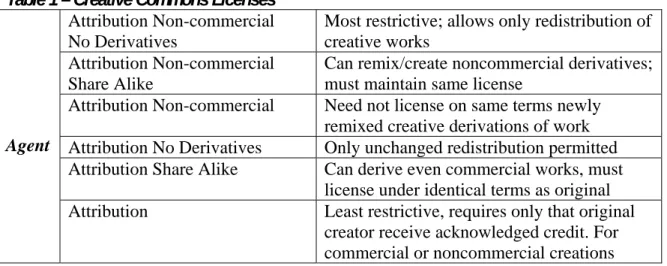
There are six basic types of Creative Commons licenses (Table 1), on a continuum from most to least restrictive.
Table 1 – Creative Commons Licenses Attribution Non-commercial No Derivatives
Most restrictive; allows only redistribution of creative works
Attribution Non-commercial Share Alike
Can remix/create noncommercial derivatives; must maintain same license
Attribution Non-commercial Need not license on same terms newly remixed creative derivations of work Attribution No Derivatives Only unchanged redistribution permitted Attribution Share Alike Can derive even commercial works, must
license under identical terms as original Agent
Attribution Least restrictive, requires only that original creator receive acknowledged credit. For commercial or noncommercial creations Each license type has a double link to a simply written commons deed in
layman’s language, and to a legal code in legal language. Within this simple format, new variations of licenses can be derived. For example, there is the option to choose a
Sampling License that allows others to transform only parts of a work for noncommercial purposes.
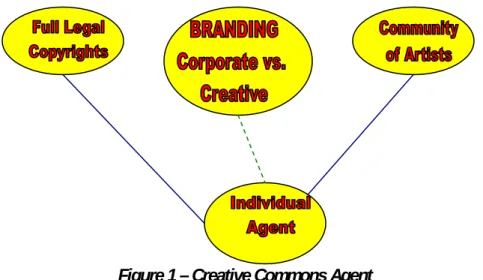
Alongside of the usual technical specifications of a Creative Commons license, we may construct a social model of the term Agent as situated within the Creative Commons license (Figure 1).
Figure 1 – Creative Commons Agent
Within this model, by national and international legislation, all individual agents are subject, by default, to current copyright legislation, whether as producers or as consumers of artistic works. Hence the “Full Legal Copyrights” bubble. Yet there is the contrapuntal pull of the community of creative artists, as well as the more general cultural image of the creative maverick and outsider, regardless of one’s artistic ability. The “Community of Artists” bubble represents this. Thus, agents can choose partially to relinquish full copyright rights; an action which the Creative Commons website presents as an act of intellectual and artistic freedom, as well as an act of civic responsibility to the community of creative artists. Hence the middle “branding” bubble with a dotted link to the
membership in the creative/artistic community to make use of the alternative logo of a Creative Commons license. It is for this reason that so much effort is expended on the attractive HTML design and marketing of different Creative Commons licenses.
In sum, then, what is most obvious about a Creative Commons license is that it frames off, using the technology of RDF metadata, specific subsets of copyright
legislative rights. What is less obvious, but equally important, is that broader social and economic mechanisms of the marketing of corporate logos, in a sense, overflow into the visible representation of the Creative Commons licenses, which attain their own flashy status as icons of alternative culture. As the Creative Commons license derives its resonant force by continued opposition to the corporate trademark and license of copyright, there is a perpetual need to both develop and maintain the community of Creative Commons license producers and consumers, by means of the extensive sets of community links radiating from the Creative Commons website.
METSRights
The METSRights schema (http://www.loc.gov/standards/rights/METSRights.xsd) is an extension to the general METS standard. The three basic elements of the standard are RightsDeclaration, RightsHolder, and Context (Table 2).
Table 2 – METSRights Schema Elements
RightsDeclaration Intellectual property rights associated with digital asset, or part thereof (Attributes: RIGHTSDECID, RIGHTSCATEGORY, OTHERCATEGORYTYPE)
RightsHolder Person or organization holding intellectual property rights to digital asset, or part thereof
Context Circumstances associated with who has what permissions and constraints
Subcategories of the RightsDeclaration category include a unique identifier (RIGHTSDECID), specification of whether the resource is COPYRIGHTED, LICENSED, PUBLIC DOMAIN, CONTRACTUAL, or OTHER (RIGHTS CATEGORY), and finally a wild card subcategory for OTHER.
It will be observed that within the METSRights schema, ability to express social and cultural variables is limited to the “Context” element. The CONTEXTCLASS attribute, especially, is used to define types of users; these include the categories of ACADEMIC USER, GENERAL PUBLIC, REPOSITORY MGR, MANAGED GRP, INSTITUTIONAL AFFILIATE, and OTHER. There is a limited expressible set of permission types, including DISCOVER, DISPLAY, COPY, DUPLICATE, MODIFY, DELETE, PRINT, and OTHER.
While the METS standard is especially intended for the institutional community of university libraries, archives and museums, it is evident, from the METS
METS information pages, most concern textual items, though METS is also capable of encoding multimedia such as audio or video files (METS 2006).
Unlike the complexities of different types and visible styles of interfaces for alternate kinds of copyright, the structure of METS metadata allows—within the rightsMD tag—only for the recording of narrative style information on the history of copyright and/or licensing of a resource. An example rts:ConstraintDescription tag provides a long description of how a volume of text was published in Great Britain in 1927; notes a title page that indicates it was originally published in 1920 and reprinted in 1927; and observes that because the work was published before 1978 and entered public domain in the home country in 1996, it is now public domain in the United States as well. Obviously, this is the sort of information only an information professional, well versed in knowledge of copyright legislation, could provide readily (p. 26). Thus, as evidenced by this example, METSRights metadata tags are weighted toward a community interface where professional human interpretation will be readily present and available. This bias is also evident in three linked metadata examples from the METSRights page. Thus, the New York University sample document
(http://www.loc.gov/standards/rights/examples/NYURights.xml ) includes under RightsDeclarationMD that any re-use of the materials requires the permission of the Charles L. Dodson estate, and users are further referred to the Fales Library staff. Under the RightsHolderComments tag, it is noted that the estate of Charles Dodgon is
RightsDeclaration tag it is noted that the Allen Ginsberg Estate files are closed until 2004 unless permission is granted by the Allen Ginsberg Estate. The RightsHolderComments explain the reason for this constraint is that the files contain confidential financial information; and a ConstraintDescription tag limits membership of the
SpecGinsbergPublic group to those receiving written permission from the Ginsberg Estate, for only specific time periods. Once again, detailed data concerning copyright and access permissions is included in the rights management metadata tags, but it is the sort of information that might best be obtained via the intermediary of a library professional. Likewise, the information provided is open to human interpretation as to whether—and to what extent—it is useful to act upon such access metadata about a work. Similarly, in the Stanford Libraries Example Two
(http://www.loc.gov/standards/rights/examples/SULRightsEx2.xml ) the
ConstraintDescription tag allows for distinguishing special prepublication permissions. For example, it allows the author and group of collaborators for a Journal of
Hieroglyphics article to have pre-print permission access only until the article is officially published, while conversely another ConstraintDescription tag limits the general public’s access to display of the full article only to such time as after the article is officially published. The metadata tags do not act to enforce these constraints, but the
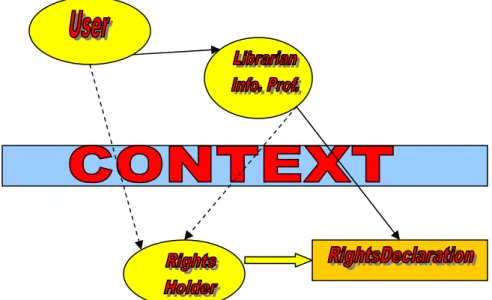
Figure 2 – METSRights Schema in Social Context
The situation most appropriate for METSRights metadata description might be
conceptualized as in Figure 2. Normally, given the usual institutional context of a library, museum, or archive in which the resource is lodged, the user of a (most likely textual) resource will rely upon the librarian or information professional for interpreting copyright and licensing information, as the case may be. The librarian or information professional would keep informed about updated biographical details and contacts concerning the RightsHolder and the RightsDeclaration through such standard library mechanisms as authority files, and ongoing bibliographic research. For sophisticated users, the metadata might also supply sufficient information so that they could themselves contact a
RightsHolder.
revising an electronic journal draft. The frame is relatively fixed, but can become disjointed in response to updates in technology. Here, context is key, but framed more generally by interaction in a library or museum setting, and probably mediated by an information professional.
Open Digital Rights Language Initiative
With ODRL, we move to a full fledged rights management system, with a data dictionary schema in addition to expression language schemas. The introductory brochure advertises ODRL as specifically for digital asset management and e-commerce; thus, ODRL is intended to be especially useful for the business community in the digital age (ODRL). While specifically intended for digital business media in such contexts as education, entertainment, and mobile software delivery, ODRL itself is available without any licensing fee as “open source.”
The W3C note on ODRL (W3C Note 2002) especially emphasizes the need for digital rights management “in open and trusted environments.” It immediately becomes clear, in reading the W3C note, that the authors consider only DRM to have sufficient security and encryption so as to enable such an ideally trusted environment. Another special feature of ODRL is its suitability for digital management, as contrasted with what seems to be more of an emphasis, for METSRights, on managing textually based
resources.
important to note that “ODRL does not enforce or mandate any policies for DRM, but provides the mechanisms to express such policies.” Assets, Rights, and Parties are the three basic entities of ODRL. Parties include both Rights Holders and end users; they also encompass individual humans as well as organizations. These parties are linked via Offers and Agreements.
As with METSRights, ODRL includes a Rights Holder entity. But in ODRL, a Rights Holder can include complex collocations of one or more Parties, who in turn can be associated with multiple Assets; they can also be dependently nested. As evidenced in the examples provided in the ODRL documentation, Rights Holders are conceived as being mostly concerned with receiving adequate payments, royalties, and percentages as Parties in a commercial transaction.
We have already noted the METSRights element of Context defined as
circumstances associated with who has what permissions and constraints. ODRL has a far more complex Context entity, which is in turn a conglomeration of ten other entities including Name, Role, Remark, Version, Date, Event, Physical Location, Digital Location, External Reference, Transaction, Service, and a unique ID. “The Context is used for a number of different purposes and can be associated with any entity.” Thus context is, in this sense, individually defined in terms of either specific parties or in terms of specific transactions taking place; it is indeed a floating frame of reference within the ODRL schema.
author, illustrator, and publisher of an ebook, includes four sets of Context tags, and three sets of Party tags (each with embedded Rightsholder tags).
The relation between the ODRL entities of Party, RightsHolder, and Context can be appreciated by viewing their schemas; thus, as indicated by the plus signs in the diagram included in the ODRL schema documentation (Figure 3), each subentity individually expands.
Figure 3 – ODRL Schema Party taken from Schema ODRL-EX-11.xsd. available at http://www.odrl.net/1.1/ODRL-EX-11-DOC/index.html
property, as can occur in less commercialistic and individualistic societies that emphasize shared community intellectual knowledge.
A recent ODRL working draft (ODRL V2.0 2006) provides further details of rights expression attributes under the Rights entity. Along with the required unique id, there are five possible rights expression types: Statement, Offer, Agreement, Request, and Ticket. The Party entity is defined as a legal entity that is able to enter into rights transactions. A major change with the most recent ODRL version is that no assumptions are made about rights assigned, or not, to different parties. Like two ships passing in the night, the Permission model and the Prohibition model act independently, stating which actions an assignee is permitted, or prohibited, to perform. An obvious result of this system is that the same expression can contain differing Permissions and Prohibitions directives, both of which must hold true.
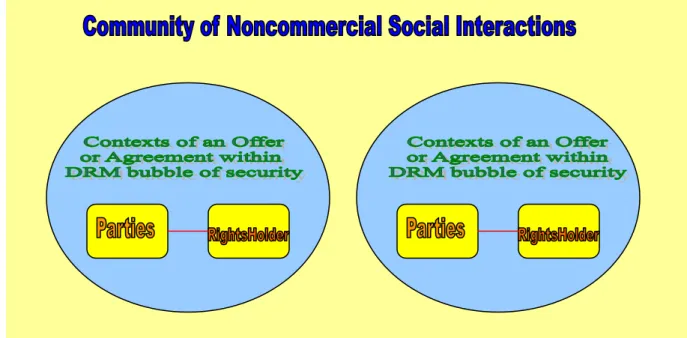
An alternative depiction of ODRL might be as in Figure 4.
Here, DRM security is the key consideration, and the schema presumes many separately coexisting individual transactions between individual Parties and RightsHolders, while outside of these commercially secure transactions, the broader social community of noncommercial interactions is under represented, except to the extent that nonprofits— for example—enter into transactions on the model of the full scale of commercial
security. ODRL presumes, and is directed toward, individualistic and secure commercial transactions between Parties and RightsHolders. While entities involved in transactions can also include communities and entire corporations, the conceptual relationship remains that of an individual transaction. The full range of noncommercial transactions, especially those with more emphasis on knowledge sharing and less emphasis on strict security, remain outside the bounds of this basic dyadic model.
So as to appreciate the difference between ODRL and Creative Commons
licenses, it is useful to visit the ODRL Creative Commons Profile Specification (Lannella 2005). The intention of this profile is to embed Creative Commons semantic expressions within the ODRL rights expression language, so as to allow extra refinements. As the profile notes, the two Creative Commons Permissions of Reproduction and Distribution are common to ODRL licenses as well. What ODRL can add to these user rights are the more specific directives of Play, Display, Execute, and Print permission types.
Creative Commons specification in ODRL would be to designate a negative constraint; for example, a NonCommercialUse constraint.
MPEG-21
With MPEG-21, we move to the greatest level of abstraction, both from the side of digital technologies and from the side of social community. The summary vision statement for MPEG-21, “to define a multimedia framework to enable transparent and augmented use of multimedia resources across a wide range of networks and devices used by different communities” (ISO and IEC 2004), is broad ranging and global in its aspirations. In terms of abstractions, MPEG-21 limits the “what” of the unit of
transaction to a Digital item, and the “who” to any User interacting digitally. MPEG-21 allows for different abstractions of users. Thus, it is possible to distinguish a more specific “End User” from a more general “User” (Table 3). Table 3 – MPEG-21 User Types
User All participants in the value or delivery chain; can include a creator, distributor, consumer, or rights holder
End User User in the role of consumer; situated at the end of a value or delivery chain. Can be a human, or an agent.
A general User, in MPEG-21, is defined purely in terms of interaction with other Users; “Users are identified specifically by their relationship to another User.” Whether the interactive entity be a human individual, a corporation, an entire community, or a national government makes no difference; if that entity is interacting with another equally validly defined interactive User of a digital item, than that entity is a User. MPEG-21 does not distinguish between Users who provide digital content, and Users who consume digital content; indeed, the same entity can simultaneously act as both types of Users. At a more abstract level, any “entity involved in the granting or exercise of rights” is
As with ODRL, we should observe that MPEG-21 presumes an individualistic interactive framework, characteristic of consumer society. Similar to the common western business and legal assumption that a “corporation” can be treated as an
“individual,” MPEG-21 similarly defines all individual “Users” as situated, in terms of their interaction with digital objects, on an isotropic plane. The MPEG-21 rights
expression language operates in terms of specified Grants governing interaction between Users. Each Grant includes a Principal, Right, Resource, and Grant element.
A License in MPEG-21 is “conceptually a container of Grants, each of which conveys to a particular Principal the sanction to exercise some identified Right against some identified Resource, possibly subject to the need for some Condition to be first fulfilled.” An authorization is indicated by a digital signature. While multiple Issuers may provide separate signatures on a License, “no additional semantic is associated with their collective signing” but it is syntactically as if each member of a group had independently signed a License. The purpose of this strategy is to allow an unambiguous syntactical understanding of a specific (singular) Issuer for each given License (DeMartini, Wang, and Wragg 2002, 12). However, a drawback of this strategy is that there is no means, without additional rights management extensions, of providing syntactic XML style conceptualizations of group ownership of a license, where such group ownership is especially salient, as with the instances addressed in Jane Hunter’s critique concerning indigenous knowledge rights.
element. The issuer element allows for such security considerations as a digital signature, or further meta-details about the License.
While the element principal represents the “subject” that carries out an action involving rights, the abstract element “principal” does not identify a specific principal. “Rather, this is carried out in types which are derivations of Principal” (DeMartini, Wang, and Wragg 2002, 31). It is in terms of these derived types that XML rights extensions are possible in MPEG-21, by making use of specific grants within the “license” mechanism.
Similarly, a Right in MPEG-21 is an abstraction that a Principal may receive authorization to effect under the authority of a Grant. The abstract type “right” does not convey the actual action. “Rather, such actions or activities are to be defined in types which are derivations of Right. Such derived types will commonly be defined in extensions to REL” (DeMartini, Wang, and Wragg 2002, 32). So here, too, there is the potential for XML rights extensions.
The MPEG-21 Rights Expression Language model might be conceptualized as in Figure 5.
Figure 5 – MPEG-21 Rights Expression Language Model
For this conceptual exercise, let us introduce another taxonomy on property and property rights that is explicitly intended for organizing abstract concepts in a global context. The latest 2004 edition of the Outline of Cultural Materials is available in XML format, by subscription, via Yale University (Murdock and et al. 2004). An Internet age update and extension of George Peter Murdock’s “Outline of Cultural Materials” that has been successively revised since the first 1938 edition, this taxonomy aims “to organize in readily accessible form the available data on a statistically representative sample of all known cultures—primitive, historical, and contemporary—for the purpose of testing cross-cultural generalizations” (Whiting 1986). Extending Murdock’s subject codes to the electronic age, the eHRAF Collection of Ethnography uses OCM (Outline of Cultural Materials) subject codes to index, by individual paragraph, accumulated ethnographic content covering global cultural belief and practice.
Especially pertinent to issues of intellectual property rights are OCM subcodes 421 through 429, under the broader heading PROPERTY (420). A major dilemma resulting from corporate emphasis on the financial and monetarily quantified quality of intellectual property, we may recollect from Hunter’s critique, is that it emphasizes issues of commercialization even in “indigenous” cultural settings where a focus on
noncommercial communal sharing or pooling of traditional knowledge may be more appropriate. In this respect, an advantage of the OCM “Property” category is that it decouples material wealth from the abstract entity of property.
In the HRAF taxonomy, in terms of interaction between two Principals or Users, one individual’s “right” correlates with the other individual’s “duty,” one individual’s “privilege” correlates with another person’s “no right,” and one individual’s “power” correlates with another party’s “liability.” In this typology, a “type of ownership” simply concerns the social organization of various holders of a title whether they be persons, corporations, or a state. And the entire “property system” will include all kinds of title or property transactions that are recognized by a specific society as measured against culturally defined subject matter classes. Thus, an abstract conceptualization of a “property system” in a strictly jural sense of the term might be conceptualized as in Figure 6.
Figure 6 – Property Rights Interactions in the Human Relations Area Files Taxonomy
and privileges; hence the challenge is to incorporate such entities, as needed, in the MPEG-21 model via XML extensions.
The HRAF classification system also provides a multifaceted taxonomy of not only material, but also immaterial, forms of property. The OCM division between “real property” (423) and “incorporeal property” (424) provides a means of including, under the latter term, ritual categories such as culturally unique songs and dances; this category is especially appropriate for classifying patents and copyrights for ritually salient entities. By contrast, HRAF defines “real property” as fixed and immovable. Similarly, a
classificatory subject division is made between a fixed and instantiated “property system” (421) and a more fluid “property in movables” (422) category, which could also include entities such as titles or ceremonial objects. Under the subclass “inheritance” (428) are included culturally variable constructs of gender and age, which provides scope for distinguishing differences in primogeniture, or variant rules of matrilineal vs. patrilineal systems of property inheritance.
Discussion
encompasses the underlying goals of ODRL and MPEG-21, while Callon’s alternate model viewing overflows as the norm with framing considered unreasonably expensive describes the philosophy behind the Creative Commons license and METSRights.
We also asked whether it is possible to incorporate visual models expressing social and textual choices into the technological design process of metadata schema development. For each of the four main metadata standards considered, it was found possible to create a graphic model representing selected aspects of social interaction. Of these, the figure representing property rights as expressed in the Human Relations Area Files OCM categories provides an especially intriguing parallel to the MPEG-21
expression of a “right,” as the HRAF model includes under that category additional moral and ethical standards such as duties, privileges and liabilities. Comparing the models for ODRL and METSRights, we found two quite distinctive conceptualizations of social context: for ODRL noncommercial and communal social interactions are viewed as external and extraneous to contextual interactions, while in METSRights context serves to mediate different types of interaction between users, informational professionals, and librarians. Modeling also provided new insight into the function of the Creative
Commons license, where the strong emotionally salient resonance placed on the logo linked to the license parallels the global situation of corporate branding of logos, whether in the business or in the individualistic and artistic self-expressive sense of the term.
schemas where it would be especially appropriate to apply XML markup extensions for indigenous rights management. The modeling studies also directed attention to the importance of including social and cultural modeling structures in metadata design schemes not as something supplemental, or external to the scheme itself; but rather as inherent in the entire design process.
Conclusions
Choice of a metadata vocabulary is, in part, a choice of a vision of reality. Or, in the sociological terminology of Callon’s theory of markets, one must frame certain aspects of reality while framing out others. But, as Callon makes clear, things tend to overflow from inside the frame to the outside world, and vice versa. For the various rights expression languages of the Creative Commons, METSRights, ODRL, and MPEG-21 I have attempted to indicate what aspects of society and culture are left out as well as those that are expressed in the respective vocabularies for these schemas. For sophisticated vocabularies such as MPEG-21, XML allows ready extensions to metadata vocabularies. For future drafts of such rights expression languages, it is a useful exercise to construct models for sociological and cultural entities in tandem with the usual
Bibliography
Atkins, Daniel E. and Maurita Peterson Holland. 2002. Issues regarding the application of information technology in indigenous communities. D-Lib Magazine. Accessed 14 July 2006 Electronic. Available from
http://www.dlib.org/dlib/march02/03guest-editorial.html.
Barton, John, Daniel Alexander, Carlos Correa, Ramesh Mashelkar, Gill Samuels, and Sandy Thomas. 2002. Integrating intellectual property rights and development policy: Report of the commission on intellectual property rights. London: Commission on Intellectual Property Rights. Accessed 13 July 2006 Electronic. Available from
http://www.iprcommission.org/graphic/documents/final_report.htm.
Bormans, Jan, Jean Gelissen, and Andrew Perkis. 2003. Mpeg-21: The 21st century multimedia framework. Signal Processing Magazine, IEEE 20, no. 2: 53-62. Brown, Micheal F. 1998. Can culture be copyrighted? (Anthropology and the
Indigenous). Current anthropology 39, no. 2: 223-252.
Callon, Michel. 1998. An essay on framing and overflowing: Economic externalities revisited by sociology. In The laws of the markets, ed. Michel Callon:244-269. Oxford: Blackwell Publishers/The Sociological Review.
________. 1998. Introduction: The embeddedness of economic markets in economics. In The laws of the markets, ed. Michel Callon:1-57. Oxford: Blackwell
Publishers/The Sociological review.
________. 2005. Why virtualism paves the way to political impotence: A reply to Daniel Miller's critique of the laws of the markets. Economic sociology: European electronic newsletter 6, no. 2: 3-20 Accessed 14 July 2006 Electronic. Available from http://econsoc.mpifg.de/archive/esfeb05.pdf.
CIKARD, Center for Indigenous Knowledge for Agriculture and Rural Development at Iowa State University. 2006. Cikard international documentation abstracts; ciesin information cooperative - organizational guide - cikard; indigenous knowledge resource centers. Ames: Iowa State University. Accessed 14 July 2006 2006. Available from http://www.ciesin.org/IC/cikard/docunit.html.
Coyle, Karen. 2004. Rights expression languages: A report for the Library of Congress. Library of Congress. Accessed 12 November 2006. Available from
http://www.loc.gov/standards/relreport.pdf.
Creative Commons. Using creative commons metadata. Accessed 28 November 2006. Available from http://creativecommons.org/technology/usingmarkup.
de Laet, Marianne. 2000. Patents, travel, space: Ethnographic encounters with objects in transit. Environment and planning D: Society and Space 18, no. 2: 149-168. ________. 2002. Patents, knowledge, and technology transfer: On the politics of
DeMartini, Thomas, Xin Wang, and Barney Wragg. 2002. Text of ISO/IEC 21000-5 CD--part 5: Rights expression language. Klagenfurt: International Organization for Standardization. Accessed 30 November 2006 Electronic pdf file. Available from http://xml.coverpages.org/MPEG-REL-CD4942.pdf.
Holland, Maurita and Dan Atkins. 2001. Digital collectives in indigenous cultures and communities meeting. Hilo, Hawaii: National Science Foundation, University of Michigan School of Information, American Indian Higher Education Consortium, Smithsonian National Museum of the American Indian. Accessed 16 July 2006 Electronic. Available from
http://www.si.umich.edu/pep/dc/meeting/background.htm.
Holland, Maurita Peterson. 2002. We come from around the world and share similar visions. D-Lib Magazine 8, no. 1. Accessed 16 July 2006 Electronic. Available from http://www.dlib.org/dlib/march02/holland/03holland.html.
Human Relations Area Files, Inc. 1997-. Ehraf collection of ethnography: A world of cultures at your fingertips. New Haven. Accessed 2006. Electronic.
Hunter, Jane. 2002. Rights markup extensions for the protection of indigenous
knowledge. The Eleventh International World Wide Web Conference, Honolulu, Hawaii, Proceedings. Australia: DSTC, University of Queensland. Accessed 14 July 2006. Available from http://www2002.org/CDROM/alternate/748/.
________. 2005. The role of information technologies in indigenous knowledge management. In Australian indigenous knowledge and libraries, ed. Martin Nakata and Marcia Langton: 113-128. Canberra: Australian Academic & Research Libraries.
Hunter, Jane, Bevan Koopman, and Jane Sledge. September 2002. Software tools for indigenous knowledge management. Museums and the Web 2003. Charlotte: Archives & Museum Informatics. Accessed 14 July 2006. Available from http://www.archimuse.com/mw2003/papers/hunter/hunter.html.
Hunter, Jane, Ronald Schroeter, Bevan Koopman, and Michael Henderson. 2004. Using the semantic grid to build bridges between museums and indigenous
communities. Proceedings of GGF11 Semantic Grid Applications Workshop, Honolulu, Hawaii. Honolulu, Hawaii. Accessed 10 June 2006. Available from http://metadata.net/filmed/pub/GGF11_SemanticGrid.pdf
ISO and IEC. 2004. Information technology--multimedia framework (MPEG-21)--part 1: Vision, technologies and strategy. ISO/IEC TR 21000-1. 2nd. Geneva. Accessed 13 November 2006 Electronic. Available from
http://standards.iso.org/ittf/PubliclyAvailableStandards/c040611_ISO_IEC_TR_2 1000-1_2004(E).zip.
Koopman, Bevan. 2005. Indigenous knowledge management project. DSTC, Smithsonian Institution. Accessed 14 July 2006 Web Page. Available from http://www.metadata.net/ICM/.
Koopman, Bevan Raymond. 2002. Software tools for indigenous knowledge
management. Bachelor of Information Technology Honours Thesis, School of Information Technology and Electrical Engineering. Queensland: University of Queensland. Accessed 14 July 2006. Available from
http://eprint.uq.edu.au.libproxy.lib.unc.edu/archive/00000093/01/koopman.pdf. Langton, Marcia and Zane Ma Rhea. 2005. Traditional indigenous biodiversity-related
knowledge. In Australian indigenous knowledge and libraries, ed. Martin Nakata and Marcia Langton: 47-72. Canberra: Australian Academic & Research
Libraries.
Lannella, Renato. 2005. ODRL Creative Commons profile specification. Accessed 30 November 2006. Available from http://odrl.net/Profiles/CC/SPEC.html.
METS. 2006. Metadata encoding and transmission standard: Primer and reference manual (draft). Accessed 29 November 2006. Available from
http://www.loc.gov/standards/mets/METSDocumentationdraft8.30.pdf. METS News and Announcements. 2006. Draft rights declaration schema is ready for
review. Accessed 28 November 2006. Available from http://www.loc.gov/standards/mets/news080503.html.
Moahi, Kgomotso H. 2004. Copyright in the digital era and some implications for indigenous knowledge. African journal of library, archives and information science 14, no. 1: 14.
Murdock, George Peter and et al. 2004. Outline of cultural materials. 5th edition with modifications 2004. New Haven: Human Relations Area Files. Accessed 15 November 2006 Electronic. Available from
http://www.yale.edu.libproxy.lib.unc.edu/hraf/collections.htm.
National Information Standards Organization. 2004. Understanding metadata. Bethseda: NISO Press. Accessed 14 July 2006. Available from
http://www.niso.org/standards/resources/UnderstandingMetadata.pdf. Nevile, Liddy and Sophie Lissonnet. 2003. Dublin core: The base for an indigenous
culture environment? Papers museums and the web. Toronto: Archives & Museum Informatics. Accessed 16 July 2006 Electronic. Available from http://www.archimuse.com/mw2003/papers/nevile/nevile.html.
ODRL. Open digital rights language brochure. Accessed 28 November 2006. Available from http://odrl.net/docs/ODRL-brochure.pdf.
ODRL V2.0. 2006. Model semantics, working draft. Accessed 28 November 2006. Available from http://odrl.net/2.0/WD-ODRL-Model.html.
School of Australian Indigenous Knowledge Systems--Charles Darwin University. 2005. Indigenous knowledge and resource management in northern Australia
(IKRMNA) - ARC linkage project, software requirement document - Jan 2005. Accessed 28 November 2006. Available from
http://www.cdu.edu.au.libproxy.lib.unc.edu/centres/ik/pdf/TAMI_soft_spec06010 5.pdf.
Sullivan, Robert. 2002. Indigenous cultural and intellectual property rights. D-Lib magazine 8, no. 5. Accessed 16 July 2006 Electronic. Available from http://www.dlib.org/dlib/may02/sullivan/05sullivan.html.
W3C Note. 2002. Open digital rights language (ODRL) version 1.1. Accessed 30 November 2006. Available from http://www.w3.org/TR/odrl/
Whiting, John W. M. 1986. George Peter Murdock, (1897-1985). American Anthropologist 88, no. 3: 682-686.