Social Media and the College Football Audience
____________________________________________________________
Galen Clavio Indiana University
____________________________________________________________
Despite the recent growth of social media as a communication and marketing tool, very little research has been conducted on college athletics audiences and their usage of online tools such as Facebook, Twitter, and YouTube. Data from a survey conducted on an FBS school's football fans were statistically analyzed, with demographic and other data utilized inexamination of traditional and online media usage. The study discovered significant differences in traditional and social media use in relation to demographic factors such as age, income, and alumni status. Media such as Twitter and podcasts tended to be generally unpopular among fans, while a negative relationship existed between Facebook usage and age. Analysis of these and other findings focused on the reasons why certain media might be more popular among certain groups than others, including consideration of the application of Ajzen's (1991) Theory of Planned Behavior to future studies of social media in sport.
Introduction
n under a decade, social media has penetrated nearly every facet of the entertainment culture in the United States, including the collegiate sports landscape. From the creation of Facebook in 2004 and Twitter in 2006 to the present, social media has provided new ways for individuals, athletes, coaches and schools to communicate and share information. Coaches can use Twitter to connect with fans, impress recruits and promote their programs (Watson, 2009). Stalwarts of the NCAA football scene have unexpectedly found themselves trying to
communicate electronically with 18 year olds (O'Neill, 2009).
Social media has provided college athletics with a great opportunity to increase its level of interaction, not just with internal stakeholders but also with fans. In the words of Mississippi State University's athletic director, Scott Stricklin (Barnes, 2011):
"It's hard to miss Twitter and Facebook as communication tools in this day in age, and I think if you're not in spaces where a large number of people are you're really missing out on an opportunity to interact and to have that instant communication" (¶3).
However, it could be argued that college sports as a whole has been remarkably slow in embracing and accepting social media as a tool for marketing, networking and public relations. In several cases, college athletic directors and sports information departments have actively worked to keep social media out of collegiate athletics. For instance, in 2009 the Southeastern
Conference, citing concerns over media exclusivity, attempted to ban all social media from its athletic events (Ostrow, 2009b). Coaches and administrators have considered banning players from social media if the players generate content that could be considered embarrassing to the school (Fittipaldo, 2011; Jovanelly & Burton, 2011).The NCAA even went so far as to ban a blogger from the press box of an tournament baseball game in the early days of social media (Terdiman, 2007).
Despite these struggles, it is becoming increasingly important for college athletic departments to embrace social media. In an age of ever-tightening athletic budgets and increasing diffusion of traditional media audiences, social media provides a comparatively inexpensive personal connection with fans, through services already offered by third parties, such as the aforementioned Facebook, Twitter and others.
In order to effectively embrace social media, college athletics must first strive to understand who in their audience is using social media, how they are using social media, and why they are using social media. This paper attempts to shed light on some of these areas,
through the empirical and theoretical examination of social media use in a college football team's fan base.
Review of Literature
Scholarly inquiry into the antecedents, effects, and general impact of social media on the sport landscape in general is still in its early stages, which has allowed for a variety of
exploratory and introductory approaches to be utilized in that inquiry. It is helpful to begin with a definition of social media, as provided by Kaplan and Haenlein (2010):
"When Web 2.0 represents the ideological and technological foundation, User Generated Content (UGC) can be seen as the sum of all way in which people make use of Social Media...In our view --- and as used herein --- Social Media is a group of Internet-based applications that build on the ideological and technological foundations of Web 2.0, and that allow the creation and exchange of User Generated Content" (P. 61).
The Web 2.0 content referred to in the preceding paragraph refers to the larger concept of a re-imagined Internet where content is continually modified by a succession of users, rather than managed by individuals or corporate interests and consumed as such (Kaplan & Haenlein, 2010; O'Reilly, 2005; O'Reilly & Battelle, 2009). The concept of User Generated Content (UGC) focuses on the ability of individuals to construct their own Internet content and share it with others, primarily in a framework where all such content is relatively equal among users and accounts (such as Twitter or Facebook). It is important to note under this definition that team websites, although a part of the "New Media" which has seen traditional content enter the digital realm, would not be considered social media because of the lack of UGC or Web 2.0 concepts. Previous literature on sport-related social media has tended to focus on two primary areas of inquiry; namely, content-based inquiry and audience-based inquiry, although some studies (e.g., Sanderson, 2011) have pointed to a melding of those two areas.
Content-based Inquiry
Content-based inquiry focuses primarily on the messages generated by teams, athletes, and opinion drivers, such as sport media. Sport-focused social media studies examining this area tend to utilize content analysis methodology, although some other measures have been utilized.
Cooper and Pierce (2011) examined NCAA athletic departments' usage of their websites for coverage provided to sports teams across divisional and gender lines. The study discovered a series of inequities in terms of self-provided coverage of men's and women's teams at the FBS and FCS levels, as well as greater coverage provided to traditional men's revenue sports such as basketball and football at the FBS and FCS levels. Only the smaller Division III athletic
department websites appeared to provide equal coverage regardless of gender and revenue. In a study of National Football League teams' usage of Facebook and websites to engage fans, Waters, Burke, Jackson, and Buning (2011) found that teams tended to focus a greater degree of their engagement efforts on their official websites. The study, which examined social media from a public relations and stewardship perspective, found that in the defined areas of reciprocity, responsibility, reporting, and relationship nurturing, the official website scored significantly higher in all areas, with the difference being smallest in the category of relationship nurturing.
Another investigation of sport and social media, by Hambrick, Simmons, Greenhalgh, and Greenwell (2010), focused on the usage of the social medium Twitter by professional athletes. The study examined the content of tweets sent by a variety of professional athletes, and placed those tweets in one of six categories: content, diversion, fanship, information sharing, interactivity and promotion. Analysis revealed that interactivity and diversion were the leading elements of Twitter usage among professional athletes, accounting for 62% of the tweets examined. Promotional tweets accounted for only 5% of the total.
Audience-based Inquiry
Audience-based scholarly inquiry into sport and social media has tended to focus on the characteristics, demographics, uses, gratifications, and factors influencing consumption of and interaction with social media. Clavio (2008a) examined the demographic characteristics of college sport fans who had gathered on independent message boards to discuss their teams. The study found that fans were predominately male, White, highly-educated and affluent, with 42% of respondents making more than $100,000 in household income per year. Among other
findings, the study revealed that the most salient usage of message boards among college sport fans related to the gathering of unique information.
A study by Ruihley and Hardin (2011) examined online fantasy sport participants and their usage of message boards from a uses and gratifications perspective. Through a survey of 322 fantasy sport users, the survey revealed that the sample was primarily male, White, and with an average household income over $70,000. Through open-ended question analysis, the study revealed four primary themes for message board use: logistical conversation, socializing, surveillance, and advice/opinion. The study's conclusions pointed towards message boards and online socializing helping fantasy sports increase involvement (through promotion), free and community-accepted content, and increases in stickiness, or channel adherence. for the fantasy sport property.
In a study comparing traditional and social media messages, Sanderson (2011) utilized textual analysis and framing theory to examine the different reactions to the public scandals surrounding golfer Tiger Woods during 2009 and 2010. The study revealed social media as a potential salve to negative framing from traditional media, with Facebook users rushing to the defense of Woods and defending him through a variety of explanations and efforts. The findings pointed towards a potential parasocial relationship between audience and athlete, and highlighted the possible public relations benefits of effective social media usage.
Much of the audience-focused analysis of social media has its roots in uses and
gratifications theory (Katz, Blumler, & Gurevitch, 1974). This theory approaches media use from an active and goal-directed perspective, assuming that users make choices about which media they select based upon how those media satisfy their needs and desires. The theory also assumes that there are different media to choose from, and that users are capable of evaluating these choices.
Clavio and Kian (2010) examined the users of a retired athlete's Twitter feed from a uses and gratifications perspective. Demographic data from these users found them to be slightly older than other studies in this vein, with a media age of 40-49. However, the audience was still predominately White, affluent and well-educated. The most salient reasons for following the athlete on Twitter dealt with information-based purposes (e.g., "I enjoy reading what the athlete writes"). A factor analysis uncovered three dimensions of gratification. One dimension focused primarily on fandom based on the athlete's personal aspects, such as being a role model or having closely followed the athlete's career. The second dimension focused on non-personal elements of fandom, such as following the athlete for business purposes. The third dimension focused on the interactive elements of Twitter, both with the athlete and with fellow fans.
Content-Audience Melding and Other Significant Literature
As noted in Kaplan and Haenlein (2010) and in many of the above studies, the social media process presents a fundamental alteration of the way users consider and consume media. Whereas traditional media had limited senders and mass audiences, the social media landscape presents the user with many senders, each of whom provides a unique perspective. McCarthy (2011), in an examination of UGC platforms in a sport setting, notes the following:
"...fans have embraced nascent platforms for user-generated content and tailored them to perform specific individual functions. The mainstream media have been unable to provide these functions in their coverage of gymnastics for reasons of time, space, and more important, profit...These platforms provide a space for fans with niche interests, which allows for a greater breadth of content while also providing a greater specificity of information within that space" (p. 280).
A study by Sheffer and Schultz (2010), which examined social media content among a group of sports journalists, found that these individuals tended to use Twitter for relaying their own opinions and commentary, rather than promote their work cross-platform or post breaking news. In other words, sports journalists were utilizing their role as users to generate original content, independent from their content as media producers. These findings stood in contrast to an earlier study by Schultz and Sheffer (2010), which surveyed sports journalists about their usage of Twitter. The survey data indicated that journalists self-reported usage of Twitter for the
purposes of cross-platform promotion of content and the breaking of news, which was the opposite of what was found in the content analysis present in Sheffer and Schultz (2010). A similar divergence of survey self-reporting and content analysis results as found in Sheffer and Schultz's (2009) study of blogging among journalists. The important thing to take from these studies collectively is that social media promotes a different kind of media usage than is present in the traditional media sphere.
Also of note in Schultz and Sheffer (2010) was the discovery that older journalists were more likely than younger journalists to self-identify use of Twitter primarily as a promotional tool for existing work on other platforms (such as on traditional newspaper websites), while younger journalists indicated their feelings that Twitter had merit as its own medium. This phenomenon could be partially explained by the Theory of Planned Behavior, or TPB (Ajzen, 1991). At its basic level, this theory postulates that the level of behavioral control a person has, when combined with their actionable intentions, can predict what behaviors they actually engage in. Behavioral control can be further explained as an operational grasp on a particular behavior. In the case of this study, this could be interpreted as self-awareness of one's ability (or lack thereof) to utilize particular types of media. Furthermore, according to TPB, these elements of behavior are influenced by subjective norms within a particular culture. If a behavior is
considered normal within a group, it is generally more likely that an individual will engage in it. Younger journalists would almost certainly be more versed in, and culturally comfortable with, Twitter as a medium than would older journalists.
Purpose of the Study
The purpose of this study is to examine the utilization of new and traditional media by fans of a college football team, and to examine differences between the various media used. With these goals in mind, the following research questions were devised:
RQ1: What are the demographic characteristics of this sample of college football fans?
RQ2: Do any demographic variables have a significant impact on the consumption of traditional media (i.e., newspapers, talk radio, team website)?
RQ3: Do any demographic variables have a significant impact on the consumption of social and new media (i.e., Facebook, Twitter, YouTube)?
Methodology
This study analyzed data collected through an online survey performed by the athletic department of a large FBS-division public university in the Midwest just prior to the start of the 2010 football season. The survey was sent out by the athletic department to its football ticket buyers through email, and a link was also posted on the department website. The bulk of the survey was devoted to collecting marketing and promotions-focused data; however, a section of the survey focused on traditional and social media usage.
The examination of this type of data set holds some advantages over more traditional methods of social media inquiry. In prior cases (e.g, Clavio & Kian, 2010; Ruihley & Hardin, 2011), the group surveyed was accessed through a social medium, a process which obviously
ignores individuals who do not utilize those media. By contrast, the data in this survey was collected via email and a web link, neither of which are classified as social media. This provides a broader look at a population of individuals, some of whom are outside the normal sphere of social media users.
Due to the nature of the survey and the online method by which the data were obtained, the sample analyzed must be classified as a convenience sample. The nature of online audiences, coupled with the inability of the survey instrument to reach the entire population of football fans, means that the results can only be generalized to the sample itself, rather than to college football fans as a whole.
The survey asked several demographic questions, including the respondent's age, income level, alumni status, number of games attended, and other similar items. In addition to asking questions relating to audience perception of marketing and promotional efforts, the survey inquired as to how often the individual visited the departmental website, used newspapers or talk radio to acquire information on the team, and used message boards to discuss the team. All of these questions were asked on a 5-point Likert-type scale, with 1 indicating "never" and 5 indicating "Several times a day". Respondents were also asked with what frequency they used various forms of new media communication, such as Facebook, Twitter, Podcasts, and YouTube, and responses occurred on the same 5-point scale as used above.
As noted in the literature review, a delineation exists between social media sites, which promote UGC and interactivity among users, and other types of new media (Kaplan & Haenlein, 2010). While the team website is not strictly a traditional media site, it is closer in nature to media such as newspapers and talk radio than it is to social media outlets such as Facebook and Twitter, due primarily to the team website's lack of user modification and UGC, as well as the content control for primarily commercial purposes. Based on these tenets of social media, the team's website was included in the "traditional" media category for the purposes of this study, due to the lack of interactivity of these sites and the greater connectedness that social media sites provide (Ostrow, 2009a).
Following acquisition, the data were cleaned and imported into SPSS 18 for review and analysis. Initially, frequency analyses were used to examine the data, followed by a series of statistical analyses, including t-tests, ANOVA, and other appropriate means of data analysis.
Results
The results of the survey yielded a total of 2,469 usable responses. Following the cleaning of the data set, a series of frequency analyses were performed, to analyze the demographic characteristics of the respondents, as called for in RQ1.
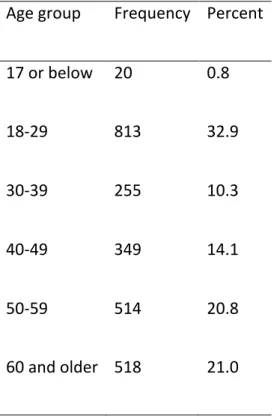
In terms of age, a plurality of respondents identified themselves as 18-29 years old (813, 32.9%), while a majority of respondents were 40 and older (1381, 55.9%). Full results from the age analysis may be found in Table 1.
Table 1 -‐ Age of survey respondents
Age group Frequency Percent
17 or below 20 0.8 18-‐29 813 32.9 30-‐39 255 10.3 40-‐49 349 14.1 50-‐59 514 20.8 60 and older 518 21.0
Respondents were asked if they were an alumnus of the school. A total of 56.6% (1,399) said that they were indeed alumni of the school, while 42.4% (1,047) indicated that they were not. Also asked was whether the respondent was a season ticket holder of the school. A majority (1,741, 70.5%) identified themselves as season ticket holders, while 698 (28.3%) indicated they were not.
In terms of household income, the largest group of respondents identified their average income as between $100,000 - $199,999 per year (742, 30%), with a majority identifying a household income of $80,000 or more. A full breakdown of household income by respondent is available in Table 2.
Table 2 -‐ Income of survey respondents
Age group Frequency Percent
$19k or less 276 11.2 $20k -‐ $39,999 145 5.9 $40k -‐ $59,999 212 8.6 $60k -‐ $79,999 265 10.7 $80k -‐ $99,999 321 13.0 $100k -‐ $199,999 742 30.0 $200,000 + 342 13.8
In order to examine whether any significant differences existed between groups in relation to traditional and social media usage, ANOVA and t-tests were utilized. In analyses involving age, the youngest group (17 and younger) was not utilized, due to the small size of the group potentially skewing the statistical output.
RQ2 asked whether any demographic variables had a significant impact on the consumption of traditional media among the college football fans in this sample. The first variable examined was that of age. A series of ANOVAs were run on the three "traditional" media, and significant differences were found in relation to age and newspaper usage [F(4, 2363) = 47.294, p < .000], talk radio [F(4, 2364) = 33.596, p < .000], and team website [F(4, 2363) = 7.827, p < .000]. Table 3 highlights the mean scores for these three traditional media by age group, while Figure 1 indicates these scores in graphical format.
Table 3 -‐ Means of traditional media usage Age group Newspapers Talk Radio Website
18-‐29 2.66 (1.01)* 1.58 (.88)* 2.12 (.99)bcd
30-‐39 3.07 (1.00)ae 2.2 (1.06)ae 2.46 (.91)ae
40-‐49 3.04 (.98)ae 2.09 (.95)a 2.31 (.85)a
50-‐59 3.11(.96)ae 2.04 (1.01)a 2.29 (.93)a
60+ 3.39 (.83)* 1.97 (.96)ab 2.25 (.94)b
Note: ap < .05 (significant when compared to 18-29 group); bp < .05 (significant when compared to 30-39 group); cp < .05 (significant when compared to 40-49 group); dp < .05 (significant when compared to 50-59 group); ep < .05 (significant when compared to 60 and older group); * (significant across all other groups)
Figure 1 -‐ Age responses to traditional media
Bonferroni post hoc tests uncovered numerous statistically significant differences within each of the analyses. Table 3 indicates those differences; several involve differences between the youngest group and the older groups.
RQ3 asked whether any demographic variables had a significant impact on the
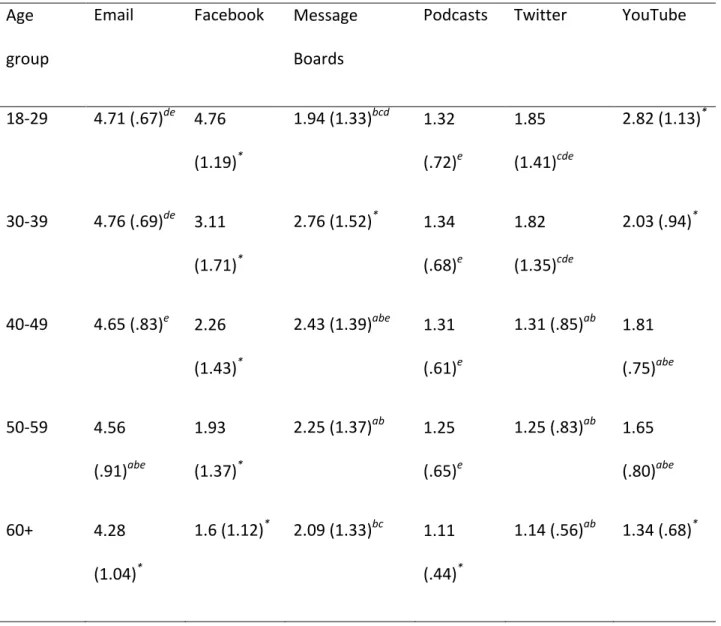
consumption of social and new media among the college football fans in this sample. Again, the first variable examined was age, and a series of ANOVAs found significant differences in relation to this variable and email use [F(4, 2362) = 24.234, p < .000], Facebook use [F(4, 2279) = 409.897, p < .000], message board use [F(4, 2357) = 20.842, p < .000], podcast use [F(4, 2242) = 9.310, p < .000], Twitter use [F(4, 2240) = 45.979, p < .000], and YouTube use [F(4, 2258) = 231.918, p < .000]. Table 4 highlights the mean scores for each age group in relation to these new and social media in tabular format, while Figure 2 illustrates the trends for each media type. Table 4 also denotes the significant differences between groups, as illustrated through Bonferroni post hoc tests.
Table 4 -‐ Means of new/social media usage
Age group
Email Facebook Message
Boards
Podcasts Twitter YouTube
18-‐29 4.71 (.67)de 4.76 (1.19)* 1.94 (1.33)bcd 1.32 (.72)e 1.85 (1.41)cde 2.82 (1.13)* 30-‐39 4.76 (.69)de 3.11 (1.71)* 2.76 (1.52)* 1.34 (.68)e 1.82 (1.35)cde 2.03 (.94)* 40-‐49 4.65 (.83)e 2.26 (1.43)* 2.43 (1.39)abe 1.31 (.61)e 1.31 (.85)ab 1.81 (.75)abe 50-‐59 4.56 (.91)abe 1.93 (1.37)* 2.25 (1.37)ab 1.25 (.65)e 1.25 (.83)ab 1.65 (.80)abe 60+ 4.28 (1.04)* 1.6 (1.12)* 2.09 (1.33)bc 1.11 (.44)* 1.14 (.56)ab 1.34 (.68)*
Note: ap < .05 (significant when compared to 18-29 group); bp < .05 (significant when compared to 30-39 group); cp < .05 (significant when compared to 40-49 group); dp < .05 (significant when compared to 50-59 group); ep < .05 (significant when compared to 60 and older group); * (significant across all other groups)
Figure 2 -‐ Age responses to new/social media
Other demographic variables were also examined in relation to new and social media usage. One such variable was income, which was re-coded into quintiles for the purposes of statistical analysis. While ANOVA revealed significant differences with all new and social media types except podcasts, three of the social media had notable differences. ANOVA revealed significant differences within income for Facebook usage, F(4, 2156) = 60.270, p < .000, with Bonferroni post hoc tests indicating significant differences between the lowest income group ($39,000 or less; M = 3.94, SD = 1.48) and all other groups, as well as significant
differences between the more than $200,000 group (M = 2.26, SD = 1.56) and all groups except the $100,000 - $199,999 (M = 2.52, SD = 1.64) group.
ANOVA also uncovered differences within income for Twitter usage, F(4, 2119) = 10.200, p < .000, with Bonferroni post hoc tests indicating significant differences between the $100,000 - $199,999 (M = 1.37, SD = .97) group and the lowest two groups ($39,999 or less, M = 1.75, SD = 1.35; $40,000 - $79,999, M = 1.61, SD = 1.23), and between the more than
$200,000 (M = 1.33, SD = .90) group and the lowest two groups. Finally, ANOVA indicated significant difference within income for YouTube usage, F(4, 2136) = 46.373, p < .000, with post hoc tests indicating significant differences between the $39,999 or less (M = 2.69, SD = 1.22) group and all other groups, with the $100,00 - $199,999 group yielding the lowest mean score (M = 1.82, SD = .93).
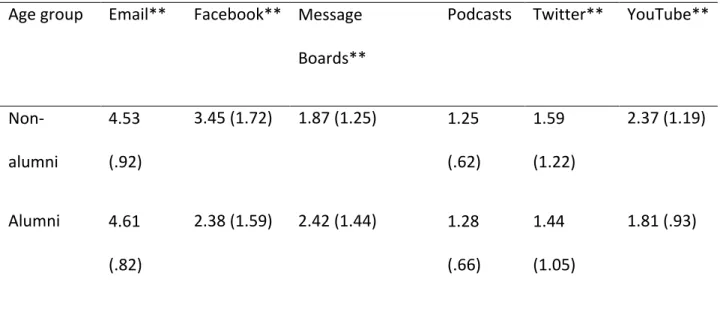
The final demographic variable examined was alumni status. Independent-samples t-tests were utilized to examine this dichotomous variable as it related to media use. Table 5 highlights the means, standard deviations, and significance level of the six new and social media measures. The t-tests uncovered significant differences in variance for five of the six, with the notable items
being Facebook usage [t(2285) = 15.238, p < .000], message board usage [t(2365) = -9.721, p < .000] and YouTube usage [t(2264) = 12.532, p < .000].
Table 5 -‐ Means, standard deviations, and t-test significance for alumni status
Age group Email** Facebook** Message
Boards**
Podcasts Twitter** YouTube**
Non-‐ alumni 4.53 (.92) 3.45 (1.72) 1.87 (1.25) 1.25 (.62) 1.59 (1.22) 2.37 (1.19) Alumni 4.61 (.82) 2.38 (1.59) 2.42 (1.44) 1.28 (.66) 1.44 (1.05) 1.81 (.93)
Note: SD included in (parentheses); ** = difference significant at .001 level
Discussion
The results from the data set analysis shed light on some interesting aspects of the college football audience. The statistical analyses demonstrate some surprising differences between groups across several variables.
Research question one asked what were the demographic characteristics of this data set of college football fans. As was found in Clavio (2008a)'s study of college sport message board users and Ruihley and Hardin's (2011) study of fantasy sport gamers, respondents were found to primarily be affluent, with over 56% of users reporting a household income of $80,000 or more. Also similar to Clavio's (2008a) demographic findings, the sample tended to be older, with a majority of respondents over 40 years of age. In light of these prior findings, the results from the present study are not surprising, although this study did contain a larger proportion of younger fans than had been seen in earlier research.
Research question two asked whether any demographic variables had a significant impact on the consumption of traditional media among this sample. As noted in the results, analysis indicated that age did have a significant impact on the usage of traditional media. Primarily, this impact appeared to occur with the youngest age group examined, the 18-29 group. These fans tended to read the newspaper less, listen to sports talk radio less, and use the football team's official website less than their older counterparts. Newspaper use tended to rise consistently with age, while website use was relatively consistent across groups in terms of mean size. The lack of consistent usage of the team website may be viewed with concern by college athletics marketers and public relations workers, particularly if they are following the patterns noted by Waters et al (2011) in terms of utilizing the official website for engagement and stewardship. While these efforts may be reaching older fans, it is possible the younger fans are not being engaged due to a
lack of participation in the website.
The lack of use of sports talk radio was somewhat surprising, particularly with the 30-39 group listening to it the most, but the youngest group listening to it the least, even less than the oldest group. This could indicate a shift of sorts in the importance of sports talk radio as a conduit for communication and interactivity related to collegiate sports, with younger fans not feeling as engaged by the medium as their older counterparts.
Research question three asked whether any demographic variables had a significant on the consumption of new and social media among this sample. The results uncovered several interesting and significant differences between groups.
First, regarding the variable of age, a number of differences appeared in all six new and social media. Particularly interesting were the contrasts between these media. For instance, email usage, which is considered distinct from social media (WebGuild, 2011), enjoys a high level of usage across all age groups surveyed, and while there were significant differences between these groups, the mean scores indicate that all age groups are checking email at least once a day, if not more. By contrast, Facebook use outstripped email use among 18-29 year olds, yet demonstrated a linear negative relationship through the age groups, dropping over three points on a five-point usage scale from youngest group to oldest group.
One might expect the other social media to demonstrate similar usage patterns, but the actual story is somewhat less clear. Similar to what was found with talk radio, message boards are more prevalent among the groups 30-39 and older than among the 18-29 group. This could possibly be due to the relative age of message boards, which have existed as a function of Internet usage for nearly as long as websites (Clavio, 2008b). However, this could also be due to the functions of the most popular forms of social media (i.e., Facebook, Twitter) overlapping with traditional message boards in the sport setting. While message boards have been considered by some to be prime, yet forgotten, social media real estate (Hawkins, 2010), the community and interactive aspects of message boards may have been supplanted by newer technology in the eyes of the younger audience, who was not forced to rely on them for sport-related Internet
community interaction, unlike their older counterparts. These findings are somewhat borne out by the findings from alumni status analysis; alumni of the program were significantly more likely to utilize message boards than were non-alumni. It is possible that alumni are more likely to seek out online communities specifically designed to foster interaction between themselves and fellow alumni, while that communal experience is not as important for non-alumni.
Two media in particular appeared to suffer from a lack of penetration into the examined sample of college football fans, at least from an age perspective. Podcasts appeared to be
unpopular regardless of age. This is somewhat surprising because the podcast medium appeared to be poised for a tremendous amount of growth as of mid-2008, when research indicated that almost 20% of users had downloaded a podcast at some point, a number that had gone up almost twelve percentage points in two years (Madden, 2008). Even more surprising were the low mean scores for Twitter, which barely paced podcast usage among the older three age groups and failed to approach the popularity of Facebook among the youngest two groups. These findings indicate that college athletic programs might want to be cautious about pouring too many resources into Twitter without first educating and encouraging its use among fans.
The final social media examined in regards to age was YouTube, and this variable demonstrated a similar negative linear pattern, with the youngest group claiming the greatest level of usage. Interestingly, YouTube was the second most popular social media, trailing only Facebook in peak mean scores. College athletic departments may want to consider expanding
their use of this medium, as it appears to demonstrate greater potential as a marketing and public relations tool among all age groups save the oldest one. The primary arguments in favor of expanding YouTube use are threefold - first, there is an obvious level of awareness across most demographic groups, including age. Second, natively hosting and uploading video can be technically prohibitive, whereas the YouTube platform uses a flash video codec system that is easily accessible and generally failsafe. And third, YouTube allows for embedding of content on third-party web pages, including the web pages of college athletic departments. This allows for the athletic department to maintain the benefits of YouTube-based video without the negative impact of redirecting users away from the organization's web page.
One possible explanation for the observed differences in both traditional and social media use could lie in a lack of confidence on the part of users in their abilities to utilize specific media. The Theory of Planned Behavior (TPB), as noted in the literature review, may help to shed further light on this phenomenon. The aforementioned Schultz and Sheffer (2010) study featured a split in Twitter usage between younger and older members of the same profession.
Interpreting the data in the present study though the lens of TPB brings the results into a bit more focus. While social media audiences doubled among those age 50 and older during the time period when this study's data was collected (Pew Internet, 2010), the level of comfort with the actual utilization of social media among older audiences is almost certainly less than of younger audiences. Examining a new medium such as email, which has been around in some form for nearly two decades, and comparing its mean scores with those of newer social media such as Facebook and YouTube, illustrates this point.
Even a medium such as sport message boards is worth examining in this context. Clavio's (2008a) study of the demographics of collegiate sport message boards found that the majority of users were over the age of 30, with a sizeable number of users over the age of 50. While the medium of message boards are certainly social in nature, they are hardly "new", as Internet-based discussion forums date back to the earliest days of the Internet. These findings would seem to indicate that older college football audiences are not necessarily technology-averse, so much as they are unfamiliar with media that is newer to them.
In a similar vein, younger college football audiences are obviously technologically oriented, but primarily towards media they are already engaged in. It is possible that these younger audiences either feel uncomfortable with their ability to operate within other types of media (such as talk radio), or that perceived generational norms regard message boards as unimportant or redundant with already existing technology (such as Facebook).
In examining the other demographic variables present in this study, it is interesting to note that non-alumni indicated higher utilization of most social media than did alumni. This is likely due to the large number of 18-29 year olds in the non-alumni group, making it younger than the alumni group overall. Whether these non-alumni are current students of the university or are simply young fans with no university affiliation is unclear, and future studies should consider examining whether younger fans who are not school alumni are being drawn to college athletic teams from a fan perspective.
The findings of this study point to a need for college athletic departments to properly leverage both traditional and social media in both communication and marketing campaigns. There is an obvious split in the fan base of the examined football team, and it would be poor business practice to simply wait for the passage of time to mend that split. Cross-promotion of different communication and marketing efforts across multiple media may well be the answer to these needs. Aside from the benefits of educating the fan base on the benefits of utilizing social
media as mentioned earlier in this section, a consistent pattern of integrating less-popular media types (such as Twitter and podcasts) with known popular media types (such as Facebook and YouTube) should yield a fan base more comfortable with the various media options at their disposal. This would provide athletic departments with a wider array of options through which to deliver their messages, while also allowing the messages to be utilized in media which bring out the best elements therein.
Conclusion
The findings of this study shed light on traditional and social media utilization among college football fans. Demographics revealed a fan sample that was primarily older and affluent, with a sizeable minority of respondents indicating they are not alumni of the school. Statistical analysis revealed that older college football fans tend to consume traditional media at greater levels than younger fans, while the reverse was true in terms of some social media. Certain forms of social media (i.e., Facebook) appeared more popular than others, while the message board medium did not appear to resonate with the youngest demographic.
This study does have some limitations. First, the data set analyzed only focused on the fans of one FBS football team, and therefore cannot statistically be generalized beyond that population. Second, the data set focused primarily on general usage of new and social media, rather than usage concentrated specifically on the football team. Finally, because it was a survey distributed through non-social media, the sample doubtless contains individuals who are not regular users of social media. While this does have some scientific benefits, as noted in the methodology section, it also creates limitations.
Future studies should examine a larger cross-section of college football fans, preferably from differing geographical areas and from teams achieving different levels of financial and on-field success. Using this study as a beginning point, it would be edifying to observe the
differences in new and social media use, both in above terms and over time. Researchers would also do well to survey fans of other sports within the collegiate athletic landscape, specifically concentrating on how new and social media resonates with fans of non-revenue sports, women's sports, and athletics participating in lower divisions. Finally, further research should be done on exploring the possible link between TPB and social media usage among college sports fans.
References
Ajzen, I. (1991). The theory of planned behavior. Organizational Behavior and Human Decision Processes, 50, 179-211.
Barnes, J. (2011, July 1). Social media is changing college athletics. WCBI.com. Retrieved September 22, 2011 from
http://www.wcbi.com/article.php?subaction=showfull&id=1309555817&archive=&start_ from=&ucat=2&
Clavio, G. (2008a). Demographics and usage profiles of users of college sport message boards. International Journal of Sport Communication, 1(4), 434-443.
Clavio, G. (2008b). Uses and gratifications of Internet collegiate sport message board users. Dissertation Abstracts International, 69(8). Retrieved September 22, 2011, from ProQuest Digital Dissertations database (Publication No. AAT 3319833)
Clavio, G., & Kian, E.M. (2010). Uses and gratifications of a retired female athlete's Twitter followers. International Journal of Sport Communciation, 3(4), 485-500.
Cooper, C.G. & Pierce, D.A. (2011). The role of divisional affiliation in athletic department web site coverage. International Journal of Sport Communication, 4(1), 70-81.
Fittipaldo, R. (2011, May 16). Social media and sports a growing dilemma. Pittsburgh Post- Gazette. Retrieved September 22, 2011 from
http://www.post-gazette.com/pg/11136/1146848-66-0.stm
Hambrick, M.E., Simmons, J.M., Greenhalgh, G.P., & Greenwell, T.C. (2011). Understanding professional athletes' use of Twitter: A content analysis of athlete tweets. International Journal of Sport Communication, 3(4), 454-471.
Hawkins, D. (2010, June 16). Message boards: The overlooked piece of social media real estate. socialmediatoday. Retrieved September 22, 2011 from
http://socialmediatoday.com/index.php?q=SMC/207552
Jovanelly, J. & Burton, N. (2011, February 23). Social media part of 21st century college sports. Daily Trojan. Retrieved September 22, 2011 at http://dailytrojan.com/2011/02/23/social- media- part-of-21st-century-college-sports/
Kaplan, A.M. & Haenlein, M. (2010). Users of the world, unite! The challenges and opportunities of Social Media. Business Horizons, 53, 59-68.
Katz, E., Blumler, J.G., & Gurevitch, M. (1974). Utilization of mass communication by the individual. In J.G. Blumler & E. Katz (Eds.), Uses of mass communications (Vol. III) (pp. 19-32). Beverly Hills, CA: Sage Publications.
Madden, M. (2008, August 28). Podcasts proliferate, but not mainstream. Pew Research. Retrieved September 22, 2011 from
http://pewresearch.org/pubs/941/podcasts-proliferate-but-not-mainstream
McCarthy, B. (2011). From Shanfan to Gymnastike: How online fan texts are affecting access to gymnastics media coverage. International Journal of Sport Communication, 4(3), 265-283.
O'Neil, D. (2009, July 7). Defining the different shades of gray. ESPN.com. Retrieved September 22, 2011 at
http://sports.espn.go.com/ncaa/columns/story?columnist=oneil_dana&id=4309373 O'Reilly, T. (2005, September 30). What is Web 2.0. O'Reilly. Retrieved September 22, 2011 at
http://oreilly.com/web2/archive/what-is-web-20.html
O'Reilly, T. & Battelle, J. (2009). Web squared: Web 2.0 five years on. Web 2.0 Summit. Retrieved September 22, 2011 from
http://www.web2summit.com/web2009/public/schedule/detail/10194
Ostrow, A. (2009a, May 25). Is social media making corporate websites irrelevant?
Mashable.com. Retrieved September 22, 2011 from
http://mashable.com/2009/05/25/vitamin-water-kobe-vs-lebron/
Ostrow, A. (2009b, August 17). Social media banned from college stadiums. Mashable.com. Retrieved September 22, 2011 at http://mashable.com/2009/08/17/sec-new-media-policy/ Pew Internet (2010). Older adults and social media. Retrieved September 22, 2011 from
http://pewinternet.org/~/media//Files/Reports/2010/Pew%20Internet%20- %20Older%20Adults%20and%20Social%20Media.pdf
Ruihley, B.J. & Hardin, R.L. (2011). Message boards and the fantasy sport experience. International Journal of Sport Communication, 4(2), 233-252.
Sanderson, J. (2011). Framing Tiger's troubles: Comparing traditional and social media. International Journal of Sport Communication, 3(4), 438-453.
Schultz, B. & Sheffer, M.L. (2010). An exploratory study of how Twitter is affecting sports journalism. International Journal of Sport Communication, 3(2), 226-239.
Sheffer, M.L. & Schultz, B. (2009). Are blogs changing the news values of newspaper reporters?
Web Journal of Mass Communication Research, 16(July). Retrieved September 22, 2011
from http://wjmcr.org/vol16
Sheffer, M.L. & Schultz, B. (2010). Paradigm shift or passing fad? Twitter and sports journalism. International Journal of Sport Communication, 3(4), 472-484.
Terdiman, D. (2007, June 11). Blogger removed from NCAA baseball game for blogging. cNet. Retrieved September 22, 2011 at http://news.cnet.com/8301-10784_3-9728156-7.html Waters, R.D., Burke, K.A., Jackson, Z.H., & Buning, J.D., (2011). Using stewardship to cultivate
fandom online: Comparing how National Football League teams use their web sites and Facebook to engage their fans. International Journal of Sport Communication, 4(2), 163-177
Watson, G. (2009, July 6). Coaches, college explore new frontier. ESPN.com. Retrieved September 22, 2011 from http://sports.espn.go.com/ncaa/news/story?id=4308218 Webguild. (2011, March 3). Social media is not killing Email. Retrieved September 22, 2011