www.ijte.net
A Five-year Reflection on Ways in
Which
the
Integration
of
Mobile
Computing
Technology
Influences
Classroom Instruction
Jason T. Hilton1, Joseph Canciello2 1
Slippery Rock University, USA 2Union Area School District, USA
To cite this article:
Hilton, J.T. & Canciello, J. (2018). A five-year reflection on ways in which the integration of
mobile computing technology influences classroom instruction.
International Journal of
Technology in Education (IJTE), 1(1), 1-11.
Volume 1, Issue 1, Fall 2018
ISSN: 2689-2758
A Five-year Reflection on Ways in Which the Integration of Mobile
Computing Technology Influences Classroom Instruction
Jason T. Hilton, Joseph Canciello
Abstract
As one-to-one technology integration with mobile computing technology (MCT) becomes increasingly popular, it is important to examine ways in which such integration can influence classroom instruction. This study explores a five-year period of MCT integration in a small suburban school district, using both survey and focus group interviews. The findings indicate a positive change in classroom instruction and greater alignment to 21st century learning, but gaps persist in the frequency and depth of technology use. Gaps relate to teacher beliefs about ways in which students make use of MCT. The results include suggestions for supporting enhanced technology use among teachers.
Keywords: Mobile computing technology, SAMR, Technology integration, Chromebooks, IPad, One-to-one.
Introduction
As one-to-one technology initiatives become increasingly popular, it is important to think about the impact these initiatives can have on classroom instruction. Typically, one-to-one technology initiatives make use of mobile computing technology (MCT), which is readily accessible computing technology that is smaller than a desktop or laptop computer, such as an iPad, Chromebook, or a Smartphone (Keengwe & Bhatgava, 2014). One-to-one integration is an expensive, both with the financial costs of the devices and system infrastructure, and with the time required for teachers to fully incorporate new devices into their classrooms. These costs are especially salient in smaller districts, where budgets are smaller, but the fixed costs of running brick and mortar schools remain high. However, the benefits of increased student access, engagement, and enhanced communication can make such an investment an effective way to enhance classroom instruction.
This study investigates the integration of MCT within a small school district, seeking to answer a call for, “future research [to] consider the relational use of technology in view of teachers‟ pedagogical beliefs and school cultures…” (Tondeur, van Braak, Ertmer, & Ottenbreit-Leftwich, 2016, p. 573). To accomplish this, a mixed-methods approach involving survey methods and focus groups was used to gather the perceptions of teachers and administrators about the ways in which MCT integration had influenced classroom instruction. The purpose of the study is to present insights into this district‟s MCT integration, so that others can learn from the experiences of a school district for five-years into such a process.
The School District
This study took place in a small, suburban school district in western Pennsylvania. The school district enrolled 709 students in the 2017-2018 academic year across two school buildings, an elementary school and a joint middle/high school (Pennsylvania Department of Education, 2018). The district shows some degree of diversity with 17.1% of students from underrepresented minority backgrounds, 53% of students from economically disadvantaged backgrounds, and 18.1% of students enrolled in special education (Pennsylvania Department of Education, 2018).
A Five-year Integration Process
classroom. Because many students were already carrying smartphones, and thus familiar with MCT, in year one of the integration the district invested in a variety of mobile devices to try to update the underperforming technology. This included 60 iPads, 90 Asus tablets and 180 Nooks. Each came with their own advantages and disadvantages.
The Asus tablets were selected for Microsoft Office and their touchscreen capabilities. However, regular problems with hardware, software and internet connectivity hampered their performance. Meanwhile, iPads were stable, fast, and efficient, but they created hurdles for many classroom teachers who could not easily navigate the iOS workarounds for common productivity tools found in Microsoft Office. Lastly, the Nooks were to be used for students to read curated books through the district‟s Title 1 program. Teachers reported that the Nooks were difficult to manage and extremely inefficient when attempting both to purchase and to push out new books to individual classrooms.
In year two of the technology integration process, the district removed all of the aging laptop carts and purchased 40 additional iPads to distribute to classrooms that previously had the aging laptop carts. As noted in year one, iPads in certain classrooms worked well, but since the iPads were less familiar to many teachers than devices which run Microsoft products, a barrier to use remained for some teachers because of their own lower levels of comfort or familiarity with software present on the iOS. Conversely, other teachers more familiar with iOS found it easy to integrate and work with the iPads in their classrooms and moved on to a number of more complex tasks. A third group of teachers, working with the Asus tablets, reported persistent struggles with both the hardware and operating system. Though the district administration originally believed that the Asus tablets would have provided the least amount of difficulty for a teacher to integrate into their classroom if they were coming from the older laptops, in the end, the Asus tablets proved to be to troublesome for teachers and students.
During year two, the district also agreed to permit students to “bring your own devices” (BYOD) in both the middle and high school. However, only a small portion of students took advantage of this opportunity, likely due to the high number of students from lower socioeconomic backgrounds, who may not have had access to personal devices for this purpose. Finally, in year two the district purchased 50 Chromebooks. The district started utilizing Google Classroom as a learning management system, as well as various applications from the GSuite, all of which work seamlessly on the Chromebooks. Teachers reported that they liked the efficiency of the Chromebooks, much like the iPads, but unlike the iPads, the productivity tools in the Chromebooks were almost identical to Microsoft Office which eased concerns about learning unfamiliar systems and applications.
Year three included the most dramatic shift in technology throughout the district. After continuous frustration with the Asus tablets, they were removed from the classrooms, as were all Nook devices. Additionally, while BYOD was still permitted within the district, the emphasis was placed on students using devices provided by the district, rather than their own devices. 50 additional iPads were purchased for the elementary schools because of their ease of use and the availability of applications more suited for younger students. With the adoption of GSuite and Google Classroom, the district decided to invest in 210 more Chromebooks, which teachers liked because of the quick startup and the interconnectivity of sharing, editing, and submitting work through Google Classroom. IT personnel reported that the Chromebooks were easy to manage, and the Chromebooks made financial sense as they are considerably cheaper than a Windows-based device or an iPad.
In year four, the district set forth a policy for future technology integration using MCT. In second to twelfth grade, classrooms were to use Google Classroom and Chromebooks, and 20 more Chromebooks were purchased to cover these needs. Kindergarten and first grade were supplied with most of the district‟s iPads. However, some iPads would still be in use in certain areas across the district, such as video production in the middle and high school and in special education throughout all grades. All classrooms in the district now contained at least one type of MCT.
Theoretical Framework
Technology Integration
For 21st century learners, technology familiarity, efficiency, and effective use are essential elements for their empowerment. “Information and communication technologies are no longer a convenience of modern life, but a staple of modern living” (Hohlfeld, Ritzhaupt, Dawson, & Wilson, 2017, p. 135). For teenagers, mobile computing technology (MCT) and social media are often their most important forms of communication (Keengwe & Bhatgava, 2014). Their widespread use of social media has resulted in a blending of public and private spaces and the creation of a digital culture that encourages social performance, reflection, and social thinking “…about topics like ethics, etiquettes and even aesthetics” (Keengwe & Bhatgava, 2014, p. 739). Currently, most schools provide access to technology, though rates of technology use are far lower than rates of technology access (Hur, Shannon, & Wolf, 2016). However, increased technology access often leads to a rise in technology use from elementary, through middle and into the high school years (Hohlfeld et al., 2017). As a consequence, it becomes clear that both access to and appropriate use of technology is essential to modern K-12 education.
Properly integrated into classroom instruction, technology has number of positive effects. Technology can enhance classroom instruction, facilitate communication, and help students to develop proper skill sets for a “smart world” (Hur et al., 2016; Keengwe & Bhatgava, 2014; Makki, O'Neal, Cotten, & Rikard, 2018). Additionally, technology use easily facilitates a differentiated instructional approach (Keengwe & Bhatgava, 2014). Furthermore, as classrooms move from traditional technology to mobile computing technology, further benefits can be realized. In the classroom, mobile devices that make use of social learning tools can increase active participation as well as enhance interaction and collaboration (Keengwe & Bhatgava, 2014). As Keengwe and Bhatgava (2014) explain in their extensive review of case studies in MCT integration, “the findings showed that these social media-enabled [devices] increased the social learning, digital learning, and construction of new co-production of knowledge” (p. 740). A process of technology integration is most effective when it avoids the pitfalls of cultural mismatches in technology use or the fostering of learners that become dependent on technology to solve problems (Keengwe & Bhatgava, 2014). Unfortunately, there remain barriers to technology integration that can prevent technology use from rising to match the level of technology access in a district.
First-order and Second-order Barriers
Barriers to technology integration are often characterized into two orders, first-order and second-order, originally defined by Ertmer (1999) and expanded upon over the last two decades. First-order barriers are those barriers extrinsic to the teacher and relate to the school in which they teach, whereas second-order barriers are those barriers intrinsic to the teacher and relate to teacher thoughts about technology integration (Makki et al., 2018). First-order barriers include lack of access to stable hardware and software, insufficient time to learn or make use of technology, and/or lack of technical support, while second-order barriers include teachers‟ confidence, beliefs, and perceived value of technology use in the teaching and learning process (Ertmer, 1999; Ertmer, Ottenbreit-Leftwich, Sadik, Sendurur, & Sendurer, 2012; Hur et al., 2016). When overcoming barriers to technology integration, first-order change necessitates a change to the environment in which one teaches while second-order change is change to one‟s fundamental beliefs about teaching (Ertmer, 2005).
Teacher Attitudes and Beliefs
In technology integration, the attitudes and beliefs of teachers are the most challenging barriers to overcome, are the biggest predictor of technology use, and have the largest impact on the effectiveness of technology integration in classrooms (Ertmer et al., 2012; Makki et al., 2018). As Hur et al. (2016) explain “…if teachers believe that technology is important for student learning, or they believe that the integration of technology is a characteristic of good teaching, they will also be likely to use technology in their own teaching practices” (p. 106).
When selecting when and how to use technology, teachers make their selections based upon what they believe constitutes good teaching and effective learning (Tondeur et al., 2016) in the context in which they are teaching (Ertmer, 2005). Proficiency with technology shapes a teacher‟s perception of the benefits of technology use, however, teacher beliefs matter more than their proficiency in using the technology and teachers who strongly value technology integration have a higher frequency of technology use (Hur et al., 2016).
Teachers who favor teacher-centered pedagogies and those who favor student-centered pedagogies have differing views on technology use. As Ertmer et al. (2012) explain, “teachers with constructivist beliefs tended to use technology to support student-centered curricula; those with traditional beliefs use computers to support teacher-centered curricula” (p. 424). Additionally, teachers who favor teacher-centered pedagogies often do not perceive technology as essential for accomplishing the learning outcomes they are after, whereas more constructivist, student-centered teachers see technology-mediated instruction as vital to 21st century learning (Tondeur et al., 2016).
Fortunately, teachers often make pragmatic decisions regarding pedagogical approaches, rather than taking approaches that fit consistently into categories of teacher-centered or student-centered. Most teachers change their pedagogical orientation based on both context and beliefs about how technology may help to accomplish a particular learning outcome (Ertmer, 2005; Author, 2016; Tondeur et al., 2016). When teachers are exposed to others engaged in frequent technology use, teachers often shift toward more student-centered, constructivist approaches to technology use (Tondeur et al., 2016). In this way, as a community teachers can engage with new pedagogical affordances brought on by technology integration, thus allowing them to overcome second-order barriers (Makki et al., 2018).
Teacher Technology Use
Teachers are more likely to use technology if they feel it facilitates their instructional goals, and less likely if they feel their goals are more easily accomplished without technology (Author, 2016; Makki et al., 2018). When teachers make use of technology, most continue to employ technology primarily to accomplish less immersive tasks, such as fact checking, paper writing or developing classroom presentations (Ertmer, 2005; Hur et al., 2016). Conceptually, these types of activities align with the “Enhancement” categories of the SAMR technology model as either Substitution or Augmentation uses of technology (Author, 2016; Kirkland, 2014; Puentedura, 2013).
However, increasingly teachers are moving to more high-skill uses for technology, such as collaborative learning and the creation of artifacts to be shared with outside communities (Hur et al., 2016). Conceptually, these types of activities align with the “Transformation” categories of the SAMR technology model as either Modification or Redefinition uses of technology (Author, 2016; Kirkland, 2014; Puentedura, 2013). Even those teachers who regularly make use of MCT in their classrooms are likely to continue to engage in both Enhancement and Transformation tasks, to best suit their specific contexts and desired outcomes (Author, 2016).
Supporting Increased Technology Integration
For school districts that wish to support and encourage technology integration, there are a number of successful strategies to employ. First-order barriers can be overcome when a district provides appropriate access to stable technology and technical support. Once provided, school leaders must focus on overcoming second-order barriers related to teacher beliefs about technology use. While having teachers participate in a single technology workshop makes little difference, long term exposure to professional development centered on technology integration can alter teacher‟s beliefs about technology and increase technology use (Hur et al., 2016; Tondeur et al., 2016). This long term professional development should focus on the benefits that technology can provide to support student learning (Hur et al., 2016) expose teachers to the actual technology they will be using (Ertmer et al., 2012), and must attend to teachers‟ pre-existing beliefs about what constitutes a “good” education and how technology can help them to accomplish what they value (Ertmer, 2005; Tondeur et al., 2016). Additionally, professional development should focus on providing teachers with new ideas for how to use technology, but should approach the new ideas for technology use in a way that attends to teachers‟ current beliefs and practices (Ertmer et al., 2012).
School administrators can also engage in behaviors that support and encourage technology integration as their expectations and evaluations have an impact on technology use. School leaders can help teachers be more successful by modeling technology use, developing a shared technology vision, and giving teachers autonomy to experiment with the technology (Hur et al., 2016; Sheninger, 2014). Additionally, administrators giving praise to teachers and supporting their technology needs strengthens teacher self-efficacy with technology use (Sheninger, 2014). Finally, administrators can provide evidence that technology use can have positive impacts on meaningful learning outcomes, especially standardized tests (Ertmer et al., 2012).
Having teachers meet in professional learning communities (PLC) can also enhance technology integration. Seeing others succeed with technology can increase the perceived need to use technology and lessen the sense of being overwhelmed by new technology (Ertmer, 2005). PLCs also provide mentoring opportunities where teachers who are more proficient with technology can support others by offering ideas and problem-solving (Hur et al., 2016).
Methodology
Study Design
This study seeks to answer two research questions: in what ways has mobile computing technology (MCT) integration altered classroom instruction within the school district and to what degree have first- and second-order barriers been overcome in technology integration? To answer these questions, a two-part approach was chosen. The first part of the study involved a brief survey designed to gather teacher thoughts on changes MCT was having on different aspects of their teaching. The survey was developed in collaboration between the primary investigator and the head of instructional technology for the school district and was designed to gather necessary information in a manner that was specific to the context of the study and that included questions designed to be easily understood by teachers within the district, thus enhancing the internal validity and reliability of the instrument (Robson, 2002). The survey was sent to all teachers in the district (n=60) and 73.3% responded (n=44), yielding a high response rate which furthers the reliability of findings (Robson, 2002). Of those that responded, 50% (n=22) were elementary teachers, 20.5% (n=9) were middle school teachers, and 29.5% (n=13) were high school teachers. The teachers represented a range of experience, with 9.1% (n=4) in their first 4 years of teaching, 15.9% (n=7) in years 5-9, 20.5% (n=9) in years 10-14, 29.5% (n=13) in years 15-20, and finally 25% (n=11) with 20 or more years of experience teaching.
Data Analysis
This study yielded data that was both quantitative and qualitative. The first part of the study yielded quantitative results from a survey that contained demographic questions and lykert scale items. This data was first analyzed using simple descriptive statistics in order to provide an analysis of the technology integration‟s relationship to classroom teaching. Additionally, data from the survey was sub-divided into two groups, those who use MCT in their classrooms sparingly (25% or less of the time) and those using MCT regularly (50% or more of the time). Comparative statistical analysis was then used in an effort to determine statistically significant differences and infer effect sizes of these differences (Robson, 2002), in order to quantify differences in the perceptions of MCT‟s relationship to teaching, as held by teachers within the district.
In the second part of the study, qualitative data was gathered through three focus groups that participated in a semi-structured interview. These included two groups of teachers distinguished by different levels of technology use as well as a focus group of senior administrators that were able to speak to district wide technology integration and their views of the changes and challenges this has created. During the interviews, audio of each was recorded and later transcribed, and field notes were also used to capture both suggested meanings and non-verbal inputs. Following the focus groups, transcribed copies of the interviews were shared with the members of each focus group to ensure that what was written captured participant statements as they had intended., thus enhancing the authenticity of the analysis (Tracy, 2013).
Because both researchers have different existing relationships with the district, analysis of the qualitative data took an iterative approach, defined as “alternating between emic, or emergent, readings of the data and an etic use of existing models, explanations, and theories” (Tracy, 2013, p. 184). This began with a data immersion phase in which both researchers read through each individual transcript to gather initial thoughts and compare these thoughts to themes prevalent within previous research. This allowed for a series of primary-cycle codes to be created that would allow further analysis to occur (Tracy, 2013). Following code creation, a second reading of each transcript was conducted by each researcher in which statements were coded using a constant-comparative method, which allowed researchers to compare the data applicable to each code and modify code definitions to fit the data (Tracy, 2013). Following this coding process, a third reading occurred in which codes were condensed, through an axial coding process, into emergent themes found within each focus group‟s interview(Tracy, 2013). Finally, themes from each of the two teacher focus groups were compared/contrasted with one another, allowing for similarities and differences in the perceptions and experiences to become visible. Throughout the coding and comparative process, both researchers first worked independently of one another, and then together to reach conclusions about appropriate codes, themes within each focus group, and the comparison of themes across the focus groups, ensuring that findings were reached in a way that enhanced inter-coder reliability (Tracy, 2013).
Results
Survey
The amount of classroom time spent using mobile computing technology (MCT) within the district varies from teacher to teacher. Overall, 56.8% (n=25) of teachers report they use technology regularly, with 27.3% (n=12) of teachers reporting they use MCT often, about ten times per month and 29.5% (n=13) of teachers reporting they use MCT frequently, more than ten times per month. In contrast, 43.2% (n=19) of teachers report they use MCT sparingly (n=19), with 31.8% (n=14) reporting they use MCT sometimes, about five times per month, 6.8% (n=3) reporting they use MCT occasionally, around twice a month, and 4.5% (n=2) reporting never using MCT, five or less times per year.
Within the district, Chromebooks were the most used mobile computing devices, with 65.9% of teachers (n=29) reporting their use. This was followed by iPads, which were used by 38.6% of teachers (n=17), and allowing students to use a personal device, such as a cell phone by 36.4% (n=16). Of the study participants, 6.8% (n=3) do not use any MCT in their classrooms.
teachers are also using MCT to allow students to locate places/regions (23.3%, n=10) and to complete calculations/quantitative data analysis (14%, n=6).
When asked to what degree lesson planning had changed as a result of MCT, from “not at all” (1) to “I have completely changed my approach” (7), teachers in this study reported an average that fell above the midpoint ( =4.11). When asked to what degree classroom instruction had changed as a result of MCT, using the same scale and range, again teachers reported an average that was above the midpoint ( =4.16). When asked to what degree assessment had changed as a result of MCT, using the same scale, teachers reported an average that was below the midpoint ( =3.23). Finally, when asked what type of impact MCT had on their students, from “negative” (1) to “positive” (7), teachers within this study overall felt that MCT had a more positive ( =5.36) impact on their students.
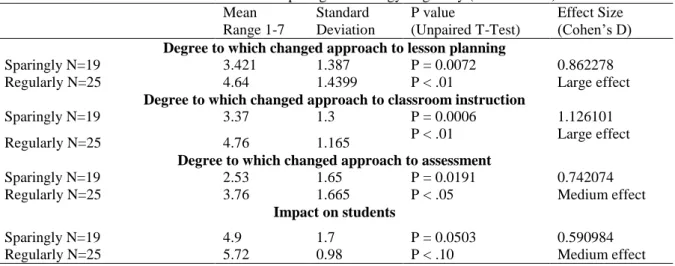
When teachers who use MCT sparingly (25% or less) are contrasted with those who use MCT regularly (50% or more), significant differences are present. In both lesson planning and classroom instruction, teachers who use MCT regularly reported significantly higher degrees of change resulting from the technology use, in both their lesson planning (p<.01, d=.86) and their classroom instruction (p<.01, d=1.13), than those who use technology sparingly. Those who use MCT regularly also report significantly higher degrees of change in their approach to assessment (p<.05, d=.74) than those who use MCT more sparingly, but the degree of difference in smaller. Finally, there is a difference in the degree to which teachers believed MCT is impacting their students (p<.10, d=.59), with those who regularly use technology reporting a higher degree of impact than those who use technology sparingly, however the difference is only statistically significant and the lowest confidence of significance.
Table 1. Comparisons of Teachers Who Use Mobile Computing Technology Sparingly (25% or less) and Those Who Use Mobile Computing Technology Regularly (50% or more)
Mean Range 1-7
Standard Deviation
P value
(Unpaired T-Test)
Effect Size (Cohen‟s D) Degree to which changed approach to lesson planning
Sparingly N=19 3.421 1.387 P = 0.0072
P < .01
0.862278 Large effect
Regularly N=25 4.64 1.4399
Degree to which changed approach to classroom instruction
Sparingly N=19 3.37 1.3 P = 0.0006
P < .01
1.126101 Large effect
Regularly N=25 4.76 1.165
Degree to which changed approach to assessment
Sparingly N=19 2.53 1.65 P = 0.0191
P < .05
0.742074 Medium effect
Regularly N=25 3.76 1.665
Impact on students
Sparingly N=19 4.9 1.7 P = 0.0503
P < .10
0.590984 Medium effect
Regularly N=25 5.72 0.98
Focus Groups
In relation to second-order barriers to technology use, there remain quite a few differences between teachers who use MCT sparingly and those who use the technology more regularly. While those who used MCT regularly expressed a balanced view of both positive and negative beliefs about how students may use the technology, those teachers who use MCT sparingly held far more negative beliefs. Of the positive beliefs, teachers mentioned that as digital natives, their students preferred technology, that technology keeps students‟ attention, and that students were better able to solve technology related problems than teachers were. A teacher who uses MCT regularly explained that, “they‟re more capable of using technology than I was…” while another stated, “…and it keeps their attention…” Negative beliefs included notions that student work on MCT is of lower quality, that students will use technology to misbehave, and that overall MCT has lessened students‟ attention spans. Speaking to the quality of work, one teacher who uses technology sparingly said that, “…the capitalization, the spelling, it‟s very hard to read. Even their writing is more juvenile…” Relating to short attention spans, another teacher who uses technology more sparingly indicated that, “in some ways it does make it a little harder to get their attention because they are so used to so much stimulation. Whereas I don‟t think that was the case when I was in school.” Teachers who use MCT regularly, as well as administrators, more often expressed positive comments relating to the value of MCT in the classroom than teachers who use the technology sparingly. These positives included that the technology made work easier, increased collaboration between teachers, that MCT increased classroom participation, and that technology was able to more often mimic real-world scenarios. As one administrator explained, “I think educationally, the benefit is that kids can be more connected to the classroom…to participate in the classroom [more] than they did maybe 10 years ago…”
A number of important themes also emerged relating to uses of MCT in the classroom. Both teachers who use MCT sparingly and those who use the MCT regularly report using the technology to facilitate communication and collaboration; however, teachers who use MCT regularly mentioned such uses far more frequently. These uses for communication and collaboration included using the technology for group work, to improve communication amongst students, and to enhance communication between students, their parents, and teachers. One teacher who uses technology sparingly indicated, “It‟s also made communicating with parents… a lot easier with Remind or classroom messenger.” Another teacher, who uses technology regularly explained, “for my kids it‟s huge because I have nonverbal kids that use it for communication… They can go out into the community, and talk to people who might not get to talk to them on a regular basis.”
A large contrast was present in the types of learning activities teachers described their students engaging in. Teachers who use MCT regularly describe more student-centered activities and Transformation uses, including using the technology for differentiated instruction, collaboration, computer coding, as well as innovative uses of MCT by students for collaborative classroom cheating (which the teachers viewed as both novel and bad). As one teacher who uses the technology to differentiate instruction explained, “…every morning they come in and scan a QR code and have a book read to them… there is no way I could sit down with 18 kids and read each of them a book of their choosing.” Another teacher, indicated that “…collaborating has become important for high school students too…you can do it in school at the same time from different classrooms… you can assign group projects and collaborate in different ways than before.”
Teachers who use MCT sparingly describe more teacher-centered activities and Enhancement uses, including looking up information on Google, writing responses, and watching videos. Additionally, this group of teachers was the only group to regularly described a lack in proficiency and needing to have students help them with technology use. As an example of an Enhancement use, one teacher explained, “they‟re looking up stuff on Google…” another explained they are creating “a Google slides presentation instead of doing it on a big banner paper...” In relation to needing student assistance, another teacher remarked, “…when there would be something on the computer that I couldn‟t figure out…I would look in the room and see what kids were there, and I go „You. Come here. Fix this‟.”
Finally, though teachers did occasionally mention administrative supports, administrators were able to better describe a number of ways in which they were encouraging increased MCT integration in the classroom. Most often, both teachers and administrators described ways in which administration encouraged autonomy in device use and that administration spent time modeling and training teachers how best to use the technology. As one administrator explained, “At the high school we still have Chromebooks and iPads, some teachers allow kids to use cell phones for various things, but that‟s on a teacher by teacher basis, not a district-wide initiative or policy.” Another administrator said, “…I spend a lot of time with teachers talking about what is essential knowledge that every kid needs to have, versus what are the obscure facts that they can Google relatively quickly and still be ok in life.”
Discussion
Five years into mobile computing technology (MCT) integration in the school district, most first-order barriers of access and stability appear to have been overcome, confirming previous research suggesting these barriers are the first to be resolved (Hur et al., 2016). Though teachers who use technology sparingly indicate that the time it takes to log into various technology uses presents a barrier, this comment is noticeably absent from the thoughts of those who use technology regularly. To this end, it would appear that teachers who use technology sparingly may project their own lack of proficiency (a second-order barrier) onto their students and the technology itself, thus reframing an internal barrier as an external one. This highlights the power of teacher beliefs to impact a teacher‟s experience with technology in the classroom, but also suggests that such perceptions can be overcome with increased experience and proficiency with MCT.
As others have argued (Ertmer et al., 2012; Hur et al., 2016; Tondeur et al., 2016), second-order barriers, most specifically teacher beliefs about the use of MCT, influence all aspects of technology integration in their classrooms. While all teachers within this study initially expressed confidence in their ability to use MCT, beliefs about what teachers and students should do with the technology and the value the technology has in the classroom actually varied considerably from teacher to teacher, and this variety of beliefs impacts the amount to which MCT can influence classroom instruction. Those teachers who use technology sparingly are more likely to hold negative beliefs about how their students will use MCT. This includes heavy suspicion that the technology distracts students, leads to lower quality work, and facilitates student cheating on classroom assignments. Those who use technology regularly hold a more balanced view in which they acknowledge that technology can be misused, but that it also presents opportunities to hold student attention, increase participation, foster collaboration, and more closely mirror real-world situations. To enhance their technology integration, it becomes clear that all teachers need to be regularly exposed to the successes and benefits of integration to consciously attend to teachers who perceive MCT use as presenting more negatives than positives.
Teacher beliefs about best practices in classroom instruction also factor into the degree to which MCT can influence their teaching (Author, 2016; Makki et al., 2018). In this study, those teachers that use technology sparingly discussed more teacher-centered instruction and Enhancement uses of technology, while those who use technology regularly described more student-centered approaches and Transformation uses of technology. While this is not indicative of the types of pedagogies embraced in the classroom when MCT is not in use, what it does suggest is that teachers who use the technology regularly see it as a tool for more immersive and engaging learning than their peers who use the technology sparingly. Using SAMR (Puentedura, 2013) as a conceptual model to understand the technology use, those teachers who use the technology sparingly tended to describe Substitution or Augmentation level uses, while those who use technology regularly tended to describe uses that are at the Modification or Redefinition levels. Again, exposure to different uses for the technology and gains they make possible may allow teachers that use technology sparingly to see new ways in which to incorporate MCT into their classroom teaching. However, exposure alone is not enough without properly attending to the beliefs these teachers hold about what constitutes a “good” education (Ertmer, 2005). Professional learning communities (PLCs) present a well proven path forward in that they would allow teachers to see the successes teachers have while attending to their pedagogical beliefs and values (Ertmer, 2005; Hur et al., 2016). Districts wishing to support increased use of MCT for teachers should create such PLCs and ensure a proper mix of teachers who use the technology sparingly with those who use the technology regularly.
use of MCTs on a teacher by teacher basis, overall investment in these technologies, as well as administrative support and the autonomy to explore innovative uses of the technologies, has led to a general perception that such technology has had a positive impact on classroom instruction for both teachers and students.
Limitations
This study looks deeply into a specific case of MCT integration within a small suburban school district in western Pennsylvania. While case studies represent rich descriptions of a particular phenomenon in a particular place and time, the ability to generalize from these findings is limited (Robson, 2002). As a consequence, the findings discussed here are meant to allow others to better understand what happened in this case, not to suggest that all cases will be like this one. Additionally, while the choice to engage in focus group interviews has the advantage of creating a space where individuals feel more secure in sharing information, they are also subject to weaknesses relating to group thought, in which focus group members may choose not to offer differing opinions so as not to stand out from others (Tracy, 2013). Their perceptions should be interpreted with this knowledge in mind.
Directions for Future Research
This study captures the perceptions of teachers relating to the integration of MCT in their school district. Missing from this study are the voices of students and outside stakeholders. Future research should gather these perceptions as they likely yield new insights about the technology use as well as new gaps for exploration. Further research could also relate to the relationship between MCT integration and performance on standardized measures of student performance. While this study aimed to capture teacher perceptions of MCT integration, other studies may wish to explore the effect of MCT on student performance pre- and post-integration.
Conclusion
As with all technology, the choice of a district to invest in mobile computing technology (MCT) in a manner that provides access to these devices in every classroom is an expensive decision, both in terms of financial resources and in terms of time and energy to prepare teachers to fully leverage new technologies in their classrooms. Looking back at the past five years of technology integration and capturing the perspectives of teachers and administrators, particularly in a smaller school district, yields valuable lessons for other districts that may pursue one-to-one integration endeavors of their own. Five years into the widespread integration of MCT, it is clear that barriers of the first order can largely be overcome with the correct application of resources. With these barriers removed, teachers report positive impacts on lesson planning and instruction and that overall the incorporation of MCT has had a positive impact on their students. Administration contributes to this success through two supports that align with well-researched best practices (Hur et al., 2016; Sheninger, 2014); teachers have autonomy to choose technology uses that best match with their pedagogical beliefs and administration offers training and modeling of different uses of technology to support increased technology use.
technology can be used to change classroom assessment will result in assessments that are more authentic to the world in which students live.
With MCT becoming more common now than traditional desktop and laptop computing, it is essential that school districts engage with this technology if they are to prepare students to be college and workforce ready. Undertaking a process of MCT integration across an entire district is expensive, especially for smaller districts with smaller budgets. By removing first-order barriers to access first, teachers can focus on their own pedagogical evolution, to overcome long-held beliefs that are negative toward technology use and to more effectively use the technology to transform their instruction into that which addresses students‟ interests and needs in the formats they are familiar with and must be proficient with for their future.
References
Ertmer, P. A. (1999). Addressing first- and second-order barriers to change: Strategies for technology integration. Educational Technology Research & Development, 47(4), 47-61.
Ertmer, P. A. (2005). Teacher pedagogical beliefs: The final frontier in our quest for technology integration?
Educational Technology Research & Development, 53(4), 25-39.
Ertmer, P. A., Ottenbreit-Leftwich, A. T., Sadik, O., Sendurur, E., & Sendurer, P. (2012). Teacher beliefs and technology integration practices: A critical relationship. Computers & Education, 59(2), 423-435. Hew, K. F., & Brush, T. (2007). Integrating technology into K-12 teaching and learning: Current knowledge
gaps and recommendations for future research. Educational Technology Research & Development, 55, 223-252.
Author (2016)
Hohlfeld, T. N., Ritzhaupt, A. D., Dawson, K., & Wilson, M. L. (2017). An examination of seven years of technology integration in Florida schools: Through the lens of the levels of digital divide in school.
Computers & Education, 113(1), 135-161.
Hur, J. W., Shannon, D., & Wolf, S. (2016). An investigation of relationships between internal and external factors affecting technology integration in classrooms. Journal of Digital Learning and Teacher
Education, 32(3), 105-114.
Keengwe, J., & Bhatgava, M. (2014). Mobile learning and integration of mobile technologies in education.
Education and Information Technologies, 19(4), 737-746.
Kirkland, A. B. (2014). Models for technology integration in the learning commons. School Libraries in
Canada, 32(1), 14-18.
Makki, T. W., O'Neal, L. J., Cotten, S. R., & Rikard, R. V. (2018). When first-order barriers are high: A comparison of second- and third-order barriers to classroom computing integration. Computers &
Education, 120(1), 90-97.
Pennsylvania Department of Education. (2018). Future ready PA index. Retrieved from https://futurereadypa.org
Puentedura, R. (2013). SAMR: A contextualized introduction. Retrieved from http://www.hippasus.com/rrpweblog/archives/000112.html
Robson, C. (2002). Real world research (Second ed.). Malden, MA: Blackwell Publishing.
Sheninger, E. (2014). Digital leadership: Changing paradigms for changing times. Thousand Oaks, CA: Corwin & Ontario Principal's Council.
Tondeur, J., van Braak, J., Ertmer, P. A., & Ottenbreit-Leftwich, A. (2016). Understanding the relationship between teachers' pedagogical beliefs and technology use in education: A systematic review of qualitative evidence. Education Technology Research & Design, 65(3), 555-575.
Tracy, S. J. (2013). Qualitative research methods: Collecting evidence, crafting analysis, communicating
impact. Malden, MA: Blackwell Publishing.
Author Information
Jason T. Hilton
008c McKay Education Building Slippery Rock University, PA 16057 USA
Contact e-mail: [email protected]