Published online August 24, 2014 (http://www.sciencepublishinggroup.com/j/ijll) doi: 10.11648/j.ijll.s.2014020501.12
ISSN: 2330-0205 (Print); ISSN: 2330-0221 (Online)
The effect of written corrective feedback on EFL learners'
writing performance: Explicit vs. implicit
Roya Pakbaz
Language and Literature Department, Yazd University, Yazd, Iran
Email address:
[email protected]To cite this article:
Roya Pakbaz. The Effect of Written Corrective Feedback on EFL Learners' Writing Performance: Explicit vs. Implicit. International
Journal of Language and Linguistics. Special Issue: Teaching English as a Foreign/Second Language. Vol. 2, No. 5-1, 2014, pp. 12-17.
doi: 10.11648/j.ijll.s.2014020501.12
Abstract:
The effectiveness of written corrective feedback has gained much interest among second language acquisition researchers since Truscott’s (1996) argument that grammar correction in L2 writing classes should be abandoned. In spite of the large body of research, there seems to be no unified agreement on the effectiveness of written corrective feedback on L2 learners' written performance. The present study seeks to investigate whether there is any positive effect of giving explicit or implicit written corrective feedback on 20 intermediate L2 learners’ ability to write in English by giving them three writing tasks: a pre-test, an immediate post-test and a delayed post-test. The participants performed on a written task, then, half of the learners received explicit feedback which means that the correct form of specific structures was provided and the other half received implicit feedback which means that the erroneous form was underlined with no correction. Two weeks later they were asked to write another essay in which the rubrics made them use the same forms, namely past tense and definite/indefinite article. A month later, the delayed post-test was conducted on a similar topic. Based on the results of mixed between-within ANOVA analysis, the students writing ability in using past tense and article use on the immediate post-test outperformed that of the pre-test. The effect was also long lasting since their performance on the delayed post-test showed an increase in the learners’ writing ability in the specified structures and this effect retained in their memory for one month. There was no statistically significant difference between the implicit and explicit group on their correct use of the specified structures.Keywords:
Written Corrective Feedback, Second Language Acquisition, Writing Ability, Implicit Feedback, Explicit Feedback1. Introduction
Debate about the merits of providing corrective feedback on L2 writing has been prominent in recent years as a result of Truscott's research, (Truscott, 1996). His ideas were against grammar correction in L2 writing classes. He claimed that corrective feedback is both ineffective and harmful and should be abandoned. Krashen (1982) was also against error correction since he believed it hinders communication and interaction among the learners. A growing body of empirical research is now investigating the agenda proposed by Ferris (1999) who talked about the benefits of grammar correction in L2 writing classes; his idea was a response to Truscott. Long (1990) was also in favor of error correction and considered it beneficial to L2 learning.
We are faced now with two different perspectives on the idea of giving learners some feedback on their writing tasks. Both groups of scholars with opposing ideas attempted to give a firm statement as to the possible effect of written feedback on the ability of the learners to write. But the reality is not as strict as this. In some situations and with some structures, and even with some special students with special proficiency levels, it may be beneficial or harmful to give some explicit or implicit feedback.
Feedback can be classified as two distinct categories, explicit or direct and implicit or indirect. Ferris (2003) had defined them as: direct corrective feedback providing the correct linguistic form or structure by the teacher to the student by writing it above the linguistic error. It may include the crossing out of an unnecessary word/phrase/morpheme, the insertion of a missing word/phrase/ morpheme, or writing the correct form or structure. On the other hand, indirect corrective feedback indicates that in some way an error has been made without explicitly mentioning the type of error or providing the correct form (Ferris, 2003). This implicit feedback may be provided in one of four ways: underlining or circling the error; recording in the margin the number of errors in a given line; or using a code to show where the error has occurred and what type of error it is (Ferris and Roberts, 2001). Rather than the teacher providing an explicit correction, students are left to resolve and correct the problem that has been drawn to their attention.
1.1. Background
During the recent years, the focus on the possible benefits of giving written corrective feedback for the writing ability of the learners has been a prominent topic for research. Several scholars have given opposing ideas and each has tried to convince others that what he argues is correct. As mentioned before, the reality doesn’t demand such absolute rules as to the does and don’ts of the writing classes. The first person who argued against written feedback was Truscott (1996). He argued that grammar correction in L2 writing classes should be abandoned, for the following reasons: (a) Substantial research shows it to be ineffective and none shows it to be helpful in any interesting sense; (b) for both theoretical and practical reasons, one can expect it to be ineffective; and (c) it has harmful effects.
Three years later, a scholar named Ferris (1999), started to stand against Truscott in his article “The Case for Grammar Correction in L2 Writing Classes: A Response to Truscott (1996)” and made a claim about the efficacy of teacher error/grammar correction in second language writing classes. He stated that: “The issue of helping students to develop their written language skills and improve their accuracy in writing is too important to be ruled on hastily. As teachers, we can only hope that we will continue to find answers and discover ways to respond more thoughtfully and effectively to our student writers’ needs." (p. 8).
Chandler (2003) seems to be more in favor of explicit type of feedback in writing skill of EFL learners. He posed three arguments for his claims: 1. explicit feedback reduces the confusion for learners and they can easily inspect their errors, 2. learners are provided with enough information to correct more complicated errors and 3. Explicit feedback is more immediate. On the other hand Ferris and Helt (2000) expressed an advantage for indirect feedback while Semke (1984) found no different between direct and indirect feedbacks. As Bitchener and Knoch (2009) rightly announced, further studies regarding any differences
between direct and indirect corrective feedback is called for to resolve the ambiguities in the plethora of previous studies on this matter.
Bitchener, Young, and Cameron (2005) were more precise and reported on the effects of different types of feedback, direct, explicit written feedback and student–researcher 5 minute individual conferences; direct, explicit written feedback only and no corrective feedback on the accuracy of written ability of L2 learners. They suggested that these types of feedback were effective in accuracy on some linguistic measures but were not influential on other occasions.
Truscott (2007) conducted a study which aimed at evaluating research on the question of how error correction affects learners’ ability to write accurately. He came to this conclusion that based on existing research: (a) the best estimate is that correction has a small negative effect on learners’ ability to write accurately, and (b) we can be 95% confident that if it has any actual benefits, they are very small, which again proved his previous ideas but with less strict claims.
Following the debate between these two groups of scholars, several researchers have been curious about finding out more about this matter and studies have been conducted, some of which will be presented in this paper.
An example is the study carried out by Bitchener (2008). His findings were the results of a 2-month study of the efficacy of written corrective feedback. He had 4 groups of learners, namely direct corrective feedback, written and oral meta-linguistic explanation; direct corrective feedback and written meta-linguistic explanation; direct corrective feedback only; the control group received no corrective feedback. He found out that accuracy in writing performance of those students who received written corrective feedback outperformed those in the control group.
In another article by Chandler (2003), the researcher had used experimental and control group data to show that students’ correction of grammatical and lexical error between assignments reduces such error in subsequent writing over one semester without reducing fluency or quality. He also came to this point that direct correction is best for producing accurate revisions, and students prefer it because it is the fastest and easiest way for them as well as the fastest way for teachers over several drafts.
The most recent attempt on the effectiveness of corrective feedback is the study of oral corrective feedback on written skill of L2 learners by Akbarzadeh, Saeidi, and Chehreh (2014). Elicitation and metalinguistic clues were utilized as feedback types and by applying such methods, they figured out that learners in oral interactive feedback group outperformed those who did not receive any feedback; therefore, correction of learners' errors should not be abandoned.
inconclusive studies on this issue, the instructors still use their own method of treating the learners’ writing errors. So, we are in need of a research which paves the way for a conclusive and clear decision for writing instructors.
The present study was conducted to evaluate the effect of two types of written corrective feedback`, namely implicit versus explicit feedback, on the ability of intermediate EFL learners' to use past tense and definite/ indefinite article in their writing performance in a pre-test, immediate post-test and a delayed post-test, which was designed to measure the possible long lasting effect of such corrective written feedback.
The target structures in this study were not chosen randomly. The reason behind choosing definite/ indefinite article was that the students across English language proficiency levels experience difficulty in the use of the English article system (Bitchener et al., 2005). For example, they may experience difficulty deciding whether an article is required and, if it is required, whether it should be definite or indefinite. The use of past tense was also determined by the same study in which it was decided that the use of past tense is among the three most recurrent error categories across different proficiency levels.
1.2. Research Questions
The present study aims at answering the following questions:
1.Does giving written corrective feedback have any effect on the writing performance of Iranian EFL learners?
2.Is there any significant different between giving implicit versus explicit written feedback on the writing performance of Iranian EFL learners?
3.Is there any significant difference between the use of past tense in three tasks, namely the pre-test, the immediate post-test and the delayed post-test?
4.
Is there any significant difference between the use of definite/indefinite articles in three tasks, namely the pre-test, the immediate post-test and the delayed post-test?2. Methodology
2.1. Participants
20 intermediate learners of English from Adib language institute participated in this study. Their level of proficiency was determined by Oxford Quick Placement Test (OQPT). The scores ranging from 28-40 indicated the intermediate level. Participants were not informed about the purpose of the task.
2.2. Instruments
The first material was OQPT which is a standardized placement test in English, designed by Allen (1992). This test is comprised of 60 questions in vocabulary, grammar, reading and cloze test and can provide an overall estimate
of the proficiency level of the participants. It was devised by Oxford and Cambridge University. The second material was the topics which were designed by the author in which care has been applied so that familiar topics be chosen so that the learners' mind be free of the content to dwell on the linguistic matters (Bygate, 2001). Additionally, the topics were selected as such to elicit both past tense and definite/indefinite articles. Three topics were as follows: 1.
1. How did you spend your last summer vacation?
2. What are the interesting things you used to do when you
were in primary school?
3. How was your last spring holiday? Did you enjoy it?
2.3. Data Collection and Coding
The students were required to conduct three written tasks. The first one was a pre-test for which the topic was: How did
you spend your last summer vacation? The motivation
behind choosing this topic was to evaluate the possible effect of using written feedback on the learners’ ability to use the correct form of past tense besides that of definite/indefinite articles. The written outputs were corrected by the instructor and a colleague who was a graduated MA in TEFL based on the before mentioned structures. Pearson Correlation was conducted to evaluate inter-rater reliability and a high correlation resulted.
Half of the papers were randomly selected and the erroneous structures were underlined and the correct form was written above them. This was considered as the explicit kind of feedback. In the remaining ten papers, the erroneous forms were just underlined and no correct form was supplied and the missing articles or errors in past tense were marked. This was regarded as the implicit feedback and the learners had to diagnose the correct form themselves.
The papers were returned to the learners five days later and two weeks after the pre-test, they were asked to write another essay on this topic: What are the interesting things
you used to do when you were in primary school? This task
was considered as the immediate post-test. Again the erroneous forms were marked by the two raters and the papers were given back to them five days later. About a month later, the final task was conducted. The learners were asked to write on this topic: How was your last spring
holiday? Did you enjoy it? This task would show whether
the correct use of the required structures had gotten stuck in the mind of the learners for a longer time or not.
2.4. Data Analysis
3. Results
For the mixed between-within ANOVA test, the independent categorical between group variable was implicit versus explicit measure. The dependent within group variables were the tasks on the three time span, namely the pre-test, immediate post-test and delayed post-test scores for each of the two structures separately.
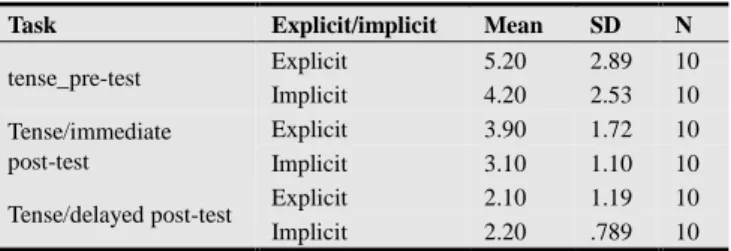
First we will inspect the data for past-tense use in writing tasks. The descriptive statistics along with the bar graph for the use of past tense in three tasks with the two types of feedback, implicit and explicit is manifested below.
Table 1. Descriptive statistics on past tense
Task Explicit/implicit Mean SD N
tense_pre-test Explicit 5.20 2.89 10
Implicit 4.20 2.53 10
Tense/immediate post-test
Explicit 3.90 1.72 10
Implicit 3.10 1.10 10
Tense/delayed post-test Explicit 2.10 1.19 10
Implicit 2.20 .789 10
The homogeneity and normality of the data was confirmed using Kolmogorove-Smirnove test and Leven's test of equality of variances accordingly. A mixed between-within analysis of variance was conducted to explore the impact of implicit versus explicit type of corrective feedback on the scores for using past tense in three successive times: a pre-test, an immediate post-test and a delayed post-test. Wilk’s Lambda=0.002, therefore, there was a statistically significant effect for time. The effect size was 0.52 which according to the scale proposed by Cohen (1988) suggests a large effect. The interaction effect for implicit and explicit feedback over time for correct use of past tense was not statistically significant, (p= 0.49). The significant value for the between subject effect was 0.28 which was again not significant indicating that there was no difference between the implicit and explicit group.
Figure 1. Past tense for 3 task sin implicit versus explicit feedback
In what follows, descriptive statistics and bar graph for using articles are indicated.
Table 2. Descriptive statistics on articles
Task Explicit/implicit Mean SD N
article_pre-test Explicit 5.30 3.59 10
Implicit 4.00 2.05 10
article_immediate post-test
Explicit 2.80 1.31 10
Implicit 3.20 1.13 10
article_delayed post-test
Explicit 2.30 .823 10
Implicit 2.60 .966 10
Figure 2. Article use for 3 tasks in implicit versus explicit feedback
To investigate the possible correct use of articles across three tasks and to compare the differences between implicit and explicit use of corrective feedback, again a mixed between-within analysis of variance was conducted. Wilk’s Lambda was 0.02, so there was a statistically significant effect for time. The effect size was 0.34 which is large one.
The interaction effect for implicit and explicit feedback over time for correct use of articles was not statistically significant, (p= 0.42). The significant value for the between subject effect was 0.71 which was again not significant indicating that there was no difference between the implicit and explicit group.
4. Discussion
According to the results obtained from these findings, repeating the writing task, with the intervention of a rater who gives implicit or explicit feedback on the written output enhances the use of specific linguistic structures like past tense or article use. Significance of attending to the comments provided by the rater should not be neglected in EFL classes.
The results of this study are in accordance with Chandler (2003), Ferris (1999) and Bitchener (2008) on the idea that giving the learners an awareness of the mistakes they make or providing them with the correct form enhances linguistically correct written output.
5. Conclusion
The current research was conducted to see whether correcting the papers and giving direct or indirect feedback to the learners influences the writing performance of L2 learners or not. The results obtained from the present study manifests that there seems to be a positive effect of giving written corrective feedback to the learners in intermediate level of proficiency on their written work. It is proved that the learners had found it useful in their writing ability to receive some correction from the instructors. They had surely pondered on their erroneous structures since they had tried to have a better performance on the succeeding tasks as the results show.
The interesting observation here is that in spite of some beliefs on the superiority of giving explicit corrective feedback over the implicit one, the findings proved an equal effect of these two methods of providing feedback. Learners seem to have found their own ways of responding to their errors and have done it irrespective of the correct form provided by the instructor. This finding is in line with Semke's (1984) idea.
The results can be of great help to the writing instructors as to an answer to the ongoing question of the necessity of giving learners the written corrective feedback on their written output. Several factors are at work here such as the learners’ proficiency level, the objectives of the classroom and whether fluency is important or accuracy is the matter, the age of the learners is also of great importance. In spite of being a subjective decision, depending on several factors mentioned above, the policy makers and course designer can make use of these findings which can help them in improving their courses.
Further research can be carried out on the possible effectiveness of giving written corrective feedback on other language structures. Studies can be conducted on different proficiency levels to compare the effect of feedback on different proficiency levels. There are several types of feedback, rather than implicit and explicit one and their effects can be studied and compared.
All in all, giving corrective written feedback on the writing of L2 learners seems to be a complicated matter since there is no unified idea on the type of feedback and the time to provide it and some other relevant factors. Each
instructor may find his or her own way of giving feedback and even there is the possibility of not providing it at all. In spite of these inconclusive matters, the idea of conducting a research on this matter should not be neglected.
References
[1] Akbarzadeh, R., Saeidi, M., & Chehreh,M. (2014). The effect of oral interactive feedback on the accuracy and complexity of EFL learners' writing performance: Uptake and retention.
Iranian Journal of Language Teaching Research 2(2),
105-126
[2] Allan, D. (1992). The Oxford Quick Placement Test. Oxford University Press.
[3] Bitchener, J. (2008). Evidence in support of written corrective feedback. Journal of Second Language Writing, 17, 102–118.
[4] Bitchener, J., Knoch, U., (2008). The value of written corrective feedback form migrant and international students.
Language Teaching Research Journal 12(2),409–431.
[5] Bitchener, J., Knoch, U., (2009). The relative effectiveness of different types of direct written corrective feedback. System 37, 322–329.
[6] Bitchener, J., Young, S., & Cameron, D., (2005). The effect of different types of corrective feedback on ESL student writing. Journal of Second Language Writing. 14, 191-205.
[7] Brown, H. D. (1994). Teaching by principles: Interactive
language teaching methodology. New York: Prentice Hall
Regents.
[8] Bygate, M. (2001). Effect of task repetition on the structure and control of oral language. In M. Bygate, P. Skehan, & M. Swain (Eds,), Researching pedagogic tasks, second language
learning, teaching and testing (pp. 23-48). HarLow:
Longman.
[9] Carroll,S.,&Swain,M.(1993).Explicit and implicit negative feedback: An empirical study of the learning of linguistic generalizations. Studies in Second Language Acquisition, 15, 357–386.
[10] Chandler, J. (2003), The efficacy of various kinds of error feedback for improvement in the accuracy and fluency of L2 student writing. Journal of Second Language Writing, 12, 100 – 111.
[11] Cohen, J. (1988). Statistical power analysis for the
behavioral sciences. Hillsdale, NJ: Erlbaum.
[12] Chuang, W. (2009). The effect of four different types of corrective feedback on EFL students' writing in Taiwan.
Dayeh University Bulletin, 4, 123-138.
[13] Ellis, R. (1990). Instructed second language acquisition:
Learning in the classroom. Oxford: Basil Blackwell Ltd.
[14] Ellis, R.(1994). The study of second language acquisition. Oxford: Oxford University Press.
[16] Ferris, D. R. (1999). The Case for Grammar Correction in L2 Writing Classes: A Response to Truscott (1996).Journal of
Second Language Writing, 8 (1) l-l1.
[17] Ferris, D. R. (2002). Treatment of error in second language
student writing. Ann Arbor: University of Michigan Press
[18] Ferris, D. R. (2003). Response to student writing:
Implications for second language students. Mahwah, NJ:
Lawrence Erlbaum Associates.
[19] Ferris, D. R., & Helt, M. (2000).Was Truscott right? New evidence on the effects of error correction in L2 writing classes. Paper presented at Proceedings of the American Association of Applied Linguistics Conference, Vancouver, B.C., March11–14, 2000.
[20] Ferris, D.R., Roberts, B., (2001). Error feedback in L2 writing classes: how explicit does it need to be? Journal of
Second Language Writing, 10, 161–184.
[21] Gass, S.(1997). Input, interaction, and the second language
learner. Mahwah, NJ: Lawrence Erlbaum Associates.
[22] Kepner, C. G. (1991). An experiment in the relationship of types of written feedback to the development of second-language writing skills. Modern Language Journal, 7, 305-313.
[23] Krashen, S. (1982). Principles and practice in second
language acquisition. Oxford: Pergamon Press.
[24] Long, M. (1990). The least a second language acquisition theory needs to explain. TESOL Quarterly, 24 (4), 649-666.
[25] Panova, I., &Lyster, R. (2002).Patterns of corrective feedback and uptake in an adult ESL classroom. TESOL
Quarterly, 36 (4), 573-595.
[26] Semke, H.(1984).The effects of the red pen. Foreign
Language Annals, 17, 195–202.
[27] Truscott, J. (1996). The Case against Grammar Correction in L2 Writing Classes. Language Learning, 46:2, 327-369.