Controlling the Data Warehouse
– a Balanced Scorecard Approach
Frank Bensberg
Department of Information Systems, University of Muenster, Germany
Data warehouse systems have become a basic techno-logical infrastructure in management decision making. Nevertheless, the overall utility of data warehouses remains unmeasured in most practical cases. As a conse-quence of this, IT-managers do not possess appropriate means to evaluate warehouse benefits in order to decide about investments in warehousing technology.
This paper develops a controlling instrument for data warehouse systems based on the Balanced Scorecard
(BSC) approach. On the basis of the technological
aspects of data warehouse systems, the BSC perspectives are developed and populated with relevant objectives and measures for data warehouse success. These perspectives are integrated into a consistent data warehouse scorecard. Finally, this instrument provides a holistic approach to drive the performance of data warehouse systems.
Keywords: data warehouse, balanced scorecard, control-ling, performance measurement, strategic management.
1. Introduction
In the last decade, the data warehouse concept has experienced great acceptance. The primary reason for building data warehouses is to im-prove information quality in order to achieve specific business objectives such as competitive advantage or enhancing decision making. Ac-cording to 18], the annual expenses for a data warehouse with 1 terabyte raw data sum up to 5.3 million US-dollar, where costs for IT-staff and IT-services dominate. In most cases, the data warehouse budget consumes a significant part of the total IT-budet and therefore cost jus-tification is a conditio sine qua non.
Though many organizations have experienced problems with implementing data warehouse systems 12], these are mostly not subject to de-tailed analysis of costs and benefits 3].
There-fore, a dedicated controlling instrument is nec-essary which is able to track data warehousing success and to steer investments in data ware-housing technology. Since data warehouse ben-efits are predominantly intangible and calcula-tion of the return on investment(ROI)of data warehousing is in most cases infeasible 23], it is necessary to evaluate data warehouse expen-ditures from both financial and non-financial views. To achieve this objective, it seems rea-sonable to examine the balance scorecard con-cept for the domain of data warehousing. From a research position, it is interesting to see that the balanced scorecard approach has been applied to different areas of information tech-nology. In 5], the development of a balanced IT scorecard for software producing business units is realized. Further scorecard-related pub-lications deal with performance measurement of ERP-software (e.g. 16] and 14]) or cre-ation of generic IT-scorecards which apply to an IT-department as a whole (e.g. 19], 20]). However, no effort has been made in order to adapt the balance scorecard to the domain of data warehousing. This seems necessary since these systems are supremeley strategic and im-plementation failure rates are high ( 23], 2]). Consequently, data warehouse systems deserve closer attention by IT-controlling in order to sucessfully support business strategy.
perspec-tive. Finally, the perspectives are merged into a conceptual data warehouse scorecard and as-pects of integration into strategic management are concluded.
2. The Data Warehouse Concept
2.1. Data Warehouse Architecture
According to INMON, a data warehouse is a
subject-oriented, integrated, non-volatile, and time-variant collection of data which serves as an infrastructure for management decisions(see 6], p. 33). This dispositive data collection is based on operational data stores (e.g. enter-prise resource planning systems like SAP R/3), but is arranged according to analytical interests and is therefore not dependent on operational business processes. The high practical accep-tance of the data warehouse concept is a result of the grown architecture of operational infor-mation systems. Since these systems are built in order to achieve a high rate of transactions, generation of decisive management information imposes a number of technical and conceptual problems(see 7], p. 42–43).
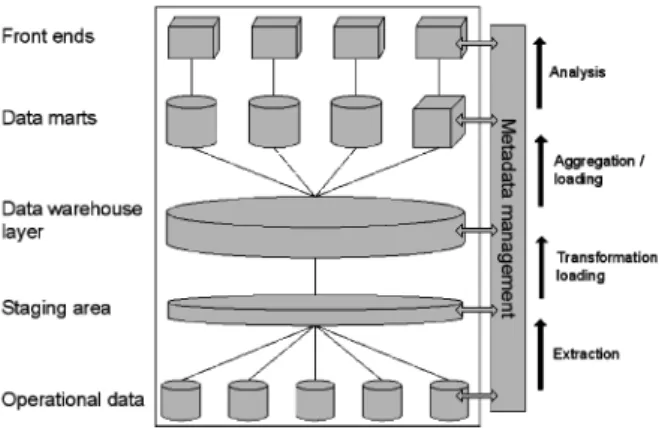
In order to keep data warehouse content up to date, it is necessary to establish a technological infrastructure which extracts relevant data from the operational information systems and con-solidates these data within a well documented database system. Consequently, the data in the data warehouse is made up of snapshots of the enterprise’s multiple operational databases. The resulting data warehouse architecture is de-picted in Fig. 1.
Fig. 1.The architecture of a data warehouse system.
This architecture consists of core components and processes which constitute a complex ana-lytical information system. The bottom layer of the warehouse is connected to the data stores of operational information systems(e.g. account-ing, sales, human ressources)in order to extract relevant data which are pooled into a staging area. In addition to this, external data (e.g. from market research institutes or financial ser-vices) can be acquired to complete the data needed for management decisions. The stag-ing area serves as a temporary data store and allows the consolidation of data from heteroge-nous sources. A typical transformation task is to remove homonyms(e.g. using an identical label for different types of attributes)and synonyms
(e.g. using two different labels for an attribute). As a result, the integrated data is loaded into a central data warehouse layer which is typi-cally normalized in order to avoid redundancies. These early tasks of the data warehouse process are executed by use of ETL-tools (extraction, transformation, loading). These tools provide connectivity to a broad set of different data stor-age formats(e.g. different database systems like Oracle, DB2 or SQL Server or different text file formats).
In order to turn warehouse data into decisive information, it must be tailored to the needs of the end users located in different organizational units(e.g. functional departments). Typically, the informational needs of the marketing de-partment differ from those of the accounting department. As a consequence of this, spe-cific departmental views on the data have to be created. These views, which are called data marts, can be further customized in order to comply with the informational needs of single users (e.g. a specific salesperson in a defined region).
To get information from these data marts, end users are provided with a set of tools which allow analytical processing. Most common are report generation tools which support sim-ple aggregations(e.g. calculation of statistical measures like mean values, etc.). In order to provide interactive analysis with user-defined views, OLAP tools are frequently used. While report generation tools and OLAP provide more or less simple analytical operations, data min-ing tools permit the analysis of complex patterns
reveal buying patterns of customers, which can be used to optimize marketing campaigns.
2.2. Organizational Implications
High complexity of data warehouse systems evolves from the fact that these systems have to be tailored to the specific requirements of the organization and cannot be set up out of the box. First, the data warehouse has to be built upon a given data infrastructure which has grown his-torically in most organizations. This multitude of heterogenous data sources requires a high number of interfaces which must be continu-ously managed in order to keep data warehouse content up to date. Besides these technologi-cal dependencies, another source of complexity evolves from the end users of data warehouse services and their different tasks. Managerial decisions are carried out by numerous managers at very different hierarchical and departmen-tal levels. Consequently, informational needs of functional area management and executive management differ significantly and lead to a high degree of specifity in information demand. Since an uncertain business environment with increasingly intense competition also implies dynamically evolving informational needs, data warehouse systems have to be flexible in order to comply with future requirements. Facing nu-merous technological and organizational depen-dencies, this flexibility is crucial for successful data warehouse evolution.
As the implementation and proliferation of a data warehouse is commonly a strategic goal, it is necessary to link data warehouses directly to business strategy. A very popular instrument for transforming strategy into action is the balanced scorecard, which has originally been introduced by KAPLANand NORTONat the enterprise level
(see 8], 9], 10], 11]).
3. Balanced Scorecard as a Strategic Controlling Instrument
The BSC has been developed in order to provide a controlling instrument which does not merely focus on financial measures, but furthermore considers non-financial measures. These mea-sures reflect relevant organizational objectives
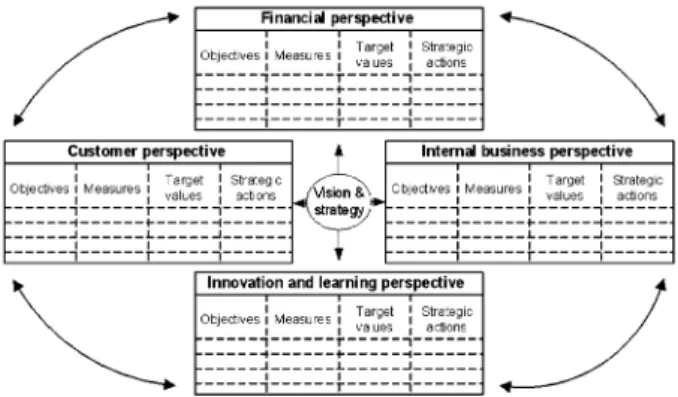
which ensure strategy implementation. This ap-proach is based on the experience that a singular focus on financial metrics reduces the quality of strategic decisions and therefore is not adequate to align business processes to strategy. The BSC suggests to measure organizational perfor-mance in four key areas which are depicted in Fig. 2.
Fig. 2.The basic model of the BSC.
Each perspective consists of strategic objectives which are derived from business strategy and are linked to specific measures. In order to use the BSC in business planning, the target val-ues for each measure have to be defined and connected to corresponding actions which will ensure achievement of the prospected value. The financial perspective describes measures which are important to the shareholders of a corporation and reflect growth and profitabil-ity. Typical measures used for this perspective include sales, return on investment, and cash flow. They reflect strategic objectives like cor-porate survival or corcor-porate success and depend on non-financial performance measures of other perspectives.
The BSC suggests that organizations have to identify the market segments that they plan to supply. For each target segment measures have to be defined which reflect the organizational performance from the market point of view. In general, measures like market share, customer retention, frequency of orders, and number of new customers are commonly used in order to populate the customer perspective.
the performance of critical business processes. These processes, which have a significant im-pact on customer satisfaction or financial mea-sures, can relate to research and development
(e.g. time to market of new technologies), pro-duction and delivery (e.g. cycle time, product quality), and service(e.g. response time). All described views of the BSC depend on the innovation and learning perspective. This per-spective is based on the assumption that only a learning and innovating organization is able to survive intense competition. Therefore, this perspective measures the innovative potential of the organizational infrastructure like employees and information systems. Commonly used mea-sures are employee satisfaction and information coverage ratio.
In order to implement a BSC for a given orga-nization, it is necessary to start scorecard de-sign at the strategic level of business. Conse-quently, the strategic business scorecard has to be adapted in a top down mode for subordi-nated organizational units such as departments, groups, projects and individuals. Finally, the BSC has to be cascaded throughout the organi-zation to ensure goal alignment at every level. As a result of this, the BSC becomes a commu-nication tool revealing the strategy of the orga-nization via a set of well-defined objectives and measures. These relate to each other through cause-effect-chains(e.g. employee satisfaction influences product quality).
4. Development of a Data Warehouse Balanced Scorecard
4.1. Organizational Prerequisites
In order to develop a data warehouse balance scorecard, it is necessary to define the organiza-tional environment. The development and oper-ation of a data warehouse system is most com-monly realized by a corporation’s information technology department(IT-department) which also is responsible for operational systems(e.g. ERP-systems) and other IT-resources. In or-der to guarantee an economic use of infor-mation technology, it is reasonable to run IT-departments as profit centers. This means that the IT-department offers products for internal and external customers. Internal customers
(e.g. functional departments)are entitled to de-cide freely if they buy IT-related services from the internal IT-department or from external sup-pliers. Of course, the IT-department has to de-fine transfer prices for each IT-related product offered on the internal market.
Consequently, the operation of a data warehouse system leads to information products which are offered to customers. There is a broad spec-trum of different services which can be offered by an IT-department based on the warehousing platform:
reporting services (definition of reports, report creation and delivery),
OLAP-services(definition and delivery of OLAP data marts and frontends to end users),
data mining services (definition and exe-cution of data mining tasks, presentation and deployment of results), and
data quality management services.
If the IT-department is run as a profit center, these information products are subject to the transfer price regime of the organization. Con-sequently, end users have to pay these trans-fer prices for usage of data warehouse ser-vices. These prerequisites form the organiza-tional framework for further data warehouse BSC development.
4.2. The Financial Perspective
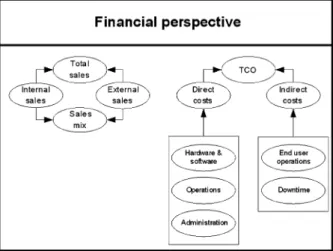
groups of customers. This can be measured via the sales mix as a ratio of internal to external sales.
In addition to sales, the costs of the ware-house system are also relevant for the finan-cial perspective. A basic phenomenon of data warehousing is that predominantly fixed costs are allocated. Therefore, it is impossible to trace down data warehousing costs to originat-ing costoriginat-ing units.
Since a significant portion of IT-related costs are commonly hidden costs, it seems reasonable to adopt a total cost of ownership approach in order to assess the effectiveness of an organiza-tion’s IT expenditures 17]. According to this, it is necessary to differentiate between direct and indirect costs. Direct costs are budgeted costs for hard- and software, operation, and adminis-tration. According to 18], the following types of direct costs have to be considered for data warehouse systems:
data warehouse platform, ETL-platform,
database and miscellaneous software, IT-staff and services, and
support and maintenance.
In contrast to this, indirect costs are non-budgeted costs which are caused by inefficient system operations or usage. Indirect costs may spring from unplanned data warehouse downtime which impedes managerial decisions to be taken and
Fig. 3.The financial perspective.
therefore decreases productivity of management processes. Moreover, another driver of indirect costs are inefficient end users’ operations. For instance, it is not efficient that end users carry out tasks that should be done by dedicated IT staff.
In order to complete the financial perspective, it is necessary to integrate all components of this sales and cost framework into the financial perspective as shown in Fig. 3.
4.3. The Customer Perspective
In order to define the customer perspective of the data warehouse BSC, the internal and exter-nal customer(s) of the data warehouse-related services have to determined first. As far as end user-oriented analytical services like report-ing, OLAP and data mining are concerned, pre-dominantly managers at different departmental levels are the primary segment of relevant in-ternal customers(e.g. executive managers and functional area managers). For this segment, a common strategic objective is to become pre-ferred provider of managerial information. In order to evaluate the achievement of this ob-jective, coverage of the data warehouse-related information products has to be measured. Possi-ble measures for this information coverage are the percentage of business decisions covered or the percentage of managerial positions sup-plied with data warehouse-related information products. In addition to this, the percentage of operational systems whose data are processed by the data warehouse may be another relevant measure.
Additionally, it seems necessary to measure end user satisfaction with the data warehouse--related information products. This can be eval-uated via surveys permitting the calculation of a customer satisfaction index, and behavioral data(e.g. log files)which reveal patterns of in-formation usage (e.g. frequency and duration of use). The resulting customer perspective for this segment is shown in Fig. 4.
Fig. 4.The customer perspective.
from poor data quality 13]and source data qual-ity problems generally become evident once the data are loaded into the warehouse 15], the ser-vice of a data warehouse environment is to pro-vide data quality management services. For instance, during the ETL-process of data ware-housing duplicates in operational data stores can be identified and properly removed. These cleaned data can be provided to the operational level in order to reduce data quality problems. For this segment, the strategic objective of a data warehouse is to become preferred provider of data quality management services. The internal market share of this service could be measured as percentage of operational systems supplied with cleaned data. In the long run, this propor-tion could decrease over time if data warehouse services persistently enhance the data quality of operational systems.
For very different data warehouse-related ser-vices external customers may also exist. For example, cleaned address data can be extracted from the data warehouse and optimized for dif-ferent marketing purposes. These addresses could be provided to affiliated or cooperating companies. A strategic objective for this seg-ment could be to become preferred mailing ad-dress supplier. In order to measure the achieve-ment of this objective, the number of addresses sold can be quantified.
4.4. The Internal Business Perspective
The internal business perspective focuses on the internal conditions for satisfying the customer supplied with the data warehouse’s services.
Since the internal processes of a data warehouse primarily serve to provide appropriate informa-tion for managerial decisions, measures are nec-essary which reflect information quality. In lit-erature, there are many approaches which can be applied to information quality 22]. According to 1](p. 142), information quality characteris-tics belong to two categories: inherent and prag-matic information quality characteristics. The former are independent of the processes that use the data for specific business purposes and indicate static quality characteristics:
Completeness of values. This character-istic is measured as the degree to which values are present in the data warehouse and are not missing.
Accuracy to reality or a surrogate source. This criterion reflects the degree to which a data value in the data warehouse con-forms to reality or an original source of data(like a document or a form).
Accessibility characterizes the ability to access the information within a data ware-house when it is required. Consequently, this criterion does reflect if the data ware-house does contain corresponding infor-mation.
Pragmatic information quality characteristics describe the appropriateness of information for special business tasks:
Relevance. This criterion describes the necessity of information for business de-cisions. It can be measured empirically by observing end user behavior in relation to the data. If data objects are not used at all, they may be irrelevant for business decisions.
Timeliness of information. In order to en-sure a responsive supply of information, it is necessary to deliver it in time. This criterion could be measured as the percent-age of information retrieval processes per-formed within the desired time frame.
it is easy to interpret, e.g. by use of vi-sualization techniques. Consequently, this criterion can be subjectiveley measured as the degree to which information is directly usable for decision purposes.
In literature, a vast multitude of different in-formation quality criteria are proposed ( 22], 21]). In practical application domains these should be selected according to situational re-quirements in order to meet the specific infor-mational needs of the management. Due to the relevance of information quality for warehouse success, it could be reasonable to integrate these metrics into a dedicated information quality per-spective.
In addition to these dedicated information qual-ity criteria, general availabilqual-ity of data ware-house services influences end user acceptance and indirect TCO caused by downtime. As a consequence of this, general performance mea-sures such as average system availability, aver-age downtime, and averaver-age response time, play an important role. The resulting internal busi-ness perspective is shown in Fig. 5.
Fig. 5.The internal business perspective.
4.5. The Innovation and Learning Perspective
This perspective has to reflect the flexibility to meet actual and future requirements. Technical flexibility stems from software and hardware platforms used for data warehouse implementa-tion. A key factor of future flexibility is vendor reliability. This can be measured by the num-ber of stable releases per year which can pro-ductively be used without major changes. In
addition, the compliance to relevant standards, conventions or legal regulations is another ma-jor driver for warehouse adaptability. This is-sue can be measured inversely by the number of standards the data warehouse system fails to comply to(see 21], p. 2.24). Another relevant factor for technical flexibility is interoperability of data warehousing components. This measure quantifies the number of information systems the data warehouse is able to interact with(see
21], p. 2.24).
The organizational flexibility of a data ware-house is predominantly driven by the qualifica-tion of employees. This particularly refers to the technical data warehousing staff who must have adequate business knowledge in order to com-municate and to understand end users informa-tional needs 23]. As a measure of qualification, experience with similar projects can be taken into account. In addition, warehousing staff has to keep pace with technical development. This can be measured by the number of training days per employee. In order to strengthen end users’ involvement, adequate training has to be pro-vided, metered as number of training days per end user. Of course, this measure influences in-direct TCO in terms of inefficient self-support or peer-to-peer-support. According to WATSON
and HALEY, it is of vital importance to
pro-vide appropriate meta data, such that end users are enabled to search and identify relevant data
(23], p. 36). Consequently, it is necessary to measure the degree to which data warehouse processes and entities are documented.
The resulting innovation and learning perspec-tive is depicted in Fig. 6.
5. Conclusion
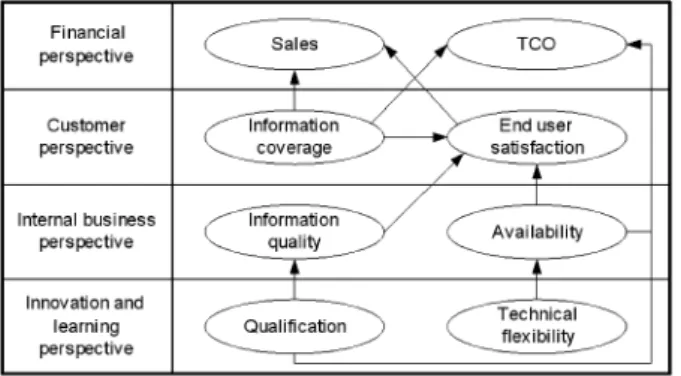
This paper proposed a balanced scorecard frame-work which can be used by IT-departments to plan and control data warehouse systems in a profit center organization. Each perspective of the balanced scorecard was supplied with ad-equate objectives and measures, such that the resulting framework represents a holistic ap-proach. The data warehouse BSC can be used as a strategic IT-management tool in order to check performance based on the objectives that have been defined in advance. All perspectives of the resulting scorecard are depicted in Fig. 7. This figure also reveals cause-effect-chains which exist between major measures.
Fig. 7.The data warehouse BSC.
In practice, the proposed framework has to be associated with corporate strategy. If a cor-porate scorecard already exists, the data ware-house scorecard has to conform to corporate objectives. In particular, it has to be deter-mined if there are corporate objectives the data warehouse can directly influence. If there is a strategic objective like “Increase competitive advantage by using information technology to focus on premium customers”, the data ware-house BSC has to translate this directive into local objectives. For instance, a resulting ob-jective for the customer perspective could be: “Integrate and supply value-based customer in-formation for sales & marketing activities”. Besides, for a data warehouse BSC it is neces-sary to conform to other scorecards developed for the IT-department. In 20], a scorecard cas-cade is proposed which derives a strategic IT-BSC from the corporate IT-BSC. Furthermore, the strategic IT-BSC is divided into a development
BSC and a operational BSC. For a data ware-house system this approach does not seem to be reasonable. This is because data warehousing systems do not conform to traditional devel-opment models of software engineering which strictly differentiate between development and operation. Consequently, it seems more suc-cessful to link the data warehouse BSC directly to the strategic IT-BSC.
According to data warehouse research litera-ture, most of the measures presented in this pa-per represent critical success factors (see 3],
15], 2], 23], 21]) that have been identifi-ed in practical success and failure studies. There-fore, this framework can be used as conceptual blueprint for the development of customized data warehouse BSCs in practical application contexts. These will play an important role in further research evaluating the effectiveness of the BSC approach to drive data warehouse performance.
6. Acknowledgements
The author would like to thank Mrs. Christina Reichel at Mummert Consulting AG for insight-ful discussions on data warehouse engineering. My thanks also go to Mr. Martin Weich and Mr. Volker Manthey at Horv´ath & Partners for their helpful experiences on practical balanced scorecard management.
References
1] ENGLISH, L.P., Improving Data Warehouse and
Business Information Quality, New York: John Wiley & Sons, 1999.
2] FROLICK, M., LINDSEY, K., Critical Factors for
Data Warehouse Failure, Journal of Data Ware-housing, Vol. 8, No. 1. http://www.dw-insti tute.com/research/display.asp?id=6592
03/11/2003]
3] HALEY, B., Implementing Successful Data
Ware-houses, in: Journal of Data Warehousing, Vol. 2 No. 2, 1998, pp. 48–51.
4] HAN, J., KAMBER, M., Data Mining – Concepts
and Techniques, San Francisco: Morgan Kaufmann Publishers, 2001.
5] IBANEZ, M., Balanced IT Scorecard Description
Version 1.0, European Software Institute(editor),
6] INMON, W.H., Building the Data Warehouse, New
York: Wiley, 1996.
7] JONES, K., An Introduction to Data Warehousing:
What Are the Implications for the Network? Inter-national Journal of Network Management, Vol. 8, 1998, pp. 42–56.
8] KAPLAN, R.S., NORTON, D.P., Putting the Balanced
Scorecard to Work, in: Harvard Business Review, Vol. 71, 1993, pp. 134–147.
9] KAPLAN, R.S., NORTON, D.P., The Balanced
Score-card – Measures that Drive Performance, in: Har-vard Business Review, Vol. 70, 1992, pp. 71–79.
10] KAPLAN, R.S., NORTON, D.P., Transforming the
Balanced Scorecard from Performance Measure-ment to Strategic ManageMeasure-ment: Part II, in: Account-ing Horizons, Vol. 15 No. 2, 2001, pp. 147–160.
11] KAPLAN, R.S., NORTON, D.P., Using the Balanced
Scorecard as a Strategic Management System. In: Harvard Business Review, Vol. 74, 1996, pp. 75–85.
12] METAGROUP, Data Warehouse Scorecard, 1999.
http://www.sfdama.org/dwscorecard.pdf
03/10/2003]
13] REDMAN. T.C., The Impact of Poor Data Quality on
the Typical Enterprise, in: Communications of the ACM, Vol. 41 No. 2, pp. 79–82.
14] ROSEMANN, M., WIESE, J., Measuring the
Perfor-mance of ERP Software – a Balanced Scorecard Approach, Proceedings of the 10th Australasian
Conference on Information Systems, 1999, pp. 773– 784.
15] SAMMON, D., FINNEGAN, P., The Ten
Command-ments of Data Warehousing, in: The DATA BASE for Advances in Information Systems, Vol. 31 No. 4, 2000, pp. 82–91.
16] SEDERA, D., GABLE, G., ROSEMANN, M., A
Bal-anced Scorecard Approach to Enterprise Systems Performance Measurement, in: Proceedings ot the 12thAustralasian Conference on Information
Sys-tems, 2001, pp. 573–584.
17] SMITHDAVID, J., SCHUFF, D., ST. LOUIS, R.,
Man-aging Your IT Total Cost of Ownership, Communi-cations of the ACM, Vol. 45. No. 1, pp. 101–106.
18] STRANGE, K.,Data Warehouse and Business
Intel-ligence: The Challenges of TCO and ROI, Gartner Symposium ITxpo, 2002 October 6-11; Orlando, Florida: Walt Disney World.
19] VANGREMBERGEN, W., SAULL, R., Aligning
Busi-ness and Information Technology through the Bal-anced Scorecard at a Major Canadian Financial Group: its Status Measured with an IT BSC Ma-turity Model, Proceedings of 34th Annual Hawaii
International Conference on System Sciences, Com-puter Society Press, 2001, pp. 1–10.
20] VAN GREMBERGEN, W., The Balanced Scorecard
and IT Governance, in: Information Systems Con-trol Journal, Vol. 2, 2000, pp. 40–43.
21] VASSILIADIS, P., Data Warehouse Modeling and
Quality Issues, Ph.D. Thesis, Technical Report, Knowledge and Database Systems Laboratory, Dept. of Electrical and Computer Engineering, Na-tional Technical University of Athens, Greece, June 2000.
22] WANG, R.Y., STOREY, V.C., FIRTH, C.P., A
Frame-work for Analysis of Data Quality Research, in:
IEEE Transactions on Knowledge and Data Engi-neering, Vol. 7, No. 4, pp. 623–640.
23] WATSON, H. J., HALEY, B., Managerial
Considera-tions with Data Warehousing, in: Communications of the ACM, Vol. 41, No. 9, pp. 32–37.
Received:June, 2003
Accepted:September, 2003
Contact address:
Frank Bensberg Department of Information Systems University of Muenster Leonardo-Campus 3 D-48149 Muenster Germany Phone:+49-(0)251-83.38028 Fax:+49-(0)251-83.38029 e-mail:[email protected]