Special Volume 3 (2012), pp. 217–223
Oliver Nakoinz
Models of Centrality
in Wiebke Bebermeier – Robert Hebenstreit – Elke Kaiser – Jan Krause (eds.), Landscape Archaeology. Proceedings of the International Conference Held in Berlin, 6th – 8th June 2012
Edited by Gerd Graßhoff and Michael Meyer, Excellence Cluster Topoi, Berlin
eTopoi ISSN 2192-2608 http://journal.topoi.org
Except where otherwise noted, content is licensed under a Creative Commons Attribution 3.0 License:
Oliver Nakoinz
Models of Centrality
Centrality; central place theory; settlement hierarchy; interaction; network; centrality vector.
Central Place Theory in Geography and Archaeology
The geographical term of centrality was defined by Christaller in 1933. He defined a central place as a place which has a relative surplus of meaning due to fulfilling central functions for the surrounding area.1 “Relative” refers to the concept that centrality is the meaning above the level which would be expected looking at the population density. Christaller developed a theory for constructing settlement systems with minimal trans-portation costs for fulfilling central functions. Central places provide central functions for all places located at a lesser distance than the next central place of the same hierarchic level. Due to the different reaches of different products or services the settlement pattern forms a spatial hierarchy. According to different tasks (supply, transport and delimitation) the theory leads to different patterns which were based on different relations of the number of central places to the number of subordinated places (K-values). As an indicator of centrality Christaller uses the number of telephones in relation to the population at each place.
Framing Christaller’s theory and analysis with concepts from model theory2allows
the following description. Christaller developed a theoretical model with three variants (different K-values) which shows the optimal structures for three different tasks. In ad-dition he obtained an empirical model which shows real centrality. The comparison allows a kind of reversal modelling which provides us with knowledge of the theoretical model which fits best to the theoretical model and hence with the task which leads to the observed settlement pattern. This comparison was one of the main purposes of Christaller’s work and gave rise to a map of tasks.3Many later works on central places
have not followed the concept of the comparison of both theoretical and empirical models but concentrated on the optimisation of structures, the generation of theoretical models or the empirical measurement of centrality. The model driven research concept combines the strengths of both the deduction of theoretical models and the empirical models based on observations. Furthermore it does not imply predefined contemporary meanings as hermeneutic approaches do.
The personal contact between P. Haggett and D. L. Clarke in Cambridge led to the reception of central place theory in archaeology.4The anglophone school of
archaeolog-ical central place research hence is orientated on concepts from locational theory like the determination of borders. Central place theory became a paradigm in Scandinavia in about 1990. The research focussed on identifying central places and reconstructing settlement hierarchies. Some years later central place theory reached Germany. Despite the fact that some German scholars had worked on central place theory around the year
1 Christaller 1933, 27. 2 Mahr 2008.
218 Oliver Nakoinz
1970 it did not become a paradigm until the end of the century. German central place research is focussed on central functions.5In recent times integrated concepts have gained significance.6 Archaeological central place research can be divided into several fields of
activity:7
1. Identifying central places 2. Reconstructing territories 3. Reconstructing hierarchies
4. Analysing the processes of centralisation 5. Analysing the cybernetics of settlement systems
Central place theory and central place research are not a uniform and developing dis-course. We can distinguish several applications and schools with different focuses in terms of time of occurrence and abandonment, region of usage and objectives of research. Some work not connected to a certain school of central place research8widens the picture of
heterogeneous discourses.
Central place theory developed into a very useful concept for understanding and planning some structures of spatial organisation. Nevertheless central place theory has some shortcomings in theory and practice.
• Centrality seems not to fit to long-distance trade.
• The offered theoretical models cover only a small part of reality. • The concept of central places is orientated on economics. • Different types of centrality are not considered.
• The applicability of central place theory to archaeology is not ideal due to the available data.
• In archaeology there are several applications of the central place concept which differ in many points and lead to different interpretations.
• In many cases the general conditions for centrality were not taken into account or were mixed up with centrality itself.
There are alternative concepts which compensate some shortcomings of the classical central place theory and partially claim to replace central place theory. First we have to mention network theory which does not focus on optimising the settlement structure but on structural advantages within the network.9Costs of transport play a minor role in
network theories. Space syntax10is a very decent tool with which to compare empirical structures for a certain type of data. View and the classification of spatial elements play an important role in space syntax analysis. Heterarchy11is discussed as a concept of spatial
organisation which applies in several cases and contradicts hierarchies and centrality. Heterarchy is a theoretical method beyond the scope of this paper since we deal here with centrality.
Improvement of Central Place Theory
It is obvious that we can improve central place theory in some points.12In this paper we focus on the most important improvements:
5 Gringmuth-Dallmer 1969. 6 Knitter et al. (in preparation). 7 Nakoinz 2009.
8 e.g., Johnson 1972; Olivier, Wirtz, and Triboulot 2002. 9 Müller 2010.
10 Hillier and Hanson 1984. 11 Crumley 1995.
Models of Centrality 219
Fig. 1 | Classification of organisation structures.
1. Extension of definition. Since central place theory is a concept about organising interaction we should focus on interaction.Centrality is the relative concentration of inter-action. This definition is a generalisation of Christaller’s definition and allows us not only to treat economic structures but also social structures, not only spatial structures but also non-spatial structures.
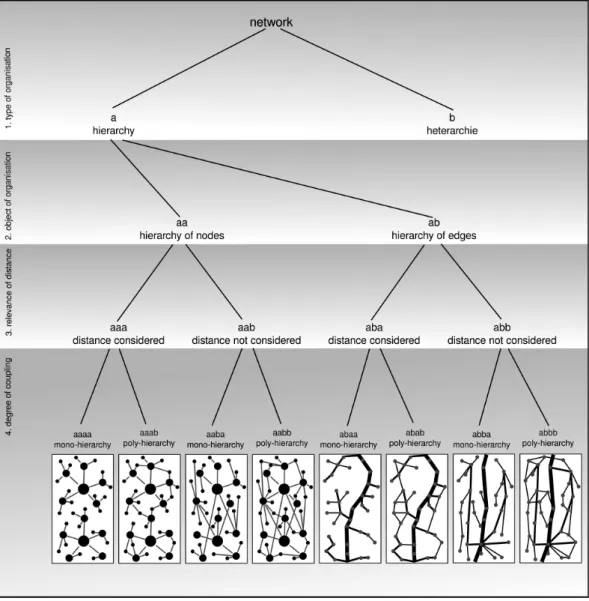
2. Extension of theoretical models of organisation structures (Fig. 1). Christaller of-fers us three theoretical models respectively one model with three variants (k3, 4, 7). Whereas these models are optimal for special purposes, other conditions were not consid-ered. We should offer a wider range of theoretical models. Therefore we use a hierarchical classification of models where each level is concerned with a key parameter (Fig. 2).
Level 1: Type of organisation. Is it possible to gain synergy effects by coordinating interaction? A positive response (a) leads to hierarchical structures while in the other case we cannot gain synergies (b) and heterarchic structures would be optimal.
220 Oliver Nakoinz
Fig. 2 | Scheme of Christaller centrality and network centrality.
Level 3: Relevance of spatial distance. Is distance or the effort of access to a place the dominating factor of transport costs? If distance is dominant (##a) we achieve structures with minimal distances. The borders of territories are crisp. If distance is a minor factor (##b) the borders are fuzzy.
Level 4: Independence of organisation structures. Are there synergies of multiple usage of organisation structures? It may be advantageous to use the same organisation structures for different tasks. This level is focussed on the balance of synergies of struc-ture and advantage of location. Multiple usage of organisation strucstruc-tures (###a) reduces the number of different structures and tends to monohierarchic structures. Independent organisation structures (###b) tend to polyhierarchic structures. The effect is obvious in hierarchic structures where the number of centres of the same level in one territory is a proxy for the independence of organisation structures. In network structures the effect may be hidden by the different weightings of the edges.
Model aaaa corresponds with the classic model of Christaller and hence can be divided into variants for different k-values. The other models expand the offer of different theo-retical models and therefore extend the coverage of the theory. This feature based com-pilation of nine theoretical models allows reverse modelling by comparing with empiric models. This allows estimation of the drivers of the development of settlement systems.
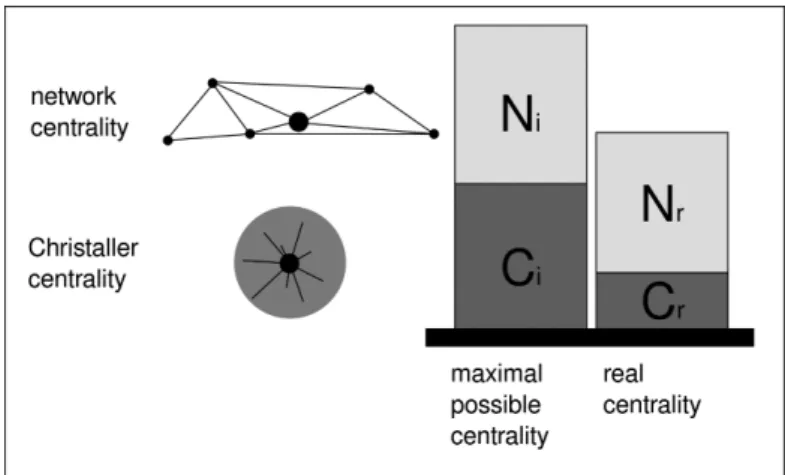
3. Integration of central place theory and network theory (Fig. 2). The extension of theoretical models includes the integration of central place theory and network theory so they are no longer contradicting paradigms but complementary models. This integration reduces the shortcomings of both concepts. This is a significant point since most central places have a certain value of Christaller centrality as well as a certain value of network centrality.
4. Vector of centrality. We can assume different types of centrality. The comparison of Christaller centrality and network centrality makes clear that there are different pa-rameters that qualify a central place. These components are
• Intensity of interaction (i) • Reach of interaction (r) • Levels of hierarchy (h) • Control of interaction (c)
Models of Centrality 221
Summary
222 Oliver Nakoinz
Bibliography
Christaller 1933
W. Christaller.Die Zentralen Orte in Süddeutschland. Jena: G. Fischer, 1933.
Crumley 1995
C.L. Crumley. “Heterarchy and the Analysis of Complex Societies”.Archaeological Papers of the American Anthropological Association6.1 (1995), 1–5.
Gringmuth-Dallmer 1969
E. Gringmuth-Dallmer. “Kulturlandschaftsmuster und Siedlungssysteme”. Siedlungs-forschung14 (1969), 7–31.
Hillier and Hanson 1984
B. Hillier and J. Hanson.The Social Logic of Space. Cambridge: Cambridge University Press, 1984.
Johnson 1972
G.A. Johnson. “A Test of the Utility of Central Place Theory in Archaeology”. In
Man, Settlement, and Urbanism. Ed. by R. Ucko P. adn Tringham and G. Dimbleby. London: Duckworth, 1972, 769–785.
Knitter et al. (in preparation)
D. Knitter et al. “Integrated Centrality Analysis. A Diachronic Comparison of West-ern Anatolian Habitats”. In preparation.
Mahr 2008
B. Mahr. “Ein Modell des Modellseins. Ein Beitrag zur Aufklärung des Modellbe-griffs”. InModelle. Ed. by U. Dirks and E. Knobloch. Frankfurt am Main: Peter Lang, 2008, 187–218.
Müller 2010
U. Müller. “Zentrale Orte und Netzwerke. Zwei Konzepte zur Beschreibung von Zentralität”. InZwischen Fjorden und Steppe. Festschrift Joh. Callmer. Ed. by C. The-une et al. Rahden/Westf.: Verlag Marie Leidorf, 2010, 57–67.
Nakoinz (in preparation)
O. Nakoinz. “Zentralität – Theorie, Methoden und Fallbeispiele zur Analyse zen-traler Orte”.eTopoi. In preparation.
Nakoinz 2009
O. Nakoinz. “Zentralortforschung und zentralörtliche Theorie”.Archäologisches Kor-respondenzblatt39 (2009), 361–380.
Nakoinz 2012
Models of Centrality 223
Olivier, Wirtz, and Triboulot 2002
L. Olivier, B. Wirtz, and B. Triboulot. “Assemblages Funéraires et Territoires dans le domaine Hallstattien Occidental”. InTerritoires celtiques. Espaces ethniques et terri-toires des agglomérations protohistoriques d’Europe occidentale. Actes du XXIVe colloque international de l’AFEAF, Martigues 2000. Ed. by D. Garcia and F. Verdin. Paris: Editions Errance, 2002, 338–362.