INTRODUCTION
Malaria remains a significant cause of human mortality and morbidity even in the wake of in-creasing research carried on in recent times. New drugs and vaccines are needed but more than that effective vector control and education of the com-munity about the deadly disease is the need of the day. Effective control measures in light of an understanding of the mechanisms underlying hu-man–parasite and vector–parasite interactions are all required to get a step closer to the ultimate goal of eradicating this disease.1
Because of a nationwide malaria eradication campaign launched in 1961, malaria was nearly eliminated in Pakistan during the 1960s. Financial and administrative constraints and misadventures led to an explosive resurgence of malaria in the 1970s, reaching epidemic proportion in 1972-73. In 1975, the strategy switched from eradication to control when malaria control interventions were integrated into the primary health care system.
Malaria continues to be a major public health problem in Pakistan since then. Extensive agricul-tural practices, a vast irrigation network and mon-soon rains have considerably added to the malariogenic potential in many areas. Both P. falciparum and P. vivax are widely distributed.
The Roll Back Malaria (RBM) partnership was launched in 1998 with the goal of reducing the burden of malaria by half by 2010.2 It is a global control strategy with an emphasis on areas where malaria is endemic and was launched in many Af-rican and Asian countries including Pakistan.3 Pa-kistan joined the RBM in 2001.4 It encompassed a comprehensive approach that included prompt and effective case management, selective vector control, epidemic management and control, envi-ronmental management and personal protection through the use of insecticide-treated nets (ITNs). The results are not forthcoming and seem unachievable according to the time frames given. According to the World Health Organization (WHO), 97% (approximately 150 million) of the Pakistani population is at risk of contracting ma-laria, with an estimated nationwide burden of 1.6 million cases per year.5
Environmental factors and behavioral patterns of vectors and human populations combine to pro-vide favorable conditions for malaria transmission. While much is known about the vector biology and behavior, the host behavior is largely over-looked.
This failure to consider community attitudes and beliefs about malaria has contributed to the inability of programs to achieve sustainable con-trol. Studies on knowledge, attitude and practices ORIGINAL ARTICLE
KAP STUDY ON MALARIA
Sheraz Jamal Khan, Muhammad Usman, Yasir Abbass, Muhammad Hussain, Mumtaz Ali Department of Medicine, Khyber Girls Medical College, Peshawar, Pakistan
ABSTRACT
Background: Knowledge, attitude and practices study about common diseases like malaria is a cost effective way to create awareness in the community. This study was conducted to know the knowledge, attitude and practices regarding malaria in our community.
Methodology: The study was conducted in the private clinic of the author. A structured questionnaire was used which contained detailed information about the demography, knowledge, attitude and practice of patients presenting with fever. This was translated to the patient and filled in by the author.
Results: Almost all the study subjects knew facts about malaria and all knew about at least one of the symptoms of malaria and 50% knew about three or more cardinal symptoms. Most of them (74%) also knew that blood test should be done to diagnose malaria. Most of the patients (76%) also knew that mosquitoes were the vectors. The knowledge about treatment was good too as 90% could name the drugs. Only 20% knew about prevention and 20% knew about the use of nets but more than 80% did not know about chemoprophylaxis.
(KAP) have demonstrated that direct interaction with community plays an important role in con-trolling malaria spread.
This study was conducted to know the knowledge, attitude and practices regarding ma-laria in our community.
MATERIAL AND METHODS
It was descriptive cross-sectional study. We used a structured questionnaire which had easy to answer questions on demographic data, basic knowledge about malaria, easily recognizable and remembered symptoms of malaria, its transmissi-bility, preventive measures on malaria, mosquito nets and health seeking behavior of the patients. The study selected 51 consecutive patients during the post monsoon malaria season during July to November, 2009. These patients were seen as out- patients in the private clinic of the author. The self administered questionnaire was filled by the author himself after asking the questions.
All data were entered and analyzed through SPSS version 15. Age was presented as mean + SD while categorical variables like Gender, edu-cation, occupation and all questions were pre-sented as frequencies and percentages.
RESULTS
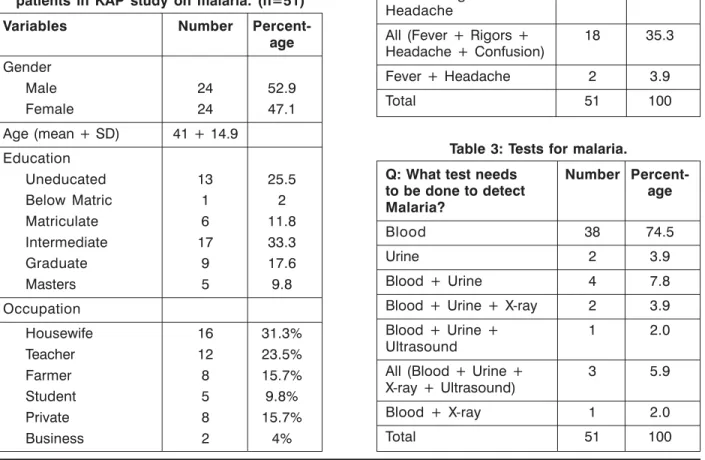
Of the 51 patients studies 27 (52.9%) were males and 24 (47.1%) were females. The mean age of all the patients was 41 + 14.9 years. The demo-graphic characteristics are given in Table 1.
Ninety eight percent of the patients knew about the disease. All patients could name at least one symptom of malaria with 23% naming three cardinal symptoms and 35% knew about four symptoms.
Seventy four percent of the patients knew that blood test should be done for malaria.
Majority (i.e. 75%) of the patients knew about mosquito as the cause of malaria. Two to six per-cent of patients also thought that other organisms were involved. All of them did not know plasmo-dium as the causative organism.
Table 2: Knowledge of the cardinal symptoms of malaria.
Q: what are the Number
Percent-cardinal symptoms age
of malaria?
Fever 7 13.7
Rigors 1 2.0
Fever + Rigors 11 21.6 Fever + Rigors + 12 23.5 Headache
All (Fever + Rigors + 18 35.3 Headache + Confusion)
Fever + Headache 2 3.9
Total 51 100
Table 3: Tests for malaria.
Q: What test needs Number
Percent-to be done Percent-to detect age
Malaria?
Blood 38 74.5
Urine 2 3.9
Blood + Urine 4 7.8 Blood + Urine + X-ray 2 3.9 Blood + Urine + 1 2.0 Ultrasound
All (Blood + Urine + 3 5.9 X-ray + Ultrasound)
Blood + X-ray 1 2.0
Total 51 100
Table 1: Demographic characteristics of patients in KAP study on malaria. (n=51)
Variables Number
Percent-age Gender
Male 24 52.9
Female 24 47.1
Age (mean + SD) 41 + 14.9 Education
Uneducated 13 25.5
Below Matric 1 2
Matriculate 6 11.8 Intermediate 17 33.3
Graduate 9 17.6
Masters 5 9.8
Occupation
Housewife 16 31.3%
Teacher 12 23.5%
Farmer 8 15.7%
Student 5 9.8%
Private 8 15.7%
Table 4: Causative agent in Malaria. Q: What is the cause Number
Percent-of Malaria? age
Mosquito 39 76.5
Bacteria 1 2.0
Virus 1 2.0
Mosquito + Bacteria 2 3.9 Mosquito + Virus 3 5.9 Mosquito + Fly 1 2.0 Mosquito + Virus + Fly 1 2.0 Mosquito + Bacteria 1 2.0 + Virus
Plasmodium 0 0.0
All (Mosquito + 2 4.0 Bacteria + Virus + Fly)
Total 51 100
Table 5: Transmission of malaria: Q: What is the mode of Number
Percent-transmission of age
Malaria?
Person to Person 3 5.9 Through Food 6 11.8 Through Mosquitoes 28 54.9 Person to Person + 7 13.7 Through mosquitoes
Person to Person + 2 3.9 Through flies
Through flies + Through 3 5.9 mosquitoes
All 2 4.0
Total 51 100
Table 6: Treatment of malaria: Q: What is the Number
Percent-treatment of age
malaria?
Quinine 6 11.8
Other Anti Malarials 7 13.7
Paracetamol 2 3.9
Quinine + Other 9 17.6 Anti Malarials
Quinine + Paracetamol 3 5.9 Quinine + Paracetamol+ 16 31.4 Artemether
Quinine + Paracetamol+ 8 15.7 Artemether + Infusion
Total 51 100
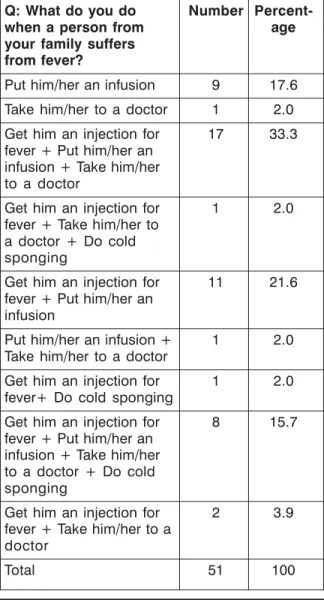
Table 7: Management during febrile illness. Q: What do you do Number
Percent-when a person from age
your family suffers from fever?
Put him/her an infusion 9 17.6 Take him/her to a doctor 1 2.0 Get him an injection for 17 33.3 fever + Put him/her an
infusion + Take him/her to a doctor
Get him an injection for 1 2.0 fever + Take him/her to
a doctor + Do cold sponging
Get him an injection for 11 21.6 fever + Put him/her an
infusion
Put him/her an infusion + 1 2.0 Take him/her to a doctor
Get him an injection for 1 2.0 fever+ Do cold sponging
Get him an injection for 8 15.7 fever + Put him/her an
infusion + Take him/her to a doctor + Do cold sponging
Get him an injection for 2 3.9 fever + Take him/her to a
doctor
Total 51 100
Fifty five percent of patients knew that trans-mission occurs through mosquitoes.
All the patients could name at least one drug for malaria with 50% knowing two or more drugs.
The knowledge and practice about “what to do?” when someone suffers from fever was var-ied and from setting up an infusion in 20% to tak-ing him to a doctor in 35%.
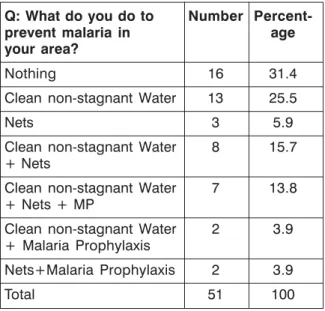
knew about clean non stagnant water and 35% knew about the use of nets. Seven percent knew about malaria prophylaxis.
Twenty five percent of people did not know about a health care worker and 47% denied having seen ahealth care worker visiting their area.
DISCUSSION
The objective of the national malaria control program is to reduce morbidity and mortality due to malaria to a level that it is no longer a public health problem in the country.
Key success factors for this goal are; clear knowledge on the clinical manifestation of malaria and early care seeking behavior. Positive health seeking behavior is critical in successful case man-agement.
The objective of this study was to investi-gate the knowledge, attitudes and practices of the community toward malaria so as to develop a cost effective behavioral change community strat-egy for community based malaria control. Knowl-edge of clinical manifestations, mode of
transmis-sion and causation of malaria is satisfactory. However, the practice of the use of mosquito bed nets, knowledge of environmental measures and knowledge about vector was lower than expected.
This study demonstrated that knowledge of clinical manifestations of malaria and its tive measures was high than its possible preven-tion. This increased awareness of these clinical features of malaria might be due to increased ac-cess to media.
Nearly all of the subjects knew that mosquito bite was the mode of transmission of malaria. This demonstrated high level of knowledge on causa-tion of malaria.
Greater knowledge about malaria causation, symptoms and prevention does not necessary translate into improved practice of preventive measures. Similar studies in different societies, especially in poor nations have almost similar re-sults.6-11 The Knowledge about the disease along with the factors responsible for its transmission and even health seeking behavior is quite adequate but the knowledge about prevention and practices in health seeking measures is scanty.
CONCLUSION
Based on the findings from this study it can be concluded that the subjects were familiar with the symptoms of malaria, mode of transmission and health seeking behavior was adequate. The knowledge about prophylaxis and vector control was grossly deficient. Similarly most of them did not even know about community health care worker and malaria control program officer. The situation is pathetic as there are gross misappropriations in malaria control and eradication program which need to be strengthened.
REFERENCES
1. World Health Organization: World Malaria Re-port 2009. Geneva; 2009.
2. Roll Back Malaria. WHO. Malaria - a global cri-sis. Fact Sheet No. 1211- Geneva Switzerland, 2002.
3. Roll Back Malaria. WHO Eastern Mediterranean Region. Cairo, Egypt. 2002; p. 1-14.
4. Asif SA. Departmental audit of malaria control programme 2001-2005 North West Frontier Province (NWFP). J Ayub Med Coll Abbottabad 2008; 20: 98-102.
5. World Health Organization: Strategic plan for malaria control and elimination in the WHO East-ern Mediterranean Region 2006-2010. [http:// www.emro.who.int/dsaf/dsa741.pdf]
Table 8: Prevention of malaria: Q: What do you do to Number
Percent-prevent malaria in age
your area?
Nothing 16 31.4
Clean non-stagnant Water 13 25.5
Nets 3 5.9
Clean non-stagnant Water 8 15.7 + Nets
Clean non-stagnant Water 7 13.8 + Nets + MP
Clean non-stagnant Water 2 3.9 + Malaria Prophylaxis
Nets+Malaria Prophylaxis 2 3.9
Total 51 100
Table 9: Knowledge about health care worker. Q: How often health Number
Percent-you are visited by age
health care worker?
Never 24 47.1
Sometimes 14 27.5
Don’t know who is a 13 25.5 health care worker
6. Hlongwana KH, Mabaso MLH, Kunene S, Govender D, Maharaj R. Community knowledge, attitudes and practices (KAP) on malaria in Swaziland: A country ear-marked for malaria elimination. Malar J 2009; 8: 29
7. Dike N, Onwujekwe O, Ojukwu J, Ikeme A, Uzochukwu B, Shu E. Influence of education and knowledge on perceptions and practices to control malaria in Southeast Nigeria. Soc Sci Med 2006; 63: 103-6.
8. Joshi AB, Banjara MR. Malaria related knowl-edge, practices and behaviour of people in Nepal. J Vector Borne Dis 2008; 45: 44-50. 9. Oguonu T, Okafor HU, Obu HA. Caregivers’
knowledge, attitude and practice on childhood malaria and treatment in urban and rural com-munities in Enugu, south-east Nigeria. Public Health 2005; 119: 409-14.
10. Booth CM, MacLean JD. Knowledge, treatment-seeking, and socioeconomic impact of malaria on the Essequibo Coast of Guyana. MJM 2001; 6: 17-25.
11. Deressa W, Ali A, Enquoselassie F. Knowledge, attitudes and practices about malaria, the mos-quito and antimalarials drugs in a rural commu-nity. Ethiop J Health Dev 2003; 17: 99-104.
Corresponding author: Dr. S. Sheraz Jamal Assoc. Prof.
Department of Medicine Khyber Girls Medical College Peshawar, Pakistan