Dynamic Process Integration Framework: Toward Efficient Information
Processing in Complex Distributed Systems
Gregor Pavlin and Michiel Kamermans Thales Nederland B.V., D-CIS Lab Delft, Nederland E-mail: [email protected], [email protected]
Mihnea Scafe¸s
University of Craiova, Romania
Keywords:service oriented architectures, distributed reasoning, negotiation, multi agent systems
Received:February 22, 2010
The Dynamic Process Integration Framework (DPIF) is a service oriented approach which supports effi-cient creation of distributed systems for collaborative reasoning. The DPIF is relevant for an important class of contemporary applications requiring efficient and reliable processing of large quantities of het-erogeneous information. An example of such an application is situation assessment in complex decision making processes in dynamic environments. The DPIF supports (i) a systematic encapsulation of hetero-geneous processes and (ii) negotiation-based self configuration mechanisms which automate creation of meaningful workflows implementing complex collaborative reasoning processes. The resulting systems support processing based on rich domain knowledge while, at the same time, the collaboration between heterogeneous services requires minimal ontological commitments.
Povzetek: Opisan je nov pristop v procesiranju informacij v kompleksnih porazdeljenih sistemih.
1 Introduction
This paper introduces a service oriented architecture sup-porting complex collaborative processing in distributed systems. The presented approach is relevant for many con-temporary applications that require reasoning about com-plex processes and phenomena in real world domains. For example, in crisis management advanced information pro-cessing is required for (i) identification of critical situa-tions, (ii) impact assessment which takes into account pos-sible evolution of physical processes, (iii) planning and evaluation of countermeasures and (iv) decision making. This can be achieved only through adequate processing of large quantities of very heterogeneous information, based on rich expertise about different aspects of the physical world. Such processing requirements typically exceed the cognitive capabilities of a single human expert; an expert typically does not have knowledge of all the relevant mech-anisms in the domain and cannot process the huge amounts of available information. On the other hand, full automa-tion of decision making processes in such settings is not feasible, since the creation of the required domain models as well as the inference are intractable problems. Specif-ically, automated inference processes involve many vari-ables and relations with accompanying representation and inference mechanisms.
Such settings require collaborative processing based on a combination of automated reasoning processes and cog-nitive capabilities of multiple human experts, each
con-tributing specific expertise and processing resources. Key to effective combination of human-based expertise and au-tomated reasoning processes is a framework which allows that each piece of the relevant information is adequately considered in the final processing outcome. The main ele-ments of such a framework are:
1. Standardized formats that facilitate sharing of hetero-geneous information.
2. Filtering services which provide stakeholders in a de-cision making process with the right information at the right moment in time. In principle, filtering ser-vices must transform heterogeneous data to more ab-stract information types and route the information to the consumers who can make use of it.
solving processes in workflows; humans are not mere users of an automated system, but contribute the processing re-sources. From the problem solving perspective, the humans can be viewed as a specific type of processing modules, integrated into the overall processing system via assistant agents.
In general, a key to efficient collaborative processing in complex domains are workflows, in which peers with different processing capabilities exchange relevant infor-mation [25, 4, 2, 3, 27]. Often such workflows are cre-ated through dynamic composition of services [5, 25]. In this way the systems can adapt at runtime and deliver tai-lored solutions to specific problems. Creation of work-flows is often based on centralized planning and ontolo-gies describing relations between different services. Ap-proaches exploiting centralized service composition have been successfully used in many relevant applications, such as business process modeling [15, 22], scientific querying [4], planning/booking systems [22] and simulation and sci-entific grid computing [14, 8].
For the challenges addressed in this paper, however, centralized approaches to composition of workflows and central description of relations between services are nei-ther practical nor necessary. Namely, we are dealing with systems in which artificial agents and experts collabora-tively process large quantities of heterogeneous informa-tion. In such settings construction of centralized ontologies describing services as well as all relations between the han-dled information types is likely to be very hard or even in-tractable. Similarly, centralized construction of workflows might not be practical, since the constellations of available services (i.e. automated processes or experts) change fre-quently at runtime. Given the time constraints, communi-cation of all changes and system states to a central work-flow composition process might not be feasible. Thus, the resulting, centrally composed workflows are likely to incor-porate only a subset of all services relevant for a problem at hand.
It turns out that efficient solutions to service composition can be obtained if we explicitly take into account the char-acteristics of the problem. In particular, many of the chal-lenges associated with centralized approaches to service composition and definition can be avoided if the resulting systems are used in organizations that can be characterized as Professional Bureaucracy [26]. In such organizations the skills are standardized, the control is decentralized to a great extent and the experts and/or automated processes do not have to share domain and processing knowledge. In other words, complex problems can be efficiently solved with the help of systems of loosely coupled experts and automated processes without a centralized control. Collab-oration in such systems can be achieved through service discovery based on local domain knowledge. Therefore, we introduce an approach which does not require central-ized service ontologies and centralcentral-ized service composition methods. Moreover, fully decentralized configuration of meaningful processing workflows can be achieved by
us-inglocal knowledge of relationsbetween different services. The approach requires simple ontologies which serve pri-marily for the alignment of the semantics and syntax of messages exchanged between the processes in workflows. In addition, the relations between types of services are cap-tured by local functions, dispersed throughout a system of modules providing the services. We show that meaning-ful workflows supporting globally coherent processing can be created by using only local domain knowledge. In this way we obtain systems which support processing based on rich domain knowledge while, at the same time, the collab-oration between heterogeneous services requires minimal ontological commitments [9].
Overall, by using the DPIF encapsulation techniques and methods, arbitrary processing services can easily be made composable and negotiable.
The paper is organized as follows. In section 2 a ra-tionale for decentralized collaborative reasoning in work-flows is provided and the basic features of the DPIF are introduced. Section 3 explains how meaningful workflows between heterogeneous processes can be dynamically im-plemented, without centralized knowledge of relations be-tween the variables in the reasoning processes. In partic-ular, we emphasize a combination of service composition, decentralized validation methods and advanced negotiation mechanisms, which allow a systematic incorporation of various criteria into the workflow creation processes. Sec-tion 4 introduces basic DPIF architecture principles while section 5 introduces an approach to efficient construction of service ontologies by exploiting the local domain knowl-edge captured by different DPIF agents. Section 6 provides conclusions and plans for the future work.
2 Collaborative processing
Reasoning about domains requires knowledge about typi-cal dependencies (i.e. relations) between relevant phenom-ena in these domains. By using (i) domain models captur-ing the relations between relevant phenomena and (ii) evi-dence based on observations of certain phenomena, we can assess (i.e. estimate) the states of the domain that cannot be observed directly. In addition, with the help of models, the future evolution in domains can be predicted. However, in complex domains reliable reasoning can be achieved only by relating large quantities of information of very hetero-geneous types with very different semantics. Such depen-dencies can be explained only through complex models.
out-puts of simple processes are used as inout-puts of other simple processes. In other words, the reasoning is based on data-driven workflows established between heterogeneous pro-cesses. In such workflows difficult problems can be solved through collaboration of heterogeneous processes, each fo-cusing on a relatively small subset of relevant aspects in the targeted domain.
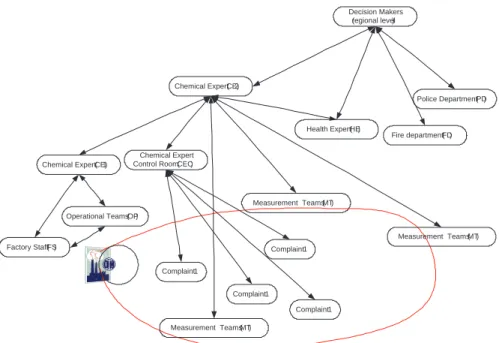
We illustrate such processing by using an example from the environmental management domain. In a chemical in-cident a leaking chemical starts burning which results in harmful fumes. The impact of a resulting fumes is miti-gated through a collaboration of experts captured by fig-ure 1. We assume that the factory staff (FS) at the incident have an overview of the current state of the damaged sys-tem; FS can estimate the quantity of the escaping chemical and its type. This information can be used by a chemical expert at the incident location (CE1) to estimate the type and quantity of toxic fumes resulting from the fire. By knowing the location of the fire, the meteorological con-ditions, and the quantity and type of the produced fumes, chemical expert (CE2) can estimate the zones in which the concentration of the toxic gases have exceeded critical lev-els and identify areas which are likely to be critical after a certain period of time. The CE2 makes use of the domain knowledge about the physical properties of the gases and their propagation mechanisms. In addition, it guides fire fighter teams (MT) which can measure gas concentrations at specific locations in order to provide feedback for a more accurate estimation of the critical area. A map showing the critical area is supplied to a health expert (HE) who uses the information on population obtained from the municipality to estimate the impact of the toxic fumes on the human population in case of exposure. Finally, the estimated im-pact on the population is supplied to decision makers, who choose between no action, evacuation and sheltering. This decision also considers estimated time and costs in case of an evacuation of people from the danger zone as well as the estimated costs and duration of a preventive evacuation. The former estimate is provided by the fire brigade repre-sentatives while the latter estimate is supplied by the police department. In other words, in such a system, each expert can be viewed as a module providing predefined services which in turn require services from other experts. Thus, the situation analysis in the presented example can be viewed as a workflow between different, weakly coupled process-ing services, each specialized in specific aspects of the do-main. Moreover, a processing service can be provided by a human (e.g. a chemical expert analyzing the extent of the contamination) or by an automated reasoning process (e.g. detection of gases based on automatic fusion of sen-sor data). Note that, for the sake of clarity, the used ex-ample is a significant abstraction of real crisis management processes.
Moreover, the example can be seen as a class of prob-lems where we have to reason about a situation which can be viewed as a specific combination of known types of events and processes, each understood by a human expert
or modeled by an artificial agent. For example, the way chemicals burn and react, the effects of exposure to toxic fumes, evacuation approaches in hospitals and schools, etc. are independent of the location and time. Therefore, we can obtain general knowledge about such processes and phe-nomena which can be used for the analysis in any situation involving such phenomena. In other words, a mapping be-tween experts and artificial agents, on the one hand, and event types, on the other hand, can be made a priori; we can assign roles to different experts and artificial agents based on their domain knowledge and models.
Since each situation (e.g. chemical incident) is a unique combination of known types of events, a specific workflow consisting of a particular combination of processing nodes is required for adequate situation assessment. In addition, due to unpredictable sequences of events it is impossible to specify an adequate workflow a priori. For example, given the wind direction, experts for the evacuation of hospitals and schools might be needed. However, if the gas is blown to the open sea instead, no evacuation experts are needed in the situation assessment process.
Clearly, a major challenge is creation of adequate work-flows which correctly integrate the relevant processes and support globally coherent processing in decentralized col-laborative systems. In the following text we explain how this can be achieved in an efficient and sound way.
2.1 Dynamic process integration framework
The Dynamic Process Integration Framework (DPIF) sup-ports decentralized creation of workflows that facilitate col-laborative problem solving. The DPIF is a service-oriented approach (SOA) which supports efficient composition of very heterogeneous processing services provided by differ-ent experts and automated reasoning processes. In the con-text of the DPIF, the information processing is abstracted from human or machine instances; a reasoning process is either provided by a human expert or an automated system implemented by a software agent. Each process provides a well defined reasoning service in the form of an estimate, prediction, cost estimate, etc. The inputs for each of such processes are provided by other processes or by direct ob-servations (i.e. sensor measurements and reports from hu-mans).
A human expert or an automated inference process is represented in the system by a software agent, a functional (i.e. processing) module which (i) supports standardized collaboration protocols and (ii) allows incorporation of ar-bitrary reasoning approaches. In other words, the agents provide a uniform communication/collaboration infrastruc-ture allowing seamless combination of heterogeneous pro-cesses provided by human experts or implemented through AI techniques. Each agent registers in the DPIF-based sys-tem (i) the services supported by its local processing capa-bilities and (ii) the required inputs, i.e. types of services that should be provided by other agents in the system.
Operational Teams (OP)
Factory Staff (FS)
Chemical Expert (CE2)
Chemical Expert (CE1)
Health Expert (HE) Decision Makers
(regional level)
Measurement Teams (MT)
Police Department (PD)
Fire department (FD)
Measurement Teams (MT)
Measurement Teams (MT) Complaint 1
Complaint 1 Complaint 1
Complaint 1 Chemical Expert
Control Room (CEC)
Figure 1: A workflow in a decision making process. Arrows denote information flow between different experts, each processing relevant information of different types. The circled region denotes the initial estimate of the area where concentration is likely to be critical.
throughout different networked devices can autonomously form workflows in which heterogeneous processes intro-duce collaborative reasoning. The configuration of work-flows is based on the relations between services captured by local models; each agentknowswhat service it can pro-vide and what it needs to do this. This local knowledge is captured by the relations between the variables in partial domain models. Thus,no centralized ontology describing relationsbetween different services of various agents is re-quired, the creation of which is likely to be intractable.
In other words, globally coherent collaborative process-ing is possible by combinprocess-ing local processes, without any global description of relations between inputs and outputs.
In the following discussion we focus on (i) principles for the creation of valid workflows based on the local pro-cessing capabilities of different agents and (ii) describe the basic elements of the DPIF architecture.
3 Processing workflows
A basic workflow element in the DPIF is a local process. Moreover, in the following discussion the term local pro-cess refers to a reasoning propro-cess provided either by a hu-man expert or an automated system implemented by a soft-ware agent. Each local process corresponds to a function
F : {X1, ..., Xn} → Y, mapping values in a domain {X1, ..., Xn}to values of some variable of interestY. The
value of Y for particular values of arguments is given by
y=fy(x1, ..., xn).
Such functions can be either explicit, based on some
rig-orous theory, or implicit, when they are provided by hu-mans or sub-symbolic processes, such as for example neu-ral networks. An example of a mathematically rigorous mapping is the functionxCE1 =fxCE1(xF S), an explicit
formula describing the relations between the fume volume per time unit represented byXCE1and the escape rate of
chemicals denoted byXF S. This function is used by the
Chemical Expert CE1 in figure 1. An implicit mapping, on the other hand, is performed by the health expert (HE) who estimates the critical regions with respect to the impact on the residents. HE interprets information about critical concentration XCE2 in combination with information on
population distribution XP OP by using an implicit
func-tionxHE =fxHE(xCE2, xP OP).
3.1 From local to global processes
com-posite mapping between directly observable variable states and hidden variables of interest.
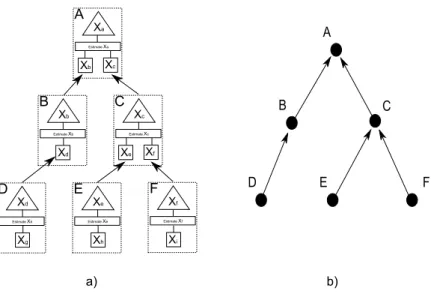
In other words, a workflow in a DPIF system corre-sponds to a full composition of functions, in which each variable replaced by a function corresponds to a required service. This yields the value of the variable of interest. Let’s assume an example with six service suppliers shown in figure 2(a), using the following functions:
xa = fa(xb, xc), xb=fb(xd), xc=fc(xe, xf),
xd = fd(xg), xe=fe(xh), xf =ff(xi).
then the workflow supporting collaborative computation of the value forxacorresponds to the composite function
fa(fb(fd(xg)), fc(fe(xh), ff(xi))) (1)
It is important to bear in mind that in DPIF no explicit function composition takes place in any of the agents. Instead, the sharing of function outputs in a workflow corresponds to such a composite function; i.e. a workflow models a (globally emergent) function, mapping all observations of the phenomena of interest (i.e. evidence) to a description of some unknown state of interest.
Each workflow corresponds to a system of systems, in which exclusively local processing leads to a globally emergent behavior that is equivalent to processing the fully composed mapping from direct observations to the state of the variable of interest.
3.2 Decentralized validation of workflow
structures
The functions in a workflow can be described through dif-ferent ad-hoc or theoretically sound frameworks (such as for example Bayesian reasoning). However, the relation between workflows and function composition has several interesting properties regardless of the theory used to de-scribe the functions. Workflows, in general, can be repre-sented by directed graphs1 whose topologies have
impor-tant implications regarding the reasoning (e.g. see figure 2(b)). Particularly important concepts in graphs are loops and cycles. Loops occur when there is more than one way to travel between two nodes by following the directed links in a graph, i.e. there exist multiple directed paths between two nodes (e.g. see figure 3(b)). Cycles occur if a node can be revisited by following a directed path (see figure 4(c)).
Loops and cycles provide an important insight into the dependencies between different services (i.e. processes) and thus the use of information in a distributed system.
If a process uses multiple inputs obtained from services belonging to aloop, then these inputs might have been gen-erated by distributed processes using the same information.
1A directed graph representing a workflow consists of nodes, each
rep-resenting a process (i.e. a function), and directed links which capture direct dependencies between the processes (i.e. supplier-consumer rela-tions).
In other words, these inputs may not be independent, which might lead to data incest [7], if the inputs are not prop-erly treated. In case of data incest, the same information is reused multiple times which is likely to lead to mislead-ing conclusions. In case of rigorous reasonmislead-ing approaches, such as Bayesian networks, this problem can be avoided by clustering of variables [12], which allows correct prob-abilistic reasoning even if the graphs contain loops. In any case, we should be aware of loops in systems implementing distributed functions.
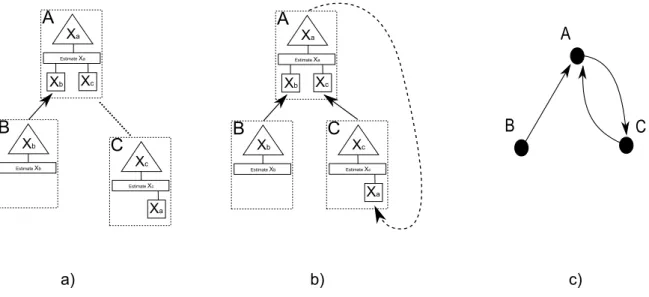
While loops may be permissible, as there are various ways to deal with them if detectable,cyclesare not permit-ted in workflows that implement inference, as they would lead to one or more components in a workflow process-ing misleadprocess-ing data. That is, the system is generatprocess-ing out-puts without adding new information to the system. In a data-driven approach this leads to a self perpetuating sys-tem which is likely to produce outputs which do not re-flect the reality. Figure 4(b) shows an example of a sys-tem with a directed cycle, where agentAkeeps supplying inputs to agent C, which in turn produces new inputs for
A. By looking at the composed function represented by a workflow, cyclical workflows would lead to infinite compo-sition sequences: if some function is directly or indirectly dependent upon itself, then this would lead to an infinitely recursive composition of the full function which is likely to result in misleading outputs.
Therefore, an integral part of the DPIF is a cycle detec-tion mechanism based on the cycle detecdetec-tion principles in-troduced in [13]. The used approach allows a fully decen-tralized detection of cycles based on peer to peer commu-nication. These principles were initially used in modular systems using Bayesian networks [13], but the technique discussed is easily carried over to a more generic domain.
In order to effect cycle-free workflows, each DPIF agent must be aware of the outputs of other agents that influence the inputs of this agent. In [13] it was shown that this in-formation can be obtained during the creation of workflows by passing simple information between the peers in a work-flow; as agents link up to form workflows, the composition of the network influencing the inputs of each agent can be recorded. By using such knowledge, agents can locally de-termine whether extension of a DPIF workflow with a new peer would introduce cycles; i.e. each agent can find out whether or not it is setting up an (in)direct dependency on itself, without any central authority.
While in this paper we cannot describe all interesting as-pects of this approach, we illustrate the basic cycle detec-tion principles from [13] with the help of an example. In figure 4(a), agent Asupplyingxa forms a workflow with
agentBsupplyingxb. AgentAknows the output variable
setSA={xa, xb}, and agentBknows the output variable
setSB ={xb}. In figure 4(b), an agentC, able to supply
xc, joins the workflow. AgentC knows its current set of
output variables;SC ={xc}. Before joining, agentA
Figure 2: a) A self-organized system of agents. Each agent supplies information concerning a particular variable of interest in the domain. These outputs are based on other inferred or directly observed variables. b) A directed graph capturing the workflow between the agents from a).
SA∩SC=∅. This holds, so the connection is allowed and
Agent C joins the workflow. As it does so, Agent A up-dates its variable set toSA ={xa, xb, xc}; i.e. Aobtains
all the relevant information about the services that influence its function by peer to peer sharing of local information.
However, when agent C looks for suppliers, the only available agent supplyingxa isA, the one to whichC is
already connected. AsC conducts a verification step, in which the variable setsSC={xc}andSA={xa, xb, xc}
are tested for empty set intersection, the intersectionSA∩
SC 6=∅, and so C knows that a cycle would be introduced
if the servicexAwere supplied to it byA.
In fact, in [13] it was shown that cycles, as well as loops, can be detected in workflows in completely decentralized manner by collaboration of peers exchanging asynchronous messages. Peers check the intersections of dynamically as-sembled variable sets at different levels of the workflow, and as new agents join the workflow the new network lay-out needs to be reflected in all agents whose downstream network has changed by new connections. Thus, we can view the task of loop and cycle detection as a combina-tion of (i) checks which travelupstream (i.e. toward the top agent) until the top agent of the network is reached, (ii) messages conveying the updated topology, and (iii) control messages which lock/unlock the agents for local checks.
In general, this approach allows for an intelligent han-dling of loops and cycles in workflows, where the choice on whether to allow a connection or not is dependent on the function performed by an agent that is responsible for expanding a workflow. There exist functions which require that all inputs are provided, in order to yield an output. In such cases, an agent modeling a function may decide to abandon a workflow when one or more of its inputs would lead to a cycle (or loop). On the other hand, there are also functions which yield output even when some inputs are left unknown, such as for example marginal conditional probabilities expressed with the help of Bayesian networks. In these cases, an agent modeling such a function may keep participating in the workflow, provided it can ensure that the inputs otherwise responsible for introducing cycles are not supplied to any other agent; i.e. the inputs are ignored in the evaluation of the function.
3.3 Negotiation
In the DPIF, communication links between local processes in agents are facilitated firstly using service discovery: whenever an agent supplying some service (we will call this service theparent service, and the agent implement-ing it theparent, ormanager agent) in a workflow requires data relating to some other service (we will call this re-quired service thechild service, and the agent implement-ing it thechild, orcontractor agent), a communication link needs to be established between the parent agent and the child agent. However, there are two important aspects that affect whether and why links are established: i) we might have several agents in the system that provide the same
ser-vice, i.e. that are able to realize the same task, and ii) we cannot always assume that a service providing agent will automatically agree to supply the service asked for by a requesting agent. For example, the providing agent might be overloaded, or it might even consider that establishing a link is inappropriate, given the current context.
In addition, on its own, service discovery can only of-fer links between agents based on a broad level of service matching, while for the system to solve a particular prob-lem, a finer level of control is required to match services on whatever additional parameters may be of importance to particular links. For this we use negotiation. Rather than performing perfect matching at the service discovery level, negotiation allows us to filter potential links found through service discovery based on additional service parameters.
Negotiation in general consists of three elements [10]:
– protocols, i.e. sets of rules that describe the steps of negotiation processes; example protocols are Contract Net (CNET), monotonic concession protocol (MCP), Rubinstein’s alternating offers and auctions [28] [24] [29].
– subject, i.e. the item being negotiated about. In ser-vice negotiation, the negotiation subject is the serser-vice with its parameters.
– strategies, i.e. the set of decisions that agents will make during the negotiation in order to reach a pre-ferred agreement.
We have developed a conceptual framework for service negotiation that will be used in the DPIF [21]. The frame-work is generic and addresses negotiation protocols, nego-tiation subject and decision components (how agents make proposals and how they select the best proposals).
Establishing links is based on one-to-many negotiation; i.e. one agent (the manager) negotiates with multiple agents (possible contractors) about a service, with an arbi-trary set of parameters (multi-issue subject) [19], [20]. The framework defines the common steps of negotiations, in-cluding starting negotiations, making proposals, deciding whether an agreement or a conflict has been reached and termination.
The negotiation subject consists of the service plus a sub-set of service parameters that are important decision factors during negotiation (they are taken into consideration when selecting the proper service providers). During negotiation, these parameters are considered negotiation issues. Thus, the negotiation designer defines the negotiable parameters of the service (negotiation issues) when configuring the ser-vice. When negotiating, agents need to know how to han-dle the issues and extra information about the issues should be added into the system. Therefore, issues have a set of properties. These properties include:
– name: a unique identifier of the issue in the subject.
Figure 4: a) a partially formed collaboration, allowing the top agent to perform inference, leading to information about the state of variablexa. b) If the potential connection represented by dashed directed link were allowed, a cycle would form in the workflow. c) A graph corresponding to a system of DPIF agent if the connection from b) were allowed.
– value type: specifies whether the value of the issue can be modified in proposals or the original value set by the manager should be kept.
In addition to the standard set of properties, agents (de-pending on their role) are allowed to assign some extra properties to the issues:
– weight: represents the relative importance of the issue in the subject, compared to the other issues.
– reference value: represents the ideal value of the issue from the point of view of the agent.
For the moment the issues are evaluated independently. The default negotiation in DPIF is an implementation of CNET [24]. A manager starts a negotiation for a service by sending a call for proposals to all the contractors that are able to provide the service. Each contractor then tries to compute a proposal. Contractors evaluate possible propos-als using a utility function that takes into consideration the effort necessary to provide the service under the conditions in the proposals. If contractors are successful in generating proposals, they send them to the manager, otherwise they withdraw from the negotiation. After receiving proposals, the manager selects the best proposals, the ones that give him the highest utility. The manager uses a weighted sum utility function to evaluate proposals.
Although the default negotiation protocol is CNET, the system allows for the use of arbitrary negotiation schemes, supporting domain specific one-to-many generic negotia-tion approaches where the protocol, the subject type and strategies are specified in the service configuration phase. There are two configuration levels:
– negotiation type level. At this level the negotiation designer defines the negotiation protocol, identifies
the negotiation issues and sets default values for their properties.
– negotiation instance level. At this level a human ex-pert can tune the issue proex-perties for a certain situa-tion.
We illustrate how negotiation takes place with such multi-issue subjects, by looking at the example described in figure 1. We emphasize the step when the CE2 de-cides to guide MTs to measure gas concentrations at a lo-cationX. In addition, CE2 decides that measurement de-vices DEV_X are the most appropriate for the measure-ments. Other devices can be used as well but with less precision. CE2 initiates a negotiation over the multi-issue subject (Gas measurement, location, device) with all MTs that are able to provide the serviceGas measurement. MTs propose various deals for this negotiation: the locations they are currently placed at and the devices they have. Ide-ally, MTs would propose the best deal (Gas measurement, X, DEV_X). CE2 must decide what MTs to choose by tak-ing into account various parameters: the distance between location X and locations where MTs are placed, the dif-ferences in precision between deviceDEV_Xand devices MTs have.
The outcome of a successful negotiation between two agents is a contract, which results in the creation of a com-munication channel supporting peer-to-peer communica-tion between the agents.
3.4 Collaborative information acquisition
The DPIF approach supports efficient gathering of infor-mation by distributing the search task throughout systems of collaborating agents, i.e. services. Namely, the search for the relevant information/data must be based on the do-main knowledge in the system, which is used for the rea-soning; only the information that is represented in implicit or explicit domain models can be processed. Since in the DPIF the domain knowledge is dispersed throughout a sys-tem y the experts or automated processes providing the rea-soning services, the information gathering is carried out by the service providers as well.
Upon establishing contracts in a particular collaboration network, the service providers initiate a search for infor-mation based on their domain knowledge. Each service provider knows exactly which information is needed and under what conditions it should be obtained. The service providers either request inputs via the DPIF service dis-covery or they have access to direct observations (e.g. they observe sensors, databases, etc.). We say that the services with a direct access to the observations are grounded in the domain; they can observe real world phenomena di-rectly. If the services are notgrounded, they delegate the search of information and pass on only the information whichconstrainsthe search process carried out by service provider. Typically, an information requester knowswhat
is needed and whereandwhenit should be obtained but does not know how this information locating can be car-ried out. This information is passed on to the provider, that knowshowthe information can be obtained in the specified spatio-temporal context.
In this way a complex search for information is broken down into several simple search processes which guaran-tee that only the relevant information is inserted into the distributed reasoning system. By using the service discov-ery and negotiation, the judgment of what is needed and what can be provided is carried out by the information con-sumers and providers themselves, without the need of intro-ducing a central authority. Note that a centralized approach to information search would require a centralized author-ity that would replicate some of the local knowledge and have a complete overview of the information acquisition processes and capabilities of all services. Such a central solution is not practical in the targeted domains, where new expertise/algorithms as well as new information sources are added frequently.
We illustrate the distributed approach to information ac-quisition with the help of the aforementioned example. Ex-pert CE2 is requested to estimate the critical zones after a leak at a chemical plant is discovered. CE2 needs ad-ditional information to accomplish this task. Based on his local expertise, CE2 knowswhatinformation should be ob-tained and under what conditions this should happen. For example, CE2 needs the information about the type and quantity of toxic fumes escaping at locationX (assuming he was just informed that there was a leak atX). He also needs information about the weather in the larger incident area. This information should be obtained within a certain
time interval and the service itself should conform to cer-tain quality requirements, percer-taining to such things as the experience of the information providers, minimum preci-sion of the estimates, etc. The requested types of infor-mation as well as the additional constraints are used by the DPIF service discovery and negotiation mechanisms which establish contacts between the DPIF agents of the re-quester CE2 and suitable information providers, such as ex-pert CE1. The negotiation ensures that the requested types of information pertain to the right location and time inter-val and that the experts with the right quality of service are involved. For example, a request from CE2 is processed in the DPIF, which finds agents of two experts that can pro-vide service of type CE1. However, during the negotiation, it may turn out that only one expert can provide the estimate of the toxic fumes at locationX within the given time in-terval. The chosen CE1 can get to the location on time and supports the required quality of the service. CE1 gets to the incident location and obtains from the factory staff the in-formation about the leaking chemical, the pressure and the leak location; i.e. CE1 knows what information should be obtained about the incident site and how this can be done. This information is used by CE1 for the estimation of the quantities of the escaping fumes. This estimate is routed to CE2 by using the peer to peer communication channel. After the first estimate of the critical areas is provided, CE2 requests additional concentration measurements at certain locations, in order to improve the initial estimate of the crit-ical zone. CE2 specifies the types of measurements, the measurement locations as well as the maximum time in-terval in which the measurements must be provided. The requests are routed via the DPIF to the measurement teams (MT) who are able to go to the specified locations and carry out concentration measurements. The subsequent negotia-tion results in the creanegotia-tion of contracts between the CE2’s agent and the agents representing the MTs which can then get to the specified locations in the given time and carry out the requested measurements.
Note that in this simplified example the search of infor-mation requires very different types of requests and acqui-sition methods. In other words, a lot of domain knowledge as well as procedural knowledge is required.
The requests to CE1 and MT reflect CE2’s knowledge of the gas propagation processes, his current knowledge of the situation as well as his processing capabilities. The bids from MT and CE1, on the other hand, reflect their capabil-ities to provide the requested information. As a result of this approach, from a global perspective, the information acquisition process implements very complex patterns in non trivial spatio-temporal context.
4 Processing modules: architecture
pro-cesses in different agents. A key feature of DPIF agents is asynchronous, data-driven processing in complex work-flows. This is achieved through a combination of weakly coupled processes inside individual agents, and service based coupling of processes between distinct agents.
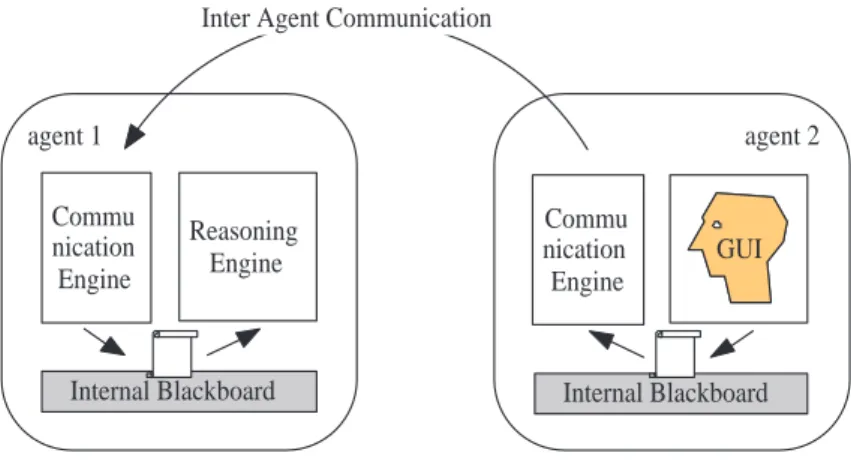
Each agent consists of at least two processes imple-mented through asynchronous threads communicating via a local blackboard (see figure 5). The “Communica-tion Engine” process is a thread that allows for message-based inter-agent communication, facilitating collabora-tion and making negotiacollabora-tion capabilities known to other agents. Through their Communication Engines, workflows between local processes in different agents can be estab-lished, by executing service discovery and negotiation (see section 3.3). The “Processing Engine” process, on the other hand, is a thread which encapsulates arbitrary automated or human based inference processes. The Processing Engine is responsible for the local processes that implement trans-formations between different types of information, based on the interpretation of complex cues. Moreover, each Pro-cessing Engine can keep track of one or more of these local processes simultaneously. The Communication En-gine supplies the Processing EnEn-gine with inputs that are obtained through inter-agent messaging, by posting these on the agent’s local blackboard for the Processing Engine to see. The Processing Engine then places the results of local inference processes on the local blackboard for the Communication Engine to pick up and relay via normal inter-agent messaging to interested agents.
The Communication and Processing engines must be able to execute simultaneously. Reasoning can be com-putationally expensive which requires a certain amount of time, but during this time an agent should be able to nego-tiate about possible collaboration with other agents, asyn-chronously collect their outputs for use in local processes and so on.
Both the Communication Engine and Processing Engine threads communicate through a limited set of messages via the local blackboard. New externally received inputs are transformed and placed by the Communication Engine on the internal blackboard, which triggers callback of ad-equate functions in the Processing Engine. The Process-ing Engine transforms these inputs into local output and places this output on the blackboard, which triggers call-back at the Communication Engine for relaying this infor-mation via normal messaging to agents interested in this output. Through cascaded processing in the resulting sys-tem of collaborating agents, each piece of information in-fluences the outcome of the collective reasoning processes, such as estimates/predictions or evaluations (i.e. reasoning result); with each contributing process, new observations and a particular expertise are incorporated into the global reasoning process.
Note that, irrespective of the type of the local processes, the Communication Engine and the Processing Engine in each agent use the same mechanisms for the creation and maintenance of correct workflows between local processes
in different agents. The uniformity of configuration mech-anisms can be used for a seamless integration of human experts into complex processing workflows. A DPIF agent representing an expert has a very simple Processing Engine which delivers the required inputs to a human expert via a suitable GUI. The expert’s conclusions, i.e. his/her service, are also formulated with the help of this GUI and routed to interested agents via the Communication Engine. Thus, agents used by human experts merely provide automated routing of information between experts, and take care of the automated creation of collaboration connections.
5 Dynamic service ontologies
In order to be able to automatically compose heterogeneous services provided by different developers or experts, the definitions of service interfaces have to be standardized, which is achieved with the help of explicit service ontolo-gies. Moreover, the locality of the domain knowledge in the DPIF approach can be exploited for efficient creation of rigorous service descriptions.
Services declared in the DPIF are typically provided by many stakeholders from different organizations whose ca-pabilities evolve with time. Large systems of service de-scriptions have to be maintained and it is very difficult to specify a complete set of services prior to the operation. In other words, traditional approaches based on rigorous centralized ontologies, such as for example [4, 22], which capture service descriptions and relationships between in-formation provided by different types of services are not practical; we simply do not know which relevant services will be available in the future and maintenance of large on-tologies is likely to be very expensive or even intractable.
Fortunately, the locality of domain knowledge in the DPIF approach supports efficient creation of service on-tologies. Because self organization and processing are based on domain knowledge encoded in local functions, we can avoid traditional approaches to constructing cen-tralized ontologies, which describe domains in terms of complex relations between the concepts corresponding to the processing services. In the targeted domains, adequate maintenance of such ontologies is likely to be an intractable challenge. Instead, the services and relations between them are described by using two types of light weight ontologies:
– The global service ontology merely captures service descriptions, the semantics and syntax of messages used for (i) service invocation and (ii) dissemination of service results. This ontology is used for the align-ment of the semantics and syntax of service descrip-tions at design time.
agent 1
Internal Blackboard Commu
nication Engine
Reasoning Engine
agent 2
Internal Blackboard Commu
nication Engine
GUI Inter Agent Communication
Figure 5: Interaction between agents providing heterogeneous processing services. Both agents use identical communi-cation engine. However, agent 1 encapsulates automated processing while agent 2 introduces human-based processing.
local knowledge of each processing module. More-over, the local ontology supports runtime creation of workflows based on service discovery.
The global ontology is a central element of the service description procedure. In order to make sure that all agents speak the same language, the global ontology captures three types of elements, namely (i) a verbal description of the service to be provided, (ii) conditions under which this service can be invoked, and (iii) a collection of represen-tational elements resulting from the information gathered by this service. While the vocabulary with which these de-scriptions can be specified is rigidly formalized, it is rich enough to allow the description of arbitrarily complex ser-vices. The global ontology is used by a matching process in which service suppliers are provided with a list of exist-ing service descriptions, based on keywords and free text. The descriptions retrieved from the global ontology are dis-played in a form that facilitates inspection of the relevant subset of existing services. If an existing service descrip-tion corresponds to the new service, it is adopted. Other-wise a service definition editor allows the experts to pro-vide a new service description, which is then added to the global ontology. By making experts responsible for decid-ing whether they perform a role similar to another domain participant or a genuinely new role, we overcome the prob-lem of an a priori defined ontology that is likely to be un-able to account for all aspects of the domain and expert capabilities.
Thelocal task ontologies, on the other hand, are created with the help of a task definition tool which supports spec-ification of the required inputs (provided by other services) for each provided service. In this way different services are related locally, based on the local domain knowledge. The task ontologies are stored with agents of participat-ing experts. These relations captured by local task ontolo-gies are central to the service discovery, which is typically initiated from within the local services. Consequently, if each expert is made responsible for the description of
re-lations between the provided and the needed services, sys-tems using complex relations between services can be built in a collaborative way, without any centralized configura-tion/administration authority.
In other words, the introduced division into a global ser-vice ontology and local task ontologies dispersed through-out the system of agents allows collaborative definition of services by experts.
Construction of such ontologies is facilitated by a col-lection of tools that (i) help the user discover the services in the global ontology by using keywords and written lan-guage, (ii) provide an interface facilitating inspection of the human readable descriptions and (iii) editors for defining local task ontologies. By using these tools, the experts de-fine elements of the global service ontology and the local task ontologies without using any formal language. At the same time, the tools automatically translate expert inputs to rigorous ontologies captured in the OWL format. In other words, by deploying the two types of ontologies in combi-nation with simple construction procedures, rigorous, ma-chine understandable service descriptions can be created without any formal knowledge of the underlying ontology techniques.
6 Conclusions and future work
The DPIF supports uniform encapsulation and combina-tion of heterogeneous processing capabilities which are re-quired for collaborative reasoning about complex domains. The processing capabilities can be provided by human ex-perts or automated reasoning processes. In the DPIF con-text, human expertise and automated processes are ab-stracted to functions with well defined outputs and inputs; each function provides a particular reasoning service given certain inputs.
The DPIF providesfunction wrappers, software agents which standardize function interfacing. The interfaces are based on standardized service descriptions as well as uniform self-configuration, negotiation and logical routing protocols. With the help of the DPIF encapsulation meth-ods very heterogeneous services can be made composable and negotiable.
The DPIF agents support automatic formation of work-flows in which heterogeneous functions correspond to sup-pliers and consumers; outputs of some functions are inputs to other functions and so on. In other words, a workflow corresponds to a set of nested functions that captures de-pendencies between very heterogeneous variables. Cre-ation of workflows and routing of informCre-ation is based on the relations between different types of information. These relations are captured bylocal functionswrapped by differ-ent modules. The DPIF approach assumes that each expert or an automated process can declare the inputs and outputs of the contributed local functions, which is sufficient for automated creation of globally meaningful workflows by using service discovery. Thus, in contrast to traditional ap-proaches to processing in workflows, neither centralized configuration of workflows nor centralized knowledge of the combination or routing rules are needed. The resulting systems support processing based on rich domain knowl-edge while, at the same time, the collaboration between heterogeneous services requires minimal ontological com-mitments.
Decentralized creation of emergent processing work-flows, based on local domain knowledge and negotiation, is useful in dynamic domains, such as crisis management, where it is difficult to maintain a centralized overview of the resources. However, if applications require optimiza-tion of workflows, centralized approaches to workflow con-struction might be necessary. The DPIF approach supports also centralized approaches in several ways. Namely, the DPIF facilitates creation of processing modules whose ser-vices can easily be composed by centralized algorithms; the local task ontologies provide the information on the compatibility of services, i.e. possible service combina-tions in workflows.
In principle, arbitrary automated reasoning techniques can be integrated into the DPIF. However, globally coher-ent reasoning in such workflows can be achieved only by using rigorous approaches to designing local models and combining partial processing results. Globally coherent
and theoretically sound collaborative reasoning is in gen-eral very challenging and it has not been discussed in this paper due to the limited space. An example of a the-oretically sound collaborative inference system based on the DPIF is the Distributed Perception Networks (DPN), a modular approach to Bayesian inference [16]. The DPN is a fully automated DPIF variant that supports exact de-centralized inference through sharing of partial inference results obtained by running inference processes on local Bayesian networks [18] in different collaborating DPN agents. If the local Bayesian networks are designed ac-cording to the rules introduced in [16], it can be shown that a collaboratively computed posterior distribution for any variable in the distributed system correctly captures all evidence. The DPN framework has been used for the im-plementation of robust distributed gas detection and leak localization systems based on Hidden Markov Models [17].
In general, however, it can be difficult to prove that a collaborative processing approach is sound (i.e. globally coherent), especially if algorithms and the used models are not based on rigorous theory, which is especially the case with human based reasoning. Recent research on struc-turing of human collaborative processing in DPIF-based systems indicated that some processing rigor can be intro-duced if the experts implement causal reasoning [6]. In such settings the reasoning could be structured with the help of qualitative models, such as causal graphs which allow exploitation of d-separation and concepts from Hid-den Markov Models (HMM) [1], such as observation and dynamic process models defined over discrete time-slices. Such structuring has several advantages. Firstly, we can prevent processing that involves the so called data-incest and recycling of information in infinite, self perpetuating reasoning cycles. Secondly, we can introduce efficient con-trol of discrete reasoning phases throughout time slices, which supports sound temporal reasoning.
In addition, several challenges remain with decentralized creation and control of workflows. It turns out that the complexity of workflow control depends on the problem itself and the used processing paradigm. In cases in which the reasoning can be structured as HMMs, valid workflows can easily be created and time-slices can be controlled via emission of simple reset messages within the system. In such settings no workflow deadlocks can occur and infor-mation can unambiguously be associated with subsequent time-slices.
7 Acknowledgments
The presented work is partially funded by the European Union under the Information and Communication Tech-nologies (ICT) theme of the 7th Framework Programme for R&D, ref. no: 224318.
References
[1] C.M. Bishop. Pattern Recognition and Machine Learning. Springer-Verlag, 2006.
[2] Shawn Bowers and Bertram Ludäscher. An ontology-driven framework for data transformation in scientific workflows. InDILS, pages 1–16, 2004.
[3] Jorge Cardoso and Amit P. Sheth. Semantic e-workflow composition.J. Intell. Inf. Syst., 21(3):191– 225, 2003.
[4] David Chiu and Gagan Agrawal. Enabling ad hoc queries over low-level scientific data sets. InSSDBM, pages 218–236, 2009.
[5] David Chiu, Sagar Deshpande, Gagan Agrawal, and Rongxing Li. A dynamic approach toward qos-aware service workflow composition. InICWS, pages 655– 662, 2009.
[6] Tina Comes, Claudine Conrado, Michiel Kamermans, Gregor Pavlin, Niek Wijngaards, and Michale Hi-ete. An intelligent decision support system for deci-sion making under uncertainty in distributed reason-ing frameworks. In7th International Conference on Information Systems for Crisis Response and Man-agement, Seattle, USA, May 2-5 2010.
[7] Subrata Das.High-Level Data Fusion. Artech House, Inc., Norwood, MA, USA, 2008.
[8] Ewa Deelman, James Blythe, Yolanda Gil, Carl Kesselman, Gaurang Mehta, Karan Vahi, Kent Black-burn, Albert Lazzarini, Adam Arbree, Richard Ca-vanaugh, and Scott Koranda. Mapping abstract com-plex workflows onto grid environments.J. Grid Com-put., 1(1):25–39, 2003.
[9] Thomas R. Gruber. Toward principles for the design of ontologies used for knowledge sharing? Int. J. Hum.-Comput. Stud., 43(5-6):907–928, 1995.
[10] N. R. Jennings, P. Faratin, A. R. Lomuscio, S. Par-sons, C. Sierra, and M. Wooldridge. Automated ne-gotiation: Prospects, methods and challenges. Inter-national Journal of Group Decision and Negotiation, 10(2):199–215, 2001.
[11] Nicholas R. Jennings, Katia P. Sycara, and Michael P. Georgeff. Editorial. Autonomous Agents and Multi-Agent Systems, 1(1):5, 1998.
[12] F. V. Jensen. Bayesian Networks and Decision Graphs. Springer-Verlag, New York, 2001.
[13] Michiel Kamermans. Distributed perception net-works: Effecting consistent agent organisation and optimising communication volume in a distributed multi-agent network setting. Masters Thesis, Infor-matics Institute, University of Amsterdam, 2008.
[14] Philip Maechling, Hans Chalupsky, Maureen Dougherty, Ewa Deelman, Yolanda Gil, Sridhar Gullapalli, Vipin Gupta, Carl Kesselman, Jihie Kim, Gaurang Mehta, Brian Mendenhall, Thomas A. Russ, Gurmeet Singh, Marc Spraragen, Garrick Staples, and Karan Vahi. Simplifying construction of com-plex workflows for non-expert users of the southern california earthquake center community modeling environment.SIGMOD Record, 34(3):24–30, 2005.
[15] Mike P. Papazoglou, Paolo Traverso, Schahram Dust-dar, and Frank Leymann. Service-oriented comput-ing: State of the art and research challenges. IEEE Computer, 40(11):38–45, 2007.
[16] G. Pavlin, P. de Oude, M. Maris, J. Nunnink, and T. Hood. A multi agent systems approach to dis-tributed Bayesian information fusion. International Journal on Information Fusion, 2008. To appear.
[17] Gregor Pavlin, Frans C. Groen, Patrick de Oude, and Michiel Kamermans. A Distributed Approach to Gas Detection and Source Localization Using Heteroge-neous Information. Springer Verlag, 2010. ISBN 978-3-642-11687-2, in print.
[18] Judea Pearl. Probabilistic Reasoning in Intelligent Systems: Networks of Plausible Inference. Morgan-Kaufmann, 1988.
[19] Mihnea Scafe¸s and Costin B˘adic˘a. Preliminary de-sign of an agent-based system for human collabora-tion in chemical incidents response. In Ulrich Ultes-Nitsche, Daniel Moldt, and Juan C. Augusto, editors,
Proc.of MSVVEIS 2009 – 7th Int.Workshop on Mod-elling, Simulation, Verification and Validation of En-terprise Information Systems. INSTICC Press, 2009.
[20] Mihnea Scafe¸s and Costin B˘adic˘a. Service negotia-tion mechanisms in collaborative processes for disas-ter management. InProceedings of the 4th South East European Doctoral Student Conference (DSC 2009), Research Track 2: Information and Communication Technologies, Thessaloniki, Greece, 2009. SEERC.
[22] Quan Z. Sheng, Boualem Benatallah, Marlon Dumas, and Eileen Oi-Yan Mak. Self-serv: A platform for rapid composition of web services in a peer-to-peer environment. InVLDB, pages 1051–1054, 2002.
[23] Ronny Siebes, David Dupplaw, Spyros Kotoulas, Adrian Perreau de Pinninck Bas, Frank van Harme-len, and David Robertson. The openknowledge sys-tem: an interaction-centered approach to knowledge sharing. In Proceedings of the 15th Intl. Confer-ence on Cooperative information systems (CoopIS) in OTM 2007, 2007.
[24] R. G. Smith. The contract net protocol: High-level communication and control in a distributed problem solver. IEEE Trans. Comput., 29(12):1104–1113, 1980.
[25] Paolo Traverso and Marco Pistore. Automated com-position of semantic web services into executable pro-cesses. InInternational Semantic Web Conference, pages 380–394, 2004.
[26] Chris J. van Aart, Bob Wielinga, and Guus Schreiber. Organizational building blocks for design of dis-tributed intelligent system. International Journal of Human-Computer Studies, 61(5):567 – 599, 2004.
[27] W.M.P. van der Aalst, A.H.M. ter Hofstede ans B. Kiepuszewski, and A.P. Barros. Workflow pat-terns. Distributed and Parallel Databases, pages 5– 51, 2003.
[28] José M. Vidal. Fundamentals of Multia-gent Systems: Using NetLogo Models. 2006. http://www.multiagent.com.