Document Management in the Cloud
03 03 04 05 06 06 06 07 08 08 09 10 11 12
Introduction
Context The Challenge
Cloud Document Management
Scope of Document Management Requirement Statutory Requirements
Commercial Requirements
Functional Requirements
Security Requirements
Non-functional Requirements
Implementation/Change Management Business Care/Summary
Oakton Service Offers
Contacts
Contents
The proliferation of digital documents and requirements for collaboration, information sharing and electronic interchange of documents, all contribute to the impetus for effective controls. The opportunities offered by cloud computing for document management must be considered in terms of operational, financial and technical viability. The requirements for access and sharing of documents are constrained by legislative provisions, such as privacy laws, discovery regulations, commercial agreements and information security policy. Cloud computing is one of the solution options that should be examined as part of an organisation’s overall Enterprise Content Management (ECM) strategy, and there are a number of critical factors to be considered. These include scope; regulatory/compliance; commercial, functional, non-functional and security requirements; a business case that thoroughly examines all solution options; effective implementation planning; and change management.
Context
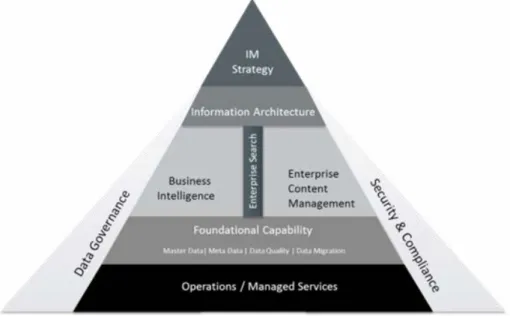
Oakton believes organisations should practice a holistic Enterprise Information Management approach in order to maximise benefits from their investments. Using Oakton’s experience, companies are able to extract greater insights when they bring structured data (e.g. information about a customer’s buying patterns) with unstructured data (e.g. documents related to the customer, such as contracts). Oakton for the past number of years has developed a holistic Enterprise Information Management approach which is supported by integrated methods delivered through some of the best practitioners in the market. This point of view addresses the impact of cloud computing relevant to the document management elements of Enterprise Content Management (ECM) within Oakton’s integrated approach.
Introduction
Figure 1 Oakton’s Information Management Framework
The Challenge
Document management in the cloud is marketed as a solution that enables users to store documents in an externally hosted service that features
document organisation, search and retrieval facilities. The cloud concept covers private, community, public and hybrid deployment models (National Institute of Standards and Technology Special Publication 800-145, The NIST Definition of Cloud Computing). Refer: -http://csrc.nist.gov/publications/nistpubs/800-145/ SP800-145.pdf.
The private domain may service a group of organisations, for example, a government sector cloud that covers a range of agencies. The premise is that organisations adopting a cloud strategy for document management are not required to acquire, install, operate and maintain their own applications and infrastructure. The cloud concept also covers a hybrid architecture, where an in-house document management system also provides cloud capabilities to support document sharing.
The challenge for Chief Information Officers, technologists and information management professionals is to develop an ECM strategy that informs a workable approach to implementing an effective document management solution within their respective operations. The implementation of in-house document management systems has not been without its problems, particularly issues with user adoption, with individuals reluctant to engage with systems that have usability, functionality or performance issues, or where
effective change management has not been applied. When determining a preferred approach within an ECM strategy, organisations must critically review feasible business and technology solution options, and cloud computing is one that should be considered. Cloud platforms have the potential to lower total cost of ownership for ECM solutions, although they do create their own issues, such as lack of governance leading to increased hosting costs. These will need to be examined in the ECM strategy.
Cloud Document Management
The definition of cloud document management services is evolving and the actual services provided by cloud-based providers cover a range of capabilities from basic repository services to more advanced features. The nature of services is also open to interpretation by vendors who focus cloud capabilities on their particular offerings. For example, a cloud capability may be conceptualised as being the repository for digital images of hard copy documents scanned and stored in externally hosted virtual repositories. Other offerings extend the services to include digital office documents created using desktop tools, engineering drawings and managing/sharing multimedia objects. Business units or departments may already use externally hosted services for specific applications involving document sharing, e.g. a hosted site for recruitment activities and documents, or a media library for sharing graphics and images.
The paradigm of cloud computing for storing and managing documents is not of itself a panacea for resolving issues that organisations have faced with in-house document management systems. The essence of the challenge facing Chief Information Officers, technologists and information management professionals is to plan, implement and maintain an effective document management capability that satisfies current business requirements and is sustainable. Oakton believes that the capabilities offered by cloud computing for document management need to be critically examined, as with all solution options, when an organisation is developing its ECM strategy.
Scope of Document Management Requirement
The requirement for document management needs to be contextualised within the business direction, strategies and overall goals and objectives of the organisation. Scope considerations include management of digital office documents, emails and their attachments, physical documents, drawings, document images and multimedia files. Documents within an organisation may not need to be managed with equal controls, and there may be alternative business/technology options applicable to documents of different value to the organisation. While doing so, it should be kept in mind that some of the enabling technologies, such as messaging and desktop authoring tools (e.g. Office 365, Google Docs) are also offered via the cloud.
Statutory Requirements
The requirement for document management needs to be contextualised within the business direction, strategies and overall goals and objectives of the organisation. Scope considerations include management of digital office documents, emails and their attachments, physical documents, drawings, document images and multimedia files. Documents within an organisation may not need to be managed with equal controls, and there may be alternative business/technology options applicable to documents of different value to the organisation. While doing so, it should be kept in mind that some of the enabling technologies, such as messaging and desktop authoring tools (e.g. Office 365, Google Docs) are also offered via the cloud.
Commercial Requirements
There may be commercial agreements that bind an organisation to specific requirements for managing and sharing documents. The commercial aspects of the services agreement need to be investigated so that there is clear definition regarding the ownership of the data stored in the repository, in order that ownership of the data may not be transferred to the service provider when an agreement is executed, or thereafter. It is important to assess the risks associated with data loss and the potential for data to be compromised.
The mechanisms required to migrate data from one cloud application to another, if required, should be investigated. The risk of the cloud provider moving data to another location needs to be assessed. Relocation of data may involve a move to another jurisdiction where regulatory obligations are incompatible with organisational requirements.
Contractual diligence is important to facilitate transitioning from a cloud service under various conditions, including liquidation of the service. Organisations will need to assess the risks associated with the return of document records, in accessible formats, at the conclusion of cloud service contracts.
The viability of a vendor as a long-term strategic partner should be subject to due diligence examination. The vendor’s product plans for the development of its cloud document management application and plans for integration with other emerging cloud applications is another consideration.
Functional Requirements
Business classification systems/taxonomies and metadata are used to define how documents are classified, with the view to supporting navigation, search and retention management. The capabilities of a service to support a business classification system that suits the needs of an organisation, including the capability to configure and modify the system, should be reviewed.
The requirements for capturing documents into the document management system need to be clearly defined, and the capabilities of the solution provider considered. The capture process should cover requirements for adding digital documents to the document management system via desktop integration; email client software and web browser application/s. There are also considerations applicable to archiving, retention and destruction policies. The requirements for document library services, such as version control, will be important, and organisations must also clearly define requirements for complex document relationships. There may be special requirements for managing drawings and the challenges of managing components of 3D models, which is especially relevant for engineering functions that use Building Information Models (BIM) .
There is clearly a need for an integrated search tool that enables users to locate and retrieve documents, using both simple and advanced search paradigms. Publishing tools (to render documents to web formats and promote to web servers) and workflow tools to automate document review and approval, may be necessary to facilitate process improvement.
The requirement for application integration, e.g. the integration between the document management repository and other business applications, should also be examined. Organisations may wish to integrate with enterprise resource planning systems, asset management financial management systems, materials management and geographical information systems (GIS), as examples, to support document storage and retrieval interfaced with the applicable business application. The complexity of integration may increase when documents are hosted via cloud services.
Security Requirements
Security of the document management system is a key component. The requirements will need to cover the management of the application,
infrastructure, data and content stored within the repository. The system may require integration with directory services for authentication and authorisation, which will need to be examined and defined. Assigning access permissions to specific roles/groups, so that read/write access to documents in the system is restricted will be necessary. There will be functions restricted to power users and system administrators and these will need to be documented.
Non-functional Requirements
The key non-functional requirements should be identified, analysed and documented. Usability has been one of the key issues with in-house
document management systems, and this aspect would need to be examined when reviewing both in-house and cloud-based document management systems. There may also be requirements to support access from mobile devices and also enable users to work on documents when not connected to the storage repository, and synchronise updates with the repository. The technology architecture needs to consider among other things, requirements for centralised, distributed or partially distributed architectures to support
performance. It is also important to consider latency or bandwidth, especially to cater for large files, such as multimedia files.
Implementation/Change Management
Organisations will have existing legacy document/records management systems in place and large volumes of documents stored in unmanaged file shares, removable media and externally hosted repositories. Considerations include how data will be migrated from existing legacy systems/file share repositories, if necessary, and whether versioning data (e.g. date created, date modified) is maintained during migration. The aspect of time-stamping is a key issue because documents may be stored in different or multiple time zones. There may be a requirement for conversion of physical documents to digital image as part of the scope, and the capture, indexing, storage and retrieval needs should be defined.
Users tend to find ways to work around a system that they do not find “useable” or “useful” to their specific needs. They will often revert to
traditional file system structures, finding work- arounds that help them share/ collaborate internally and externally, such as continuing to use email for document sharing, or using publicly available document repository sites that abound on the internet, perhaps with no authorisation.
The use of workarounds may have significant implications in terms of legislative requirements, such as privacy and retention policies, as well issues that
may emanate from contractual obligations. Effective organisational change management (OCM) is another key factor in successful implementation. It is imperative that organisations develop an OCM strategy that addresses all factors relevant to the user interaction with the system, develop document- and records-management policies, principles and guidelines and provide appropriate training to assist users so they become comfortable and productive using the system.
Business Case/Summary
The business case for document management should consider a number of business and technology solution options, including:
- Document Management in the Cloud ~ private, public or hybrid. One of the key tenets of cloud document management is that organisations save capital and operational costs in not having to invest in buying and maintaining software applications or infrastructure to support document management.
- Document Management in-house. This option covers the implementation of an in-situ document management system with the business taking the ownership of implementing and maintaining the required applications and infrastructure.
- Hybrid. Combination of (a) and (b). An in-situ document management application may be used for managing documents that are sensitive.
Meanwhile an integrated cloud component could be utilised for information sharing with other agencies, business partners, service providers,
e.g. project teams.
The options for cloud document management, as with an in-house option, need to be critically examined in terms of operational, financial and technology feasibility during the development of the business case.
As with all things cloud, the initial purchase and deployment might be easy, but if careful planning is not done at the outset it has the potential to turn into a mess very quickly. Having covered different aspects of cloud-based document management solutions it is Oakton’s advice organisations should spend a few moments to plan the adoption before launching into full-scale deployment.
Oakton Service Offers
Oakton offers these services relevant to cloud-based document management: - Cloud Readiness Assessment. This is an assessment of an organisation’s ability to leverage cloud-based assets based on their maturity.
- ECM Maturity and Readiness Assessment. Assesses whether your organisation is positioned to achieve the desired level of maturity of capabilities for ECM.
- ECM Strategy and Process Design. Establishes strategies for the adoption of ECM, including cloud services, to encourage regulatory compliance and requirements that support business objectives.
- ECM Platform Strategy and Architecture. Helps organisations to assess technology solution options in order to establish policies, standards and
reference architectures that support governance of ECM capabilities or initiatives. - ECM Solution Selection and Sourcing. Provides direction or guidance on the evaluation and selection of ECM Services and Platform capabilities, as well assisting in the management of strategic sourcing activities.
- ECM Design, Development and Implementation. Provides the design, development and implementation services, or assures the quality of third party service providers.
- ECM Managed Services. Provide the application and infrastructure to manage ECM systems, including cloud-based services.
Future events cannot reliably be predicted accurately. Oakton makes no statements, representations or warranties about the accuracy or completeness of, and you should not rely on, any information relating to this document, including forecasts and estimates (‘Information’) disclosed to you by Oakton. To the full extent permitted by law, Oakton disclaims all responsibility for Information and all liability (including without limitation, liability in negligence) for all expenses, losses, damages and costs you may incur as a result of the Information being inaccurate or incomplete in any way for any reason.
© Oakton Services Pty Ltd 2011. This work is copyright. Except as permitted under the Copyright Act 1968 (Cth), no part of this publication may be reproduced by any process, without the written permission of
Oakton Services Pty Ltd.
Oakton is a registered trademark of Oakton Limited
12
Contacts
Oakton
Level 8, 271 Collins Street Melbourne VIC 3000 t +61 3 9617 0200 f +61 3 9621 1951 e [email protected] www.oakton.com.au
Oakton Services Pty Ltd ABN 31 100 103 268
Melbourne Head office Level 8 271 Collins Street Melbourne VIC 3000 Australia t +61 3 9617 0200 f +61 3 9621 1951
Perth Level 14 Governor Stirling Tower 197 St Georges Terrace Perth WA 6000 Australia t +61 8 6188 7680 f +61 8 6188 7607
Sydney Level 3 65 Berry Street North Sydney NSW 2060 Australia t +61 2 9923 9800 f +61 2 9929 6731
Canberra Unit 2 45Wentworth Avenue Kingston ACT 2604 Australia t +61 2 6230 1997 f +61 2 6230 1919