Vol. 3, N 2, 2015, pp. 347366
UDC (811.111' 276.6+378.147):347.176.2
AN INVESTIGATION INTO THE RELATIVE EFFECTIVENESS
OF DATA-DRIVEN LEARNING (DDL) WITH INTEGRATION
INTO PPP AND III
Pramod Kumar SahUniversity of Central Lancashire, UK
Phone: +44 7921859255 E-Mail: [email protected]
Abstract. This article reports on mixed methods classroom investigation that ascertained the relative effectiveness of two different explicit grammar teaching frameworks: (a) Data-Driven Learning (DDL) with integration into Present-Practice-Produce (PPP) and (b) Illustration-Interaction-Induction (III). The analysis of the pre-, and delayed post-tests indicated that both the frameworks were effective in terms of acquiring written discourse markers. However, the framework DDL with III was more effective than DDL with PPP to some degree. The use of DDL helped the learners develop their autonomy. Qualitative results showed that the participants had positive attitudes towards DDL in spite of some difficulties they faced while discovering patterns through concordance data. They struggled to comprehend many of the difficult words and complex structures used in the concordance data, which by and large seemed to demotivate them. This suggests a need to pre-edit the concordance data beforehand for lower level learners. The evidence also suggested the need for teachers‟ explanation of the patterns discovered through DDL to assure their discovery from the risk of overgeneralization.
Key words: concordance data, discovery learning, learner autonomy, DDL, PPP, III
1.INTRODUCTION
Grammar teaching is still a controversial issue in the field of second or foreign language teaching (Barnard and Scampton, 2008). It has been of great interest to researchers and teachers to investigate whether grammar is worth teaching to ESL/EFL (English as a Second Language/English as a Foreign Language) learners. Some applied linguists, such as Cown (2009), Thornbury (1999) and Ellis (2002, 2006, 2008) advocate teaching grammar, whereas Krashen and Terrel (1983) along with some other linguists find grammar teaching of little or no importance in second language acquisition. Despite having negative views towards grammar teaching, there is evidence that (Borg & Bums, 2008; Nassaji & Fotos, 2010; Rose & O‟Neill, 1999; Ellis, 2010), and it is widely accepted that, grammar teaching helps in second or foreign language acquisition. However, finding an effective approach and method can be a potential issue in grammar teaching. For the teaching of ESL/EFL grammar, different methodologies came into practice and were followed and rejected over time, but none of them seems to have been completely satisfactory. Prabhu (1900) therefore claimed that a particular method may not be effective in every context, nor can it satisfy every need of the learners.
that the learning, which comes from self-discovery, is comparatively more firmly fixed in our minds than that from teacher driven learning. The incorporation of discovery learning and the contemporary revolution of corpus based teaching, Tim John (1991, p. 2) suggested „Data-Driven Learning‟ (DDL) as an approach to teaching and learning grammar. In DDL, the focus was shifted from deductive to inductive learning, and „noticing‟ (Schmidt, 1990) of, and consciousness-raising from, corpus data was taken on in the form of concordance citations (Johns, 1991) as language input and self-discovery of grammar by learners (O‟Keeffe et al,, 2007). A number of corpus-based studies have been undertaken, and yet DDL has not been assimilated into mainstream teaching practices. One of the reasons for the failure of DDL‟s establishment is the lack of supporting teaching materials and a suitable methodology for the application of DDL. Secondly, Tim Johns (1991) himself had doubts as to whether DDL could be effective on its own, and, therefore, further suggested investigating the method(s) that can be integrated with DDL.
The literature on grammar teaching suggests some principles that might be relevant and taken into account while designing grammar lessons (Ellis, 2008), such as „consciousness-raising‟ (Ellis, 1993), „noticing‟ (Schmidt, 1999), „authentic data‟, „form-focused instruction‟, „practice and opportunity for production‟ (Ellis, 2008), and „learners as researchers‟ (John, 1990). Nonetheless, all the existing methodologies are criticised for missing one or another principle(s). For example, Present-Practice-Produce (PPP) has been criticised for being theoretically, rather than practically grounded, and for not seeming to incorporate the principles such as learners‟ autonomy, noticing, etc. On the other hand, Illustration- Interaction-Induction (III), which came into existence in opposition to PPP (McCarthy & Carter, 1995), seems to ignore the opportunity for practice. Therefore, a number of studies are still in progress seeking better approaches to teaching and learning of grammar.
The current study was designed to explore a suitable method for DDL that can address the shortcomings of DDL. It focused on ascertaining the relative effectiveness of DDL with integration into PPP and III. In PPP, new language is presented to the learners, which they practice through controlled and accurate drilling and then they produce their own utterances based on the given patterns. In III, on the other hand, students are provided with an illustration of language and they interact with it before becoming aware of how the language works, therefore the induction of the discovered patterns takes place through illustration and interaction. Two interventions, (a) DDL with PPP and (b) DDL with III, were developed. A total of 30 EAP students were equally assigned to these two experimental groups and each group was exposed to an intervention. Pre-test, post-test and delayed-post tests were given to the students, the scores of which were used to determine the effectiveness of each intervention and to compare the relative effectiveness of both interventions. Similarly, a focus group was conducted to delve into the learners‟ attitudes towards DDL and other aspects of the interventions, such as the need for practice, teachers‟ assistance and learning difficulties and problems. This study asked the following questions:
RQ 1: Is DDL an effective approach to teaching written Discourse Markers to L2 learners of English in an EAP context?
RQ 2: What is the relative effectiveness of DDL with Present-Practice-Produce (PPP) and DDL with Illustration-Interaction-Induction (III) for the acquisition of written Discourse Markers?
2.LITERATURE REVIEW
2.1. Approaches to grammar teaching
Since the origin of the Grammar Translation (GT) methodology, the deductive approach to teaching grammar has existed and is still dominantly used in many teaching contexts. However, low level of achievement in target language acquisition as a product of deductive teaching and „an ever-developing awareness of the complexity of language brought about by corpus linguistics‟ (Ronalli, 2001, p. 2) have shown the problems with deductive approach. Consequently, a number of approaches have been suggested comprising of inductive approach, noticing and consciousness-raising and discovery learning.
The EFL grammar has been instructed implicitly and explicitly. There are contrastive views towards the choice of one over another in the literature of grammar teaching. Those who supported Krashen‟s idea (i.e., language learning is an unconscious process) find the implicit instruction to be more effective. Some research also concluded that if L2 learners can access and apply the same mental process as that of L1, then L2 acquisition ought to result through comprehensible input and interaction (Schwartz, 1993; Nassaji&Fotos, 2004). In contrast, it has been considerably evident that explicit instruction is significant in order to have learners focus their attention on particular form(s) (Schmidt, 2001; Pienemann, 1988). Similarly, Norris and Ortega defended the importance of explicit instruction by examining the effectiveness of L2 teaching in 49 different studies (2000). There are also studies that have suggested both explicit and implicit instruction to have been effective in different contexts (Tutinis, 2012).
In the similar vein, there is evidence showing contradiction between the choice and preference of deductive and inductive approach to teaching grammar. Although both inductive and deductive approach are the type of explicit instruction (Norris & Ortega, 2000; Erlam, 2003; Hulstijn, 2005), they are different in principles. Studies directed to investigate the effectiveness of deductive and inductive approach have varied results; such as, Herron &Tomasello (1992) found inductive approach to be more effective, whereas Robinson (1996), Seliger (1975), and Krashen (2002) found deductive to be more effective. At the same time, Abraham (1985), Rosa & O‟Neill (1999) and Shaffer (1989) did not find any distinction between these two approaches. Consequently, both approaches seem to be effective in different contexts depending on the cognitive style of the learners and the language structure presented (Eistenstein, 1987).
Moreover, explicit instruction seems to be necessary to develop explicit knowledge (Ellis, 2010). The explicit knowledge helps to acquire implicit knowledge, following the automatization of that explicit knowledge (McLaughlin, Rossman, McLeod, 1983).
Therefore, explicit instruction seems to be important in grammar teaching. Similarly, inductive approach might be more helpful to comprehend the input, particularly as a result of learners‟ own discovery of grammar. However, the learners‟ discovery of grammar might not be sufficient for learning, and therefore can be combined with teachers‟ explanation of grammar concepts (Henry, Evelyn & Terence, 2011; Burgess& Elherington, 2012). As a result, inductive approach can be integrated with explicit grammar explanation (Azad, 2013), probably for better acquisition of grammar. There are some recent studies that advocate implicit instruction (Nagaratnam&Al-Mekhlafi, 2012; Ke, 2008). Consequently, both types of instruction might be effective in different EFL situations.
EAP context. The DDL approach is further integrated into an older approach – PPP, and a newer approach - III to ascertain the effectiveness of variables such as practice, consciousness-raising, and explicit grammar instruction.
2.2. Practice vs. consciousness-raising
There has been debate among applied linguistics whether practice exercises help learners acquire a target language. They also seem to argue whether consciousness-raising activities can have better impact on learning than practice exercises. A number of studies (e.g., Batstone, 1994; Long, 1991; Long & Robinson, 1998) argue against the use of „practice‟ in EFL/ESL classrooms, whereas those supporting PPP approach (Johns & Carter, 2014) advocate the need for practice. Studies such as VanPatten (2004), Wong & VanPatten (2003) express doubt about the usefulness of practice with a claim that „repetitive output practice‟ (DeKeyser, 2010, p. 156) does not necessarily provide opportunities to practice the target behaviour, however, they do not seem to reject focus on forms. Similarly, Long (1991), Long & Robinson (1998) further reject practice exercises that focus on forms. Ellis (1993) contrastively does not show doubt on practice focused on form but he finds it to be of limited use given that it does not help to acquire new grammar structures, only with automatization of those forms. In other words, some researchers reject the praxis of practice, whereas some just show doubt on form focused practice, as Ellis (1994) mentions that the results of empirical research are not very encouraging for practice.
The use practice has also received a good deal of support. Ur (1988) argues that practice transfers the knowledge from short-term memory to long-term memory, and it also increases fluency and stimulates noticing (Shehadeh, 2002; Swain & Lapkin 1998; DeKeyser 2010). Nonetheless, practice in terms of „drill and kill‟ may not be very helpful to acquire proficiency in the target language since „acquisition happens as a by-product of comprehension‟ (VanPatten, 2003, p. 26). Practice has to be defined in terms of facilitating the learners with opportunities to comprehend the forms and meanings and to use them frequently until it transfers to long-term memory, so the practice might help in acquisition.
2.3. Defining DDL
In recent decades, a number of researchers (e.g. R. Carter, M. McCarthy, A. Bolton) have brought a paradigm shift in the field of language learning and teaching from electronic corpora. Tim Johns, while promoting language learning through corpus data, proposed Data-Driven Learning (DDL) in 1991, although the use of corpus data had earlier been introduced by Sandra McKay (1980), then continued by Ahmad et al (1985) and Johns (1986) himself.
Data-Driven Learning (DDL) is defined as an approach in which „the language learner is also, essentially, a research worker whose learning needs to be driven by access to linguistic data‟ Johns, 1991a, p. 2). Oldin (1994) defines DDL as: “an approach to language teaching that gives central importance to developing the learners‟ ability to „puzzle out‟ how the target language operates from examples of authentic usages. The approach is particularly associated with the use of computer concordances in the classroom but can be extended to other situations where the student has to work inductively from authentic data (p. 320).”
The main rationale of this approach is that „research is too serious to be left to the researchers‟, and therefore, the learners are to be given an opportunity to „see the patterning in the target language and to form generalizations to account for that patterning‟ (p. 2). DDL is a type of inductive approach. However, there is a distinctive feature of DDL that the teacher does not know in advance, exactly what patterning the students would come up with in DDL. The next distinctive feature of DDL is that the input „cuts out the middleman as far as possible and gives the learner direct access to the data‟ (p. 30), and hence they can be better learners outside the classroom (Johns, 1991b). He suggested three steps to plan a DDL based lesson: „identification, classification, and generalization‟, that he again termed as „research, practice, and improvising‟ (Johns, 1997a, p. 101). Nevertheless, these terms have still not been made clear in terms of implementation of DDL (Boulton, 2010).
2.4. Empirical research: DDL and language learning
The recent technology-based approaches to language learning have provided teachers with opportunities to develop learners‟ autonomy (Benson, 2001, Sah, 2015). DDL, by and large, outlines its key concepts as learner-centred, discovery learning, authentic data, learners‟ autonomy and revolutionaries (Boulton, 2009). Additionally, DDL, as noted by Chambers and Kelly (2002 mentioned in O‟Keefe, McCarthy, Carter, 2007, p. 24), brings together constructivists theories of learning, communicative approach to language teaching and developments within the area of learners‟ autonomy (Veckers & Ene, 2006). Dehghan & Darasawang (2014) and Sah (2015), in their study, found the students to become more independent to use language learning resources after using DDL. Guan (2013) additionally outlines that DDL creates a learning environment that attracts learners‟ attention with the emphasis on classroom interaction. It is therefore necessary to consider activities that develop autonomy among language learners.
DDL, which is claimed to develop learner autonomy, is still struggling to become established owing to the lack of suitable methodology for its application (Wilson, 2013). While designing different methodologies for DDL, Kaltenbock & Mechlmauer-Larcher (2005, p. 79) have categorized the methods into two different strata: „learners-corpus-interaction‟ and „teachers-corpus-„learners-corpus-interaction‟. The former involves learners to browse corpus „much in the same as they would explore an unknown land‟ (Bernadini, 2002, p. 166), where they are the master for all their learning. The latter, in contrast, involves teachers editing the concordance data to make sure that the learners arrive at the desired findings and leanings. The later type of methodology, unlike the former one, does not often include using computers in the classroom to access data; instead, teachers prepare handouts containing concordance lines (Bouton, 2010). Moreover, in terms of either using computers in the classrooms or handouts, Jarris & Szymczyk (2009) conducted a research, the results of which indicated the students liking paper-based materials. In this concern, Gotz (2012) also conducted a research on undergraduate students to find more effective methods, which resulted in that the pre-editing of materials and pre-selection of appropriate corpora make DDL more motivating. However, explorative and evaluative studies on using different methods of DDL have rarely been undertaken (Flowerdew, 2009), and therefore a number of researchers, including Tim Johns, cast doubt whether DDL can be a complete approach to teaching language in itself or „can the new approach be integrated with older and more familiar methods?‟ (1991a, p. 3). Consequently, this study attempts to integrate DDL with other methods PPP and III.
2.5. Grammar in English for Academic Purposes (EAP)
As the majority of the research has shown high relevance of grammar teaching in second or foreign language learning, it is also likely to be important in English for Academic Purposes (EAP). However, there is a very limited amount of research on the teaching of grammar in EAP contexts. Burgess & Etherington (2002) conducted a survey on the attitude of teachers in the UK towards grammar teaching in EAP context. The survey revealed that the majority of the teachers saw grammar important for their students and favoured discourse-based approaches. Similarly, in 2008, Borg & Burns accomplished a survey on the teachers from America (2.5%), Asia (23.2%), Europe (25.7%) and Australia and New Zealand (46%) to find out their attitude toward teaching grammar, the result of which outlined the teachers‟ support for need for grammar teaching. Barnard & Scampton (2008) also studied on the same issue and concluded with the similar result. Additionally, they attempted to include more aspects of grammar teaching in their study. The teachers in their study mentioned that the students wanted them to present the lesson explicitly and found the role of practice to be effective. They also stated that the students found authentic texts difficult because of the vocabulary used; however, it was not clear whether the students had difficulty in handling grammar presented within authentic texts.
As a result, the teaching of grammar seems equally valued and demanded in EAP contexts as well. Since these studies, however limited, support the need for grammar teaching and teachers‟ explanation for grammar patterns, the present study has focused on teaching grammar to EAP learners, particularly to suggest an effective approach. This study also looked at the effectiveness of using practice, consciousness-raising and teachers‟ explanation of grammar patterns given that these issues were raised in Burgess & Etherington (2002), Barnard & Scampton (2008) and Borg & Burns (2008).
3.METHODOLOGY
The current study adopts mixed methods to explore the relative effectiveness of Data-Driven Learning (DDL) with integration into a relatively older method PPP and a newer method III, and to determine the attitude of learners towards Data-Driven Learning. In mixed methods, the strengths of one method can be utilized to overcome the weaknesses of another, as data obtained from both methods complement each other (Dornyei, 2007). This method, therefore, seems to be relevant, given that the present study attempts to obtain quantitative data through tests to measure the learnability of the language through the proposed interventions and qualitative data through a focus group to find out the attitude of the learners towards Data-Driven Learning (DDL). The use of mixed methods, in addition, has helped maintain the validity of this study‟s outcomes through the triangulation of the data obtained from both research instruments.
3.1. The sample and the setting
of Reference for Languages (CEFR). The sample for this study was based on the „Representative Sample Paradigm‟ (Perry, 2005); as the sample representing all L2 learners of English doing a pre-sessional course in the UK and the purpose of the study was to generalize the findings to a large group of L2 learners of English doing pre-sessional courses. There were hundreds of students taking the course at that time, and therefore a sample had to be chosen from the whole population. Taking variables into consideration, the study followed convenience sampling because of practical constraints, such as availability at a certain time and accessibility (Dornyei, 2007). For equal possibility of sampling, I chose two groups from the list of about 8 groups the Language Academy had formed. They had the same language proficiency level as tested by the Academy. The sample size was thought to be 30 participants but, unfortunately, data was recorded for only 20 participants, since a few of the students could not attend the final input sessions and/or take the post and delayed-post tests.
3.2. Research design
The data was collected through two different instruments: Tests and Focus-group interview.
3.2.1. Tests
The quantitative data was collected through written tests. A pilot test was given before the real test, as „it is extremely unwise to write a test and give it straight to the students, often unforeseen problems arise‟ (Harmer, 1987, p. 59). The pilot test did not experience any problem, and the real tests were administrated. Pre-tests were given to evaluate the students‟ receptive and productive knowledge in terms of using written discourse markers before the students were treated with the interventions. They were then given post-tests after the interventions were applied to them, and eventually were given delayed post-tests two weeks after the post-tests. The scores of pre-, post- and delayed post-tests were compared to determine the effectiveness of the respective interventions and the mean score of both interventions were further compared to examine the relative effectiveness of both interventions. Each test had two sections representing a receptive and a productive test. The productive test included the items that required the participants to fill in the blanks with the most suitable written discourse markers. Similarly, for the receptive test, the subjects were given multiple choice questions that required the participants to choose suitable discourse markers from the given options.
Moreover, while constructing the tests, care was taken to avoid making the test easier to complete by one group than another. Similarly, to avoid any inaccuracy in the test items, the sentences (test items) were taken from the British National Corpus (BNC). The BNC was also used to derive corpus data for the students for the Data-Driven Learning.
3.2.2. Focus-group
Focus groups are a useful tool to gather data on the attitudes of participants in a research (Cohen et al., 2007), and therefore a focus group of 4 participants was formed to collect data on learners‟ attitudes towards DDL. The choice of taking part in the focus group was entirely up to the participants. A focus group is also significant since a „within-group interaction can yield high-quality data as it can create a synergistic environment that results in a deep and insightful discussion‟ (Dornyei, 2007, p. 144). The focus group was semi-structured, requiring „the participants to stay on the points‟ (Wisker, 2001, p. 176) by focusing on specific problems, and on the other hand, allowing the interviewer to follow questions with additional questions that would probe further.
During the focus group sessions, I acted as moderator to explain beforehand what was „expected of participants and will happen to the results‟ (Dawson, 2006, p. 79). I also introduced some key issues that prompted the participants to talk in order to show their attitudes towards DDL. However, some participants commented on unprompted, and made the information even richer. The focus group was electronically recorded for future reference, the knowledge of which was given to the participants beforehand.
3.3.3. Data collection and analysis
The method of data collection was experiment with parallel interviews (Cohen et al., 2007) incorporating experiment with interviews. Johnson and Christensen (2004), as mentioned in Dornyei (2007), point out that we can sometimes enhance an experiment even further by conducting interviews, whether face-to-face or focus group interviews to get at the research participants‟ perspectives and meanings relating to the experimental research findings. The experiment and interviews protocol present both qualitative and quantitative data for this current study. More specifically, the experiment was conducted in order to ascertain the relative effectiveness of Data-Driven Learning (DDL) with integration into PPP and III while teaching written discourse markers to L2 learners of English on a pre-sessional course. For this purpose, two interventions were designed: „DDL with PPP‟ and „DDL with III‟.
The students were given pre-tests to measure their knowledge of the use of written discourse markers before the interventions were conducted. After the interventions, post-tests were given to the participants to examine their achievement, thereby measuring the effectiveness of DDL and the relative effectiveness of its integration into PPP and III. The scores of the pre-tests were compared to the gain scores of the post-tests. This was followed by delayed post-tests to investigate whether the learning lasted for a longer period.
3.3. Interventions
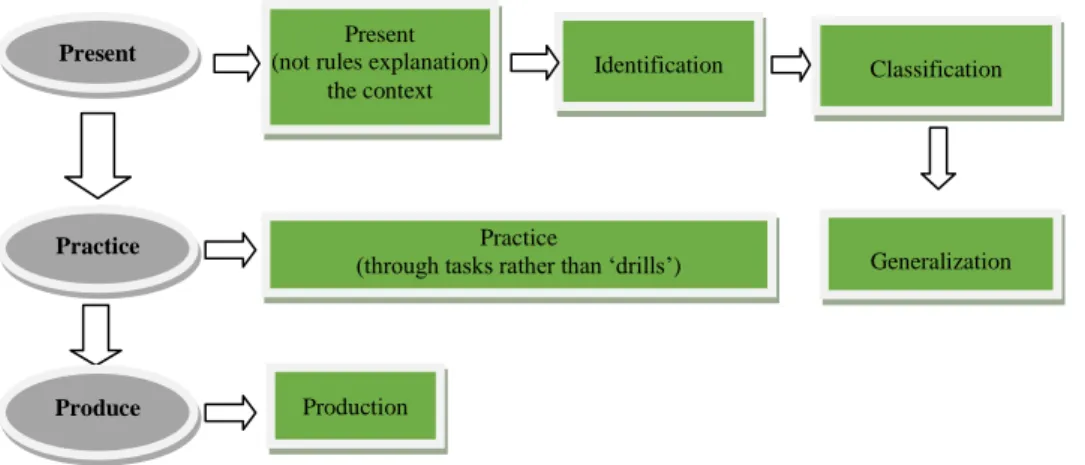
Diagram 2: Intervention: 1 DDL with PPP
This intervention is an attempt to integrate the DDL approach with an older method PPP. This intervention is designed with the intention to upgrade the DDL approach by integrating „practice‟ and „production‟ into it.
Present: This is the first stage where a teacher presents the lesson, but does NOT explain the grammatical rules or patterns as it is done in the original form of PPP. He/she explicitly informs the students what they are going to learn, and then sets a task to motive and to gain their concentration towards the language he/she plans to introduce. Then, the students are given authentic corpus data (concordance data). They then identify the language through noticing and consciousness-raising activities; classify the language; and finally generalize the patterns of the language. After the students have discovered the new language, the teacher will briefly explain the newly discovered patterns. This is the stage where Data-Driven Learning actually takes place.
Practice: After the patterns are discovered and the teacher has explained them, the students are required to do some practice exercises. „Practice‟, here, does not necessarily mean repetition or drilling as in the original version of PPP or Audiolingualism. It might rather refer to activities that encourage learners to use the language they have discovered, such as gap fill exercises or sentence re-writing, etc., in order to drive the information from short-term memory to long-term memory.
Produce: This is the final stage where the learners are required to produce their own sentences following the patterns the learners have discovered. This activity also helps to automatise the information for language production with accuracy.
This intervention is an attempt to integrate the DDL approach with a newer method, Illustration-Interaction-Induction (III) (McCarthy and Carter, 1995). Unlike PPP, this method does not include the opportunity for practice and production, rather focuses on consciousness-raising. I have attempted to integrate the features of both DDL and III in order to examine whether the hybrid approach would be comparatively more effective.
Present (not rules explanation)
the context
Identification Classification Present
Generalization
Generalization
Practice Practice
(through tasks rather than „drills‟)
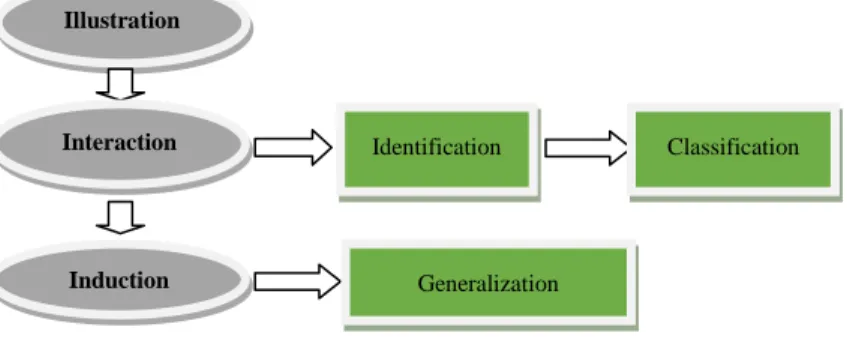
Diagram 3: Intervention 2: DDL with III
Illustration: Unlike PPP, this approach suggests a lesson begin with the illustration of authentic data. By authentic data, based on DDL, I mean the concordance derived from corpus data. This can be displayed electronically or can be given to the students in a printed handout.
Interaction: In a similar way to that used in the first Intervention (DDL with PPP), at this stage, the students will discuss the language features observed in the data through consciousness raising activities. The students will firstly identify the language they are being exposed to, and then they will classify the concordance data to describe the features of the target language.
Induction: At this stage, the students collaboratively try to discover the patterns (not rules) and the teacher might guide them if they need any support. By patterns here I mean the structures in which the language has been used in a particular context. These patterns may not be generalized in the way that prescriptive rules can.
3.4. The nature of concordance data
As already mentioned, Data-Driven Learning requires learners discovering their own grammar by noticing the underlying patterns in the concordance data. Both intervention groups navigated through concordance-based materials. To design such materials, I made use of the Complete Lexical Tutor to obtain concordance lines based on written British National Corpus (BNC). The selection of this particular type of corpora was based on the criteria that the BNC includes real life data that represent British English. The students in this study were undertaking a pre-sessional course with an aim to develop their academic English to join British universities. Subsequently, it was believed that they would benefit more from the BNC. Secondly, the BNC was freely available online and therefore easily accessible that offered the motivated students the opportunities to follow up their own research of concordance data. Similarly, as discussed in the literature review, students prefer printouts to computers to deal with concordance lines for DDL, therefore I used handouts containing the concordance lines in my classrooms. That was also the case owing to the fact of the limited time frame of the study. Moreover, the corpus data used in DDL tasks varied from full concordances to Key Word in Context (KWIC) format and conversational extracts. I made use of the KWIC concordance since the lessons were based on discovering the patterns and use of different written lexical discourse markers in EAP writing.
Illustration
Identification Interaction
Induction
Classification
4.RESULTS
RQ 1: Is DDL an effective approach for teaching written Discourse Markers to L2 learners of English in an EAP context?
The participants of both experimental groups appeared to have an upward scoring performance in both post-test and delayed post-test over the pre-test, and it can therefore be said that DDL might be an effective approach in this particular situation irrespective of its integration into other methods. The mean score for experimental group 1 was 4.4 out of 10 in the pre-test, reaching 6.5 in the post-test but, although remaining higher than the test, dropping to 6 in the delayed post-test. Similarly, the mean score 4.5 in the pre-test reached 9.2 in the post-pre-test and 8.2 in the delayed post-pre-test in the DDL with III experimental group. These data evidently suggest that DDL in both interventions was successful in helping the participants to learn.
With regard to the students‟ attitude towards DDL, it appeared that the participants had a positive attitude despite some difficulties they experienced while working with this approach. They seemed to find DDL an effective approach that can help for self-study, and therefore developed their autonomy. Consequently, it can be concluded that DDL might be an effective approach to teaching discourse markers to L2 users of English in an EAP context.
RQ 2: What is the relative effectiveness of DDL with Present-Practice-Produce (PPP) and DDL with Illustration-Interaction-Induction (III) for the acquisition of written discourse markers?
The test scores clearly indicated the effectiveness of DDL regardless of its integration into two different methods. The scores did not show a significant difference between the two groups; however, the DDL with III group appeared to have better effect to some level. The test scores in the post-tests in both interventions were higher than the pre-tests, suggesting that the participants had learned through these interventions. Yet, the delayed post-tests received lower scores than the post-tests, but higher than the pre-tests.
As a result, the evidence suggests that the learning was possibly constant over time until the delayed post-tests, which might be automatized to become permanent learning in the future. This could be because it takes a long time for information to transfer from a short term memory to long term memory for automatization of that information, and practice plays a significant role in transferring that information (McLaughlin, Rossman & McLeod, 1983).
RQ 3: What might be the problems of implementing DDL in this setting?
The evidence suggests that DDL was successfully implemented in this setting, however, there were some problems that the students faced while learning through this approach. In contrast to Wilson‟s (2013) study that concluded that DDL was unsuitable for lower levels of learner, this study appeared to find DDL to have some degree of suitability for lower level learners. Nevertheless, the difficult words and complex sentence structures were likely to make it difficult for them to comprehend the contexts.
Similarly, the learners seemingly had a problem understanding the meaning of unusual words that have pragmatic meanings in terms of the UK culture. This might be because authentic language is too difficult for the learners to realize (Morrison, 1989 and William, 1983). Indeed Gotz (2012) found such materials to be useful when they were pre-edited. Therefore, for the lower level of learners, it would be important to pre-edit the concordance data in order to bridge the gap in students‟ comprehension.
Moreover, similar to the research of Chujo et al. (2012), the learners in this study tended to show the need for teachers‟ support in order to explain the patterns and usages. The students discovered the patterns, but they needed the teacher to confirm whether their discovery was correct. On this point, I also believe that having the teacher explain the discovered patterns will also benefit students with lower language skills.
The next problem that the students encountered was that it was monotonous to repeatedly go over the concordance data. Nonetheless, I think it was not really a problem. It appeared that the students‟ lack of motivation for self learning was more crucial, as the students were probably more used to teacher-initiated learning. Therefore, the tasks requiring students‟ self learning was new and monotonous for them. They might have expected the teacher to explain patterns for them, rather than getting them to explore.
4.DISCUSSION
The focus group, which was especially grounded in finding attitudes of the students towards DDL, resulted in responses that tended to show the students‟ positive attitudes. There were a few issues raised during the work of the focus group. Firstly, they shared their overall positive impression while discussing their general impression on DDL. Secondly, they discussed the issue of learners as researchers and revealed that they could find the meaning and patterns by themselves. They also reported to use DDL as a research tool outside the classrooms to find out the solutions to the problems. Thus, as suggested by Nazari (2014) and Wachob (2005) it is possible that learners can take control of their own learning to act autonomously in DDL. This also supports the works by Veckers & Ene (2006) and Dehghan & Darasawang (2014) who found DDL to be a suitable tool for developing learners‟ autonomy. Thirdly, the discussion moved towards the problems that the students faced while using DDL. The common problem that they mentioned was the difficulty in understanding difficult words and complex sentence structures in concordance data. This might have demotivated the students to some extent, as also found in William (1983) and Morrison (1989). This may be the reason why Wilson (2013) found DDL unsuitable for lower level learners. In contrast, this study assumes that DDL might be suitable for lower level learners. However, I would recommend pre-editing of the concordance data in order to bridge the language gap, as also recommended by Gotz (2012). The next issue discussed was whether they needed teachers‟ support. The results indicated some degree of agreement on the need for teachers‟ support, especially to describe the difficult words and structures to help them comprehend the context. The students also wanted the teacher to explain the patterns after they had explored their grammar. This may be owing to their lack of confidence or their habit of depending on teachers. Therefore, it might be helpful if a teacher explains the patterns after the students have discovered patterns through given concordance data. This also prevents learners form developing false consciousness due to the lack of „negative evidence‟ (White, 1988, p. 125) in the concordance data. Ellis (1984) also points out that input alone is not sufficient, and consequently, the exposure to data should be combined with instruction.
5.LIMITATIONS
Several limitations of this study are worth commenting on. First, whereas the sample represents a population of multilingual L2 learners of EAP in the UK, the participants consisted of 17 Chinese speakers and 3 Arabic speakers of English. The majority of participants might have used their L1 to mediate their understanding, thereby influencing the results. Similarly, this study employed a „convenience non-random sampling‟ that might have resulted in a selection bias, and consequently influenced the findings. The small sample size, which limited the number of variables, also limited the generalizability of the findings and diminished the statistical strength of the analysis.
Another important limitation of this study is the length of the study. One of the findings, that consciousness-raising showed better learning than practice in DDL, might have had different results if it had been a long term study. As earlier discussed, the effects of practice are often seen in the long term, but this study was limited to a short period. Similarly, there was a very short gap between the post-test and the delayed post-test. A longer gap between these tests might also have shown different results.
productive test items. Longer tests are more reliable and also needed to generalize the learning that reduce the possibility of guessing (Cohen et al, 2007). Since the test items were objective in nature, the participants might have guessed the answers, thus limiting the values of the results.
6.CONCLUSION
This study chose a corpus based inductive approach to teaching grammar, namely Data-Driven Learning, to ascertain its effectiveness when integrated into other methods, while teaching and learning written discourse markers for EAP students in the UK. The reason I attempted to integrate DDL with other methods, was to add more value to DDL in order to enhance its strength and effectiveness. Two interventions were therefore developed: „DDL with PPP‟ and „DDL with III‟. These were then applied to two different experimental groups. A pre-test was given to the students which was used as a baseline for comparison with the scores of the post and delayed post-tests in order to examine the relative effectiveness of both interventions.
The test results suggest that both interventions had an impact on the performance of the written discourse markers, with participants showing an increased number of correct responses following the interventions. However, the experimental group that received DDL with III intervention showed a relatively better acquisition than the DDL with PPP group in the short term. The scores of the post-tests were significantly higher than those in the pre-tests, which again decreased in the delayed post-test. The scores of the delayed post-tests were higher than the pre-tests. From this, two conclusions can be drawn: on the one hand, the interventions were effective since they resulted in a greater ability of students to use written discourse markers in the short term, whilst on the other hand, the results might have been different, had the intervention been sustained over time as there was a lower ability shown in the delayed-post tests.
The study also seemed to demonstrate that the consciousness-raising was more effective than practice, thereby supporting Ellis‟ (2002) claim of consciousness-raising being more effective than practice and in line with anti-practice linguists (Long, 1991; Long & Robinson, 1998; DeKeyser, 2010; VanPatten, 2004; and Wong & VanPatten, 2003). Nonetheless, the use of practice had a short-term impact upon learners‟ ability and all the participants of the focus group felt the need for practice to automatise their output, as might have been expected according to McLaughlin, Rossman & McLead, (1983). Therefore, it would be unwise to claim practice or PPP as discredited methods, as some (e.g., Lewis, 1993; Skehan, 1996) have suggested. Moreover, it is also asserted that practice has a long-term effect (Ur, 1988; McLaughlin, Rossman & McLeod, 1983; Karpicke & III, 2007), which is a point that could not be evaluated within the time framework of this study.
Furthermore, this study looked at the students‟ attitudes towards DDL. All but one of the participants acknowledged a degree of acquisition through this approach. This one student found repeated review of concordance data, without any communicative activity, to be monotonous. This might be why Johns (1991) stated learners need to be highly motivated for DDL.
the concordance data before exposing it to the learners. Difficulty understanding the meaning of unusual words in the target language because of their cultural and pragmatic meanings may not be unusual, however. In addition, the participants mentioned that they needed teachers to explain the patterns discovered through the concordance data in order to make sure that what they had discovered was correct. This substantiates the need for explicit explanation (Norris & Ortega, 2000) of learners‟ discovered patterns.
Consequently, this study recommends the integration of explicit explanations of patterns into DDL following the learners‟ own discovery of patterns, as suggested by Burgess & Etherington (2002), and Bamard & Scampton (2008).
The findings indicate a direction for future research, especially in the light of integrating other methods into DDL, using a larger sample size and increasing the duration of the study. In particular, a longer interval between post-test and delayed post-test might be useful. One might also look at the type of noticing and mediation the learners experience while trying to discover patterns from concordance data.
REFERENCES
Abraham, R. “Field independence-dependence and the teaching of grammar”. TESOL Quarterly 19 (1985): 689-702.
Ahmad, K., Corbett, G., Rogers, M. and Sussex, R. Computers, Language Learning and
Language Teaching. Cambridge, England: Cambridge University Press, 1985.
Azad, M. A. K. “Grammar teaching in EFL classrooms: Teachers‟ attitudes and beliefs”. ASA University Review 7, no 2 (2013):111-126.
Barnard, R. & Scampton, D.“Teaching grammar: a survey of EAP teachers in New Zealand”. New Zealand Studies in Applied Linguistics 14, 2 (2008): 59-82.
Batstone, R. “Key concepts in ELT: noticing”. ELT Journal 50, no. 3 (1996): 273. Bernardini, S. “Exploring new directions for discovery learning”. In Kettemann, Bernard
& Marko, Georg (eds.), Teaching and Learning by Doing Corpus Analysis. Proceedings of the Fourth International Conference on Teaching and Language
Corpora, 19-24, Amsterdam: Rodopi, 2002.
Benson, P. Teaching and researching autonomy in language. Applied Linguistics in Series, London: Longman. 2001.
Boulton, A. “Testing the limits of data-driven learning: Language proficiency and training”. ReCALL 21, no. 1 (2009): 37-51.
Boulton, A. “Data-Driven Learning: Taking the Computer out of the Equation”. Language Learning 60, no. 3 (2010): 534-572.
Borg. S. and Bums, A. “Integrating grammar in Adult TESOL classrooms”. Applied Linguistics 29, no. 2 (2008):456-482.
Burgess, J. and Etherington, S. “Focus on grammatical form: Explicit or implicit?”. System 30, (2002): 433-458.
Carter, R. and McCarthy, M. “Grammar and the spoken language”. Applied Linguistics 16, (1995): 141-158.
Chujo, et al. “Paper-based, Computer-based and Combined Data-driven learning suing a Web-based concordancer”. Language Education in Asia 3, no. 2 (2012):132-145. Cohen, L., Manion, L. & Morrision, K. Research methods in education (6th Ed.). London:
Cowan, R. The teacher‟s grammar of English. Cambridge: CUP, 2009.
Dehghan, A. and Darasawang, P. “Independent learning through the use of data driven learning”. Proceedings of the International Conference: DRAL 2/ILA, 2014.
DeKeyser, R. M. “Practice for second language learning: Don‟t throw out the baby with the bathwater”. International Journal of English Studies 10, no.1 (2010):155-165. Dornyei, Z. Research methods in applied linguistics. Oxford: OUP, 2007.
Ellis, R. “Second language acquisition research: how does it help teachers?” ELT Journal. 47, no. 1 (1993): 3-11.
Eisenstein, M. “Grammatical explanations in ESL: Teach the student, Not the Method”. In M. Long & J. Richards (Eds.), Methodology in TESOL (pp. 282- 292). New Jersey: Heinle & Heinle Publishers, 1987.
Ellis, R. “Grammar teaching- practice or consciousness-raising?”. In J. C. Richards, & W. A. Renandya (Eds.). Methodology in language teaching: An anthology of current
practice (pp. 167-174). Cambridge: CUP, 2002.
Ellis, R. “Current issues in the teaching of grammar: an SLA perspective”. TESOL Quarterly 40, no. 1(2006): 83-107.
Ellis, R. “Principles of Instructed Second Language Acquisition”. CAL Digest, December, 2008: 1-6.
Ellis, R. “Does explicit grammar instruction work?”. NIJLL Project Review, no. 2 (2010): 3-22.
Erlam, R. “The effects of deductive and inductive instruction on the acquisition of direct object pronouns in French as a second language”. The Modern Language Journal 87(2003): 242-260.
Flowerdew, L. “Applying Corpus Linguistics to Pedagogy: A Critical Evaluation”. International Journal of Corpus Linguistics 14, no. 3 (2009):393- 417.
Gilakjani, A. P. and Ahmadi, S. M. “Roles of consciousness in second language acquisition.Theory and Practice”. Language Studies 1, no. 5 (2011): 435-442.
Gotz, S. Testing task-types in data-driven learning: benefits and limitations. Academia.edu, (2012):AccessedAugust27,2014 https://www.academia.edu/2102634/Testing_task-types_in_data-driven_learning_Benefits_and_limitations.
Guan, X. “A study on the application of Data-driven learning in vocabulary teaching and learning in China‟s EFL class”. Journal of Language Teaching and Research, 4, no. 1(2013):105- 112.
Harmer, J. Teaching and Learning Grammar: London: Longman, 1987.
Henry, W.C.H., Evelyn, W.M.C. and Terence, T.S.L. “Examining the effectiveness of adopting an inductive approach to the teaching of English grammar”, 2011. http://www.edb.org.hk/HKTC/download/eras/1011/ERAS1011_R09.pdf
Herron, C. and Tomasello, M. “Acquiring grammatical structures by guided induction”.
French Review 65 (1992):708-718.
Hulstijn, J. H. “Theoretical and empirical issues in the study of implicit and explicit second-language learning”. Studies in Second Language Acquisition 27 (2005):129-140. Jarvis, H. and Szymczyk, M. “Students views on learning grammar with web- and
book-based material”. ELT Journal 64, no. 1 (2009): 32- 44.
Johns, C. and Carter, R. “Teaching spoken discourse markers explicitly: A comparison of III and PPP”. International Journal of English Studies 14, no. 1 (2014): 37-54. Johns, T. and King, P. “Classroom Concordancing‟ in Birmingham University”. English
Johns, T. “Contexts: the background, development and trialling of a concordance-based CALL programme”. In: A. Wichmann, S. Fligelstone, T. McEnery & G. Knowles (Eds.),
Teaching and Learning Corpora, 100-115. Harlow: Addison Wesley Longman, 1997a.
Kaltenbock, G. and Mehlmauer-Larcher, B. “Computer Corpora and the Language Classroom: On the Potential and Limitations of Computer Corpora in Language Teaching”. ReCALL 17, no.1 (2005): 65-84.
Ke, Z. “An inductive approach to English grammar teaching: HKBU Papers”. Applied Languages Studies 12 (2008):1-18.
Krashen, S. and Terrell, T. The natural approach. Oxford : OUP, 1983.
Krashen, S. Explorations in language acquisition and use: The Taipei lectures. Taipei: Crane Publishing Company, 2002.
Lewis, M. The lexical approach. LTP Teacher Trainings, 1993.
Long, M. “Focus on form: a design feature in language teaching methodology”. In K. de Bot, D. Coste, R. Ginsberg & C. Kramsch (Eds.), Foreign language research in cross-cultural perspective, 39-52. Amsterdam/Philadelphia: John Benjamins, 1991. Long, M. H. and Robinson, P. “Focus on form: Theory, research, and practice”. In C.
Doughty & J. Williams (Eds.), Focus on Form in Classroom Second Language Acquisition, 15-41. New York: Cambridge University Press, 1998.
McKay, S. “Developing vocabulary materials with a computer corpus”. RELC Journal 11, no. 2 (1980):77-87.
McLaughlin, B., Rossman, T. and McLead, B. “Second language learning: an information-processing perspective”. Journal of Research in Language Studies 33, no. 2 (1983): 135-158.
Mohamed, N. “Consciousness-raising tasks: a learner perspective”. ELT Journal 58, no. 3 (2004): 228- 237.
Morrison, B. “Using news broadcasts for authentic listening comprehension”. ELT Journal 43, no. 1 (1989): 14-23.
Nagaratnam, R. P. and Al-Mekhlafi, “Attitudes towards EFL grammar instruction: inductive of deductive”. LEARN Journal 1, no. 2 (2012): 78-105.
Norris, J. and Ortega, L. “Effectiveness of L2 instruction: A research synthesis and quantitative meta-analysis”. Language Learning 50 (2000):417-428.
Nassaji, H. and Fotos, S. “Current developments in research on the teaching of grammar”. Annual Review of Applied Linguistics, 24 (2004):129-145.
Odlin, T. Perspectives on Pedagogical Grammar. Cambridge: Cambridge University Press, 1994.
O‟Keeffe, A., McCarthy, M. and Carter, R. From corpus to classroom. Cambridge: Cambridge University Press, 2007.
Perry, F. L. Research in applied linguistics. London: Lowerence Erlbaum Association, 2005. Pienemann, M. “Determining the influence of instruction on L2 speech processing”.
AILA Review 5 (1988):40-72.
Prabhu, N. “There is no best method – why?” TESOL Quarterly 24, no. 2 (1990):161 – 176 Ranalli, J. M. “Consciousness-raising versus deductive approaches to language instruction: a
study of learner preferences”. University of Birmingham, 2011
Rosa, R. and O‟Neill, M. D. “Explicitness, intake, and the issue of awareness” Second Language Acquisition, 21 (1999): 511-556.
Sah, P. K. “Data-driven learning (DDL) for enhancing learner autonomy”. IATEFL Independence, Issue 64, August, 2015.
Sah, P. K. “If only it were true: the problems with grammar teaching”. NELTA Choutari, 2014.
http://neltachoutari.wordpress.com/2014/05/01/if-only-it-were-true-the-problems-with-grammar-teaching/
Schmidta, R. “The role of consciousness in second language learning”. Applied Linguistics 11 (1990):129 - 158.
Schmidt, R. W. “Attention”. In P. Robinson (Ed.), Cognition and Second Language Instruction (pp. 3-32). Cambridge: Cambridge University Press, 2001.
Schwartz, B. “On explicit and negative data effecting and affecting competence and linguistic behavior”. Studies in Second Language Acquisition 15 (1993):147-163. Seliger, H. W. “Inductive method and deductive method in language teaching: A
re-examination”. IRAL-International Review of Applied Linguistics in Teaching 13 (1975): 1-18.
Shaffer, C. “A comparison of inductive and deductive approached to teaching languages”. The Modern Language Journal 73 (1989):395-403.
Shehadeh, A. “Comprehensible output from occurrence to acquisition: an agenda for acquisition research”. Language Learning 52, no. 3 (2002):597-647
Swain, M. and Lapkin, S. “Interaction and second language learning: Two adolescent French immersion students working together”. The Modern Language Journal 8, no.3 (1998):320-337.
Thornbury, S. How to teach grammar. London: Longman, 1999.
Tutunis, B. “Grammar in EFL pedagogy: To be or not to be: Explicit or implicit grammar instruction in EFL”. International Journal of Humanities and Social Science 2, no. 5 (2012): 120-122.
Ur, P. Grammar practice activities: A practical guide for teachers. Cambridge: Cambridge University Press, 1988.
VanPatten, B. From input to output: A teacher's guide to second language acquisition. New York: McGraw-Hill, 2003.
VanPatten, B. “Input processing in second language acquisition”. In B. VanPatten (Ed.),
Processing Instruction. Theory, Research, and Commentary (pp. 5-31). Mahwah, NJ:
Erlbaum, 2004.
Vickers, C. H. and Ena, E. “Grammatical accuracy and learner autonomy in advanced writing”. ELT Journal 60, no. 2 (2006): 109- 116.
White,L. “Implications of Learnability Theories for Second Language Learning and Teaching”. Printed at TESOL, Chicago, 1988.
Wong, W. and VanPatten, B. “The evidence is IN: Drills are OUT”. Foreign Language Annals 36, no. 3 (2003):403-423.
Yoon, H. and A. Hirvela. (2004) “ESL students‟ attitudes towards corpus use in L2”.
APPENDIX
Focus Group Questions
The aim of this interview is to know your attitude towards the use of Data-Driven Learning (DDL) and if it has been an effective approach to teaching written discourse markers. The result of this study is intended to give pedagogical suggestions to EFL teachers. Your answers will confidentially be used for research purposes only.
1. What is your overall impression towards using Data-Driven Learning while learning written discourse markers?
2. Do you think this has helped you develop your autonomy? If „yes‟, in what way?
3. What do you think, if any, were the difficulties that you faced while dealing with the concordance data?
4. Do you think you needed opportunity to practice and produce the patterns that you discovered through the concordance data?
5. What did you like and/or dislike about this approach of teaching, if any?