9
Electromyography (EMG) based Classification of
Finger Movements using SVM
Nurazrin Mohd Esa, Azlan Mohd Zain & Mahadi Bahari
School of Computing, Faculty of Engineering,Universiti Teknologi Malaysia 81310 UTM Johor Bahru, Johor, Malaysia
Email: [email protected],[email protected], [email protected]
Submitted: 12/01/2018. Revised edition: 29/05/2018. Accepted: 30/05/2018. Published online: 21 November 2018
Abstract—Myoelectric control prostheses hand are currently popular developing clinical option that offers amputee person to control their artificial hand by analyzing the contacting muscle residual. Myoelectric control system contains three main phase which are data segmentation, feature extraction and classification. The main factor that affect the performance of myoelectric control system is the choice of feature extraction methods. There are two types of feature extraction technique used to extract the signal which are the Hudgins feature consist of Zero Crossing, Waveform Length (WL), Sign Scope Change (SSC) and Mean Absolute Value (MAV), the single Root Mean Square (RMS). Then, the combination of both is proposed in this study. An analysis of these different techniques result were examine to achieve a favorable classification accuracy (CA). Our outcomes demonstrate that the combination of RMS and Hudgins feature set demonstrate the best average classification accuracy for all ten fingers developments. The classification process implemented in this studies is using Support Vector Machine (SVM) technique.
Keywords—Myoelectric control system, Time Domain feature extraction, Classification, Support Vector Machine
I.INTRODUCTION
The loss of the human lower arm is a noteworthy incapacity that significantly confines the ordinary capacities and connections of people with upper-limb amputation [1]. In international scenario such as Italy, the number of upper limb loss is estimated as 4000 people per year [2] while in larger country such as USA there are about 340000 people living with this situation [3]. The communication ability with
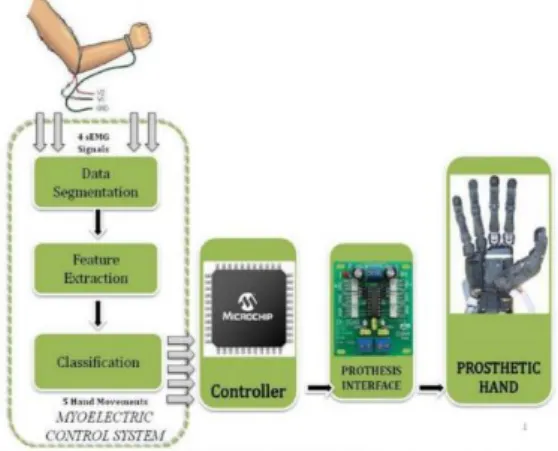
this present reality can be reestablished utilizing myoelectric control ([4]; [5]), where the electromyogram (EMG) signals created by the human muscles are utilized to infer control orders for controlled upper-limb prostheses. Regularly an example acknowledgment structure is used to characterize the procured EMG signals into one of a predefined sets of lower arm developments ([4]; [6]). Generally, the control upper limb prostheses system consists of several important stages which are pre-processing, feature extraction and classification. Fig. 1 shows the process of myoelectric control of prostheses hand.
Among these stages, the main contributor to system recognition performance is feature extraction and classification technique implemented. According to [6] the proper feature will straightforwardly ideal in moving toward high order exactness. Subsequently, different feature set have been used in the writing exhibiting the practicality of myoelectric control ([8]; [9]; [10]). Albeit numerous exploration works have for the most part endeavored to investigate and inspect a fitting feature vector for various particular EMG signal applications (e.g. [11]; [6]; [12]), there have a couple of works which make profoundly quantitative examinations of their characteristics, especially in excess perspective. The most common uses feature extraction is time domain features which quick and easy to implements because extract directly from raw dataset. ([13]; [6]; [14]).
10
Fig. 3(a). Position of sensor. [18]
Fig. 3(b). Position of sensor2 [18]
them that the distance of the two informational collections to hyper-plane is maximally vast. Author [17] stated that one of the aspects that offer priority to SVM over different classifiers is that it gives just a single solution. This implies SVM is a superior classifier than numerous layer perceptron (MLP) neural systems (NN), which gives you more than one solution relying on local minimum. Hence, we implemented the OVA multiclass SVM to classify the ten finger movements.
Fig. 1
.
The process of Myoelectric Control of Hand Prostheses [7]This paper handles the distinguished on ten finger movements utilizing surface-EMG-data in view of signal processing methods. The EMG signals were obtained utilizing two electrode patch on two particular muscles of the hand. In this work we analyzed three sorts of time domain include feature extraction strategies in view of classification accuracy of SVM techniques. Our outcomes demonstrate that the combination of RMS and Hudgins feature set demonstrate the best average classification accuracy for all ten fingers developments. The rests of this paper is organized as takes after. Segment II depicts the methodology for finger recognition system. The result and discussion are featured in Section III and the conclusion of this study show up in Section IV.
II.METHODOLOGY
This section introduces methodology applied for EMG based classification of finger movement using SVM as classification method. The process start with EMG signal acquisition phase, pre-processing of EMG signal, feature extraction and lastly classification phased. Fig. 2 shows the flowchart of this process.
A. Acquisition of EMG Signal
EMG signal data acquired from [18]. Refer from author [18], the EMG information was gathered utilizing two EMG channels (Delsys DE 2.x series EMG sensors). Then, this signal collected been processed by the Bagnoli Desktop
EMG Systems from Delsys Inc. During collecting data experiment, two channel of sensor firmly sticks into the skin by application of 2-slot adhesive skin interface.
Fig. 2. Flowchart of EMG based finger classification
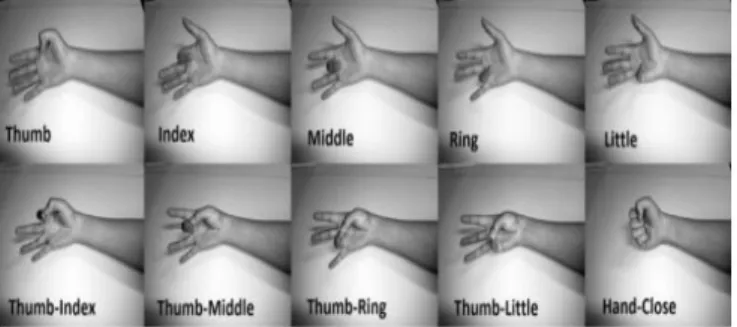
A conductive adhesive reference electrode (Dermatrode Reference Electrode) was used on the wrist of each subject. Fig. 3(a) and 3(b) shows the images on the position of the electrode patch on person wrist. The EMG signals gathered from the electrode were amplified utilizing a Delsys Bagnoli-8 amplifier to an aggregate pick up of 1000. A 12-bit analog-to digital converter (National Instruments, BNC-2090) was utilized to test the flag at 4000 Hz; the signal information were then obtained utilizing Delsys EMGWorks Acquisition programming. The ten single and pinch movement that have been identified are hand close (HC), index (I), little (L), middle (M), thumb (T), ring finger (R) and the pinch movement from combination of thumb and index (T-I), thumb and little (T-L), thumb and middle (T-M) and thumb and ring fingers (T-R). Fig. 4 show the ten types images of finer movement studies.
Data Acquisition
Pre-processing
(Filtering, Windowing)
Feature Extraction (RMS/Hudgins/ RMS+Hudgins)
Classification
(One versus All SVM) Start
11 Fig. 1. Types of finger movement studied [18]
B. Pre-processing of EMG Signal
Pre-processing is optional after data acquisition process which helps in reducing the influence of unintended hand motions. According to author [19], measure signals always contaminated by disturbance of either the sensor used to acquire the data or individual trembles during the process. This contaminated signal class as a noise. Author [20] support the statement by state that the most difficulty in dealing with EMG signal is due its noisy characteristics. This statement highlights the need of the pre-processing phase such as filtering methods. In this study, only filtering and windowing implemented. However, the basic description of rectification technique also provided follows by the reviews on filtering methods and description of windowing in details.
1) Rectification
Rectification is the way toward changing over the raw EMG single to a solitary extremity recurrence (generally positive). This procedure is to guarantee that the signal does not end up zero when average. This average zero is possible when there are negative and positive components in the same signal. Hence, convert this is compulsory to facilitate the study.
2) Filtering
Filtering is the process of removing noise from data. There are several filter used to filter the noise. The most popular filter applied almost by all researchers is high and low pass filter. Low pass filter used to remove the high frequency noise, while high pass filter remove movement artefact. The value of cut-off frequency for low and high pass filter varies from 250-5000Hz and 0.1 to 100Hz respectively (Zecca et al., 2002). The common low pass filter is 500Hz, while high pass filter cut-off is 10 or 20 Hz. There are also different filter applied by researchers such as Notch filter common cut-off is 50 or 60Hz. There are also difference filter name but same cut-off value applied which is comb filter with the same common cut-off 50Hz. Table 1
summarize the example of available filtering methods applied in literature with their cut-off value.
TABLE I. THE CUT-OFF FREQUENCY OF FILTER
Type of filter Cut-off value (Reference)
Remarks
Low pass filter Above 450Hz [6] 500Hz [21] 3-10Hz [22]
Remove high
frequency noise.
High Pass filter 20Hz [23]and [21] To reduce
motion artefact.
Notch filter 50Hz line interference [18] and [24]
50/60Hz [6] 60Hz [22]
Noise reduction.
Comb filter 50Hz [21] To remove
power-line interference.
Bandpass filter 20-450Hz [18] and [24] 10-450Hz [22]
Reduce noise.
3) Windowing Phase
A windowing is a procedure of grouping of information restricted in a schedule opening, which is utilized to estimate signal features [6]. The natures of raw EMG signal contain large information in insignificant ways. However, this situation can change if this raw data been manipulated and convert into feature space data that contain high information. To convert it, the windowing process is compulsory [25].The issues in windowing process are the determination of width for each segment of windows. If the width of segment is to short, it will leads to bias feature estimation while if too long cause likely to failed in real-time because high computational operations.
12 shows the disjoint segmentation process which divided into three segment length.
Fig. 5. Disjoint segmentation [6]
Fig. 6. Overlapping segmentation [6]
C. Feature Extraction phase
Feeding the EMG signal as a raw time sequence, directly into the classifier causes degrading the classification performance. Raw EMG signal contains large sequence of input and varies in randomness that causes complexity. To caters the problem due to the curse dimensionality, feature extraction process consequently implements in order to condense only important EMG parts represent each classes ([26];[27]).The features were extracted using a time domain feature set which consists of mean absolute value (MAV), waveform length (WL), zero crossings (ZCs), slope sign changes (SSC) and root mean square (RMS). All features were extracted by using Matlab code provided by [28]. The description of each feature set uses are describe briefly below.
1) Mean Absolute Value (MA V) .
MAV is the average of the absolute value of the EMG signal amplitude in a sample of data. It is widely famous one as commonly used in EMG signal recognition (e.g. [13]; [27]). However, there is the limitation of using MAV as single feature training set which is there are possibilities that different classes may contain the same mean value. But, it is still can discriminated best depends on the variation of classes. The formula of extracting the MAV is as
2) Zero Crossing (ZC):
Zero crossing (ZC) in time domain defines as the measure of frequency information of the EMG signal (e.g. [13]; [29]). The value represents number of times that the amplitude of EMG signal passes the zero amplitude axes. The formula of extracting the ZC is as
3) Waveform Length (WL)
Waveform length (WL) in time domain features represents cumulative length of the EMG waveform over the time segment. It usually uses to identify the complexity of EMG signal sequence [13];[6]. Wavelength (WAVE) is another representative name for this feature. The formula of extracting the WL is as
4) Slope Scope Change (SSC)
Similarly to the ZC, Slope sign change (SSC), is a method of EMG signal represent frequency information [13]; [29]. The different with ZC is the value represent cumulative numbers of times that slope of the dataset change sign either negative to positive value or conversely. It is performed using threshold function among three sequential segments changes for avoiding the background noise EMG signal. The mathematical formula of SSC is as
.
5) Root Mean Square (RMS)
Another popular commonly used as features set is root mean square (RMS) [26]; [30]. The formulation of RMS is quite similar t standard deviation where amplitude modulated (1)
(2)
(3)
13 modeled related to non-fatiguing and constant force. The mathematical formula of RMS is as
D. Classification using SVM Phase
Higher accuracy, less number of computational time and low storage space are the characteristic that measure the efficiency of recognition system. Nowadays, there are many classifiers that capable in providing the high efficiency to the system. Among them, SVM fulfill almost all the criteria of the effective classifier. Study by [31] shows that SVM is superior in terms of classification in recognizing multiple hand motion compared to other algorithm. Research conduct by [32] and [6] confirmed the effectiveness of EMG pattern recognition using SVM methods. Hence, SVM had proven to be powerful classification tools [15]. SVM is kernel based classification that the theory is from structural risk management (SRM) idea [15]. It algorithm will design the hyper-plane that linearly separate two data sets that maximally large the distance between dataset of two classes. The kernels of algorithm in SVM also provides the ability of classify data in non-linear separation without increasing calculation cost significantly. Even, the basic SVM only support binary classification, these function has been extend to support multiclass classification with combining these binary classification ideas. Then, SVM has been expand their functionality by produce One-versus-one (OVO) methods and one-versus-all (OVA) to support multiclass classification problem.
III.RESULT AND DISCUSSION
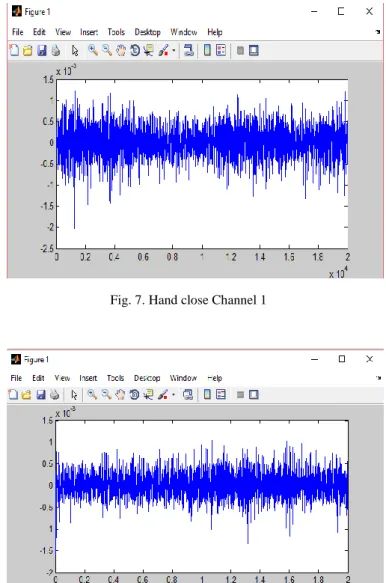
EMG signal for this study acquired from [18] which consist of ten classes of individual and combined fingers movements including: HC, L, M, I, R, T, T-I,T-L,T-M and T-R. The data acquired has already been Bandpass filtered between 20-450 Hz with a notch filter implemented to remove the 50 Hz line interference. Fig. 7 and 8 shows the sample of raw EMG signal which consist of 20000ms sequence. Based on this figure, there are the different in distribution of the graph plot from different finger class.
Fig. 7. Hand close Channel 1
Fig. 8. Thumb-ring Channel 1
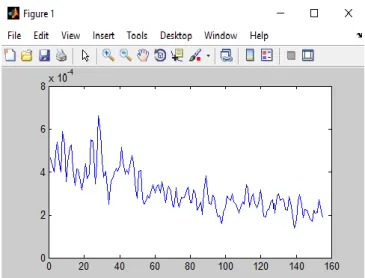
Then, this raw data are segmented based on Adrian and Green, (2007) technique which are overlapping windowing with window size 256 with 128 increment windows. Fig. 9 shows the graph of hand close EMG signal after extracted using MAV feature extraction. Then, to obtain best classification, there are three feature set methods from feature extraction used as the input of the training. They are single Root mean square, Hudgins methods which combination of Mean absolute value, Zero crossing, Waveform length and Sign slope change and the combination of Hudgins feature and RMS. The result of accuracy for each testing group based from each feature extraction is used to compare with other results are as shown in Table II.
14 Fig. 9. EMG signal of Hand close data after MAV feature
extraction
TABLE II. CLASSIFICATION RESULT OBTAINED ON EMG SIGNAL
Finger Movement Classes
Classification Accuracy (%)
RMS Hudgin (MAV,WL, SSC, ZC)
RMS+ Hudgins
HC 100% 96.67% 96.67%
L 70% 86.67% 80%
M 100% 96.67% 96.67%
I 86.67 93% 93.33%
R 83.33% 83% 86.67%
T 83.33% 96.67% 96.67%
T-I 93.33% 86.67% 93.33%
T-L 73.33% 86.67% 90%
T-M 100% 90% 90%
T-R 100% 96.67% 96.67%
Based on Table II, the classification accuracy results between each different group using different feature extraction are shown clearly with the percentage and the best feature extraction is highlighted to demonstrate the highest accuracy in each group. for classification of hand close, middle, thumb middle and thumb ring movement, when compare between the three feature set, the single extract from RMS shows the highest accuracy (100%); for class little, Hudgins set produced top result with 86.6%; similarly, from class index and thumb index , the combination of RMS and Hudgins set produced highest accuracy (93.33%). for classification of hand close, middle, thumb middle and thumb ring movement, when compare between the three feature set, the single extract from RMS shows the highest
accuracy (100%); for class little, hudgins set produced top result with 86.6% ;similarly, from class index and thumb index , the combination of rms and hudgins set produced highest accuracy (93.33%).
Fig. 10. Classification Accuracy based on Feature set
Besides, the best accuracy also obtain using this combination feature set for the rest ring and thumb class with 86.67% and 96.67% respectively. Fig. 10 indicate the classification accuracy for ten finger movement based on three feature set. From this figure, the result shows that little fingers are the most difficult class to distinguishable comparing to others eight class
CONCLUSION
15 ACKNOWLEDGMENT
We would like to thank reviewer(s) for useful advices and comments. The authors greatly acknowledge the Research management Centre, (UTM) and Ministry of Higher Education Malaysia (MOHE) for financial support through the Fundamental Research Grant Scheme (FRGS) No. R.J130000.7828.4F868
REFERENCES
[1] Kuiken, Todd A., Guanglin Li, Blair A. Lock, Robert D. Lipschutz, Laura A. Miller, Kathy A. Stubblefield, and Kevin B. Englehart. (2009). Targeted Muscle Reinnervation for Real-time Myoelectric Control of Multifunction Artificial Arms. Jama, 301(6), 619-628. [2] Cutti, A. G., Verni, G., Gruppioni, E., and Amoresano,
A. (2012). Nuove tecnologie e innovazione nelle protesi di arto superiore. Medi. Chir. Ortoped. 3, 20-33.
[3] NLLIC (National Limb Loss Information Center) (2007). Fact Sheet: Limb Loss in the United States. Knoxville, TN: Amputee Coalition of America. [4] Englehart, Kevin, and Bernard Hudgins. (2003). A
Robust, Real-time Control Scheme for Multifunction Myoelectric Control. IEEE Transactions on Biomedical Engineering. 50(7), 848-854.
[5] Hudgins, B., Parker, P., and Scott, R. N. (1993). A New Strategy for Multifunction Myoelectric Control. IEEE Trans. Biomed. Eng. 40, 82-94. doi: 10.1109/10.204774.
[6] Firoozabadi, S. Mohammad P., M. Asghari Oskoei, and Huosheng Hu. (2008). A Human-computer Interface Based on Forehead Multi-channel Bio-signals to Control a Virtual Wheelchair. Proceedings of the 14th Iranian Conference on Biomedical Engineering (ICBME), 272-277.
[7] Fariman, H. J., Ahmad, S. A., Marhaban, M. H., Ghasab, M. A., & Chappell, P. H. (2016). Hand Movements Classification for Myoelectric Control System Using Adaptive Resonance Theory. Australasian Physical & Engineering Sciences in Medicine, 39(1), 85-102.
[8] Oskoei, Mohammadreza Asghari, and Huosheng Hu. (2007). Myoelectric Control Systems—A Survey. Biomedical Signal Processing and Control. 2(4), 275-294.
[9] Phinyomark, Angkoon, Pornchai Phukpattaranont, and Chusak Limsakul. (2012). Feature Reduction and Selection for EMG Signal Classification. Expert Systems with Applications, 39(8), 7420-7431.
[10] Rafiee, J., M. A. Rafiee, F. Yavari, and M. P. Schoen. (2011). Feature Extraction of Forearm EMG Signals for Prosthetics. Expert Systems with Applications, 38(4), 4058-4067.
[11] Boostani, Reza, and Mohammad Hassan Moradi. (2003). Evaluation of the Forearm EMG Signal Features for the Control of a Prosthetic Hand. Physiological Measurement, 24(2), 309.
[12] Phinyomark, Angkoon, Chusak Limsakul, and Pornchai Phukpattaranont. (2009). A Comparative Study of Wavelet Denoising for Multifunction Myoelectric Control. Computer and Automation Engineering, ICCAE'09. International Conference on, IEEE, 21-25.
[13] Hudgins, Bernard, Philip Parker, and Robert N. Scott. (1993). A New Strategy for Multifunction Myoelectric Control. IEEE Transactions on Biomedical Engineering, 40(1), 82-94.
[14] Tkach, Dennis, He Huang, and Todd A. Kuiken. (2010). Study of Stability of Time-domain Features for Electromyographic Pattern Recognition. Journal Of Neuroengineering and Rehabilitation. 7(1), 21. [15] Cristianini, Nello, and John Shawe-Taylor. (2000). An
Introduction to Support Vector Machines and Other Kernel-Based Learning Methods. Cambridge University Press.
[16] Cortes, Corinna, and Vladimir Vapnik. (1995). Support Vector Machine [J]. Machine Learning, 20(3), 273-297.
[17] Waris, Muhammad Asim, Mohsin Jamil, Yasar Ayaz, and Syed Omer Gilani. (2014). Classification of Functional Motions of Hand for Upper Limb Prosthesis with Surface Electromyography. International Journal of Biology and Biomedical Engineering, 8, 15-20.
[18] R. N. Khushaba, M. Takruri, S. Kodagoda, and G. Dissanayake. (2012). Toward Improved Control of Prosthetic Fingers Using Surface Electromyogram (EMG) Signals. Expert Systems with Applications, 39(12), 10731-10738.
[19] Xie, Renqiang, and Juncheng Cao. (2016). Accelerometer-based Hand Gesture Recognition by Neural Network and Similarity Matching. IEEE Sensors Journal, 16(11), 4537-4545.
[20] Ahsan, Md Rezwanul, Muhammad I. Ibrahimy, and Othman O. Khalifa. (2009). EMG Signal Classification for Human Computer Interaction: A Review. European Journal of Scientific Research, 33(3), 480-501.
[21] Hahne, Janne M., F. Biessmann, Ning Jiang, H. Rehbaum, Dario Farina, F. C. Meinecke, K-R. Müller, and L. C. Parra. (2014). Linear and Nonlinear Regression Techniques for Simultaneous and Proportional Myoelectric Control. IEEE Transactions on Neural Systems and Rehabilitation Engineering, 22(2), 269-279.
16 Decomposition for Multifunction Prosthesis Control. Physiological Measurement. 30(5), 441.
[23] Young, Aaron J., Lauren H. Smith, Elliott J. Rouse, and Levi J. Hargrove. (2013). Classification of Simultaneous Movements Using Surface EMG Pattern Recognition. IEEE Transactions on Biomedical Engineering, 60(5), 1250-1258.
[24] Altamimy, Hegazy Megahed, Mohamed Sobhy Rezk, Mohammed Mohammed Abdelkareem, Hamdy Samy
![Fig. 5. Disjoint segmentation [6]](https://thumb-us.123doks.com/thumbv2/123dok_us/8003376.2121566/4.892.93.399.164.333/fig-disjoint-segmentation.webp)