OPTIMIZATION OF THE MENU FOR INSTITUTIONS
OF RESTAURANT INDUSTRY BASED
ON MATHEMATICAL MODELLING METHODS
Dariya BASYUK, Inna LEVYTSKANational University of Life and Environmental Sciences of Ukraine Kyiv, Ukraine
Liubov IVCHENKO
National University of Food Technologies Kyiv, Ukraine
Iryna SEMENYSHYNA
State Agrarian and Engineering University in Podilya Kamianets-Podilskyi, Ukraine
Svitlana KOLIADENKO Vinnytsia National Agrarian University
Vinnytsia, Ukraine
DOI: 10.13165/IE-20-14-1-08
Substantiated proposals in the study for the compilation of an individual menu can be the basis for the diversification of restaurant services and increase the competitiveness of the enterprises in the industry, as they take into account the current trends in nutrition and the requirements of the organization for useful and controlled nutrition with restrictions on the content of energy and useful substances, whilst also minimizing the cost of the check. They can be implemented in restaurant establishments in the form of the introduction of an additional module in widespread information and payment systems (Fidello F&B, Micros, “Parus-Restaurant,” SERVIO, 1C-Rarus: Restaurant + Bar + Cafe, Iiko, R-keeper, others.).
Keywords: Restaurant management, menu customization, balanced eating, check minimization, linear programming, optimization.
JEL: L60, L66.
1. Introduction
Increasing competition among establishments in the restaurant industry requires the orientation of enterprises towards maximizing the consideration of current trends in healthy eating, and the fulfilment of the wishes of target groups of consumers and the individual requests of visitors. The success of the restaurant business involves a creative approach to its organization, the maximum use of the facilities of the institution, and the introduction of additional channels of communication with customers. An individual approach to each client, taking into account their culinary and gastronomic preferences, becomes one of the main modern trends in the organization of catering.
There will come a time when restaurant customers will not only be able to choose dishes at their own discretion, but also to shape them independently, taking into account the peculiarities of their diet and personal tastes. In this case, individual nutrition can vary for a number of reasons, including: diets for medical indications; vegetarianism; the nationality or age of consumers; raw food diet; Ayurvedic nutrition; Fruitarianism, etc. However, any choice of nutrition should ensure a balanced consumption of energy, protein, carbohydrates, fats, vitamins, and micro-elements, taking into account the daily physiological needs of a particular person in terms of nutrients.
2. Literature review
A considerable amount of work both by international and Ukrainian researchers is devoted to determining balance in human nutrition and the factors that influence this indicator. Scientists have proposed various algorithms for the development of recipes in order to obtain the optimal ingredient composition of meals.
emphasized, and balanced nutrition is associated with both personal human needs and the concentration of nutrients in foods [3].
The global introduction of mobile and online technology into the restaurant business contributes to the organization of the broadcasting by consumers of their gastronomic preferences to food companies, and aids their managers in fixing and maintaining the wishes of their regular customers. The ability to order food online, free Wi-Fi in estab-lishments, the presence of an electronic menu – these are already common catering ser-vices for visitors. Modern restaurant information systems allow businesses to analyze the dynamics of sales to further predict them and, accordingly, to prepare a procurement plan and work schedules for line staff.
One of the technologies of restaurant service is related to the availability of terminals or tablets that include the menu at every restaurant table. This service allows customers to or-der meals without waiting for the waiter, make changes to the oror-der, and visualize the meal and its value. This paper proposes the use of these technologies to make an individual menu with a specific content of energy, nutrients, micro-elements, or vitamins. The mathematical programming methods used to solve this problem are widely used in dietetics.
Already in the first publications on this topic [4; 5] we discussed the practical applica-tions of the solution to the problem of producing the optimal diet. A review of scientific works devoted to the use of linear programming in the optimization of nutrition and compiling diets, taking into account certain limitations, was provided in the article [6]. In particular, attention was drawn to the considerable potential of linear programming techniques for finding solutions to various nutrition problems.
The works of French researchers such as Briend, Darmon, Ferguson, and Erhardt [7] emphasized that linear programming is “the ideal tool for rigorously converting precise nutrient constraints into food combinations.” The studies of Dutch scientists such as van Dooren, Tyszler, Kramer, and Aiking [8], taking into account low food costs, include restrictions on the emissions of greenhouse gases into the atmosphere that accompany the cultivation of certain foods.
The research of such scholars as Parlesak et al. [9] are dedicated to the creation of low-cost consumer product baskets that take into account nutrient recommendations, dietary recommendations, and cultural acceptance. Linear programming methods were also used.
There are works, particularly those of Ukrainian scientists such as Liashenko and Shulak [10], where different approaches to the design of information subsystems for de-termining a balanced diet are offered.
Mathematical methods of designing diets with certain conditions on the content of ingredients are used by the Kharkov scientists Cherevko, Krutovyi, and others [11–15].
Research in the field of biotechnology also suggests the use of computer technology – for example, recipe optimization tasks can be used to develop a functional product. In this case, the formulation of the problem introduces criteria for minimizing deviations from the specified content of nutritional and biological indicators [16].
therapeutic prophylactic action. In addition, quite often the word “optimization” is used in a more general sense rather than in terms of optimization by mathematical program-ming methods. Finally, even in studies that are devoted to finding the best diet with the goal of minimizing its cost, a set of specific foods, not meals, is meant.
3. Purpose
The purpose of this study is to develop proposals that combine the efforts of food establishments to diversify their services, the capabilities of mathematics and informa-tion technologies, and current customer requirements for balanced and healthy eating.
The problem of the optimal cost of food and the minimization of the check in the restaurant establishment without a reduction in the daily physiological norm of energy exchange is also urgent, taking into account the realities of our country. The limitations of the linear programming problem are then related to the consumption of energy, nutri-ents, minerals, and vitamins, and the intended result is hindered by the cost of the check. Accordingly, another objective of the study was to improve the service process in restaurant establishments by introducing a menu-based service that helps customers to consume nutrients and minimize cost.
4. Methods
The methods of analysis and synthesis, statistical comparisons, and the grouping and generalization of scientific data on the energy values of the products of restaurants in Ukrainian and Georgian cuisine and their cost as of April 1, 2020, were used in the study of the optimization of the process of providing food services in institutions of the res-taurant industry. Linear programming methods, Excel spreadsheets, and the “Solution Search” superstructure were used to solve the research objectives.
5. Results
S=c1x1+c2x2+c3x3+…cnxn → min
і виконуються обмеження
a11x1+a21x2+a31x3+…an1xn ≥ b1
a21x1+a22x2+a32x3+…an2xn ≥ b2
a13x1+a23x2+a33x3+…an3xn ≥ b3
– – – – – – –
-а1mx1+a2mx2+a3mx3+…anmxn ≥ bm.
Typically, in studies using this model, the mix problem, the variables X(x1, x2,….xn)
are ingredients in the formulation of certain dishes, foods in the diet of daily or single consumption, components of a “grocery basket,” or food additives. In this work, it is suggested to use a set of dishes from the menu of a particular establishment as variables.
The coefficients с1,c2,….cn of the objective function of the problem are prices. In this case, the price of the dishes is included into the restaurant menu.
The limitations of the task can be formulated as inequalities with the signs >=, <=, or equality = depending on their content. Thus, for example, the range is indicated within which it is permissible to adjust the content of nutrients.
Coefficients a11, a12,…..amn in the restriction system are the content of nutrients, en-ergy, minerals, or vitamins in a particular dish. That is, the meaning of the coefficients in the system of inequalities can change depending on the task that is being set. Ac-cordingly, the interpretation of the right-hand side of inequalities b1,b2,….bm, may be
different – namely, they may be restrictions on the consumption of energy, fats, proteins, carbohydrates, different minerals, and vitamins. In addition, weight restrictions on some dishes from the catering menu can be placed on the right side.
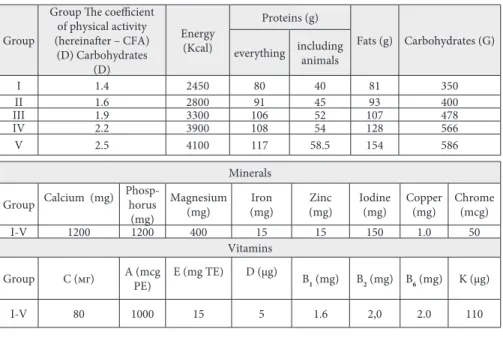
The initial data for obtaining the optimal admissible plan X(x1, x2,….xn) in the solu-tion of the problem are: nutrient and energy consumpsolu-tion rates for a certain category of population, component prices (in our case, prices of meals in the institution’s menu), and the composition of substances in components (in our case in every dish). The source of energy for the body is nutrients. There are many tables of average energy consumption for various activities that can be used to determine daily energy costs [18]. It is possible to calculate the daily need for basic nutrients and biologically active substances (proteins, fats, carbohydrates, vitamins, minerals) on the basis of the obtained value of the average energy consumption. The norms of consumption of basic nutrients by the population of Ukraine are determined depending on sex, age, and physical activity, approved by the order of the Ministry of Health of Ukraine of September 3, 2017, No. 1073 “On approval of the Norms of physiological needs of the population of Ukraine in basic nutrients and energy” [1].
foreign and domestic tourists – namely, men aged 18–29 years. According to the MOH order above, the daily requirement of this population in proteins, fats and carbohydrates, minerals, and vitamins is shown in Table 1.
Table 1. Daily requirements of men (18–29 years) for energy, essential nutrients, and biologically active substances
Group
Group The coefficient of physical activity (hereinafter – CFA) (D) Carbohydrates
(D)
Energy (Kcal)
Proteins (g)
Fats (g) Carbohydrates (G) everything including animals
I 1.4 2450 80 40 81 350
II 1.6 2800 91 45 93 400
III 1.9 3300 106 52 107 478
IV 2.2 3900 108 54 128 566
V 2.5 4100 117 58.5 154 586
Minerals
Group Calcium (mg) Phosp-horus (mg)
Magnesium
(mg) (mg)Iron (mg)Zinc Iodine (mg) Copper (mg) Chrome (mcg)
I-V 1200 1200 400 15 15 150 1.0 50
Vitamins
Group С (мг) А (mcg PE) Е (mg TE) D (μg) В1 (mg) В2 (mg) В6 (mg) K (μg)
I-V 80 1000 15 5 1.6 2,0 2.0 110
Source: Based on [1]
The specific indications of the units of daily requirement for vitamins, which are pre-sented in the table, are related to the use of coefficients for the conversion of various forms of vitamin preparations. For example, vitamin A (mcg PE) is in retinol equivalent. These details are not relevant to the topic of this work and are related to the biological activity of vitamins, the study of which is engaged in vitaminology.
It should be emphasized that, for various reasons, producing an optimal diet is a dif-ficult task and often has several options. Therefore, at the same time, to take into account the consumption of energy, fats, proteins, carbohydrates, essential micro-elements, and vitamins when solving one optimization problem is almost impossible. Additional fac-tors that complicate this task are:
– the content of nutrients and energy in the same dish may vary, albeit slightly, de-pending on the quality of the ingredients or the characteristics of the preparation;
• the number of dishes offered for selection may also vary depending on the individual needs of the consumer (diet, religious beliefs, current health, etc.);
• the requirements of the consumer when forming the order (collective, individual, festive, every day, etc.)
• the type and peculiarities of business process organization in restaurant establish-ment.
Therefore, the limitations of the task should be less severe to allow the consumption of a substance or energy within a certain interval. The presence of an optimization task template makes it easy to change both the nomenclature of dishes and their number, as well as to adjust the rates of consumption of nutrients and energy, depending on the characteristics of the consumer (gender, age, physical activity etc.).
Therefore, the development of daily menu options for men aged 18–29 years, opti-mized by minimizing the cost of the check and taking into account restrictions on ener-gy, fat, protein, and carbohydrate consumption, is proposed in this this paper. Assuming that the customer pays at each visit to the restaurant (not necessarily the hotel structure), the daily menu was divided into three parts: breakfast, lunch, and dinner. According to common recommendations, for 3 meals a day, the ratio of energy and nutrients should be as follows: 30% – 40% – 30%. It is also extremely difficult to implement this.
The national variety of cuisines offered at Kyiv food companies can satisfy almost any taste. The menu of the Ukrainian cuisine restaurant “Ukrainian dishes” was chosen for the following reasons:
• it presents the national cuisine; • it has a fairly diverse menu;
• it is actively visited by foreign tourists;
• its menu and prices are calculated for average consumers; • its menu does not indicate the content of nutrients and energy.
The solution to the task of preparing a breakfast menu of dishes from Ukrainian cuisine with a minimum cost for the specified institution and with a certain content of proteins, fats, carbohydrates, and energy is presented in the Table 2.
Table 2 includes:
• the names of the dishes, taken from the menu offered for selection in the establish-ment;
• the prices from the menu, scaled up to 1 kg of food;
• the content of nutrients and energy, scaled up to 1 kg of each dish;
• the intervals of restrictions on the content of nutrients and energy (the right part of the restrictions);
• the actual content of nutrients and energy (the left part of the restrictions); • additional restrictions on the presence of a particular dish among the favourites; • cells with search results, namely the weight of foods recommended for consumption
Table 2. The optimized version of the breakfast menu at the restaurant “Ukrainian dishes” for consumers of the selected category
Oatmeal porridge with nuts and honey Scrambled eggs with bacon Pancakes with sour cream and jam The omelette is natural Bread Tea Pancakes with Cheese Coffee with Milk Cheesecakes
X1 X2 X4 X5 X6 X7 Х8 Х9 X10 Cost, UAH Food weight, kg 0.20 0 0.12 0 0 0 0 0.20 0 105.84
Prices (UAH / kg) 190 367 482 312 75 40 505 50 680
LIMITATION part SignLeft Rightpart Proteins 46 102 120 122 55 0 110 15 130 26.60 >= 20
Fat 47 275 75 184 10 0 43 18 194 22.00 >= 22 Carbohydrates 263 6 300 19 400 80 279 100 196 108.60 >= 90 Energy 1480 2130 2600 2220 1900 310 1950 500 3002 708.00 >= 700 Proteins 46 102 120 122 55 0 110 15 130 26.60 <= 27 Fat 47 275 75 184 10 0 43 18 194 22.00 <= 27 Carbohydrates 263 6 300 19 400 80 279 100 196 108.60 <= 110 Energy 1480 2130 2600 2220 1900 310 1950 500 3002 708.00 <= 1000
Bread 0 0 0 0 1 0 0 0 0 0.00 = 0
Pancakes 0 0 1 0 0 0 0 0 0 0.12 >= 0.12 Source: Authors’ calculation
Similarly, the task of compiling an optimal Ukrainian lunch and dinner menu for the selected consumer category was prepared and solved (Table 3).
Thus, consumption rates are exceeded by all indicators (energy, protein, fats, and carbohydrates); the main excess was consumed during lunch.
Table 3. Calculation of the amount of energy, proteins, fats, and carbohydrates in the Ukrainian version of the menu of consumers of the selected category Men,
18–29 years old, KFA 1.4 Energy (kcal) Proteins (g) Fat (g) Carbohydrates (g)
Norms 2450 80 81 350
Breakfast 708 26.6 22 196
Lunch 1182 44 54 129
Dinner 797.2 21 31.6 65.9
Realistically applied 2687.2 91.6 107.6 390.9
Difference 237.2 11.6 26.6 40.9
Difference, % 9.68% 14.50% 32.84% 11.69%
The largest excess is in terms of fats. Accordingly, there can be two recommendations: • to increase the coefficient of physical activity;
• to reduce energy, protein, fat, and carbohydrate intake in the coming days.
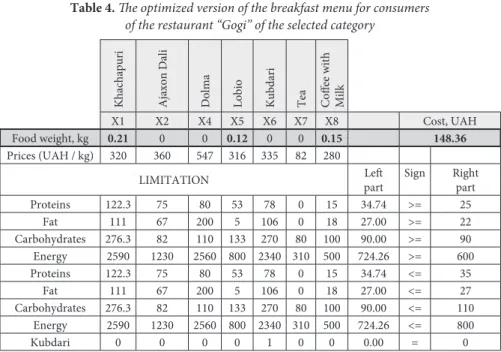
In recent years, many food establishments have opened in Ukraine, and in particu-lar in Kyiv, offering Georgian cuisine. Among them are highly professional specialists – Georgians, whose cuisine is popular with both Ukrainians and foreign tourists. There-fore, it was decided as a second example to use the menu from the Georgian restaurant “Gogi,” in Kiev. Accordingly, the names of the dishes and their prices were taken from the menu of this restaurant. The results of solving the problem of optimizing the break-fast menu with minimal cost and restrictions on the protein, fat, carbohydrate, and en-ergy content are presented in the Table 4.
Table 4. The optimized version of the breakfast menu for consumers of the restaurant “Gogi” of the selected category
Khachapuri Ajaxon Dali Dolma Lobio Kubdari Tea Coffee with Milk
X1 X2 X4 X5 X6 X7 Х8 Cost, UAH
Food weight, kg 0.21 0 0 0.12 0 0 0.15 148.36
Prices (UAH / kg) 320 360 547 316 335 82 280
LIMITATION Leftpart Sign Rightpart Proteins 122.3 75 80 53 78 0 15 34.74 >= 25
Fat 111 67 200 5 106 0 18 27.00 >= 22 Carbohydrates 276.3 82 110 133 270 80 100 90.00 >= 90 Energy 2590 1230 2560 800 2340 310 500 724.26 >= 600 Proteins 122.3 75 80 53 78 0 15 34.74 <= 35 Fat 111 67 200 5 106 0 18 27.00 <= 27 Carbohydrates 276.3 82 110 133 270 80 100 90.00 <= 110 Energy 2590 1230 2560 800 2340 310 500 724.26 <= 800
Kubdari 0 0 0 0 1 0 0 0.00 = 0
Source: Authors’ calculation
Table 5. Calculation of the amount of energy, proteins, fats, and carbohydrates in the Georgian version of the menu of consumers of the selected category
Men,
18–29 years old, KFA 1.4 Energy (kcal) Proteins (g) Fat (g) Carbohydrates (g)
Norms 2450 80 81 350
Breakfast 724 34,74 27 90
Lunch 1257,4 52,7 53,2 133,25
Dinner 613,5 16,2 11,31 100
Realistically applied 2594,9 103,64 91,51 323,25
Difference 144,9 23,64 10,51 –26,75
Difference, % 5,91% 29,55% 12,98% –7,64%
Source: Authors’ calculation
Thus, exceeding the norms of consumption of nutrients and energy is accomplished by the following indicators: energy – by 5.91%; proteins – almost 30%; fat – almost 13%. The intake of carbohydrates is 7.64% below the norm.
A significant exaggeration of the norms of protein consumption is related to the spec-ificity of Georgian cuisine – namely, a large number of meat dishes.
By giving the customer an invoice, the restaurant informs them only of the amount of money spent. If, at the same time, energy, fats, proteins and carbohydrates consumed during the diet were included in the bill, subsequent meals may be adjusted.
We emphasize that dieting is a rather difficult task, the peculiarities of which are conditioned not only by the basic principles of rational nutrition, but also by the char-acteristics of each person in a certain population group – not only by age and gender, working and living conditions, but also by health, deviations in the mode of life, and other reasons. Therefore, even the norms of the use of nutrients and energy differ accord-ing to various researchers. If, after drawaccord-ing up a daily diet and calculataccord-ing its chemical composition for proteins, fats, and carbohydrates, the obtained results deviate from the normative by more than 5%, then the diet is considered insufficiently balanced and the meals included in the menu should be revisited.
The effectiveness of including the cost minimization condition can be estimated by comparing the total checks received with the lowest possible score, and without taking into account this condition (Table 6).
Table 6. Efficiency of optimization of a diet on condition of minimization of cost Ukrainian cuisine restaurant check Georgian cuisine restaurant check
min max min max
Breakfast 105.84 109.32 148.36 164.96
Lunch 205.75 213.1 234.36 281.35
Dinner 135 137.02 248.98 319.24
Тotal 446.59 459.44 631.7 765.55
Cost increase 3% 21%
It should be noted that some well-known restaurant companies operating in Ukraine are already paying attention to the need for energy balance when choosing an order, by giving information about the energy and nutritional value of dishes on the menu. At the website of the restaurant chain “Puzata Hata,” one can find information about the energy, protein, fat, and carbohydrate content of the dish that the customer chooses. The restaurant chain “McDonalds” places this information not only on their website, but also in print promotional items and in fiscal checks.
The authors suggestions for the development of templates for finding the optimal content and energy of a menu, while minimizing its cost, can be used to improve and in-dividualize the services of restaurants, the development of complex menus for individual visitors and organized contingents of consumers, and the development of an additional module of information systems at the enterprise providing food services.
It should be noted that the specialized information systems used in the institutions of the restaurant industry can significantly simplify and accelerate all business processes, in particular by determining the cost of ingredients for each dish, calculating the required number and cost of restaurant products, and creating a menu for the dining hall and the bar price list. Due to the introduction of additional modules in the software systems, the formation of individual checks is simplified, taking into account certain criteria.
For the functioning of a module that implements this method of offering a menu, only information about the available energy value of dishes is sufficient, that is, sufficient access to the database in which this information is available is required. Therefore, this module can be implemented in several variants.
1. The implementation of this module can be implemented as an additional one in the relevant software system (Fidello F&B, Micros, Software complex “Parus-Restaurant,” software complex SERVIO, 1C-Rarus: Restaurant + Bar + Cafe, software complex Iiko, R-keeper and others). This module can extend the functionality of existing programs and allow restaurants to offer menus according to the specified criteria.
2. This module can also be implemented as a separate program that uses data from an existing database, and that uses the appropriate program to select menus with the cor-responding energy value.
3. It can be implemented in the form of a web-application, which will allow it to be inte-grated into the website of the respective catering facility, and provide the possibility of selecting menus from the available dishes based on the set criteria.
4. The implementation of the module in the form of a Telegram bot is promising. Tele-gram provides an open ARI for developing custom versions of bots. This implementa-tion opimplementa-tion will allow for a restricted Internet connecimplementa-tion by sending a request to get a response – a menu.
6. Conclusions
ac-cordance with the individual requirements of the consumer and the features of the food enterprise is substantiated.
The approaches explored in the article can be extended for different categories of consumers and implemented in restaurants of different types of service in order to orga-nize a balanced healthy diet, maintaining regular customers and the aiding the formation of a highly competitive position.
References
1. MINISTRY OF HEALTH OF UKRAINE. Pro zatverdzhennja Norm fiziologhichnykh potreb naselennja Ukrajiny v osnovnykh kharchovykh rechovynakh i energhiji: nakaz Ministerstva okhorony zdorov’ja Ukrajiny [On approval of the Norms of physiologi-cal needs of the population of Ukraine in basic nutrients and energy] vid 03.09.2017 № 1073. Verkhovna Rada of Ukraine: Legislation of Ukraine [online]. Available from: https://zakon.rada.gov.ua/laws/show/z1206-17#Text
2. BORISENKO, A.A., L.A. SARYICHEVA, and A.A. BORISENKO. Modelirovanie,
raz-rabotka i optimizatsiya produktov zdorovogo pitaniya: monografiya [Modeling,
devel-opment and optimization of healthy food products: monograph]. Stavropol: SevKa-vGTU, 2012.
3. TIKHONOVA, A.S. Zbalansovanistj kharchuvannja ljudyny – osnova zdorov’ja naciji [Balanced human nutrition – the basis of a nation’s health]. In: A.S. TIKHONOVA.
Pryncypy zbalansuvannja prodovoljchoji bezpeky: monoghrafija. Kiev: Kondor, 2014,
pp. 24–40.
4. SMITH, V.E. Linear Programming Models for the Determination of Palatable Human Diets. American Journal of Agricultural Economics. 1959, 41(2), 272–283. Available from: https://doi.org/10.2307/1235154
5. STIGLER, G.J. The Cost of Subsistence. American Journal of Agricultural Economics. 1945, 27(2), 303–314. Available from: https://doi.org/10.2307/12318106
6. VAN DOOREN, C. Review of the Use of Linear Programming to Optimize Diets, Nu-tritiously. Economically and Environmentally. Frontiers in Nutrition. 2018, 5. Available from: https://doi.org/10.3389/fnut.2018.00048
7. BRIEND, A., N. DARMON, E. FERGUSON, and J.G. ERHARDT. Linear program-ming: a mathematical tool for analyzing and optimizing children’s diets during the complementary feeding period. Journal of Pediatric Gastroenterology and Nutrition. 2003, 36(1), 12–22. Available from: https://doi.org/10.1097/00005176-200301000-00006
8. VAN DOOREN, C., M. TYSZLER, G. KRAMER, and H. AIKING. Combining low price, low climate impact and high nutritional value in one shopping basket through diet optimization by linear programming, Sustainability. 2015, 7(9), 12837–12855. Available from: https://doi.org/10.3390/su70912837
ONE. 2016, 11(10), e0163411. Available from: https://doi.org/10.1371/journal. pone.0163411
10. LJASHENKO, O.A. and V.O. SHULAK. Zastosuvannja funkcionaljno-moduljnogho pidkhodu do proektuvannja pidsystem vyznachennja zbalansovanogho racionu khar-chuvannja [Application of functional-modular approach to designing a subsystem for determining a balanced diet]. Komp’juterne modeljuvannja: analiz, upravlinnja,
opty-mizacija. 2018, (2), 34–44.
11. CHEREVKO, O. I., Z.A. KRUTOVYJ, V.M. MYKHAJLOV, L.O. KASILOVA, G.V. ZAPARENKO, and N.V. MANZHOS. Proektuvannja system kharchuvannja liku-valjno-profilaktychnoji diji: monoghrafija. Ch. 1. Matematychni aspekty stvorennja
system kharchuvannja [Design of power supply systems for therapeutic and
prophy-lactic action. Part 1. Mathematical aspects of the creation of food systems]. Kharkiv, 2013.
12. KRUTOVYJ, Z.A. and G.V. ZAPARENKO. Pro aljternatyvnyj pidkhid do proektu-vannja receptur khlibobulochnykh i boroshnjanykh kondytersjkykh vyrobiv [On an alternative approach to designing recipes for bakery and flour confectionery prod-ucts]. In: O.I. CHEREVKA, ed. Proghresyvna tekhnika ta tekhnologhiji kharchovykh
vyrobnyctv, restorannogho ta ghoteljnogho ghospodarstv i torghivli. Mizhnarodna
naukovo-praktychna konferencija, 18 zhovtnja 2012 r. Kharkiv: KhDUHT, 2012, pp. 48–49.
13. KRUTOVYJ, Z.A. and A.O. PIVNENKO. Matematychni modeli proektuvannja dob-ovykh racioniv kharchuvannja z vysokym vmistom kaljciju na bazi racioniv odnora-zovogho spozhyvannja [Mathematical models of design of daily rations with high cal-cium content on the basis of single-use rations]. Proghresyvni tekhnika ta tekhnologhiji
kharchovykh vyrobnyctv restorannogho ghospodarstva i torghivli. 2011, (1), 415–423.
ISSN 2312-3990 [print].
14. CHEREVKO, O.I., Z.A. KRUTOVYJ, G.V. ZAPARENKO, P.V. LUK’JANCHYKOV, and A.O. BORYSOVA. Zabezpechennja riznomanitnosti kharchuvannja v dovg-hotryvalij systemi kharchuvannja ta stvorennja cyklovogho racionu [Ensuring the diversity of nutrition in a long-term nutrition system and creating a cyclic diet].
Proghresyvni tekhnika ta tekhnologhiji kharchovykh vyrobnyctv restorannogho
ghospo-darstva i torghivli. 2017, (2), 241–251. ISSN 2312-3990 [print].
15. CHEREVKO, O.I., Z.A. KRUTOVYJ, G.V. ZAPARENKO, and I.M. PAVLJUK. Op-tymizacija dobovykh i cyklovykh racioniv dlja system kharchuvannja likuvaljnoji diji [Optimization of daily and cyclic rations for food systems of medical action].
Proghresyvni tekhnika ta tekhnologhiji kharchovykh vyrobnyctv restorannogho
ghospo-darstva i torghivli. 2016, (1), 275–284. ISSN 2312-3990 [print].
16. GLAZKOVA, I.V. and Yu.A. IVASHKIN. Optimizatsiya ratsionov pitaniya s ispol-zovaniem kompyuternyih tehnologiy [Optimization of diets using computer technol-ogy]. Pischevaya promyishlennost. 2010, (6), 61–63.
for restaurant business management]. Visnyk Natsionalnoho universytetu Lvivska
poli-tekhnika. 2015, 814, 395–409.
18. PAVLOTSKA, L.F., N.V. DUDENKO, Y.Y. LEVITIN, et al. Fiziolohiia kharchuvannia