Am J Respir Crit Care Med Vol 157. pp 192–198, 1998
Role of CD11b in Focal Acid–induced Pneumonia and
Contralateral Lung Injury in Rats
HIDEAKI MOTOSUGI, WILLIAM M. QUINLAN, MARK BREE, and CLAIRE M. DOERSCHUK
Herman B Wells Center for Pediatric Research, Section of Pulmonology, Department of Pediatrics, Indiana University, Indianapolis, Indiana; Physiology Program, Harvard School of Public Health, Boston, Massachusetts; and Repligen Corporation, Boston, Massachusetts
Neutrophil emigration in response to acid aspiration does not require the adhesion complex, CD11/ CD18. This study examined the role of CD11b/CD18 using the anti-CD11b F(ab9)2, 1B6, in focal HCl– induced intracapillary neutrophil sequestration and edema formation within rat lungs, as well as the effect of pretreatment with endotoxin on this injury. The results show that at the site of aspiration pneumonia, anti-CD11b F(ab9)2 did not inhibit neutrophil sequestration or edema formation, either with or without endotoxin pretreatment. In the contralateral lung, focal HCl aspiration induced neu-trophil sequestration that was inhibited by the anti-CD11b F(ab9)2, but no edema formation. The combined effect of endotoxin pretreatment and HCl aspiration induced CD11b/CD18-independent edema formation in the contralateral lung. These data indicate that CD11b/CD18-independent path-ways mediate neutrophil sequestration and edema formation at that pneumonic site with or without pretreatment with endotoxin. CD11b/CD18 mediates neutrophil sequestration at distant sites when no endotoxin is present, although this CD11b/CD18-dependent sequestration is not association with edema formation. The combined effects of endotoxin and HCl aspiration induce edema formation at distant sites that could not be prevented by inhibiting the function of the CD11b/CD18 prior to aspi-ration. Motosugi, H, Quinlan WM, Bree M, Doerschuk CM. Role of CD11b in focal acid–induced
pneumonia and contralateral lung injury in rats. AM J RESPIR CRIT CARE MED 1998;157:192–198.
Aspiration pneumonia is a common clinical problem in pa-tients undergoing surgical procedures, in children with gastroe-sophageal reflex, and in immunocompromised hosts (1–3). The aspirated acid causes a focal lung injury and an inflammatory response. However, the lung injury does not always remain con-fined to the site of aspiration, and patients are at risk for the development of the adult respiratory distress syndrome.
Neutrophil sequestration and edema formation are two im-portant components of the acute inflammatory response. Dur-ing this response, neutrophils are delivered to the pulmonary capillary bed where they first sequester and then adhere to en-dothelial cells. Specific adhesion molecules are thought to me-diate the interactions between neutrophils and endothelial cells, and CD11b/CD18 is one of the integrins that mediates this adhesion (4–6). Previous studies have shown that CD18-mediated adhesion does not play a role in neutrophil emigra-tion induced by hydrochloric acid in rabbits (7). Subsequent studies, also using intact antibodies against human CD18 as well as intercellular adhesion molecule-1 (ICAM-1) showed that neutrophil sequestration and edema formation were not
prevented at the site of aspiration but were at least partially prevented in the contralateral lung (8).
Patients at risk for the development of diffuse pulmonary edema following focal lung injuries, systemic infections and septicemia, or multiple traumas often have multiple inflamma-tory insults and combinations of mediators present during the pathogenesis of the acute lung injury. Studies in animals have shown that a single mediator is often not sufficient to induce lung injury (9–16). The purpose of this study was to determine the role of CD11b in neutrophil sequestration and edema for-mation following acid aspiration, both at the site of acid-induced injury and at distant sites within the opposite lung, using F(ab9)2 of an anti-CD11b antibody. This study also determined the effect of pretreatment with intravascular Escherichia coli endotoxin on acid aspiration–induced lung injury.
METHODS
Animals
Sprague-Dawley rats weighing 200 to 250 g were used in this study. The animals were housed in the Laboratory Animal Resource Center at Indiana University according to institutional guidelines.
Antibodies
F(ab9)2 of the anti-CD11b antibody, 1B6, and the control antibody of
the same isotype, MB10.6 were generated. Preliminary studies were performed to determine the dose of anti-CD11b F(ab9)2 that
satu-rated CD11b on the surface of rat neutrophils. Rats received either anti-CD11b F(ab9)2 (2 mg/kg, intravenously) or no antibody, and
blood samples were obtained at frequent intervals for 24 h. Aliquots of blood samples were incubated with fluorescein isothiocyanate (FITC)-labeled anti-CD11b antibody in vitro and the labeling was measured
(Received in original form February 23, 1996 and in revised form September 4, 1997)
This study is supported by PHS HL 48160 and HL 52466 and a grant from Eli Lilly. Dr. Doerschuk is supported by a Career Investigator Award from the American Lung Association.
Motosugi, Quinlan, Bree, et al.: CD11b in Aspiration Pneumonia 193
using a flow cytometer. If more than 90% of the binding sites were oc-cupied when rats were treated with the anti-CD11b F(ab9)2in vivo,
then the CD11b was considered saturated. The data showed that more than 90% of the binding sites were blocked for at least 24 h. The stud-ies presented in this manuscript required blockage of CD11b for only 4 h. The endotoxin contaminations in these preparations were less than 0.5 eu/mg.
Radioisotopes
For measurements of extravascular albumin, 125iodine-labeled human
serum albumin was purchased from Mallinckrodt Medical Inc., St. Louis, MO. Sodium 51chromate was purchased from NEN Products,
Boston, MA.
Rat red blood cells (RBC) were obtained by exsanguination. Rats were anesthetized with ketamine hydrochloride (80 to 100 mg/kg, in-tramuscularly) and acepromazine maleate (8 to 10 mg/kg, intramuscu-larly). The peritoneal space was opened and blood was drawn from the inferior vena cava. Saline was added to 5 ml blood for a total vol-ume of 40 ml. After centrifugation, the RBC were suspended in saline, and Na51Cr (150 to 180 mCi) was added. After incubation for 10 min at
378 C, the RBC were washed and resuspended to 5 ml.
Protocol I: Hydrochloric Acid–induced Lung Injury in Normal Rats
Edema formation. Rats were anesthetized using ketamine hydrochlo-ride (80 to 100 mg/kg, intramuscularly) and acepromazine maleate (8 to 10 mg/kg, intramuscularly). The carotid artery was cannulated through a ventral midline incision in the neck, and a tracheotomy was performed. After a blood sample was removed for measurement of circulating leukocyte counts, 125I-albumin (2 mCi/rat, intra-arterially)
were injected, followed immediately by either anti-CD11b or control F(ab9)2 (2 mg/kg, intra-arterially). At 15 min after injection of either
F(ab9)2, a blood sample was obtained. Immediately thereafter, a
neo-natal feeding tube (3.5 French) was passed through the trachea and wedged in a distal bronchus. Either HCl (0.1 N, 0.2 ml/rat) mixed with 5% colloidal carbon or NaCl plus 5% colloid carbon was instilled into the distal lung parenchyma through this tube. Blood samples were ob-tained 0.5, 1, 2, 3, and 4 h after instillation. At 3 h, 50 min, 51Cr-RBC
(5 to 8 mCi/rat, intra-arterially) were injected. At 4 h, a blood sample was taken for measurement of circulating leukocyte counts and radio-isotope levels, and the heart was stopped using saturated potassium chloride. The chest was rapidly opened, the base of the heart was tied, and the heart and lungs were removed from the thoracic cavity en bloc. The lungs were inflated with air and rapidly frozen in liquid ni-trogen. The colloidal carbon-stained pneumonic region was removed and placed in one preweighted scintillation vial. The same region of the contralateral lung was excised and placed in a second scintillation vial. The remaining lung tissue from the pneumonic and the contralat-eral lungs was sectioned and placed in four additional vials. No colloi-dal carbon was observed in the contralateral lung. The lung tissue, as well as blood and plasma samples, was counted in a gamma counter interfaced with a PC equipped with software to separate multiple iso-topes. After the radioisotope levels were determined, the lung and blood tissues were dried in a 608 C oven.
The circulating leukocyte counts were measured using an auto-mated Coulter counter. The differentials were counted using Wright-stained blood smears. The leukocyte, neutrophil, mononuclear cell, and platelet counts were corrected for changes in hematocrit that oc-curred over the course of an experiment.
The blood weight was calculated by dividing the number of 51
Cr-RBC counts in the lung piece by the number of 51Cr-RBC/g blood.
The blood-free dry weight was calculated by subtracting the dry blood weight from the total weight of the dried tissue. The extravascular al-bumin/g blood-free dry lung (EVA) was calculated as (17, 18):
where
EVA total albumin volume in piece–intravascular albumin volume g blood-free dry lung
---=
intravascular albumin volume
blood volume I-albumin 125 g blood ⁄ Cr-RBC 51 g blood ⁄ ---× =
The extravascular lung water/g blood-free dry lung (EVLW) was calculated as (17, 18):
Neutrophil sequestration within the capillary bed. The experimental protocol described above excluding injection of 125I-albumin was
re-peated in three groups of rats:
Group 1: Control F(ab9)2 followed by instillation of NaCl.
Group 2: Control F(ab9)2 followed by instillation of HCl.
Group 3: Anti-CD11b F(ab9)2 followed by instillation of HCl.
At 3 h, 50 min after instillation of HCl or NaCl, 51Cr-RBC were
in-jected intra-arterially. Five minutes later, 153Gd-labeled microspheres
(15 mM in diameter, 2 mCi/rat; NEN Products) were injected intrave-nously. At 4 h, the animal’s heart was stopped using intra-arterial in-jection of saturated potassium chloride. The chest was rapidly opened, the base of the heart was tied, and the lungs were fixed with 4% glut-araldehyde in phosphate-buffered saline (PBS) by instillation through the trachea. The heart and lungs were removed en bloc. The colloidal-carbon stained blackened region was removed, as well as the same re-gion of the contralateral lung, and both were placed in scintillation vi-als. The remaining lung was sectioned and placed in five scintillation vials. The lung pieces, as well as blood and plasma samples, were counted in a gamma counter as described previously. Sections from the pneumonic region and from the same region of the contralateral side were embedded in methacrylate, sectioned at 2 mm in thickness, and stained with hematoxylin–eosin. No colloidal carbon was ob-served in the contralateral lung either grossly or microscopically.
Neutrophil sequestration was quantitated by counting the number of intravascular neutrophils and RBC in 10 fields at 3600 oil magnifi-cation. The number of neutrophils was expressed as neutrophils/1,000 RBC (19, 20).
The blood weight/gram blood-free wet lung weight was calculated as described earlier. The blood flow was estimated by calculating the percent of the total blood flow that reached the pneumonic or con-tralateral region and was normalized for variation in size of piece by dividing by the blood-free wet weight of the region (21). This value was expressed as the %blood flow/g blood-free wet weight:
Protocol II: Hydrochloric Acid-induced Lung Injury in Rats Pretreated with Endotoxin
Rats were pretreated with E. coli endotoxin (10 mg/kg, intravenously) 22, 18, and 2 h before instillation of HCl. Edema formation was mea-sured in anesthetized rats given either anti-CD11b F(ab9)2 (2 mg/kg,
intra-arterially), control F(ab9)2 (2 mg/kg, intra-arterially), or no
anti-body at the time of 125I-albumin injection. At 15 min after injection of
either F(ab9)2, a blood sample was obtained, and either HCl (0.1 N,
0.2 ml/rat) or NaCl mixed with 5% colloidal carbon was instilled as described above. EVA and EVLW were measured after 4 h as de-scribed in Protocol I.
Neutrophil sequestration was measured in endotoxin-pretreated, anesthetized rats given either anti-CD11b F(ab9)2 or control F(ab9)2
(2 mg/kg, intra-arterially). After 15 min, they received instillations of either HCl or NaCl as previously described. Neutrophil sequestration was quantitated using morphometric techniques as previously described.
Statistics
One-way analyses of variance (ANOVA) were used to compare EVA, EVLW, blood weight, blood flow, circulating leukocyte, neu-trophil, mononuclear, leukocyte, and platelets counts, and the number of neutrophils/1,000 RBC between the appropriate groups (22). Fol-lowing a significant ANOVA, multiple contrasts were used with a Bonferroni adjustment to determine which groups were significantly different (23). Paired student t tests were used to compare pneumonic and contralateral regions of lungs. A p value less than 0.05 was consid-ered statistically significant. The data are expressed as the mean value
6 SEM.
EVLW wet blood-free weight–dry blood-free weight g blood-free dry lung
---=
%blood flow g blood-free wet weight
---Gd-MS in lung piece 153
Gd-MS in total lung 153
194 AMERICAN JOURNAL OF RESPIRATORY AND CRITICAL CARE MEDICINE VOL 157 1998
RESULTS
Protocol I: Hydrochloric Acid–induced Lung Injury in Normal Rats
The circulating neutrophil counts in the rats studied in Proto-col I are shown in Figure 1. Instillation of HCl increased the number of circulating neutrophils at 3 and 4 h after instilla-tion. Neither the anti-CD11b F(ab9)2 nor the control F(ab9)2
induced a decrease in the circulating neutrophil counts at any time point. There were also no changes in the total leukocyte or platelet counts (data not shown). However, anti-CD11b and control F(ab9)2 both prevented the increase in circulating neutrophil counts by HCl.
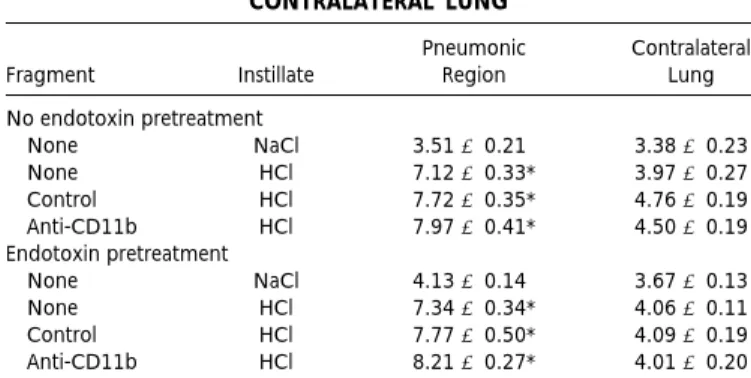
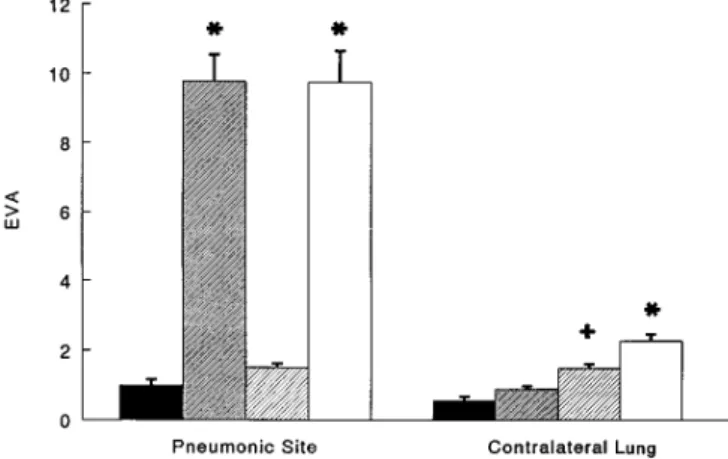
In the pneumonic region, instillation of HCl induced a sig-nificant increase in the EVA (Figure 2) and the EVLW (Table 1) that was not inhibited by either the control F(ab9)2 or the anti-CD11b F(ab9)2. In the same region of the contralateral lung, instillation of HCl did not alter EVA (p 5 0.288). How-ever, treatment of rats with anti-CD11b F(ab9)2 tended to cause a slight increase in EVA and EVLW in the contralateral lung (p 5 0.056 using a Bonferroni correction) that achieved significance in the rats pretreated with control F(ab9)2 (p 5 0.005), Figure 2.
Table 2 shows the blood weight and blood flow in the pneu-monic and contralateral regions. Instillation of HCl induced a fall in the blood weight that was partially inhibited by both the anti-CD11b and the control F(ab9)2. There was no significant change in the blood weight of the contralateral region in any group. Blood flow to the pneumonic region was reduced by 43% after instillation of NaCl. This reduction was increased to 72% when HCl was instilled, and the anti-CD11b F(ab9)2 did not inhibit this decrease (77%).
Figure 3 shows the numbers of neutrophils that were se-questered in the capillary bed. Instillation of either NaCl or HCl induced a significant increase in the number of neutro-phils/1,000 RBC in the pneumonic region compared with the same region of the contralateral lung in rats given instillations of NaCl. Instillation of HCl tended to cause an increase in neutrophils/1,000 RBC compared with NaCl, but this increase was variable and not significant. Anti-CD11b had no signifi-cant effect. However, in the contralateral side, instillation of HCl induced a significant increase in the number of seques-tered neutrophils and this increase was completely prevented by anti-CD11b but not control F(ab9)2 (Figure 3).
Protocol II: Hydrochloric Acid–induced Lung Injury in Rats Pretreated with Endotoxin
Endotoxin pretreatment reduced the total circulating leuko-cyte, neutrophil, and platelet counts after 22 h (preaspiration counts in Figure 1 compared with Figure 4). Instillation of ei-ther NaCl or HCl induced a rise in the circulating neutrophil counts that was significant at 2 h for HCl and at 3 h for both instillates. When rats were pretreated with anti-CD11b F(ab9)2 but not control F(ab9)2, the increase was prevented (Figure 4). No change in platelets occurred over the 4-h study.
Figure 1. Circulating neutrophil counts in rats that did not receive endotoxin. Injection of anti-CD11b or control F(ab9)2 did not cause a decrease in the circulating neutrophil counts at any time point. Rats that received instillation of HCl showed a significant in-crease in circulating neutrophil counts at 3 and 4 h (p , 0.05). This increase was inhibited when the animals were treated with ei-ther anti-CD11b or control F(ab9)2 (p , 0.05). Dotted line: NaCl in-stillate; solid line: HCl inin-stillate; open circles: no pretreatment; filled
circles: control F(ab9)2; filled squares: anti-CD11b F(ab9)2.
Figure 2. Edema formation as measured by EVA/g blood-free dry lung weight in HCl-induced pneumonia (pneumonic site) and the contralateral lung. In the pneumonic site, HCl induced an increase in EVA that was not inhibited by anti-CD11b or control F(ab9)2. No lung injury was observed in the contralateral lung. However, pre-treatment with either anti-CD11b or control F(ab9)2 caused an in-crease in EVA that was significant for control F(ab9)2. Solid bars: no pretreatment, instillates of NaCl; narrow stripes: no pretreatment, instillates of HCl; wide stripes: pretreatment with control F(ab9)2, instillates of HCl; open bars: pretreatment with anti-CD11b F(ab9)2, instillates of HCl. *Significantly different from instillates of NaCl (p , 0.05). 1p 5 0.056 compared with instillates of NaCl using a Bonferroni correction.
TABLE 1
EVLW IN PNEUMONIC REGIONS AND CONTRALATERAL LUNG
Fragment Instillate
Pneumonic Region
Contralateral Lung
No endotoxin pretreatment
None NaCl 3.51 6 0.21 3.38 6 0.23 None HCl 7.12 6 0.33* 3.97 6 0.27 Control HCl 7.72 6 0.35* 4.76 6 0.19 Anti-CD11b HCl 7.97 6 0.41* 4.50 6 0.19 Endotoxin pretreatment
None NaCl 4.13 6 0.14 3.67 6 0.13 None HCl 7.34 6 0.34* 4.06 6 0.11 Control HCl 7.77 6 0.50* 4.09 6 0.19 Anti-CD11b HCl 8.21 6 0.27* 4.01 6 0.20
Motosugi, Quinlan, Bree, et al.: CD11b in Aspiration Pneumonia 195
The effect of pretreating rats with intravascular injection of endotoxin on EVA, EVLW, blood weight, and blood flow are shown in Figure 5, Table 1, and Table 2. Pretreatment with en-dotoxin did not increase the EVA (Figure 1) or the EVLW
(Table 1) at the site of NaCl instillation compared with rats that did not receive endotoxin. Instillation of HCl caused an increase in EVA and EVLW that was similar to that in rats that did not receive endotoxin (Figure 5 and Table 1). In addi-tion, endotoxin did not alter the decrease in blood weight at the site of acid instillation (Table 2). The changes in blood flow were more variable, presumably due to variable hemody-namic changes induced by endotoxin, and there were no sig-nificant differences between any groups. In the contralateral region, instillation of HCl did not induce an increase in EVA compared with NaCl in rats that did not receive endotoxin. However, endotoxin pretreatment did induce a significant in-TABLE 2
BLOOD WEIGHT AND BLOOD FLOW IN PNEUMONIC REGIONS AND CONTRALATERAL LUNG
Fragment Instillate Pneumonic Region Contralateral Lung Percent Change
Blood weight (g/g blood-free dry lung) No endotoxin pretreatment
None NaCl 2.25 6 0.20 3.20 6 0.19 229 6 7 None HCl 1.34 6 0.14* 3.51 6 0.34 262 6 2* Control HCl 1.58 6 0.25 3.28 6 0.31 252 6 6* Anti-CD11b HCl 1.90 6 0.22 3.53 6 0.19 247 6 4 Endotoxin pretreatment
None NaCl 2.35 6 0.17 2.48 6 0.08 25 6 8 None HCl 1.46 6 0.09* 2.48 6 0.10 240 6 6* Control HCl 1.24 6 0.16* 2.32 6 0.11 247 6 5* Anti-CD11b HCl 1.04 6 0.10* 2.80 6 0.27 260 6 7* Blood flow (%/g blood-free dry lung)
No endotoxin pretreatment
Control NaCl 17 6 2 30 6 2 243 6 7 Control HCl 8 6 1* 29 6 3 272 6 4†
Anti-CD11b HCl 7 6 1* 28 6 0 277 6 5†
Endotoxin pretreatment
Control NaCl 18 6 2 25 6 1 227 6 9 Control HCl 13 6 2 26 6 3 243 6 14 Anti-CD11b NaCl 19 6 2 24 6 1 221 6 7 Anti-CD11b HCl 11 6 1 21 6 1 249 6 8
* p , 0.05 compared with rats that received no antibody fragments and instillates of NaCl. † p , 0.05 compared with rats that received control F(ab9)
2 and instillates of NaCl.
Figure 3. Neutrophil sequestration as measured by intravascular neutrophils/1,000 RBC in HCl-induced pneumonia (pneumonic site) and the contralateral lung. Either NaCl or HCl induced a sig-nificant increase in neutrophil sequestration compared with the contralateral region of the animals given NaCl (p , 0.05). Instilla-tion of HCl but not NaCl induced an increase in neutrophil seques-tration in the contralateral region. This increase was completely prevented when the rats were pretreated with anti-CD11b F(ab9)2.
Open triangles: mean value for each rat; closed circles: mean value
for the group 6 SEM. *Significantly different from rats pretreated with control F(ab9)2 that received instillates of NaCl (p , 0.05).
1Significantly different from rats pretreated with control F(ab9)
2 that received instillates of HCl (p , 0.05).
196 AMERICAN JOURNAL OF RESPIRATORY AND CRITICAL CARE MEDICINE VOL 157 1998
crease in EVA following NaCl instillation (Figure 5), which increased further after instillation of HCl.
The effect of the antibodies on HCl-induced injury in en-dotoxin-pretreated rats is shown in Figure 6 and Tables 1 and 2. In the pneumonic region, neither the anti-CD11b nor the control F(ab9)2 prevented the changes in EVA, EVLW, or blood weight. There was also no effect on these values in the contralateral lung region.
The number of sequestered neutrophils is shown in Figure 7. Comparison of the results in Figures 3 and 7 show that endo-toxin induced an increase in neutrophil sequestration within the pneumonic and the contralateral regions. Instillation of HCl but not NaCl increased sequestration in the pneumonic region compared with the contralateral region. Neither anti-CD11b nor control F(ab9)2 prevented this increase.
DISCUSSION
This study investigated neutrophil sequestration and edema formation in focal aspiration pneumonia and the subsequent changes that occur in the contralateral lung, as well as the ef-fect of pretreatment with endotoxin on focal aspiration pneu-monia. In rats given intrabronchial instillations of HCl for 4 h, neutrophil sequestration and edema formation, both lung wa-ter and protein, was increased at the site of the instillation. In the contralateral region, neutrophil sequestration occurred but no increase in edema formation was observed. These data con-trast with those of Goldman and colleagues (24) who showed an increase in wet-to-dry weight ratios in the contralateral lung following acute aspiration pneumonia.
Pretreatment with endotoxin increased neutrophil tration throughout the lung (Figure 7). This increased seques-tration is most likely due to the production of cytokines in re-sponse to endotoxin that both activate neutrophils and induce upregulation of adhesion molecules, particularly ICAM-1 and members of the selectin family (4, 25). After instillation of HCl but not NaCl, there was a further increase in neutrophil sequestration at the site of aspiration. HCl also induced a local increase in edema formation, but this increase was similar in the endotoxin-pretreated and the control rats (Figures 3 and 6). In the contralateral lung, instillation of HCl did not further enhance the endotoxin-induced increase in neutrophil seques-tration. Despite no additional sequestration, the instillation of HCl did induce an increase in permeability that was not ob-served in rats that did not receive endotoxin. This lung injury is presumably due to the ability of circulating mediators re-leased from the site of aspiration to induce further activation of neutrophils that were already sequestered. These data sug-gest that there is a synergistic effect of endotoxin pretreat-Figure 5. The effect of pretreatment with endotoxin on edema
for-mation in HCl-induced pneumonia (pneumonic site) and the con-tralateral lung. In the pneumonic site, the increase induced by in-stillation of HCl was similar in the endotoxin-pretreated and control rats. In the contralateral region, endotoxin induced an increase in EVA in rats given instillates of NaCl, and HCl induced a further in-crease. Solid bars: no pretreatment, instillates of NaCl; narrow stripes: no pretreatment, instillates of HCl; wide stripes: pretreatment with endotoxin, instillates of NaCl; open bars: pretreatment with endo-toxin, instillates of HCl. *Significantly different from rats with the same pretreatment given instillates of NaCl (p , 0.05). 1Significantly
different from rats given control pretreatment and instillates of NaCl.
Figure 6. The effect of anti-CD11b F(ab9)2 on edema formation in endotoxin-pretreated rats with HCl-induced pneumonia. Anti-CD11b antibodies had no effect in either the pneumonic or the contralateral regions. Solid bars: no antibody pretreatment, instil-lates of NaCl; narrow stripes: no antibody pretreatment, instilinstil-lates of HCl; wide stripes: pretreatment with control F(ab9)2, instillates of HCl; open bars: pretreatment with anti-CD11b F(ab9)2, instillates of HCl. *Significantly different from instillates of NaCl (p , 0.05).
Figure 7. The effect of anti-CD11b F(ab9)2 on neutrophil sequestra-tion in endotoxin-pretreated rats with HCl-induced pneumonia.
Solid bars: no antibody pretreatment, instillates of NaCl; narrow stripes: no antibody pretreatment, instillates of HCl; wide stripes:
Motosugi, Quinlan, Bree, et al.: CD11b in Aspiration Pneumonia 197
ment and instillation of acid only at the contralateral site and not at the site of aspiration.
Blockade of CD11b using anti-CD11b F(ab9)2 did not alter either neutrophil sequestration or edema formation at the site of acid instillation. These data suggest that neither edema for-mation nor neutrophil sequestration requires CD11b-medi-ated neutrophil adhesion, indicating that CD11b/CD18-inde-pendent pathways are utilized. These studies confirm and extend those of Goldman and colleagues (8) who showed that neither CD18 nor ICAM-1 was required for neutrophil se-questration and edema formation at the injured site. Alterna-tive adhesion pathways and changes in biomechanical proper-ties of neutrophils could be mediating this CD11b/CD18-independent pathway. CD11a/CD18 is unlikely to substitute for CD11b/CD18, as CD11a/CD18 plays no significant role in cobra venom factor–induced permeability changes (26) and anti-CD18 antibodies had no effect in HCl-induced injury (7, 8). Selectins are thought to be required for loose initial interac-tions between neutrophils and endothelial cells in preparation for CD11/CD18-ICAM-1-mediated adhesion, but are unlikely to induce interactions firm enough to allow neutrophil-medi-ated endothelial injury to occur, at least in the systemic circu-lation (4). However, a possible contribution of selectins can not be excluded. Finally, changes in the biomechanical prop-erties of the endothelium or the neutrophils may result in se-questration. In normal pulmonary microvasculature, neutro-phils must deform to pass through the majority of capillary pathways (27, 28). Endothelial cell injury or edema formation within the alveolocapillary wall may further narrow capillar-ies, causing sequestration of neutrophils. Changes in the bio-mechanical properties of neutrophils, particularly in their stiff-ness, in response to activation have been described (29, 30). Stiffened neutrophils may be unable to deform to pass through capillary segments.
Studies from our laboratory and others have shown that a focal injury often results in sequestration and emigration at distant sites. Cohen and Batra demonstrated that repeated saline lavage of a right lung segment induces emigration of neutrophils in the contralateral lung within 24 h (31). Focal in-stillation of Streptococcus pneumoniae induced neutrophil sequestration in the contralateral pulmonary capillaries within 4 h (21). This increase has been attributed to circulating medi-ators released from the site of injury. Goldman and colleagues demonstrated increased numbers of neutrophils in the con-tralateral lung following instillation of HCl (8). They also showed that in the contralateral lung, CD18 and ICAM-1 were required for neutrophil sequestration (8). Our studies extend their work to show that in the contralateral lung of rats that did not receive endotoxin, neutrophil sequestration was pre-vented by pretreatment with the anti-CD11b F(ab9)2. These data indicate that, in contrast to the site of aspiration, CD11b-mediated adhesion was required for neutrophil sequestration at sites distant from the pneumonia. This difference between the mechanisms of neutrophil sequestration at the site of aspi-ration and at a distant site suggests that circulating factors duce sequestration through pathways different from those in-duced by local factors accumulating at the injured site. However, this sequestration did not induce edema formation (Figure 2), indicating that CD11b/CD18-mediated neutrophil sequestra-tion is not sufficient to induce an injury. Other factors that are likely to include local production of cytokines or direct tissue injury are required for edema formation to occur.
To determine the role of CD11b/CD18 in aspiration pneu-monia following endotoxemia, rats pretreated with endotoxin received anti-CD11b F(ab9)2 before instillation of HCL. Inhi-bition of CD11b/CD18 in endotoxin-pretreated rats had no
ef-fect on the formation of edema at either the site or aspiration or the contralateral lung injury. Neutrophil sequestration at the site of aspiration was also not inhibited, indicating that CD11b-independent mechanisms of adhesion were mediating sequestration in both endotoxin-pretreated and control rats (Figures 3 and 7). Interestingly, although HCl did not induce a further increase in neutrophil sequestration in the contralat-eral lung beyond that caused by endotoxin alone, anti-CD11b F(ab9)2 given in the last 4 h of the study did not reduce this se-questration. Because the anti-CD11b F(ab9)2 is unlikely to cause already adherent neutrophils to detach, these data sug-gest either that the endotoxin-induced sequestration was no longer occurring or that CD11b was not mediating sequestra-tion during these last 4 h.
In summary, at the site of acid aspiration, CD11b-mediated adhesion is not required for either edema formation or neu-trophil sequestration, with or without pretreatment with en-dotoxin. In the contralateral lung, HCl-induced neutrophil se-questration required CD11b in rats that were not treated with endotoxin. Despite CD11b-dependent sequestration of neu-trophils in the contralateral lung, no edema formation occurred. Pretreatment with endotoxin induced neutrophil sequestra-tion diffusely within the lungs, and subsequent instillasequestra-tion of HCl caused no further increase in sequestration within the contralateral lung. The increase in edema formation within the contralateral lung that was observed only when rats were given the combined stimuli of endotoxin pretreatment and acid aspi-ration was not prevented by inhibition of CD11b-mediated adhesion during the aspiration. As rats are well recognized to be less sensitive to endotoxemia than humans, these observa-tions may understate the effects of combined stimuli in patients at risk of adult respiratory distress syndrome (ARDS), although the role of endotoxemia in the pathogenesis of ARDS and mul-tiorgan failure is controversial and remains to be clarified.
Acknowledgment: The writers thank Dr. Toshio Kumasaka for his help in the performance and analysis of these experiments and Barbara Fletcher for her help in the preparation of this manuscript.
References
1. Wynne, J. W. 1982. Aspiration pneumonitis: correlation of experimental models with clinical disease. Clin. Chest Med. 3:25–34.
2. Dal Santo, G. 1986. Acid aspiration: pathophysiological aspects, preven-tion, and therapy. Int. Anesthesiol. Clin. 24:31–52.
3. Ribaudo, C. A., and W. J. Grace. 1971. Pulmonary aspiration. Am. J.
Med. 50:510–520.
4. Carlos, T. M., and J. M. Harlan. 1994. Leukocyte-endothelial adhesion molecules. Blood 84:2068–2101.
5. Harlan, J. M., R. K. Winn, N. B. Vedder, C. M. Doerschuk, and C. L. Rice. 1992. In vivo models of leukocyte adherence to endothelium. In J. M. Harlan and D. Y. Lui, editors. Adhesion: Its Role in Inflamma-tory Disease. Freeman and Co., New York. 117–150.
6. Albelda, S. M., C. W. Smith, and P. A. Ward. 1994. Adhesion molecules and inflammatory injury. FASEB J. 8:504–512.
7. Doerschuk, C. M., R. K. Winn, H. O. Coxson, and J. M. Harlan. 1990. CD18-dependent and -independent mechanisms of neutrophil adher-ence in the pulmonary and systemic microvasculature of rabbits. J.
Immunol. 114:2327–2333.
8. Goldman, G., R. Welbourn, L. Kobzik, C. R. Valeri, D. Shepro, and H. B. Hechtman. 1995. Neutrophil adhesion receptor CD18 mediates remote but not localized acid aspiration injury. Surgery 117:83–89. 9. Tate, R. N., and J. E. Repine. 1983. Neutrophils and the adult
respira-tory distress syndrome. Am. Rev. Respir. Dis. 128:552–559.
10. Herbert, Y., and H. Y. Reynolds. 1987. Lung inflammation: normal host defense or a complication of some diseases. Ann. Rev. Med. 38:295– 323.
198 AMERICAN JOURNAL OF RESPIRATORY AND CRITICAL CARE MEDICINE VOL 157 1998
12. Brigham, K. L., and B. Meyrick. 1986. Endotoxin and lung injury. Am.
Rev. Respir. Dis. 133:913–927.
13. Gie, R. P., C. M. Doerschuk, D. English, H. O. Coxson, and J. C. Hogg. 1991. Neutrophil-associated lung injury following the infusion of acti-vated plasma. J. Appl. Physiol. 70:1271–1278.
14. Webster, R. O., G. L. Larsen, B. C. Mitchell, A. J. Goins, and P. M. Hen-son. 1982. Absence of inflammatory lung injury in rabbits challenged intravascularly with complement-derived chemotactic factors. Am.
Rev. Respir. Dis. 125:335–340.
15. Worthen, G. S., C. Haslett, A. J. Ress, R. S. Gumbay, J. E. Henson, and P. M. Henson. 1987. Neutrophil mediated pulmonary vascular injury. Synergistic effect of trace amounts of lipopolysaccharide and neutro-phil stimuli on vascular permeability and neutroneutro-phil sequestration in the lung. Am. Rev. Respir. Dis. 136:19–28.
16. Wortel, C. H., and C. M. Doerschuk. 1993. Neutrophils and neutrophil– endothelial cell adhesion in ARDS. New Horizons 1:631–637. 17. Allard, M. F., C. M. Doerschuk, M. L. Brumwell, A. Belzberg, and J. C.
Hogg. 1988. Oleic acid–induced lung injury in rabbits: the effect of fi-brinogen depletion and Arvin. J. Appl. Physiol. 64:920–928.
18. Doerschuk, C. M., and H. S. Sekhon. 1990. Blood volume and edema in post-pneumonectomy lung growth in rats. J. Appl. Physiol. 69:1178– 1182.
19. Doerschuk, C. M., M. F. Allard, B. A. Martin, A. MacKenzie, and J. C. Hogg. 1987. Marginated pool of neutrophils in lungs of rabbits. J.
Appl. Physiol. 63:1806–1815.
20. Doerschuk, C. M. 1992. The role of CD18-mediated adhesion in neutro-phil sequestration induced in infusion of activated plasma in rabbits.
Am. J. Respir. Cell Mol. Biol. 7:140–148.
21. Doerschuk, C. M., J. Markos, H. O. Coxson, D. English, and J. C. Hogg. 1994. Quantitation of neutrophil migration in acute bacterial pneumo-nia in rabbits. J. Appl. Physiol. 77:2593–2599.
22. Zar, J. H. 1984. Biostatistical Analysis, 2nd ed. Prentice-Hall,
Engle-wood Cliffs, NJ. 162–170.
23. Hollard, B. S., and M. D. Copenhaver. 1987. An improved sequentially rejective Bonferroni test procedure. Biometrics 43:417–423.
24. Goldman, G., R. Welbourn, J. M. Klausner, L. Kobzik, D. Shepro, and H. B. Hechtman. 1993. Leukocytes mediate acid aspiration–induced multiorgan edema. Surgery 114:13–20.
25. Ballantyne, C. M., J. E. Sligh, Jr., S. Y. Dai, and A. L. Beaudet. 1992. Characterization of the murine ICAM-1 gene. Genomics 14:1076– 1080.
26. Mulligan, M. S., C. W. Smith, D. C. Anderson, R. F. Todd, III, M. Mi-yasaka, T. Tamatani, T. B. Issekutz, and P. A. Ward. 1993. Role of leukocyte adhesion molecules in complement-induced lung injury. J.
Immunol. 150:2401–2406.
27. Doerschuk, C. M., N. Beyers, H. O. Coxson, B. Wiggs, and J. C. Hogg. 1994. Comparison of neutrophil and capillary diameters and their re-lation to neutrophil sequestration in the lung. J. Appl. Physiol. 74: 3040–3045.
28. Wiggs, B. R., D. English, W. M. Quinlan, N. A. Doyle, J. C. Hogg, and C. M. Doerschuk. 1994. The contributions of capillary pathway size and neutrophil deformability to neutrophil transit through rabbit lungs. J. Appl. Physiol. 77:463–470.
29. Worthen, G. S., B. Schwab, III, E. L. Elson, and G. P. Downey. 1989. Mechanics of stimulated neutrophils: cell stiffening induces retention in capillaries. Science 245:183–186.
30. Inano, H., D. English, and C. M. Doerschuk. 1992. Effect of zymosan-activated plasma on the deformability of rabbit polymorphonuclear leukocytes and the role of the cytoskeleton. J. Appl. Physiol. 73:1370– 1376.