Sliding Window Algorithms for k-Clustering
Problems
Michele Borassi Google Zürich [email protected] Alessandro Epasto Google Research New YorkSilvio Lattanzi Google Research Zürich
Sergei Vassilviskii Google Research New York
Morteza Zadimoghaddam Google Research Cambridge
Abstract
The sliding window model of computation captures scenarios in which data is arriving continuously, but only the latestwelements should be used for analysis. The goal is to design algorithms that update the solution efficiently with each arrival rather than recomputing it from scratch. In this work, we focus onk-clustering problems such ask-means andk-median. In this setting, we provide simple and practical algorithms that offer stronger performance guarantees than previous results. Empirically, we show that our methods store only a small fraction of the data, are orders of magnitude faster, and find solutions with costs only slightly higher than those returned by algorithms with access to the full dataset.
1
Introduction
Data clustering is a central tenet of unsupervised machine learning. One version of the problem can be phrased as grouping data intokclusters so that elements within the same cluster are similar to each other. Classic formulations of this question include thek-median andk-means problems for which good approximation algorithms are known [1, 44]. Unfortunately, these algorithms often do not scale to large modern datasets requiring researchers to turn to parallel [8], distributed [9], and streaming methods. In the latter model, points arrive one at a time and the goal is to find algorithms that quickly update a smallsketch(or summary) of the input data that can then be used to compute an approximately optimal solution.
One significant limitation of the classic data stream model is that it ignores the time when a data point arrived; in fact, all of the points in the input are treated with equal significance. However, in practice, it is often important (and sometimes necessary) to restrict the computation to very recent data. This restriction may be due to data freshness—e.g., when training a model on recent events, data from many days ago may be less relevant compared to data from the previous hour. Another motivation arises from legal reasons, e.g., data privacy laws such as the General Data Protection Regulation (GDPR), encourage and mandate that companies not retain certain user data beyond a specified period. This has resulted in many products including a data retention policy [54]. Such recency requirements can be modeled by thesliding windowmodel. Here the goal is to maintain a small sketch of the input data, just as with the streaming model, and then use only this sketch to approximate the solution on the lastwelements of the stream.
Clustering in the sliding window model is the main question that we study in this work. A trivial solution simply maintains thewelements in the window and recomputes the clusters from scratch at each step. We intend to find solutions that use less space, and are more efficient at processing each
new element. In particular, we present an algorithm which uses space linear ink, and polylogarithmic inw, but still attains a constant factor approximation.
Related Work Clustering.Clustering is a fundamental problem in unsupervised machine learning and has application in a disparate variety of settings, including data summarization, exploratory data analysis, matrix approximations and outlier detection [39, 41, 46, 50]. One of the most studied formulations in clustering of metric spaces is that of findingkcenters that minimize an objective consisting of the`pnorm of the distances of all points to their closest center. Forp∈ {1,2,∞} this problem corresponds tok-median,k-means, andk-center, respectively, which are NP-hard, but constant factor approximation algorithms are known [1, 34, 44]. Several techniques have been used to tackle these problems at scale, including dimensionality reduction [45], core-sets [6], distributed algorithms [5], and streaming methods reviewed later. To clarify between Euclidean or general metric spaces, we note that our results work on arbitrary general metric spaces. The hardness results in the literature hold even for special case of Euclidean metrics and the constant factor approximation algorithms hold for the general metric spaces.
Streaming model.Significant attention has been devoted to models for analyzing large-scale datasets that evolve over time. The streaming model of computation is of the most well-known (see [49] for a survey) and focuses on defining low-memory algorithms for processing data arriving one item at a time. A number of interesting results are known in this model ranging from the estimation of stream statistics [3, 10], to submodular optimization [7], to graph problems [2, 30, 42], and many others. Clustering is also well studied in this setting, including algorithms fork-median,k-means, andk-center in the insertion-only stream case [6, 20, 35].
Sliding window streaming model.The sliding window model significantly increases the difficultly of the problem, since deletions need to be handled as well. Several techniques are known, including the exponential histogram framework [27] that addresses weakly additive set functions, and the smooth histogram framework [18] that is suited for functions that are well-behaved and possesses a sufficiently small constant approximation. Since many problems, such ask-clustering, do not fit into these two categories, a number of algorithms have been developed for specific problems such as submodular optimization [14, 21, 29], graph sparsification [26], minimizing the enclosing ball [55], private heavy hitters [54], diversity maximization [14] and linear algebra operations [15]. Sliding window algorithms find also applications in data summarization [23].
Turning to sliding window algorithms for clustering, for thek-center problem Cohen et al. [25] show a(6 +)-approximation usingO(klog ∆)space and per point update time ofO(k2log ∆), where
∆is the spread of the metric, i.e. the ratio of the largest to the smallest pairwise distances. For k-median andk-means, [17] give constant factor approximation algorithms that useO(k3log6
w)
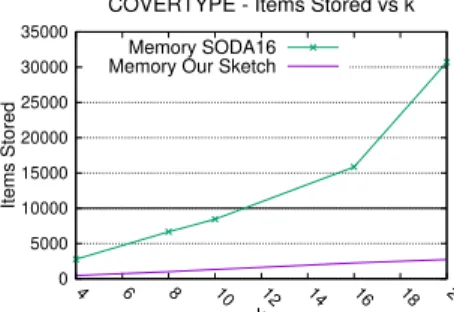
space and per point update time ofO(poly(k,logw)).1 Their bound is polylogarithmic inw, but cubicink, making it impractical unlesskw.2In this paper we improve their bounds and give a simpler algorithm with only linear dependency ofk. Furthermore we show experimentally (Figure 1 and Table 1) that our algorithm is faster and uses significantly less memory than the one presented in [17] even with very small valuesk(i.e.,k ≥ 4). In a different approach, [56] study a variant where one receives points in batches and uses heuristics to reduce the space and time. Their approach does provide approximation guarantees but it applies only to the Euclidean k-means case. Recently, [32] studied clustering problems in the distributed sliding window model, but these results are not applicable to our setting.
The more challenging fully-dynamic stream case has also received attention [16, 38]. Contrary to our result for the sliding window case, in the fully-dynamic case, obtaining aO˜(k)memory, low update time algorithm, for thearbitrarymetrick-clustering case with general`pnorms is an open problem. For the special case ofd-dimensional Euclidean spaces fork-means, there are positive results—[38] giveO˜(kd4)-space core-set with1 +approximation.
Dynamic algorithms have also been studied in a consistent model [24, 43], but there the objective is to minimize the number of changes to the solution as the input evolves, rather than minimizing the approximation ratio and space used. Finally, a relaxation of the fully dynamic model that allows only
1
We note that the authors assume that the cost of any solution is polynomial inw. We chose to state our bounds explicitly, which introduces a dependence on the ratio of the max and min costs of the solution.
2
We note here that in some practical applicationskcan be large. For instance, in spam and abuse [53], near-duplicate detection [37] or reconciliation tasks [52].
a limited number of deletions has also been addressed [33, 48]. The only work related to clustering is that of submodular maximization [48] which includes exemplar-based clustering as a special case. Our Contributions We simplify and improve the state-of-the-art ofk-clustering sliding window algorithms, resulting in lower memory algorithms. Specifically, we:
• Introduce a simple new algorithm fork-clustering in the sliding window setting (Section 3.2). The algorithm is an example of a more general technique that we develop for minimization problems in this setting. (Section 3).
• Prove that the algorithm needs space linear inkto obtain a constant approximate solution (Theorem 3.4), thus improving over the best previously known result which requiredΩ(k3) space.
• Show empirically that the algorithm is orders of magnitude faster, more space efficient, and more accurate than previous solutions, even for small values ofk(Section 4).
2
Preliminaries
LetXbe a set of arbitrary points, andd :X×X →Rbe a distance function. We assume that(X,d)
is an arbitrary metric space, that is,dis non-negative, symmetric, and satisfies the triangle inequality. For simplicity of exposition we will make a series of additional assumptions, in supplementary material, we explain how we can remove all these assumptions. We assume that the distances are normalized to lie between1and∆. We will also consider weighted instances of our problem where, in addition, we are given a functionweight:X →Zdenoting the multiplicity of the point.
The k-clustering family of problems asks to find a set of k cluster centers that minimizes a particular objective function. For a pointx and a set of points Y = {y1, y2, . . . , ym}, we let d(x, Y) = miny∈Y d(x, y), and letcl(x, Y)be the point that realizes it,arg miny∈Y d(x, y).The cost of a set of centersCis:fp(X,C) =Px∈Xd
p(x,C). Similarly for weighted instances, we have fp(X,weight,C) =Px∈Xweight(x)d
p(x,C).
Note that forp= 2, this is precisely thek-MEDOIDSproblem.3 Forp= 1, the above encodes the k-MEDIANproblem. Whenpis clear from the context, we will drop the subscript. We also refer to the optimum cost for a particular instance(X, d)asOPTp(X), and the optimal clustering as C∗
p(X) ={c∗1,c∗2, . . . ,c∗k}, shortening toC∗when clear from context. Throughout the paper, we assume thatpis a constant withp≥1.
While mapping a point to its nearest cluster is optimal, any map µ : X → X will produce a valid clustering. In a slight abuse of notation we extend the definition offp to sayfp(X, µ) =
P
x∈Xd(x, µ(x)) p.
In this work, we are interested in algorithms for sliding window problems, we refer to the window size aswand to the set of elements in the active window asW, and we usenfor the size of the entire stream, typicallynw. We denote byXtthet-th element of the stream and byX[a,b]the subset of the stream from timeatob(both included). For simplicity of exposition, we assume that we have access to a lower boundmand upper boundM of the cost of the optimal solution in any sliding window.4
We use two tools repeatedly in our analysis. The first is the relaxed triangle inequality. Forp≥1
and anyx, y, z∈X, we have:d(x, y)p≤2p−1(d(x, z)p+d(z, y)p).The second is the fact that the value of the optimum solution of a clustering problem does not change drastically if the points are shifted around by a small amount. This is captured by Lemma 2.1 which was first proved in [35]. For completeness we present its proof in the supplementary material.
Lemma 2.1. Given a set of pointsX ={x1, . . . , xn}consider a multisetY ={y1, . . . , yn}such thatP
id p(x
i, yi)≤αOPTp(X), for a constantα. LetB∗be the optimalk-clustering solution for Y. Thenfp(X,B∗)∈O((1 +α)OP Tp(X)).
3
In the Euclidean space, if the centers do not need to be part of the input, then settingp= 2recovers the k-MEANSproblem.
4
These assumptions are not necessary. In the supplementary material, we explain how we estimate them in our experiments and how from a theoretical perspective we can remove the assumptions.
Given a set of pointsX, a mappingµ:X →Y, and a weighted instance defined by(Y,weight), we say that the weighted instance isconsistentwithµ, if for ally∈Y, we have thatweight(y) =
|{x∈X|µ(x) =y}|. We say it is-consistent(for constant≥0), if for ally∈Y, we have that |{x∈X |µ(x) =y}| ≤weight(y)≤(1 +)|{x∈X |µ(x) =y}|.
Finally, we remark that thek-clustering problem is NP-hard, so our focus will be on finding efficient approximation algorithms. We say that we obtain anαapproximation for a clustering problem iffp(X,C)≤α·OPTp(X). The best-known approximation factor for all the problems that we consider are constant [1, 19, 36]. Additionally, since the algorithms work in arbitrary metric spaces, we measure update time in terms of distance function evaluations and use the number of points as space cost (all other costs are negligible).
3
Algorithm and Analysis
The starting point of our clustering is the development of efficient sketching technique that, given a stream of points,X, a mappingµ, and a time,τ, returns a weighted instance that is-consistent with µfor the points inserted at or afterτ. To see why having such a sketch is useful, supposeµhas a cost a constant factor larger than the cost of the optimal solution. Then we could get an approximation to the sliding window problem by computing an approximately optimal clustering on the weighted instance (see Lemma 2.1).
To develop such a sketch, we begin by relaxing our goal by allowing our sketch to return a weighted instance that is-consistent withµfor theentire streamX as opposed to the substream starting at Xτ. Although a single sketch with this property is not enough to obtain a good algorithm for the overall problem, we design a sliding window algorithm that builds multiple such sketches in parallel. We can show that it is enough to maintain a polylogarithmic number of carefully chosen sketches to guarantee that we can return a good approximation to the optimal solution in the active window. In subsection 3.1 we describe how we construct a single efficient sketch. Then, in the subsection 3.2, we describe how we can combine different sketches to obtain a good approximation. All of the missing proofs of the lemmas and the pseudo-code for all the missing algorithms are presented in the supplementary material.
3.1 Augmented Meyerson Sketch
Our sketching technique builds upon previous clustering algorithms developed for the streaming model of computation. Among these, a powerful approach is the sketch introduced for facility location problems by Meyerson [47].
At its core, given an approximate lower bound to the value of the optimum solution, Meyerson’s algorithm constructs a setCof sizeO(klog ∆), known as asketch, and a consistent weighted instance, such that, with constant probability,fp(X,C)∈O(OPTp(X)). Given such a sketch, it is easy to both: amplify the success probability to be arbitrarily close to 1 by running multiple copies in parallel, and reduce the number of centers tokby keeping track of the number of points assigned to each c∈ Cand then clustering this weighted instance intokgroups.
What makes the sketch appealing in practice is its easy construction—each arriving point is added as a new center with some carefully chosen probability. If a new point does not make it as a center, it is assigned to the nearest existing center, and the latter’s weight is incremented by 1.
Meyerson algorithm was initially designed for online problems, and then adapted to algorithms in the streaming computation model, where points arrive one at a time but are never deleted. To solve the sliding window problem naively, one can simply start a new sketch with every newly arriving point, but this is inefficient. To overcome these limitations we extend the Meyerson sketch. In particular, there are two challenges that we face in sliding window models:
1. The weight of each cluster is not monotonically increasing, as points that are assigned to the cluster time out and are dropped from the window.
2. The designated center of each cluster may itself expire and be removed from the window, requiring us to pick a new representative for the cluster.
Using some auxiliary bookkeeping we can augment the classic Meyerson sketch to return a weighted instance that is-consistent with a mappingµwhose cost is a constant factor larger than the cost of the optimal solution for the entire streamX. More precisely,
Lemma 3.1. Letwbe the size of the sliding window,∈(0,1)be a constant andtthe current time. Let(X,d)be a metric space and fixγ∈(0,1). The augmented Meyerson algorithm computes an im-plicitmappingµ:X→ C, and an-consistent weighted instance(C,weight\)for all substreamsX[τ,t] withτ≥t−w, such that, with probability1−γ, we have:|C| ≤22p+8klogγ−1log ∆ and fp(X[τ,t],C)≤22p+8OPTp(X).
The algorithm uses spaceO(klogγ−1log ∆ log(M/m)(logM+ logw+ log ∆))and stores the cost of the consistent mapping,f(X, µ), and allows a1 +approximation to the cost of the-consistent mapping, denoted byfb(X[τ,t], µ). This is the-consistent mapping that is computed by the augmented Meyerson algorithm. In section 2,M andmare defined as the upper and lower bounds on the cost of the optimal solution.
Note that whenM/mand∆are polynomial inw,5the above space bound isO(klogγ−1log3
(w)). 3.2 Sliding Window Algorithm
In the previous section we have shown that we can the Meyerson sketch to have enough information to output a solution using the points in the active window whose cost is comparable to the cost of the optimal computed on the whole stream. However, we need an algorithm that is competitive with the cost of the optimum solution computed solely on the elements in the sliding window.
We give some intuition behind our algorithm before delving into the details. Suppose we had a good guess on the value of the optimum solution,λ∗and imagine splitting the inputx1, x2, . . . , xtinto blocksA1={x1, x2, . . . , xb1},A2={xb1+1, . . . , xb2}, etc. with the constraints that (i) each block
has optimum cost smaller thanλ∗, and (ii) is also maximal, that is adding the next element to the block causes its cost to exceedλ∗. It is easy to see, that any sliding window of optimal solution of costλ∗overlaps at most two blocks. The idea behind our algorithm is that, if we started an augmented Meyerson sketch in each block, and we obtain a good mapping for the suffix of the first of these two blocks, we can recover a good approximate solution for the sliding window.
We now show how to formalize this idea. During the execution of the algorithm, we first discretize the possible values of the optimum solution, and run a set of sketches for each value ofλ. Specifically, for each guessλ, we run Algorithm 1 to compute the AugmentedMeyerson for two consecutive substreams,Aλ andBλ, of the input streamX. (The full pseudocode of AugmentedMeyerson is available in the supplementary material.) When a new point,x, arrives we check whether the k-clustering cost of the solution computed on the sketch after addingxtoBλexceedsλ. If not, we add it to the sketch forBλ, if so we reset theBλsubstream tox, and rename the old sketch ofBλas Aλ. Thus the algorithm maintains two sketches, on consecutive subintervals. Notice that the cost of each sketch is at mostλ, and each sketch is grown to be maximal before being reset.
We remark that to convert the Meyerson sketch to ak-clustering solution, we need to run ak-clustering algorithm on the weighted instance given by the sketch. Since the problem is NP-hard, letALGdenote anyρ-approximate algorithm, such as the one by [36]. LetS(Z) = (Y(Z),weight(Z))denote the augmented Meyerson sketch built on a (sub)streamZ, withY(Z)as the centers, andweight(Z)as the (approximate) weight function. We denote byALG(S(Z))the solution obtained by runningALG over the weighted instanceS(Z). Letfbp(S(Z),ALG(S(Z)))be the estimated cost of the solution ALG(S(Z))over the streamZobtained by the sketchS(Z).
We show that we can implement a functionfbpthat operates only on the information in the augmented Meyerson sketchS(Z)and gives aβ∈O(ρ)approximation to the cost on the unabridged input. Lemma 3.2(Approximate solution and approximate cost from a sketch). Using an approximation algorithmALG, from the augmented Meyerson sketchS(Z), with probability≥1−γ, we can output a solutionALG(S(Z))and an estimatefbp(S(Z),ALG(S(Z)))of its cost s.t.fp(Z,ALG(S(Z)))≤
b
fp(S(Z),ALG(S(Z)))≤β(ρ)fp(Z,OPT(Z))for a constantβ(ρ)≤23p+6ρdepending only the approximation factorρofALG.
5
Algorithm 1Meyerson Sketches,ComputeSketches(X, w, λ, m, M,∆)
1: Input: A sequence of pointsX=x0, x1, x2, . . . , xn. The size of the windoww. Cost thresholdλ. A lower
boundmand upper boundMof the cost of the optimal solution and upper bound on distances∆. 2: Output: Two sketches for the streamS1andS2.
3: S1←AugmentedMeyerson(∅, w, m, M,∆);S2←AugmentedMeyerson(∅, w, m, M,∆)
4: Aλ← ∅;Bλ← ∅ (Recall thatAλ, Bλare sets andS1andS2the corresponding sketches. Note that the
content of the sets is not stored explicitly.) 5: forx∈Xdo
6: LetStempbe computed by AugmentedMeyerson(Bλ∪ {x}, w, m, M,∆). (Note: it can be computed
by addingxto a copy of the sketch maintained byS2)
7: iffbp(Stemp,ALG(Stemp))≤λthen
8: Add x to the stream of the sketch S2. (Bλ ← Bλ ∪ {x}, S2 ←
AugmentedMeyerson(Bλ, w, m, M,∆))
9: else
10: S1←S2;S2←AugmentedMeyerson({x}, w, m, M,∆). (Aλ←Bλ;Bλ← {x})
11: end if
12: end for
13: Return (S1, S2, and start and end times ofAλandBλ)
Composition of sketches from sub-streams Before presenting the global sliding window algo-rithm that uses these pairs of sketches, we introduce some additional notation. LetS(Z)be the augmented Meyerson sketch computed over the streamZ. LetSuffixτ(S(Z))denote the sketch obtained from a sketchSfor the points that arrived afterτ. This can be done using the operations defined in the supplementary material.
We say that a timeτis contained in a substreamAifAcontains elements inserted on or after time τ. Finally we defineAτ as the suffix ofA that contains elements starting at timeτ. Given two sketchesS(A), andS(B)computed over two disjoint substreamsA, B, letS(A)∪S(B)be the sketch obtained by joining the centers ofS(A)andS(B)(and summing their respective weights) in a single instance. We now prove a key property of the augmented Meyerson sketches we defined before.
Lemma 3.3 (Composition with a Suffix of stream). Given two substreams A,B (with possibly B = ∅) and a timeτ inA, letALGbe a constant approximation algorithm for thek-clustering problem. Then ifOPTp(A) ≤O(OPTp(Aτ ∪B), then, with probability≥1−O(γ), we have fp(Aτ∪B,ALG(Suffixτ(S(A))∪S(B)))≤O(OPTp(Aτ∪B)).
The main idea of the proof is to show thatSuffixτ(S(A))∪S(B)is-consistent with a good mapping fromAτ∪B and then by using a technique similar to Lemma 2.1 show that we can compute a constant approximation from an-consistent sketch.
Algorithm 2Our main algorithm. Input:X, m, M,∆, approx. factor ofALG(β) andδ. 1: Λ← {m,(1 +δ)m, . . . ,2pβ(1 +δ)M}
2: forλ∈Λdo
3: Sλ,1, Sλ,2←ComputeSketches(X, w, λ, m, M,∆)
4: end for
5: if Bλ∗=W for someλ∗then returnALG(Sλ∗,2) 6: λ∗←min({λ:Aλ6⊆W})
7: τ←max(|X| −w,1)
8: if W∩Aλ∗6=∅then returnALG(Suffixτ(Sλ∗,1)∪Sλ∗,2) 9: else returnALG(Suffixτ(Sλ∗,2))
Final algorithm. We can now present the full algorithm in Algorithm 2. As mentioned before, we run multiple copies ofComputeSketchesin parallel, for geometrically increasing values ofλ. For each value ofλ, we maintain the pair of sketches over the streamX. Finally, we compute the centers using such sketches. If we get lucky, and for the sliding windowW there exists a subsequence whereBλ∗is preciselyW, we use the appropriate sketch and returnALG(Sλ∗,2). Otherwise, we find the smallestλ∗for whichAλis not a subset ofW. We then use the pair of sketches associated with Aλ∗andBλ∗, combining the sketch of the suffix ofAλ∗that intersects withW, and the sketch on Bλ∗.
The main result is that this algorithm provides a constant approximation of thek-clustering problem, for anyp ≥ 1, with probability at least 1−γ, using space linear ink and logarithmic in other parameters. The total running time of the algorithm depends on the complexity ofALG. LetT(n, k)
be the complexity of solving an instance ofk-clustering with sizenpoints usingALG.
Theorem 3.4. With probability 1 − γ, Algorithm 2, outputs an O(1)-approximation for the sliding window k-clustering problem using space: O klog(∆)(log(∆) + log(w) + log(M)) log2(M/m) log(γ−1log(M/m)) and total update time O(T(klog(∆), k) log2(M/m) log(γ−1log(M/m)) (log(∆) + log(w) + log(M)).
We remark that ifM and∆are polynomial inw, then the total space isO(klog4wlog(logw/γ))
and the total update time isO(T(klogw, k) log3(w) log(logw/γ)). The main component in the constant approximation factor of Theorem 3.4 statement comes from the23p+5ρapproximation for the insertion-only case [43]. Herepis the norm, andρis the offline algorithm factor. Given the composition operation in our analysis in addition to applying triangle inequality and some other steps, we end up with an approximation factor≈28p+6ρ. We do not aim to optimize for this approximation factor, however it could be an interesting future direction.
4
Empirical Evaluation
We now describe the methodology of our empirical evaluation before providing our experiments results. We report only the main results in the section, more details on the experiments and results are in supplementary material. Our code is available open-source on github6. All datasets used are publicly-available.
Datasets. We used 3 real-world datasets from the UCI Repository [28] that have been used in previous experiments onk-clustering for data streams settings: SKINTYPE [12],n= 245057, d= 4, SHUTTLE,n = 58000, d = 9, and COVERTYPE [13],n = 581012, d = 54. Consistent with previous work, we stream all points in the natural order (as they are stored in the dataset). We also use 4 publicly-available synthetic dataset from [31] (the S-Set series) that have ground-truth clusters. We use 4 datasets (s1, s2, s3, s4) that are increasingly harder to cluster and have eachk= 15ground-truth clusters. Consistent with previous work, we stream the points in random order (as they are sorted by ground truth in the dataset). In all datasets, we pre-process each dataset to have zero mean and unit standard deviation in each dimension. All experiments use Euclidean distance, we focus on the theK-MEANSobjective (p= 2) which we use as cost. We usek-means++ [4] as the solverALGto extract the solution from our sketch.
Parameters. We vary the number of centers,k, from4to40and window size,w, from10,000to
40,000. We experiment withδ= [0.1,0.2]and set= 0.05(empirically the results are robust to wide settings of).
Metrics.We focus on three key metrics: cost of the clustering, maximum space requirement of our sketch, and average running time of the update function. To give an implementation independent view into space and update time, we report as space usage the number of points stored, and as update time the number of distance evaluations. All of the other costs are negligible by comparison. Baselines.We consider the following baselines.
Batch K-Means++: We usek-means++ over the entire window as a proxy for the optimum, since the latter is NP-hard to compute. At every insertion, we report the best solution over 10 runs of k-means++ on the window. Observe that this is inefficient as it requiresΩ(w)space andΩ(kw)run time per update.Sampling: We maintain a random sample of points from the active window, and then runk-means++ on the sample. This allows us to evaluate the performance of a baseline, at the same space cost of our algorithm. SODA16: We also evaluated the only previously published algorithm for this setting in [17].
We note that we made some practical modifications to further improve the performance of our algorithm which we report in the supplementary material.
6
https://github.com/google-research/google-research/tree/master/sliding_window_ clustering/
0 5000 10000 15000 20000 25000 30000 35000 4 6 8 10 12 14 16 18 20 Items Stored k
COVERTYPE - Items Stored vs k
Memory SODA16 Memory Our Sketch
Figure 1: Comparison of the max memory use of SODA16 and our algorithm forW = 10,000.
Dataset k Space Decr.
Factor Speed-Up Factor Cost (ratio) COVER 4 5.23 10.88 99.5% 16 6.04 13.10 95.1% SHUTTLE 4 5.07 9.09 106.8% 16 15.32 15.14 118.9%
Table 1: Decrease of space use, decrease in (speed-up) and ratio of mean cost of the solutions of our algorithm vs the SODA16 baseline (100%means same cost,<100%means a reduction in cost).
Comparison with previous work. We begin by comparing our algorithm to the previously pub-lished algorithm of [17]. The baseline in this paragraph isSODA16algorithm in [17]. We confirm empirically that the memory use of this baseline already exceeds the size of the sliding window for very smallk, and that it is significantly slower than our algorithm. Figure 1 shows the space used by our algorithm and by the baseline over the COVERTYPE dataset for a|W|= 10,000and differentk. We confirm that our algorithm’s memory grows linearly inkwhile the baseline grows super-linearly inkand that fork >10the baseline costs more than storing the entire window. In Table 1 we show that our algorithm is significantly faster and uses less memory than theSODA16already for small values ofk. In the supplementary material we show that the difference is even larger for bigger values ofk. Given the inefficiency of the SODA16 baseline, for the rest of the section we do not run experiments with it.
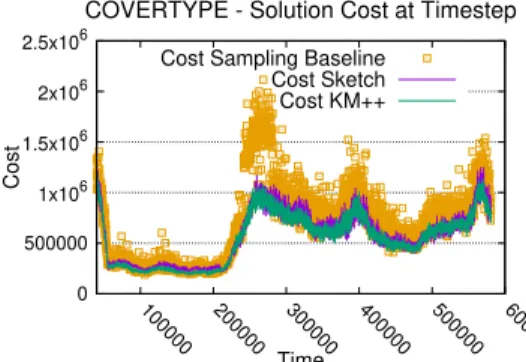
Cost of the solution. We now take a look at how the cost of the solution evolves over time during the execution of our algorithm. In Figure 2 we plot the cost of the solution obtained by our algorithm (Sketch), our proxy for the optimum (KM++) and the sampling baseline (Sampling Baseline) on the COVERTYPE dataset. The sampling baseline is allowed to store the same number of points stored by our algorithm (at the same point in time). We usek= 20,|W|= 40,000, andδ= 0.2. The plot is obtained by computing the cost of the algorithms every100timesteps. Observe that our algorithm closely tracks that of the offline algorithm result, even as the cost fluctuates up and down. Our algorithm’s cost is always close to that of the off-line algorithm and significantly better than the random sampling baseline
Update time and space tradeoff. We now investigate the time and space tradeoff of our algorithm. As a baseline we look at the cost required simply to recompute the solution usingk-means++ at every time step. In Table 2 (δ= 0.2) we focus on the COVERTYPE dataset, the other results are similar. Table 2 shows the percent of the sliding window data points stored (Space) and the percent of update
W k Space Time
40000
10 3.5% (0.39%) 0.45% (0.29%)
20 6.5% (0.87%) 0.93% (0.63%)
40 11.3% (1.74%) 1.58% (1.23%)
Table 2:Max percentage of sliding window (lengthW) stored (Space) and median percentage of time (Time) vs. one run ofk-means++ (stddev in parantesis).
0 500000 1x10⁶ 1.5x10⁶ 2x10⁶ 2.5x10⁶ 100000 200000 300000 400000 500000 600000 Cost Time
COVERTYPE - Solution Cost at Timestep
Cost Sampling Baseline Cost Sketch Cost KM++
Figure 2: Cost of the solution obtained by our algorithm (Sketch) and the two baselines fork= 20, |W|= 40,000andδ= 0.2on COVERTYPE.
time (Time) of our algorithm vs a single run ofk-means++ over the window. In the supplementary material we show that the savings become larger (at parity ofk) as|W|grows and that we always store a small fraction of the window, providing order-of-magnitude speed ups (e.g., we use<0.5%of the time of the baseline fork= 10,|W|= 40,000). Here the baseline is thek-means++ algorithm. Recovering ground-truth clusters. We evaluated the accuracy of the clusters produced by our algorithm on a dataset with ground-truth clusters using the well known V-Measure accuracy definition for clustering [51]. We observe that on all datasets our algorithm performs better than the sampling baseline and in line with the offlinek-means++. For example, on the s1 our algorithm gets V-Measure of 0.969, whilek-means++ gets0.969and sampling gets0.933. The full results are available in the supplementary material.
5
Conclusion
We present the first algorithms for thek-clustering problem on sliding windows with space linear in k. Empirically we observe that the algorithm performs much better than the analytic bounds, and it allows to store only a small fraction of the input. A natural avenue for future work is to give a tighter analysis, and reduce this gap between theory and practice.
Broader Impact
Clustering is a fundamental unsupervised machine learning problem that lies at the core of multiple real-world applications. In this paper, we address the problem of clustering in a sliding window setting. As we argued in the introduction, the sliding window model allows us to discard old data which is a core principle in data retention policies.
Whenever a clustering algorithm is used on user data it is important to consider the impact it may have on the users. In this work we focus on the algorithmic aspects of the problem and we do not address other considerations of using clustering that may be needed in practical settings. For instance, there is a burgeoning literature on fairness considerations in unsupervised methods, including clustering, which further delves into these issues. We refer to this literature [22, 40, 11] for addressing such issues.
References
[1] Sara Ahmadian, Ashkan Norouzi-Fard, Ola Svensson, and Justin Ward. Better guarantees for k-means and euclidean k-median by primal-dual algorithms. In58th IEEE Annual Symposium on Foundations of Computer Science, FOCS 2017, Berkeley, CA, USA, October 15-17, 2017, pages 61–72, 2017.
[2] Kook Jin Ahn, Sudipto Guha, and Andrew McGregor. Analyzing graph structure via linear measurements. InProceedings of the Twenty-third Annual ACM-SIAM Symposium on Discrete
Algorithms, SODA ’12, pages 459–467, Philadelphia, PA, USA, 2012. Society for Industrial and Applied Mathematics.
[3] Noga Alon, Yossi Matias, and Mario Szegedy. The space complexity of approximating the frequency moments. InProceedings of the Twenty-eighth Annual ACM Symposium on Theory of Computing, STOC ’96, pages 20–29, New York, NY, USA, 1996. ACM.
[4] David Arthur and Sergei Vassilvitskii. k-means++: The advantages of careful seeding. In Proceedings of the eighteenth annual ACM-SIAM symposium on Discrete algorithms, pages 1027–1035. Society for Industrial and Applied Mathematics, 2007.
[5] Olivier Bachem, Mario Lucic, and Andreas Krause. Distributed and provably good seedings for k-means in constant rounds. InProceedings of the 34th International Conference on Machine Learning-Volume 70, pages 292–300. JMLR. org, 2017.
[6] Olivier Bachem, Mario Lucic, and Silvio Lattanzi. One-shot coresets: The case of k-clustering. InInternational Conference on Artificial Intelligence and Statistics, AISTATS 2018, 9-11 April 2018, Playa Blanca, Lanzarote, Canary Islands, Spain, pages 784–792, 2018.
[7] Ashwinkumar Badanidiyuru, Baharan Mirzasoleiman, Amin Karbasi, and Andreas Krause. Streaming submodular maximization: Massive data summarization on the fly. InACM SIGKDD, pages 671–680. ACM, 2014.
[8] Bahman Bahmani, Benjamin Moseley, Andrea Vattani, Ravi Kumar, and Sergei Vassilvitskii. Scalable k-means++.Proc. VLDB Endow., 5(7):622–633, March 2012.
[9] Maria-Florina F Balcan, Steven Ehrlich, and Yingyu Liang. Distributed k-means and k-median clustering on general topologies. In C. J. C. Burges, L. Bottou, M. Welling, Z. Ghahramani, and K. Q. Weinberger, editors,Advances in Neural Information Processing Systems 26, pages 1995–2003. Curran Associates, Inc., 2013.
[10] Ziv Bar-Yossef, T. S. Jayram, Ravi Kumar, D. Sivakumar, and Luca Trevisan. Counting distinct elements in a data stream. InProceedings of the 6th International Workshop on Randomization and Approximation Techniques, RANDOM ’02, pages 1–10, Berlin, Heidelberg, 2002. Springer-Verlag.
[11] Solon Barocas, Moritz Hardt, and Arvind Narayanan. Fairness and Machine Learning. fairml-book.org, 2019. http://www.fairmlbook.org.
[12] Rajen Bhatt and Abhinav Dhall. Skin segmentation dataset. UCI Machine Learning Repository, 2010.
[13] Jock A Blackard and Denis J Dean. Comparative accuracies of artificial neural networks and discriminant analysis in predicting forest cover types from cartographic variables. Computers and electronics in agriculture, 24(3):131–151, 1999.
[14] Borassi, Epasto, Lattanzi, Vassilvitskii, and Zadimoghaddam. Better sliding window algorithms to maximize subadditive and diversity objectives. In The Principles of Database Systems (PODS), 2019.
[15] Vladimir Braverman, Petros Drineas, Cameron Musco, Christopher Musco, Jalaj Upadhyay, David P Woodruff, and Samson Zhou. Near optimal linear algebra in the online and sliding window models. arXiv preprint arXiv:1805.03765, 2018.
[16] Vladimir Braverman, Gereon Frahling, Harry Lang, Christian Sohler, and Lin F Yang. Clustering high dimensional dynamic data streams. InProceedings of the 34th International Conference on Machine Learning-Volume 70, pages 576–585. JMLR. org, 2017.
[17] Vladimir Braverman, Harry Lang, Keith Levin, and Morteza Monemizadeh. Clustering problems on sliding windows. InSODA, pages 1374–1390, 2016.
[18] Vladimir Braverman and Rafail Ostrovsky. Smooth histograms for sliding windows. InFOCS, pages 283–293, 2007.
[19] Jaroslaw Byrka, Thomas Pensyl, Bartosz Rybicki, Aravind Srinivasan, and Khoa Trinh. An improved approximation fork-median, and positive correlation in budgeted optimization. In Proceedings of the Twenty-Sixth Annual ACM-SIAM Symposium on Discrete Algorithms, SODA 2015, San Diego, CA, USA, January 4-6, 2015, pages 737–756, 2015.
[20] Moses Charikar, Liadan O’Callaghan, and Rina Panigrahy. Better streaming algorithms for clustering problems. InProceedings of the Thirty-fifth Annual ACM Symposium on Theory of Computing, STOC ’03, pages 30–39, New York, NY, USA, 2003. ACM.
[21] Jiecao Chen, Huy L. Nguyen, and Qin Zhang. Submodular maximization over sliding windows. CoRR, abs/1611.00129, 2016.
[22] Flavio Chierichetti, Ravi Kumar, Silvio Lattanzi, and Sergei Vassilvitskii. Fair clustering through fairlets. InAdvances in Neural Information Processing Systems, pages 5029–5037, 2017.
[23] G. Chrysos, O. Papapetrou, D. Pnevmatikatos, A. Dollas, and M. Garofalakis. Data stream statistics over sliding windows: How to summarize 150 million updates per second on a single node. In2019 29th International Conference on Field Programmable Logic and Applications (FPL), pages 278–285, 2019.
[24] Vincent Cohen-Addad, Niklas Oskar D Hjuler, Nikos Parotsidis, David Saulpic, and Chris Schwiegelshohn. Fully dynamic consistent facility location. InAdvances in Neural Information Processing Systems, pages 3250–3260, 2019.
[25] Vincent Cohen-Addad, Chris Schwiegelshohn, and Christian Sohler. Diameter and k-Center in Sliding Windows. In43rd International Colloquium on Automata, Languages, and Program-ming (ICALP 2016), pages 19:1–19:12, 2016.
[26] Michael S Crouch, Andrew McGregor, and Daniel Stubbs. Dynamic graphs in the sliding-window model. InEuropean Symposium on Algorithms, pages 337–348. Springer, 2013. [27] Mayur Datar, Aristides Gionis, Piotr Indyk, and Rajeev Motwani. Maintaining stream statistics
over sliding windows.SIAM journal on computing, 31(6):1794–1813, 2002. [28] Dua Dheeru and Efi Karra Taniskidou. UCI machine learning repository, 2017.
[29] Alessandro Epasto, Silvio Lattanzi, Sergei Vassilvitskii, and Morteza Zadimoghaddam. Submod-ular optimization over sliding windows. InProceedings of the 26th International Conference on World Wide Web, WWW ’17, pages 421–430, Republic and Canton of Geneva, Switzerland, 2017. International World Wide Web Conferences Steering Committee.
[30] Joan Feigenbaum, Sampath Kannan, Andrew McGregor, Siddharth Suri, and Jian Zhang. On graph problems in a semi-streaming model. Theor. Comput. Sci., 348(2):207–216, December 2005.
[31] Pasi Fränti and Sami Sieranoja. K-means properties on six clustering benchmark datasets, 2018. [32] Sutanu Gayen and NV Vinodchandran. New algorithms for distributed sliding windows. In
LIPIcs-Leibniz International Proceedings in Informatics, volume 101. Schloss Dagstuhl-Leibniz-Zentrum fuer Informatik, 2018.
[33] Antonio Ginart, Melody Guan, Gregory Valiant, and James Y Zou. Making ai forget you: Data deletion in machine learning. InAdvances in Neural Information Processing Systems, pages 3513–3526, 2019.
[34] Teofilo F Gonzalez. Clustering to minimize the maximum intercluster distance. TCS, 38:293– 306, 1985.
[35] S. Guha, N. Mishra, R. Motwani, and L. O’Callaghan. Clustering data streams. InProceedings of the 41st Annual Symposium on Foundations of Computer Science, FOCS ’00, pages 359–, Washington, DC, USA, 2000. IEEE Computer Society.
[36] Anupam Gupta and Kanat Tangwongsan. Simpler analyses of local search algorithms for facility location. CoRR, abs/0809.2554, 2008.
[37] Oktie Hassanzadeh, Fei Chiang, Hyun Chul Lee, and Renée J Miller. Framework for evaluating clustering algorithms in duplicate detection. Proceedings of the VLDB Endowment, 2(1):1282– 1293, 2009.
[38] Wei Hu, Zhao Song, Lin F Yang, and Peilin Zhong. Nearly optimal dynamick-means clustering for high-dimensional data. arXiv preprint arXiv:1802.00459, 2018.
[39] Anil K Jain. Data clustering: 50 years beyondk-means.Pattern Recognition Letters, 31(8):651– 666, 2010.
[40] Michael Kearns and Aaron Roth. The Ethical Algorithm: The Science of Socially Aware Algorithm Design. Oxford University Press, 2019.
[41] Matthäus Kleindessner, Pranjal Awasthi, and Jamie Morgenstern. Fair k-center clustering for data summarization. In Kamalika Chaudhuri and Ruslan Salakhutdinov, editors,Proceedings of the 36th International Conference on Machine Learning, volume 97 ofProceedings of Machine Learning Research, pages 3448–3457, Long Beach, California, USA, 09–15 Jun 2019. PMLR. [42] Robert Krauthgamer and David Reitblat. Almost-smooth histograms and sliding-window graph
algorithms.arXiv preprint arXiv:1904.07957, 2019.
[43] Silvio Lattanzi and Sergei Vassilvitskii. Consistent k-clustering. InProceedings of the 34th International Conference on Machine Learning-Volume 70, pages 1975–1984. JMLR. org, 2017. [44] Shi Li and Ola Svensson. Approximating k-median via pseudo-approximation.SIAM J. Comput.,
45(2):530–547, 2016.
[45] Konstantin Makarychev, Yury Makarychev, and Ilya Razenshteyn. Performance of johnson-lindenstrauss transform for k-means and k-medians clustering. InProceedings of the 51st Annual ACM SIGACT Symposium on Theory of Computing, pages 1027–1038, 2019.
[46] Gustavo Malkomes, Matt J Kusner, Wenlin Chen, Kilian Q Weinberger, and Benjamin Moseley. Fast distributed k-center clustering with outliers on massive data. In Advances in Neural Information Processing Systems, pages 1063–1071, 2015.
[47] Adam Meyerson. Online facility location. InFoundations of Computer Science, 2001. Proceed-ings. 42nd IEEE Symposium on, pages 426–431. IEEE, 2001.
[48] Baharan Mirzasoleiman, Amin Karbasi, and Andreas Krause. Deletion-robust submodular maximization: Data summarization with the right to be forgotten. InProceedings of the 34th International Conference on Machine Learning-Volume 70, pages 2449–2458. JMLR. org, 2017. [49] S. Muthukrishnan. Data streams: Algorithms and applications. Found. Trends Theor. Comput.
Sci., 1(2):117–236, August 2005.
[50] Dino Oglic and Thomas Gärtner. Nyström method with kernel k-means++ samples as landmarks. InProceedings of the 34th International Conference on Machine Learning-Volume 70, pages 2652–2660. JMLR. org, 2017.
[51] Andrew Rosenberg and Julia Hirschberg. V-measure: A conditional entropy-based external cluster evaluation measure. InProceedings of the 2007 joint conference on empirical methods in natural language processing and computational natural language learning (EMNLP-CoNLL), pages 410–420, 2007.
[52] M Ali Rostami, Alieh Saeedi, Eric Peukert, and Erhard Rahm. Interactive visualization of large similarity graphs and entity resolution clusters. InEDBT, pages 690–693, 2018.
[53] Mina Sheikhalishahi, Andrea Saracino, Mohamed Mejri, Nadia Tawbi, and Fabio Martinelli. Fast and effective clustering of spam emails based on structural similarity. InInternational Symposium on Foundations and Practice of Security, pages 195–211. Springer, 2015.
[54] Jalaj Upadhyay. Sublinear space private algorithms under the sliding window model. In International Conference on Machine Learning, pages 6363–6372, 2019.
[55] Yanhao Wang, Yuchen Li, and Kian-Lee Tan. Coresets for minimum enclosing balls over sliding windows. InProceedings of the 25th ACM SIGKDD International Conference on Knowledge Discovery & Data Mining, pages 314–323, 2019.
[56] Jonghem Youn, Junho Shim, and Sang-Goo Lee. Efficient data stream clustering with sliding windows based on locality-sensitive hashing.IEEE Access, 6:63757–63776, 2018.