Traffic Analysis in the Network
of a Local Voice over Internet
Protocol Operator
Jakub Sobczak
Faculty of Electronics and Telecommunications, Poznań University of Technology, Poznań, Poland
Abstract—Voice over Internet Protocol market is growing rapidly. This article is the initial step towards creating a method for modeling systems for Voice over Internet Pro-tocol operators. The purpose of this research is to gather statistics of a live VoIP-operator system, analyze them and determine if it is possible to create a specific model of such system using traditional approach. After evaluation, the data will be used, in future research, to create an analytical model of VoIP-based telecommunications system.
Keywords—VoIP, VoIP modeling.
1. Introduction
As accessing the Internet has recently become easy and affordable, people may be on-line almost everywhere – at home, at work and while commuting. Together with the increasing popularity and accessibility of the Internet, fairly huge number of telecom operators started offering a service of Voice over Internet Protocol (VoIP) calls.
According to the ITU Statistics Newslog [1] the number of VoIP subscribers have grown from just over six million in 2005 to 34.6 million at the end of 2008, which was about 24% of fixed line telephone subscribers in Europe at that time. The number of VoIP subscribers is growing and according to [2] VoIP services revenues are going to reach USD 65 billion in 2012.
What is more, market research made by IBISWorld [3], one of the most trusted independent source of industry and market research in the United States of America, points out that the VoIP industry has the greatest growth factor of all industries (including the search engine industry). The cal-culated growth percentage is vast 179,035.8%, even though VoIP officially came on the market in 2002. However, the most interesting figure mentioned in that research is the forecast for VoIP which predicts that this technology will still be the best-performing industry in the coming decade (2010–2019) with a growth dynamics 149.6%.
Moreover, according to [4], the VoIP market has grown (in Poland only) by almost 30% (Table 1 and Fig. 1) in 2010 after a vast decrease in growth dynamics between 2007 and 2009 – this clearly shows that the dynamic of the VoIP market has returned to an upward trend. In addition to this, the persisting financial uncertainty has raised consumers’ “cash consciousness” and created an additional ground for VoIP market to grow.
It is – however – also worth mentioning, that VoIP’s role has recently changed. In the individual segment, Voice over IP is usually an additional part of a larger package (e.g., TV, Internet and telephone) which is offered as a sub-stitute for a more expensive PSTN landline. This may sug-gest that VoIP’s main role is to keep the client and prevent him from migrating to mobile telephone systems [4]. In the business segment, the role of IP telephony is still very strong, mainly due to much higher voice traffic produced by companies.
Table 1
VoIP market in Poland – value and growth dynamics Year Value [M PLN] Growth dynamics [%]
2007 403 90.3
2008 497 23.4
2009 520 4.5
2010 658 26.7
Fig. 1. VoIP market in Poland – value and growth dynamics [4].
According to the Central Statistical Office in Poland ca-ble operators provided VoIP telephone service for about 415,000 customers in 2010, which together with customers of the biggest independent operators (Actio, Freeconet, Tlenofon), adds up to about 0.52 million Voice over In-ternet Protocol users in Poland. This is merely a 1% of what the whole Europe accounted for at that time – 45 million users [5].
Considering all the aforementioned information, it seems obvious that VoIP market will not stop growing and that is why the author of this article believes it is necessary to create a method of VoIP network analysis and planning. Such methods have already been created and discussed, but mostly for the traditional fixed-line networks. This article is the author’s first step to create a method of system modeling for VoIP operators, which would allow them to calculate and predict the type of traffic they may expect and, basing on this calculation, to determine the required resources to serve the estimated traffic.
The purpose of this research is to evaluate and analyze traf-fic data collected in the network of a live VoIP operator in order to prove if it is possible to model VoIP traffic with traditional telecommunications theory. In order to do this, information about traffic type and structure has to be ob-tained by observation carried out on a live system. After evaluation, the data will be used in future research, to cre-ate an analytical model of VoIP-based telecommunications system.
The article is organized as follows. Section 2 describes Voice over Internet Protocol market as well as the motiva-tion of this study. The next secmotiva-tion presents VoIP system architecture and identifies the point of data collection in the VoIP system. The following section shows collected data whereas the results are discussed in Section 3. Finally, Section 4 concludes the article.
2. Voice over Internet Protocol
2.1. VoIP System Architecture
Architecture of a VoIP-operator system differs from a typ-ical Public Switched Telephone Network (PSTN) architec-ture. First of all, it is usually less complicated and may be based on Internet Protocol (IP) only (Fig. 2).
Fig. 2. VoIP system architecture.
Even though different Voice over IP operators usually have their own architectures, the main concept is the same – we can distinguish (Fig. 2) hardware responsible for:
authen-tication and authorization (Radius server connected to the Database), signalling handling (VoIP Server) and providing additional services (IVR, fax). Apart from that, in order to provide its service, each operator has to have the possibil-ity to terminate the outgoing traffic – in this research, the traffic termination is outsourced to other wholesale opera-tors. This kind of VoIP architecture is easily scalable and manageable.
2.2. Point of Measurement
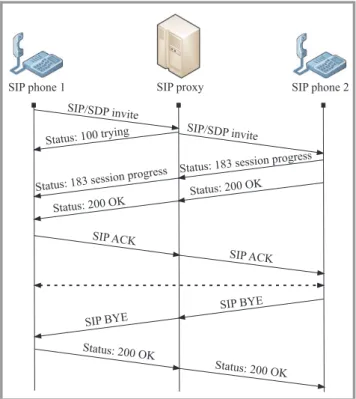
From a traffic engineering of such system point of view, in order to be able to create a model of such a system, it is necessary to gather certain information about the structure of traffic being carried by the system, like: traffic intensity (arrival rate), service time (service intensity), amount of requested resource (type of codec). To collect all the nec-essary information it is essential to choose a correct point of measurement where it is possible to analyze incoming and outgoing communication. Figure 3 shows the call flow of a typical call. The information which has to be gathered for this research is media format (VoIP codec used – e.g. G.711, G.729, T.38, etc.) and arrival times of the SIP ACK and SIP BYE packages – to determine the service time of a single call.
Fig. 3. Connection establishing and terminating procedure (SIP).
For the purpose of this research a live system of a Voice over Internet Protocol operator “BeFree-Mobile” was ex-amined. Apart from providing cheap roaming solutions, BeFree-Mobile also offers VoIP service for a limited num-ber of customers (Section 3). The data was collected on the network interfaces connecting operator’s VoIP system to the Internet (Fig. 2, “Point of measurement”).
3. Collected Data
The data was collected during a 30-day test period 1 June 2012 – 30 June 2012. The traffic was generated by 298 customers, among which 127 are business customers and 171 are individual customers. Results of this study are listed and analyzed in the following subsections.
In Sections 3.1 and 3.2 Average Number of Calls (ANC) and Average Service Time (AST) distributions are pre-sented and discussed.
3.1. Average Number of Calls (ANC)
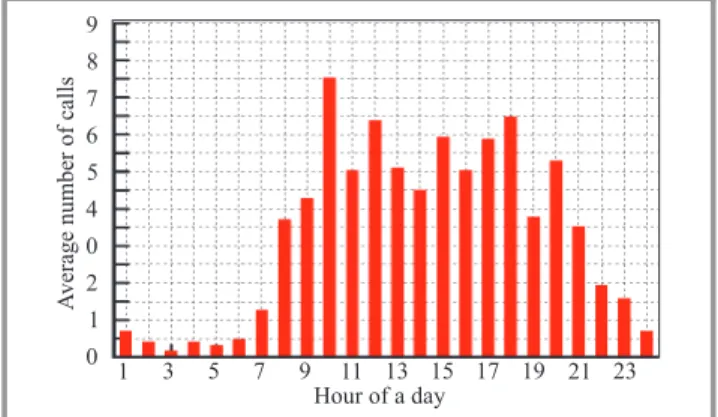
ANC parameter is the average number of calls made during a certain hour of a day throughout a 30-day test period. Av-erage number of calls values were calculated for each hour separately. Figure 4 shows the distribution of ANC param-eter averaged over all (30) days of observation. According to this chart, it may be noticed that business customers have a major influence on the system – not only does the greatest increase in the ANC parameter occur between 6 and 9 a.m. (when the workday starts), but also it drops significantly after 6 p.m. (when the workday ends). There is also – however – a noticeable increase in the ANC parameter at 8 p.m. which is probably caused by residential customers.
Fig. 4. Average number of calls – 30 day average.
Even though this distribution already depicts the expected outcome, the author decided to check how the distribu-tion changes if separate days were taken into consideradistribu-tion. Figures 5–11 show ANC distribution throughout the whole day – separately for each day of the week. The study of the first five charts (Figures 5–9) brings the same result as in the case of Fig. 4 – the highest value of the ANC is observed around midday.
If weekdays are taken into account, the observation made at the beginning of Section 3.1 – stating that business cus-tomers have a major influence on this system – seems to be confirmed. Figures 10 and 11 show that the busy hour is shifted to the late afternoon. What is more, the intensity also seems to have dropped slightly. Also, an interesting fact may be pointed out after analyzing Fig. 11 – people tend to wake up a little later on Sundays.
Fig. 5. Average number of calls – Monday.
Fig. 6. Average number of calls – Tuesday.
Fig. 7. Average number of calls – Wednesday.
Fig. 9. Average number of calls – Friday.
Fig. 10. Average number of calls – Saturday.
Fig. 11. Average number of calls – Sunday.
3.2. Average Service Time (AST)
AST parameter is the average length of all calls made dur-ing a certain hour of a day throughout a 30-day test period. Average Service Time values were calculated for each hour separately. Figure 12 shows the distribution of the AST parameter averaged over all (30) days of observation. The analysis of this chart shows that the longest average service times occurred before midnight – residential customers tend to make less calls, but longer ones. However, it is worth noting that this result is influenced by the fact that the ANC parameter drops significantly near midnight, which – in turn – may be caused by the data set not being big enough.
Fig. 12. Average service time – 30 day average.
Fig. 13. Average service time – Monday.
Fig. 14. Average service time – Tuesday.
Fig. 16. Average service time – Thursday.
Fig. 17. Average service time – Friday.
As previously, the author decided to check how the distri-bution changes if separate days were taken into considera-tion. Figures 13–19 show AST distribution throughout the whole day – separately for each day of the week. The study of the first five charts (Figs. 13–17) shows that in majority of the weekdays there is a drop in AST parameter about 1 p.m. This might suggest that business customers might be having a lunch break at this time. Apart from that, this analysis brings the same result as in the case of Fig. 12 – the peaks in AST parameter near midnight may be caused by not enough data collected (too short observation period).
The analysis of charts depicting AST parameter during weekdays (Figs. 18 and 19) confirms previous observa-tion that people tend to wake up a little later on Sundays. Moreover, it is also worth noting that in the case of the AST parameter, the trend is the same during workdays and weekends – the highest values occur between 9 and 12 p.m.
3.3. Conclusion
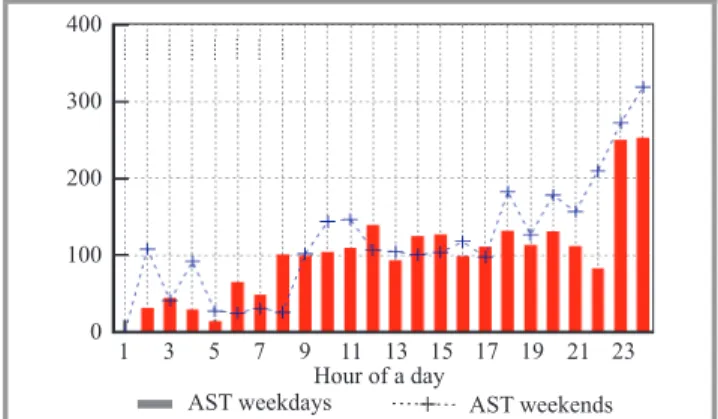
Even though a small VoIP operator’s system was examined, the outcome of this research is interesting, since it has not only confirmed author’s expectations but also provided im-portant observations. Figures 20 and 21 are a summary of the all aforementioned statistics. It is clearly visible that the busy hour is shifted from 11–12 a.m. during workdays to 7–8 p.m. on weekends if we compare ANC parameter for workdays and weekends. What is more, this study also
Fig. 18. Average service time – Saturday.
Fig. 19. Average service time – Sunday.
Fig. 20. Average number of calls – weekdays vs. weekends.
shows that AST parameter achieves the highest values be-tween 9 and 12 p.m. during weekends as well as during workdays.
However, the observed traffic was very homogeneous as all of the customers were using G.711 codec. What is more, in such system the influence of signalling payload is too small to have to be taken into consideration, which would probably change if much bigger network was ex-amined. The single-service nature of the monitored VoIP system clearly shows, that this system may be modeled by the well-known single rate models, based on Erlang-B formula.
4. Conclusions and Future Works
This article presents evaluation of the traffic being carried by a system of a small Voice over Internet Protocol operator. The most interesting outcome of this research is the conclu-sion that in small networks with a homogeneous structure of voice streams, VoIP systems may be easily modeled by traditional single-rate traffic models.
In the next stage of this research, networks and systems of much bigger VoIP operators will be taken into consider-ation. It is worth noting that in the case of bigger VoIP operators due to expected diversity of traffic, it will be nec-essary to apply multiservice traffic models.
References
[1] ICT Statistics Newslog,VoIP in Europe: Its bite is worse than its bark, 2009 [Online]. Available: http://www.itu.int/ITU-D/ict/newslog/ VoIP+In+Europe+Its+Bite+Is+Worse+Than+Its+Bark.aspx
[2] Visiongain, The Voice Over Internet Protocol (VoIP) Market 2012–2017: Prospects for Skype and Other Players, 2012 [Online]. Available: http://www.visiongain.com/Report/854/
The-Voice-Over-Internet-Protocol-%28VoIP%29-Market-2012-2017-Prospects-for-Skype-and-Other-Players
[3] IBISWorld Market Research, Voice over IP (VoIP) Industry best-performing industry of the past decade (2000–2009), 2009 [Online]. Available: http://www.ibisworld.com/
[4] PMR Publications,VoIP market in Poland 2010. Development fore-casts for 2011-2015, 2010 [Online]. Available:
http://www.pmrpublications.com/product/VoIP-market-Poland-2010 [5] TechWatch,Merger creates Poland’s biggest VoIP operator, 2010
[On-line]. Available: http://www.techwatch.co.uk/2010/04/08/ merger-creates-polands-biggest-voip-operator/
[6] J. Sobczak and M. Głąbowski, “Top-down approach to Voice over Internet Protocol modeling”, inProc. 51st Int. Feder. Telecommun. Engin. European Community Congr., Poznań, Poland, 2012.
Jakub Sobczak received the M.Sc. degree from Poznań Uni-versity of Technology in 2010. He currently is a Ph.D. student at Faculty of Electronics and Telecommunications and is en-gaged in research in the area of multiservice networks and Voice over Internet Protocol modeling. He is also interested in aviation, ham radio operating and learning foreign languages.
E-mail: [email protected] Faculty of Electronics and Telecommunications Poznań University of Technology
Polanka st 3