US Government Cloud Computing
Technology Roadmap
Volume II
Release 1.0 (Draft)
Useful Information for Cloud
Adopters
Lee Badger, Robert Bohn, Shilong Chu, Mike Hogan, Fang Liu, Viktor Kaufmann, Jian Mao, John Messina, Kevin Mills, Annie Sokol, Jin Tong, Fred Whiteside and Dawn Leaf
NIST Cloud Computing Program
Information Technology Laboratory
U.S. Department of Commerce John E. Bryson, Secretary National Institute of Standards and Technology Patrick D. Gallagher, Under Secretary for Standards and Technology and Director NIST Special Publication 500-293
(Draft)
US Government Cloud Computing Technology Roadmap Volume II Release 1.0 (Draft)
Useful Information for Cloud Adopters
Lee Badger, Robert Bohn, Shilong Chu, Mike Hogan, Fang Liu, Viktor Kaufmann, Jian Mao, John Messina, Kevin Mills, Annie Sokol, Jin Tong, Fred Whiteside and Dawn Leaf
Cloud Computing Program Information Technology Laboratory National Institute of Standards and Technology Gaithersburg, MD 20899
November 2011
Information Technology Laboratory
Reports on Computer Systems Technology
The Information Technology Laboratory (ITL) at the National Institute of Standards and Technology (NIST) promotes the U.S. economy and public welfare by providing technical leadership for the nation’s measurement and standards infrastructure. ITL develops tests, test methods, reference data, proof of concept implementations, and technical analysis to advance the development and productive use of information technology. This Special Publication 500-series reports on ITL’s research, guidance, and outreach efforts in Information Technology and its collaborative activities with industry, government, and academic organizations.
Certain commercial entities, equipment, or materials may be identified in this document in order to describe an experimental procedure or concept adequately. Such
identification is not intended to imply recommendation or endorsement by the National Institute of Standards and Technology, nor is it intended to imply that the
entities, materials, or equipment are necessarily the best available for the purpose. National Institute of Standards and Technology Special Publication 500-293 (Draft)
Acknowledgments
The authors, Shilong Chu, Fang Liu, Viktor Kaufmann, Jian Mao, and Jin Tong, of Knowcean Consulting Incorporated (under contract through the Federal Integrated Product Team, Space & Naval Warfare (SPAWAR) Systems Center Atlantic, Lee Badger, Robert Bohn, Mike Hogan, John Messina, Kevin Mills, Annie Sokol, Fred Whiteside and Dawn Leaf of the National Institute of Standards and Technology (NIST), gratefully acknowledge and appreciate the broad
contributions from members of the NIST Cloud Computing US Government Target Business Use Case, Reference Architecture and Taxonomy, Standards Acceleration to Jumpstart the Adoption of Cloud Computing (SAJACC), Security, and Standards Roadmap Working Groups. We especially acknowledge Carolyn French, Romayne Hines, Michaela Iorga, Elizabeth Lennon, and Peter Mell of NIST for providing technical input and detailed editorial support. Appendix A presents an extended list of contributors that participated and contributed to NIST public working groups.
Appendix B lists references that were consulted in the development of this document. Additional acknowledgments will be added upon the final publication of this guideline.
Table of Contents
Executive Summary ... 11
1 Introduction ... 13
1.1 NIST Cloud Computing Program Background ... 13
1.2 NIST Cloud Computing Program Vision ... 13
1.3 Intended Audience and Use ... 14
1.4 Document Organization ... 14
2 NIST Cloud Computing Definition and Reference Architecture ... 16
2.1 Revisiting the Definition ... 16
2.2 NIST Cloud Computing Reference Architecture ... 18
2.2.1 Conceptual Model ... 19
2.2.2 Cloud Computing Actors ... 19
2.2.3 Architecture Components ... 23
2.3 NIST Cloud Computing Taxonomy ... 24
3 Cloud Computing Use Cases and Requirements ... 26
3.1 Target Business Use Case and High-Level Requirements ... 26
3.1.1 Business Use Case Template... 28
3.1.2 Business Use Case Summaries ... 28
3.1.3 Business Use Case Analysis ... 31
3.2 SAJACC Use Cases and Technical Requirements... 44
4 Cloud Computing Standards and Gap Analysis ... 46
4.1 Cloud Computing Standards ... 46
4.2 Cloud Computing Standards Gaps and USG Priorities ... 47
4.3 Accelerating the Development and the Use of Cloud Computing Standards ... 48
5 High-Priority Security Requirements ... 49
5.1 Understanding Security in the Cloud Context ... 50
5.1.1 Cloud Service Model Perspectives ... 50
5.1.2 Implications of Cloud Deployment Models ... 50
5.1.3 Shared Security Responsibilities ... 50
5.2 Challenging Security Requirements and Risk Mitigations ... 51
5.3 Process-Oriented Requirements ... 52
5.3.1 Application of NIST SP 800-53-style Controls and Compliance ... 52
5.3.2 Cloud Audit Assurance and Log Sensitivity Management ... 53
5.3.3 Cloud Certification and Accreditation Guidelines ... 56
5.3.4 Clear eDiscovery Guidelines ... 56
5.3.5 Cloud Privacy Guidelines... 57
5.3.6 Clarified Security Control Roles and Responsibilities ... 59
5.3.7 Trustworthiness of Cloud Operators ... 59
5.3.8 Business Continuity and Disaster Recovery ... 60
5.4 Focused Technical Requirements ... 61
5.4.1 Technical Continuous Monitoring Capabilities ... 62
5.4.2 Visibility for Customers ... 63
5.4.3 Control for Customers ... 63
5.4.4 Data ProtectionConcerns ... 65
5.4.5 Risk of Account Compromise ... 66
5.4.6 Identity and Access Management (IAM) and Authorization ... 67
5.4.7 Multi-tenancyRisks and Concerns ... 69
5.4.8 Cloud-Based Denial of Service ... 70
5.4.9 Incident Response ... 71
6 Other Related Work ... 72
6.1 Cloud Data Issues ... 72
6.1.1 Operational Data Functions ... 72
6.1.2 Informational Data and Data Services ... 74
6.2 Service-Level Agreement Taxonomy ... 75
6.3 Reliability Research in Cloud-based Complex Systems ... 77
7 Summary and Next Steps ... 78
Appendix A. USG Federal Cloud Computing Standards Working Group Members and Interagency, Academic, Standards Organizations, and Industry Contributors ... 79
Executive Summary
The first release of the Special Publication 500-293, United States Government USG Cloud Computing Technology Roadmap document consists of two volumes. Consistent with the NIST Cloud Computing program strategy, the roadmap focuses on both strategic and tactical objectives related to cloud computing.
Volume I, High-Priority Requirements to Further USG Cloud Computing Adoption, frames the discussion and introduces the roadmap in terms of summarized strategic requirements that must be met for USG agencies to further cloud adoption. The roadmap strategic elements can be characterized as “high-priority technical areas” which are enablers for cloud computing in both the short and long term. Volume II, Useful Information for Cloud Adopters, provides information for those actively working on strategic and tactical cloud computing initiatives, including but not limited to, government cloud adopters. This volume presents a summary of the work completed from November 2010 through September 2011 through the NIST Cloud Computing program and collaborative effort to develop a USG Cloud
Computing Technology Roadmap.
This document presents a representative sample of the work that was completed and documented through this effort. Additional working documents, special publications, meeting and other collaboration artifacts can be found on the NIST Cloud Computing Web site http://www.nist.gov/itl/cloud/index.cfm.
Volume II:
Introduces a conceptual model, the NIST Cloud Computing Reference Architecture and Taxonomy;
Presents USG target business use cases and technical use cases in the cloud;
Identifies existing interoperability, portability, and security standards that are applicable to the cloud computing model and specifies high-priority gaps for which new or revised standards, guidance, and technology need to be developed;
Discusses security challenges in the context of cloud computing adoption, high-priority security requirements, and current and future risk mitigation measures requirements; and
Provides insight into the rationale for the list of candidate Priority Action Plans (PAPs) recommended for voluntary self-tasking by government and private sector organizations, listed in Volume I.
The document presents a subset of the analysis that drove the rationale for the requirements introduced in Volume I of this NIST Special Publication, titled High-Priority Requirements to Further USG Agency Cloud Computing Adoption.
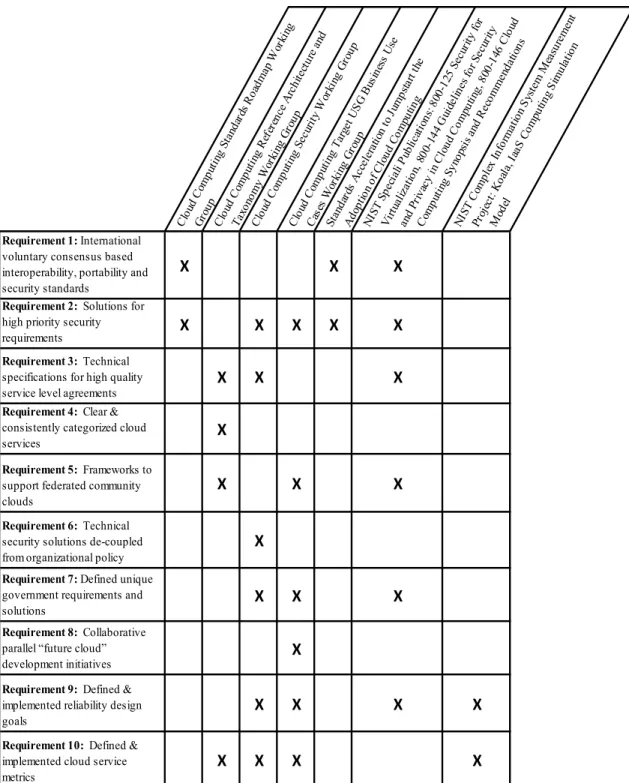
The following Figure 1 shows the relationship between the high-priority requirements in Volume I and the key NIST-led activities and contributing sources that are summarized here in Volume II.
Clo ud C ompu ting Stan dard s Roa dm ap W orki ng Gro up Clo ud C ompu ting Ref eren ce A rchi tect ure and Taxo nom y W orki ng G roup Clo ud C ompu ting Secu rity Wor king Gro up Clo ud C ompu ting Targ et U SG B usin ess Use Cas es W orki ng G roup Stan dard s A ccel erat ion to J umps tart the Ado ptio n of Clo ud C om putin g NIS T Sp ecia li Pu blic atio ns: 8 00-1 25 S ecur ity fo r Virt ualiz atio n, 8 00-1 44 G uide lines for S ecur ity and Priv acy in C loud Com putin g, 8 00-1 46 C loud Com putin g Sy nops is a nd R ecom men datio ns NIS T C ompl ex In form atio n Sy stem Mea sure men t Proj ect: Koa la, I aaS Com putin g Si mul atio n Mod el Requirement 1: International voluntary consensus based interoperability, portability and security standards
X X X
Requirement 2: Solutions for high priority security
requirements X X X X X
Requirement 3: Technical specifications for high quality
service level agreements X X X
Requirement 4: Clear & consistently categorized cloud
services X
Requirement 5: Frameworks to support federated community
clouds X X X
Requirement 6: Technical security solutions de-coupled
from organizational policy X
Requirement 7: Defined unique government requirements and
solutions X X X
Requirement 8: Collaborative parallel “future cloud”
development initiatives X
Requirement 9: Defined & implemented reliability design
goals X X X X
Requirement 10: Defined & implemented cloud service
metrics X X X X
1 Introduction
1.1 NIST Cloud Computing Program Background
The National Institute of Standards and Technology plays a technology leadership role in accelerating the federal government’s secure adoption of cloud computing. In this role, NIST, in close consultation and collaboration with standards bodies, the private sector, and other stakeholders, is leading the efforts to develop the necessary standards and guidelines that will facilitate the secure, rapid adoption of cloud computing.
The NIST Cloud Computing Program was formally launched in November 2010, and supports the US federal government effort to incorporate cloud computing, where appropriate, as a replacement for, or enhancement of, the traditional information systems and application models. The NIST Cloud Computing Program operates in coordination with other federal cloud computing efforts and is integrated within the Federal Cloud Computing Strategy.1
For more information regarding the program’s scope and objectives, the reader is referred to Volume I of this NIST Special Publication 500-293: High-Priority Requirements to Further USG Agency Cloud Computing Adoption.
In order to leverage the expertise of the broad cloud computing stakeholder community, NIST has established the following Public Working Groups:
Cloud Computing Reference Architecture and Taxonomy Working Group
Cloud Computing Target Business Use Cases Working Group
Cloud Computing SAJACC Technical Use Cases Working Group
Cloud Computing Standards Roadmap Working Group
Cloud Computing Security Working Group
The groups are listed in the same sequence that their respective subject matter is presented in this document. The order does not imply priority or chronological sequencing.
1.2 NIST Cloud Computing Program Vision
NIST seeks to provide thought leadership and guidance around the cloud computing model to catalyze its use within industry and government, and to shorten the adoption cycle, which will enable near-term cost savings and increased ability to quickly create and deploy safe and secure enterprise solutions.
Additionally, NIST is committed to fostering cloud computing practices that support interoperability, portability, and security requirements that are appropriate and achievable for various usage scenarios, by focusing on the necessary standards, specifications, and guidance that must be in place for these
requirements to be met.
The first release of the USG Cloud Computing Technology Roadmap is presented as a two-volume NIST Special Publication 500-293 document. The process and document together are the mechanism used to define and communicate the high-priority USG interoperability, portability, and security requirements for cloud computing, and to identify the necessary associated standards, guidance, and technology.
1 Office of Management and Budget, U.S. Chief Information Officer, Federal Cloud Computing Strategy, Feb. 8,
This document, Volume II of the Special Publication, focuses on work that helped to identify the USG high-priority interoperability, portability, and security requirements which are introduced in Volume I and summarizes work in the following areas:
Introduction of an overall cloud computing conceptual model in the form of the NIST Cloud Computing Reference Architecture and Taxonomy. This technical reference can be used to understand, discuss, categorize, and compare different cloud service offerings, and to facilitate the communication and analysis of the security, interoperability, and portability candidate standards and reference implementations.
Presentation of a template and an initial set of USG target business and technical use cases that describe how government agencies seek to use cloud computing, and presentation of key, specific technical requirements that surfaced through these use cases.
Identification of existing interoperability, portability, and security standards and guidance that are applicable to the cloud computing model, and identification of high-priority gaps for which new or revised standards, guidance, and technology need to be developed.
Identification of the high-priority security requirements that challenge the adoption of cloud computing and presentation of proposed mitigation strategies.
Discussion of considerations and activities related to cloud Service-Level Agreements (SLAs).
1.3 Intended Audience and Use
This publication is intended for a diverse audience:
US Policy Makers, US Federal CIO Council, and those with identified key roles identified in
the Federal Cloud Computing Strategy – as a technology-oriented reference to inform policy
and planning.
USG Agencies – as a useful tool in the context of the USG Federal Cloud Computing Strategy
risk-based management decision framework.
Cloud Computing Stakeholders (Academia, Government, Industry, Standards Developing
Organizations) – as a consolidated presentation of USG cloud computing technology
perspectives and work, including a unifying cloud computing reference model, a set of documented technical requirements, and a list of identified gaps in standards, guidance, and technology.
1.4 Document Organization
Consistent with the NIST Cloud Computing program strategy, the roadmap focuses on both strategic and tactical objectives related to cloud computing. The strategic roadmap elements can be characterized as “high-priority technical areas” which are enablers for cloud computing in both the short and long term. The tactical work not only supports strategic goals, but is intended to support cloud adopters in the interim deployment period as the cloud computing model is maturing.
This initial release of the roadmap special publication consists of two volumes.
Volume I is aimed at interested parties who wish to gain a general understanding and overview of the background, purpose, context, work, results, and next steps of the USG Cloud Computing Technology Roadmap initiative. Volume I reflects the collective inputs of USG agencies through the Federal CIO Council-sponsored Cloud Computing Standards and Technology Working Group.
Volume I, High-Priority Requirements to Further USG Cloud Computing Adoption, frames the discussion and introduces the roadmap in terms of:
Prioritized strategic and tactical requirements that must be met for USG agencies to further cloud adoption;
Interoperability, portability, and security standards, guidelines, and technology that must be in place to satisfy these requirements; and
Recommended list of Priority Action Plans (PAPs) as candidates for development and
implementation, through voluntary self-tasking by the cloud computing stakeholder community, to support standards, guidelines, and technology development.
This volume, Volume II, Useful Information for Cloud Adopters, is designed to be useful at the tactical level to those actively working on cloud computing initiatives, including but not limited to, US
government cloud adopters. Volume II summarizes the work completed to date, explains the assessment findings based on this work, and highlights how these findings support the key requirements in the roadmap introduced in Volume I.
The Executive Summary of this volume includes a chart that shows the correlation between the set of high-priority USG requirements presented in Volume I, and the NIST projects and public working group efforts and findings summarized in Volume II.
The remainder of Volume II is organized into the following sections: Section 2 presents the NIST cloud computing definition and reference architecture. Section 3 presents USG cloud computing requirements through business use cases and technical use cases. Section 4 summarizes cloud computing technology standards and gap analysis. Section 5 discusses cloud computing security and presents a list of security impediments and corresponding mitigations.
A third volume, Technical Considerations for USG Cloud Computing Deployment Decisions, is under development, and in keeping with the NIST transparent and collaborative process, is currently available as a working document. Volume III is being developed as an interagency project through the Federal Cloud Computing Standards and Technology Working Group, and will leverage the NIST-led cloud computing program public working group process. Volume III is intended to serve as a guide for decision makers who are planning and implementing cloud computing solutions by explaining how the technical work and resources in Volume II can be applied, consistent with the Federal Cloud Computing Strategy “Decision Framework for Cloud Migration.” The current version of the working document defines and proposes a methodology for defining a representative sample of common cloud computing planning and deployment scenarios, presents the initial candidate set of 12, presents a process for applying the technical work, and proof-of-concept examples of how this can be accomplished. Volume III was initiated in parallel, but is logically dependent on the technical work contained in Volume II, and will necessarily be completed and presented as part of the roadmap special publication in a subsequent release.
The Volume I and Volume II draft special publications, as well as the working document under
development as Volume III, are publically available through the NIST ITL Cloud Computing Web site, as are all of the NIST Cloud Computing special publications and work-in-progress documents,
2 NIST Cloud Computing Definition and Reference Architecture
Cloud computing is an emerging computing model which has evolved as a result of the maturity of underlying prerequisite technologies. There are differences in perspective as to when a set of underlying
technologies becomes a “cloud” model. In order to categorize cloud computing services, and to expect some level of consistent characteristics to be associated with the services, cloud adopters need a consistent frame of reference. The NIST Cloud Computing Reference Architecture and Taxonomy document defines a standard reference architecture and taxonomy that provide the USG agencies with a common and consistent frame of reference for comparing cloud services from different service providers when selecting and deploying cloud services to support their mission requirements. At a certain level of abstraction, a cloud adopter does not need to repeatedly interpret the technical representation of cloud services available from different vendors. Rather the use of a common reference architecture by the cloud service providers can be an efficient tool that ensures consistent categorization of the services offered. 2.1 Revisiting the Definition
This document uses the NIST SP 800-145, The NIST Cloud Computing Definition, to explain characteristics of cloud computing. For the convenience of the reader, the following is excerpted from NIST SP 800-145: Cloud computing is a model for enabling convenient, on-demand network access to a shared pool of configurable computing resources (e.g., networks, servers, storage, applications, and services) that can be rapidly provisioned and released with minimal management effort or service provider interaction.
This definition lists five essential
characteristics that are common among all
cloud computing services:
On-demand self-service: A consumer can unilaterally provision computing capabilities, such as server time and network storage, as needed automatically without requiring human interaction with each service’s provider.
Highlights: The NIST cloud computing definition
identifies three distinct service models, i.e., Software as a Service, Platform as a Service, and Infrastructure as a Service.
In late 2010, the NIST Cloud Computing
Reference Architecture project team surveyed and completed an analysis of existing cloud computing reference models, and developed a vendor-neutral reference architecture which extends the NIST cloud computing definition.
This effort leveraged a collaborative process through the NIST Cloud Computing Reference Architecture and Taxonomy working group. Through a discussion and validation process, the NIST cloud computing reference architecture project team and working group analyzed the intricacies of different types of cloud services and confirmed the need for “Clear and Consistently Categorized Cloud Services” - NIST USG Cloud Computing Technology Roadmap Volume I, Requirement 4.
The NIST cloud computing definition and
reference architecture provide a technical basis for discussing“Frameworks to support federated community clouds” - Volume I, Requirement 5. The companion NIST cloud computing taxonomy effort has also identified the need for: “Technical specification for high-quality service-level agreements” – Volume I, Requirement 3, and “defined and implemented cloud service metrics” – Volume I, Requirement 10.
See NIST Special Publication 800-145, The NIST Definition of Cloud Computing, and NIST Special Publication 500-292, NIST Cloud Computing Reference Architecture.
Broad network access: Capabilities are available over the network and accessed through standard mechanisms that promote use by heterogeneous thin or thick client platforms (e.g., mobile phones, laptops, and personal digital assistants [PDAs]).
Resource pooling: The provider’s computing resources are pooled to serve multiple consumers using a multi-tenant model, with different physical and virtual resources dynamically assigned and reassigned according to consumer demand. There is a sense of location independence in that the subscriber generally has no control or knowledge over the exact location of the provided resources but may be able to specify location at a higher level of abstraction (e.g., country, state, or data center). Examples of resources include storage, processing, memory, network bandwidth, and virtual machines.
Rapid elasticity: Capabilities can be rapidly and elastically provisioned, in some cases automatically, to quickly scale out and rapidly released to quickly scale in. To the consumer, the capabilities available for provisioning often appear to be unlimited and can be purchased in any quantity at any time.
Measured Service: Cloud systems automatically control and optimize resource use by leveraging a metering capability at some level of abstraction appropriate to the type of service (e.g., storage, processing, bandwidth, and active user accounts). Resource usage can be monitored, controlled, and reported, providing transparency for both the provider and consumer of the utilized service.
Service Models
Cloud Software as a Service (SaaS): The capability provided to the consumer to use the provider’s applications running on a cloud infrastructure. The applications are accessible from various client devices through a thin client interface such as a Web browser (e.g., Web-based email). The consumer does not manage or control the underlying cloud infrastructure including network, servers, operating systems, storage, or even individual application capabilities, with the possible exception of limited user-specific application configuration settings.
Cloud Platform as a Service (PaaS): The capability provided to the consumer is to deploy onto the cloud infrastructure consumer-created or acquired applications created using programming languages and tools supported by the provider. The consumer does not manage or control the underlying cloud infrastructure including network, servers, operating systems, or storage, but has control over the deployed applications and possibly application hosting environment configurations.
Cloud Infrastructure as a Service (IaaS): The capability provided to the consumer is to provision
processing, storage, networks, and other fundamental computing resources where the consumer is able to deploy and run arbitrary software, which can include operating systems and applications. The consumer does not manage or control the underlying cloud infrastructure but has control over the operating systems, storage, deployed applications, and possibly limited control of select networking components (e.g., host firewalls).
Deployment Models
Based on how exclusive the cloud infrastructure is operated and made available to a consumer, cloud services can also be categorized by a series of deployment models:
Private cloud: The cloud infrastructure is operated solely for an organization. It may be managed by the organization or a third party and may exist on-premise or off-premise.
Community cloud: The cloud infrastructure is shared by several organizations and supports a specific community that has shared concerns (e.g., mission, security requirements, policy, and compliance
considerations). It may be managed by the organizations or a third party and may exist on-premise or off-premise.
Public cloud: The cloud infrastructure is made available to the general public or a large industry group and is owned by an organization selling cloud services.
Hybrid cloud: The cloud infrastructure is a composition of two or more clouds (private, community, or public) that remain unique entities but are bound together by standardized or proprietary technology that enables data and application portability (e.g., cloud bursting for load balancing between clouds).
2.2 NIST Cloud Computing Reference Architecture
The NIST cloud computing reference architecture is a logical extension to the NIST cloud computing definition. This extension provides a common frame of reference to help USG and other cloud computing stakeholders to:
Gain a further understanding of the technical and operational intricacies of cloud computing;
Communicate cloud consumers’ requirements precisely;
Categorize and compare cloud services objectively; and
Analyze security, interoperability, and portability requirements systematically in order to better inform solution implementations.
The reference architecture describes a conceptual model comprising abstract architectural elements and their relations or interactions, such as
Cloud computing actors and how they interact with each other in their activities;
System components and how these components are orchestrated to deliver the computing services;
Management functionalities that are required to support the life cycle of operations; and
Other cross-cutting aspects such as security and privacy associated with these elements.
The reference architecture is a high-level, abstract model not tied to any specific cloud technology or vendor product, that focuses on the requirements of “what” cloud services provide and not on “how to” design and implement these services.
The reference architecture also provides a companion cloud computing taxonomy detailing the definitions and relationships of a control vocabulary.
A cloud solution provider may use this reference architecture to guide the development of real
architectures from different viewpoints (such as application architecture, middleware architecture, data architecture, and network architecture), given constraints imposed by the organization’s operational and technical environments. The reference architecture has a direct benefit for the cloud consumer as well. By mapping the various cloud solution products to the architectural components defined in the reference architecture, a cloud consumer can understand and compare cloud service offerings and make informed decisions. For other stakeholders, such as academia and Standards Developing Organizations (SDOs), the reference architecture can help frame issues and provide a common baseline for research.
As described above, the NIST Cloud Computing Reference Architecture Project Team surveyed and completed an initial analysis of existing cloud computing reference architectures and reference models. On this basis, the project team developed a straw man model of architectural concepts. This effort leveraged a collaborative process from the NIST Cloud Computing Reference Architecture and
participation from the industry, academic, SDOs, and private and public sector cloud adopters. The project team iteratively revised the reference model by incorporating comments and feedback received from the working group. This section summarizes version 1.0 of the reference architecture and taxonomy. 2.2.1 Conceptual Model
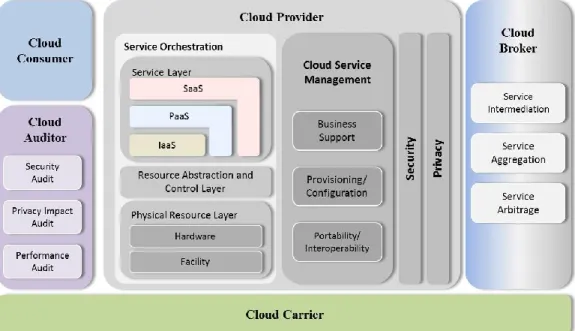
Figure 2 presents the NIST cloud computing reference architecture, which identifies the major actors, their activities, and their functions in cloud computing. The diagram depicts a generic high-level architecture and is intended to facilitate the understanding of the requirements, uses, characteristics, and standards of cloud computing.
Figure 2: The Conceptual Reference Model 2.2.2 Cloud Computing Actors
As shown in Figure 2, the NIST cloud computing reference architecture defines five major actors: cloud consumer, cloud provider, cloud carrier, cloud auditor, and cloud broker. Each actor is an entity (a person or an organization) that participates in a transaction or process or performs tasks in cloud computing. 2.2.2.1 Cloud Consumer
The cloud consumer is the principal stakeholder that uses the cloud computing services. A cloud consumer represents a person or organization that maintains a business relationship with, and uses the service from, a cloud provider. A cloud consumer browses the service catalog from a cloud provider, requests the appropriate service, sets up service contracts with the cloud provider, and uses the service. The cloud consumer may be billed for the service provisioned, and needs to arrange payments
accordingly.
Cloud consumers use Service-Level Agreements (SLAs) for specifying the technical performance requirements to be fulfilled by a cloud provider. SLAs can cover terms regarding the quality of service, security, and remedies for performance failures. A cloud provider may also list in the SLAs a set of restrictions or limitations, and obligations that cloud consumers must accept. In a mature market
terms. Typically a cloud provider’s public pricing policy and SLAs are nonnegotiable, although a cloud consumer who expects to have heavy usage might be able to negotiate for better contracts.
SaaS applications are made accessible via a network to the SaaS consumers. The consumers of SaaS can be organizations that provide their members with access to software applications, end users who directly use software applications, or software application administrators who configure applications for end users. SaaS consumers can be billed based on the number of end users, the time of use, the network bandwidth consumed, the amount of data stored, or the duration of stored data.
PaaS consumers employ the tools and execution resources provided by cloud providers to develop, test, deploy, and manage the operation of PaaS applications hosted in a cloud environment. PaaS consumers can be application developers who design and implement application software, application testers who run and test applications in a cloud-based environment, application deployers who publish applications into the cloud, and application administrators who configure, monitor, and manage applications deployed in a cloud. PaaS consumers can be billed according to the number of PaaS users, the processing, storage, and network resources consumed by the PaaS application, and the duration of the platform usage. IaaS clouds provide cloud consumers with virtual computers, network-accessible storage, network infrastructure components, and other fundamental computing resources, on which IaaS consumers can deploy and run arbitrary software. IaaS can be used by system developers, system administrators, and IT managers who are interested in creating, installing, monitoring, and managing services and applications deployed in an IaaS cloud. IaaS consumers can be billed according to the amount or duration of the resources consumed, such as CPU hours used by virtual computers, volume and duration of data stored, network bandwidth consumed, or the number of IP addresses used for certain intervals.
2.2.2.2 Cloud Provider
A cloud provider is the entity (a person or an organization) responsible for making a service available to interested parties. A cloud provider acquires and manages the computing infrastructure required for providing the services, runs the cloud software that provides the services, and makes the arrangements to deliver the cloud services to cloud consumers through network access.
For SaaS, the cloud provider deploys, configures, maintains, and updates the operation of the software applications on a cloud infrastructure. The SaaS cloud provider is mostly responsible for managing the applications, security, and the cloud infrastructure, while the SaaS cloud consumer has limited
administrative control of the applications.
For PaaS, the cloud provider manages the computing infrastructure for the platform and runs the cloud software that provides the components of the platform, such as runtime software execution stack, databases, and other middleware components. The PaaS cloud provider typically also supports the development, deployment, and management process of the PaaS cloud consumer by providing tools such as integrated development environments (IDEs), development versions of cloud software, software development kits (SDKs), and deployment and management tools. The PaaS cloud consumer has control over the applications and possibly over some of the hosting environment settings, but has no or limited access to the infrastructure underlying the platform such as network, servers, operating systems (OSs), or storage.
For IaaS, the cloud provider acquires the physical computing resources underlying the service, including the servers, networks, storage, and hosting infrastructure. The cloud provider runs the cloud software necessary to render the necessary computing resources to the IaaS cloud consumer through a set of service interfaces and computing resource abstractions, such as virtual machines and virtual network interfaces. In return, the IaaS cloud consumer uses these computing resources, such as a virtual computer,
for fundamental computing needs. Compared to SaaS and PaaS consumers, an IaaS consumer has access to more fundamental forms of computing resources and thus has control over more software components in an application stack, including the OS. The IaaS cloud provider, on the other hand, has control over the physical hardware and cloud software that make the provisioning of these infrastructure services possible, for example, the physical servers, network equipment, storage devices, host OS, and hypervisor software for virtualization.
A cloud provider’s activities span five major areas including service deployment, service orchestration, cloud service management, security, and privacy.
2.2.2.3 Cloud Auditor
A cloud auditor is a party that can perform an independent examination of cloud service controls with the intent to express an opinion thereon. Audits are performed to verify conformance to standards through a review of objective evidence. A cloud auditor can evaluate the services provided by a cloud provider such as security controls, privacy impact, and performance.
Auditing is especially important for federal agencies. The Federal Cloud Computing Strategy document published in February 2011 pointed out that “agencies should include a contractual clause enabling third parties to assess security controls of cloud providers.” Security controls are the management, operational, and technical safeguards or countermeasures employed within an organizational information system to protect the confidentiality, integrity, and availability of the system and its information. For security auditing, a cloud auditor can make an assessment of the security controls in the information system to determine the extent to which the controls are implemented correctly, operating as intended, and producing the desired outcome with respect to the security requirements for the system. The security auditing should also assess the compliance with the specified regulation and with the security policy. For example, an auditor can be tasked with ensuring that the correct policies are applied to data retention according to relevant rules for the jurisdiction. The auditor may ensure that fixed content has not been modified and that the legal and business data archival requirements have been satisfied.
A privacy impact audit can help federal agencies comply with applicable privacy laws and regulations governing an individual’s privacy, and to ensure confidentiality, integrity, and availability of an individual’s personal information at every stage of development and operation.
2.2.2.4 Cloud Broker
As cloud computing evolves, the integration of cloud services can be too complex for cloud consumers to manage. A cloud consumer may request cloud services from a cloud broker, instead of contacting a cloud provider directly. A cloud broker is an entity that manages the use, performance, and delivery of cloud services and negotiates relationships between cloud providers and cloud consumers.
In general, a cloud broker can provide services in three categories:
Service Intermediation: A cloud broker enhances a given service by improving some specific capability and providing value-added services to cloud consumers. The improvement can be
managing access to cloud services, identity management, performance reporting, enhanced security, etc.
Service Aggregation: A cloud broker combines and integrates multiple services into one or more new services. The broker provides data integration and ensures the secure data movement between the cloud consumer and multiple cloud providers.
Service Arbitrage: Service arbitrage is similar to service aggregation except that the services being aggregated are not fixed. Service arbitrage means a broker has the flexibility to choose services from multiple agencies. The cloud broker, for example, can use a credit-scoring service to measure and select an agency with the best score.
2.2.2.5 Cloud Carrier
A cloud carrier acts as an intermediary that provides connectivity and transport of cloud services between cloud consumers and cloud providers. Cloud carriers provide access to consumers through network, telecommunication, and other access devices. For example, cloud consumers can obtain cloud services through network access devices, such as desktop computers, laptops, mobile phones, and other mobile Internet devices (MIDs). The distribution of cloud services is normally provided by network and
telecommunication carriers or a transport agent, where a transport agent refers to a business organization that provides physical transport of storage media, such as high-capacity hard drives.
2.2.2.6 Scope of Control between Provider and Consumer
The cloud provider and cloud consumer share the control of resources in a cloud system. As illustrated in Figure 3, different service models affect an organization’s control over the computational resources and thus what can be done in a cloud system. Figure 3 shows these differences using a classic software stack notation comprised of the application, middleware, and OS layers. This analysis of delineation of controls over the application stack increases understanding of the responsibilities of parties involved in managing the cloud application.
Figure 3: Scope of Controls between Provider and Consumer
The application layer includes software applications targeted at end users or programs. The
applications are used by SaaS consumers, or installed/managed/maintained by PaaS consumers, IaaS consumers, and SaaS providers.
The middleware layer provides software building blocks (e.g., libraries, database, and Java virtual machine) for developing application software in the cloud. The middleware is used by PaaS consumers, installed/managed/maintained by IaaS consumers or PaaS providers, and hidden from SaaS consumers.
The OS layer includes operating system and drivers, and is hidden from SaaS and PaaS consumers. An IaaS cloud allows one or multiple guest OSs to run virtualized on a single physical host.
Generally, consumers have broad freedom to choose which OS is to be hosted among all the OSs that could be supported by the cloud provider. The IaaS consumers should assume full responsibility for the guest OS(s), while the IaaS provider controls the host OS.
2.2.3 Architecture Components
This section describes the architectural elements with which cloud actors interact, including an abstraction of the system components that orchestrate together to deliver the service capabilities, the different
deployment models of these infrastructure components, and the management activities cloud providers engage in with cloud consumers.
2.2.3.1 Service Orchestration
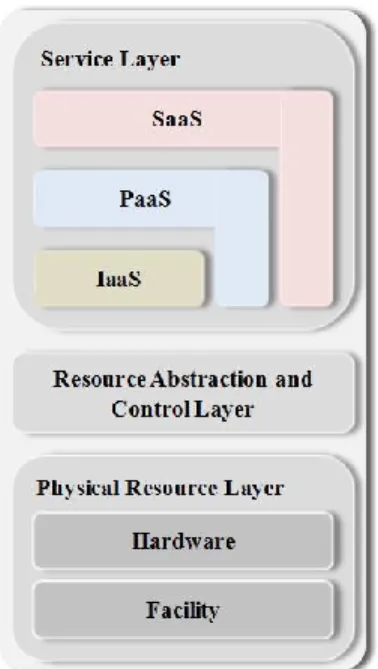
Service Orchestration refers to the composition of system components to support the cloud provider activities in arrangement, coordination, and management of computing resources in order to provide cloud services to cloud consumers. Figure 4 shows a generic stack diagram of this composition that underlies the provisioning of cloud services.
Figure 4: Cloud Provider - Service Orchestration
A three-layered model is used in this representation to depict the grouping of the three types of system components that cloud providers need to compose to deliver their services.
In the model shown in Figure 4, the top is the service layer, where cloud providers define interfaces for cloud consumers to access the computing services. Access interfaces of each of the three service models are provided in this layer. It is possible, though not necessary, that SaaS applications can be built on top of PaaS components, and PaaS components can be built on top of IaaS components. The optional dependency relationships among SaaS, PaaS, and IaaS components are represented graphically as components stacking on each other; while the angling of the components represents that each of the service component can stand by itself. For example, a SaaS application can be implemented and hosted on
virtual machines from an IaaS cloud, or it can be implemented directly on top of cloud resources without using IaaS virtual machines.
The middle layer in the model is the resource abstraction and control layer. This layer contains the system components that cloud providers use to provide and manage access to the physical computing resources through software abstraction. Examples of resource abstraction components include software elements such as hypervisors, virtual machines, virtual data storage, and other computing resource abstractions. The resource abstraction needs to ensure efficient, secure, and reliable usage of the underlying physical resources. While virtual machine technology is commonly used at this layer, other means of providing the necessary software abstractions are also possible. The control aspect of this layer refers to the software components that are responsible for resource allocation, access control, and usage monitoring. This is the software framework that ties together the numerous underlying physical resources and their software abstractions to enable resource pooling, dynamic allocation, and measured service. Various open source and proprietary cloud software are examples of this type of middleware.
The lowest layer in the stack is the physical resource layer, which includes all the physical computing resources. This layer includes hardware resources, such as computers (CPU and memory), networks (routers, firewalls, switches, network links, and interfaces), storage components (hard disks), and other physical computing infrastructure elements. It also includes facility resources, such as heating, ventilation and air conditioning (HVAC), power, communications, and other aspects of the physical plant.
Following system architecture conventions, the horizontal positioning, i.e., the layering, in a model represents dependency relationships – the upper layer components are dependent on adjacent lower layer to function. The resource abstraction and control layer exposes virtual cloud resources on top of the physical resource layer and supports the service layer where cloud services interfaces are exposed to cloud consumers. Cloud consumers do not have direct access to the physical resources.
2.2.3.2 Cloud Service Management
Cloud Service Management includes all of the service-related functions that are necessary for the management and operation of those services required by or proposed to cloud consumers. Cloud service management can be described from the perspective of business support, provisioning and configuration, and from the perspective of portability and interoperability requirements.
2.3 NIST Cloud Computing Taxonomy
The NIST Cloud Computing taxonomy was developed in conjunction with the reference architecture and describes key cloud computing concepts, the relationships between these concepts, and their given context. The taxonomy organizes the key concepts into four levels:
Level 1: Role, which indicates a set of obligations and behaviors as conceptualized by the associated actors in the context of cloud computing;
Level 2: Activity, which entails the general behaviors or tasks associated to a specific role;
Level 3: Component, which refers to the specific processes, actions, or tasks that must be performed to meet the objective of a specific activity; and
Level 4: Sub-component, which presents a modular part of a component.
The taxonomy can be used as a source for developing a controlled vocabulary of cloud computing terms that will provide an increased clarification and standardization of the cloud computing terminology. Details about this taxonomy and the related vocabulary can be found on the NIST cloud computing
reference architecture and taxonomy collaboration site: http://collaborate.nist.gov/twiki-cloud-computing/bin/view/CloudComputing/ReferenceArchitectureTaxonomy.
3 Cloud Computing Use Cases and Requirements
Although use cases have been traditionally employed as a system analysis tool that links the actors to the system functions, the same methodology has also been widely used within business architectures for such purposes as describing business processes of an enterprise, actors corresponding to these processes, and organizational participants. Using well-defined elements such as actors, conditions, and activity flows, a use case can systematically reveal the requirements and constraints which can subsequently direct system architecture and design.
The NIST projects and working groups apply use case methodology to define business and technical operational scenarios and requirements.
Business use cases document scenarios at the functional mission level. The use case describes the business goal with no assumptions as to how cloud computing technology (deployment model constraints) will be deployed to achieve that goal. These business use cases can then be explored by walking through the considerations of planning and deploying candidate cloud computing service and deployment model options, issues, and constraints. While this process has documented business use cases that are in pilot or operational deployment stage, the objective of the Target focuses on those business use cases that agencies have identified as an opportunity, but consider to be difficult to implement, or have a perceived impediment to implementation.
The second case where use case methodology is applied is definition of technical use cases in the Standards Acceleration to Jumpstart the Adoption of Cloud Computing (SAJACC) effort. These use cases are designed to facilitate the qualitative testing of standards through the use of third-party APIs implemented in adherence to candidate specifications and emerging standards. Of necessity, each SAJACC use case represents a single activity, such as the deletion of data, and the actions needed to successfully execute that activity (receive the request, respond to the request, execute the request, etc.).
A business use case is decomposed into a list of high-level requirements, then into successively more detailed requirements, until it can ultimately be mapped to technical requirements that are required to identify and execute the appropriate SAJACC use cases.
3.1 Target Business Use Case and High-Level Requirements
The main objective of the NIST Cloud Computing Target Business Use Case (TBUC) Project is to work with federal CIOs to identify and document application and service use cases for potential migration to a cloud environment. As described in the Federal Cloud Computing Strategy, NIST is working with agencies to define target business use cases that are complex, or have technical hurdles or standards gaps that need to be overcome. The high-level requirements that are extracted from the target business use cases are the primary deliverables for that project area.
At the time of this writing, the business use cases from agencies and departments summarized here have perceived impediments or obstacles that prevent their immediate implementation or require workarounds. These business use cases focus attention on the areas where technical and procedural gaps are assessed and prioritized to propose recommendations for mitigation. After target business use cases are developed,
they are analyzed to determine which business requirements are pertinent to the cloud. These business requirements are examined to determine their relevance to security, portability, and interoperability needs, and whether they are mission-specific requirements or cross-cutting requirements. The final step is to determine the relationship of the business requirements to the SAJACC technical use cases.
A template to capture target business use cases was created and is described in the next section. An initial portfolio of target business use cases using this template was developed using two methods. The most common approach is documentation via interviews with agency and department CIOs identified through the Federal CIO Council Cloud Computing Executive Steering Committee and Cloud First Task Force. Information is gathered about the business use case through information provided by agencies, after which NIST-led interviews of key members of the cloud effort are conducted to flesh out the business use case and identify areas of concern. Alternatively, participants in the NIST-chaired public Cloud Computing Business Use Case Working Group (CCBUCWG) volunteer to document and obtain agency
sponsorship of business use cases that might be of interest. Sponsoring federal agencies develop the business use cases and submit them to the project team as contributions. As business use cases are drafted, they are presented to the Cloud Computing Business Use Case Working Group for review and comment.
As requirements are identified and areas of research are prioritized, NIST works with federal agencies, industry, SDOs, and academia to identify options for addressing challenges, using the vendor-neutral reference architecture and taxonomy as a frame of reference. This research results in the definition of new or augmented standards, guidance, and technology requirements where appropriate. The portfolio of target business use cases can also be used by Federal CIOs to aid them in considering their projects. As federal CIOs identify new business use cases, it is helpful to the broader community to add them to this portfolio. As the portfolio of business use cases is expanded, trends and commonalities become more apparent, permitting prioritization of research areas.
Highlights: Target business use cases of federal
agencies were captured to understand security, interoperability, and portability requirements. These business use cases and the cross-cutting requirements extracted were developed as part of the iterative and complementary process used to identify the strategic requirements in Volume I of the Technical Roadmap.
Specifically, this section summarizes the use cases which were used as the basis for defining the following high-priority requirements listed in the NIST USG Cloud Computing
Technology Roadmap Volume I
high-priority requirements:
“Solutions for High-priority Security Requirements” - Requirement 2;
“Frameworks to support federated community clouds” Requirement 5;
“Defined unique government regulatory requirements, technology gaps, and solutions”- Requirement 7:
“Collaborative parallel ‘future cloud’ development initiatives”-Requirement 8;
“Defined and implemented reliability design goals” – Requirement 9; and
“Defined and implemented cloud service metrics” – Requirement 10.
3.1.1 Business Use Case Template
In order to identify common themes across business use cases, a template for documenting business use cases was created with input from the CCBUCWG. The template was designed to organize how the business use case was documented, ensure that the documenter articulated how the project met the NIST definition for cloud computing, and to encourage consideration of the various elements of the NIST Cloud Computing Reference Architecture.
The template consists of five major sections: description, background, cloud computing concept of operations, analysis, and concerns and challenges. The description is a brief, one-paragraph summary of the purpose and goals of the business use case. The background provides an explanation of how the business use case is currently solved, along with any definitions and descriptions needed to understand the business use case generally. The cloud computing concept of operations examines how a cloud implementation would work and identifies the key requirements that a cloud implementation would need to meet.
The analysis section incorporates the NIST definition of cloud computing and the reference architecture, leading the documenter to consider the service model, delivery model, the five essential characteristics, and the NIST focus areas of security, portability, and interoperability. Finally, any concerns or challenges expressed by the sponsor are captured.
3.1.2 Business Use Case Summaries 3.1.2.1 NIST IT Service Management
Delivery Model: Private Cloud
Service Model: SaaS
Agency: National Institute of Standards and Technology
FISMA2 Impact Level: Moderate
NIST is interested in moving its service ticketing system to the cloud as part of a larger move to an IT Service Management model for providing services to end users. One of the main drivers for moving the trouble ticket system to the cloud is to allow IT to focus its resources on applications that directly implement functional aspects of the NIST mission. Moving non-core applications to the cloud eliminates the need to patch and update software and servers.
A longer-term goal of this implementation is to enable other service groups (such as telecommunications, security, and building maintenance) within NIST to use this tool as well. In this way, a single service request can be routed to appropriate service providers within NIST in a seamless way. The use of a cloud application would provide flexibility in the timing of deployments and the availability of system
resources for testing and training.
3.1.2.2 US Census Virtual Desktop Infrastructure
Delivery Model: Private Cloud
Service Model: SaaS
Agency: United States Bureau of the Census
FISMA Impact Level: Moderate
The United States Bureau of the Census proposes to use cloud technology to comply with the Telework Enhancement Act of 2010 and to improve productivity by eliminating the need to use the SafeBoot device encryption tool. The benefits of this approach are in realizing a decreased cost of delivering computing and support services, creating a mobile workforce capable of using a variety of devices, and improving security by limiting the loss of sensitive data through the loss or theft of a mobile device or by malicious software. Specifically, the use of a Virtual Desktop Infrastructure (VDI) will reduce the high cost
associated with providing and maintaining desktop service. The US Census expects to use a private cloud environment for its cloud effort.
Securing sensitive data is critical to enabling telework. By running virtual machines on a server and ensuring that all data resides on network storage, data can be properly secured. Finally, end-user compliance with security policies can be improved through managed personalization of the desktop environment.
The security infrastructure that enables single-sign-on and two-factor authentication is also an essential part of the solution and will be deployed in the same private cloud.
3.1.2.3 USAID Virtual Desktop Infrastructure (VDI)
Delivery Model: Community Cloud
Service Model: SaaS
Agency: US Agency for International Development
FISMA Impact Level: Moderate
USAID is interested in migrating to the cloud to provide IT services for its users distributed across the globe. The plan (in-progress) is to move email, office productivity, and some business applications into a cloud-based infrastructure and implement a cloud-based VDI to enable secure access to the services. This migration will decrease the cost of delivering computing and support services, create a mobile workforce that will use a variety of devices, and improve security by limiting the loss of sensitive data through the loss or theft of a mobile device or by malicious software. Specifically, the VDI will reduce the high cost associated with providing and maintaining desktop service, and by moving IT services into the cloud, help to reduce the need and the cost associated with developing and maintaining data centers. USAID expects a hybrid cloud environment that uses both private cloud and community cloud for its cloud effort. The security infrastructure that enables single-sign-on and two-factor authentication is also an essential part of the solution and will be deployed in the same private cloud.
3.1.2.4 USAID Office Productivity
Delivery Model: Community Cloud
Service Model: SaaS
Agency: US Agency for International Development
FISMA Impact Level: Moderate Internal, Low External
USAID OCIO plans to use Google Apps service for government to provide cloud-based email and
document management service for USAID users. This service is expected to be deployed in an outsourced community cloud and accessed through the VDI or directly through the Internet. The other business applications are expected to be deployed in an on-site private cloud at the beginning and will later be migrated into an outsourced private cloud. These cloud-based applications will be accessed through the cloud-based VDI. The security infrastructure that enables single-sign-on, two-factor authentication, and identity management is an essential part of the solution and will be deployed in the same on-site private cloud.
3.1.2.5 FGDC Geospatial Cloud
Delivery Model: Community Cloud, Public Cloud
Service Model: PaaS
Agency: Federal Geospatial Data Committee
FISMA Impact Level: Moderate and Low, depending on need.
The Federal Geographic Data Committee and the General Services Administration (GSA) Cloud Computing Program Management Office operate the GeoCloud project on behalf of a wide range of federal agencies to explore the impact and possibilities of a geospatial computing-oriented cloud. The initiative seeks to define and investigate cloud savings, best practices, and lessons learned by migrating, benchmarking, and operating a set of ten existing public-access geospatial projects from six currently participating agencies –US Geologic Survey (USGS), National Oceanic and Atmospheric Administration (NOAA), Bureau of the Census, Environmental Protection Agency (EPA), Department of Agriculture (USDA), and Department of the Interior (DOI) with interest from the Department of Homeland Security (DHS).
The overall plan is to define, construct, and maintain a set of common geospatial platforms to support the project, using a joint agency platform model. Once platforms are in place and under maintenance, each project team will evaluate their application on its matching platform, document the steps needed to ensure security and performance, and track lessons learned along the way. To date, two platforms have been defined; one has been hardened and constructed and operates on Amazon’s AWS public cloud. The project teams are beginning their exploration and sandbox phase to discover and document the processes needed to maintain these existing applications in the cloud.
Some agency geospatial applications, targeted for the public cloud, have data storage or processing needs that appear to make them more cost-effective in a community cloud setting. These applications will be piloted on similar shared platforms in a community facility housed in the US Geologic Survey. 3.1.2.6 NOAA Email
Delivery Model: Community Cloud
Service Model: SaaS
Agency: National Oceanic and Atmospheric Administration
FISMA Impact Level: Moderate
NOAA envisions using a cloud-based Unified Messaging Service (UMS) to replace NOAA’s existing in-house-hosted email and calendaring systems and its installation of Blackberry Enterprise Server. The UMS would decrease system maintenance responsibilities for NOAA, and provide users with new features as they become available in the cloud-based solution. Additionally, NOAA expects to expand collaboration capabilities through increased use of integrated messaging and collaboration tools, and, optionally, to obtain archival and eDiscovery capabilities.
3.1.2.7 FAA eDiscovery
Delivery Model: Community Cloud
Service Model: SaaS
Agency: Federal Aviation Administration, Federal Cloud Computing Working Group
FISMA Impact Level: Moderate
The FAA, in conjunction with the Federal Cloud First Task Force and other federal agencies, is seeking a cloud-based eDiscovery solution, motivated by the agency’s moving email to a cloud-based solution. This solution would be composed of an archive, identification and collection capability, data preservation
capability, and the processing and export of content. The objective is to implement a cloud-based eDiscovery solution that can analyze both in-house and cloud-based email systems because of the time that the project will take to migrate the FAA’s email from in-house systems to the cloud. During the migration of email, the ability to respond to eDiscovery and FOIA requests is necessary.
3.1.2.8 In-depth Email
Delivery Model: All
Service Model: All
Agency: N/A
FISMA Impact Level: Moderate, Low
Currently available collaboration solutions tend to fall into one of two categories. The first category is a single client-based solution (e.g., Outlook/Exchange, Zimbra, Mobile.me) and provides a number of integrated functions within the client interface (e.g., email, calendar, address book, etc.). The second category is an amalgamation of a variety of separate tools, sometimes integrated within the mail client framework using plugins (e.g., Thunderbird supports a variety of calendar plug-ins).
In the majority of cases, Email/User Collaboration tools are services hosted within the organization and are designed to connect to user client systems. Web-based email, while a frequent functional offering is typically a casual use offering (leveraged when users travelling or it is inconvenient to access a work system). Despite its current low utilization, Web-based systems offer enhanced security and
administrative controls. These solutions are pertinent to a Secure/Classified environment.
As laptops and ‘Smart’ mobile devices become more common, there is more pressure to make the user collaboration tools work within this extended usage paradigm. Ensuring that data and security models are adhered to in the mobile environment is critical.
3.1.3 Business Use Case Analysis
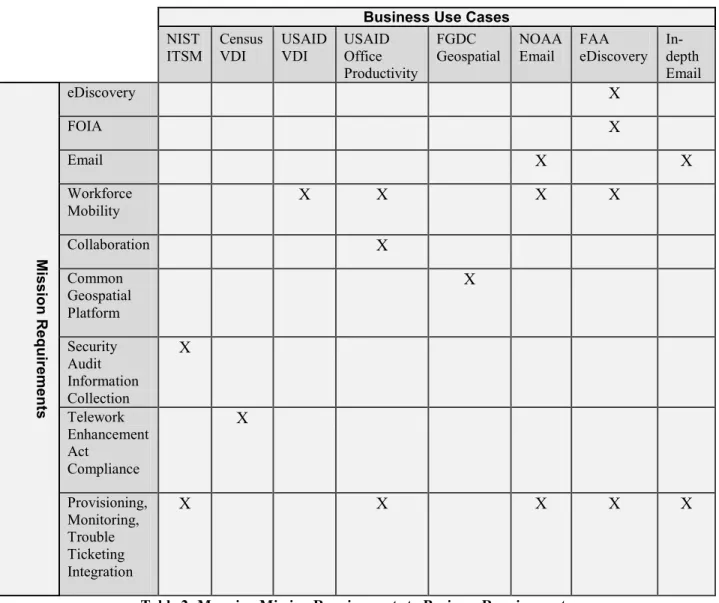
Mission requirements are extracted from the business use cases. Mission requirements are high-level requirements that must be met to successfully support the primary goals of the business use case. Cross-cutting system requirements which relate to security, portability, and interoperability are also identified. These system requirements are used to inform high-level strategic USG requirements in cloud adoption. Complementary tactical efforts, such as technical requirement analysis from the SAJACC effort and cloud security impediments analysis, benefit from these source requirements.
3.1.3.1 Mission Requirements
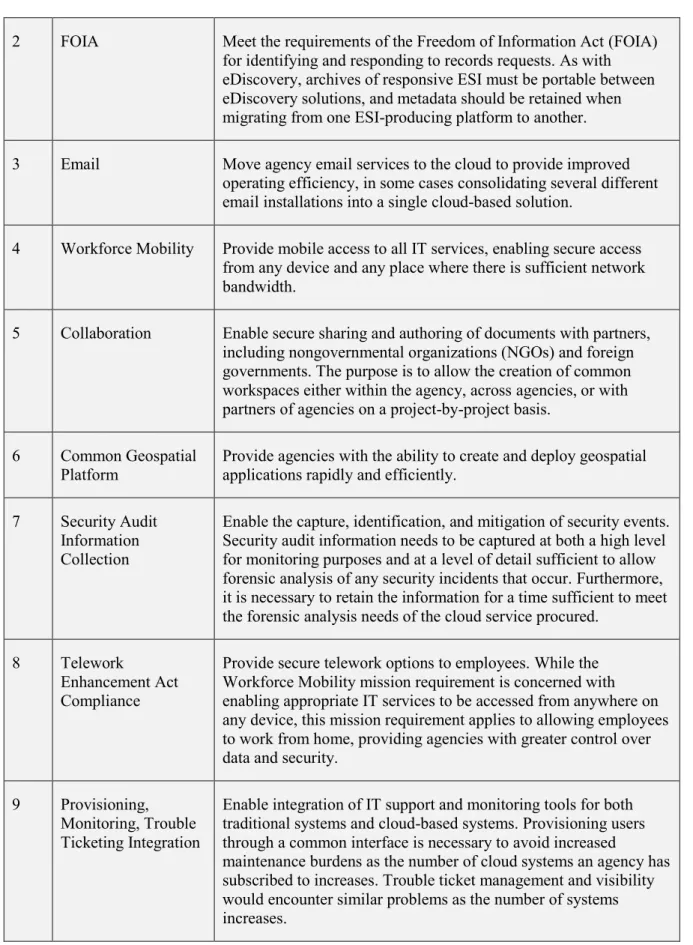
The portfolios of target business use cases help to identify the following mission requirements in USG agency migration to cloud computing:
Requirement Description
1 eDiscovery Meet eDiscovery requirements, identify electronic records meeting search criteria, and retrieve both the records and their metadata. Archives of responsive Electronically Stored Information (ESI) such as documents and spreadsheets should be portable among eDiscovery solutions. These ESI must retain metadata during migration between ESI-producing platforms.
2 FOIA Meet the requirements of the Freedom of Information Act (FOIA) for identifying and responding to records requests. As with eDiscovery, archives of responsive ESI must be portable between eDiscovery solutions, and metadata should be retained when migrating from one ESI-producing platform to another.
3 Email Move agency email services to the cloud to provide improved operating efficiency, in some cases consolidating several different email installations into a single cloud-based solution.
4 Workforce Mobility Provide mobile access to all IT services, enabling secure access from any device and any place where there is sufficient network bandwidth.
5 Collaboration Enable secure sharing and authoring of documents with partners, including nongovernmental organizations (NGOs) and foreign governments. The purpose is to allow the creation of common workspaces either within the agency, across agencies, or with partners of agencies on a project-by-project basis.
6 Common Geospatial Platform
Provide agencies with the ability to create and deploy geospatial applications rapidly and efficiently.
7 Security Audit Information Collection
Enable the capture, identification, and mitigation of security events. Security audit information needs to be captured at both a high level for monitoring purposes and at a level of detail sufficient to allow forensic analysis of any security incidents that occur. Furthermore, it is necessary to retain the information for a time sufficient to meet the forensic analysis needs of the cloud service procured.
8 Telework
Enhancement Act Compliance
Provide secure telework options to employees. While the Workforce Mobility mission requirement is concerned with enabling appropriate IT services to be accessed from anywhere on any device, this mission requirement applies to allowing employees to work from home, providing agencies with greater control over data and security.
9 Provisioning, Monitoring, Trouble Ticketing Integration
Enable integration of IT support and monitoring tools for both traditional systems and cloud-based systems. Provisioning users through a common interface is necessary to avoid increased
maintenance burdens as the number of cloud systems an agency has subscribed to increases. Trouble ticket management and visibility would encounter similar problems as the number of systems increases.