Client Engagement Methodology
Media Net Link has spent the last ten years perfecting the art of managing projects to successful completion for large and medium sized companies. We don't do this by shooting from the hip, thinking we have all the answers or building something that doesn’t quite fit your needs. Our strength is applying our technical expertise and to what the client wants. Determining exactly what the client wants is the hard part, and it requires close communication.
We have completed over 1500 custom projects successfully because we consult with the client at the requisite level. We know from experience that every client is unique, and so are their needs. Translating a client’s specific needs into the best technology solution is what we do best, and it is exactly what Media Net Link dedicates itself to for each and every client.
We do this by following a engagement process that relies heavily on ongoing client involvement, ensuring that we do not continue to move forward unless we are meeting the client’s needs. For every client engagement we deliver solutions following these steps.
Phase 1) Needs Analysis, Design and Client Sign-off
Phase 2) Development, Testing, Review and Modification
Phase 3) Installation and Launch
Phase 4) Warranty and Maintenance
Phase 1: Needs Analysis, Design and Client Sign-off
Media Net Link views this phase as the most critical stage of a project. We spend the time it takes
here to fully understand the needs of our client and the scope of the project before doing any
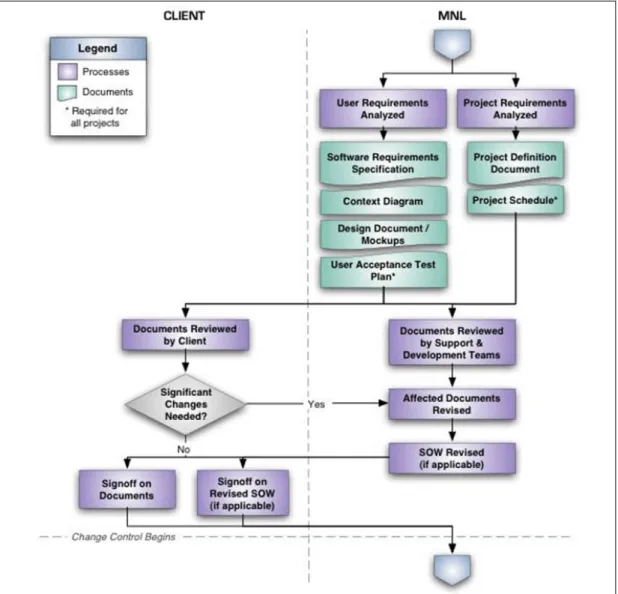
development. The diagram (Figure 1) on the following page illustrates MNL’s requirements
gathering and analysis process, which is described in more detail below.
Needs Analysis
In the Needs Analysis phase, MNL project managers and technical leads consult with the
client to identify and document the data and systems requirements, including business
rules and system functionality. The result is a comprehensive needs assessment.
•
Software Requirements Specification - includes all business needs of the project as it
relates to the user, including system functionalities, dependencies and critical success
factors
•
Project Definition Document – xxxx
Design
After understanding the client’s needs, MNL translates the client’s needs into an technical
and functional design. Our strength is in applying what we know to what the client wants.
MNL provides the client with detailed documentation on how we plan to implement the
project.
•
Context Diagram - xxx
•
Design Document / Mock-ups – our plan to implement what is in the Requirements
Specification, including user interface, database data structure & lists of fields, security
architecture, and software configuration management (SCM) requirements
•
User Acceptance Test Plans – MNL’s testing strategy and approach to ensure that all
business rules and requirements have been met
•
Project Schedule - a list of all project milestones and dates when they will be achieved
Client Review
The documents described above are given to the client’s Project Manager to review and
accept. Any changes requested by the client at this time are then re-analyzed by MNL’s
design team, and all of the supporting documentation is updated with those changes. This
phase is complete when the client Project Manager has signed off on the documentation
set.
Phase 2: Development, Testing, Review and Modification
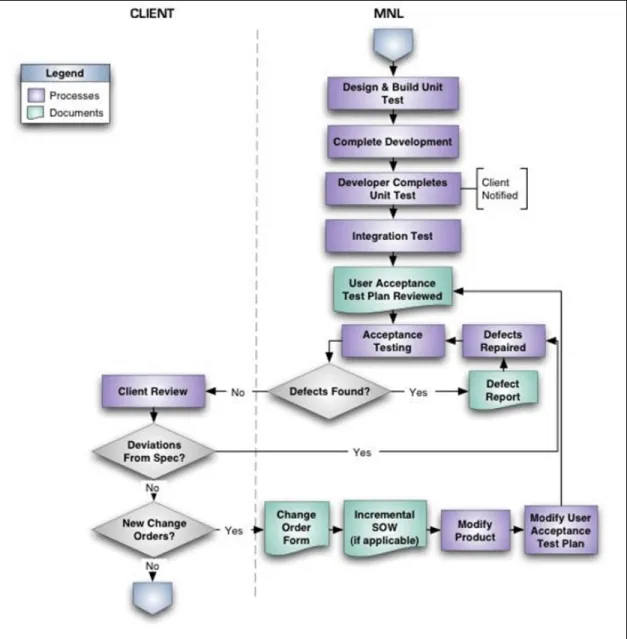
In this phase, MNL builds the product to the client’s specifications. We continue to communicate with and involve our client at this critical stage, giving the client opportunities to make corrections and changes.
MNL uses a 2-tier development environment when working with clients that need a low cost, stable, and secure solution. All development occurs on a development environment platform. Once components have been successfully tested by MNL, and reviewed and certified by the client Project Manager, they move to the production environment.
Each discrete portion of the database will be tested by MNL by its own internal testing unit. When all of the portions of the project are completed, MNL will conduct end-to-end user acceptance testing, which tests the system as a whole.
Development
In this phase, MNL will develop the database and front-end application in the “test” environment. All data and business needs identified in the Needs Analysis phase will be built into the database and front-end application. Some things MNL does during this phase are:
• Set up the technical database environment
• Build the database based on data identified during Needs Analysis
• Import and verify data import
• Build the user interface
• Code the application to maintain data integrity and enforce business rules
• Allow and restrict access to data based on approved business rules
• Assess and develop reporting capabilities if needed
Testing
Each discrete portion of the database will be tested by MNL by its own internal testing unit. When all of the portions of the project are completed, MNL will conduct end-to-end user acceptance testing, which tests the system as a whole. On some projects, MNL provides client access to our
development sites before or during this testing, giving the client opportunity to review and make changes.
Review
Once user acceptance testing is complete, the client Project Manager is notified and can review the product in depth. During this phase, the client Project Manager and a review team will review the entire database and front-end application.
The client will be able to report all feedback directly to MNL using our proprietary customer support system called AthenaRMS (Request Management System). We developed this system for our use and other support staff within the HP partner web system. This easy-to-use tool will enable any client staff to enter a trouble ticket via the web, and receive responses via e-mail. Interested parties can check on ticket status via the web as well. MNL’s response time commitment is one (1) business day.
This phase is complete when the client Project Manager has signed off on the correctness and completeness of the application’s implementation.
Modify and Finalize Database and Application
all modified documentation will be sent to the client Project Manager. This phase is complete when the client Project Manger has signed off on the correctness and completeness of the application’s implementation.
Phase 3: Installation and Launch
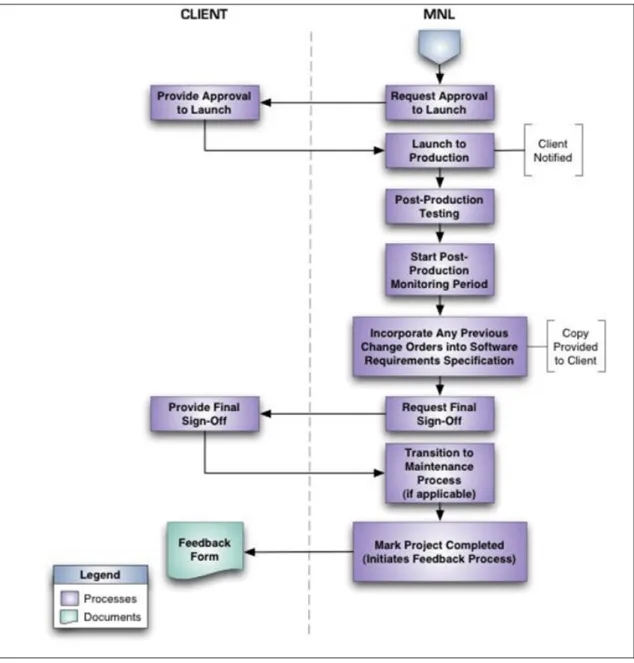
The database and front-end application will be installed either at the client’s location or at an MNL hosted location. Once installed, MNL will re-execute the user acceptance testing plan to make sure the application was installed correctly and completely on the production web server.
MNL will train the client’s Project Administrator to use the database and front-end application. MNL may also provide end-user training if needed.
Phase 4: Warranty and Maintenance
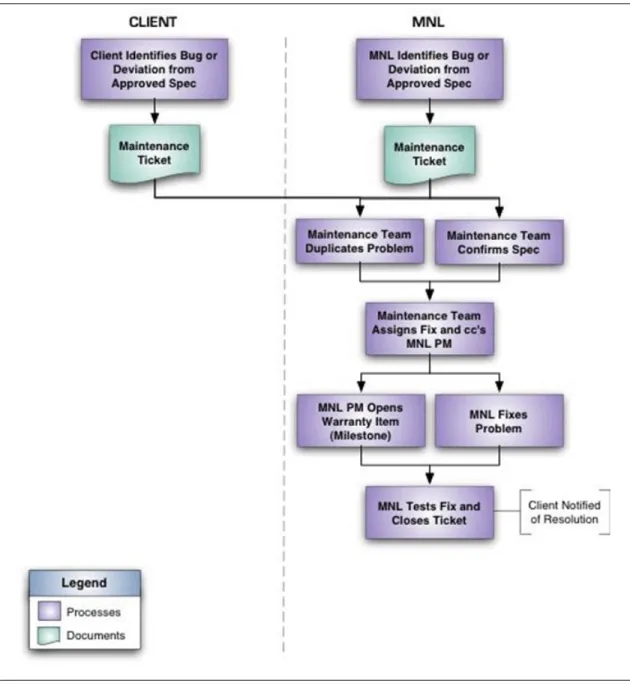
MNL guarantees its work through its warranty process. If a bug is discovered by the client or by us, MNL will resolve the issue free of charge. All issues will be resolved according to issue priority levels determined during the Needs Analysis phase. These can be altered at any time.
MNL will perform regular backups during the maintenance phase. The database and front-end application can be installed on an alternate machine for any disaster recovery efforts.