The Collective Advancement of Education through
Open Technology, Open Content, and Open
Knowledge
Edited by
Toru Iiyoshi and M. S. Vijay Kumar
Foreword by John Seely Brown
The MIT Press
Cambridge, Massachusetts London, England
The Carnegie Foundation for the Advancement of Teaching
For information about special quantity discounts, please email special_sales@ mitpress.mit.edu
This book was set in Sabon by SNP Best-set Typesetter Ltd., Hong Kong. Printed and bound in the United States of America.
Library of Congress Cataloging-in-Publication Data
Opening up education : the collective advancement of education through open technology, open content, and open knowledge / edited by Toru Iiyoshi and M. S. Vijay Kumar.
p. cm.
Includes bibliographical references and index. ISBN 978-0-262-03371-8 (hardcover : alk. paper)
1. Distance education—Computer-assisted instruction. 2. Education, Higher—Effect of technological innovations on. 3. Educational technology. 4. Open learning. I. Iiyoshi, Toru. II. Kumar, M. S. Vijay. LC5800.O678 2008
378.1′758—dc22
2007039375 10 9 8 7 6 5 4 3 2 1
—whose support and encouragement makes this important work possible.
Foreword: Creating a Culture of Learning xi John Seely Brown
Acknowledgments xix
Introduction: An Invitation to Open Up the Future of Education 1
Toru Iiyoshi and M. S. Vijay Kumar
Section I: Open Educational Technology 11
1 Section Introduction: “Open Educational Technology: Tempered Aspirations” 13
Owen McGrath
2 “Designing Open Educational Technology” 27 David Kahle
3 “The Gates Are Shut: Technical and Cultural Barriers to Open Education” 47
Stuart D. Lee
4 “Does an Open Source Strategy Matter? Lessons Learned from the iLabs Project” 61
Phillip D. Long and Stephen C. Ehrmann
5 “Evaluating the Results of Open Education” 77 Edward Walker
6 “A Harvest Too Large? A Framework for Educational Abundance” 89
7 “Digital Libraries, Learning Communities, and Open Education” 105
Clifford Lynch
8 “Open Source in Open Education: Promises and Challenges” 119
Christopher J. Mackie
Section II: Open Educational Content 133
9 Section Introduction: “Open Educational Content: Transforming Access to Education” 135
Flora McMartin
10 “Widening Participation in Education through Open Educational Resources” 149
Andy Lane
11 “Building Open Learning as a Community-based Research Activity” 165
Candace Thille
12 “Extending the Impact of Open Educational Resources through Alignment with Pedagogical Content Knowledge and Institutional Strategy: Lessons Learned from the MERLOT Community Experience” 181
Tom Carey and Gerard L. Hanley
13 “Why Understanding the Use and Users of Open Education Matters” 197
Diane Harley
14 “OpenCourseWare: Building a Culture of Sharing” 213 Steven R. Lerman, Shigeru Miyagawa, and Anne H. Margulies 15 “Challenges and Opportunities for the Open Education Movement:
A Connexions Case Study” 229 Richard G. Baraniuk
16 “2005–2012: The OpenCourseWars” 247 David Wiley
17 “Revolutionizing Education through Innovation: Can Openness Transform Teaching and Learning?” 261
Catherine M. Casserly and Marshall S. Smith
Section III: Open Educational Knowledge 277
18 Section Introduction: “Open Educational Knowledge: More than Opening the Classroom Door” 279
Cheryl R. Richardson
19 “Inquiry Unplugged: A Scholarship of Teaching and Learning for Open Understanding” 289
Richard A. Gale
20 “The Middle of Open Spaces: Generating Knowledge about Learning through Multiple Layers of Open Teaching Communities” 303
Randall Bass and Dan Bernstein
21 “Open Teaching: The Key to Sustainable and Effective Open Education” 319
Diana Laurillard
22 “Promoting Technology-enabled Knowledge Building and Sharing for Sustainable Open Educational Innovations” 337
Toru Iiyoshi and Cheryl R. Richardson 23 “Scaffolding for Systemic Change” 357
Barbara Cambridge
24 “Learning Design: Sharing Pedagogical Know-How” 375 James Dalziel
25 “Common Knowledge: Openness in Higher Education” 389 Diana G. Oblinger and Marilyn M. Lombardi
26 “Open for What? A Case Study of Institutional Leadership and Transformation” 401
Bernadine Chuck Fong
27 “What’s Next for Open Knowledge?” 417 Mary Taylor Huber and Pat Hutchings
Conclusion: New Pathways for Shaping the Collective Agenda to Open Up Education 429
Toru Iiyoshi and M. S. Vijay Kumar About the Authors 441
How could I say no? When approached by Toru and Vijay to participate in the workshop bringing the authors of this infl uential book together to discuss their preliminary chapter drafts, I was intrigued. After all, the challenges that we face in education today are daunting, and the editors had assembled quite an impressive company who were struggling to fi nd ways through education to respond to those challenges. The world becomes more complex and interconnected at a lightning-fast pace, and almost every serious social issue requires an engaged public that is not only traditionally literate, but adept in a new, systemic literacy. This new literacy requires an understanding of different kinds of feedback systems, exponential processes, the unintended consequences inherent in evolving social systems, etcetera. In addition, the unrelenting velocity of change means that many of our skills have a shorter shelf life, suggesting that much of our learning will need to take place outside of traditional school and university environments. It is also unlikely that suffi cient resources will be available to build enough new campuses to meet the growing demand for higher education, at least not the sort of campuses we have traditionally built for colleges and universities. Nor is it likely that current methods of teaching and learning will suffi ce to prepare students for the lives they will lead in the twenty-fi rst century.
In response, we need to fi nd a way to reconceptualize many twentieth-century education models, and at the same time reinforce learning outside of formal schooling. There may be powerful ways to blur the distinction between formal learning and informal where both turn on the social life of learning. Of course, we need to get back to basics—refi ning the most
effect modes of teaching, mentoring, and coaching, but we also should put some thought to informal teaching to support the inevitability and necessity of informal learning.
Fortunately, the networked age might be the “silver bullet” that will provide a way to both improve education and to set the stage for a nec-essary culture of learning. In the digital age, communities self-organize around the Internet, which has created a global “platform” that has vastly expanded access to all sorts of resources including formal and informal educational materials. The Internet has also fostered a new culture of sharing, one in which content is freely contributed and dis-tributed with few restrictions.
The latest evolution of the Internet, the so-called Web 2.0 has blurred the line between producers and consumers of content and has shifted attention from access to information toward access to other people. New kinds of online resources—such as social networking sites, blogs, wikis, and virtual communities—have allowed people with common interests to meet, share ideas, and collaborate in innovative ways. Indeed, the Web 2.0 is creating a new kind of participatory medium that is ideal for sup-porting multiple modes of learning. Two of those include social learning, based on the premise that our understanding of content is socially con-structed through conversations about that content and through grounded interactions around problems or actions. The focus is not so much on what we learn but on how we learn.
The second, perhaps even more signifi cant, aspect of social learning, involves not only “learning about” the subject matter but also “learning to be” a full participant in the fi eld. This involves acquiring the practices and norms of established practitioners in that fi eld or acculturating into a community of practice. By entering into this community, you are required to assimilate the sensibilities and ways of seeing the world embodied within that community. And this is exactly what happens if you want to join an open source community with their key practices and expected contributions.
A culture of sharing, augmented with a culture of participation now made more feasible than ever with the Internet and Web 2.0 platforms will most likely start with the students themselves, as we see so vividly in both the complex massively multiplayer game worlds and the power
of study groups—whether conducted face-to-face or virtually. But the culture of sharing and participation must also involve content. MIT broke the ice when then President Chuck Vest launched the bold Open-CourseWare (OCW) project. Other universities quickly followed MIT’s lead, and both the content and the means of accessing class materials and remixing and repurposing them for different audiences grew. But it is time that we move beyond merely considering content. We must begin to determine ways in which this content can encompass multiple kinds of instructional or learning activities within it. It is, after all, the combi-nation of things we do with content that creates learning platforms.
Technology, of course, is key, and I want to dwell on only two aspects of how technology can now transform our learningscape: immersion and intelligent tutoring systems. Immersion is a concept that has received all too little attention in the learning literature. Consider, for example, how every one of us has learned the immensely complex system that is our own native language. We learn language through immersion and desire. Immersion comes from being surrounded by others talking and interact-ing with us and is furthered facilitated by our deep desire to interact, be understood and express our needs. We learn language fearlessly and constantly. Nearly everyone with whom we interact is a teacher for us—albeit an informal teacher, encouraging us to say new things, cor-recting us, extending our vocabulary, and so on. This simple form of immersion is fundamentally social in nature.
In today’s high tech, graphically rich world we now have almost limit-less opportunities to leverage immersion. We can now build simulation models of cites, historic events, atomic structures, biological and mechani-cal systems to name just a few. Our challenge becomes how to share the vast simulations and data bases that already exist and share them in a way that others can extend, remix and compose them in order to expand their reach and scope. I still dream of a virtual human system where I can explore any aspect of how our bodies function from organs to cells to membranes. There are promising signs, but as of yet we have no real framework for constructing and sharing modules of such a system. But if we can entertain the semantic web, perhaps we could entertain a vast and recursively interconnected web of simulations. No one group can build it all, but many could contribute, including students themselves.
Although richly visual, immersive three dimensional simulations will help the born digital student master complex topics, that will not be enough. We need to augment these systems (as well as the more passive course material) with computer-based intelligent tutors. Intelligent tutor-ing systems have had a long history stretchtutor-ing back to the 1970s where, in fact, I fi rst became engaged in the issues of education and training. Some of our systems were pretty impressive as long as you overlooked the fact that they required a million dollar computer per student for our most advanced systems. But now we have machines 10,000 times more powerful, and in the last few years we have experienced the commoditiz-ing of computcommoditiz-ing where vast amounts of computer power can be ren-dered cheaply through cluster or utility computing or even more recently, cloud computing. This means that our past dreams for building intelli-gent tutoring systems that could afford open-ended learning under the skillful eye of a tutor/coach/mentor is now becoming realistic. Indeed, the prior work of Carnegie Mellon University (CMU) and now their Open Learning Initiative (OLI), wonderfully described in this book, have reignited interest in this direction by demonstrating the power and utility of such systems.
The third category I want to dwell on is knowledge. For decades we have worked to create better theories of learning and successful models of teaching. We collect small fragments of data and struggle to capture context from which this data was extracted, but it is a slow process. Context is suffi ciently nuanced that complete characterizations of it are extremely diffi cult. As a result, educational experiments are seldom defi n-itive, and best practices are, at best, rendered in snapshots for others to interpret—see the description of the KEEP Toolkit in Toru Iiyoshi’s and Cheryl R. Richardson’s chapter in section III for the best and most evoca-tive example of this. But we can do more.
If there was one thing I took away from the Carnegie meeting, it was that no one pedagogical or technical approach is the answer to ensuring that students are engaged and prepared. We need to be catholic in our point of view. There are thousands of colleges and universities world-wide, as well as many other institutions of learning, including training centers and technical schools. In addition, there are tens of thousands of institutions that support “informal” learning. And as the section
headings in this book illustrate, we need to think about how technology, content, and knowledge about learning and teaching can be creatively combined to enhance education and ignite students’ passions, imagina-tions and desires to participate in constant learning about (and sense making of) the world around us. And we need to collect shared, distrib-uted, refl ective practicums in which experiences are vetted, clustered, commented on, and tried out in new contexts, as several of the authors here posit.
Again, in the spirit of sharing and participation, how might we start to instrument our learningscapes and to start collecting massive amounts of data about what is working and what is not and why. Consider OCW. There may well be millions of students using this material, but we need to ask what we’re learning from them. Are there particular paragraphs or problems (in a problem set) that are routinely misinterpreted? How are test questions being misinterpreted? What sequence of materials appears to be working best? Are any systematic error patterns showing up? Can we model these errors? These queries barely scratch the surface of the information we need to collect, but readers who are particularly interested in these questions will be especially informed by Diana Laurillard’s chapter. And of course, just as Amazon does in their Web site, experiments can be designed and continuously run and the data collected to see what works best for a class of users. When enough micro experiments are run and the data is continuously collected and analyzed automatically it can lead to some surprising breakthroughs.
But if we do all the above along with all the ideas expressed in this book—will it be enough to meet the educational challenges we currently face? I would suggest we need to extend our thinking around open edu-cation to include more of a Learning 2.0 (based on Web 2.0) perspective. There are two primary reasons why this might be true. The fi rst turns on a question fi rst posed to me by John King, associate provost of University of Michigan. He asked how many students I thought that University of Michigan (Ann Arbor) taught each year. I knew that the university had approximately 40,000 students give or take a few thou-sand, so that was my answer. He responded that 250,000 was closer to the actuality, adding that I had gotten UM’s enrollment right. What you forget, he said, is that each year the incoming students bring their social
networks with them. These networks reach back into UM students’ com-munities and schools. Using the social software and social network tools of SMS, IM, Facebook, MySpace, they extend the discussions, debates, bull sessions and study groups that naturally arise on campus to encom-pass this broader constituency, thus amplifying the effect the university is having across the state.
Now I doubt that there is hard evidence regarding the extent this is currently happening, but nevertheless it does draw attention to the broader learning milieu or learning landscape we need to consider, and it brings attention to extended forms of participation offered by the Internet. These extended forms start to merge tools for doing research with tools for learning—a boundary that needs to be blurred ever more. As a simple example, consider how many students pick up the practice of writing software by joining an open source community of practice such as Linux, Apache, etcetera. There may be small groups on a campus, but generally these communities of practice are highly distributed. Joining one of these communities entails fi rst becoming a legitimate peripheral participant working on a small project improving or extending some piece of code and slowly building up a reputation from the work you do to moving into more central tasks and challenges in the community. Participants are learning new techniques about software practice from watching the work of their peers, defending their own work and partici-pating in community discussions about emergent problems. This peer-based learning process is about learning-to-be a practitioner rather than just learning about software. Today’s students don’t want to spend years learning about something before they start to learn-to-be a practitioner in that knowledge domain. Of course, this happens to some extent on today’s campuses in the form of practicums and laboratory exercises, but these are usually labor intensive in terms of the instructor’s time and effort. They are also labor intensive for the student. But time spent on learning is a funny commodity. If the student is passionately engaged in acquiring the practice, then time seems to disappear. Passion is the key, which brings us to our last point.
Today the Web offers students incredible opportunities to fi nd and join niche communities, niches that make up much of what Chris Anderson in 2004 in Wired magazine termed the “Long Tail.” Finding
and joining a niche community that ignites their passion sets the stage through productive inquiry and peer-based learning to acquire both the practice of and knowledge about a fi eld. Nearly all the resources dis-cussed in this book, along with the millions of niche amateur (from the Latin word amateur meaning lover of) communities could provide a powerful learningscape for life long learning that is grounded in the learning practices acquired on campus. Not only would this provide real leverage for open education, but it would be a major step toward creat-ing a culture of learncreat-ing for the twenty-fi rst century.
This volume is a product of a journey that started one and half years ago and would have been simply impossible to commence or complete without the scaffolding of support, encouragement, effort and plain old fashioned commitment, so freely offered by so many to whom we are profoundly grateful. As we take this opportunity to recognize several of them we are profoundly conscious that it has taken a village.
First of all, we have greatly benefi ted from the wisdom and generosity of our authors. We are indebted to them for willingly giving of their experience, expertise, and vision to this endeavor. We deeply appreciate their patience and fl exibility, which was challenged on more than one occasion over the course of this production, and of course, we were thrilled to have many stimulating exchanges of ideas and engaging dis-cussions with them.
We were extremely fortunate to have as part of our core editorial team, the talent and energy of Owen McGrath, Flora McMartin, and Cheryl Richardson, as section editors. Whether coaxing and cajoling our authors to meet impossible deadlines, providing critical reviews, or working to bring coherence to the disparate contributions, these three colleagues brought invaluable dedication, professionalism, and scholarly perspec-tive to this effort.
We are deeply obliged to Gay Clyburn for guiding us, gently but fi rmly, through the publishing process. We are also thankful to her and the copy editors, Ellen Wert, Kristen Garabedian, and Lori Low for their tireless and uncomplaining efforts to help produce a fi nished volume out of a rich but sometimes rough collection of essays. We are grateful to
Ellen Faran and her colleagues at the MIT Press for their valuable help with this publication.
Our note of thanks would be incomplete if we did not recognize some people whose work and thinking have been important infl uences in this fi eld: Hal Abelson at MIT, Joseph Hardin from the Sakai Foundation and the University of Michigan, Larry Lessig from Stanford University, Ira Fuchs from the Andrew W. Mellon Foundation, and Marshall Smith from the William and Flora Hewlett Foundation are among the people who have always urged us to think hard about the non-trivial issues of being “open” in education.
We are very conscious of the signifi cance of our institutional surround in this effort. The supportive environment at the Carnegie Foundation and MIT, who in their own distinctive ways are engaging deeply in establishing the value of open and innovative educational practices, has been valuable. We are grateful for the support and encouragement from the leadership of our organizations, including Lee Shulman, Pat Hutch-ings, John Barcroft, and Ann Fitzgerald at the Carnegie Foundation and Dean Daniel Hastings at MIT.
The book project would not have been launched had it not been for the encouragement at the outset from John Seeley Brown, provocateur and thinker at large, who recognized the signifi cance of undertaking this collective scholarly effort at this time and put his intellectual weight behind it.
Finally and foremost a note of deep gratitude and genuine admiration for a “Most Valuable Player”—Emily Crawford from the Carnegie Foundation, for shepherding this exercise—coordinating the myriad calls and meetings (working closely with Mary Curtin at MIT), organizing the online project workspace, communication, and overall project man-agement that was absolutely critical to execute this complex production effort, and for good measure helping us with proofreading the manu-scripts and providing helpful feedback.
Toru Iiyoshi and M. S. Vijay Kumar
It’s almost as if a window was opened through which the future was very clearly visible. “See that?” he said. “That’s the future in which you are going to live your life.”
—Albert A. Gore, An Inconvenient Truth (2006)
Al Gore fi rst realized what the future might look like when one of his undergraduate professors showed him how human activity—unless changed—would lead to the acceleration of global warming, resulting in serious harm to the environment and all life on earth. Alerted and intrigued, but most importantly motivated, Gore began working to change the future. The window was opened to him as a young man, and together with people around the world, he began to take action, both individually and collectively, to bring about a preferred future.
Similarly, our motivation for embarking on this book has been to open a window for our readers into the future of education. We hope that as you read through its chapters and see visions of what is possible, you will be alerted, intrigued, and motivated to start taking steps, in your own capacity, towards a preferred future for education.
A Perfect Storm
Before we jump into that future, though, let us quickly look back and remind ourselves that education’s history is one of expansion and inno-vation. As the number of people participating in education has increased, so has the number of ways in which we learn and teach. In other words, the history of education is a narrative on opening up education. Over the last few decades, new media and information communication
technologies have enabled faculty, students, and educational institutions to advance education in many ways. Computer-Assisted Learning, Intel-ligent Tutoring Systems, Computer-Supported Collaborative Learning, interactive multimedia, telecommunications, and the Internet have not only transformed how we learn and teach but have also extended edu-cational opportunity.
Today, a confl uence of events is creating the perfect storm for signifi -cantly advancing education. With a growing inventory of openly avail-able educational tools and resources, and with an increasingly engaged and connected community, transformative opportunities for education abound. We see a proliferation of new initiatives, many with the poten-tial to radically change the ecology and the economics of education. However, to date, many innovative educational endeavors still remain in isolated and closed domains, rarely shared across classrooms, disci-plines, or institutions. Thus, educators fi nd it diffi cult to advance their pedagogical practice and knowledge as a community.
The good news is that the emerging open education movement in higher education and beyond is beginning to change the way educators use, share, and improve educational resources and knowledge by making them open and freely available.
We are cognizant that the term “open education” can have multiple interpretations and the movement has multiple dimensions.
Rather than propose one more defi nition, our reference to open educa-tion embraces the many dimensions of this movement as well the many interpretations of the term “open” as it has been applied to education over time, such as increased access, greater choice, and fl exibility. What we offer instead is an extension to these defi nitions that emphasizes the value of collectivity leading to an assertion (more in the nature of an aspiration) that a key tenet of open education is that education can be improved by making educational assets visible and accessible and by harnessing the collective wisdom of a community of practice and refl ection.
There are several indicators of how the open education movement is affecting the educational landscape. For example, tens of thousands of course Web sites and other educational materials are now freely available from hundreds of institutions, organizations, and projects from thou-sands of educators around the world, representing an unprecedented
upsurge in access to educational resources. At the same time, hundreds of educational institutions have joined international consortia and alli-ances to develop and share open educational technologies, resources, and repositories, creating new models of collaboration for the production and distribution of educational resources. Furthermore, some of these groups are moving toward the collaborative construction, extension, and revision of course materials across disciplines, indicating that “building upon each other’s work,” which has been a valued common practice in research over centuries, fi nally starts gaining momentum in teaching and learning.
Perhaps the most signifi cant sign of open education’s promise of deep transformation is that it is becoming an essential part of the discourse on educational opportunity and change at institutional, national, and international levels. Forums sponsored by OECD (See Giving Knowledge for Free: The Emergence of Open Educational Resources at http://www.oecd.org/cer) and UNESCO (See http://www. unesco.org/iiep/virtualuniversity/forums.php), and conferences hosted by developing countries, actively explore the effectiveness and viability of open solutions to address large-scale educational reform. Teacher training and faculty development efforts are areas of particular interest, along with opportunities for continuous education. Meanwhile, institu-tions in developed countries are beginning to grapple with how the open education movement can bring vitality and relevance to curricula through new models of learner participation, and through disciplinary and global perspectives. These institutions are also beginning to rethink their educational infrastructure in order to better support open education.
Yet, despite the increasing interest in open education and the avail-ability of these growing collections of educational tools and resources, we risk missing the transformative and innovative opportunities, be it for improving teaching and learning in a single classroom or creating the necessary educational capacity for nation building. As a global educational community, we can benefi t from a deeper under-standing of how open educational tools and resources are being created and used in ways that build upon one another’s experience and practical knowledge. It is vital that we continue to explore possible synergies and sustainability strategies for all these current and
future open education efforts and promote a “culture of openness” across boundaries and borders.
We believe that the timing is right for the engagement exercise called for in this book. The movement has advanced far enough for us to articulate the visions and conditions necessary for opening up educa-tion in ways that can dramatically advance learning and teaching. It is our hope that the experience and wisdom captured in this volume will help to make such visions and conditions tangible and move us forward.
Building This Collection
As a collection of 30 refl ective and generative essays by 38 prominent leaders and thinkers involved in open education initiatives, this volume explores the challenges to be addressed, the opportunities to be seized, and the potential synergies to be realized from the various efforts in the movement for enhancing educational quality and access. The authors are faculty, researchers, academic technology experts, directors of major open education projects, administrators, leaders of professional organizations, and program offi cers and scholars from granting and research foundations, so, as you can imagine, the perspectives, ideas, and visions they provide are broad, diverse, and, of course, thought provoking.
From the inception of this project, our goal was to engage the authors in a collective exercise of critical refl ection on the open education movement. With the aforementioned key tenet of open education as a foundation, we presented our authors with a framing question: “How can we take full advantage of open educational technology, content, and knowledge to create opportunities to improve the quality of education?” Finally, in order to establish coherence within and across the sections of this volume, we urged our authors to consider the following dimensions in addressing the framing question:
• The educational value proposition and implications of open education
initiatives;
• The micro and macro factors that would accelerate these initiatives
• The means and mechanisms for iteratively and continuously
improv-ing the quality of teachimprov-ing and learnimprov-ing through effective devel-opment and sharing of educational innovations and pedagogical knowledge.
We also used several elaborated questions for each of these statements to help the authors better refl ect on and respond to these issues (Appendix A).
In September 2006, the authors and the editorial team convened the Open Education Summit at The Carnegie Foundation for the Advancement of Teaching in Stanford, California, to launch the book project. The summit brought together many of the book’s contributors to collectively explore and articulate their visions for open education and the issues they saw emerging in this rapidly growing area. The intent was not only to bootstrap the publication project but also to identify future research and development agendas. Questions emerged relating to understanding and promoting the impact of open education efforts.
• How can we enable and encourage learners and educators to
partici-pate in open education?
• What does open education mean as an agency for both formal and
informal education?
• How can niche learning communities take advantage of open
education?
• What support needs to be provided?
• What are the different types of warranting mechanisms underlying the
different types of certifi cation we currently have?
In addition, many possible indicators of transformation, signifi cant risk and challenges, and synergy were suggested from multiple perspectives during the Summit (Appendix B).
The Organization of This Book
Even though many of our authors have been closely associated with various signifi cant open education initiatives, this volume is neither a collection of reports on open education projects nor up-to-date summa-ries of their successes. Instead, the authors have shared their critical analyses and refl ections on the strategic underpinnings of past and current
open education efforts, exploring issues and possibilities, and building upon their own and others’ experiences. They have delved into the impli-cations and visions for future work in three areas: open educational technology, content, and knowledge of practice.
We took this three-section organization (technology, content, and knowledge) largely as a convenient and easily understood framework. Naturally, the three categories are not mutually exclusive. In fact, their natural interrelationships become evident from the very beginning, and as you read through these chapters you will fi nd that many of them discuss possibilities and challenges across these dimensions, exploring critical implications and synergies not just for one area but also for the entire realm of open education.
Each section opens with a section editor’s introduction that includes: a brief defi nition(s) of the area and the scope of the section; major issues and topics in the area; a sample of the main ideas and viewpoints presented in the chapters of that section, and some perspectives from the section editors, along with some navigational guidance. A set of chapters then addresses the multiple dimensions of the impact that various open education efforts have had and could have on the form and function of education. Finally, each section ends with a chapter contributed by leaders from a funding or research founda-tion that has devoted signifi cant effort toward advancing open education.
Throughout this volume, perspectives are offered on how “lessons learned” from these ambitious open education efforts can achieve a col-lective vision, characterized by an abundance of sustainable and trans-formative educational opportunities and not merely pervasive use of technology-enabled tools and resources.
The book implicitly celebrates the success of the initiatives that have helped invigorate the open education movement. But it is also an invita-tion to explore areas of discomfort as we refl ect on the limited impact so far and the potential for remarkable change.
Our intent, fi nally, is to issue a wake-up call to the education com-munity to not miss the boat and under-explore the potential for reinvent-ing and energizreinvent-ing education. Otherwise, the open education movement will be ephemeral and will not make substantial impact on learning and teaching. Accordingly, we close the volume with a chapter in which we
share some concrete recommendations for shaping the collective agenda for open education’s future.
What Readers Should Look For
We anticipate that the readers of this book—as educators committed to innovation and change, students interested in how technologies can help bridge living and learning, and leaders interested in shared resources, planning, and policy making—will be concerned with the future of education.
For us as editors, assembling this volume and working closely with the section editors and authors has been a tremendous adventure and reward-ing journey. We invite you, the readers, to join and extend this excursion as you make your way through the book, taking your individual paths and making stops along the way depending on where you want to go and what you might be seeking. We encourage you to cross the borders of the book’s sections on technology, content, and knowledge.
As you navigate your way through this collection we urge you to consider the role of open education in helping to explore solutions to the critical challenges that we all face everyday as learners, practitioners, educational researchers and planners. And we invite you to grapple with questions such as these: How can we make teaching and learning more stimulating and engaging? How can we make good teaching and learning practices visible and shareable? How can we harness educators’ inspira-tion and passion for better teaching and learning?
We hope your intellectual journey through this book is an engaging, productive, and rewarding experience that will assist you as you join others to construct an ideal future for education.
Bon Voyage! Reference
David, L., Bender, L., Burns, S. Z. (Producers), and Guggenheim, D. (Director). (2006). An Inconvenient Truth [Motion Picture]. Based on the book An
Incon-venient Truth: The Planetary Emergency of Global Warming and What We Can Do About It by Al Gore. United States: Paramount Classics and Participant
Appendix A. The Questions Used to Promote Authors’ Refl
ections
The Educational Value Proposition and Implications of Open Education Initiatives The Micro and Macro Factors That Will Move These Initiatives from Their Current Stage to Whatever Their “Golden” State Might be Approaches to Share Effectively, as a Community of Practice and Refl
ection, the Innovations and
Pedagogical Experience and Knowledge to Improve the Quality of Teaching and Learning in Various Contexts and at Many Levels
In Your Field . . .
What are the unique value propositions of your initiative(s)? What are the educational or other motivations behind your initiative(s)? If there was only one thing you could change about ways your initiative is organized, what would it be? Given your initiative’s current standing and your goals, what more will it take to achieve them? What kind of community do we need in order to build, leverage, and take advantage of open education and for what purposes? How can we encourage and support effective adoption and adaptation of open educational tools and resources to promote local pedagogical innovations?
What are your critical and candid refl
ections
on
what
you and others have done in the fi
eld so far (in terms of
successes, obstacles, problems, and impact)?
Given their “open” nature, what do you see as key risks to the quality of open educational tools and resources? And, what are effective mechanisms to ensure their quality? How can we take advantage of open tools, resources, and knowledge to transform and improve teaching, learning, and educational systems?
Thinking broadly . . .
What is the potential for open education to change educational outcomes? Why? What are constructive ways of evaluating the effectiveness of open educational assets in teaching and learning? How can we make open education sustainable? How can we make open education scalable? Why is interoperability and standardization of format critical? What are major challenges? What have you learned from others’ successes and challenges (within your fi
eld and across
fi elds)? How could these fi
elds
and
Appendix B: Select Indicators of Transformation, Signifi cant Risk and Challenges, and Synergy from the Open Education Summit
1. Indicators of Transformation
• Virtual “meta” universities created which offers access to cross-linked
educational resources.
• Curriculum approval processes include criteria about re-use/adaptation
of the most appropriate resources and expertise from other teachers and learners
• Students keep the record of their own learning that has been validated
in a variety of ways by a variety of educators.
• Greatly expanded and accepted pathways to learning anything and
everything
• 100% of students fi nish college who enter college.
• Contribution to research on teaching of their subject is necessary
cri-terion for promotion to full professor in top universities. 2. Indicators of Signifi cant Risk/Challenges
• Lack of meaningful methods of assessing and validating what someone
has learned.
• Failure to integrate open education initiatives into other institutional
approaches to enhance faculty development.
• Reluctance to participate in open education because of fi nancial,
sus-tainability, and preservation concerns.
• Less coherence in many individuals’ education through decreased
guid-ance, feedback, structure, warranting of choices.
• The cultural communities that surround causes are fractured and not
replaced leaves a growing anomaly associated with participation in the learning process.
3. Indicators of Synergy
• Partnering across institutions or systems to offer subscription based
education.
• Wider and more economical access to textbooks and other educational
materials.
• More fl exible means of pursuing teaching and learning goals.
• Productivity of educational organizations increases while redundant
work is reduced and energy shifted to more creative work with learning and teaching.
• Funding for teaching innovation is dependent upon re-use of existing
Open Educational Technology: Tempered
Aspirations
Owen McGrath
The chapters in this section grew out of initial proposals and a culminat-ing day-long meetculminat-ing at which participants gathered to discuss issues of openness in educational technology, resources, and scholarship. These authors have led higher education projects, initiatives, or organizations involved in aspects of design, development, adoption, policy making, standards setting, or evaluation of open technologies used in higher education teaching and learning settings. For them, the term “open edu-cational technology” has broad meaning that extends well beyond any lowest-common-denominator defi nition such as “open source software for education.” While the terminology may be new, the sharing and cooperation it denotes are not. More novel, perhaps, is the broader scale of organization, development, and adoption attempted in these projects.
Across the variety of perspectives on open educational technology represented, these authors are all concerned with promoting and sustain-ing openly distributable information technologies that hold potential for improving and extending the reach of higher education. Their shared aspirations for this work go far beyond using technology to support the status quo. Along with design and adoption of open technologies in these projects are also open approaches to teaching and learning that look for cultural barriers to tear down and traditional instructional arrangements to reconfi gure. The projects described here offer views of teaching and learning that are about much more than economical transmission of information on the Internet. The technologies discussed serve educa-tional initiatives whose goals and scope of inquiry are not solely con-cerned with spreading more knowledge. Instead, broadened notions of
teaching and learning underlie these technology initiatives—some explicit, most implicit—that see, for instance, the learning situation of university-level students as being about the communities and activities in which they participate.
Major Issues/Questions
At the meeting that led to this book, the authors in this section agreed that initiatives such as theirs would not catch on widely if they could not show results. White papers and manifestos alone will not sustain an open education movement. But how to study and evaluate such projects? Here these authors were quick to agree that conventional approaches are often inadequate. Approaches using cost-benefi t analyses and benchmark comparisons of impact, though admirable and sensible, often cannot tell the full story. Some of these projects, for instance, involve an impressive variety in implementation across sites, with the focus adjusted to local activity and communities of learners. In such cases, evaluation might have to look like rigorous descriptions concerned with learning as a local, socially constructed amalgam of shared meaning and community activity.
While emphasizing design and evaluation, these authors also identify institutional and cultural barriers to the advancement of open education. Especially in this fi rst section of the book, there is an awareness of not only external barriers but also internal challenges to the processes of creating open educational technology. Several of these chapters point to issues posed by the scale and organizational processes involved in creat-ing, maintaincreat-ing, and extending open source technology. Observers of the open source software phenomena in general tend to agree on the importance of analyzing the organizational processes involved—not just the code produced. The same holds true in these chapters about open educational technologies, as we’ll see.
In offering a brief description of the chapters, I will point out some of the ways they converge around the issues of design and evaluation, and also offer some background context for certain technological and orga-nizational issues raised by the authors. Whether considering design, development, or implementation, the authors of these chapters share a focus on the problem of scale: the organizational and process challenges
common to large-scale, cross-institutional open education technology projects.
In reading the chapters, a few fundamental questions to keep in mind include:
1) How should open educational technology be built, extended, and maintained in the large cross-institutional and international efforts? 2) How can the teaching and learning activities supported by the tech-nology be evaluated in an open way?
3) How do the perspectives of teachers and learners inform these projects?
A Principled Open Design
David Kahle (2008) provides some answers to the fi rst two questions by setting forth design considerations for those who would build and extend open educational technologies. Based on his experience developing the Visual Understanding Environment (VUE) at Tufts, Kahle describes prin-ciples to consider when building or extending open education technolo-gies. As Kahle points out, these guidelines are very general. In thinking through specifi c implications of Kahle’s principles, we can appreciate how they point us to key areas where conventional design approaches need to be adapted in order to work for open educational technology.
The emphasis on ownership, which Kahle defi nes in terms of extend-ibility, entails one such breakaway from conventional software design approaches. Where open source applications are being developed, extended, and owned by large international consortia of institutions, new questions arise as to who the users and stakeholders are, how to gain their input in the design process, and how to balance local and commu-nity needs when they diverge. The design and development process becomes especially challenging when determining and reconciling the needs of one institution’s users with those of the wider community. Also, the teachers and students who would use the technology are often not readily at hand. Instead, ideas, requirements, feature requests, bug reports, etcetera, often only fi nd their way into the development process after percolating up from within remote member institutions. While the conventional approach to the requirements process has been to interact with users and stakeholders in the information-gathering phase, a
far-fl ung community like VUE’s user base makes such direct interaction challenging or even impossible.
The temptation, then, is to rely heavily on one’s access to users at the local institution. In the case of VUE, as Kahle mentions, such reliance would have led to a tool shaped to meet the specifi c needs of one institu-tion at the expense of the needs of the wider community. Instead, Kahle’s principled approach entailed developing VUE for interoperability with the OKI (Open Knowledge Initiative) digital library connections, for fl exibility in how categories are added, and for customizability for inter-face layout. All are examples of generalized features for which more parochial design alternatives would have met one institution’s needs while rendering the tool unserviceable for many others.
Opening Up Institutional Connections
Kahle’s advocacy of design principles such as accessibility and ownership resonates in Stuart Lee’s (2008) discussion of Oxford University’s deci-sion to adopt Bodington, an open source learning management system originally developed by Leeds University. Of the various open educa-tional technologies mentioned in this section, one of the more recogniz-able is the learning management system. Across the many commercial and open source choices, these systems encompass a fairly similar suite of tools integrated into one package with a simple if familiar role hier-archy of instructor, teaching assistant, and student.
It is particularly this role hierarchy that troubles Lee, but his critique of role-based control structures goes beyond merely pointing out a mis-match with contemporary teaching and learning arrangements within Oxford. Adopting a hierarchy in which roles are organized primarily around the concept of instructor-led courses would also close many gates to the outside world, he argues. In an era in which institutional, national, and international initiatives herald technological opportunities to open up education on a whole new scale, something as seemingly minor as a role-based authorization system could preempt new possibilities for access.
Bodington imposes few limits. Rather than pre-assigned roles for users, it allows for hierarchies, groups, and access control to be added to indi-vidual sites as needed. Users do not have roles. Instead, the groups they
join have access permissions assigned for resources, thereby accommo-dating a fl exible, multi-way dissemination of materials such as fi les and documents. With arrangements spanning across the teaching and learn-ing continuum from personal spaces to whole “societies,” most of Bodington’s educational resources remain open to viewing by anyone on the Internet.
Lee’s focus on overcoming potential sequestration and barriers, we see, applies not just to students but also to teachers. In the pilot study described at the end of the chapter, literature lecturers were surveyed about their attitudes on sharing lecture notes, slides, and reading lists. From the brief description of the survey responses, one gains a different conceptual angle—quite different from offi cial accounts offered by insti-tutional or national initiatives—on the sense of the lecturers’ movement within their communities of teaching. The lecturers’ candid perspectives reveal perceptions of confl ict and autonomy that are important to hear in discussions of open education. Bodington’s technical affordances for sharing teaching materials within and across institutions may open up possibilities for supporting this less-visible community of teaching—a topic relevant to the third section of this book. But the example also gives a strong hint that group interests and perspectives need careful accounting if open education initiatives are to generate change in the organizational lives of these institutions.
Tools, Tasks, and Time
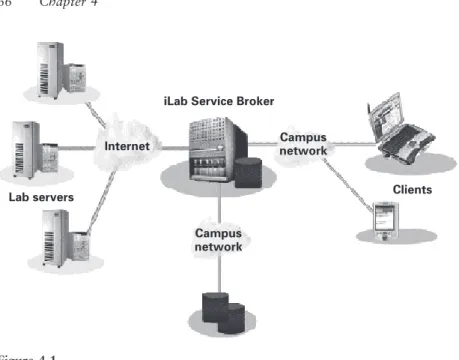
Where Stuart Lee describes the propping open of electronic gates at Oxford, Phil Long and Steve Ehrmann (2008) recount a story of tech-nological openings attempted within another privileged realm: under-graduate engineering education at MIT. To appreciate the iLabs project, it’s useful to notice from the start that a hoped-for goal was to let stu-dents “try out the identity of being a professional.” This conception of learning as identity-building guided the project in ways that might urge us to consider which theoretical perspectives on learning can provide a full account of these lab activities coordinated around research equip-ment. The chapter also invites us to reconsider the taken-for-granted “chalk and talk” arrangements so familiar in traditional higher educa-tion math and science settings. In iLabs, instruments and equipment—
though big and expensive resources used by researchers—are made available to students for extended periods of time. Since instrument time is costly and demand for research access a priority, there might have been little reason or incentive for giving access to undergraduates without the clever economizing made possible by the Web services broker. As the project matured, iLabs activities involved new participation structures and access to partly structured, open-ended inquiry for students. When connected to electronic laboratory tools, the suite of iLabs programs enabled students to encounter problems similar to those typically encoun-tered by expert researchers.
According to the evaluation report conducted by the TLT Group (ref-erenced in the chapter), the analyses were often of the kind researchers typically grapple with: Things just don’t behave as one would expect. Framed in terms of whether access to the tools enabled students to expe-rience authentic engineering practice, the initial phase of iLabs might be classifi ed as offering simply some changes in the what and how, such as the instrumental conditions and handling aspects of the students’ lab activities. Merely giving the students access to these instruments did not represent much of an overall change in their access to joint participation in real laboratory activity, as the disappointing results of the early pen-dulum labs would seem to confi rm.
In fact, a variety of lab procedures were attempted. A tacit model of learning as joint participation seems to have evolved during this project. Assessing the students’ results in these labs was no longer to be consid-ered a separate and fi nal phase. Opportunities for teachers and students to participate together in redesigning and refi ning the lab experiments would seem to constitute a new kind of activity system, especially where taking on the improvements together may have offered students a new perspective on their instructors’ understandings of how to practice science.
Evaluating Open Educational Technology
The kind of detailed retrospective evaluation seen in the iLabs project is exemplary in both depth and methodology. Ed Walker (2008) yearns for a day when open technology projects rise or fall based on this kind of evaluation. For open education technology to succeed, argues Walker,
initiatives cannot be about just making more source code open, but must also concern opening up the evidence of learning progress in the activities the software supports.
A cynic might ask why open educational technology should be held to such lofty standards when for so many years equivalent commercial systems have seemingly not. Though somewhat true, the cynic’s com-plaint misses more subtle implications in Walker’s entreaty. Walker’s chapter touches on areas where open educational technology initiatives need extra care: especially around issues of data collection, or “tactical gathering of data” as he calls it. Here lurks a potential problem in many open technology projects due in part to the way these large-scale, cross-institutional open source development projects are often organized. Many open educational technology projects risk falling short in pro-viding functionality for capturing and monitoring user activity— information that is key to Walker’s metric and method components.
A corollary evaluation problem touched on in Walker’s chapter deserves consideration here. As if all the data-gathering issues were not enough, evaluation of technology innovation in higher education has always faced two other lethal foes: span and scope. Unlike areas of edu-cational research where longitudinal studies are feasible, technology-related evaluation efforts often suffer from acutely small time spans within which to deliver results that will be deemed relevant. Fast devel-opment cycles and short adoption curves make a mockery of many well-intentioned technology investigations. Even when attaining scientifi c rigor and careful deliberation, investigators deliver their results often to fi nd that the particular technologies under study have already become widely adopted or supplanted by something new.
Pursuing a line of inquiry that involves asking what general “effects” a technology has on students’ learning turns out not to be fruitful. A major reason involves the often wildly dramatic differences in study fi ndings across settings. Some researchers will conclude that a given technology has a signifi cant positive effect on learning; others quickly follow with a conclusion exactly opposite. And in between these two shores usually fl ows a river of studies exhibiting what is known as the “no signifi cant difference” phenomenon. As one seasoned evaluator observed, what vexes evaluation efforts usually turns out to be not the technology being studied, but the questions being asked. The kinds of
evaluations that do end up making a useful difference are rarely about universal impacts, but often are about how different adaptations of a technology idea might work in different ways across settings (Ehrmann, 1998).
Visions of a New Learning Ecology
Counterpoised to Walker’s entreaty for rigorous evaluation based on careful assessment is the chapter by Batson, Paharia, and Kumar (2008), who proclaim that the advancement of open education is, if not inevita-ble, so compelling that what is needed now is not more evidence but raised awareness of the “enablers” that can help overcome key remaining institutional “barriers” to progress. Open educational technology’s distinguishing features cluster around aspects of visibility, social interac-tion, shared meaning-making, and unfettered access to resources. Educational activities made possible in open educational environments are characterized by the opportunities for collaborative participation and creative exchange. Freed technologically from resource scarcity around which higher educational institutions have traditionally organized, according to Batson, Paharia, and Kumar, the new era of information abundance requires transformed approaches to teaching and learning.
For Batson, Paharia, and Kumar, a key conceptual shift necessary in realizing the possibilities of open educational technologies is to see how they restore the “social” character of learning that has so often been suppressed in the past. The chapter traces the beginning of this restora-tion back to the rise decades ago of the ability to link students by networked computers. Those early conversations and dialogues over networks, the authors point out, offered a variety of new communicative situations that fell in between speaking and writing—a kind of public “persistent conversation” made possible by a communication medium not readily available in traditional composition classrooms (Bruce, Peyton, and Batson, 1993). As simple as the technology appears to us today, the kinds of visible conversations made possible by these early real-time conferencing programs led to some of the fi rst educational experimentation with open arrangements and collaborative technologies that are commonplace today.
Going further, Batson, Paharia, and Kumar point to another new area of abundance: increased technological connectedness outside the class-room. From these authors’ open learning perspective, paying attention to students’ extracurricular digital practices is not simply about spanning a generation gap. It’s about leaving behind many traditional teaching arrangements in favor of something better. Barriers to teaching and learning innovation can be seen in the traditional assumptions that stu-dents must operate within solitary instructional performances. In other parts of their lives, students participate in networks that promote “remix,” such as imitation, sharing, and collaboration. That issues of authorship and ownership are organized and handled so differently in those many other online settings creates a provocative challenge to con-ventional institutional wisdom, the authors suggest.
Unbound Books vs. Unbound People
This oscillating interest—shifting from how students participate in activ-ities to how pedagogically to structure activactiv-ities—emerges as a key ana-lytical issue for the authors in this section, as they consider how to promote open educational technologies (and plan, design, build, and adopt the information technologies that will support them). Another dimension of the relational character of learning comes into relief in Clifford Lynch’s (2008) critical analysis of the popular proposition about open education: a sort of universal education for all made possible by connecting more and more information resources with more and more people. The views offered in Lee’s, Long and Ehrmann’s, and Kumar’s chapters—of learning being characteristic of a person’s participation in ongoing activity—are brought further into relief by Lynch’s argument that to equate access to information resources and access to education is to miss the fundamentally social character of education.
Echoing the previous chapter’s message that it would be premature to start closing down traditional institutions of higher education just yet, Lynch’s chapter reminds us that teaching and learning are not simply about the transmission of information and acquisition of knowledge. His chapter makes this point in several ways: by emphasizing the social nature of education and by warning against a superfi cial notion of what “social” entails, especially in the context of digital libraries. This chapter
offsets simplistic views of networked information technology as an irresistible change agent in education. Even careful analyses of emerging decentralized social production offer expansive views on the potential transformation of economic and political relations but tend to focus solely on higher education’s role in publishing (Benkler, 2006). As Lynch points out, well-intended plans to expand the reach of university educa-tion often overestimate the value of open Internet technologies in sup-porting “communities” around resources such as digital libraries. While Lynch speculates on how communities might be successfully organized around content-based practice, he also perceives profound changes in education that would need to attend the advent of truly open higher education online.
As with the other chapters in this book, Lynch’s arguments point to the need for more critical understanding of how digital content actually gets taken up and used by people (Brown and Duguid, 2000). What should also be clear by now is that Lynch’s argument is not a call for evaluative studies to measure the impact or general learning outcomes brought about by digital libraries. Thankfully, the literature on educa-tional uses of digital library resources is not strongly characterized by a concern with identifying and measuring general effects produced by the technology. Any such attempt would confront even greater obstacles than those of other open educational technology realms: not only the diffi culty of interpreting across a variety of research designs but also an endless variation in the technologies used.
Productive Consumption
Where other authors write from their particular positions on the open learning stage, Christopher Mackie (2008) offers insights from his per-spective behind the scenes as a grant offi cer for the Mellon Foundation, a major funder of open educational initiatives. Like the others, Mackie wants to see profound change in the traditional institutional culture of higher education. Obviously not willing to settle for piecemeal engineer-ing of teachengineer-ing and learnengineer-ing settengineer-ings, he wants wholesale changes in the way digital technologies and media are produced and consumed in higher education. His alternative and much more ambitious approach to improvement entails a sort of new political economy of open learning.
In Mackie’s view, the culture of universities needs to change fundamen-tally to allow for the kinds of open technology development and resource sharing described by authors in this book.
While the pathways to such change might not be clear, the outcomes of its progress are easier to imagine, as Mackie considers what the changed nature of institutional engagement with making and sharing open educa-tional opportunities could look like. The shift in the locus of software development away from proprietary commercial companies and into loosely organized consortia of higher education institutions, as Mackie sees it, has led to noticeably different processes and results in the produc-tion of community source software. Indeed, most of the software projects featured in this book are more like cathedrals than bazaars, to use Eric Raymond’s metaphor (1999). Unlike the larger open source movement described by Weber, programming here is carried out predominantly by paid staff who work within fairly traditional organizational structures (2004). Behind the community source projects are evolving organizations still experimenting with management structures that might allow them to better coordinate distributed software development.
However, as Mackie points out, many of the same simplicity princi-ples—loose coupling, lightweight data standards, shared code reposito-ries—that make community source projects successful do not apply conveniently when it comes to making and sharing open educational content. How best to cultivate and sustain the production and consump-tion of educaconsump-tional resources on a broad scale has become a major focus of open education advocates, as the chapters in the second section of the book reveal.
Implications
My fi nal purpose in this overview is to suggest some criteria for choosing among theoretical traditions that might help in allowing us to account for the range of design and evaluation issues raised in these chapters. To end by prescribing one particular theory of teaching and learning would, it seems, be contrary to this book’s general theme of openness. So I offer at least two.
In reading these chapters, it is worthwhile to notice how these projects question conventional notions about learning and instruction. From a
comparative point of view, learning to become an engineer or a writer of compositions is not considered here simply as being an effect of, response to, or outcome of instruction per se—whether in a lab, class-room, or online. In these chapters, the units of analysis for teaching and learning extend well beyond instruction of individual students. Instead, the institutional organization of teachers and students coordinated around technology-mediated activity in communities seems to be the preferred norm here.
Two allied viewpoints, social practice theory (Lave and Wenger, 1991) and cultural historical activity theory (Cole, 1996), offer approaches to describing and accounting for many of the interesting observations and questions found in these chapters. By treating teaching and learning as sociocultural processes, both theoretical positions take an interest in learning as being about changing participation in socially situated prac-tices and activities. Being able to account for how and why it is that some formal educational situations can be organized in ways that, oddly enough, appear at times even to militate against learning is another strength of both viewpoints. Both also offer interesting ways of talking about key observations made in several of these chapters: the prevalence of confl ict, problems of access and sequestration, and the formation of learners’ identities (Lave, 1996). And as many chapters in this book indicate, overcoming institutional and cultural barriers requires much more than technology solutions; it requires an approach to understand-ing how barriers get socially organized in the fi rst place (Goldman, Chaiklin, and McDermott, 1994).
Our choice of theories to use for the design, study, and evaluation of open education will, as always, make available certain kinds of questions for the asking and certain stories for the telling (Shulman, 2007). For the authors in this section and the book as a whole, the narratives worth telling often unfold from variations on questions like “Who is doing what?” instead of simply “Who knows what?” As raised in several chapters, questions about the long-term trajectory of learners and of the production of their identities open up a line of inquiry that is central to social practice theory and cultural historical activity, as well. And where several chapters turn a critical focus on traditions of resource scarcity— educational haves and have-nots—both theoretical perspectives offer ways of examining institutional policies and arrangements, especially the