THAT
1200, 1203, 1206
Description
The THAT 1200-series InGenius balanced linereceivers overcome a serious limitation of conventional balanced input stages: poor common mode rejection in real-world applications. While conventional input stages measure well in the lab and perform well on paper, they fail to live up to their CMRR specs when fed from even slightly unbalanced source impedances — a common situation in almost any pro sound environment. This is because conventional stages have low common-mode input impedance, which interacts with imbalances in source impedance to unbalance common-mode signals, making them indistin-guishable from desired, balanced signals.
Developed by Bill Whitlock of Jensen Transformers, the patented InGenius input stage uses clever bootstrapping to raise its common-mode input impedance into the meg-ohm range without the noise penalty from the obvious solution of using high-valued resistors. Like transformers, InGenius line receivers maintain their high CMRR over a wide range of source impedance imbalances — even when fed from single-ended sources. But unlike trans-formers, these wide bandwidth solid state de-vices offer dc-coupling, low distortion, and transparent sound in a small package at rea-sonable cost.
FEATURES
·
High CMRR: typ. 90 dB at 60 Hz·
Extremely high common-mode input impedance·
Maintains balance under real-world conditions·
Transformer-like performance in an IC·
Excellent audio performance·
Wide bandwidth: typ. > 22 MHz·
High slew rate: typ. 12 V/us·
Low distortion: typ. 0.0005 % THD·
Low noise: typ. -107 dBu·
Several gains: 0 dB, -3 dB, & -6 dBAPPLICATIONS
·
Balanced Audio Line Receivers
·
Instrumentation Amplifiers
·
Differential Amplifiers
·
Transformer Front-End Replacements
·
ADC Front-Ends
+1
+1
R1 R2
R3 R4
IN-IN+
REF
CM OUT
Vcc Vee Vout
+1
-
+CM IN
Cb
R5 R7
R8
R10
R11 OA1
OA2
OA3 OA4
Part no. THAT1200 THAT1203 THAT1206
R2 , R4 6 kÙ 6 Ù 5 Ù
k k R1 , R3
6 kÙ 6 Ù 7 Ù
k k R7 , R8
24 kÙ 17 Ù 17 Ù
k k R6 , R9
0
7 Ù 7 Ù
k k
24K 24K
24K R6
R9
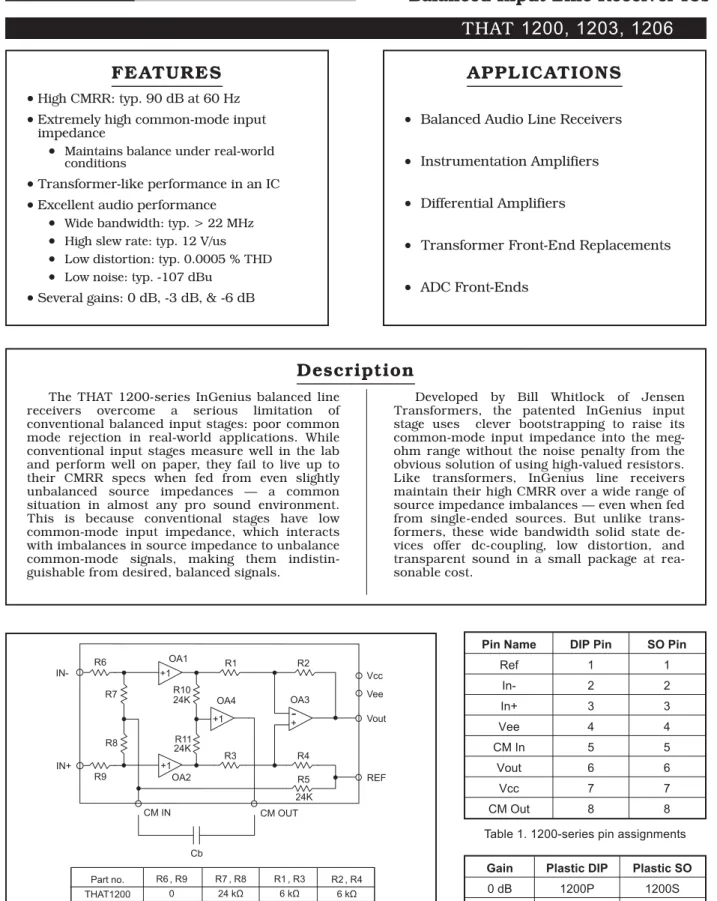
Figure 1. THAT1200-series equivalent circuit diagram
Pin Name DIP Pin SO Pin
Ref 1 1
In- 2 2
In+ 3 3
Vee 4 4
CM In 5 5
Vout 6 6
Vcc 7 7
CM Out 8 8
Table 1. 1200-series pin assignments
Gain Plastic DIP Plastic SO
0 dB 1200P 1200S
-3 dB 1203P 1203S
-6 dB 1206P 1206S
Table 2. Ordering information
Protected under U.S. Patent Numbers, 5,568,561 and 6,160,451. Additional patents pending. InGenius is a registered trademark of THAT Corporation.
Page 2 InGenius High-CMRR Balanced Input Line Receiver ICs
Absolute Maximum Ratings (T
A= 25°C)
Positive Supply Voltage (VCC) +20 V Negative Supply Voltage (VEE) -20 V Storage Temperature Range (TST) -40 to +125°C Output Short-Circuit Duration (tSH) Continuous
θJa PDIP Pkg 86°C/W
θJa SO Pkg 104°C/W
Operating Temperature Range (TOP) 0 to +85°C
Junction Temperature (TJ) 125°C
THAT1200 THAT1203 THAT1206
Input Voltage (VIN) ±25 V ± 31 V ± 31 V
Electrical Characteristics
2 , 3 , 4Parameter Symbol Conditions Min Typ Max Units
Supply Current ICC No signal — 4.7 8.0 mA
Supply Voltage VCC, VEE ±3 ±18 V
Input Bias Current IB No signal; Either input — 700 1,400 nA
connected to GND
Input Offset Current IB-OFF No signal — — ±300 nA
Input Voltage Range VIN-CM Common mode ±12.5 ±13.0 — V
VIN-DIFF Differential (equal and opposite swing)
THAT 1200 21.0 21.5 — dBu
THAT 1203 24.0 24.5 — dBu
THAT 1206 24.0 24.5 — dBu
Input Impedance ZIN-DIFF Differential 48.0 kΩ
ZIN-CM Common mode with bootstrap
60 Hz 10.0 MΩ
20 kHz 3.2 MΩ
Common Mode Rejection Ratio CMRR1 Matched source impedances; VCM= ±10V
DC 70 90 — dB
60 Hz 70 90 — dB
20 kHz — 85 — dB
Common Mode Rejection Ratio5CMRRIEC 10Ωunmatched source impedances; VCM= ±10V
DC — 90 — dB
60 Hz — 90 — dB
20 kHz — 85 — dB
Common Mode Rejection Ratio CMRR2 600Ωunmatched source impedances; VCM= ±10V
60 Hz — 70 — dB
20 kHz — 65 — dB
Power Supply Rejection Ratio6 PSRR At 60 Hz, with VCC= -VEE
THAT1200 — 82 — dB
THAT1203 — 80 — dB
THAT1206 — 80 — dB
SPECIFICATIONS
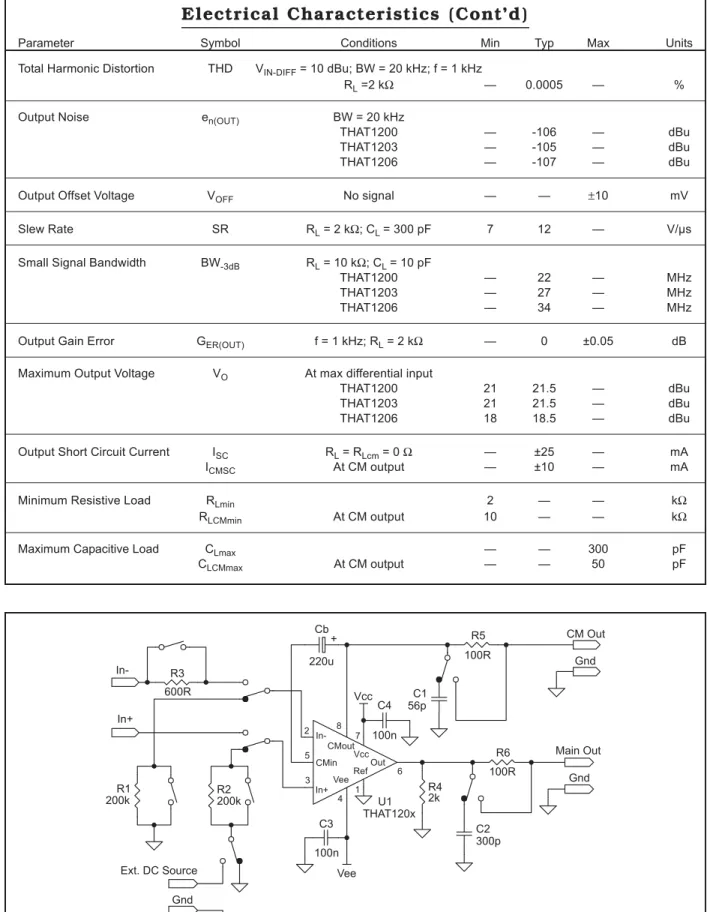
11. All specifications are subject to change without notice. 2. Unless otherwise noted, TA=25°C, VCC= +15V, VEE= -15V
3. See test circuit in Figure 2. 4. 0 dBu = 0.775Vrms.
5. Per IEC Standard 60268-3 for testing CMRR of balanced inputs.
Electrical Characteristics (Cont’d)
Parameter Symbol Conditions Min Typ Max Units
Total Harmonic Distortion THD VIN-DIFF= 10 dBu; BW = 20 kHz; f = 1 kHz
RL=2 kΩ — 0.0005 — %
Output Noise en(OUT) BW = 20 kHz
THAT1200 — -106 — dBu
THAT1203 — -105 — dBu
THAT1206 — -107 — dBu
Output Offset Voltage VOFF No signal — — ±10 mV
Slew Rate SR RL= 2 kΩ; CL= 300 pF 7 12 — V/µs
Small Signal Bandwidth BW-3dB RL= 10 kΩ; CL= 10 pF
THAT1200 — 22 — MHz
THAT1203 — 27 — MHz
THAT1206 — 34 — MHz
Output Gain Error GER(OUT) f = 1 kHz; RL= 2 kΩ — 0 ±0.05 dB
Maximum Output Voltage VO At max differential input
THAT1200 21 21.5 — dBu
THAT1203 21 21.5 — dBu
THAT1206 18 18.5 — dBu
Output Short Circuit Current ISC RL= RLcm= 0Ω — ±25 — mA
ICMSC At CM output — ±10 — mA
Minimum Resistive Load RLmin 2 — — kΩ
RLCMmin At CM output 10 — — kΩ
Maximum Capacitive Load CLmax — — 300 pF
CLCMmax At CM output — — 50 pF
1 In-2
In+ 3
CMin 5
4 8
7 Out
6 U1 THAT120x Cb
220u
C1 56p
C2 300p C3
100n
C4
100n
R1 200k
R2 200k R3
600R
R4 2k
R5 100R
R6 100R Vcc
Vee
In-In+
Ext. DC Source
CM Out
Main Out
Gnd Gnd
Gnd
CMout Vcc Ref Vee +
Theory of Operation
The InGenius concept was invented to overcomelimitations of traditional approaches to active input stage design. Because of the many misconceptions about the performance of conventional input stages, and to set the stage for discussion of InGenius, we will begin by discussing conventional approaches.
Traditional Balanced Input Stages
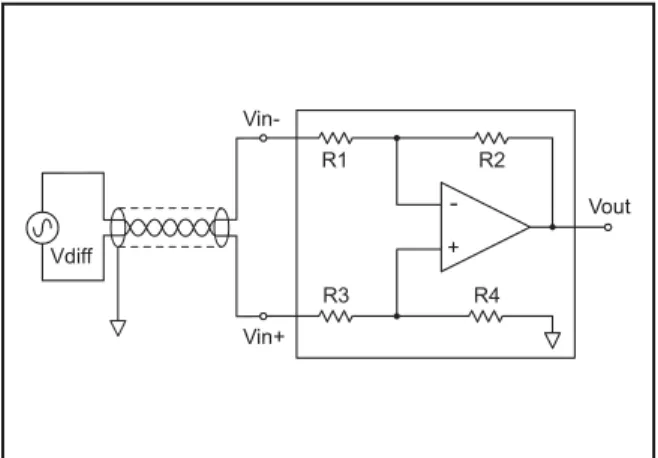
The typical balanced input stage used in most professional audio products is shown in figure 3. It amplifies differential signals but rejects com-mon-mode interference based on the precision of the match in the ratios R2/R1and R4/R3. In this circuit,
Vout=(Vin+)(1+RR2)(RR+R )+(Vin−)RR 1
4
3 4
2 1
In modern integrated circuits (such as the THAT 1240 series), these resistor ratios are trimmed (usu-ally with a laser) to extreme precision, resulting in typical match of ±0.005%. So, one can assume that R2/R1=R4/R3. In this case, we can simplify this
for-mula as follows:
Vout Vin V
R R
R
R in
R R R
R
=( +)( + )( ) + +( −)
( ) 1 2
1 2
1 2
1
2 1
1 1
yielding:
[
]
Vout Vin Vin R R = ( +) (+ −) 2
1
CMRR Depends on Resistor Match
When driven from a theoretical, true voltage source, the precisely matched resistor ratios deliver extremely high CMRR. With perfectly matched resis-tor ratios, for Vin+=-Vin- (this corresponds to a pure
differential input signal), then Vout=2*(Vin+)*R2/R1.
On the other hand, for Vin+=Vin-(this corresponds to
a pure common mode signal), then Vout=0. This
pro-duces an infinite common mode rejection ratio. Any difference between the ratios R2/R1 and R4/R3 will
lead to less than perfect CMRR.
The Impact of Driving Source Impedance
However, in the real world, where sources have non-zero output impedance, the situation is more complicated. Figure 4 shows the equivalent circuit of a real-world differential application. In this case, the source connected to the differential receiver has source impedance of Rs+in the positive side, and R
s-in the negative side. Because these two resistive ele-ments are in series with each other, they only serve to attenuate the signal Vdiff relative to the input
imped-ance of the differential stage. Even if they (Rs+ and Rs-) are mismatched, this attenuation is the only con-sequence of non-zero source impedance.
However, the same cannot be said for com-mon-mode interference. Comcom-mon-mode signals ap-pearinphase between the two input terminals. For in-phase signals, the source impedances can have significant impact. As shown in Figure 5, this is be-cause each leg of the source impedance forms a volt-age divider when it interacts with the input impedance of its respective input of the differential amplifier.
Because the + and - inputs of the operational am-plifier are forced by feedback to maintain the same voltage, the individual common-mode impedances of each side of the differential stage are:
ZCM+=R3+R4; and
ZCM RRR R
−= 3+34 1
.
So long as R1=R3, these impedances, which form a load for common-mode input signals, are identical. (This is why, in discrete applications, it is wise to choose R1=R3, and why, in all integrated applica-tions, these resistors are chosen to be the same value.)
The total common-mode input impedance is
Page 4 InGenius High CMRR-Balanced Input Line Receiver IC
Vdiff +
- Vout
Vin+
Vin-R1 R2
R3 R4
Figure 3. Basic differential amplifier
Rs-Rs+
+
- Vout
Vin+
Vin-R1 R2
R3 R4
Vdiff 2 Vdiff
2 -+
-+
Figure 4. Basic differential amplifier showing mismatched source impedances
ZCM R RR R
= +
+
3 4
3 1 1
.
Source Impedance Mismatches Ruin Good CMRR Even if R1perfectly matches R3, any mismatch in
the source impedances RS+ and RS- will cause the
voltage dividers to be unequal between the two input legs. This means that Vin-and Vin+in Figure 5 are no
longer equal to each other. Essentially, imbalances in the two source impedances convert the common mode signal to a differential signal, which will not be rejected by the input stage no matter how high its theoretical CMRR is.
To see how this plays out in practice, consider the case of a typical unity-gain conventional balanced line receiver with common-mode input impedance of 10 kΩ. In such cases, a source impedance imbalance of only 10 Ω can degrade CMRR to no better than 66 dB. A 10 Ωmismatch could be caused by toler-ances in coupling capacitors or output build-out re-sistors. The situation becomes much worse when a conventional balanced line receiver is driven from an unbalanced source, where it is common to use at least 100 Ωin series with the output for protection. (With a 100Ω unbalanced output impedance, and a 10 kΩ common-mode input impedance, even a per-fect simple input stage can provide no more than 46 dB CMRR!)
The best solution to this problem is to increase the line receiver's common-mode input impedance enough to minimize the unbalancing effect of the volt-age divider. Preferably, this means achieving input impedances on the order of several megohms. How-ever, in a conventional differential amplifier, this re-quires high-value resistances in the circuit. High resistance carries with it a high noise penalty, making this straightforward approach impractical for quality audio devices.
Instrumentation Amplifiers
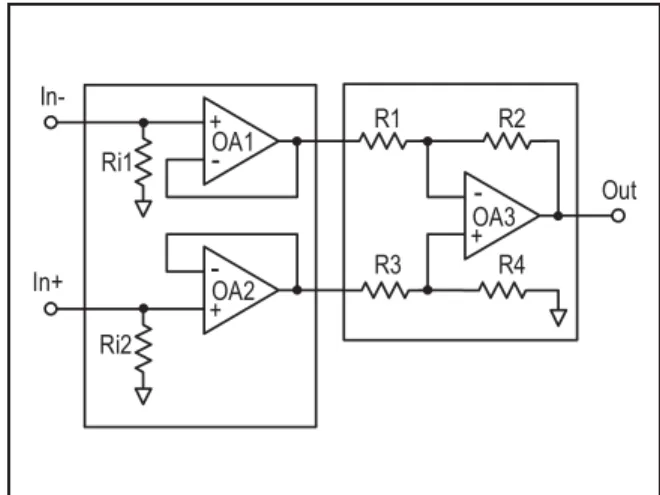
Some designers prefer the more elaborate ap-proach of an instrumentation amplifier, as shown in Figure 6. In this circuit, it is possible to raise the
in-put impedance (both common-mode and differential) of the stage because the load seen by the source is decoupled by OA1 and OA2 from the balanced stage (OA3 along with R1, R2, R3, and R4). In this circuit, ZCM- = Ri1, and ZCM+= Ri2.
To retain 90 dB CMRR in the face of a 10Ω mis-match in source impedance would require Ri1 and Ri2to be > 317 kΩ. Of course, any difference in the
values of Ri1and Ri2themselves would further
unbal-ance common mode signals as well, so these resis-tors would ideally be trimmed just like the resisresis-tors in the single opamp stage of Figure 3. Unfortunately for this approach, it is difficult and expensive to make precision trimmed resistors with such high val-ues.
Furthermore, since the input bias current for am-plifiers OA1 and OA2 flows through these resistors, their input currents must be extremely low if they are not to cause significant offsets. Practically, this neces-sitates using FET input stages for OA1 and OA2. While FETs may be a viable alternative, it is difficult to achieve with them the low noise performance of modern bipolar input stages.
Transformer Input Stages
From the point of view of common mode input impedance, as well as that of electrical isolation, a transformer in front of the first active input stage is really the best possible solution. Transformers are the only approach of which we are aware that pro-vides true electrical isolation with reasonable fidelity. Furthermore, their common-mode input impedance is easily extremely high (tens of Megohms), and al-most completely decoupled from their differential in-put impedance.
But, transformers have many other limitations. They do not offer dc coupling, and suffer from satu-ration at low frequencies unless they are physically large and carefully made. Again, unless they are carefully made (which usually equates to high cost), they introduce phase shift at high audio-band fre-quencies. Furthermore, they tend to be big and heavy and pick up external magnetic fields,
some-Vcm
Rs-Rs+
Zcm-Zcm+
Zcm +
- Vout
Vin+
Vin-R1 R2
R3 R4
Figure 5. Basic differential amplifier driven by common-mode input signal
Out
In-In+
+
-+
-+
-
OA1OA2
OA3 Ri1
Ri2
R1 R2
R3 R4
times making it difficult to locate transformer-cou-pled equipment to avoid interference.
Fortunately, audio equipment usually does not re-quire true electrical isolation. In most cases, trans-formers out-perform conventional input stages only because they excel at rejecting common-mode signals in real-world situations. It is no coincidence that the InGenius concept was developed by an individual re-sponsible for manufacturing the world's premier line of audio transformers (Bill Whitlock, of Jensen Transformers). Bill's InGenius technology offers all the advantages of solid state input stages, including dc coupling, negligible phase shift from dc to beyond the edge of the audio band, and vanishingly low dis-tortion, along with the primary advantage of a trans-former: extremely high common-mode input impedance.
The InGenius Approach
The InGenius approach to balanced line receivers uses bootstrapping to increase common mode input impedance. With bootstrapping, we first create a rep-lica of the common mode signal, and then feed it back appropriately to the inputs to increase the input impedance. Because doing this in a differential amplifier involves additional complications, it is use-ful to review the bootstrap concept with a sin-gle-ended design first. We will then show how Bill Whitlock applied that concept to the differential case. Bootstrapping: a Simple Single-Ended Example
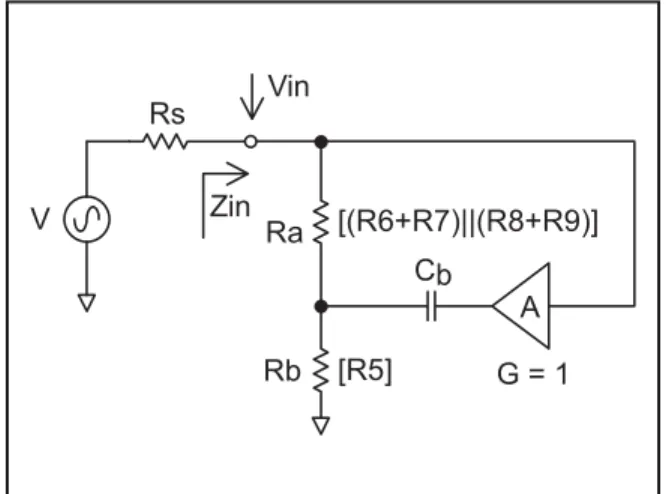
To illustrate the concept behind bootstrapping, consider the the single-ended bootstrap shown in Figure 7. In this circuit, amplifier A is configured for unity gain, and can be considered to have infinite in-put impedance. Capacitor Cb blocks DC, so at DC,
the input impedance, Zin, is Ra+Rb.
However, for high-frequency AC signals (where Cb is effectively a short), amplifier A drives the junction of Raand Rbthrough Cb to nearly the same AC volt-age as Vin. As a result, practically no AC current flows through Ra. This effectively increases the input impedance seen at Zin.
The cutoff frequency of the filter formed by Cb and Ra/Rbis determined primarily by the values of Cb and Rb. (Because so little current flows in Ra, it is hardly involved in this filter.)
Input impedance Zin; at frequency f, is described
the following equation:
Zin Ra Rb G
f f n
f fD
= + +
+ −
( )
( )
( ) ( )
1 1 1
2
2 2
where
fn
C
R a Rb R a Rb b
= ⋅
+ ⋅
1
2π( )
f =D R C b b
1 2π
For example, if Raand Rbare 10 kΩeach, ZinDCis
20 kΩ. This resistance provides a DC path for am-plifier bias current. At higher frequencies, the boot-strap greatly increases the input impedance, limited ultimately by how close gain G approaches unity.
Common Mode Bootstrapping in an
Instrumentation Amplifier = InGenius
The genius behind Bill Whitlock's invention was to recognize that in an instrumentation amplifier, it is possible bootstrap the common-mode signal to in-crease common-mode input impedance. This is the concept behind the InGenius patents. To see how this works, refer to the circuit of Figure 8.
Like Figure 1, Figure 8 shows an equivalent cir-cuit for the THAT 1200-series ICs. OA1 and OA2 are high input-impedance, unity-gain buffers feeding dif-ferential amplifier OA3 in an instrumentation ampli-fier configuration. OA4 is a third high input-impedance, unity-gain buffer. With R10 = R11, the voltage at the input to OA4 will be equal to the common-mode component of the input signal. OA4 buffers this signal, and feeds it back to both inputs via capacitor Cband resistors R6, R7, R8, R9, and R5. Note that in most applications Cbis large (>100µf).
Page 6 InGenius High-CMRR Balanced Input Line Receiver ICs
Ra
Rb
G = 1
Cb
A
[R5]
[(R6+R7)||(R8+R9)]
Zin
Rs
V
Vin
Figure 7. Single-ended bootstrap topology
+1
+1
R1 R2
R3 R4
IN-IN+ REF
CM OUT
Vout
+1 -+
CM IN
Cb
R5 R7
R8
R10
R11 OA1
OA2
OA3 OA4
24K 24K
24K R6
R9
Similarly to the single-ended application above, at high frequencies, the junction of R7, R8, and R5 is driven through Cb to the same potential as the com-mon-mode input voltage. Hence at high frequencies, no common-mode current flows in resistors R6 and R7, or R8and R9. Since OA1and OA2have high input impedances, this effectively raises the input imped-ance seen at In+ and In- to high-frequency com-mon-mode signals. Of course, for differential signals, the input impedance is (R6+R7+R8+R9). And, at DC, the common-mode input impedance is:
Z R R R R
R R R R R
CM DC=
+ +
+ + + +
( 6 7)( 8 9)
6 7 8 9
5.
DC bias for OA1 and OA2is supplied through R5 and either R7or R8.
For the resistor values chosen for the 1200-series ICs, the input impedances ZCM and Zdiff, are de-scribed by the following equations:
ZCM DC=36kΩ
ZCM f k C f
C f
b
b
( ) ( )
( . )
=36 1 50240++ ⋅⋅ ⋅⋅ 1 73 8
2 2
Ω ; where f is the
in-put frequency,
Zdiff =R6+R7+R8+R9=48kΩ
In order to get the most out of this topology, OA1 and OA2 must have high input impedance, and the common-mode gain loop (OA1, OA2, R10/R11and OA4) must have precisely unity gain over the entire audio band. THAT Corporation integrated the InGenius parts in our complimentary dielectric isolation pro-cess because it offers very high bandwidth and low
noise for relatively high-voltage applications like this one. This in turn makes it easier to meet these re-quirements, and typically, results in a maximum mid-audio-band ZinCMof > 20 MΩ.
Because OA1 and OA2 isolate the differential am-plifier (OA3) from the effects of external source im-pedances, the CMRR of OA3 and its associated four resistors is determined solely by OA3's bandwidth and the precision of the resistor matching. Our com-plimentary DI process contributes to high bandwidth in OA3, and we use on-chip laser trimming to ensure extremely good matching, as well as precise gain, in those four thin-film resistors.
Finally, perhaps the most common interfering sig-nals that a good differential line receiver must reject is the power-line frequency: usually either 50 or 60 Hz and its harmonics. So, it is essential that the common-mode input impedance remain high down to 50 Hz, and up to at least to the edge of the audio band. While THAT's process and circuit design en-sure the latter condition, the value of Cb will deter-mine how low in frequency the common-mode input impedance will be increased. To maintain at least a 1 MΩcommon-mode input impedance, Cbshould be
at least 10µf.
It is possible to solve the above equation for Cbin terms of the desired ZCM for a specific frequency. However, reaching a general closed-form solution is difficult and results in a very complex formula. The relatively simple formula below takes advantage of some approximation, and yields good results for ZCM between about 100 kΩand 10 MΩ.
Cb≅0 553 10. × −3ZCMf
For additional information refer to:
Balanced Lines in Audio Systems - Fact, Fiction, and Transformers, by Bill Whitlock, AES 97th Convention, Preprint 3917, October 1994
A New Balanced Audio Input Circuit for Maximum Common-mode Rejection in Real-world Environments, by Bill Whitlock, AES 101st Convention Preprint 4372, 1996.
Common-Mode to Differential-Mode Conversion in Shielded Twisted-pair Cables (Shield-Current-Induced Noise), by Jim Brown & Bill Whitlock, AES 114th Convention, Preprint 5747, February 2003
Applications
Basic Application
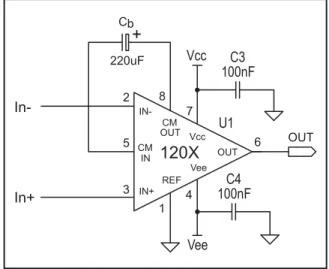
At its most basic, THAT’s 1200-series ICs need very little external support circuitry. As is shown in the basic application circuit of Figure 9, they need lit-tle else beyond positive and negative power supplies, a ground reference, the common-mode bootstrap ca-pacitor, and input and output connections. Because all 1200-series ICs are wide bandwidth parts, it is important to provide bypass capacitors for both posi-tive and negaposi-tive supply rails within an inch or so of the part. Sharing supply bypass capacitors across several 1200-series ICs separated by several inches on a circuit board (as, for example, along the back panel of a multi-input product) is not recom-mended1.
Bootstrap Capacitor Polarity
Because the bootstrap capacitor, Cb, will usually
be large (see formula on page 7) an electrolytic or tantalum capacitor is a logical choice. Such capaci-tors are normally polarized, though non-polarized types are available at higher cost. For the 1200-series, a polarized capacitor is appropriate, with the positive end towards CMout(pin 8), because
of the direction of the input bias currents for internal opamps OA1 and OA2. Furthermore, because Cb
never has much voltage across it2, it only needs to support a few tens of mV. Therefore, we recommend a 220 uF, 3V capacitor for Cb.
RFI Protection
3As an input stage, the 1200-series ICs are suscep-tible to RF interference (RFI). Like most semiconduc-tor devices, if high levels of RF are permitted at the input pins of 1200-series parts, they may become nonlinear, which can create audible interference. Therefore, it is good design practice to filter un-wanted high frequencies at the input of any product in which the 1200-series is used. The objective should be to prevent RF from entering the chassis, and especially, the circuit board of any devices using a 1200-series part. Generally, this is done by means of small capacitors connected between the signal in-puts and chassis ground, with the capacitors located as physically close to the input connectors as possi-ble.
Figure 10 shows a basic, simple application cir-cuit to protect the 1200 series against RFI. For many non-demanding applications, this simple circuit will suffice. C1and C2provide RF bypassing from pins 2 and 3 of the input XLR connector to chassis ground and the XLR connector's shell (which are tied to-gether, ideally only at the XLR connector jack). RF picked up on the cable plugged into the connector is conducted by C1and C2 to chassis ground. Chassis ground should connect to circuit ground through one (and only one) low inductance path, usually at the power supply connector.
Page 8 InGenius High-CMRR Balanced Input Line Receiver ICs
U1
Vcc
Vee
C4
100nF
C3
100nF
In-In+
5 IN-2
IN+ 3
8
4 1
7
6 OUT CM
IN CM OUT
REF Vcc Vee Cb
220uF
OUT
+
120X
Figure 9. Basic 1200-series application circuit
U1 Vcc
Vee C4 100nF
C3 100nF
5
IN-2
IN+
3 8
4 1
7
6
OUT CM
IN CM OUT
REF Vcc
Vee
Cb 220uF
5 423 1 2
31
J1 XLR-F
OUT
C2 100pF NPO C1 100pF NPO
+
120X
Figure 10. THAT1200 application with simple RFI protection
1Lack of proper bypassing may not cause obvious problems at normal temperatures. We have seen cases in which improperly bypassed parts begin
to draw excessive current when operated near their upper temperature limits. Close bypassing prevents this phenomenon.
2Even at DC, C
bwill not see much voltage, because the signal at the junction of R7and R8should closely equal the signal at the junction of R10and
R11. With OA4configured for unity gain, both ends of Cbsee the same signal - AC and DC - except for offsets.
3Good practice to protect inputs against RFI is a science in itself, and it is beyond the scope of this data sheet to provide more than a glimpse of this
complex subject. We refer the interested reader to:
Considerations in Grounding and Shielding Audio Devices, by Stephan R. Macatee, JAES Volume 43, Number 6, pp.472-483; June 1995; Noise Susceptibility in Analog and Digital Signal Processing Systems, by Neil A. Muncy, AES 97th Convention Preprint 3930, October 1996.
The one drawback to this circuit is that C1and C2 will reduce the common-mode input impedance of the 1200 stage to ~ 80 kΩat 20 kHz. Of course, this figure drops by a factor of ten for each decade in-crease in frequency. Additionally, any mismatch be-tween these capacitors can unbalance an interfering common-mode signal, thus making it impossible for the 1200 to reject it.
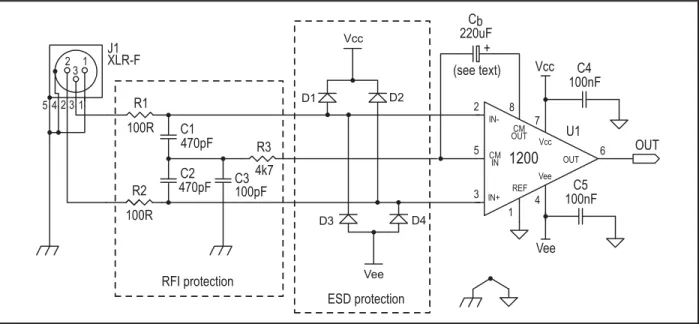
Figure 11 shows a more elaborate and robust cir-cuit for RFI protection. While more complex, it offers many improvements over the circuit of Figure 10 that make it worth serious consideration. First, C1and C2 are larger than their counterparts in Figure 10. Be-cause they are in series with each other, they act as a 235 pf capacitor across pins 2 and 3 of the XLR. This allows them to be effective at lower frequencies. Second, because their center point ties to chassis ground through a smaller, common capacitor (C3, 100 pf), any mismatch in their values has less ten-dency to unbalance common-mode signals compared to the circuit of figure 104. Third, because they are driven from the common-mode bootstrap circuit through R3, this common point gains the benefit of the InGenius common-mode bootstrapping. Finally, R1 and R2 provide some additional buildout imped-ance against which the bypass capacitors can work, making the entire network more effective against strong RF signals.
ESD Protection
All the 1200-series ICs contain internal over-voltage protection circuitry for the two input pins. Figure 12 is an equivalent circuit of this cir-cuitry.
These internal diodes provide modest protection against common low-voltage ESD incidents. How-ever, because these ICs are intended to be connected directly to the input connectors of electronic
products, they may be exposed to unpredictable and possibly extreme ESD. For ESD to affect the InGenius operation, it would have to be conducted via one of the input connectors to the device itself. This is unlikely, but certainly not impossible. Not surprisingly, THAT's own testing indicates that re-peated exposure to high levels (above 1 kV) of ESD through pins 2 and/or 3 of the input XLR connector can adversely affect the device's CMRR, and may cause failure if the ESD reaches sufficiently high lev-els.
If the application requires surviving such ESD in-cidents, THAT recommends the circuit of either Fig-ure 13 or 14. FigFig-ure 13 is appropriate for the 1203 and 1206, both of which support input signals that swing higher than the supply rails. This arrangement of signal and Zener diodes permits the maximum al-lowable (audio) input signal to reach the IC's input
5 IN-2
IN+ 3
8
4 1
7
6 OUT CM
IN CM OUT
REF Vcc Vee
U1
R3
4k7
Cb
220uF
C1
470pF
C2
470pF
C3
100pF
R1
R2
5 4 3 12 2
31
J1
XLR-F
Vcc
Vee
OUT
100R
100R
(see text)
+
C5
100nF
C4
100nF
120X
Figure 11. THAT1200 application with recommended RFI protection.
Ra
Rb Rc
Rd Vcc
Vee
Vee IN+
IN-CM IN Vcc
Figure 12. Internal input protection circuitry
pins, but directs high-energy ESD impulses to the rails. So long as the supply rails are adequately de-coupled and the diodes themselves are reasonably robust, all but the most drastic ESD events will not affect the 1203/6 IC itself. Figure 14, which works similarly, is appropriate for the 1200, which is lim-ited to input signals up to about the supply rails.
D1 through D4 in figures 13 and 14 can be 1N4148 types, while the 12V Zener diodes should be ½ watt to allow them to support relatively high cur-rents with 12V across them for the short duration of an ESD pulse.
We will continue to work to find real world solu-tions to the often difficult problem of ESD protection.
Please look to our web site for future application notes regarding this subject.
Note that we know of no circuit that will protect against really strong ESD, such as lightning, so please do not take this advice as suggesting that the circuits of Figures 13 and 14 are completely immune to ESD!
AC Coupling Inputs
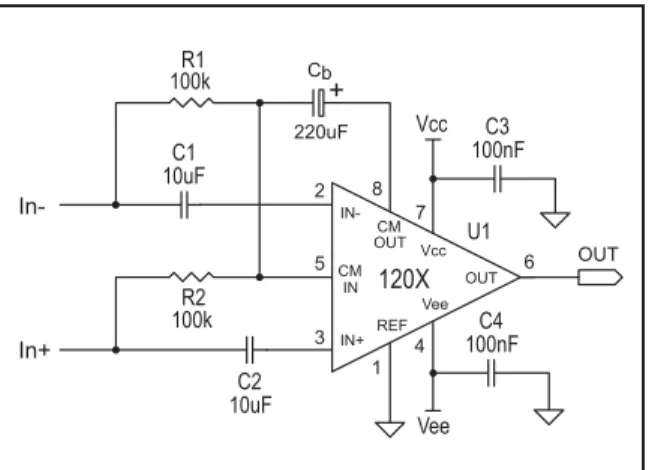
It is not necessary to AC couple the 1200-series inputs. However, if desired, we recommend the cir-cuit of Figure 15. In this circir-cuit Resistors R1and R2 benefit from the common-mode bootstrap via their connection to CMin. This reduces their impact on common-mode input impedance, preserving the
ben-Page 10 InGenius High-CMRR Balanced Input Line Receiver ICs
Vcc
Vee D5 12V
D6 12V
D2 D1
D4 D3
5 IN-2
IN+ 3
8
4 1
7
6 OUT CM
IN CM OUT
REF Vcc
Vee
U1 R3
4k7
Cb 220uF
C1 470pF C2
470pF C3100pF R1
R2
5 4 3 12 2
31
J1
XLR-F Vcc
Vee
OUT 100R
100R
(see text)
RFI protection
+
C5 100nF
C4 100nF
1203 or 1206
ESD protection
Figure 13. RFI and ESD protection for the 1203 and 1206
Vcc
Vee D2 D1
D4 D3
5
IN-2
IN+
3 8
4 1
7
6
OUT CM
IN CM OUT
REF Vcc
Vee
U1 R3
4k7
Cb 220uF
C1 470pF C2
470pF C3100pF R1
R2
5 4 3 12 2
31
J1
XLR-F Vcc
Vee
OUT 100R
100R
(see text)
RFI protection
+
C5 100nF
C4 100nF
ESD protection
1200
efit of InGenius, while providing a discharge path for charge in the input coupling capacitor. Choose capac-itors large enough to present minimal impedance to the lowest signals of interest, compared to the differ-ential input impedance of the InGenius IC (48 kΩ). If desired, this may be combined with the RF protec-tion of Figures 10 or 11, and ESD protecprotec-tion of fig-ures 13 or 14.
Dual Layout Option
InGenius ICs are available only from THAT Cor-poration. Should a manufacturer wish to provide some alternatives to the 1200 series, it is possible to lay out the circuit board for a 1200 such that a THAT 1240-series (conventional) balanced input stage could be substituted in a pinch. Since the 1240
se-ries is pin-compatible with similar parts available from other manufacturers, this offers the possibility of several reduced-performance second sources if 1200-series ICs were for unavailable for any reason.
The PCB layout shown in Figure 16 provide man-ufacturers with the option to load a PCB with either of these input stages. Note that these figures are not to scale. The interconnects should be as short as practical, constrained only by component size and relevant manufacturing considerations.
When a THAT 1200-series IC is installed, capaci-tor Cbis connected between CMinand CMout. No
con-nection is made between Vout and CMin. When the
THAT 1240-series is used, capacitor Cb is removed,
and a jumper connects the Voutand Sense pins.
U1 Vcc
Vee C4 100nF
C3 100nF
In-In+
C1 10uF
R1 100k
C2 10uF
5 IN-2
IN+ 3
8
4 1
7
6 OUT CM
IN CM OUT
REF Vcc
Vee Cb
220uF
OUT +
120X
R2 100k
Figure 15. AC coupling 1200-series inputs
Vcc Gnd
In-In+
Vee
CM out or N/C Vcc Vout CM in or Sense
Short only for THAT1240-series Ref
In-In+ Vee
Cb THAT1200-series
or THAT1240-series
+
load only for THAT1200-series
Figure 16. Dual PCB layout for THAT120X and THAT124X
Information furnished by THAT Corporation is believed to be accurate and reliable. However no responsibil-ity is assumed by THAT Corporation for its use nor for any infringements of patents or other rights of third par-ties which may result from its use.
LIFE SUPPORT POLICY
THAT Corporation products are not designed for use in life support equipment where malfunction of such products can reasonably be expected to result in personal injury or death. The buyer uses or sells such prod-ucts for life suport application at the buyer’s own risk and agrees to hold harmless THAT Corporation from all damages, claims, suits or expense resulting from such use.
CAUTION: THIS IS AN ESD (ELECTROSTATIC DISCHARGE) SENSITIVE DEVICE.
It can be damaged by the currents generated by electrostatic discharge. Static charge and therefore danger-ous voltages can accumulate and discharge without detection causing a loss of function or performance to occur. Use ESD preventative measures when storing and handling this device. Unused devices should be stored in conductive packaging. Packaging should be discharged before the devices are removed. ESD damage can occur to these devices even after they are installed in a board-level assembly. Circuits should include specific and ap-propriate ESD protection.
Package and Soldering Information
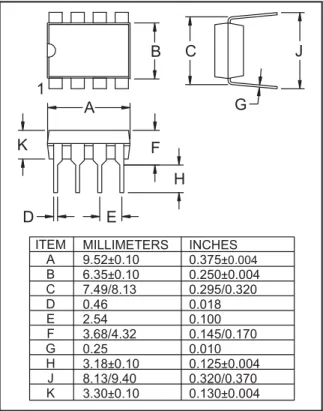
The THAT 1200 series is available in both 8-pinmini-DIP and 8-pin SOIC packages. The package di-mensions are shown in Figures 17 and 18 below, while pinouts are given in Table 1 on page 1.
The 1200 series is available only in lead-free, "green" packages (both SO and DIP). The lead frames are copper, plated with successive layers of nickel paladium, and gold. This approach makes it possible to solder these devices using lead-free and
lead-bearing solders. The plastic mold compound contains no hazardous substances as specified in the RoHS directive.
The surface-mount package has been qualified using reflow temperatures as high as 260°C for 10 seconds. This makes them suitable for use in a 100% tin solder process. Furthermore, the 1200 series has been qualified to a JEDEC moisture sensitivity level of MSL1. No special humidity precautions are re-quired prior to flow soldering the parts.
The through-hole package leads can be subjected to a soldering temperature of 300 °C for up to 10 sec-onds.
Page 12 InGenius High-CMRR Balanced Input Line Receiver ICs
0.41/0.89 0.31/0.71 H
h
0.016/0.035 0.012/0.027 0.230/0.244
0.007/0.010 0.060/0.068 0.014/0.018 0.188/0.197 0.004/0.008 INCHES
0.150/0.157 G
H F
C B
D
F G D E A a1 B C
ITEM MILLIMETERS
0.36/0.46
0.18/0.25 1.52/1.73 1.27 4.78/5.00 0.10/0.20 3.81/3.99 5.84/6.20
0.050 A
E
a1
0-8°
hx45° 1
Figure 17. -S (SO) version package outline drawing
B
A
K
F
H
E
D
G
J
C
ITEM A B C D E F G H J K
1
MILLIMETERS 9.52 0.10 6.35 0.10 7.49/8.13 0.46 2.54 3.68/4.32 0.25 3.18 0.10 8.13/9.40 3.30 0.10
± ±
±
±
INCHES 0.375 0.250 0.004 0.295/0.320 0.018 0.100 0.145/0.170 0.010 0.125 0.004 0.320/0.370 0.130 0.004
±0.004 ±
±
±