Programme for International Student Assessment
Excellence through Equity
GIvInG EvERy StudEnt thE ChAnCE
to SuCCEEd
Excellence Through Equity
GivinG EvEry StudEnt
thE ChanCE to SuCCEEd
(volumE ii)
note by turkey: the information in this document with reference to “Cyprus” relates to the southern part of the island. there is no single authority representing both turkish and Greek Cypriot people on the island. turkey recognises the turkish republic of northern Cyprus (trnC). until a lasting and equitable solution is found within the context of the united nations, turkey shall preserve its position concerning the “Cyprus issue”.
note by all the European union member States of the oECd and the European union: the republic of Cyprus is recognised by all members of the united nations with the exception of turkey. the information in this document relates to the area under the effective control of the Government of the republic of Cyprus.
the statistical data for israel are supplied by and under the responsibility of the relevant israeli authorities. the use of such data by the oECd is without prejudice to the status of the Golan heights, East Jerusalem and israeli settlements in the West Bank under the terms of international law.
Photo credits:
© Flying Colours ltd /Getty images © Jacobs Stock Photography /Kzenon © khoa vu /Flickr /Getty images © mel Curtis /Corbis
© Shutterstock /Kzenon © Simon Jarratt /Corbis
Corrigenda to oECd publications may be found on line at: www.oecd.org/publishing/corrigenda. © oECd 2013
you can copy, download or print oECd content for your own use, and you can include excerpts from oECd publications, databases and multimedia products in your own documents, presentations, blogs, websites and teaching materials, provided that suitable acknowledgement of oECd as source and copyright owner is given. all requests for public or commercial use and translation rights should be submitted to [email protected]. requests for permission to photocopy portions of this material for public or commercial use shall be addressed directly to the Copyright Clearance Center (CCC) at [email protected] or the Centre français d’exploitation du droit de copie (CFC) at [email protected].
sovereignty over any territory, to the delimitation of international frontiers and boundaries and to the name of any territory, city or area.
Please cite this publication as:
oECd (2013), PISA 2012 Results: Excellence Through Equity: Giving Every Student the Chance to Succeed
(Volume II), PiSa, oECd Publishing. http://dx.doi.org/10.1787/9789264201132-en
iSBn 978-92-64-20112-5 (print) iSBn 978-92-64-20113-2 (PdF)
Equipping citizens with the skills necessary to achieve their full potential, participate in an increasingly interconnected global economy, and ultimately convert better jobs into better lives is a central preoccupation of policy makers around the world. Results from the OECD’s recent Survey of Adult Skills show that highly skilled adults are twice as likely to be employed and almost three times more likely to earn an above-median salary than poorly skilled adults. In other words, poor skills severely limit people’s access to better-paying and more rewarding jobs. Highly skilled people are also more likely to volunteer, see themselves as actors rather than as objects of political processes, and are more likely to trust others. Fairness, integrity and inclusiveness in public policy thus all hinge on the skills of citizens.
The ongoing economic crisis has only increased the urgency of investing in the acquisition and development of citizens’ skills – both through the education system and in the workplace. At a time when public budgets are tight and there is little room for further monetary and fiscal stimulus, investing in structural reforms to boost productivity, such as education and skills development, is key to future growth. Indeed, investment in these areas is essential to support the recovery, as well as to address long-standing issues such as youth unemployment and gender inequality.
In this context, more and more countries are looking beyond their own borders for evidence of the most successful and efficient policies and practices. Indeed, in a global economy, success is no longer measured against national standards alone, but against the best-performing and most rapidly improving education systems. Over the past decade, the OECD Programme for International Student Assessment, PISA, has become the world’s premier yardstick for evaluating the quality, equity and efficiency of school systems. But the evidence base that PISA has produced goes well beyond statistical benchmarking. By identifying the characteristics of high-performing education systems PISA allows governments and educators to identify effective policies that they can then adapt to their local contexts.
The results from the PISA 2012 assessment, which was conducted at a time when many of the 65 participating countries and economies were grappling with the effects of the crisis, reveal wide differences in education outcomes, both within and across countries. Using the data collected in previous PISA rounds, we have been able to track the evolution of student performance over time and across subjects. Of the 64 countries and economies with comparable data, 40 improved their average performance in at least one subject. Top performers such as Shanghai in China or Singapore were able to further extend their lead, while countries like Brazil, Mexico, Tunisia and Turkey achieved major improvements from previously low levels of performance.
Some education systems have demonstrated that it is possible to secure strong and equitable learning outcomes at the same time as achieving rapid improvements. Of the 13 countries and economies that significantly improved their mathematics performance between 2003 and 2012, three also show improvements in equity in education during the same period, and another nine improved their performance while maintaining an already high level of equity – proving that countries do not have to sacrifice high performance to achieve equity in education opportunities.
Nonetheless, PISA 2012 results show wide differences between countries in mathematics performance. The equivalent of almost six years of schooling, 245 score points, separates the highest and lowest average performances
within countries is even greater, with over 300 points – the equivalent of more than seven years of schooling – often separating the highest- and the lowest-achieving students in a country. Clearly, all countries and economies have excellent students, but few have enabled all students to excel.
The report also reveals worrying gender differences in students’ attitudes towards mathematics: even when girls perform as well as boys in mathematics, they report less perseverance, less motivation to learn mathematics, less belief in their own mathematics skills, and higher levels of anxiety about mathematics. While the average girl underperforms in mathematics compared with the average boy, the gender gap in favour of boys is even wider among the highest-achieving students. These findings have serious implications not only for higher education, where young women are already under-represented in the science, technology, engineering and mathematics fields of study, but also later on, when these young women enter the labour market. This confirms the findings of the OECD Gender Strategy, which identifies some of the factors that create – and widen – the gender gap in education, labour and entrepreneurship. Supporting girls’ positive attitudes towards and investment in learning mathematics will go a long way towards narrowing this gap.
PISA 2012 also finds that the highest-performing school systems are those that allocate educational resources more equitably among advantaged and disadvantaged schools and that grant more autonomy over curricula and assessments to individual schools. A belief that all students can achieve at a high level and a willingness to engage all stakeholders in education – including students, through such channels as seeking student feedback on teaching practices – are hallmarks of successful school systems.
PISA is not only an accurate indicator of students’ abilities to participate fully in society after compulsory school, but also a powerful tool that countries and economies can use to fine-tune their education policies. There is no single combination of policies and practices that will work for everyone, everywhere. Every country has room for improvement, even the top performers. That’s why the OECD produces this triennial report on the state of education across the globe: to share evidence of the best policies and practices and to offer our timely and targeted support to help countries provide the best education possible for all of their students. With high levels of youth unemployment, rising inequality, a significant gender gap, and an urgent need to boost growth in many countries, we have no time to lose. The OECD stands ready to support policy makers in this challenging and crucial endeavour.
Angel Gurría
This report is the product of a collaborative effort between the countries participating in PISA, the experts and institutions working within the framework of the PISA Consortium, and the OECD Secretariat. The report was drafted by Andreas Schleicher, Francesco Avvisati, Francesca Borgonovi, Miyako Ikeda, Hiromichi Katayama, Flore-Anne Messy, Chiara Monticone, Guillermo Montt, Sophie Vayssettes and Pablo Zoido of the OECD Directorate for Education and Skills and the Directorate for Financial Affairs, with statistical support from Simone Bloem and Giannina Rech and editorial oversight by Marilyn Achiron. Additional analytical and editorial support was provided by Adele Atkinson, Jonas Bertling, Marika Boiron, Célia Braga-Schich, Tracey Burns, Michael Davidson, Cassandra Davis, Elizabeth Del Bourgo, John A. Dossey, Joachim Funke, Samuel Greiff, Tue Halgreen, Ben Jensen, Eckhard Klieme, André Laboul, Henry Levin, Juliette Mendelovits, Tadakazu Miki, Christian Monseur, Simon Normandeau, Mathilde Overduin, Elodie Pools, Dara Ramalingam, William H. Schmidt (whose work was supported by the Thomas J. Alexander fellowship programme), Kaye Stacey, Lazar Stankov, Ross Turner, Elisabeth Villoutreix and Allan Wigfield. The system-level data collection was conducted by the OECD NESLI (INES Network for the Collection and Adjudication of System-Level Descriptive Information on Educational Structures, Policies and Practices) team: Bonifacio Agapin, Estelle Herbaut and Jean Yip. Volume II also draws on the analytic work undertaken by Jaap Scheerens and Douglas Willms in the context of PISA 2000. Administrative support was provided by Claire Chetcuti, Juliet Evans, Jennah Huxley and Diana Tramontano.
The OECD contracted the Australian Council for Educational Research (ACER) to manage the development of the mathematics, problem solving and financial literacy frameworks for PISA 2012. Achieve was also contracted by the OECD to develop the mathematics framework with ACER. The expert group that guided the preparation of the mathematics assessment framework and instruments was chaired by Kaye Stacey; Joachim Funke chaired the expert group that guided the preparation of the problem-solving assessment framework and instruments; and Annamaria Lusardi led the expert group that guided the preparation of the financial literacy assessment framework and instruments. The PISA assessment instruments and the data underlying the report were prepared by the PISA Consortium, under the direction of Raymond Adams at ACER.
The development of the report was steered by the PISA Governing Board, which is chaired by Lorna Bertrand (United Kingdom), with Ben
ő
Csapó (Hungary), Daniel McGrath (United States) and Ryo Watanabe (Japan) as vice chairs. Annex C of the volumes lists the members of the various PISA bodies, as well as the individual experts and consultants who have contributed to this report and to PISA in general.ExEcutivE Summary ...13
rEadEr’S GuidE ...17
What iS PiSa? ...19
ChApter 1 dEfininG and mEaSurinG Equity in Education ...25
how PiSa examines equity in education opportunities ...28
• The quantity and quality of educational resources ...28
• Instructional content and practices ...29
• Combining better performance with greater equity ...29
Examining equity throughout this report ...30
ChApter 2 Equity in outcomES ...33
Performance and socio-economic status across school systems ...34
• Disparities in performance related to socio-economic status ...38
• Resilient students ...40
• Mean performance, after taking account of socio-economic status ...40
• Between-school variation in performance ...44
• Performance differences across schools and socio-economic disparities ...46
Providing access to schooling to all 15-year-olds ...53
trends in equity between PiSa 2003 and PiSa 2012 ...56
• Trends in the profile and distribution of students in schools ...59
ChApter 3 thE challEnGE of divErSity ...63
family structure and student performance ...64
Parents’ job status: targeting education policies through social policy for the unemployed ...66
School location and variation in performance across geographical areas ...69
Equity in outcomes for immigrant students ...71
• The impact of other social policies on the profile of immigrant students ...72
• High levels of performance across a diverse student population ...72
• Higher levels of performance among an increasingly diverse student population ...74
• Language minorities among immigrant students ...79
• First- and second-generation students ...80
• The “late-arrival penalty” ...80
concentration of disadvantage ...82
Performance, immigrant status and country of origin ...84
ChApter 4 Equity in oPPortunitiES to lEarn and in rESourcES ...87
disparities in exposure to formal mathematics, socio-economic status and performance ...90
• Disparities within countries...91
• Differences in exposure to mathematics and average mathematics performance across school systems ...91
• More is not always better ...95
• Challenging school environments ...95
• Learning opportunities outside school and parents’ expectations of schools...95
Opportunities, resources, performance and socio-economic status ...98
Participation in pre-primary education ...99
Chapter 5 POlicy imPlicatiOns Of Equity in EducatiOn ...103
Patterns in the relationship between performance and socio-economic status ...105
a disproportionate number of low-performing students ...111
different slopes and strengths of socio-economic gradients ...111
• Universal policies for countries where performance differences are small and there is a weak relationship between performance and socio-economic status ...112
• Policies that target socio-economic disadvantage for those countries where there are small performance differences and a strong relationship between performance and socio-economic status ...114
• Policies that target both performance and socio-economic disadvantage for countries where there are large performance differences and a strong relationship between performance and socio-economic status ...115
large socio-economic disparities ...117
targeting low-performing and socio-economically disadvantaged schools ...119
targeting students within schools ...122
annex a Pisa 2012 tEchnical backgrOund ...129
annex a1 Construction of mathematics scales and indices from the student, school and parent context questionnaires ...130
annex a2 The PISA target population, the PISA samples and the definition of schools ...146
annex a3 Technical notes on analyses in this volume...158
annex a4 Quality assurance ...162
annex a5 Technical details of trends analyses ...163
annex B Pisa 2012 data ...173
annex b1 Results for countries and economies ...174
annex b2 Results for regions within countries...281
annex b3 List of tables available on line ...324
FIGURES
Map of PISA countries and economies ...20
Figure II.1.1 Likelihood of positive social and economic outcomes among highly literate adults ...26
Figure II.1.2 Student performance and equity ...27
Figure II.2.1 Students’ socio-economic status and performance, OECD countries ...35
Figure II.2.2 Comparing countries’ performance in mathematics and equity in education outcomes ...36
Figure II.2.3 Proportion of the variation in mathematics performance explained by elements of socio-economic status ...39
Figure II.2.4 Percentage of resilient students ...41
Figure II.2.5 Mean mathematics performance, before and after accounting for countries’/ economies’ socio-economic profile ...42
Figure II.2.6 Mean mathematics performance, by national quarter of socio-economic status ...43
Figure II.2.a Mean mathematics performance in countries and regions ...45
Figure II.2.7 Total variation in mathematics performance and variation between and within schools ...47
Figure II.2.8 Performance differences between and within schools explained by students’ and schools’ socio-economic status ...48
Figure II.2.9 Performance differences within and between schools across socio-economic groups ...50
Figure II.2.10 Mathematics performance of students in socio-economically advantaged, average and disadvantaged schools ...51
Figure II.2.11 Distribution of students across school performance and socio-economic profile ...52
Figure II.2.12 Change between 2003 and 2012 in the strength of the socio-economic gradient and annualised mathematics performance ...57
Figure II.2.13 Change between 2003 and 2012 in the slope of the socio-economic gradient and annualised mathematics performance ...58
Figure II.2.14 Change between 2003 and 2012 in student resiliency to socio-economic status ...59
Figure II.2.15 Change between 2003 and 2012 in social inclusion ...60
Figure II.3.1 Difference in mathematics performance, by type of family ...65
Figure II.3.2 Difference in mathematics performance, by parents’ work status ...67
Figure II.3.3 Mean mathematics performance, by school location, after accounting for socio-economic status ...70
Figure II.3.4 Difference in mathematics performance between immigrant and non-immigrant students ...73
Figure II.3.5 Change between 2003 and 2012 in immigrant students’ mathematics performance ...75
Figure II.3.6 Change between 2003 and 2012 in the share of students with an immigrant background...76
Figure II.3.7 Difference in mathematics performance, by immigrant and language background ...79
Figure II.3.8 Percentage of students with mathematics performance below and above the baseline level (Level 2), by immigrant background ...81
Figure II.3.9 Proportion of immigrant students in socio-economically disadvantaged, average and advantaged schools ...83
BOXES Box II.1.1. What do the PISA scores mean? ...28
Box II.2.1. What is socio-economic status and how is it measured? ...37
Box II.2.2. Geographic location, regions and variation in student performance ...44
Box II.2.3. What are the main characteristics of students attending socio-economically advantaged and disadvantaged schools? ...49
Box II.2.4. Improving in PISA: Mexico ...54
Box II.2.5. Comparing indices in PISA 2003 and PISA 2012 ...56
Box II.3.1. Population relevance or attributable risk ...66
Box II.3.2. Improving in PISA: Germany ...76
Box II.3.3. Language minorities among non-immigrant students ...78
Figure II.4.2 Magnitude of performance differences related to students’ exposure to formal mathematics,
by schools’ socio-economic profile ...90
Figure II.4.3 Relationship between mathematics performance and variation in students’ exposure to formal mathematics ...92
Figure II.4.4 Between-school differences in exposure to formal mathematics, socio-economic status and performance...93
Figure II.4.5 Summary of PISA measures of equity in educational resources ...94
Figure II.4.6 Teacher quantity and quality, by schools’ socio-economic profile ...96
Figure II.4.7 Differences in teacher quality explained by students’ and schools’ socio-economic profile ...97
Figure II.4.8 Differences in disciplinary climate, by schools’ socio-economic profile ...97
Figure II.4.9 Differences in disciplinary climate explained by students’ and schools’ socio-economic profile...98
Figure II.4.10 Performance differences related to differences in exposure to formal mathematics to learn and resources ...99
Figure II.4.11 Differences in mathematics performance, by attendance at pre-primary school ...100
Figure II.4.12 Pre-primary school, mathematics performance and students’ socio-economic status ...101
Figure II.5.1a Summary of PISA measures of equity in education ...106
Figure II.5.1b Summary of PISA measures of equity in education (continued) ...107
Figure II.5.2 Relationship between school performance and schools’ socio-economic profile in countries that have large proportions of students performing below Level 2: Indonesia, Kazakhstan, Peru and Tunisia ...112
Figure II.5.3 Relationship between school performance and schools’ socio-economic profile in countries with high performance and flat and weak gradients: Canada and Viet Nam ...113
Figure II.5.4 Relationship between school performance and schools’ socio-economic profile in countries with average or low performance and flat and weak gradients: Brazil, Italy, Mexico and the United States ...114
Figure II.5.5 Relationship between school performance and schools’ socio-economic profile with average or low performance and flat and strong gradients: Chile, Greece, Malaysia and Turkey ...115
Figure II.5.6 Relationship between school performance and schools’ socio-economic profile in countries with high performance and steep and strong gradients: Germany and New Zealand...116
Figure II.5.7 Relationship between school performance and schools’ socio-economic profile in countries with low performance and steep and strong gradients: Hungary, Israel, Singapore and the Slovak Republic ...117
Figure II.5.8 Relationship between school performance and schools’ socio-economic profile in countries with marked socio-economic disparities and average equity in outcomes: Bulgaria, Colombia, Costa Rica and Ireland ...118
Figure II.5.9 Relationship between school performance and schools’ socio-economic profile in countries with high equity but marked socio-economic disparities: Hong Kong-China, Jordan, Qatar and Thailand ...119
Figure II.5.10 Relationship between school performance and schools’ socio-economic profiles in countries with strong between-school gradients: Iceland and Uruguay ...120
Figure II.5.11 Relationship between school performance and schools’ socio-economic profile in countries with weak between-school gradients: Norway and Portugal ...121
Figure II.5.12 Relationship between school performance and schools’ socio-economic profile in countries with marked performance differences within schools: Denmark, Finland, Spain and Switzerland ...122
Figure II.5.13 Relationship between school performance and schools’ socio-economic profile for all other countries and economies ...123
Figure A.3.1 Labels used in a two-way table ...158
Figure A5.1 Annualised change in mathematics performance since PISA 2003 and observed differences in performance between PISA 2012 and PISA 2003 ...169
Figure A5.2 Annualised change in reading performance since PISA 2000 and observed differences in performance between PISA 2012 and PISA 2000 ...169
Figure A5.3 Annualised change in science performance since PISA 2006 and observed differences in performance between PISA 2012 and PISA 2006 ...170
TABLES Table II.A Snapshot of equity in education in PISA 2012 and change since PISA 2003 ...15
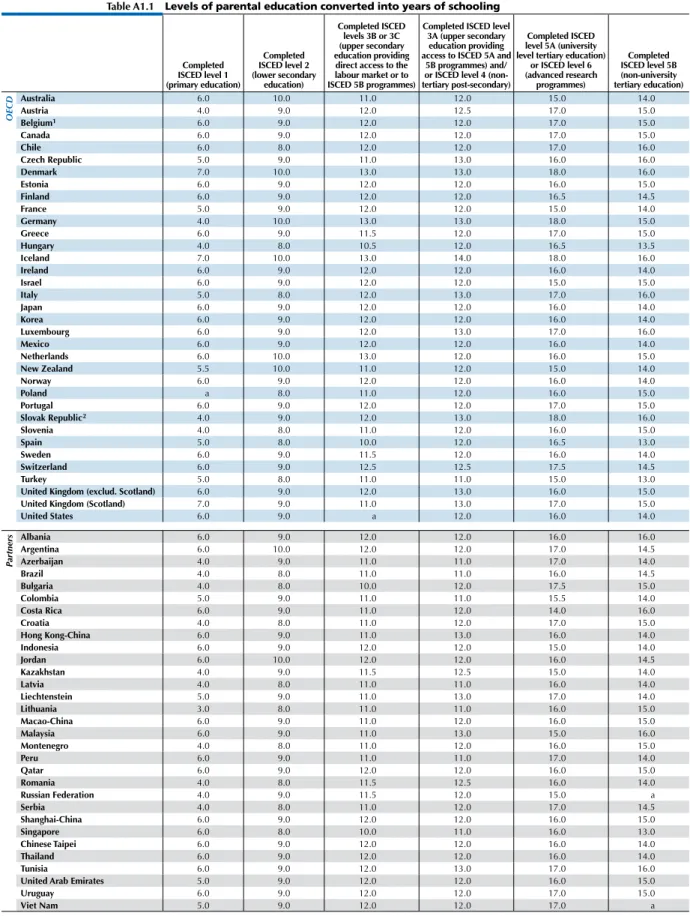
Table A1.1 Levels of parental education converted into years of schooling ...133
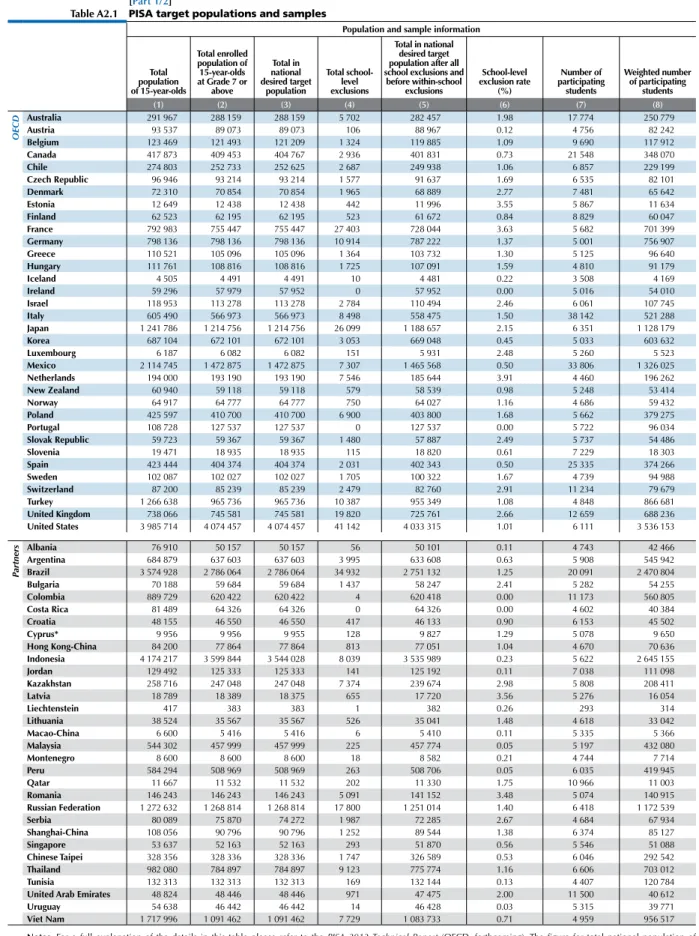
Table A2.1 PISA target populations and samples ...148
Table A2.2 Exclusions ...150
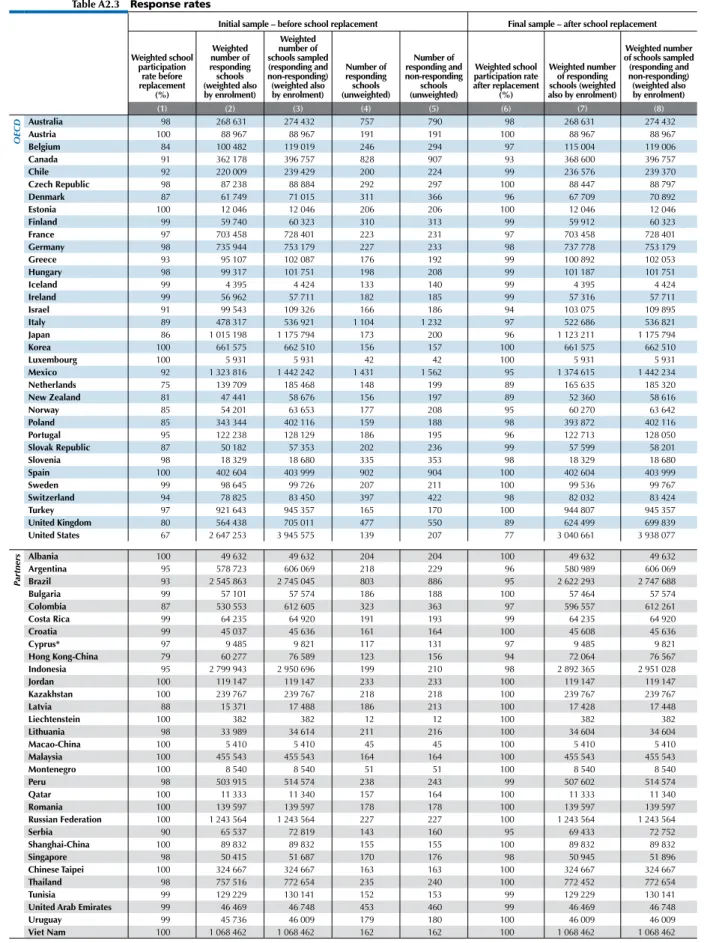
Table A2.3 Response rates ...152
Table A2.4a Percentage of students at each grade level ...155
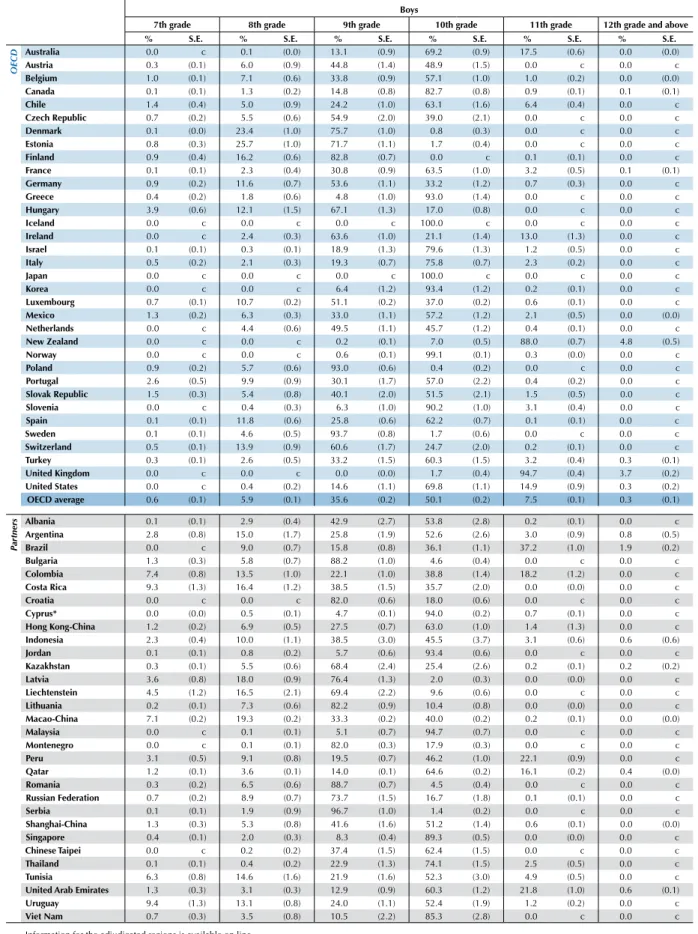
Table A2.4b Percentage of students at each grade level, by gender ...156
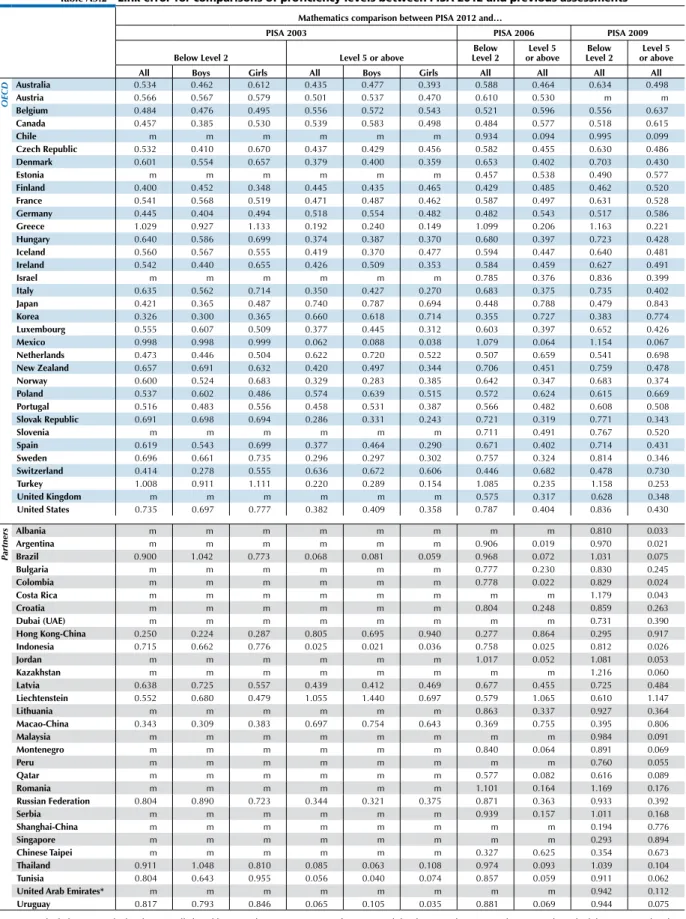
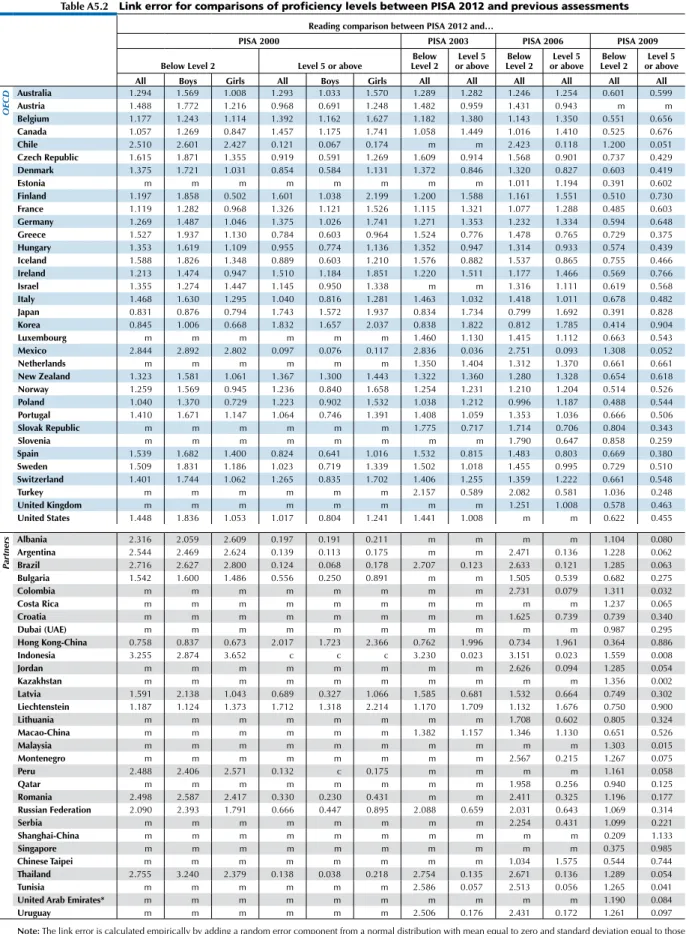
Table A5.1 Link error for comparisons of performance between PISA 2012 and previous assessments ...164
Table A5.2 Link error for comparisons of proficiency levels between PISA 2012 and previous assessments ...165
Table A5.3 Link error for comparisons of annualised and curvilinear change between PISA 2012 and previous assessments ...168
Table II.2.1 Relationship between performance in mathematics, reading and science, and socio-economic status ...174
Table II.2.2 Elements of socio-economic status, by quarters of socio-economic status within countries ...176
Table II.2.3 Elements of socio-economic status across countries ...183
Table II.2.4a Students’ socio-economic status and mathematics performance ...185
Table II.2.4b Change between 2003 and 2012 in students’ socio-economic status and mathematics performance ...186
Table II.2.5 Performance and selected elements of socio-economic status across countries ...189
Table II.2.6 Relationship between mathematics performance and elements of socio-economic status ...193
Table II.2.7a Percentage of resilient students and low-achievers among disadvantaged students, by gender ...194
Table II.2.7b Change between 2003 and 2012 in the percentage of resilient students among disadvantaged students, by gender ...195
Table II.2.8a Variation in mathematics performance ...196
Table II.2.8b Change between 2003 and 2012 in the variation in mathematics performance ...197
Table II.2.9a Relationship between mathematics performance and socio-economic status, between and within schools ...200
Table II.2.9b Change between 2003 and 2012 in the relationship between mathematics performance and socio-economic status, between and within schools ...202
Table II.2.10 Parents’ education and occupation, and students’ home possessions, by schools’ socio-economic profile ...205
Table II.2.11 School performance and schools’ socio-economic profile ...208
Table II.2.12 Change between 2003 and 2012 in enrolment of 15-year-olds ...210
Table II.2.13a Students’ socio-economic status ...212
Table II.2.13b Change between 2003 and 2012 in the socio-economic status of students ...214
Table II.3.1 Mathematics performance and type of family ...217
Table II.3.2 Mathematics performance, parents’ work status and socio-economic status ...219
Table II.3.3a Relationship between mathematics performance and school location ...222
Table II.3.3b Change between 2003 and 2012 in the relationship between mathematics performance and school location ...224
Table II.3.4a Mathematics performance and immigrant background...227
Table II.3.4b Change between 2003 and 2012 in the relationship between mathematics performance and immigrant background ...229
Table II.3.5 Mathematics performance, immigrant background and language spoken at home...232
Table II.3.6a Mathematics performance and immigrant background for first- and second-generation students ...236
Table II.3.6b Change between 2003 and 2012 in the relationship between mathematics performance and immigrant background for first- and second-generation students ...239
Table II.3.7 Proficiency levels in mathematics, by immigrant background for first- and second-generation students ...245
Table II.3.8 Mathematics performance, first-generation immigrant students, and age at arrival ...246
Table II.3.9 Concentration of immigrant students in school ...248
Table II.3.10 Concentration, in school, of students who do not speak the language of assessment at home ...250
Table II.3.11 Host country/economy, country of origin and mathematics performance ...252
Table II.4.1 Equity in opportunity to learn: Formal mathematics ...254
Table II.4.2 Mathematics performance and student population, by schools’ socio-economic profile ...257
Table II.4.5 Correlation between student socio-economic status and selected student and school characteristics ...264
Table II.4.6 Correlation between school socio-economic profile and selected student and school characteristics ...265
Table II.4.7 Correlation of the variation of students’ socio-economic status within a school and selected student and school characteristics ...266
Table II.4.8 Inequity in access to educational resources: Student-teacher ratio ...267
Table II.4.9 Inequity in access to educational resources: Percentage of teachers with university-level qualifications ...269
Table II.4.10 Inequity in access to educational resources: Disciplinary climate ...271
Table II.4.11 Impact of socio-economic status after accounting for student characteristics and educational resources at school ...273
Table II.4.12 Pre-primary school attendance, mathematics performance and students’ socio-economic status ...276
Table II.4.13 Relationship between performance, pre-primary school attendance and socio-economic status ...279
Table II.4.14 Relationship between performance, pre-primary school attendance and immigrant background ...280
Table B2.II.1 Relationship between mathematics performance and socio-economic status, by region ...281
Table B2.II.2 Students’ socio-economic status and mathematics performance, by region ...285
Table B2.II.3 Relationship between mathematics performance and elements of socio-economic status, by region ...287
Table B2.II.5 Variation in mathematics performance, by region ...291
Table B2.II.6 Relationship between performance in mathematics and socio-economic status, between and within schools, by region ...293
Table B2.II.7 Students’ socio-economic status, by region ...297
Table B2.II.9 Mathematics performance and immigrant background, by region ...301
Table B2.II.15 Mathematics performance and student population, by schools’ socio-economic profile and region ...305
Table B2.II.16 Inequity in access to instructional content: Formal mathematics, by region ...313
Table B2.II.24 Pre-primary school attendance, mathematics performance and students’ socio-economic status, by region ...317
Table B2.II.25 Variation in mathematics performance across students, schools and regions ...323
This book has...
StatLinks
2
A service that delivers Excel
®files
from the printed page!
Look for the StatLinks at the bottom left-hand corner of the tables or graphs in this book. To download the matching Excel® spreadsheet, just type the link into your Internet browser,
starting with the http://dx.doi.org prefix.
If you’re reading the PDF e-book edition, and your PC is connected to the Internet, simply click on the link. You’ll find StatLinks appearing in more OECD books.
PISA defines equity in education as providing all students, regardless of gender, family background or socio-economic status, with opportunities to benefit from education. Defined in this way, equity does not imply that everyone should have the same results. It does mean, however, that students’ socio-economic status or the fact that they have an immigrant background has little or no impact on their performance, and that all students, regardless of their background, are offered access to quality educational resources and opportunities to learn.
Of the 39 countries and economies that participated in both PISA 2003 and 2012, Mexico, Turkey and Germany improved both their mathematics performance and their levels of equity in education during the period.
These three countries improved both equity and performance either by reducing the extent to which students’ socio-economic background predicts their mathematics performance or by reducing the average difference in performance between advantaged and disadvantaged students. Ten additional countries and economies improved their average performance between 2003 and 2012 while maintaining their equity levels.
Australia, Canada, Estonia, Finland, Hong Kong-China, Japan, Korea, Liechtenstein, Macao-China and the Netherlands and achieve high levels of performance and equity in education opportunities as assessed in PISA 2012.
Equity in education opportunities is average in 10 countries and economies and below average in 3 of the 23 countries and economies that perform above the OECD average in mathematics. In all countries and economies that participated in PISA 2012, a student’s socio-economic status has a strong impact on his or her performance. Across OECD countries, 15% of the variation in student performance in mathematics is attributed to differences in students’ socio-economic status. Among high-performing countries, this proportion ranges from 3% in Macao-China to 20% in Belgium. In contrast, in Bulgaria, Chile, France, Hungary, Peru, the Slovak Republic and Uruguay more than 20% of the difference in student performance can be attributed to students’ socio-economic status.
Across OECD countries, a more socio-economically advantaged student scores 39 points higher in mathematics – the equivalent of nearly one year of schooling – than a less-advantaged student.
Among the 23 highest-performing countries and economies, performance differences related to socio-economic status are narrower-than-average in Canada, Estonia, Finland, Hong Kong-China, Macao-China and Viet Nam, about average in 12 countries and economies, and wider-than-average in 5. Striking performance differences are also observed between students in advantaged schools and those in disadvantaged schools: students attending socio-economically advantaged schools outscore those in disadvantaged schools by more than 104 points in mathematics, on average across OECD countries.
Across OECD countries 6% of the entire student population are “resilient”, meaning that they beat the socio-economic odds against them and exceed expectations, when compared with students in other countries. In Hong Kong-China, Macao-China, Shanghai-China, Singapore and Viet Nam 13% or more of the overall student population are resilient and perform among the top 25% across all participating countries after taking socio-economic status into account. Between 2003 and 2012, the share of resilient students increased in Germany, Italy, Mexico, Poland, Tunisia and Turkey.
the difference in mathematics performance between immigrant and non-immigrant students shrank by 10 score points during the same period.
Immigrant students tend to be socio-economically disadvantaged in comparison to non-immigrant students, yet even when comparing students of similar socio-economic status, immigrant students perform worse in mathematics than non-immigrant students. In 2012, they scored an average of 37 points lower in mathematics than non-immigrant students before accounting for socio-economic status, and an average of 23 points lower after accounting for socio-economic status. In Canada, Ireland, Israel, New Zealand and the United Kingdom, however, immigrant and non-immigrant students perform equally well.
The concentration of immigrant students in a school is not, in itself, associated with poor performance. In general, immigrant students and those who do not speak the language of assessment at home tend to be concentrated in disadvantaged schools. In the United States, for example, 40% of students in disadvantaged schools are immigrants, whereas 13% of students in advantaged schools are. Across OECD countries, students who attend schools where more than one in four students are immigrants tend to perform worse than those in schools with no immigrant students. However, the 19 score-point difference between the two groups is more than halved – to 7 points – after the socio-economic status of the students and schools is taken into account. Belgium, Estonia, Greece, Mexico and Portugal are the only countries where there are performance differences of 20 score points or more between the two groups, after accounting for socio-economic status.
Across OECD countries, students who reported that they had attended pre-primary school for more than one year score 53 points higher in mathematics – the equivalent of more than one year of schooling – than students who had not attended pre-primary education.
In all but two countries with available data, students who had attended pre-primary education for more than one year outperformed students who had not, before taking socio-economic status into account. This finding remains unchanged even after socio-economic status is accounted for, except in Croatia, Estonia, Ireland, Korea, Latvia, Slovenia and the United States.
OECD countries allocate at least an equal, if not a larger, number of mathematics teachers to socio-economically disadvantaged schools as to advantaged schools; but disadvantaged schools tend to have great difficulty in attracting qualified teachers.
In the Netherlands, the proportion of qualified teachers in advantaged schools (52%) is three times larger than the proportion of qualified teachers in disadvantaged schools (14%), while the student-teacher ratio is 28% higher in advantaged schools than it is in disadvantaged schools (18 students compared with 14 students per teacher, respectively).
•
Table II.A [1/2]•
SnapShot of equity in education in piSa 2012 and change Since piSa 2003 Countries/economies with mean mathematics performance above the OECD average
Countries/economies where the strength of the relationship between mathematics performance and socio-economic status is below the OECD average Countries/economies where performance differences across socio-economic groups are below the OECD average
Countries/economies with mean mathematics performance not statistically different from the OECD average
Countries/economies where the strength of the relationship between mathematics performance and socio-economic status is not statistically different from the OECD average Countries/economies where performance differences across socio-economic spectrum are not statistically different from the OECD average
Countries/economies with mean mathematics performance below the OECD average
Countries/economies where the strength of the relationship between mathematics performance and socio-economic status is above the OECD average Countries/economies where performance differences across socio-economic spectrum are above the OECD average
Mean performance in mathematics
Strength of the relationship between mathematics performance
and socio-economic status across socio-economic groupsPerformance difference Percentage of resilient students
Mean score Percentage of explained variance in mathematics performance
Score-point difference in mathematics associated
with a one-unit increase in ESCS1
Percentage of disadvantaged students who perform among the top 25% of students across all participating countries and economies, after accounting for ESCS1
OECD average 494 14.8 39 6.4
Macao-China 538 2.6 17 16.9
Hong Kong-China 561 7.5 27 18.1
Liechtenstein 535 7.6 28 10.1
Estonia 521 8.6 29 9.5
Finland 519 9.4 33 8.1
Canada 518 9.4 31 8.3
Japan 536 9.8 41 11.3
Korea 554 10.1 42 12.7
Netherlands 523 11.5 40 8.6
Australia 504 12.3 42 6.3
Switzerland 531 12.8 38 9.9
Singapore 573 14.4 44 15.1
Ireland 501 14.6 38 6.3
Viet Nam 511 14.6 29 16.9
Shanghai-China 613 15.1 41 19.2
Slovenia 501 15.6 42 5.9
Austria 506 15.8 43 6.1
Denmark 500 16.5 39 4.9
Poland 518 16.6 41 8.4
Germany 514 16.9 43 7.5
Chinese Taipei 560 17.9 58 12.3
New Zealand 500 18.4 52 5.3
Belgium 515 19.6 49 7.1
Norway 489 7.4 32 5.3
Iceland 493 7.7 31 5.2
United Kingdom 494 12.5 41 5.8
Latvia 491 14.7 35 6.4
Czech Republic 499 16.2 51 5.9
Portugal 487 19.6 35 7.7
France 495 22.5 57 5.4
Qatar 376 5.6 27 0.4
Kazakhstan 432 8.0 27 2.1
Jordan 386 8.4 22 0.9
Indonesia 375 9.6 20 2.5
United Arab Emirates 434 9.8 33 1.2
Thailand 427 9.9 22 6.3
Italy 485 10.1 30 6.4
Mexico 413 10.4 19 3.9
Sweden 478 10.6 36 4.3
Russian Federation 482 11.4 38 5.2
Serbia 449 11.7 34 3.6
Croatia 471 12.0 36 5.1
Tunisia 388 12.4 22 2.9
Montenegro 410 12.7 33 1.3
Malaysia 421 13.4 30 2.7
Lithuania 479 13.8 36 5.6
Cyprus* 440 14.1 38 1.9
Turkey 448 14.5 32 7.2
United States 481 14.8 35 5.2
Argentina 388 15.1 26 1.1
Colombia 376 15.4 25 1.5
Greece 453 15.5 34 3.2
Brazil 391 15.7 26 1.7
Spain 484 15.8 34 6.4
Israel 466 17.2 51 3.1
Luxembourg 490 18.3 37 6.1
Costa Rica 407 18.9 24 1.9
Romania 445 19.3 38 2.8
Bulgaria 439 22.3 42 2.1
Uruguay 409 22.8 37 2.1
Hungary 477 23.1 47 4.1
Chile 423 23.1 34 1.7
Peru 368 23.4 33 0.5
Slovak Republic 482 24.6 54 3.9
Note: Countries/economies in which the change between PISA 2003 and PISA 2012 (2012 - 2003) is statistically significant are marked in bold. 1. ESCS refers to the PISA index of economic, social and cultural status.
Countries and economies are presented in three groups: those whose mean performance is above the OECD average, those whose mean performance is not statistically different from the OECD average, and those whose mean performance is below the OECD average. Within each group, countries and economies are ranked in ascending order of the strength of the relationship between performance and socio-economic status observed in PISA 2012.
* See notes in the Reader’s Guide.
Source: OECD, PISA 2012 Database, Tables II.2.1, II.2.7a, II.2.7b, II.2.8b and II.2.9b.
SnapShot of equity in education in piSa 2012 and change Since piSa 2003 Countries/economies with mean mathematics performance above the OECD average
Countries/economies where the strength of the relationship between mathematics performance and socio-economic status is below the OECD average Countries/economies where performance differences across socio-economic groups are below the OECD average
Countries/economies with mean mathematics performance not statistically different from the OECD average
Countries/economies where the strength of the relationship between mathematics performance and socio-economic status is not statistically different from the OECD average Countries/economies where performance differences across socio-economic spectrum are not statistically different from the OECD average
Countries/economies with mean mathematics performance below the OECD average
Countries/economies where the strength of the relationship between mathematics performance and socio-economic status is above the OECD average Countries/economies where performance differences across socio-economic spectrum are above the OECD average
Trends in mathematics performance
Trends in the strength of the relationship between
mathematics performance and socio-economic status
Trends in the slope of the socio-economic gradient
for mathematics Trends in the percentage of resilient students Change between
PISA 2003 and PISA 2012 in mathematics mean score
(2012 - 2003)
Change between PISA 2003 and PISA 2012 in the percentage of variance in mathematics performance explained by students’
ESCS1 (2012 - 2003)
Change between PISA 2003 and PISA 2012 in the score-point difference in mathematics performance associated with a one-unit increase
on ESCS1 (2012 - 2003)
Change between PISA 2003 and PISA 2012 in the percentage of resilient students (2012 - 2003)
OECD average -3 -2.0 0 -0.3
Macao-China 11 0.8 5 -2.5
Hong Kong-China 11 -0.4 -3 1.1
Liechtenstein -1 -14.9 -19 c
Estonia m m m m
Finland -26 -1.1 5 -3.3
Canada -14 -0.8 1 -1.6
Japan 2 -2.0 -2 0.5
Korea 12 -4.4 5 0.6
Netherlands -15 -6.8 0 -1.7
Australia -20 -1.6 2 -1.9
Switzerland 4 -5.2 -3 0.8
Singapore m m m m
Ireland -1 -1.1 2 -0.2
Viet Nam m m m m
Shanghai-China m m m m
Slovenia m m m m
Austria 0 0.8 2 -0.6
Denmark -14 -0.8 1 -1.7
Poland 27 0.2 1 2.5
Germany 11 -6.9 -1 1.3
Chinese Taipei m m m m
New Zealand -24 1.8 8 -2.9
Belgium -15 -3.4 -2 -1.2
Norway -6 -4.7 -8 1.1
Iceland -22 0.6 5 -1.7
United Kingdom m m m m
Latvia 7 2.8 1 0.4
Czech Republic -17 -2.3 5 -0.7
Portugal 21 1.1 7 -0.1
France -16 2.2 14 -2.5
Qatar m m m m
Kazakhstan m m m m
Jordan m m m m
Indonesia 15 2.4 -1 0.7
United Arab Emirates m m m m
Thailand 10 -1.5 -1 -1.5
Italy 20 -2.2 -1 1.8
Mexico 28 -6.8 -11 2.5
Sweden -31 -3.7 -1 -2.9
Russian Federation 14 0.8 7 -1.2
Serbia m m m m
Croatia m m m m
Tunisia 29 -1.4 -3 1.5
Montenegro m m m m
Malaysia m m m m
Lithuania m m m m
Cyprus* m m m m
Turkey 25 -10.4 -18 4.4
United States -2 -4.2 -7 0.9
Argentina m m m m
Colombia m m m m
Greece 8 -0.5 -2 0.4
Brazil 35 0.7 -5 -0.2
Spain -1 3.2 6 -2.1
Israel m m m m
Luxembourg -3 1.7 2 -0.1
Costa Rica m m m m
Romania m m m m
Bulgaria m m m m
Uruguay -13 6.9 3 -1.5
Hungary -13 -2.6 -3 0.1
Chile m m m m
Peru m m m m
Slovak Republic -17 1.0 6 -0.6
Note: Countries/economies in which the change between PISA 2003 and PISA 2012 (2012 - 2003) is statistically significant are marked in bold. 1. ESCS refers to the PISA index of economic, social and cultural status.
Countries and economies are presented in three groups: those whose mean performance is above the OECD average, those whose mean performance is not statistically different from the OECD average, and those whose mean performance is below the OECD average. Within each group, countries and economies are ranked in ascending order of the strength of the relationship between performance and socio-economic status observed in PISA 2012.
* See notes in the Reader’s Guide.
Data underlying the figures
The data referred to in this volume are presented in Annex B and, in greater detail, including some additional tables, on the PISA website (www.pisa.oecd.org).
Four symbols are used to denote missing data:
a The category does not apply in the country concerned. Data are therefore missing.
c There are too few observations or no observation to provide reliable estimates (i.e. there are fewer than 30 students or fewer than 5 schools with valid data).
m Data are not available. These data were not submitted by the country or were collected but subsequently removed from the publication for technical reasons.
w Data have been withdrawn or have not been collected at the request of the country concerned.
Country coverage
This publication features data on 65 countries and economies, including all 34 OECD countries and 31 partner countries and economies (see map in the section What is PISA?).
The statistical data for Israel are supplied by and under the responsibility of the relevant Israeli authorities. The use of such data by the OECD is without prejudice to the status of the Golan Heights, East Jerusalem and Israeli settlements in the West Bank under the terms of international law.
Two notes were added to the statistical data related to Cyprus:
1. Note by Turkey: The information in this document with reference to “Cyprus” relates to the southern part of the Island. There is no single authority representing both Turkish and Greek Cypriot people on the Island. Turkey recognises the Turkish Republic of Northern Cyprus (TRNC). Until a lasting and equitable solution is found within the context of the United Nations, Turkey shall preserve its position concerning the “Cyprus issue”.
2. Note by all the European Union Member States of the OECD and the European Union: The Republic of Cyprus is recognised by all members of the United Nations with the exception of Turkey. The information in this document relates to the area under the effective control of the Government of the Republic of Cyprus.
Calculating international averages
An OECD average corresponding to the arithmetic mean of the respective country estimates was calculated for most indicators presented in this report. The OECD average is used to compare performance across school systems. In the case of some countries, data may not be available for specific indicators, or specific categories may not apply. Readers should, therefore, keep in mind that the term “OECD average” refers to the OECD countries included in the respective comparisons.
Rounding figures
Because of rounding, some figures in tables may not exactly add up to the totals. Totals, differences and averages are always calculated on the basis of exact numbers and are rounded only after calculation.
All standard errors in this publication have been rounded to one or two decimal places. Where the value 0.0 or 0.00 is shown, this does not imply that the standard error is zero, but that it is smaller than 0.05 or 0.005, respectively.
Reporting student data
The report uses “15-year-olds” as shorthand for the PISA target population. PISA covers students who are aged between 15 years 3 months and 16 years 2 months at the time of assessment and who are enrolled in school and have completed at least 6 years of formal schooling, regardless of the type of institution in which they are enrolled and of whether they are in full-time or part-time education, of whether they attend academic or vocational programmes, and of whether they attend public or private schools or foreign schools within the country.
Reporting school data
The principals of the schools in which students were assessed provided information on their schools’ characteristics by completing a school questionnaire. Where responses from school principals are presented in this publication, they are weighted so that they are proportionate to the number of 15-year-olds enrolled in the school.
Focusing on statistically significant differences
This volume discusses only statistically significant differences or changes. These are denoted in darker colours in figures and in bold font in tables. See Annex A3 for further information.
Abbreviations used in this report
ESCS PISA index of economic, social and cultural status PPP Purchasing power parity
GDP Gross domestic product S.D. Standard deviation
ISCED International Standard Classification of Education S.E. Standard error ISCO International Standard Classification
of Occupations
STEM Science, Technology, Engineering and Mathematics
Further documentation
For further information on the PISA assessment instruments and the methods used in PISA, see the PISA 2012 Technical Report (OECD, forthcoming). The reader should note that there are gaps in the numbering of tables because some tables appear on line only and are not included in this publication. To consult the set of web-only data tables, visit the PISA website (www.pisa.oecd.org).
This report uses the OECD StatLinks service. Below each table and chart is a url leading to a corresponding ExcelTM workbook containing the underlying data. These urls are stable and will remain unchanged over time. In addition, readers of the e-books will be able to click directly on these links and the workbook will open in a separate window, if their internet browser is open and running.
“What is important for citizens to know and be able to do?” That is the question that underlies the triennial survey of 15-year-old students around the world known as the Programme for International Student Assessment (PISA). PISA assesses the extent to which students near the end of compulsory education have acquired key knowledge and skills that are essential for full participation in modern societies. The assessment, which focuses on reading, mathematics, science and problem solving, does not just ascertain whether students can reproduce knowledge; it also examines how well students can extrapolate from what they have learned and apply that knowledge in unfamiliar settings, both in and outside of school. This approach reflects the fact that modern economies reward individuals not for what they know, but for what they can do with what they know.
PISA is an ongoing programme that offers insights for education policy and practice, and that helps monitor trends in students’ acquisition of knowledge and skills across countries and economies and in different demographic subgroups within each country. PISA results reveal what is possible in education by showing what students in the highest-performing and most rapidly improving school systems can do. The findings allow policy makers around the world to gauge the knowledge and skills of students in their own countries in comparison with those in other countries, set policy targets against measurable goals achieved by other school systems, and learn from policies and practices applied elsewhere. While PISA cannot identify cause-and-effect relationships between policies/practices and student outcomes, it can show educators, policy makers and the interested public how education systems are similar and different – and what that means for students.
a test the whole world can take
PISA is now used as an assessment tool in many regions around the world. It was implemented in 43 countries and economies in the first assessment (32 in 2000 and 11 in 2002), 41 in the second assessment (2003), 57 in the third assessment (2006) and 75 in the fourth assessment (65 in 2009 and 10 in 2010). So far, 65 countries and economies have participated in PISA 2012.
In addition to OECD member countries, the survey has been or is being conducted in:
East, South and Southeast Asia:Himachal Pradesh-India, Hong Kong-China, Indonesia, Macao-China, Malaysia,
Shanghai-China, Singapore, Chinese Taipei, Tamil Nadu-India, Thailand and Viet Nam.
Central, Mediterranean and Eastern Europe, and Central Asia: Albania, Azerbaijan, Bulgaria, Croatia, Georgia,
Kazakhstan, Kyrgyzstan, Latvia, Liechtenstein, Lithuania, the former Yugoslav Republic of Macedonia, Malta, Moldova, Montenegro, Romania, the Russian Federation and Serbia.
The Middle East:Jordan, Qatar and the United Arab Emirates.
Central and South America:Argentina, Brazil, Colombia, Costa Rica, Netherlands-Antilles, Panama, Peru, Trinidad
and Tobago, Uruguay and Miranda-Venezuela.
Africa: Mauritius and Tunisia.
Decisions about the scope and nature of the PISA assessments and the background information to be collected are made by participating countries based on recommendations from leading experts. Considerable efforts and resources are devoted to achieving cultural and linguistic breadth and balance in assessment materials. Since the design and translation of the test, as well as sampling and data collection, are subject to strict quality controls, PISA
Map of PISA countries and economies
OECD countries Partner countries and economies in PISA 2012 Partner countries and economies in previous cycles
Australia Japan Albania Montenegro Azerbaijan
Austria Korea Argentina Peru Georgia
Belgium Luxembourg Brazil Qatar Himachal Pradesh-India
Canada Mexico Bulgaria Romania Kyrgyzstan
Chile Netherlands Colombia Russian Federation Former Yugoslav Republic of Macedonia
Czech Republic New Zealand Costa Rica Serbia Malta
Denmark Norway Croatia Shanghai-China Mauritius
Estonia Poland Cyprus1, 2 Singapore Miranda-Venezuela Finland Portugal Hong Kong-China Chinese Taipei Moldova
France Slovak Republic Indonesia Thailand Panama
Germany Slovenia Jordan Tunisia Tamil Nadu-India
Greece Spain Kazakhstan United Arab Emirates Trinidad and Tobago
Hungary Sweden Latvia Uruguay
Iceland Switzerland Liechtenstein Viet Nam
Ireland Turkey Lithuania
Israel United Kingdom Macao-China
Italy United States Malaysia
1. Note by Turkey: The information in this document with reference to “Cyprus” relates to the southern part of the Island. There is no single authority representing both Turkish and Greek Cypriot people on the Island. Turkey recognises the Turkish Republic of Northern Cyprus (TRNC). Until a lasting and equitable solution is found within the context of the United Nations, Turkey shall preserve its position concerning the “Cyprus issue”.
2. Note by all the European Union Member States of the OECD and the European Union: The Republic of Cyprus is recognised by all members of the United Nations with the exception of Turkey. The information in this document relates to the area under the effective control of the Government of the Republic of Cyprus.
PISA’s unique features include its:
• policy orientation, which links data on student learning outcomes with data on students’ backgrounds and attitudes towards learning and on key factors that shape their learning, in and outside of school, in order to highlight differences in performance and identify the characteristics of students, schools and school systems that perform well;
• innovative concept of “literacy”, which refers to students’ capacity to apply knowledge and skills in key subjects, and to analyse, reason and communicate effectively as they identify, interpret and solve problems in a variety of situations;
• relevance to lifelong learning, as PISA asks students to report on their motivation to learn, their beliefs about themselves, and their learning strategies;
• regularity, which enables countries and economies to monitor their progress in meeting key learning objectives; and
• breadth of coverage, which, in PISA 2012, encompasses the 34 OECD member countries and 31 partner countries and economies.
Who are the piSa StudentS?
Differences between countries in the nature and extent of pre-primary education and care, in the age of entry into formal schooling, in the structure of the school system, and in the prevalence of grade repetition mean that school grade levels are often not good indicators of where students are in their cognitive development. To better compare student performance internationally, PISA targets a specific age of students. PISA students are aged between 15 years 3 months and 16 years 2 months at the time of the assessment, and have completed at least 6 years of formal schooling. They can be enrolled in any type of institution, participate in full-time or part-time education, in academic or vocational programmes, and attend public or private schools or foreign schools within the country or economy. (For an operational definition of this target population, see Annex A2.) Using this age across countries and over time allows PISA to compare consistently the knowledge and skills of individuals born in the same year who are still in school at age 15, despite the diversity of their education histories in and outside of school.
The population of participating students is defined by strict technical standards, as are the students who are excluded from participating (see Annex A2). The overall exclusion rate within a country was required to be below 5% to ensure that, under reasonable assumptions, any distortions in national mean scores would remain within plus or minus 5 score points, i.e. typically within the order of magnitude of 2 standard errors of sampling. Exclusion could take place either through the schools that participated or the students who participated within schools (see Annex A2, Tables A2.1 and A2.2).
There are several reasons why a school or a student could be excluded from PISA. Schools might be excluded because they are situated in remote regions and are inaccessible, because they are very small, or because of organisational or operational factors that precluded participation. Students might be excluded because of intellectual disability or limited proficiency in the language of the assessment.
Key features of piSa 2012
The content
• The PISA 2012 survey focused on mathematics, with reading, science and problem solving as minor areas of assessment. For the first time, PISA 2012 also included an assessment of the financial literacy of young people, which was optional for countries and economies.
• PISA assesses not only whether students can reproduce knowledge, but also whether they can extrapolate from what they have learned and apply their knowledge in new situations. It emphasises the mastery of processes, the understanding of concepts, and the ability to function in various types of situations.
The students
• Around 510 000 students completed the assessment in 2012, representing about 28 million 15-year-olds in the schools of the 65 participating countries and economies.
The assessment
• Paper-based tests were used, with assessments lasting a total of two hours for each student. In a range of countries and economies, an additional 40 minutes were devoted to the computer-based assessment of mathematics, reading and problem solving.
• Test items were a mixture of multiple-choice items and questions requiring students to construct their own responses. The items were organised in groups based on a passage setting out a real-life situation. A total of about 390 minutes of test items were covered, with different students taking different combinations of test items.
• Students answered a background questionnaire, which took 30 minutes to complete, that sought information about themselves, their homes and their school and learning experiences. School principals were given a questionnaire, to complete in 30 minutes, that covered the school system and the learning environment. In some countries and economies, optional questionnaires were distributed to parents, who were asked to provide information on their perceptions of and involvement in their child’s school, their support for learning in the home, and their child’s career expectations, particularly in mathematics. Countries and economies could choose two other optional questionnaires for students: one asked students about their familiarity with and use of information and communication technologies, and the second sought information about their education to date, including any interruptions in their schooling and whether and how they are preparing for a future career.
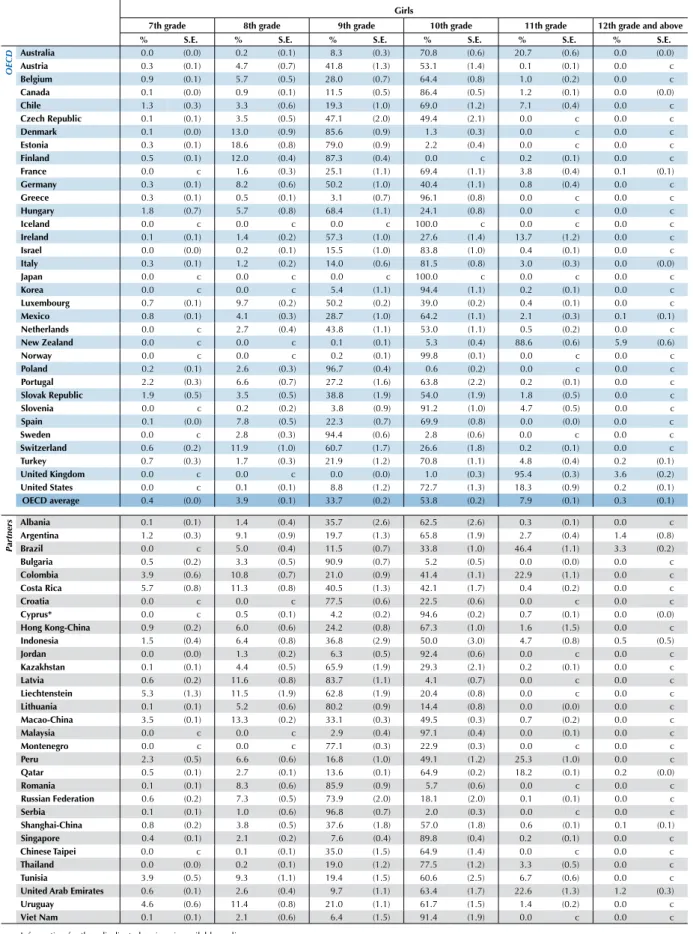
amounted to less than 1%; it was less than 4% in all countries and economies. When the exclusion of students who met the internationally established exclusion criteria is also taken into account, the exclusion rates increase slightly. However, the overall exclusion rate remains below 2% in 30 participating countries and economies, below 5% in 57 participating countries and economies, and below 7% in all countries except Luxembourg (8.4%). In 11 out of the 34 OECD countries, the percentage of school-level exclusions amounted to less than 1% and was less than 3% in 31 OECD countries. When student exclusions within schools were also taken into account, there were 11 OECD countries below 2% and 26 OECD countries below 5%.
(For more detailed information about the restrictions on the level of exclusions in PISA 2012, see Annex A2.)
What kinds of results does the test provide?
The PISA assessment provides three main types of outcomes:
• basic indicators that provide a baseline profile of students’ knowledge and skills;
• indicators that show how skills relate to important demographic, social, economic and educational variables; and
• indicators on trends that show changes in student performance and in the relationships between student-level and school-level variables and outcomes.
Although indicators can highlight important issues, they do not provide direct answers to policy questions. To respond to this, PISA also developed a policy-oriented analysis plan that uses the indicators as a basis for policy discussion.
Where can you find the results?
This is the second of six volumes that present the results from PISA 2012. It begins by defining equity in education and discusses how PISA measures equity. Chapter 2 focuses on the relationship between socio-economic status and student performance in mathematics; Chapter 3 examines various aspects of students’ background that have an impact on education outcomes, such as family structure and immigrant background; and Chapter 4 explores the close relationship among educational resources, such as opportunities to learn, teacher quality and quantity, and the school’s disciplinary climate, and socio-economic status and performance in mathematics. Whenever comparable data are available, trends between 2003 and 2012 are highlighted, and case studies, examining the policy reforms adopted by countries that have improved in PISA, are presented throughout. The concluding chapter discusses the policy implications of the PISA results.
The other five volumes cover the following issues:
Volume I, What Students Know and Can Do: Student Performance in Mathematics, Reading and Science, summarises the performance of students in PISA 2012. It describes how performance is defined, measured and reported, and then provides results from the assessment, showing what students are able to do in mathematics. After a summary of mathematics performance, it examines the ways in which this performance varies on subscales representing different aspects of mathematics literacy. Given that any comparison of the outcomes of education systems needs to take into consideration countries’ social and economic circumstances, and the resources they devote to education, the volume also presents the results within countries’ economic and social contexts. In addition, the volume examines the relationship between the frequency and intensity of students’ exposure to subject content in school, what is known as “opportunity to learn”, and student performance. The volume concludes with a description of student results in reading and science. Trends in student performance in mathematics between 2003 and 2012, in reading between 2000 and 2012, and in science between 2006 and 2012 are examined when comparable data are available. Throughout the volume, case studies examine in greater detail the policy reforms adopted by countries that have improved in PISA.
Volume III, Ready to Learn: Students’ Engagement, Drive and Self-Beliefs, explores students’ engagement with and at school, their drive and motivation to succeed, and the beliefs they hold about themselves as mathematics learners. The volume identifies the students who are at particular risk of having low levels of engagement in, and holding negative dispositions towards, school in general and mathematics in particular, and how engagement, drive, motivation and self-beliefs are related to mathematics performance. The volume identifies the roles schools can play in shaping the well-being of students and the role parents can play in promoting their children’s engagement with and dispositions towards learning. Changes in students’ engagement, drive, motivation and self-beliefs between 2003 and 2012, and how those dispositions have changed during the period among particular subgroups of students, notably socio-economically