c
Sharif University of Technology, April 2009
Cement-Based Solidication/Stabilization
of Heavy Metal Contaminated Soils
with the Objective of Achieving High
Compressive Strength for the Final Matrix
H. Ganjidoust
1;, A. Hassani
1and A. Rajabpour Ashkiki
1Abstract. The Solidication/Stabilization (S/S) of heavy metal contaminated soils using Ordinary Pontlandite Cement (OPC) is studied as a hazardous waste treatment technology. The soil-binder ratio of 8% by weight is selected for treatment by setting a justication constraint on the solidied matrix. In order to consider the physical and chemical characteristics of the solidied soil-cement mixtures, Compressive Strength, Toxicity Characteristic Leaching Procedure (TCLP), X-Ray Diraction (XRD) and Scanning Electron Microscopy (SEM) are the tests done during this research. The results indicate that despite an intensive decrease in the compressive strength of solidied soil at early curing ages, the justication constraint set on the preparation of specimens enhances hydration reactions; and the solidied matrix achieves high compressive strength after 7 curing days. The leaching metal concentration in leachates is decreased gradually by aging from 1 to 28 curing days, indicating more metal stabilization in the form of metal hydroxide precipitation, which presents itself in the developed crystalline phases of hydrated cement, as observed in XRD patterns or by absorption on CSH gel or crystals. Leaching metal concentration in leachates is lower than regulatory limits, so there is no strength concern for environmentally safe disposal. Heavy metal contamination diverts the cement hydration reactions toward production of more subsidiary products, that bear less compressive strength, instead of main hydration products. Therefore, the main crystalline phases develop irregularly and coat the aggregates poorly, as observed in SEM micrographs.
Keywords: Solidication/stabilization; Heavy metal contaminated soils; Portland cement; Leaching; XRD; SEM.
INTRODUCTION
Solidication/Stabilization (S/S) is typically a pro-cess that involves mixing the waste with a binder to reduce the contaminant leachability by physical and chemical means, which convert the waste into an environmentally acceptable waste form for safe disposal or construction [1-4].
For the purpose of solidication, many organic and inorganic binders have been used, most of which have stabilizing characteristics. Ordinary Portland
1. Department of Civil Engineering, Faculty of Engineering, Tarbiat Modares University, Tehran, Iran.
*. Corresponding author. E-mail: [email protected] Received 8 July 2006; received in revised form 22 April 2008; accepted 26 July 2008
Cement (OPC) is the most widely used binder due to its cost eectiveness, availability and compatibility with a variety of wastes [1-4].
The solidication and stabilization of heavy metal contaminated soils by Ordinary Portland Cement are studied in this research paper.
In much research, the nal solidied wastes have achieved low compressive strength, in particular, wastes not containing lime, pozzolanic materials or high pollution level waste.
In this study, in addition to S/S treatment, a com-pressive strength achievement for the nal matrix was considered so that it could be used as a construction material. Then, for this purpose, justication of the cement mortar is set as a constraint at the specimen preparation.
MATERIALS AND METHODS Materials
Ordinary Portland Cement type II supplied from the Abyek Ghazvin Cement Plant was used throughout this research.
The heavy metal contaminated soil (waste) was supplied from a mining factory. Due to moisture content, the clod soil is rst crushed into small pieces and the air is dried for 24 hours under solar heat. Then, it is ground by a bar mill to particles of 100% , passing sieve number being 100 (150 m) for the well micro encapsulation process.
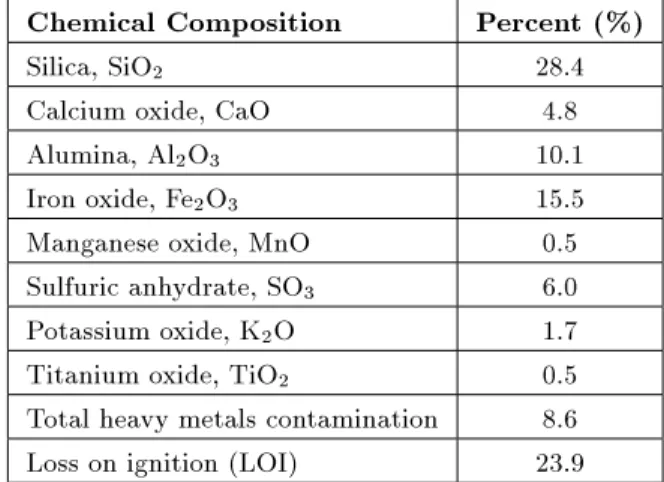
Tables 1 and 2, respectively, indicate the chemical composition of the soil and soil pollution composition with the results of the untreated soil leaching test, fol-lowing the Toxicity Characteristic Leaching Procedure (TCLP) [5]. Figure 1 shows a SEM micrograph of the soil structure and texture after physical changes and the passing sieve.
Double washed quarry sand was used as the aggregate material, controlled by ASTM C33-93 [6] for sieve analysis and ASTM C127-88 [7] for water absorption, which accounted for 2.02% of aggregate dry weight.
Table 1. Chemical composition of soil based on XRF (X-Ray Fluorescence) analysis.
Chemical Composition Percent (%)
Silica, SiO2 28.4
Calcium oxide, CaO 4.8 Alumina, Al2O3 10.1
Iron oxide, Fe2O3 15.5
Manganese oxide, MnO 0.5 Sulfuric anhydrate, SO3 6.0
Potassium oxide, K2O 1.7
Titanium oxide, TiO2 0.5
Total heavy metals contamination 8.6 Loss on ignition (LOI) 23.9 Table 2. Soil pollution composition and results of untreated soil leaching test and TCLP limits.
Metal Concentration in Leachate (mg/l) Soil Pollution Untreated TCLP Composition (%) Soil Limits
Zn 7.7 2440
-Pb 0.8-0.6 57.2 5
Cd 0.05 1.88 1
Ni 0.04 0.46 7
Co 0.01 0.51
-Figure 1. SEM micrograph of heavy metals
contaminated soil after physical changes and passing sieve number 100 (magnication 200).
Preparation of Specimens
The specimens were prepared according to ASTM C109-93 [8] with xed water-binder and sand-binder ratios of 0.485 and 2.75, respectively.
Regarding the strength achievement objective, the nal soil-binder (soil-cement) ratio for preparation of S/S specimens was selected by examining dierent soil-binder ratios and setting a justication constraint. Here, specimens with soil-binder ratios of 5, 10, 15 and 20% by weight were prepared. The justication constraint that was an observation or a visual control of the hardness achievement, excluded specimens with a related soil-binder ratio, which had not hardened for sound de-molding after 24 hours of casting. By slightly touching and pressing the top surface of the molded cement-soil mixtures, the hardness achievement con-trol exerted itself during the justication constraint. Specimens with a higher soil-binder ratio had very soft surfaces and became deformed by touching or pressing. Regarding the justication constraint, specimens with a soil-binder ratio of 5% by weight hardened fully and specimens with a soil-binder ratio of 10% by weight hardened appropriately, but specimens with soil-binder ratios of 15 and 20% by weight were rejected due to weak hardening characteristics.
In order to reach the nal soil-binder ratio, fur-ther investigations were carried out by making more specimens with soil-binder ratios of 6, 7, 8 and 9% by weight. Additionally, during and after de-molding, the nal cubic shape of the specimens were considered and the specimens with related soil-binder ratios that had deformed shapes or broken edges were omitted.
Following this justication, the soil-binder ratio of 8% by weight was nally selected for the solid-ication/stabilization treatment. Hereafter, all the main specimens made for studying the S/S treatment included a soil-cement ratio of 8% by weight and were considered at curing ages of 1,3,7,14 and 28 days.
In addition to main specimens, in order to com-pare the physical and chemical characteristics of the solidied soil-cement mixtures with an ordinary cement mixture at the same curing ages, control specimens that only included a cement mixture (not blended with contaminated soil) were prepared. When the specimens were de-molded, they had to be cured under lime-saturated water to prevent losing the heavy metal ions. The specimens were carried in air with 70 5% R.H. and under 23C conditions for the rst 5 days and
transferred to lime-saturated water for the rest of the curing process.
In this research, for each mixture combination, the specimens were prepared in triplicate, the average value of which represented the result.
Unconned Compressive Strength Test
The compressive strength of the cement mortar in both solidied soils and with control specimens was tested in a conventional method according to the standard ASTM C109-93 test method, using 50 mm cubic molds. Regarding low compressive strength values, to measure the compressive strength of the main specimens cured for 1 and 3 days, a crew type machine for soil compres-sive strength testing was used. Comprescompres-sive strengths of other main specimens and all control specimens were measured, using a hydraulic type machine for concrete testing with a loading rate of 1.0 k-N/s.
Leaching Test
The metal leaching was assessed by following the Toxicity Characteristic Leaching Procedure (TCLP) dened by U.S.EPA (Method 1311). The specimens tested in the compressive strength were crushed and the central core of each sample was further crushed to reduce the particle size to less than 9.5 mm; aggregates were discarded and then a 40 gr portion was sampled and transferred to the extraction vessel. The extract was acetic acid (pH 2.88), which was added at the solid-liquid ratio of 1:20 by weight. The vessel was agitated in an End-Over-End rotation at 302 rpm for 16 hours using an agitation rotary apparatus or tumbler.
Due to agitation and neutralization reactions between the cement portion of the soil-cement mixture and the acidic extract, the turbid leachates included separated and suspended parts of the soil-cement mixture such as contaminated soil, cement and sand particles. At the end of a 16 hour leaching test, a short retention time was given to the extraction vessels for the settlement of suspended coarse solids; then, the leachate was ltered for the removal of ne suspended solids. To avoid metal precipitation from the dissolved liquid phase into the solid phase, which causes error in the accuracy of the metal concentration measurement,
the leachate pH was reduced to less than 2.0 by the addition of nitric acid before the metallic analysis, because metals remain dissolved in pH less than 2.0. Metal concentration was measured by ame Atomic Absorption Spectrometry (AAS).
X-Ray Diraction (XRD)
The crystalline phases of cement hydrates and the probable compounds of stabilized metals were charac-terized using a Cu-K XRD device. Here, some other
parts of the crushed main specimens that were cured for 7 and 28 days were ground into powder and analyzed by the XRD device for the reection angle (2) from 10
to 70. To identify the crystalline phases, the results
were compared with the Joint Committee on Powder Diraction Standards (JCPDS).
Scanning Electron Microscopy (SEM)
A XL30 Philips SEM was used to consider the mi-crostructure and phase development of the solidied soil. Flat surface pieces from previously crushed main and control specimens, which had been cured for 7 and 28 days, were selected and treated with acetone-alcohol solution to stop hydration reactions [9]. Gold was used as a conducting medium to coat the surface of samples under vacuum conditions in the Sputter Coater device.
RESULTS AND DISCUSSIONS Compressive Strength Results
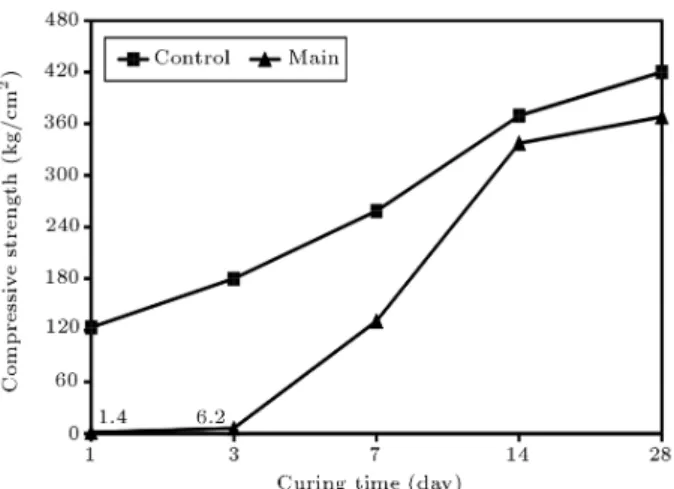
The compressive strength of the main and control specimens are shown in Figure 2.
The addition of heavy metal contaminated soil at the level of 8% by weight caused an intensive decrease in compressive strength from 123 kg/cm2in the control
Figure 2. Compressive strength of specimens as function of curing time (day).
specimens to 1.4 kg/cm2 in the main specimens, at a
one day curing age.
The intensive decrease in the compressive strength of main specimens has both chemical and physical reasons. The chemical reason, which is the main cause of an intensive decrease in compressive strength at the early curing ages of 1 and 3 days, is attributed to heavy metal contamination [9-17]. Heavy metal oxides such as zinc, lead, chromium and iron cause the retardation of cement paste and prevent the formation of main cement hydration products such as Calcium Silicate Hydrates (CSH) and pont-landite (Ca(OH)2) crystals, which bear the mechanical
forces [9] such as compressive forces in a solidied cement matrix.
Physical reasons include the presence of ne particles of soil with high specic surface areas, which might eectively reduce the amount of cement available for binding the ne and coarse aggregates required to provide adequate strength [18]. In addition, soil might cover the surface of aggregates and prevent the adhesion of the cement paste and the aggregates [19].
Compared to specimens cured for one day, the compressive strength of main specimens cured for 3 days has increased, but negative eects, especially chemical eects, on cement hydration limited this increment strongly.
Extending the curing period of solidied soil, especially after 3 days, the hydration reactions of the cement started and resulted in the formation of main products, which bear high compressive strength. As shown in Figure 2, even after an improvement in the compressive strength achievement of the main specimens including contaminated soil, the compressive strength was still less than the control specimens' at all curing ages. In fact, the presence of heavy metal contamination has a secondary chemical eect on the formation of cement hydration products, in addition to its primary retarding and disordering eects. Heavy metals diverted the cement hydration reactions toward production of more subsidiary products that bear less compressive strength, instead of main hydration products. This eect is studied in detail in the analysis of XRD patterns.
Therefore, the secondary chemical eect of heavy metal contamination on hydration reactions and the physical eects of soil together, caused a permanent dierence between the compressive strength of main and control specimens, even after 7 curing days, when the cement hydration reactions and strength achieve-ment in the main specimens started. This dierence also lasts during all curing ages, as shown in Figure 2. A comparison between the compressive strength of main specimens cured for 3 days and EPA regulatory limits for safe land disposal, equal to 3.5 kg/cm2 [1],
indicates that there is no strength concern for
environ-mentally safe disposal. Another comparison between compressive strengths of main specimens cured for long curing ages, especially 7 and 14 days, and ACI 299R-99 [20] shows that the nal matrix (solidied soil) could be considered as Controlled Low Strength Materials (CLSM) for limited constructions. However, the com-pressive strength of the 28-day cured main specimens is close to that of the control specimens which are known as concrete, but before any application, the leaching results of the solidied soil should satisfy the environmental limits.
It is necessary to emphasize that if the solidied soil is considered for a specic construction application, besides environmentally safe disposal tests and leaching tests, it must undergo other related standards and acceptable test methods for the desired characteristics and properties.
In fact, in this section, the compressive strength achievement procedure was studied tentatively and no construction application was exactly considered or oered. Furthermore, any application of the nal matrix must be limited to environmentally disposable actions at or near the waste location such as polluted sites, landlls or tailing dams and so on, which are severely protected from public accessibility in order to avoid any possible health problems in the future.
Leaching Results
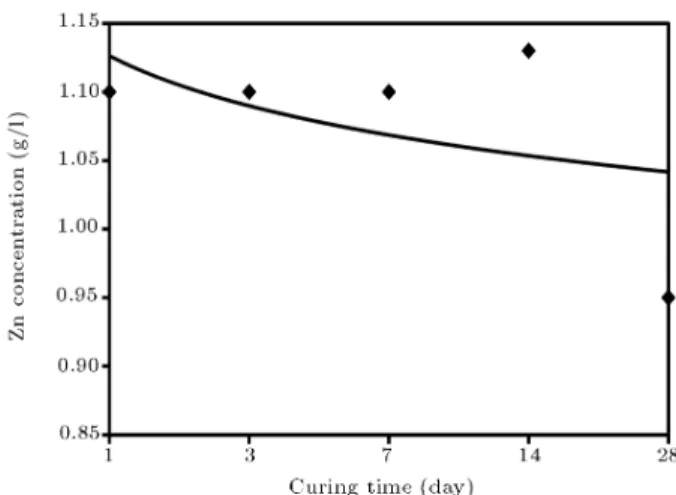
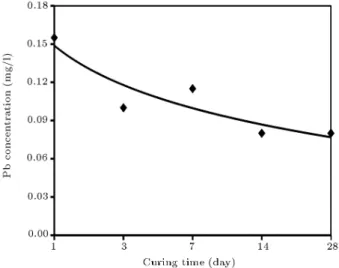
Figures 3 to 7 show Zn, Pb, Co, Cd and Ni concentra-tions in leachates in TCLP leaching tests, respectively. It is generally observable that extending the curing age of solidied soil decreases the metal concen-tration in leachates. For example, lead concenconcen-tration is decreased gradually from 0.155 mg/l in one day cured solidied soil leahcate to 0.08 mg/l in 28-day cured solidied soil leachate.
This indicates that the treatment has been
en-Figure 3. Zn ion concentration leached from cement-based solidied soil (main specimens).
Figure 4. Pb ion concentration leached from cement-based solidied soil (main specimens).
Figure 5. Cd ion concentration leached from cement-based solidied soil (main specimens).
Figure 6. Ni ion concentration leached from cement-based solidied soil (main specimens).
Figure 7. Co ion concentration leached from cement-based solidied soil (main specimens).
hanced [15] by the hardness achievement and formation of main crystalline phases, which increased the acid neutralization capacity of the matrix and prevented metal solution in acidic leachants [21,22].
Additionally, due to aging, more hydration reac-tions took place and, as a result, more metals stabilized in the form of metal hydroxide precipitations, which presented themselves in the developing crystalline phases of hydrated cement or were absorbed into the CSH gel or crystals.
As a signicant result, the leaching concentrations of all metals at any curing age were considerably lower than TCLP regulatory limits according to Table 1.
At the end of the leaching test (TCLP), after 16 hours of contact between the extract and 40 gr crushed particles of the main specimens selected for TCLP test, the leachate pH increased from the initial values of 2.88 to 11.56, 11.68, 11.10, 11.24 and 10.89, which relate to specimens cured for 1, 3, 7, 14 and 28 days, respectively.
As mentioned in compressive strength results, at the early curing ages of 1 and 3 days, cement-soil mixtures contained little amounts of cement hydration products, especially main products. Thus, during leaching tests, acid neutralization was mostly due to the direct solution of the unhydrated cement portion of the cement-soil mixtures.
After cement retardation, since the hydration reactions started in the soil-cement mixture, main hydration products developed and increased in the hydrating mixture; also compared to early curing ages, the amount of unhydrated cement decreased in the main specimens that were cured for longer times. Main products such as Ca(OH)2 and CSH crystalline are
more resistant to acidic conditions than unhydrated cement. So, acid neutralization in greatly cured specimens results from the dissolution of Ca(OH)2
of the solidied mixture. Therefore, compared to specimens cured for 1 and 3 days, the leachate pH of specimens cured for 14 and 28 days decreased generally, as mentioned above in the pH results.
XRD Results
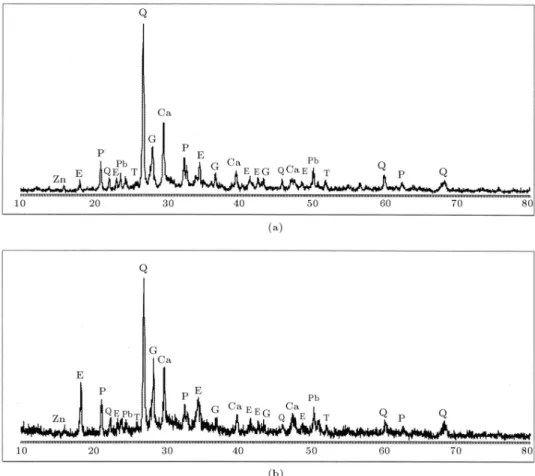
Figures 8a and 8b show the XRD patterns of cement-based solidied soil hydrated for 7 and 28 days, re-spectively. Results show that due to the presence of ground aggregates in the powdered sample one sharp and some thin peaks of Quartz were observed in both patterns.
As observed in Figure 8a, pontlandite, one of two main cement hydration products, was detected in the related XRD pattern of a soil-cement mixture cured for 7 days. This crystalline phase was also detected in the XRD pattern of the soil-cement mixture cured for 28 days with a little sharper peak, especially about the reection angle (2) of 18.5. This indicates that despite retardation and other negative impacts at early curing ages, the hydration reactions have continued.
The presence of Ettringite (subsidiary hydration product) and some unhydrated di- and tricalcium
silicates (cement clinker constituents) indicate that the hydration reactions have been diverted toward the pro-duction of subsidiary products. Typically, it is dened that the heavy metals pollution enhances Ettringite production in hydrating cement pastes [22,23]. In both patterns, especially in Figure 8b, zinc and lead were found in stabilized forms of CaZn2(OH)6.2H2O
[9-11,24,25] and Ca2Pb2O5(OH)2, respectively.
In fact, these metals are stabilized in pontlandite crystals, based on J. Conner's S/S mechanisms, as shown in Figure 9 [24].
According to Conner's mechanisms, the major mechanism for lead stabilization is to be absorbed on CSH crystal surfaces; however, results showed that Pb could also be stabilized as the detected compound in Figure 8.
SEM Results
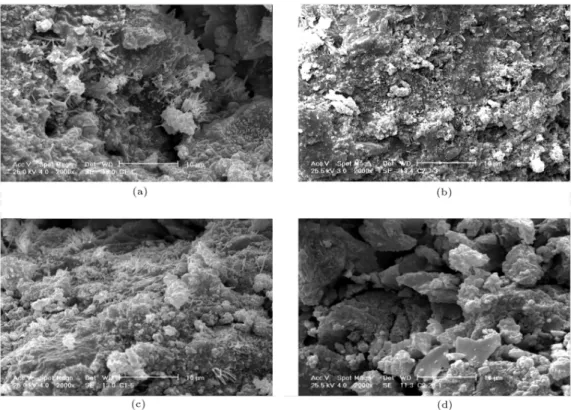
The microstructure of 7-day hydrated cement in control specimens is shown in Figure 10a, which includes normally developed forms of main crystalline phases (CSH and Ca(OH)2) and Ettringite. Blending the
contaminated soil with cement paste decreased the
Figure 8. XRD patterns: (a) 7-day cured main specimens and (b) 28-day cured main specimens. P = pontlandite; Q = quartz; E = Ettringite; T = di and tri calcium silicates; Ca = CaCO3; G = gypsum; Zn = CaZn2(OH)6.2H2O; Pb =
Figure 9. Solidication and stabilization of heavy metals by hydrates of Portland cement [15,24].
production and development of the main crystals and caused the hydration products to coat the aggregates poorly, as shown in Figure 10b.
Figures 10c and 10d show the microstructure of the control and main specimens cured for 28 days. As shown in Figure 10c, due to aging and continuous hydration reactions, the crystalline phases in the 28-day cured control specimens were more developed than in the 7-day cured control specimens (Figure 10b); but, in Figure 10d, the crystalline phases in the 28-day cured solidied soil were developed irregularly. Then, as a result, the porosity of the matrix increased.
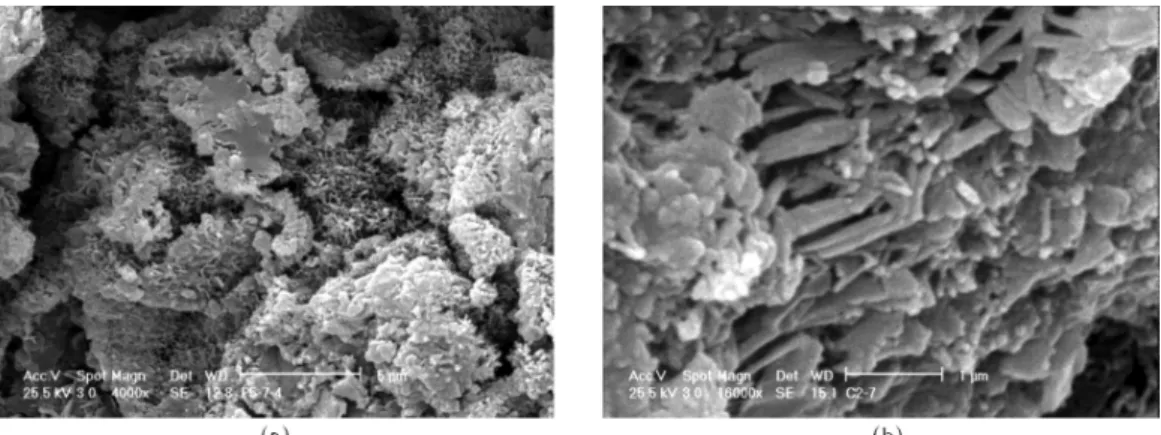
Figures 11a and 11b show large amounts of Et-tringite with a needle shape structure that grew in the solidied matrix microstructure.
CONCLUSION
This research was carried out to investigate solidica-tion and stabilizasolidica-tion of heavy metal contaminated soil as a hazardous waste treatment technology and also to consider the high compressive strength achievement for the nal solidied matrix by setting a justication constraint on the treatment.
This research has shown that, despite an intensive decrease in the compressive strength of the solidied soil at early curing ages, the justication constraint set on the preparation of specimens enhanced hydration reactions and the solidied matrix achieved a high compressive strength after 7 curing days.
Besides blending cement (binder) with contami-nated soil (waste) in S/S treatment, the justication constraint signicantly decreased metal leaching con-centrations to the TCLP regulatory limits that are required for environmentally safe land disposal of any waste treatment such as solidication and stabilization. Heavy metal contamination and soil presence in treatment mixtures had negative eects on cement hydration reactions and retarded them at early curing ages. As a result, the solidied soil-cement mixtures achieved low compressive strength.
According to low compressive strength achieve-ment and the nal leachate pH of the solidied soil specimens, waste treatment included metal stabiliza-tion and acid neutralizastabiliza-tion at early curing ages of
Figure 10. SEM micrographs of 7- and 28- day cured main (solidied soil) and control specimens at magnitude of 2000: (a) 7-day cured control; (b) 7-day cured solidied soil; (c) 28-day cured control; and (d) 28-day cured solidied soil.
Figure 11. SEM micrographs of Ettringite produced in solidied soil: (a) at magnitude of 4000; and (b) at magnitude of 16000.
1 and 3 days. After the cement hydration reactions resumed, waste treatment included solidication and more stabilization in pontlandite crystals based on J. Conner's S/S mechanisms.
An analysis of XRD patterns showed that heavy metals contamination diverted hydration reactions to-ward the production of subsidiary low strength prod-ucts instead of major high strength prodprod-ucts. There-fore, the main crystalline phases developed irregularly and coated the aggregates poorly, as observed in SEM micrographs.
REFERENCES
1. Spence, R.D. and Shi, C., Stabilization and Solidi-cation of Hazardous, Radioactive and Mixed Wastes, CRC Press, Boca Raton, FL, US (2004).
2. USEPA \Solidication/stabilization resource guide", EPA542-B-99-002, Adapted from http:// www.epa.gov/ (1999).
3. USEPA \Treatment technologies for site cleanup: Annual status report (10th E.)", EPA542-R-01-004, Adapted from http://www.epa.gov/ (2001).
4. USEPA \Treatment technologies for site cleanup: Annual status report (11th E.)", EPA542-R-03-009, Adapted from http://www.epa.gov/ (2004).
5. USEPA Method 1311 \Toxicity characteristic leaching procedure, test method for evaluation of solid wastes, physical, chemical methods, SW846", Adapted from http://www.epa.gov/ (2003).
6. American Society for Testing and Materials \Standard test method for concrete aggregates", ASTM C33-93 (1993).
7. American Society for Testing and Materials \Standard test method for specic gravity and absorption of coarse aggregates", ASTM C127-88 (1993).
8. American Society for Testing and Materials \Standard test method for compressive strength of hydraulic ce-ment mortars (using 2-in. or 50-mm cube specimens)", ASTM C109-93 (1993).
9. Asavapisit, S., Fowler, G. and Cheeseman, C.R. \Solu-tion chemistry during cement hydra\Solu-tion in the presence of metal hydroxide waste", Cement and Concrete Research, 27, pp. 1249-1260 (1997).
10. Fernandez, I., Chacon, E. and Irabien, A. \Inuence of lead, zinc, iron (III) and chromium (III) oxides on the setting time and strength development of Portland cement", Cement and Concrete Research, 31, pp. 1213-1219 (2001).
11. Hamilton, I.W. and Sammes, N.M. \Encapsulation of steel foundry bag house dusts in cement mortar", Cement and Concrete Research, 29, pp. 55- 61 (1999). 12. Hanna, R.A., Barrie, P.J., Cheesman, C.R., Buchler, PM. and Perry, R. \Solid stale Si and Al FTIR study of cement pastes containing industrial wastes and organics", Cement and Concrete Research, 25, pp. 1435-1444 (1995).
13. Hills, C.D., Sollar, C.J. and Perry, R. \Ordinary Portland cement based solidication: the role of OPC reviewed", Cement and Concrete Research, 23, pp. 196-212 (1993).
14. Hills, C.D., Koe, L., Sollar, C.J. and Perry, R. \Early heat of hydration during the solidication of a metal plating sludge", Cement and Concrete Research, 22, pp. 822-832 (1992).
15. Park, C. \Hydration and solidication of hazardous wastes containing heavy metals using modied cemen-titious materials", Cement and Concrete Research, 30, pp. 429-435 (1999).
16. Tashiro, C., Takahashi, H., Kanaya, M., Hirakida, I. and Yoshida, R. \Hardening property of cement mortar adding heavy metal compound and solubility of heavy metal from hardened mortar", Cement and Concrete Research, 9, pp. 283-290 (1997).
17. Youn, J.H., Jeong, B.G., Lee, H.M., Chung, H.S. and Park, C. \Immobilization of heavy metals using ordinary Portland cement and lime-rice husk ash", Journal of Korean Solid Waste Engineering Society, 12(5), pp. 645-653 (1995).
18. Zain, M.F.M., Islam, M.N., Radin, S.S. and Yap, S.G. \Cement-based solidication for the safe disposal of
blasted copper slag", Cement and Concrete Compos-ites, 26, pp. 845-851 (2004).
19. Neville, A.M. Properties of Concrete, 4th Ed., Long-man House, Burnt Mill, Harlow, England (1995). 20. ACI \Controlled low strength materials", ACI
299R-99 (1299R-999).
21. Li, X.D., Poon, C.S., Sun, H., Lo, I.M.C. and Kirk, D.W. \Heavy metal speciation and leaching behaviors in cement based solidied/stabilized waste materials", Journal of Hazardous Materials, A82, pp. 215- 230 (2001).
22. Tashiro, C. and Oba, J. \The eects of Cr2O3,
Cu(OH)2, ZnO and PbO on the compressive strength
and the hydrates of the hardened C3A paste", Cement
and Concrete Research, 9, pp. 253-258 (1997). 23. Tashiro, C., Oba, J. and Akama, K. \The eects of
several heavy metal oxides on the formation of Ettrin-gite and the microstructure of hardened EttrinEttrin-gite", Cement and Concrete Research, 9, pp. 303-308 (1997). 24. Conner, J.R. \Chemical xation and solidication of hazardous wastes", Van Nostrand, New York (1990). 25. Mollah, N.Y.A., Hess, T.R., Tsai, Y.N. and Cocke,
D.L. \FTIR and XPS investigations of the eects of carbonation on the solidication/stabilization of cement based system-Portland type V with zinc", Ce-ment and Concrete Research, 23, pp. 773-784 (1993).