Culture as the Core: Challenges and Possible
Solutions in Integrating Culture into Foreign
Language Teaching
Dianbing Chen
Zhejiang Normal University, China
Xinxiao Yang
Zhejiang Normal University, China
Abstract—In this qualitative study, the researchers examined the experience of a sample of language instructors in foreign language programs to identify the challenges they encountered and the strategies they applied in integrating culture into their daily teaching. The findings of this study indicated that in spite of confronting challenges in cultural teaching, language instructors have made individual efforts on culture teaching in their specific programs. The article concluded with possible implications for language teachers and suggestions for future studies.
Index Terms—culture teaching, FL instruction, qualitative study, challenges, strategies
I. INTRODUCTION
For many foreign language instructors, teaching students how to say “teacher” in the target language is one of the first things they do when they meet their students. If it is easy to simply tell students that the word “teacher” in Chinese is “lao shi (老师)” or “sensei (先生・せんせい)” in Japanese, it certainly takes more time to teach students how to properly address their teachers in the target culture. For example, in the United States, people usually address a teacher as Mr./Mrs./Ms. and add his/her last name. In China, the translation of the word “teacher” is “lao shi,” and people generally address a teacher as his/her last name plus “lao shi.” In Japan, the translation of the word “teacher” is “sensei,” and people refer to a teacher as his/her last name plus “sensei”.
Although it is not difficult to train students to address their teachers appropriately in the target language and culture by having them imitate native speakers’ behaviors and conversations, it is more challenging to help students understand the meanings, beliefs, and values attached to the word “teacher” in the target language and the role of “teacher” in a specific culture. For example, in the United States, “teacher” usually refers to a person who provides schooling for pupils and students (“Teacher”, 2012). In China, people usually use “lao shi” to address a teacher or to address a respected person who actually does not work at school (“老师”, 2012). In Japan, people generally use “sensei” to address a teacher, a doctor, a lawyer or a politician (“Sensei”, 2012).
Moreover, if one studies the use of the word “teacher” in different languages further, one would find out that in America, “teacher” is generally seen as a commonplace job, and teachers have been paid relatively low salaries (“Teacher”, 2012). In China, people have a tradition of respecting teachers and a belief that any respected person has something to teach others (“儒教”, 2012). In Japan, “sensei” is actually a title used to refer to some figures of authority, and teachers, like doctors, lawyers, and politicians, are people who have achieved a certain level of mastery in some skills (“Sensei”, 2012). If our students have such an understanding of “teacher” in the target culture, one can say that they have a better understanding of the underlying ideas, attitudes, meanings, and values that explain why a society performs its practices and creates its products.
The above example of teaching the word “teacher” to student showed that through the learning of other languages, students could gain a knowledge and understanding of the cultures that use that language. In fact, students cannot truly master the language until they have also mastered the cultural contexts in which the language occurs. So, while grammar and vocabulary are essential parts of language instruction, it is the acquisition of the ability to communicate and behave in meaningful and appropriate ways with users of other languages that is the ultimate goal of today’s foreign language classroom. Culture as the core in language instruction needs to be integrated in language instructions.
II. BACKGROUND
About four decades later, Standards for foreign language learning in the 21st century (1996) listed culture as one of five goals of learning foreign language. Since then, foreign language instructors have generally accepted that teaching culture is an indispensable part of teaching language. In 2007, a Modern Language Association of America (MLA) report on foreign language learning in higher education emphasized the importance of teaching both language and culture at the post-secondary level, which demonstrates that culture continues to be an important element in foreign language education in the 21st century.
In the field of teaching language, a number of scholars (Arens, 2010; Barnes-Karol & Broner, 2010; Byrd, Hals, Watzke, & Valencia, 2011) have accepted the guidance of the National Standards and the 5Cs (communication, cultures, connections, comparisons and communities) of learning foreign languages. One of 5Cs, culture, includes three closely interrelated components, “the philosophical perspectives, the behavioral practices, and the products—both tangible and intangible—of a society” (National Standards, 2006, p. 47). Corresponding with the National Standards, many scholars and researchers (Schulz, 2007; Barnes-Karol & Broner, 2010; Kearney, 2010) have argued that the objectives for the learning of culture should move beyond simple “culture as fact,” for example, stereotypes, famous events, hero figures, and aim at gaining cultural perspectives, such as worldviews, values, and beliefs.
Although the late 20th and early 21st centuries have witnessed a renewed interest in language education due in part to internationalization, globalization, and the aftermath of September 11, 2001, yet the inclusion of culture in language instruction remained an unresolved issue and foreign language instructors confront many difficulties in teaching culture and cultural perspectives in practice for the following reasons: (1) instructors’ negative attitudes towards teaching culture, (2) the lack of effective instruction, resource, and technology of teaching culture, and (3) the absence of academic support for teaching culture at the post-secondary level. For example, teachers and learners might have the following beliefs as Lange and Paige (2003) indicated,
(1) Culture is complex and elusive, incorporating as it does elements such as attitudes, beliefs, ideologies, perceptions, ways of behaving and thinking, and values; (2) Many teachers say: ‘Culture is not language, so why should we have to deal with it and its complexities’? It takes away from the needed focus on language and communication. (3) Any discussion of cultural differences could cause language learners to change their own ways of thinking and behaving. In other words, culture takes the learning experience far beyond the realm of comfort, experience, and interest of both teachers and the learners. (p. x).
First of all, culture is still viewed as a traditional domain of anthropology rather than education, therefore, a substantial amount of important writing on culture teaching and learning exists, much of which is completely unrelated to language education (Lafayette, 1997; Furstenberg, 2010). For example, although some foreign language educators (Shrum & Glisan, 2005; Tokuhama-Espinosa, 2008) mentioned using music, fine arts, classical literatures, or other resources, which essentially fall into the cultural products and cultural practices categories, while teaching foreign languages, they still avoid using the word “culture.” Instead of simply understanding cultural products and patterns, the National Standards (2006) require that students demonstrate the understanding of the relationships between cultural products and cultural perspectives, as well as cultural patterns and cultural perspectives. Therefore, by only displaying cultural products and/or presenting cultural practices, without having students investigate, compare and reflect on the target cultural perspectives, foreign language instructors hardly fulfill the National Standards’ requirements.
Second, foreign language instructors often lack resources, effective strategies, and technology to teach cultural perspectives. A 2007 Modern Language Association of America (MLA) report requires higher education to foster foreign language learners’ translingual and transcultural competence in the post-9/11environment. However, it is much harder to teach culture than language. Unlike teaching linguistic components, which many linguistics and language educators have worked on for generations and have incorporated into all kinds of textbooks, foreign language instructors hardly get enough support from their teacher education programs, textbooks or reference books for teaching culture (Byrd, Hals, Watzke, & Valencia, 2011). For example, many popular books written for pre-service language teachers, such as Approaches and Methods in Language Teaching (Richards & Rodgers, 2001), and Teacher’s Handbook: Contextualized Language Instruction (Shrum & Glisan, 2005), do not include any content related to the teaching of culture.
Third, since college-level students are usually high school graduates, younger or older adults, their fully formed first language skills and cultural knowledge may affect their foreign language learning, in such areas as cognitive ability, and attitudes towards language and culture (Tokuhama-Espinosa, 2008). Thus, we have to consider college-level language students as adult learners. However, most foreign language instructors were not specifically trained for teaching adults. In this case, the National Standards (2006) and the Modern Language Association of America (MLA) report (2007) are not very helpful for two reasons: the National Standards are specifically designed for K-12 levels, and the MLA report contains mostly general requirements, rather than explicit teaching guidelines.
More and more scholars in the field of teaching foreign language advocate teaching culture, and the National Standards require instructors to teach culture and cultural perspectives. Nevertheless, the lacks of resources and academic support, as well as instructors’ own negative attitudes, are still obstacles to teaching culture in foreign language education (Yang & Chen, 2014). Can meaningful culture teaching take place given the identified challenges? The purpose of this study is to illuminate findings from a qualitative case study that answers this overarching question.
This study was guided by the following overarching question: Can meaningful culture teaching take place given the identified challenges? Also, the following secondary questions were added:
1: What challenges do language instructors encounter when integrating “culture” in their language teaching? 2: What instructional strategies do language instructors perceive as practical and effective in culture teaching?
III. METHODOLOGY
In this study, the researchers utilized a qualitative case study, a methodology in which “the case itself is center stage, not variable” (Schwandt, 1997, p.13). Much has been written about case study and where it fits in a mainstream research tradition (Merriam, 2009; Stake, 2005; Thomas, 2011; Yin, 1994; Yang & Chen, 2014). More specifically, in order to treat the experience of each instructor as a separate case as well as compare and contrast the effects of those different cases, the researchers conduct what Stake (2005) called a “collective case study”. It was the researchers’ intention to study the experiences of those cases, as well as their similarities and differences on influencing students’ foreign language learning, which would “lead to better understanding, and perhaps better theorizing, about a still larger collection of cases” (Stake, 2005, pp. 445-446). Perhaps more importantly, case study supports instructors in valuing the uniqueness of their classes. Learning from them, and showing how their experience and knowledge can be made accessible to other practitioners in simple but disciplined ways. They are particularly suited to practitioners who want to understand and solve teaching problem in their own context (Thomas, 2011; Yang & Chen, 2014). The purpose of this investigation was to identify and inform best practices in dealing with challenges occurred in instructors’ culture-teaching experience. Therefore, a qualitative case study approach is tailored for this study.
Setting
The researchers examined six different language programs at Rocky Mountain University (RMU) in the western United Sates. The university was chosen for the following reasons. The department offered Spanish, German, French, Russian, Chinese, Japanese and Arabic language courses in both undergraduate and graduate programs. There were twenty-four faculty members and fourteen graduate assistants as instructors in the department when they conducted this study. In the fall semester 2011, the Department offered 108 foreign language courses as Figure 3.1 shows. Arabic, Japanese and Chinese are less taught languages with four total native speakers as instructors. French and Spanish are more frequently taught languages with twenty-two total instructors. Russian and German fall in between, with twelve instructors.
Language 1000 2000 3000 4000 5000 Total
Arabic 2 1 1 4
Japanese 1 1 1 1 4
Chinese 2 2 1 5
Russian 3 2 3 3 11
German 4 2 3 2 3 14
French 5 4 3 5 9 26
Spanish 15 8 6 3 12 44
Figure 1. In Fall Semester of 2011, the Number of Foreign Language classes offered by the Modern Language Department at RMU (1000~~4000 level classes are designed for undergraduate students. 5000 level classes are designed for graduate students.)
Participants
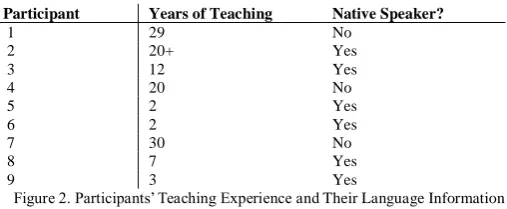
Participants included six instructors (see Figure 2) from seven different programs. On average, the researchers interviewed each of these six instructors twice and visited each of their language classes three times for this study. The six instructors are representative of three different types of language instructors: (1) tenured professors with many decades of teaching and research experiences, such as Dr. Charles and Dr. Hassan; (2) tenure-line instructors in their 40s with more than ten years of teaching experience, such as Lin and Frank; (3) graduate assistants who teach introductory language classes and who have just begun the teaching careers, such as Claudia and Asta. Their age range from 20s to 50s, their experiences range from one year to twenty-nine years, they teach introductory, intermediate, and advanced level courses. Three of them are native speakers, and the other three are not. In other words, these six instructors represented multiple generations and various types of language instructors at RMU.
Participant Years of Teaching Native Speaker?
1 29 No
2 20+ Yes
3 12 Yes
4 20 No
5 2 Yes
6 2 Yes
7 30 No
8 7 Yes
9 3 Yes
Figure 2. Participants’ Teaching Experience and Their Language Information
Spanish literature and Hispanic culture. Dr. Charles is a well-recognized expert at RMU for his teaching and research in the Modern Language Department. Dr. Charles has taught many Spanish courses, including introductory classes for beginners and literacy classes for graduate students. Dr. Hassan has also been teaching at RMU for over twenty years. Originally, Dr. Hassan came from Tunisia, and Arabic is his first language. His Arabic cultural origin is strongly reflected by the decorations in his office and his passion when he talked about how to bring Arabic culture into language classrooms. Dr. Hassan is currently working on bringing more teachers to the Modern Language Department at RMU to expand the Arabic language program.
Lin and Frank are senior lecturers in their 40s in the Modern Language Department. Lin came from China in 2002 and has been teaching Chinese at RMU ever since. Lin initially started the Chinese program at RMU. Frank was born in the United States, and German is his second language. He has been teaching German at RMU for over twenty years. Frank teaches German courses at all levels and has interests in Germany literacy and culture.
Claudia and Asta are two instructors in their late 20s. Both have been teaching foreign languages at RMU for less than a year. Claudia recently came from Mexico to pursue a master degree in Spanish while teaching introductory Spanish courses as a graduate assistant. She was not used to life in America, and her English was not very fluent. On the contrary, Asta was born in America and always wanted to be a German teacher. She had lived in Germany for about two years when she was a child. Both Claudia and Asta were teaching beginning level courses during the time of the study and were eager to learn more about how to teach a foreign language.
Data collection and analysis
Qualitative inquiry was the utilized research platform for this study because of the exploratory nature of this subject. The data collection sources utilized in this study were interviews, classroom observations, and document mining (Yin, 2009). Categorical aggregation (Stake, 2005) was used to analyze the data, resulting in a collection of various instances from different data sources that led to the formation of general themes of this study. Cross-checking of themes was conducted by different researchers to ensure validity and thoroughness.
Instructors were observed for a period of four months during planning, instructing, and office hour times in order to document cultural teaching practices that occurred. Also, interviews and document mining were conducted with instructors to know their experiences, opinions, feelings, or other information that cannot be observed (Merriam, 2009). Additionally, the researchers collected various types of documents including lesson plans, syllabi, textbooks, student assignments, tests, and online documents regarding cultural teaching practices to help uncover meaning, develop understanding and provide insights relevant to the research questions.
IV. RESULTS
The objective of this study was to inform and identify best practices in culture teaching through investigating the live experience of language instructors. Two major categories emerged from the data based on the experience and perceptions of culture teaching reported by language instructors through their efforts to attempt, appraise, and apply cultural teaching within their multiple life contexts. They included:
1. Challenges in Culture Teaching
2. Practical and Effective Strategies in Culture Teaching Challenges in Cultural Teaching
Generally, participants agreed that culture is a key component in foreign language classes and they have attempted to weave culture into their daily instruction, they also reported all the challenges they have encountered. The following excerpts demonstrated some experiences shared by participants when asked to describe challenges they have encountered when integrating culture in their language instructions.
Lack of standards of what a culture teaching class looks like. Participants referenced lack of standards of what a culture teaching class looks like as their first challenge in weaving culture into their teaching. According to their experience, two factors that are troubling their cultural teaching: (1) various individual understandings of culture teaching in FL classroom; and (2) teaching textbook culture or reality culture.
Through data collection and analysis, the researchers noted that different instructors shared a different understanding of what it really means to teach culture in FL classroom. As Charles shared,
Culture could be defined as general types of things, related to language, literature, arts, physical, important people, and so forth. Culture could also be related to the norms, ideas, and ways of doing things, linguistic expressions, attitudes, and so forth of people. It ranges very broadly in my definition. When basic texts talk about culture, they usually will do in terms of, in Spanish texts of course, country, factors of these countries, their languages are more than one, the numbers of people who live there, some important cities, few significant people, and that’s about it. Then they assumed that they’ve talked something about culture, I’m not sure. (Laugh) I’m not sure that is really teaching culture. I think that focuses the facts about the country. Then culture, you can do all of that without reading anything written by someone from that culture, without listening to any music. There might be a picture or two, but the pictures tend to be things like monuments, parks, and the museums.
Culture in the classroom is something that has to be defined as a curriculum. In other words, it should be in teachers’ minds even at the beginning level of learning that teachers should not only introduce the mechanics of the language, not only the format of the language, they also need to introduce students the aspects of culture. They are not only learning the cold language. We are not only teaching students how to write letters, how to say the words, how to put words together to say the sentences. Language is a primarily cultural practice. I take it into my account when I start teaching. Although my class initially is a language course, I also bring cultural elements in it. During the limited time we have in classroom, I hope to introduce students to culture aspects, a bigger picture for their future study.
Lin echoed Hassen’s perspectives. But she also mentioned “different languages have different culture, so there is no unified standard here at the university. We follow 5Cs of the National Standards, and designed a curriculum to cover culture”. She shared,
Personally, every language is the carrier of its culture. Therefore, it is hard to teach language without teaching culture. When you use the textbook to teach language, there will be culture between the lines. I mean, you need to teach students about the culture, or you will find a common phenomenon in student’s language learning: students have no problem in learning the vocabularies and grammar but when it comes to use them, they do not know how to use them within a certain culture context because they do not know the culture. In the National Standard, there are different levels of language learning. The standard they used to define the different levels lies in the understanding of the culture. In the real teaching practice, we do not have special culture session; the culture teaching usually goes hand in hand with vocabularies and grammar teaching. I employ all of them and do them routinely. Sometimes, I teach them how to sing a Chinese song because there are culture elements in the songs. Sometimes, I assigned them to interview with Chinese speakers outside class. Also, some of the assignments helped them understand Chinese culture such as outsider interview (interview someone from China). Moreover, here at the university, there is a language change program to encourage the American students to talk to their language partners, who are usually students from China. It was surely helpful to help them understand Chinese culture.
Asta shared her culture teaching experience through her understandings of culture teaching in a language course, I think if you really want your students to understand the language, you have to teach culture, at least. For example, in 1010 we talk about foods. There are some foods that do not exist in America. So you have to teach about that, and how they eat them. When we talk about the meal, I explained that we eat cereals for breakfast, which is very rare in Germany. It is not like never happen but it doesn’t happen every day. If you really want your kids to understand the language, culture comes naturally. You also should give students a real context for the language. If you give a real context, the language and culture would come naturally. For example, today we talk about restaurants. In Germany, the tip is that you give about extra one dollar because the waitress actually makes a decent wage. But here the waitresses actually do not make much; you have to tip them 15-20%. So we talked about that difference in order for them to understand the word “tip”. And how to order their foods and how to talk in a restaurant, where to seat, all these things. Just teaching them vocabularies does not make a real context.
Frank also shared his understanding of culture and culture teaching in a FL classroom,
Culture remains a component in all my classes. The area I rarely taught is in between of intermediate and advanced level. 3000 level is the class that I rarely taught. As far as the first three semesters, which I teach frequently, I have cultural component all the time. In fact it is a big component, probably. At least half of readings or more are culture. Of course we use cultural studies as part of language acquisition strategies. Of course we have strictly grammar lessons. For intermediate level, we have three classes for each week, and I try to keep grammar down to less than one lesson a week.
I think there are two primary objectives of teaching culture. The first is for language acquisition. You use it as a tool to introduce language, and give them examples of how it is used in a format they find interesting. The second thing is to increase their cultural awareness. It is one of few opportunities that students spend time in another culture. Especially if their major is not culture studies, their foreign language classes is their best place to get culture. Of course in anthropology classes you learn a lot about culture and I’m not sure how much you can learn culture in engineer classes (laugh). They are exposed to culture during their language studies.
Claudia mentioned that she was sometimes confused by different standards of teaching culture in a FL classroom from different directions and reported,
was more focused on culture. I can see their reaction is very different. They are more in the class, they want to learn, and they want to talk even with mistakes. They try to communicate about their feelings.
More importantly, participants argued that conflict between textbook culture and reality culture confused both teachers and students. Charles argued that the culture taught in classroom and represented in the textbook were like second hand information to teachers and students. He reported,
Students are presented to limited realities. You don’t want to teach students negative things that would cause them to look down on other people. That would not be appropriate. But I think it’s Ok to point out the differences, and areas that have difficulties based on realities. All texts tend to present information that they boil down everything to several obvious things. So is that really teaching students culture? You can tell students about culture, can you teach them about culture? You can certainly tell them about it, how things are done, or perhaps point out how thing are done differently from their home situation. When I personally teach culture, I don’t care a lot about how many people live in the Mexico city, and those kinds of things. But I do like them to reflect on how they observe individual people doing things, and how some of that probably related to the culture and language.
Hassen added the importance role that teachers and researchers played in bridging the culture gap between textbooks and reality by suggesting,
I think it is important for teachers and researchers of culture to know and understand reality culture. When we talk about culture, we have to be very careful, because we have many colors in one culture. When we talk about Arabic culture we are teaching, in fact, we are teaching many cultures, many Arabic dialects. It is very important to make students behave themselves in certain culture, in certain dialect. When I teach Arabic 3050, which is a course about dialects; I introduce different dialects by using videos or audios from Arabic countries. Hopefully, after we analyze those, both linguistically and culturally, students will develop that kind of knowledge. Arabic is not only spoken in Arabic countries, it is also spoken in many other parts of the world, it only affected other languages historically, and it also accepted many vocabularies from other languages. I think it is important for students to develop that kind of ideas. It depends how much time the student in that program, spending in language and culture
Asta shared that sometimes the culture in the textbook was there for its own sake without considering students’ comprehension ability. She referenced,
They (textbooks) have a lot of dramatic stuffs in there that I maybe put them into different order. Like some vocabularies should go through chapters, or group up a little bit. Culturally they try to put a lot of things into it. Like every couple chapters they have a film that tells the stories, they try to choose modern version of the stories instead of fairy tales, the most famous German stories. And they have videos come with the books and talk about different cultural things. I don’t really use the videos very often in 1010 because it is just some native speakers narrate some new things going on. I don’t think they understand anyway. And they are very fast, I don’t think they would do any good any way.
Frank shared his worries of the misconceptions students got from different resources that confused students in his classroom. He mentioned,
There are many misconceptions and expectations that they gained from movies about Germans. And Germany is the enemy for the two World Wars, which has left a lot of stereotypes about Germany in minds of Americans. We have relatively little opportunities to interact with Germans. The stereotypes are very common and often go un-clarified. For a German teacher, especially the Nazi past, you can count on to address that regularly. In fact, the two big cultural topics that Americans have interests in learning are not happy subjects, the Nazi era and the era of the Berlin Wall. The two political situations have been responsible for a lot of misery. A lot of students want to know about that. Those lessons are extremely successful, usually. The students are fascinated and want to know more about that. They compare Germany today with Germany of the 40s, 50s, 60s and 70s. This is interesting thing.
Claudia argued her points through an example,
For example, in all of the basic texts, they have foreign students which are invented, all of the young students are university students, there is never non-university students, all of their families have money, all of the families take vacations. I personally that it has something to do with they are trying to show the North American students the best aspects of so-called culture. It probably reflects that the people who write the textbooks, some of them are native speakers and they are protective of their own culture. I think it’s OK not to talk about negative things, but it is necessary to talk about realities, and maybe even difficulties.
In general, the participants’ sharing indicated that although culture teaching was required by national standards, there was no specific requirement on how culture should be taught in the classroom. To some extent, instructors just tested on their own understanding and perceptions on how they should to teach culture and how much they should teach culture.
Practical and Effective Strategies in Culture Teaching
While sharing their challenges in culture teaching, all participants suggested that they have not just sit and waited for miracles to happen. Instead, they have their own ways to weave culture into their daily instructions. Through analyzing the data from interviews and classroom observation, the researchers summarized the following practical and effective strategies implemented by the participants.
The first possible way is field trip: texts tend to reflect the things that students here might do. When they go to restaurant, an order food, and menus often reflects foods usually in this country instead of common food there. I think they want students to learn vocabularies in Spanish that they can talk their lives here, rather than learning words about things that are not necessarily in another country. So the basic level texts could be more authentic, could teach much more culture. Forgetting about have students eat breakfast at 8:00 am, and have pancakes and syrups on them, instead of having them eat at other time and like in Argentina, have beverages with/without sugar or with/without cream, the kind of bread they would have. We could have make text more authentic rather than having them go to the beach, or the places that all the American students would like to go. I don’t know why they do this, or maybe they think “if tell American students about the reality, they will look down on us”. Therefore, they need to show students the very best to demonstrate that we are the people superior. But that’s my personal theories. That’s why there’s never anything about civil war in textbooks. Or have young people who cannot afford to go to school, which never appears in textbooks. There are many of them have to go to work because they cannot afford to go to school. We just don’t teach about it. And I don’t know the reverses are true. I don’t know the texts in Argentina to teach about English in the United States. They just show people from upper social level groups.
Another possibility would be having students in class interact with people in that country in the target language. The focus there may be mainly linguistically, but students probably would ask things about culture. Language does not exist in the vacuum; you have to have a context, in which language to be taught. And, contexts could be related to the cultures.
In addition, living in the targeted country is another way. If you are in a county, your experience limited to visit important places, seeing things from those perspectives, yes, that helps some. But if you are there for a longer period of time, interact with that people in a lot of settings, become an acquaintance to individuals and families, you are in peoples’ homes and so forth. Then you have the opportunities to be exposed to a lot of things. Then you will not be exposed, if you simply there, outside, taking a bus to go see something. Yes, that would allow you some access, but going to someone’s home, talking to them, getting to know them, that’s different kind of culture, to which you exposed. And I found my students being more interested to the way people do things, the way people react things, peoples’ attitudes, where they live than the names of important people. Sometimes they are interested in products, foods, beverages, and just so many things. We don’t all do things the same ways. Everyone in the world doesn’t eat the same things, the same breakfasts, or the same lunch, meals. I think you can only be aware of those things if you spend longer period of times there. You can visit parks or mountains, but it is not as rewarding as speaking to people in their language. I think that’s important. There are so many opportunities for misunderstandings or miscommunications, if you don’t understand peoples’ culture.
Asta shared her experience in creating a real setting for her language and cultural teaching classes:
I think if you really want your students to understand the language, you have to teach culture, at least. For example, in 1010 we talk about foods. There are some foods that do not exist in America. So you have to teach about that, and how they eat them. When we talk about the meal, I explained that we eat cereals for breakfast, which is very rare in Germany. It is not like never happen but it doesn’t happen every day. If you really want your kids to understand the language, culture comes naturally. You also should give students a real context for the language. If you give a real context, the language and culture would come naturally. For example, today we talk about restaurants. In Germany, the tip is that you give about extra one dollar because the waitress actually makes a decent wage. But here the waitresses actually do not make much; you have to tip them 15-20%. So we talked about that difference in order for them to understand the word “tip”. And how to order their foods and how to talk in a restaurant, where to seat, all these things. Just teaching them vocabularies does not make a real context.
Lin echoed the above effective ways in culture teaching by admitting that she has applied all the methods that can benefit her classroom teaching:
I applied all of them and do them routinely. I usually take students out and have class in a Chinese restaurant to have them really in the cultural settings. In the second year of their learning, I start to assign them to interview native Chinese her on campus or doing some group projects on a specific culture elements they are interested in such as Chinese food or Chinese wine. Also, here at the university, there is a language exchange program where American students can talk to their language partners who are students from China. It is surely helpful to help them understand Chinese culture. Another thing I have done is every Summer, students here at the university have the opportunities to go to study at a university in China for two months. When they are in China, they will make friends and keep in touch with each other through different communication modes such as Skype. This way it can enhance their cultural skills including culture understanding.
Strategy 2 Involving native and non-native instructors. Participants all agreed that the importance of involving native and nonnative instructors in culture teaching and the benefits of having a balanced faculty group. Lin said that the Chinese language program needs to hire more faculty and “we need both types of faculties: faculty whose first language is Chinese and faculty who got a degree in Chinese”.
Charles argued the benefits of having a native speaker to teach culture:
that would be done here. For the non-native speakers, it depends on what they read and experience, how much they traveled and how much they paid attention. They probably have a little bit of disadvantages. But regarding to teach the language itself, unless the native speakers have had some types of special preparation, they maybe not know the language very well to teach it. Just because someone can speak the language does not mean they can teach someone else. The non-native speakers probably have advantages there because they have gone through the process that their students have to go through. So they have advantages. I think the native speakers are certainly aware of their culture, they maybe not know enough to, or that’s just part of them, they try to step outside of their culture so they can see it from a new perspective. They may not think that’s different enough or worthwhile enough to mention. And I think sometimes native speakers of the language are more protective their culture, in the sense that they want to talk from the most positive side possible.
Asta, as a non-native speaker echoed from her perspectives:
I think culturally they have advantages, because every time when students have questions they always know the answers. But sometimes I have to go research it first. But I think linguistically, in some ways I have advantages because I have to learn German so I understand the ways that you are learning. For native speakers, they just know this is the way it is. They know about tricks of the rules or something. Their accents are of course better than mine
Strategy 3 Inviting students’ discussions on culture. The most common strategy the participants shared was discussions on culture. In the following example, instructor Hassen shared his experience:
One of ways that many people use is to bring in short videos and have them [students] watch and discuss them. I encourage them to make comments about language, ask them which words they catch, and I also encourage them to make cultural comments, and make comparison of what happens in the video and what if the same idea was addressed in their own country. In other words, the materials are available; they are more available than ever they have been. You bring in documents, videos or satellites television, you have students watch them and recognize cultural elements. You can also do chatting, which is students like very much, so they can put what they learned into practice. You can invite some people from your home country, or some Arabic speakers in any part of the world, and you have your students to practice your language. I want them to ask questions like, who the person is, how many brothers and sister that he has, what the person wears, what he has for lunch, and so on. I also grade student how they behave in terms of language and culture.
Claudia mentioned that while talking about culture, she likes to let students discuss and compare:
I ask them a lot of questions. Sometimes, I have them talk in groups. I ask each student and get answers, after that, then I use each answer to form some arguments. Or sometimes, I have them sat in a circle and have conversation. I usually speak very little and invite students to speak a lot. Sometimes I put them into groups to talk about how they think about this literature, this reading. Also, I ask students to compare the culture differences among countries. I’ve been doing that a lot. For example, compare the ethnic groups in Mexico and the ethnic groups in America. How Mexico treat them compared with how America treat them here. Or compare foods in Mexico and food here. Or compare how you greet, this kind of things.
Lin echoed Claudia’s insights and illustrated her points with an example:
Cultural discussion and comparison is really helpful in enhancing students’ understanding. For instance, the difference between “您好” and “你好”. Both of them are used to greet people. But unlike American culture, we have them to greet different groups of people. “您好” is used to greet people who are older or whom you deeply respected.
Strategy 4. Spending quality time on preparing the culture classes. Participants all pointed the quality time spent on preparing a culture class. Charles used “critical” and Claudia used “the only way” to a successful language and culture instruction. Other participants illustrated with examples in their specific targeted cultures. Lin argued:
Sometimes people will forget a very simple fact in teaching: Preparation makes perfect and works its miracle. As a Chinese saying goes, ten minutes on the stage take ten years to prepare. China is a country with a long history where culture varies among different provinces. As a teacher, in order to prepare a perfect culture class, I need pay attention to every detail of culture notes I will explain to my students which involves hours of research even as a native speaker.
Asta shared a similar viewpoint and added:
Culture teaching needs a lot of preparation. Because I have to make sure I have pictures ready, or other examples, so they can understand what I try to say. Especially if it is a brand new grammar concept, I just cheated and do it in English. Because we have such a small amount of class time, we cannot afford to say this thing in Germany over and over again, if I just say it once or twice in English.
Hassan based on his decades of culture teaching experience suggested instructors also need preparation in their offices:
Frank added to this strategy by sharing his way of preparing a culture class:
When I prepare, because preparation is everything for a language class, what I try to do is going through it all, in many cases I don’t use all the texts. When I do use texts, I go through it very carefully and make sure there is not anything that I don’t like or don’t approach the problem appropriately, and then I write down my alternative approach. I tell my students you shouldn’t just depend on your books when you study, you should take notes in class. It makes me laugh if I say that because I have to take notes when I was a student every class. I am astonished that how many of my students now never take notes. They just not learned that in high school.
V. DISCUSSION AND INTERPRETATION
As shown by the qualitative results, in general, language instructors did perceive that there were still challenges in the field of culture teaching in terms of the definition and standards of culture teaching in the classroom, and the conflict between textbook culture and reality culture. However, from the strategies they shared, the researchers are happy to witness and write down the efforts and time they have spent on their attempt to culture teaching.
These findings support the findings and suggestions of Banks and Banks (2010), Byrd, Hals, Watzke, and Valencia (2011), Paige (2003), and Yang and Chen (2014). Based on the present study, the theory and practice of culture as the core in FL teaching and learning are still facing challenges and still needs continuous efforts from classroom teachers and researchers.
Also, during this study, the researchers found out that there is no collaboration among the faculty members in the language department. In many ways, they are fighting the difficulties and challenges by themselves. So researchers would like to make three recommendations to all the language departments or programs. First of all, a foreign language department at college or university can actively seek cooperation with experts on campus in order to improving its teaching quality. For example, a language department can work with programs within a college of education to improve instructors’ abilities of teaching by encouraging them to taking teacher preparation courses. Language department can also seek help from technological departments, so instructors can get technology support to broaden the ways in which they acquire more authentic teaching/learning resources.
In addition, a language department can help instructors who teach the same language courses to build a database that includes various cultural products and authentic materials, which language instructors can contribute to and draw from. Through such a database, instructors can share teaching resources with each other and save time.
Finally, the researchers would suggest a language department should encourage and support language instructors to go to academic conferences in the field of foreign language education, as well as create opportunities for instructors to discuss and share experience. In this way, language instructors can learn from experts and their colleagues and eventually improve their own abilities of teaching.
For scholars and future research
Scholars from the professions of language teaching and the educational field can work together and write textbooks that focus on teaching culture as required by the National Standards and the 5Cs goals. Especially for some less-taught language like Arabic, and Russian, the textbooks published decades ago are not suitable for the teaching foreign language in the 21st century any more. Furthermore, the researchers suggest scholars in the profession of teaching modern languages conduct more substantial research in the classrooms on how to teach culture, how to connect cultural products, patterns with cultural perspectives. The results from future research would reveal more problems of teaching culture in foreign language programs, and improve the ways in which language instructors connect the National Standards (2006) with their own courses. In the end, the researchers recommend that scholars build close cooperative relationships with language instructors, so they can find out more problems in practice that need to be solved and help instructors to understand how to teach a language, which can better help filling the gap between the theory and practice of effectively teaching culture.
VI. CONCLUSION
This manuscript investigated the challenges confronted by teachers and instructors when they attempted to embedded culture into their language instructions. Also, this study explored some down-to-earth strategies that have been applied and proved to be useful by the participants.
The results were encouraging in terms of identifying the challenges and the strategies in weaving culture into culture teaching. Participants reported the challenges that occurred in their culture teaching, and this may have led t their being more willing to figuring out ways to solve them. The participants also shared their strategies in teaching culture, which might be helpful to all teachers who have worked hard on finding a way out in culture teaching.
REFERENCES
[2] Banks, J. A., & Banks, C. A. M. (Eds.). (2010). Multicultural education: Issues and perspectives (7th ed.). San Francisco, CA: John Wiley & Sons, Inc.
[3] Barnes-Karol, G., & Broner, M. A. (2010). Using images as spring boards to teach cultural perspectives in light of the ideals of the MLA report. Foreign Language Annals, 43(3), 422-445.
[4] Byrd, D. R., Hlas, A. C., Watzke, J. & Valencia, M. F. M. (2011). An examination of culture knowledge: A study of L2 teachers’ and teacher educators’ beliefs and practices. Foreign Language Annals, 44(1), 4-39.
[5] Furstenberg, G. (2010). Making culture the core of the language class: Can it be done? The Modern Language Journal, 94(2), 329-332.
[6] Kearney, E. (2010). Cultural immersion in the foreign language classroom: Some narrative possibilities. The Modern Language Journal, 94(2), 332-336.
[7] Lafayette, R. C. (1997). Integrating the teaching of culture into the foreign language classroom. In P. R. Heusinkveld. (Ed.), Pathways to culture (pp. 119-148). Yarmouth, ME: Intercultural Press, Inc.
[8] Lange, D. L., & Paige, R. M. (2003). Interdisciplinary perspectives on culture learning in the second language curriculum. In Lange, D. L., & Paige, R. M. (Eds.). Culture as the core: Perspectives on culture in second language learning (pp. ix-xvii). Greenwich, CN: Information Age Publishing Inc.
[9] Merriam, S. B. (2009). Qualitative research: A guide to design and implementation. San Francisco, CA: Jossey-Bass.
[10] MLA Ad Hoc Committee on Foreign Languages (2007). Foreign languages and higher education: New structures for a changed world. Profession 2007, 234–245.
[11] National Standards in Foreign Language Learning Education Project. (1996). Standards for foreign language learning in the 21st century. Yonkers, NY: National Standards in Foreign Language Education Project.
[12] National Standards in Foreign Language Learning Education Project (2006). Standards for foreign language learning in the 21st century (3rd ed.). Alexandra, VA: Author.
[13] Richards, J. C., & Rodgers, T. S. (2001). Approaches and methods in language teaching (2nd ed.). New York: Cambridge University Press.
[14] Confucious. (n. d.). In Wikipedia. Retrieved January 20, 2012, from http://zh.wikipedia.org/wiki/confucious.
[15] Schulz, R. A. (2007). The challenge of assessing cultural understanding in the context of foreign language instruction. Foreign Language Annals, 40(1), 9-26.
[16] Schwandt, T. A. (1997). Qualitative inquiry: A dictionary of terms. Thousand Oaks, CA: Sage. [17] Sensei. (n. d.). In Wikipedia. Retrieved January 20, 2012, from http://zh.wikipedia.org/wiki/sensei.
[18] Shrum, J. L. & Glisan, E. W. (2005). Teacher’s handbook: Contextualized language instruction (3rd ed.). Boston, MA: Thomson Heinle.
[19] Stake, R. E. (2005). Qualitative case studies. In Denzin N. K., & Lincoln, Y. S. (Eds.), Handbook of qualitative research (pp.443-466). Thousand Oaks, CA: Sage.
[20] Teacher. (n. d.). In Wikipedia. Retrieved January 20, 2012, from http://en.wikipedia.org/wiki/Teacher. [21] Thomas, G. (2011). How to do your case study: A guide for student & researchers. Thousand Oaks, CA: Sage.
[22] Tokuhama-Espinosa, T. (2008). Living languages: Multilingualism across the lifespan. Westport, CT: Praeger Publishers. [23] Tomlinson, C. A. (2001). How to differentiate instruction in mixed-ability classrooms (2nd ed.). Alexandria, VA: Association
for Supervision and Curriculum Development.
[24] Yang, X., & Chen, D., (2014). Do instructors’ perceptions on teaching culture in foreign language classroom make a difference: Lessons from a qualitative study of language instructors and learners". The Journal of Language Teaching and Learning, 4(2), 1-14.
[25] Yin, R. K. (1984). Case study research: Design and methods. Newbury Park, CA: Sage.
[26] Yin, R. K. (2009). Case study research: Design and methods (4th ed.). Thousand Oaks, CA: Sage.
Dianbing Chen was born in Yantai, China in 1979. He received his PH. D. degree in Education from University of Wyoming, USA in 2014. He is currently an assistant professor in College of Education, Zhejiang Normal University in China. His research interest includes Culture and educational leadership.
Through his research and publications, Dr. Chen has won himself several international scholarships from University of Wyoming.
Xinxiao Yang was born in Yantai, China in 1981. She received her master degree in Curriculum and Instruction from Minnesota State University in 2008 and her PH.D. degree in Education from University of Wyoming, USA in 2012. She is currently an assis tant professor in College of Education, Zhejiang Normal University. Her research interest includes Classroom teaching, instruction, and management.