Research Article
a
April
2019
Computer Science and Software Engineering
ISSN: 2277-128X (Volume-9, Issue-4)
A Safety System for Automatic Accident Detection and
Injured Rescue System
Amna Ahmed Ibrahim Dawood, Megdi Eltayeb*, Akram Omara
Biomedical Engineering, Sudan University of Science and Technology, Khartoum, Sudan
[email protected], [email protected], [email protected]
Abstract— With the large increase for vehicles and cars of various kinds and the movement of large development that occur every day on the roads and streets it was natural and realistic to increase traffic accidents by multiple causes, but the real dilemma lies in how to rescue the injured in these accidents. Accounting for traffic jams and lack of presence of ambulances or cars traffic police near the scene impediments Impede to the quick access to the accidents location, or even the arrival of ambulances carrying the injured to hospitals, which reduces the probability to survive in case of severe injuries or also doubles the rate of exacerbation of minor injuries. The model that we are presenting today is an attempt to provide radical solutions to those problems that have been mentioned previously and up to facilitate the access of ambulances to the accident location or to hospitals easily depending on the three electronic circuits, the first one in a civil's cars, the second in the ambulances, and the third one in the traffic light system. The first circuit situated in civilian's cars and its mission is to inform the ambulances by sending massage contain the location of the accident. The second is the circuit in the ambulance which controls traffic signals facing the ambulance on its way to either the accident location or to hospitals. The third circuit is the traffic signal which is connected with the second mentioned circuit (ambulance) by radio frequency, to give a full control on the traffic lights by ambulances system. All these circuits designed and work together to facilitate the arrival of ambulances to the accident in order to ensure quick access to rescue cases resulting from the incident.
Keywords— Include at least 5 keywords or phrases
I. INTRODUCTION
This document is a template. An electronic copy can be downloaded from the Journal website. For questions on paper guidelines, please contact the journal publications committee as indicated on the journal website. Information about final paper submission is available from the conference website.
Road accident is global and complex problem because every year more than 1.17 million people die in road crashes around the world [1].road traffic injuries have negative effect on health and development because more than 1.2 million lives each year [2]. Only 28 countries in the world community they represent 449 million people around 7% of the world’s population apply the road safety laws, which that reduce all five risk factors speed, drunk driving, helmets, seat-belts and child restraints [3]. The road accident victims (injuries and fatalities) are the vulnerable road users (VRUs), pedestrians, motorcyclists, bicyclists and non-motorized vehicles (NMV) occupants [4]. The society and decision makers consider the Road traffic injures are public health problem because the death and disability on large scale among young people [5]. The rates risk of a road traffic death in the African Region is highest than European Region, because the development of the economic in European Region contributes to increased motorization and road infrastructure construction [6].
A. Automated systems for helping accident victim
ISSN(E): 2277-128X, ISSN(P): 2277-6451, pp. 50-56 B. Technologies for accident detection
Many technologies uses for helping victims depended on Global Positioning System (GPS) and Global System for Mobile Communication (GSM) modem. About one billion people use GSM on the world and it available in 190 countries [13]. Global System for Mobile Communication (GSM) is modem used in many applications by to controlling and monitoring the transformer load from anywhere by sending a message. It is highly efficient communication through the mobile, also highly economic and less cost. GPS - Global Positioning System GPS is used for tracking and navigation [14]. The GPS Technology provides precise time and position information by atomic clocks and location data. A GPS is called tracking because it uses to determine the users position on earth [15].
C. The role of Traffic lights for helping victim
Traffic lights, developed since 1912.it used for making flow of car, pedestrian crossings, rail trains, and other at road easily [16,17]. Currently many countries are facing a problem of accident between the emergency vehicle and other vehicle at intersection. [18, 19]. So that the conventional traffic light needs to be upgraded to solve the problem of congestion and allow the ambulance to cross the interaction without waste the time and make accident with other car. In this paper I used radio frequency to solve this urgent problem.
D. Road accidents
Road accidents are a global phenomenon on world, so that many studies and organizations concern about this critical situation. Our research involves three studies concern about road accident detection and how to help accident victims which they are: The first study, describes how smart phones, such as the iPhone and Google Android platforms, can automatically detect traffic accidents using accelerometers and acoustic data, immediately notify a central emergency dispatch server after an accident, and provide situational awareness through photographs, GPS coordinates, VOIP (Voice Over Internet Protocol) communication channels, and accident data recording. The paper also provides the following contributions to the study of detecting traffic accidents via smart phones: Show how smart phone sensors, network connections, and web services can be used to provide situational awareness to first responders. Provide empirical results demonstrating the efficacy of different approaches employed by smart phone accident detection systems to prevent false positives. Actually using of smart phones and services provided by the Internet is a smart and effective idea, Present a formal model for accident detection that combines sensors and context data. But it may also be accompanied by some of the obstacles that are related to technical problems and Internet coverage that may hinder or cause delays in the process, additionally the absent of responder that has to be addressed and resolved in our proposal study by making full control in the hands of ambulances drivers and we didn’t need internet.
The second study, provide security to the vehicle in very reasonable cost using the basic microcontroller AT89C52 for cost effective and also for easy understanding. In this study used assembly programming for better accuracy and GPS and GSM modules which helps to trace the vehicle anywhere on the globe. The exact location of the vehicle is sent to the remote devices (mobile phones) using GSM modem. This study did not address the subject of response technology for the notification of the incident [20, 21].
The third study, the ambulance is controlled by the control unit which furnishes adequate route to the ambulance and also controls the traffic light by traffic section according to the ambulance location and thus reaching the hospital safely." Here we have same idea. but The different between our proposed system and previous study that the ambulance drivers have a full control traffic light they face on the route to the hospital or to the accident location, the thing that will offer more time than waiting for a signal from the control unit, which could be delayed for several factors most notably poor Internet network coverage or any technical difficulties you may encounter network [22].
II. METHODOLOGY
In The proposed system consists of three main units: Vehicle unit, ambulance unit and traffic light system unit. These three units work together as system to help the ambulance to reaches the hospital without any delay in the time.
A. Vehicle unit
ISSN(E): 2277-128X, ISSN(P): 2277-6451, pp. 50-56
Figure 1: Block diagram of vehicle circuit
B. Ambulance unit
Ambulance unit which contains switch with four keys, Encoder and RF transmitter. The switch contains four keys, representing the known four direction and represent also the largest possible number of traffic light that can exist in one area, an intersection area.
Figure 2: Ambulance unit diagram
When ambulance driver pressing on one of the four switches and electrical signal will pass to the encoder which will encode it and pass it to the transmitter RF. This frequency is received by traffic light system which is mentioned in the traffic light unit. When an ambulance approaching from the traffic light (5kilometers) by 120 meters or less directly there are Contact occurs between Transmitter RF which in the ambulance unit and receiver one which in the traffic light unit.
C. Traffic lights system (TLC)
Traffic lights requires more than slight control and coordination to ensure that traffic moves as smoothly and safely as possible and that pedestrians are protected when they cross the roads.
Figure 3: Traffic unite diagram
A variety of different control systems are used to accomplish this , ranging from simple clockwork mechanisms to sophisticated computerized control and coordination systems that self-adjust to minimize delay to people using the road.This units is consists of RF receiver, decoder, microcontroller and traffic light leads.
D. How the proposal system works?
ISSN(E): 2277-128X, ISSN(P): 2277-6451, pp. 50-56
III. RESULT AND DISCUSSION
A. Circuits Design
The proposed system consists of three circuits were designed as follows: Vehicle circuit, Ambulance circuit and Traffic signal circuit
B. Vehicle circuit
The circuit shown below is the vehicle circuit, as shown in this circuit it consists of the following: Vibration sensor, Gas sensor, Microcontroller (Arduino Uno), GPS, GSM and LCD.
Figure 4: Vehicle circuit design
The basic task of this circuit is to alarm and inform the ambulance that the vehicle faced a traffic accident, and then locate the vehicle (latitude and longitude).
1.1.Ambulance circuit
The circuit shown below is the ambulance circuit, as shown in this circuit it consists of the following: Four switches, encoder (HT 12), and transmitter RF
Figure 5: Ambulance circuit design
The circuit mission is to contact the traffic light circuit, and full control to give priority to ambulances and give them enough time to get to the place of traffic accident or to hospitals for Saving Lives.
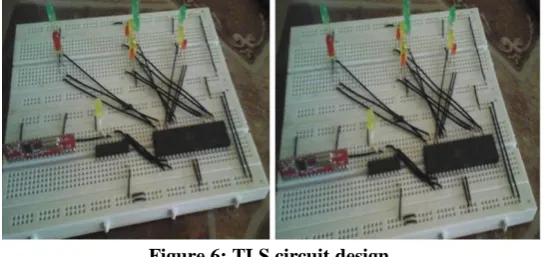
C. TLS circuit
The circuit shown below is the Traffic Light System circuit, as shown in this circuit it consists of the following: Receiver RF, Decoder (HT 12), 16 LEDS, and Microcontroller (ATMEGA 32).
ISSN(E): 2277-128X, ISSN(P): 2277-6451, pp. 50-56
The mission of this part of system is coming from the reception signals ambulances to give it full control of signals and priority at traffic at any time.
D. Vehicle circuit result:
After turning on the vehicle circuit, sensors turning on, the circuit determines the location based on latitude and longitude and as shown on LCD (See figure next).
Figure 7: Vehicle circuit result
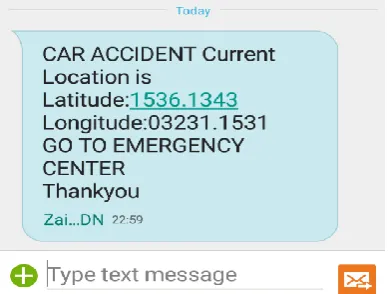
The figure below shows the form of the message sent by the vehicle circuit containing the location.
Figure 8: form of the message which sent by the vehicle circuit
E. Ambulance and TLC circuits result
After connecting the ambulances and the TLC circuit and operating them, we found that when pressing one of the switches in the ambulance circuit, one of the LEDs light turn the green light while the rest is running the red light - which symbolizes four traffic signals distributed in the form of signals in the intersections of four ways - Another key occurs the same process but from a different direction as shown in the pictures below different direction as shown in the pictures below
ISSN(E): 2277-128X, ISSN(P): 2277-6451, pp. 50-56
Through the results achieved and explained previously, the importance of the proposal is shown by giving the opportunity and priority and control of ambulances to enable them to exploit the golden hour in the best way and to provide the opportunity to save critical cases that are dealt with after the collision of traffic, In the previous chapter that the proposal represents a good opportunity to reduce the time of arrival of ambulances to hospitals and emergency units, which is an important factor among other factors that negatively affect or respond to the rescue in cases of traffic accidents.
We have determined through the experiments that giving priority to ambulances is one of the most important factors that must be dealt with great attention, because it is related to the time of arrival appropriate to the centers of receiving the ambulance service and avoidance of danger to life. it also explained to us the importance of addressing the concept of the golden hour and its direct association with the survival of the patients.
IV. CONCLUSION
All applied and pure human sciences agree that the ultimate goal of research, studies, inventions and innovations is to facilitate the daily life of human and to preserve his life. The value of preserving and protecting human beings is the first of all human values and the great goals of science. On this general path, through which we have reached an innovative way to facilitate the task of ambulance personnel and give them priority and time to save the injured during traffic accidents, and as shown from the above results, this proposal contributes effectively to reduce the number of loya l Resulting in traffic accidents by giving ambulances and paramedics priority and reducing their travel time Therefore, we recommend that this proposal be applied to the Khartoum state in a preliminary manner, and then circulate it to all states with high population density and traffic congestion. Also we recommend to deal seriously with the concept of golden hour because it present an important time and maybe it take some human life in critical zone and can change the future of people.
REFERENCES
[1] Atubi, A.O., 2012. Road Traffic accidents in Warri and Environs: A ten-year survey. AFRREV IJAH: An International Journal of Arts and Humanities, 1(2), pp.195-210
[2] World Health Organization, 2015. Global status report on road safety 2015. World Health Organization.
[3] World Health Organization. Violence, Injury Prevention and World Health Organization, 2013. Global status report on road safety 2013: supporting a decade of action. World Health Organization.
[4] Per, L. and Al-Haji, G., 2005. Road Safety in Southeast Asia Factors Affecting Motorcycle Safety. Dept of Science and Technology, Linkoping University, Sweden.
[5] World Health Organization, 2015. Global status report on road safety 2015. World Health Organization.
[6] Sumayya, P.A. and Shefeena, P.S., 2015. Vanet based vehicle tracking module for safe and efficient road transportation system. Procedia Computer Science, 46, pp.1173-1180.
[7] Prachi, B., Kasturi, D. and Priyanka, C., 2014. Intelligent accident-detection and ambulance-rescue system. PULSE, 450(16), p.2.
[8] Sonika, S., Sathiyasekar, D.K. and Jaishree, S., 2014. Intelligent accident identification system using GPS, GSM modem. International Journal of Advanced Research in Computer and Communication Engineering, 3(2). [9] Prachi, B., Kasturi, D. and Priyanka, C., 2014. Intelligent accident-detection and ambulance-rescue system.
PULSE, 450(16), p.2.
[10] Martinez, F.J., Toh, C.K., Cano, J.C., Calafate, C.T. and Manzoni, P., 2010. Emergency services in future intelligent transportation systems based on vehicular communication networks. IEEE Intelligent Transportation Systems Magazine, 2(2), pp.6-20.
[11] Martinez, F.J., Toh, C.K., Cano, J.C., Calafate, C.T. and Manzoni, P., 2010. Emergency services in future intelligent transportation systems based on vehicular communication networks. IEEE Intelligent Transportation Systems Magazine, 2(2), pp.6-20.
[12] International Journal of Scientific & Engineering Research, Volume 4, Issue 8, August-2013 1937 ISSN 2229-5518 IJSER © 2013 http://www.ijser.org
[13] Automatic Vehicle Accident Detection And Messaging System Using GPS and GSM Modems Sri Krishna Chaitanya Varma, Poornesh, Tarun Varma, Harsha
[14] Prabha, C., Sunitha, R. and Anitha, R., 2014. Automatic vehicle accident detection and messaging system using GSM and GPS modem. International Journal of Advanced Research in Electrical, Electronics and Instrumentation Engineering, 3(7), pp.10723-10727
ISSN(E): 2277-128X, ISSN(P): 2277-6451, pp. 50-56
[16] Ghazal, B., ElKhatib, K., Chahine, K. and Kherfan, M., 2016, April. Smart traffic light control system. In Electrical, Electronics, Computer Engineering and their Applications (EECEA), 2016 Third International Conference on (pp. 140-145). IEEE.
[17] Kham, N.H. and Nwe, C.M., 2014. Implementation of modern traffic light control system. International journal of scientific and research publications, 4(6).
[18] Kham, N.H. and Nwe, C.M., 2014. Implementation of modern traffic light control system. International journal of scientific and research publications, 4(6).
[19] Hashim, N.M.Z., Jaafar, A.S., Ali, N.A., Salahuddin, L., Mohamad, N.R. and Ibrahim, M.A., 2013. Traffic light control system for emergency vehicles using radio frequency. IOSR Journal of Engineering (IOSRJEN) Volume, 3, pp.43-52.
[20] White, J., Thompson, C., Turner, H., Dougherty, B. and Schmidt, D.C., 2011. Wreckwatch: Automatic traffic accident detection and notification with smartphones. Mobile Networks and Applications, 16(3), pp.285-303. [21] Prabha, C., Sunitha, R. and Anitha, R., 2014. Automatic vehicle accident detection and messaging system using
GSM and GPS modem. International Journal of Advanced Research in Electrical, Electronics and Instrumentation Engineering, 3(7), pp.10723-10727.