ARTIGO ORIGINAL
ABSTRACT
Introduction: Congenital adrenal hyperplasia due to 21-hydroxylase deficiency is one of the most frequent inborn conditions. It is
caused by distinct mutations in the CYP21A2 gene and in the majority of cases the disease’s severity correlates with CYP21A2 allelic variation Our aim was to describe the mutational spectrum of CYP21A2 and evaluate genotype-phenotype correlation in a cohort of portuguese patients with 21-hydroxylase deficiency.
Material and Methods: Retrospective study of 22 patients with clinical diagnosis of 21-hydroxylase deficiency. Molecular analysis of
CYP21A2 was performed and genotype-phenotype correlation was then established.
Results: Genotyping was performed in 22 unrelated patients: 5 with classic salt-wasting (average age of diagnosis 10.2 days; minimum
1, maximum 20 days), 7 with classic simple virilizing (average age of diagnosis 3.5 years; minimum 0 days, maximum 7 years) and 10 with nonclassical form (average age of diagnosis 5.7 years; minimum 4 years, maximum 8 years). The most frequent genetic defects in the classic forms were I2 splice (24%) and I172N (24%), followed by Q318X (16%) and gene deletions (16%) and in the nonclassical form, the V281L (80%). The overall concordance between genotype and phenotype was 81,8%. Genotype accurately predicted phenotype in 83.3%, 100% and 90% of patients with classic salt-wasting, classic simple virilizing and nonclassical mutations, respectively.
Discussion: The frequency of genetic defects in our patients was comparable to similar studies. In most cases there was a good
correlation between genotype and phenotype.
Conclusions: Molecular analysis of CYP21A2 provides useful information in terms of prediction of disease severity, genetic and
prenatal counseling.
Keywords: Adrenal Hyperplasia, Congenital; Genotype; Phenotype; Steroid 21-Hydroxylase.
Congenital Adrenal Hyperplasia Due to
21-Hydroxylase Deficiency:
Genotype-Phenotype Correlation
Hiperplasia Congénita da Suprarrenal por Deficiência de 21-Hidroxílase:
Correlação Genótipo-Fenótipo
1. Departamento da Criança e do Adolescente. Unidade de Endocrinologia Pediátrica. Centro Hospitalar do Porto. Porto. Portugal. 2. Serviço de Endocrinologia, Diabetes e Metabolismo. Centro Hospitalar do Porto. Porto. Portugal.
Recebido: 10 de Junho de 2014 - Aceite: 13 de Outubro de 2014 | Copyright © Ordem dos Médicos 2015
Catarina MENDES1, Inês VAZ MATOS1, Luís RIBEIRO1, Maria João OLIVEIRA1, Helena CARDOSO2, Teresa BORGES1
Acta Med Port 2015 Jan-Feb;28(1):56-62
RESUMO
Introdução: A hiperplasia congénita da suprarrenal por deficiência de 21-hidroxílase constitui uma das doenças hereditárias mais
comuns. Resulta de diferentes mutações no gene CYP21A2 e, na maioria dos casos, a gravidade da doença correlaciona-se com a variação alélica do CYP21A2. O objetivo deste estudo foi descrever o espectro mutacional do CYP21A2 e avaliar a correlação genótipo-fenótipo numa coorte de doentes portugueses com deficiência de 21-hidroxílase.
Material e Métodos: Estudo retrospetivo de 22 doentes com diagnóstico clínico de deficiência de 21-hidroxílase. Foi feita análise
molecular do CYP21A2 e estabelecida a correlação genótipo-fenótipo.
Resultados: Foi realizada genotipagem em 22 doentes não relacionados: 5 com a forma clássica perdedora de sal (idade média ao
diagnóstico de 10,2 dias; mínimo 1, máximo 20 dias), 7 com a forma clássica virilizante simples (idade média ao diagnóstico de 3,5 anos; mínimo 0 dias, máximo 7 anos) e 10 com a forma não clássica (idade média ao diagnóstico de 5,7 anos; mínimo 4 anos, máximo 8 anos). Os defeitos genéticos mais frequentes nas formas clássicas foram o I2 splice (24%) e I172N (24%), seguindo-se o Q318X (16%) e deleções de genes (16%) e, na forma não clássica, o V281L (80%). Verificou-se uma concordância genótipo-fenótipo global de 81,8%. O genótipo permitiu prever adequadamente o fenótipo em 83,3%, 100% e 90% dos doentes com mutações compatíveis com a forma clássica perdedora de sal, clássica virilizante simples e não clássica, respectivamente.
Discussão: A frequência de defeitos genéticos observados nos nossos doentes é comparável a estudos semelhantes. Observou-se,
na maioria dos casos, uma boa correlação genótipo-fenótipo.
Conclusões: A análise molecular do CYP21A2 fornece informação importante relativamente à gravidade da doença e no
aconselha-mento genético e pré-natal.
Palavras-chave: Esteróide 21-Hidroxílase; Fenótipo; Genótipo; Hiperplasia Congénita Suprarrenal.
INTRODUCTION
Congenital adrenal hyperplasia (CAH) includes a group of autosomal recessive genetic disorders affecting corti-sol synthesis. It is one of the most common genetic dis-eases and approximately 95% of the patients present with 21-hydroxylase (21-OH) enzyme deficiency,1 an enzyme responsible for the conversion of 17-hydroxyprogesterone (17-OHP) into 11-deoxycortisol, a cortisol precursor and for the conversion of progesterone into deoxy-corticosterone,
an aldosterone precursor.2
ARTIGO ORIGINAL
CYP21A2 within meiosis.5 Approximately 75% of the
patients are compound heterozygous for mutations that are responsible for the disease and its severity is determined by the activity of the less seriously affected allele which maintains residual 21-OH activity.6-9
CAH is ranked into classical and non-classical (NC) forms. Classical CAH is subdivided into salt-wasting (SWCAH) and non-salt wasting, also termed simple virilising CAH (SVCAH).
Classical CAH occurs in around 1 in each 7,000-15,000 births, on most populations.10 Non-classical CAH incidence is less well-defined, although a prevalence of 1 in each 1,000 births is estimated.11
In SWCAH, unlike SVCAH, patients are not able to synthesize enough aldosterone in order to keep sodium homeostasis,6-9 corresponding to the most severe form of the disease and affecting approximately 75% of the patients presenting with the classical form.12
Beyond the signs of virilisation and hypocortisolism, the patients present with mineralocorticoid failure, with a tendency for potentially deadly episodes of hypotension, hyponatremic dehydration with hyperkalemia and hypovolemic shock, particularly in newborn infants.6-9,12 The diagnosis is usually early in life in female patients due to the presence of genital virilisation, secondary to androgen excess during pregnancy. In male newborn infants, clinical manifestations are more subtle, involving scrotal and genital hyperpigmentation at birth, feeding difficulties and failure to thrive. Diagnosis may be obtained later, often in the context of an adrenal crisis.6-9,12
CAH presents with signs of prenatal virilisation of external genitalia in females and hypocortisolism and pseudo-precocious puberty in both genders.11,12 It may present with accelerated growth and advancement of skeletal maturation, phallic enlargement in boys and clitoromegalia in girls.7,11,12
The milder forms are termed non-classical or late-onset forms. These do not present with neonatal genital virilisation but rather with signs of hyperandrogenism at a later stage. It may present with development of pubic hair, acne and advanced bone age in childhood and with acne, hirsutism and abnormal menstrual cycles in adolescence. It may in fact be asymptomatic in male patients.11,12
The elevation of 17-OHP – the main substrate for the enzyme - is the most characteristic biochemical abnormality in 21-OH deficiency. Basal serum 17-OHP values usually exceed 10,000 ng/dL although about 10% of severely affected infants have low initial levels in the newborn period, especially if levels are obtained on the first day of life. Measurements of basal serum 17-OHP significantly increase upon ACTH stimulation (1,500 to 10,000 ng/dL).12 but levels may be normal or slightly elevated in NC forms. Several studies analysed the correlation between CYP21A2 genotype and the phenotype6,7,9,13 and found
this to be high (80-90%) although the phenotype may not always be predicted by the genotype.8,13,14
Our study aimed to describe the spectrum of mutations of the CYP21A2 gene in patients with CAH and to assess the genotypic-phenotypic correlation in a group of Portuguese children with 21-OH deficiency.
MATERIAL AND METHODS:
This was a retrospective study involving 22 children with clinical and laboratorial criteria of 21-OH deficiency attending the Endocrinology Department at Porto Hospital Centre between 2000 and 2013.
Molecular testing of CYP21A2 gene was carried out in all the patients, based on DNA obtained from peripheral blood samples. The most common mutations were analysed, as well as deletions/conversions in the CYP21A2 gene: P30L (exon 1), I2 splice (intron 2), I172N (exon 4), V281L (exon 7), Q318X and R356W (exon 8), cluster E6 (exon 6), P453S (exon 10).
Testing did not include the sequencing of the entire gene in patients in whom no mutation was found.
The search for large deletions/conversions in the CYP21A2 gene was based on multiplex ligation-dependent probe amplification (MRC Holland) techniques.
Phenotype classification of patients was established upon a joint review by the three pediatric endocrinologists in our Department, based on clinical and hormonal criteria, through the retrospective analysis of patient’s clinical record. In the presence of evident clinical and biochemical signs of adrenal crisis (failure to thrive, hyponatremia, hyperkalemia and high renin level), patients were ranked as presenting with SWCAH. In this group, the level of 17-OHP in the first month of life was > 2,500 ng/dL. The female patients with ambiguous genitalia but no electrolyte imbalance or in whom an early virilisation beyond the neonatal period was detected, were classified as presenting with SVCAH forms. The boys that developed signs and symptoms of hyperandrogenism, advanced growth or bone age, with high levels of 17-OHP but no evidence of salt wasting were also included in this group of patients. The presence of symptoms of hyperandrogenism in pre-puberty (development of pubic hair, acne, hirsutism, adult body odor and absence of complete genital virilisation) associated to high levels of 17-OHP was used for the diagnosis of patients with non-classical forms. These patients had levels of 17-OHP ≥ 500 ng/dL.
Classification by mutation group:
The mutations that are responsible for the disease were classified into 4 groups, according to the level of the estimated enzymatic activity for each mutation, based on
ARTIGO ORIGINAL
Table 1
-
Type of molecular defect, clinical and biochemical data of non-family related patients with 21-OH deficiency
Patient Gender Genotype Clinical presentation Age at diagnosis Basal 17-OHP level (ng/dL) Stimulated 17-OHP level (ng/dL) T (ng/dL) Observed phenotype Active renin level (pg/mL) 1 F Q318X/Q318X/del
Adrenal crisis + V
irilisation 8 d 6970 -1172 SWCAH > 300 2 F R356W/R356W
Adrenal crisis + V
irilisation 12 d -SWCAH -3 M I2 splice/F306+nt Adrenal crisis 10 d 5850 -2241 SWCAH -4 F
I2 splice/I2 splice
Adrenal crisis + V
irilisation 20 d 5820 -292 SWCAH 20062 5 F I2 splice/Δ8pb/Q318X Virilisation 1 d 3220 -1330 SWCAH 37.2 6 F I2 splice/I172N Virilisation 0 d > 2500 -SVCAH -7 F I172N/I172N
Precocious puberty + V
irilisation 2 Y 4690 -SVCAH 33.65 8 M I2 splice/I172N
Precocious puberty +
AG 2 Y 3652 3960 292 SVCAH 11 2 9 F I172N/F306+nt
Precocious puberty + V
irilisation 3 Y 5350 -SVCAH 28 10 M Q318X/-Puberdade precoce 3 Y 4230 -SVCAH -11 M I172N/V281L
Precocious puberty +
AG 4 Y 4550 -142 SVCAH 165 12 M Δ8pb/del
Precocious puberty +
AG + O
7 Y 9554 8884 -SVCAH -13 F V281L/Q318X
Precocious puberty +
AG 4 Y 1220 -32 NC -14 F I172N/V281L
Precocious puberty +
AG 4 Y 4140 -21 NC -15 F V281L/V281L
Precocious puberty +
AG 5 Y 2880 3750 79 NC -16 F V281L/V281L/del
Precocious puberty +
AG 5 Y 3120 -78 NC -17 F V281L/V281L
Precocious puberty +
AG + O
5 Y 830 -22 NC -18 F V281L/V281L Precocious puberty 7 Y 1700 3150 77 NC -19 F I172N/V281L
Precocious puberty +
AG + O
7 Y 4170 -50 NC -20 F
V281L/-Precocious puberty + O
7 Y 500 1600 -NC -21 M V281L/V281L
Precocious puberty +
AG 8 Y 4730 -30.3 NC -22 F V281L/V281L
Precocious puberty + O
5 Y 1270 3901 4.0 NC -AG – advanced growth; O – adult body odor; SWCAH – salt-wasting CAH classical form; SVCAH – simple virilising CAH classical form; NC – nonclassical form; 17-OHP (17-hydroxiprogesterone); Stimulated 17-OHP – 17-OHP levels upon ACTH stimulation test; T –
Testosterone; d – days;
ARTIGO ORIGINAL
∆8bp, F306+t, cluster E6, Q318X, R356W). Group A included patients homozygous for l2 splice mutation or compound heterozygous for I2 splice and null mutation, with minimal enzyme activity (0-1%). Group B included the patients with I172N mutations (with ~2% residual enzyme activity), homozygous or compound heterozygous with groups 0, A or B. Group C included genotypes with a mild mutation in at least one of the V281L, P30L or P453s alleles (~20-60% residual enzyme activity, homozygous or compound heterozygous with group 0, A or B. A fifth group (unclassified) included patients in whom only one mutation in one of the alleles of CYP21A2 was found.
The expected phenotype for group 0 and A is SWCAH, SVCAH for group B patients and NC CAH forms for group C patients.
Based on the patient’s genotype, a predicted phenotype was established, according to the enzyme activity (allowed by the less- affected allele) and the degree of concordance between the expected and the observed phenotype was evaluated.
RESULTS
In total, 22 non-related patients diagnosed with CAH due to 21-OH deficiency were genotyped. The molecular defects, as well as clinical and biochemical data are shown in Table 1. As regards the clinical phenotype, 12 patients (54.5%) presented with the classical form (5 patients with SWCAH [41.7%], 7 with SVCAH [58.3%]), and 10 patients (45.5%) with the non-classical form.
All the patients were Caucasian and a clear female predominance (16/22 patients) was found.
The average age at which SWCAH was diagnosed was 10.2 days (minimum 1, maximum, 20 days). As regards SVCAH, only one newborn girl was diagnosed at birth. In the remaining patients the average age was 3.5-years (minimum, 2 years, maximum, 7 years). Non-classical forms were diagnosed at an age average of 5.7-year (minimum, 4 years, maximum, 8 years).
A subsequent 21-OH deficiency diagnosis was found
in the brothers (upon family screening) of two patients (patients 16 and 21) (these were not included in the study). The remaining patients did not show any positive family history.
Basal levels of 17-OHP varied between 2,500 and 9,554 ng/dL in classical and between 500 and 4,730 ng/dL in non-classical forms. In the patients that underwent the ACTH stimulation test the 17-OHP level measured at 60 minutes varied between 1,600 and 8,884 ng/dL.
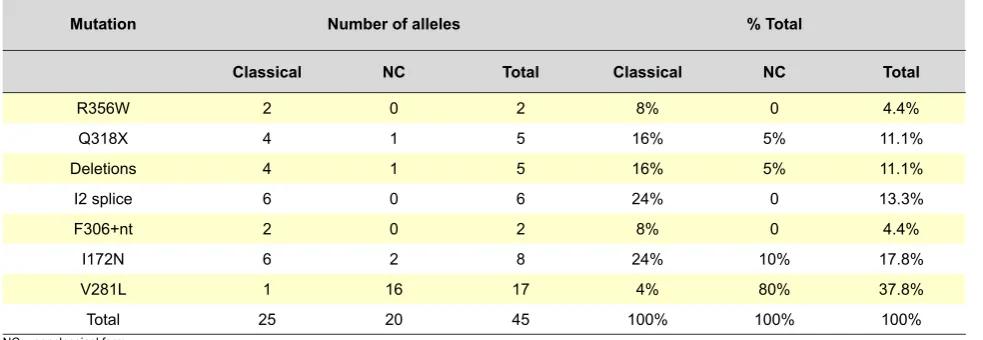
The frequency of molecular defects found in our group of patients is shown in Table 2. From the 22 patients, mutations in both alleles were found in 20 patients (90.9%), therefore confirming the genetic diagnosis of the disease. The presence of only one mutation (Q318X and V281L) was found in 2 patients. The most prevalent mutations in the classical form were the I2 splice (24%) and the I172N (24%), followed by the Q318X mutation (16%) and gene deletions (16%). In non-classical forms, V281L was the most frequent mutation (80%).
The type of mutation according to the expected degree of enzyme activity and expected clinical phenotype is shown in Table 3. Eight patients were homozygous for mutations, 12 were compound heterozygous and 2 were heterozygous for one mutation. A 81.8% genotype-phenotype concordance (18/22 patients) was found, with total concordance in groups A and B where SWCAH and SVAH presentation was expected, respectively. A newborn girl diagnosed on the first day of life with ambiguous genitalia, despite not having presented with salt-wasting signs, was classified as a SWCAH phenotype as she required treatment with mineralocorticoid and salt supplementation. Early diagnosis and treatment were provided to this patient and adrenal crisis was prevented. In group 0, in which SWCAH was expected, one of three patients was discordant (66.7% genotype-phenotype concordance). This was a boy with a mutation consistent with the SWCAH form and with SVCAH clinical manifestations, who was diagnosed at the age of 7 due to the development of signs of puberty and advanced growth, with basal 17-OHP levels of 9,554 ng/dL at the time Table 2 - Frequency of mutations in 45 affected alleles in 22 non-family related patients with 21-OH deficiency
Mutation Number of alleles % Total
Classical NC Total Classical NC Total
R356W 2 0 2 8% 0 4.4%
Q318X 4 1 5 16% 5% 11.1%
Deletions 4 1 5 16% 5% 11.1%
I2 splice 6 0 6 24% 0 13.3%
F306+nt 2 0 2 8% 0 4.4%
I172N 6 2 8 24% 10% 17.8%
V281L 1 16 17 4% 80% 37.8%
Total 25 20 45 100% 100% 100%
ARTIGO ORIGINAL Table 3 - Genotypes ranked according to the expected severity of the involved mutations and its correlation with the phenotype
Group Genotype patientsNº of Observed phenotype
Expected
phenotype Genotype-phenotype correlation
SWCAH SVCAH NC
Group 0 R356W/R356W 1 1 SWCAH 100%
Q318X/Q318X/del 1 1 SWCAH 100%
Δ8pb/del 1 1 SWCAH 0%
Group A I2 splice/F306+nt 1 1 SWCAH 100%
I2 splice/Δ8pb/Q318X 1 1 SWCAH 100%
I2 splice/I2 splice 1 1 SWCAH 100%
Group B I2 splice/I172N 2 2 SWCAH 100%
I172N/I172N 1 1 SWCAH 100%
I172N/F306+nt 1 1 SWCAH 100%
Group C I172N/V281L 3 1 2 NC 66.7%
V281L/V281L 5 5 NC 100%
V281L/V281L/del 1 1 NC 100%
V281L/Q318X 1 1 NC 100%
Non-classified Q318X/- 1 1 Asymptomatic 0%
V281L/- 1 1 Asymptomatic 0%
Total 22 5 7 10 81.8%
SWCAH – salt-wasting CAH; SVCAH – simple virilising CAH; NC – nonclassical form.
of diagnosis and stimulated 17-OHP levels of 8,884 ng/dL. A 90% concordance was found in group C (9/10 patients). A discordant patient regarded a boy with a consistent genotype with a NC form and presenting with SWCAH clinical phenotype. This patient presented with precocious pseudo-puberty signs and intensely advanced growth at the age of 4, with a testosterone level of 142 ng/ dL and basal 17-OHP of 4,550 ng/dL.
Two patients, one boy with SWCAH clinical manifestations at the age of 3 and a girl with NC CAH phenotype diagnosed at the age of 7, presented with a single mutation and were expected to have been asymptomatic.
DISCUSSION
Our study describes the mutational spectrum, as well as the allelic frequency and genotype-phenotype correlation regarding a group of Portuguese non-related patients with CAH due to 21-OH deficiency.
All the mutations identified in our patients had been previously recognized6,7,11,generated by the recombination between the active CYP21 gene and its pseudogene. In our group of patients, the mutational spectrum was generally in line with that described in several studies. 6,7,15-18 The most prevalent mutations found in the classical forms included the I2 splice (24%) and I172N (24%), followed by the Q318X (16%) and gene deletions (16%). A higher frequency of the Q318X mutation than in most populations was found in our group of patients, also in line with other studies.19,20 The V281L mutation was more prevalent in NC forms (80%), in line with other populations,6-9,17,18,20-23 as well as with a previous study involving the Portuguese population.13 A good genotype-phenotype correlation was found in our study (global correlation of 81.8%) and the
genotype allowed for a phenotype prediction in 83.3%, 100% and 90% of the patients with mutations consistent with SWCAH, SVCAH and NC forms, respectively. The groups A and B were those in which a higher concordance was found. This difference regarding other studies14,16-21,24 (in which a higher concordance was found in the groups at the extremes of severity) may be explained by the reduced size of our group of patients and by the type of mutations found. The observed phenotype was less severe than expected on one patient (patient 12). This was a patient with two null mutations presenting with SWCAH. In such patients, some studies14,25 hypothesise that genetic variations in CYP2C19 and CYP3A4, the presence of other enzymes with a capability to modulate the electrolyte balance in patients with CAH or a combination of unknown factors may model these steroid pathways and therefore explain these findings.
In contrast, one of the patients (patient 11) presented with a more severe form than expected by the genotype, with clinical manifestations compatible with SVCAH and a NC-predictor genotype. The high variability of the enzyme activity in the mutation I172N14 can contribute to the phenotype variability and may explain this patient’s diagnosis. The observed discrepancies may also be explained by new mutations that were not searched at the time of diagnosis (and that may explain for the phenotype of the 2 children in whom only one mutation was detected), by incomplete genotyping, by compound heterozygosity for two or more mutations and by other genetic variations in androgen biosynthesis or sensitivity.
ARTIGO ORIGINAL
REFERENCES
1. Merke DP, Bornstein SR. Congenital adrenal hyperplasia. Lancet. 2005;365:2125-36.
2. Miller WL. Molecular biology of steroid hormone synthesis. Endocr Rev. 1988;9:295-318.
3. White PC, Tusie-Luna MT, New MI, Speiser PW. Mutations in steroid 21-hydroxylase (CYP21). Hum Mutat. 1994;3:373–8.
4. Miller WL. Genetics, diagnosis and management of 21-hydroxylase deficiency. J Clin Endocrinol Metab. 1994;78:241–6.
5. Koppens PF, Hoogenboezem T, Degenhart HJ. Carriership of a defective tenascin-X gene in steroid 21-hydroxylase deficiency patients: TNXB-TNXA hybrids in apparent large-scale gene conversions. Hum Mol Genet. 2002;11:2581–90.
6. Speiser PW, Dupont J, Zhu D, Serrat J, Buegeleisen M, Tusie-Luna MT, et al. Disease expression and molecular genotype in congenital adrenal hyperplasia due to 21-hydroxylase deficiency. J Clin Invest. 1992;90:584–95.
7. Wedell A, Thilen A, Ritzen EM, Stengler B, Luthman H. Mutational spectrum of the steroid 21-hydroxylase gene in Sweden: implications for genetic diagnosis and association with disease manifestation. J Clin Endocrinol Metab. 1994;78:1145–52.
8. Wilson RC, Mercado AB, Cheng KC, New MI. Steroid 21-hydroxylase deficiency: genotype may not predict phenotype. J Clin Endocrinol Metab. 1995;80:2322–9.
9. Ezquieta B, Oliver A, Gracia R, Gancedo PG. Analysis of steroid 21-hydroxylase gene mutations in the Spanish population. Hum Genet. 1995;96:198–204.
10. Pang SY, Wallace MA, Hofman L, Thuline HC, Dorche C, Lyon IC, et at. Worldwide experience in newborn screening for classical congenital adrenal hyperplasia due to 21-hydroxylase deficiency. Pediatrics. 1998;81:866–74.
11. Speiser PW, Dupont B, Rubinstein P, Piazza A, Kastelan A, New MI. High frequency of non-classical steroid 21-hydroxylase deficiency. Am J Hum Genet. 1985;37:650–67.
12. White PC, Speiser PW. Congenital adrenal hyperplasia due to 21-hydroxylase deficiency. Endocr Rev. 2000;21:245–91.
13. Friães A, Rêgo AT, Aragüés JM, Moura LF, Mirante A, Mascarenhas MR, et al. CYP21A2 mutations in Portuguese patients with congenital adrenal hyperplasia: identification of two novel mutations and characterization of diagnosis, as well as an underestimate of the forms with milder clinical presentation1,23 or reflect the small size of the group of patients. In addition, the NC form of CAH may present with a variety of symptoms of hyperandrogenism, making a differential diagnosis more difficult, namely with the Polycystic Ovary Syndrome. It should be mentioned that only patients aged below 18 were included in our group of patients and that many NC forms of CAH are diagnosed in adult age related to infertility.26
A female predominance was also evident, in line with literature. As an autosomic recessive pathology, it should occur equally in both genders.23 This asymmetry, mainly observed in NC forms, in which all the children presented with a V281L genotype in at least one of the alleles (with a 9:1 female:male proportion) may relate to the fact that boys are often underdiagnosed as signs of hyperandrogenism are less obvious.17
CONCLUSIONS
The knowledge of the ethnic origin of the CYP21A2 mutations is crucial in all CAH forms. The fact that there is a limited number of mutations responsible for most CAH cases, already described in literature and confirmed in our
study, makes the detection of mutations useful in prenatal screening. The prenatal diagnosis with the analysis of DNA obtained by amniocentesis or by a chorionic villus biopsy has major therapeutic impact in female gender and prevents external genitalia virilisation and an incorrect gender attribution. In addition, it may anticipate the development of a potentially lethal adrenal crisis and prevent hyperandrogenism in childhood.
Despite some variability in clinical expression, a good correlation of the CYP21A2 genotype with the CAH phenotype was found in most cases. Therefore, our study reinforces the importance of the molecular study of the CYP21A2 as a complementary tool to predict the severity of the disease as well as the importance in genetic and prenatal counselling.
CONFLICTS OF INTEREST
The authors declare that there were no conflicts of interest in writing this manuscript.
FINANCIAL SUPPORT
The authors declare that there was no financial support for writing this manuscript.
four different partial gene conversions. Mol Genet Metab. 2006;88:58– 65.
14. Finkielstain GP, Chen W, Mehta SP, Fujimura FK, Hanna RM, Van Ryzin C, et al. Comprehensive genetic analysis of 182 unrelated families with congenital adrenal hyperplasia due to 21-hydroxylase deficiency. J Clin Endocrinol Metab. 2011;96:E161-72.
15. Wedell A. Molecular genetics of congenital adrenal hyperplasia (21- hydroxylase deficiency): implications for diagnosis, prognosis and treatment. Acta Paediatr. 1998;87:159-64.
16. Krone N, Braun A, Roscher AA, Knorr D, Schwarz HP. Predicting phenotype in steroid 21-hydroxylase deficiency? Comprehensive genotyping in 155 unrelated, well defined patients from southern Germany. J Clin Endocrinol Metab. 2000;85:1059-65.
17. New MI, Abraham M, Gonzalez B, Dumic M, Razzaghy-Azar M, Chitayat D, et al. Genotype-phenotype correlation in 1,507 families with congenital adrenal hyperplasia owing to 21-hydroxylase deficiency. Proc Natl Acad Sci U S A. 2013;110:2611-6.
18. Vieira A, Paiva S, Baptista C, Ruas L, Silva J, Gonçalves J, et al. Late onset congenital adrenal hyperplasia due to 21-hydroxylase deficiency: revision of literature and preconception genetic study of five couples. Acta Med Port. 2011;24:99-110.
19. Dracopoulou−Vabouli M, Maniati−Christidi M, Dacou−Voutetakis C. The spectrum of molecular defects of the CYP21 gene in the Hellenic population: Variable concordance between genotype and phenotype in the different forms of congenital adrenal hyperplasia. J Clin Endocrinol Metab. 2001;86:2845–8.
20. Carrera P, Bordone L, Azzani T, Brunelli V, Garancini MP, Chiumello G, et al. Point mutations in Italian patients with classic, non-classic, and cryptic forms of steroid 21-hydroxylase deficiency. Hum Genet. 1996;98:662–5.
21. Bachega TA, Billerbeck AE, Madureira G, Marcondes JA, Longui CA, Leite MV, et al. Molecular genotyping in Brazilian patients with the classical and nonclassical forms of 21-hydroxylase deficiency. J Clin Endocrinol Metab. 1998;83:4416–9.
22. Rumsby G, Avey CJ, Conway GS, Honour JW. Genotype-phenotype analysis in late onset 21-hydroxylase deficiency in comparison to the classical forms. Clin Endocrinol. 1998;48:707–11.
ARTIGO ORIGINAL
deficiency. J Clin Endocrinol Metab. 2006;91:4205-14.
24. Skordis N, Kyriakou A, Tardy V, Ioannou YS, Varvaresou A, Dracopoulou-Vabouli M, et al. Molecular defects of the CYP21A2 gene in Greek-Cypriot patients with congenital adrenal hyperplasia. Horm Res Paediatr. 2011;75:180-6.
25. Gomes LG, Huang N, Agrawal V, Mendonça BB, Bachega TA, Miller
WL. Extraadrenal 21-hydroxylation by CYP2C19 and CYP3A4: effect on 21-hydroxylase deficiency. J Clin Endocrinol Metab. 2009;94:89–95. 26. Marques CJ, Pignatelli D, Carvalho B, Barceló J, Almeida AC, Fernandes
Catarina MENDES, Inês VAZ MATOS, Luís RIBEIRO, Maria João OLIVEIRA, Helena CARDOSO, Teresa BORGES