ARTIGO ORIGINAL
RESUMO
Introdução: As pessoas com demência e os seus familiares deveriam ter acesso atempado a cuidados formais na comunidade (centros de dia, apoio domiciliário). O projecto EU-Actifcare investigou o acesso/utilização destes serviços em países europeus. Des-crevemos a implementação do estudo de coorte e a avaliação inicial em Portugal, com foco nas necessidades de cuidados e recurso aos serviços.
Material e Métodos: Selecionámos uma amostra de conveniência de 66 pessoas com diagnóstico de demência ligeira a moderada (residindo na comunidade sem cuidados formais relevantes) e respetivos familiares-cuidadores. A avaliação (clínico-funcional e social) incluiu os instrumentos Camberwell Assessment of Need for the Elderly e Resource Utilization in Dementia.
Resultados: Identificámos necessidades não-cobertas dos doentes (média 1,1; DP = 1,7), principalmente de companhia (23% dos casos), sofrimento psicológico (20%) e atividades diárias (14%). Os familiares-cuidadores dedicavam 150 minutos/dia (mediana) à prestação de cuidados e 44% apresentavam necessidades não-cobertas de sofrimento psicológico. Quando havia problemas de acesso/utilização dos serviços de saúde e sociais na comunidade, estes estavam frequentemente relacionados com recusa ou des-conhecimento de utentes/familiares.
Discussão: A seleção dos participantes não foi fácil, pela especificidade dos critérios adotados. Não almejando representatividade nacional, recrutámos uma amostra típica de pessoas em estádios ligeiros a moderados de demência, em serviços e regiões diferen-tes. Nalguns casos, encontrámos necessidades não-cobertas e repercussões familiares que já justificariam respostas de serviços na comunidade, não fossem os problemas de acesso/utilização.
Conclusão: Na área das demências, existem dificuldades no acesso atempado e utilização efectiva de cuidados formais, coexistindo com uma cobertura menor de necessidades específicas.
Needs for Care and Service Use in Dementia: Baseline
Assessment of Portuguese Participants in the Actifcare
Cohort Study
Necessidades de Cuidados e Recurso aos Serviços na
Demência: Avaliação Inicial da Coorte Portuguesa no
Estudo Actifcare
1. Centro de Estudos de Doenças Crónicas - CEDOC. Faculdade de Ciências Médicas / NOVA Medical School. Universidade NOVA de Lisboa. Lisboa. Portugal. 2. Unidade de Saúde Familiar Marginal. Agrupamento dos Centros de Saúde de Cascais. Cascais. Portugal.
3. Unidade de Saúde Familiar Fernão Ferro Mais. Agrupamento dos Centros de Saúde de Almada-Seixal. Seixal. Portugal 4. Instituto de Saúde Ambiental. Faculdade de Medicina. Centro Hospitalar e Universitário de Lisboa. Lisboa. Portugal. 5. Faculdade de Ciências Médicas / NOVA Medical School. Universidade NOVA de Lisboa. Lisboa. Portugal. 6. Hospital de Egas Moniz. Centro Hospitalar de Lisboa Ocidental. Lisboa. Portugal.
7. Nottingham Institute of Mental Health. Nothingham. United Kingdom. 8. Bangor University. Bangor. United Kingdom.
9. Maastricht University. Maastricht. The Netherlands.
Autor correspondente: Manuel Gonçalves-Pereira. [email protected]
Recebido: 01 de agosto de 2018 - Aceite: 10 de dezembro de 2018 | Copyright © Ordem dos Médicos 2019
Manuel GONÇALVES-PEREIRA1, Maria J. MARQUES1, Conceição BALSINHA1,2, Alexandra FERNANDES3,
Ana Sá MACHADO1, Ana VERDELHO4, Bernardo BARAHONA-CORRÊA5,6, Helena BÁRRIOS5, João GUIMARÃES5,
Joana GRAVE5, Luísa ALVES1,6, Manuel Caldas de ALMEIDA5, Teresa Alves REIS1, Martin ORRELL7, Bob WOODS8,
Marjolein de VUGT9, Frans VERHEY9, em representação do ACTIFCARE CONSORTIUM
Acta Med Port 2019 May;32(5):355-367 ▪ https://doi.org/10.20344/amp.11136 ABSTRACT
Introduction: People with dementia and their relatives should have timely access to formal care in the community. The EU-Actifcare project analysed access to and use of formal services, as related to unmet needs for care. We describe the cohort study implementation and baseline results in Portugal, with a focus on needs for care and service use assessments.
Material and Methods: Our convenience sample consisted of 66 dyads of community-dwelling people with mild to moderate dementia and no significant use of formal services, and their informal carers. Measures included the Camberwell Assessment of Need for the Elderly and Resources Utilization in Dementia.
Results: People with dementia had unmet needs (mean 1.1; SD 1.7), mainly regarding company (23%), psychological distress (20%), and daily activities (14%). Family caregivers spent 150 minutes/day (median) providing support, and 44% had psychological distress unmet needs. Problems with access to or use of formal services, when present, were frequently due to attitudes or lack of knowledge of any or both members of the dyad.
Discussion: The recruitment process was challenging, since the inclusion criteria were restrictive. Not claiming generalizability, we recruited a typical sample of Portuguese people with mild to moderate dementia and no significant formal community support. Levels and type of unmet needs found in some participants would call for formal support, were it not for problems regarding access or use.
Conclusion: There are difficulties regarding timely access and effective use of formal care in dementia, along with relevant unmet needs.
ARTIGO ORIGINAL
INTRODUCTION
Increasing prevalence of dementia has been found with global ageing, reaching an estimated 131.5 million people by 2050 and a huge disease burden.1 In Portugal, an
esti-mated 160,287 patients above the age of 60 with dementia have been found in 2013,2 which could be an even higher
number considering the Portuguese prevalence recently obtained by the 10/66 method - Dementia Research Group (9.23%; 95% CI 7.80 – 10.90).3
Multiple biopsychosocial needs are involved in demen-tia, involving different complex entities.4,5 Responses from
health promotion to the different levels of prevention are in-cluded in this concept of ‘health needs’.6 In health service
research, a ‘need (for care)’ is an issue to which an ‘ade-quate’ intervention exists, i.e. an evidence-based response which could potentially meet (satisfy), fully or in part, such ‘need’.4,5 Internationally, needs assessment in dementia is
becoming increasingly relevant.7 Unmet needs within
differ-ent psycho-geriatric disorders have also been described in Portugal.8–10 In addition, most patients have family support,
presenting with their own needs:11 objective and subjective
burden12 and psychological distress,12,13 as it has also been
documented in Portugal.14,15
Suboptimal service response has been found.16,17 An
earlier diagnosis would improve healthcare to many pa-tients and families.18 Despite the attempts to implement
timely diagnosis, important constraints remain, frequently due to the normalisation of symptoms or lack of informa-tion.19,20 The search for diagnosis or access to care is also
delayed by stigmas, leading to family burnout and prema-ture institutionalisation.18,21 In addition, failures in referral to
secondary healthcare (neurology, psychiatry) and in inter and intradepartmental liaisons are worth mentioning.16,22,23
Service research has been focused on early or late-stage dementia rather than in middle-late-stage, in which a timely access and regular utilisation of community servic-es are crucial (e.g. home care). When informal care is no longer sufficient, needs related to the clinical progression of patients can be met, with an improved quality of life of patients and family, reducing family burden and associated costs or delaying institutionalisation.24,25 There are however
problems related to formal care access and regular utilisa-tion.20,26
Service utilisation is analysed by the Andersen Model27
which was recently updated.28,29 Access to formal care
de-pends on the interaction between individual as well as con-textual determinants. The former include factors predispos-ing people to use (e.g. sociodemographic, beliefs), enablpredispos-ing factors (e.g. financial resources, health insurance, waiting lists) and those related to patient and family needs (per-ceived or evaluated). The contextual level is easily divided into predisposing factors (e.g. sociodemographic, cultural),
enabling (e.g. health, service and equipment expenditure, health policies) and related to environmental needs / pop-ulation indicators (e.g. life expectancy, mortality, levels of disability). Inter-factorial dynamics is particularly complex in conditions such as dementia, due to progressively changing needs.
In line with other studies,30 the Actifcare project (ACcess to TImely Formal Care) within the European Union Joint Programme Neurodegenerative Disease /JPND (2014 - 2017) was inspired by the Andersen model. It was focused on middle-stage dementia (transition from informal care, when this becomes suboptimal, to combinations between those and community formal care e.g., home care, day care centres).31 The study was focused on formal service
ac-cess and utilisation in eight European countries (Germany, Netherlands, Ireland, Italy, Norway, Portugal, United King-dom and Sweden), including the evaluation of unmet needs and quality of life of patients and their families. The avail-ability, accessibility and service utilisation within the different countries were also analysed.31 Different components (work
packages-WPs) were included in this global project: WP2 (literature review; qualitative study of patients’, informal car-egivers’ and healthcare professionals’ experiences, as well as political and administrative perspectives), WP3 (longitu-dinal cohort study on formal care access / utilisation), WP4 (cost-efficiency analysis based on WP3), WP5 (identification of best-practice strategies and recommendations).31
Predisposing and enabling factors and constraints to for-mal care utilisation throughout one year within these eight countries were analysed by the longitudinal study (WP3), in addition to the participants’ needs and quality of life.31 The
study was aimed at the initial assessment (baseline) of the Portuguese cohort included in the study, focused on needs for care and service access/utilisation.
MATERIAL AND METHODS Design
The general protocol of the EU-Actifcare project is avail-able at www.actifcare.eu,including the methodology of the cohort study (WP3)31: this was a longitudinal, observational,
six and twelve-month follow-up study. Only the initial as-sessment of the group of participants was described in the study, as well as the specific characteristics of the study implementation in Portugal.
Participants
Dyads of patients with dementia and their main informal caregivers were selected.
Inclusion criteria: patients diagnosed (DSM-IV-TR) according to the assistant physician,32 with early to
ARTIGO ORIGINAL
Rating-CDR scale);33 score < 25 in Mini Mental State
Ex-amination (MMSE) scale34; unpaid (informal) caregiver with
a regular contact with the patient (at least once a week); need for formal care over the subsequent year, according to the assistant physician’s subjective evaluation (allowing for the inclusion of a significant number of patients present-ing in a transition stage for formal care). ‘Community formal care’ was defined as home care or day care services (e.g. centres) or any other regular support (at least once a week) from paid professionals or other caregivers.
Exclusion criteria (patients): alcohol-related persisting dementia, Huntington’s disease (any subtype was reported, whenever present); relevant formal care due to dementia at that moment or over the past six months (community or institutional care for family relief).
Exclusion criteria (patients/caregivers): severe lan-guage, hearing or literacy impairment; relevant comorbidity (e.g. severe mental disease or other, developmental disor-der).
The recruiting of at least 50 dyads per country was an-ticipated by the EU-Actifcare protocol, 400 in total. When-ever a national representativeness was not ensured, con-venience samples should prevent from reproducing any nationwide atypical situations. In Portugal, anticipating the presence of recruiting constraints due to the restrictive char-acteristics of study inclusion criteria (mentioned above), we linked up with primary care, neurology and psychiatry out-patient clinics, private services and non-profit organisations (e.g. Alzheimer Portugal) in different regions (Lisbon, south bank of the Tagus, Cascais, Evora, Mora, Gouveia).
Measures
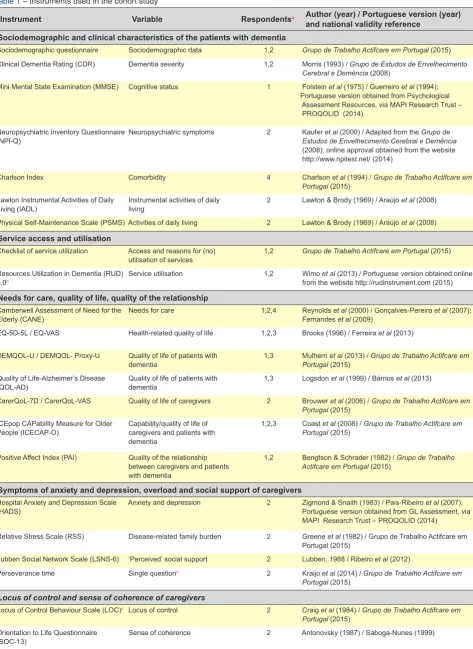
The study variables and evaluation instruments are shown in Table 1.31 Portuguese versions of different
instru-ments were already validated,31 while the preliminary
valid-ity data of the remaining instruments were not described in the study, nor any data on each dyad’s quality of life, in-terpersonal relationship, social support and locus of control (Table 1).
Assessment of patients with dementia
Data from two interviews were mainly described in the study, focused on the assessment of needs and description of service utilisation: Camberwell Assessment of Need for the Elderly(CANE)4,5 and Resources Utilization in Dementia
(RUD).35 The presence of (un)met needs for care, according
to a ‘patient-centred’ approach, is assessed by the CANE interview, including 24 domains (biological, psychological or social) and allowing for the comparison between the per-spective of needs of patients, informal caregivers and pro-fessionals (these are considered into a fourth score which is obtained by researchers / assessors). There are absent, unmet or met needs within each domain. Total score is ob-tained by adding up the scores regarding items in which needs are recorded.8 This instrument has shown robust
validity and reliability (test-retest, inter-observer),5 with
in-ternationally confirmed psychometric properties.7,36 In
Por-tugal, the instrument was translated,8 validated9 and used in
service research.10,14 The perspectives of needs of patients,
informal caregivers and assessors were considered in this study.
Formal and informal care utilisation in dementia are measured by the RUD interview, which was translated into 58 different languages.35 As regards informal care
utilisa-tion, data on the time spent by the family-caregivers in care provision / supervision were obtained. The instrument has shown good psychometric properties (face validity, reli-ability).35 The evaluation of formal care access / utilisation
was supplemented with an ad hoc check-list,31 in addition
to patient’s clinical and functional characteristics: dementia severity,33 cognitive status,34 neuro-psychiatric symptoms37,
comorbidities38 and functional status39 (Table 1).
Assessment of informal caregivers
Information needs and those related to psychological distress were assessed (two items in CANE interview spe-cific for caregivers)4,5 and resource utilisation (RUD).35 The
presence of symptoms of anxiety and depression was also assessed (Table 1): anxiety and depression symptoms,40
disease-related family burden,41 perseverance time42 and
sense of coherence.43 Symptoms of depression and/or
anxiety were quantified by the Hospital Anxiety and Depres-sion Scale (HADS) and internationally validated cut-offs in ‘depression’ and ‘anxiety’ subscales were considered: ≥ 11 (probable case) and ≥ 8 (possible case).40,44 These cut-offs
were not strictly validated in Portugal45 and were used with
limitations.
Procedures
Training of interviewers
Ten interviewers (clinical psychologists) were selected and four training sessions on the administration and scoring of the instruments (videos, role-play sessions) were carried out, focused on the CANE interview and in inter-observer agreement. Information was provided at the recruiting loca-tions.
Study pilot
A study pilot (n = 5) was carried out in Lisbon, allowing for the improvement of the Portuguese versions of the in-struments and aimed at procedure coordination.
Fieldwork activity
Interviews were scheduled at the patient’s home or any other convenient place, in which privacy and comfort were ensured. These were separately conducted with the patient and family-caregiver (including different moments together, whenever adequate and divided in two moments in order to reduce evaluation overload).
Quality control
ARTIGO ORIGINAL Table 1 – Instruments used in the cohort study
Instrument Variable Respondentsa Author (year) / Portuguese version (year)
and national validity reference Sociodemographic and clinical characteristics of the patients with dementia
Sociodemographic questionnaire Sociodemographic data 1,2 Grupo de Trabalho Actifcare em Portugal (2015) Clinical Dementia Rating (CDR) Dementia severity 1,2 Morris (1993) / Grupo de Estudos de Envelhecimento
Cerebral e Demência (2008)
Mini Mental State Examination (MMSE) Cognitive status 1 Folstein et al (1975) / Guerreiro et al (1994); Portuguese version obtained from Psychological Assessment Resources, via MAPI Research Trust – PROQOLID (2014)
Neuropsychiatric Inventory Questionnaire
(NPI-Q) Neuropsychiatric symptoms 2 Kaufer Estudos de Envelhecimento Cerebral e Demênciaet al (2000) / Adapted from the Grupo de (2008); online approval obtained from the website http://www.npitest.net/ (2014)
Charlson Index Comorbidity 4 Charlson et al (1994) / Grupo de Trabalho Actifcare em Portugal (2015)
Lawton Instrumental Activities of Daily
Living (IADL) Instrumental activities of daily living 2 Lawton & Brody (1969) / Araújo et al (2008) Physical Self-Maintenance Scale (PSMS) Activities of daily living 2 Lawton & Brody (1969) / Araújo et al (2008)
Service access and utilisation
Checklist of service utilization Access and reasons for (no)
utilisation of services 1,2 Grupo de Trabalho Actifcare em Portugal (2015) Resources Utilization in Dementia (RUD)
5.0b
Service utilisation 1,2 Wimo et al (2013) / Portuguese version obtained online from the website http://rudinstrument.com (2015)
Needs for care, quality of life, quality of the relationship
Camberwell Assessment of Need for the
Elderly (CANE) Needs for care 1,2,4 Reynolds Fernandes et alet al (2000) / Gonçalves-Pereira (2009) et al (2007); EQ-5D-5L / EQ-VAS Health-related quality of life 1,2,3 Brooks (1996) / Ferreira et al (2013)
DEMQOL-U / DEMQOL- Proxy-U Quality of life of patients with
dementia 1,3 Mulhern Portugal (2015)et al (2013) / Grupo de Trabalho Actifcare em Quality of Life-Alzheimer’s Disease
(QOL-AD) Quality of life of patients with dementia 1,3 Logsdon et al (1999) / Bárrios et al (2013)
CarerQoL-7D / CarerQoL-VAS Quality of life of caregivers 2 Brouwer et al (2006) / Grupo de Trabalho Actifcare em Portugal (2015)
ICEpop CAPability Measure for Older
People (ICECAP-O) Capability/quality of life of caregivers and patients with dementia
1,2,3 Coast et al (2008) / Grupo de Trabalho Actifcare em Portugal (2015)
Positive Affect Index (PAI) Quality of the relationship between caregivers and patients with dementia
1,2 Bengtson & Schrader (1982) / Grupo de Trabalho Actifcare em Portugal (2015)
Symptoms of anxiety and depression, overload and social support of caregivers
Hospital Anxiety and Depression Scale
(HADS) Anxiety and depression 2 Zigmond & Snaith (1983) / Pais-Ribeiro Portuguese version obtained from GL Assessment, via et al (2007); MAPI Research Trust – PROQOLID (2014)
Relative Stress Scale (RSS) Disease-related family burden 2 Greene et al (1982) / Grupo de Trabalho Actifcare em Portugal (2015)
Lubben Social Network Scale (LSNS-6) ‘Perceived’ social support 2 Lubben, 1988 / Ribeiro et al (2012)
Perseverance time Single questiond 2 Kraijo et al (2014) / Grupo de Trabalho Actifcare em Portugal (2015)
Locus of control and sense of coherence of caregivers
Locus of Control Behaviour Scale (LOC)c Locus of control 2 Craig et al (1984) / Grupo de Trabalho Actifcare em Portugal (2015)
Orientation to Life Questionnaire
(SOC-13) Sense of coherence 2 Antonovsky (1987) / Saboga-Nunes (1999)
ARTIGO ORIGINAL
MACRO system (WP3 coordination/Bangor University). A data randomised cross-check was involved in a second level of quality control (European): data from each centre was checked by another centre, until a final consensus was reached.
Statistical analysis
An exploratory analysis of the interesting variables was carried out, followed by an inferential study using non-parametric (Kruskall-Wallis, Mann-Whitney, chi-square) or parametric tests, according to the conditions of applicability. Kappa coefficients (-1 to +1) were obtained for each item of the CANE interview (the agreement between the perspec-tive of unmet needs of patients and informal caregivers was considered, while the perspective of interviewers was not). Depending on the value of Kappa, a poor (K < 0.20); slight (0.21 – 0.40); fair (0.41-0.60); good (0.61-0.80) or excellent (K> 0,81) level of agreement was considered.46 A 0.05 level
of significance has been considered. Statistical Package for the Social Sciences/SPSS, v23.0 for Windows software was used.
Ethical and formal aspects
An informed consent has been obtained from patients and caregivers. The study was approved by the different Ethics Committee of the involved institutions ( NMS/Facul-dade de Ciências Médicas; Centro Hospitalar de Lisboa Ocidental; ARS Lisboa e Vale do Tejo; ARS Alentejo) and
by the Comissão Nacional de Proteção de Dados.
Agree-ments were made with Alzheimer Portugal, Santa Casa da
Misericórdia de Mora, Hospital do Mar-Luz Saúde and
As-sociação de Beneficência Popular de Gouveia.
RESULTS
Demographic and clinical characteristics
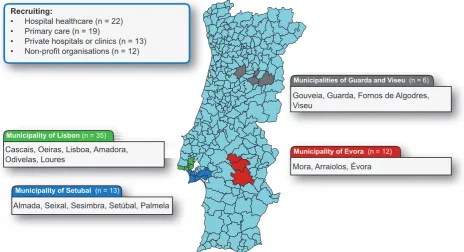
In total, 66 dyads of patients with dementia and caregiv-ers were included in the study, following the exclusion of 17 that did not comply with inclusion criteria. The participants lived in 18 different municipalities and were selected from outpatient clinics of family medicine, neurology and psy-chiatry (mainly public, even though also from private institu-tions) or non-profit organisations (Fig. 1).
Characteristics of the Portuguese participants are shown in Table 2 and were compared with the global sam-ple of the EU-Actifcare47 (mean age of 77.3 has been found,
range 57-91, 2/3 female and 45.5% with basic education, 12.1% secondary and 12.1% high education). Most patients were diagnosed with Alzheimer’s disease (37.9%) while most (89.4%) patients presented with early-stage (mild) dementia (CDR 1). Comorbidity was found in 41 patients (62.1%), e.g. diabetes: 20 (30.3%); peptic ulcer: 6 (9.1%); coronary heart disease: 5 (7.6%); peripheral vascular dis-ease: 5 (7.6%). Caregivers were aged between 35 and 91 (mean 64.9), mostly female (around 2 thirds), spousal (60.6%) and/or living with the patient (84.8%). Some illit-erate patients were found (13.6%), while 48.5% had basic education, 16.7% secondary and 21.2% high education. When HADS was applied to caregivers, 6 (9.1%) pre-sented with depression and anxiety, 7 (10.6%) with de-pression and no anxiety and 3 (4.5%) with anxiety and no depression (probable cases: cut-off 10/11). Caregivers with symptoms of anxiety and/or depression (16 patients; 24.2%) have described higher family burden, when com-pared to the remaining 50 (RSS: median 50.2 vs. 28.2; p
< 0.001). No significant differences were found as regards
Figure 1 – Participant recruiting and regional distribution
Municipality of Lisbon (n = 35)
Municipality of Setubal (n = 13)
Municipality of Evora (n = 12)
Municipalities of Guarda and Viseu (n = 6)
Recruiting:
• Hospital healthcare (n = 22) • Primary care (n = 19)
• Private hospitals or clinics (n = 13) • Non-profit organisations (n = 12)
Cascais, Oeiras, Lisboa, Amadora, Odivelas, Loures
Almada, Seixal, Sesimbra, Setúbal, Palmela
Mora, Arraiolos, Évora
ARTIGO ORIGINAL Table 2 – Sociodemographic and clinical characteristics of the patients with dementia and their family / informal caregivers: Portuguese and non-Portuguese participants in EU-Actifcare
Patients with dementia Portuguese participants (n = 66) Non-Portuguese participants (n = 385)a p-value
Age, years, mean (SD) 77.3 (6.2) 77.8 (8.1) 0.516
Gender: female, n (%) 41 (62.1) 205 (53.2) 0.228
Education, years, mean (SD) 6.4 (6.1) 10.4 (3.8) 0.001
Types of dementia, n (%) 0.169
Alzheimer 25 (37.9) 193 (50.4)
Vascular 8 (12.1) 44 (11.5)
Mixed 7 (10.6) 49 (12.8)
Dementia with Lewy Bodies 2 (3.0) 4 (1.0)
Other 4 (6.1) 23 (6.0)
Unspecified 20 (30.3) 72 (18.7)
CDR categories 1 / 2, n (%) 59 (89.4) / 7 (10.6) 295 (76.6) / 80 (20.8) / 10 (2.6) sem informação 0.052
MMSE, mean (SD) 17.8 (4.8) 19.2 (4.9) 0.033
NPI total score, mean (SD) 6.8 (5.5) 7.9 (5.5) 0.139
Comorbidity (Charlson), mean (SD) 1.8 (0.9) 1.6 (0.7) 0.110
None, n (%)b 25 (37.9) 194 (51.1)
Low comorbidity, n (%)b 31 (47.0) 131 (34.5)
High comorbidity, n (%)b 10 (15.2) 55 (14.5)
Sem informação 0 5 (1.3)
IADL, mean (SD) 3.7 (2) 3.4 (1.9) 0.190
PSMS, mean (SD) 3.7 (2) 3.7 (1.8) 0.935
Informal caregivers
Age, years, mean (SD) 64.9 (15.0) 66.7 (12.9) 0.318
Gender, female, n (%) 44 (66.7) 255 (66.4) 0.967
Educação, anos, média (DP) 9 (6.3) 12.4 (3.8) 0.001
Cohabitation with patients with dementia, n (%) 56 (84.8) 267 (69.5) 0.011
Relationship with patients with dementia, n (%) 0.447
Spouse / marital status 40 (60.6) 248 (64.4)
Son, daughter 20 (30.3) 117 (30.4)
Other family (e.g. daughter-in-law, sister) 6 (9.1) 20 (5.2)
Anxiety (HADS), mean (SD) 6.5 (3.9) 6.2 (3.8) 0.452
Depression (HADS), mean (SD) 6.4 (4.4) 4.5 (3.4) 0.001
Total RSS, mean (SD) 22.3 (11.5) 21.1 (10.8) 0.432
Emotional distress 10.5 (4.8) 9.2 (4.9) 0.038
Social distress 7.3 (5.3) 7.6 (4.8) 0.318
Negative feelings 4.4 (2.9) 4.4 (2.9) 0.262
Perseverance time, n (%) 0.544
Less than 1 week 0 0
More than 1 week, less than 1 month 0 5 (1.3)
More than 1 month, less than 6 months 4 (6.3) 19 (5.0)
More than 6 months, less than 1 year 7 (11.1) 30 (7.9)
More than 1 year, less than 2 years 7 (9.5) 59 (15.6)
More than 2 years 48 (73.0) 265 (70.1)
SOC-13, mean (SD) 64 (11.1) 67.7 (10.9) 0.012
CDR: Clinical Dementia Rating Scale; MMSE: Mini Mental State Examination; NPI: Neuropsychiatric Inventory; IADL: Instrumental Activities of Daily Living; PSMS: Physical Self-Main-tenance Scale; HADS: Hospital Anxiety Depression Rating Scale; RSS: Relative Stress Scale; SOC-13: Sense of Coherence Scale-13. a Unpublished data. Note: Data in Kerpershoek.
ARTIGO ORIGINAL
the needs of corresponding patients. As regards caregivers’ needs, a significant association between needs of ‘psycho-logical distress’ has been found (which was not found as re-gards ‘information on dementia’) and probable anxiety and/ or depression (p = 0.004).
Needs for care
Total needs for care and differences between per-spectives
The perspectives of unmet needs (item by item) of patients and caregivers are shown in Table 3. No or poor agreement between those two perspectives has been found in most items. Fair of good levels of agreement were only found in ‘feeding’, mobility/falls’, ‘vision/hearing/communi-cation’, ‘personal care’ and ‘care to other people’. Unmet needs most frequently described by the patients regarded ‘psychological distress’ (19.7%), ‘information’ (18.2%), ‘memory’ (18.5%), ‘companion care’ (18.5%) and ‘vision/
hearing/communication’ (16.7%), while those most fre-quently described by caregivers regarded ‘activities of daily living’ (27.3%), ‘psychological distress’ (15.2%), ‘compan-ion care’ (15.6%), ‘memory’ (12.1%) and ‘social benefits’ (12.1%).
A comparison between the perspectives of total needs of patients, caregivers and assessors is also shown in Table 3. No significant differences were found regarding unmet needs. Lower met needs (and total) were described by pa-tients, when compared to caregivers and assessors (p < 0.001). Unmet needs per person ranging between 0 and 8 have been described by assessors (>2 were described by 9 (13.6%) participants.
Assessors’ integrative perspectives on needs for care
Assessors’ perspectives on patients and caregivers’ needs for care (item per item) are shown in Table 4. More
Table 3 – Unmet needs for care (perspectives of patients with dementia and informal caregivers) and total needs for care (including the perspectives of assessors)
Unmet needs, n (%) Patients with dementia Informal caregivers Kappa agreementa p-valueb
Housing 1 (1.5) 1 (1.5) -0.016 0.865
Household care 2 (3) 1 (1.5) 0.357 < 0.001
Eating 0 (0) 1 (1.5) 0.643 < 0.001
Personal care 1 (1.5) 0 (0) 0.507 < 0.001
Care to other people 0 (0) 0 (0) 0.476 < 0.001
Activities of daily living 4 (6.1) 18 (27.3) 0.224 0.001
Memory 12 (18.5) 8 (12.1) 0.041 0.470
Vision / hearing / communication 11 (16.7) 4 (6.1) 0.572 < 0.001
Mobility / falls 2 (3) 2 (3) 0.626 < 0.001
Continence care 5 (7.8) 5 (7.8) 0.359 < 0.001
Physical health 1 (1.5) 4 (6.2) 0.061 0.333
Medication / harmful substances 1 (1.5) 3 (4.6) 0.203 0.012
Psychotic symptoms 1 (1.5) 2 (3) 0.134 0.052
Psychological distress 13 (19.7) 10 (15.2) 0.312 < 0.001
Information (on dementia and treatment) 12 (18.2) 4 (7) 0.039 0.721
Personal safety (parasuicidal behaviour) 2 (3) 1 (1.5) 0.313 0.001
Personal safety (unintentional exposure) 2 (3) 1 (1.5) 0.299 0.002
Abuse / neglect 0 (0) 0 (0) --
Behaviour 0 (0) 2 (3) --
Alcohol 0 (0) 0 (0) --
Companion care 12 (18.5) 10 (15.6) 0.288 0.003
Intimate relationships 5 (7.7) 3 (4.6) -0.064 0.564
Financial management 0 (0) 1 (1.5) 0.261 0.003
Social benefits 1 (1.5) 8 (12.1) 0.029 0.733
Total needs, mean (SD) Patients with dementia Informal caregivers Assessors p-valuec
Unmet needs 1.3 (1.8) 1.4 (1.4) 1.1 (1.7) 0.238
Met needs 5.0 (2.6) 8.0 (2.7) 7.7 (2.8) < 0.001
Global needs (met or unmet) 6.3 (2.7) 9.4 (3.0) 8.9 (3.1) < 0.001
aThe kappa coefficient was obtained for each item in order to assess the agreement between patients with dementia and caregivers regarding unmet needs of the patients.bp-value
refers to the differences between the perspectives of patients and caregivers regarding unmet needs (item by item). cp-value refers to the differences between the perspectives of
ARTIGO ORIGINAL frequent unmet needs of patients (mean 1.1; SD = 1.7) re-garded ‘companion care’ (22.7%), ‘psychological distress’
(19.7%) and ‘activities of daily living’ (13.6%). Even though no unmet needs were described by 33 (50.0%) patients, the presence of at least three unmet needs was described by 9 (14.0%). Almost half of the caregivers in our cohort described unmet needs regarding ‘psychological distress’ (43.9%), even though these were only described by asses-sors in 12.1% of the patients as regards ‘information’ (Ta-ble 4). From their own perspective, unmet needs regarding ‘psychological distress’ and ‘information’ were described by 25.8% and 19.7% of caregivers, respectively.
Formal and informal care utilisation
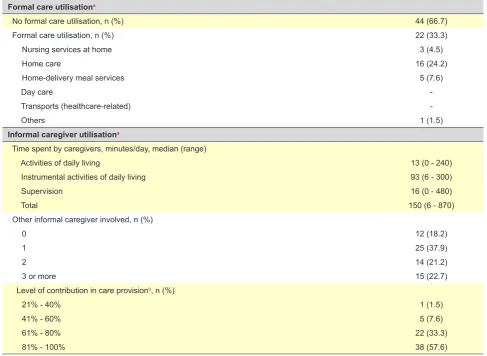
In total, 44 of the patients (66.7%) did not use any for-mal services during the month preceding the interview (e.g. nursing / home care, home-delivered meals, day care cen-tre), while the remaining (33.3%) have used formal care
ac-cording to the inclusion criteria (e.g. nursing / home care, due to other conditions; old maid providing no significant support to dementia-related disability) (Table 5).
The hypothesis of using some kind of formal care as defined in the protocol was considered by 20 (30.3% of the total) from the 44 ‘non user’ patients. The reason most frequently given for non-utilisation was patient refusal (33.4%), caregiver’s or both, mainly regarding day care centres, home-delivered meals or temporary hospitalisation or admission to a nursing home. Reluctance to care was described by participants due to the lack of quality and as-sociation with “dependence” and “decline” (sic). Unaware-ness (25.8%) was also described by some patients and/or caregivers regarding service utilisation, to which some in-terest would be assigned, as admitted in the interviews: e.g. temporary hospitalisation / admission to a nursing home, support group for caregivers, cognitive stimulation. The re-maining reasons (40.8%) for non-utilisation were distributed
Table 4 – Needs for care of patients with dementia and informal caregivers, according to the integrating perspective of assessors
Identified needs
Items / domains No need Met need Unmet need No information
Needs of patients with dementia, n (%)
Housing 65 (98.5) 1 (1.5) -
Household care 10 (15.2) 55 (83.3) 1 (1.5)
Eating 11 (16.7) 53 (80.3) 1 (1.5) 1 (1.5)
Personal care 26 (39.4) 39 (59.1) - 1 (1.5)
Care to other people 59 (89.4) 6 (9.1) 1 (1.5)
Activities of daily living 37 (56.1) 19 (28.8) 9 (13.6) 1 (1.5)
Memory - 61 (92.4) 3 (4.5) 2 (3.0)
Vision / hearing / communication 47 (71.2) 11 (16.7) 4 (6.1) 4 (6.1)
Mobility / falls 45 (68.2) 18 (27.3) 2 (3.0) 1 (1.5)
Continence care 47 (71.2) 9 (13.6) 5 (7.6) 5 (7.6)
Physical health 2 (3.0) 62 (93.9) 1 (1.5) 1 (1.5)
Medication / harmful substances 7 (10.6) 52 (78.8) 2 (3.0) 5 (7.6)
Psychotic symptoms 57 (86.4) 5 (7.6) 1 (1.5) 3 (4.5)
Psychological distress 37 (56.1) 12 (18.2) 13 (19.7) 4 (6.1)
Information (on dementia and treatment) 57 (86.4) - 2 (3.0) 7 (10.6)
Personal safety (parasuicidal behaviour) 61 (92.4) 1 (1.5) 2 (3.0) 2 (3.0) Personal safety (unintentional exposure) 25 (37.9) 31 (47.0) 4 (6.1) 6 (9.1)
Abuse / neglect 63 (95.5) - 1 (1.5) 2 (3.0)
Behaviour 55 (80.3) 8 (12.1) 1 (1.5) 2 (3.0)
Alcohol 64 (97.0) - 2 (3.0)
Companion care 43 (65.2) 5 (7.6) 15 (22.7) 3 (4.5)
Intimate relationships 61 (90.9) 1 (1.5) 2 (3.0) 2 (3.0)
Financial management 6 (13.6) 58 (87.9) 1 (1.5) 1 (1.5)
Social benefits 44 (66.7) 4 (6.1) 2 (3.0) 16 (24.2)
Needs of informal caregivers, n(%)
Needs of information 51 (77.3) 3 (4.5) 8 (12.1) 4 (6.1)
ARTIGO ORIGINAL
among different categories (e.g. waiting time; unavailability; distance; financial constraints).
The support provided by local services to deal with these problems (CANE/section III) was frequently lower than what was considered by assessors as required, in patients with most common unmet needs (‘companion care’, ‘psychologi-cal distress’ and ‘activities of daily living’). For instance, no support was provided to patients describing unmet needs for ‘activities of daily living’, even though small-moderate assistance would be required by 88.8% of these. It is worth mentioning that 49 (74.2%) patients had attended medical consultation(s) over the past month (which was not consid-ered as ‘formal care’ in this project).
Finally, as regards informal care, a 60-minute mode and 150 minutes/day median have been found (mostly to assist daily living instrumental activities: 93 minutes/day). Even though at least one informal caregiver was involved with 54 of the patients (81.8%), most main caregivers (57.6%) described as having ensured more than 80% of patient’s care.
DISCUSSION
The EU-Actifcare project was focused on service access and utilisation, including day care centres or home care. An
observational study involving an accurately selected sig-nificant European sample was included, from a tendentially systemic point of view, with patients with dementia and car-egivers. A comprehensive evaluation of needs and service utilisation by a subgroup of Portuguese patients with early-stage (mild) to middle-early-stage dementia living in the commu-nity has been described.
Main results and comparison with other studies
From the assessors’ perspective, the participants pre-sented, on average, with one unmet need, mainly regard-ing ‘companion care’ (22.7%), ‘psychological distress’ (19.7%) and ‘activities of daily living’ (13.6%) (suggesting the presence of suboptimal informal care and/or a partial indication for formal care as services could respond within these domains). Most frequently found unmet needs in non-Portuguese participants in the sample of the EU-Actifcare47
regarded ‘activities of daily living’ (32.1%), ‘companion care’ (28.7%) and ‘memory’ (15.1%), while Portuguese pa-tients’ met needs mainly regarded ‘physical health’ (93.9%), ‘memory’ (92.4%) and ‘financial management’ (87.9%). Lower met needs regarding ‘physical health’ (65.4%) and ‘memory’ (82.6%) while similar met needs regarding ‘finan-cial management’ (83.2%) were found in non-Portuguese
Table 5 – Formal and informal care utilisation
Formal care utilisationa
No formal care utilisation, n (%) 44 (66.7)
Formal care utilisation, n (%) 22 (33.3)
Nursing services at home 3 (4.5)
Home care 16 (24.2)
Home-delivery meal services 5 (7.6)
Day care
Transports (healthcare-related)
Others 1 (1.5)
Informal caregiver utilisationa
Time spent by caregivers, minutes/day, median (range)
Activities of daily living 13 (0 - 240)
Instrumental activities of daily living 93 (6 - 300)
Supervision 16 (0 - 480)
Total 150 (6 - 870)
Other informal caregiver involved, n (%)
0 12 (18.2)
1 25 (37.9)
2 14 (21.2)
3 or more 15 (22.7)
Level of contribution in care provisionb, n (%)
21% - 40% 1 (1.5)
41% - 60% 5 (7.6)
61% - 80% 22 (33.3)
81% - 100% 38 (57.6)
ARTIGO ORIGINAL participants. However, the comparison of the levels of needs between the different participant countries in the
EU-Actifcare was limited by the fact that convenience samples were used, in line with what happened with the compari-son of other results in our study between the participating countries or with the comparison of the levels of need with results from other studies.
Our findings were generally in line with internation-al studies, e.g. by Miranda-Castillo et al., in which more frequent unmet needs regarded ‘activities of daily living’ (50.7%), ‘companion care’ (39.5%) and ‘psychological dis-tress’ (30.9%)48 while it is worth mentioning that only 5% of
our patients presented with unmet needs regarding ‘memo-ry’ (these were almost always met), which is usually higher in patients with dementia admitted to day hospitals,4
hospi-tals49 or nursing homes4,50,51 (or even in geriatric populations
with heterogeneous neuropsychiatric diagnoses).52 In other
national studies, unmet needs mainly regarded ‘psychologi-cal distress’, ‘activities of daily living’, ‘companion care’ and ‘memory’9 or ‘psychological distress’, ‘activities of daily
liv-ing’ and ‘benefits’.10 The use of a specific group of patients
in our study (presenting with early to middle-stage demen-tia, with no formal care within the community) is what makes our results unusual, when compared to literature.
Differences have been found in the assessment of the needs of patients with dementia (when the perspectives of patients and caregivers were compared, for instance).7,51,53
In this small group of Portuguese patients, this was more significant in ‘housing’, ‘memory’, ‘physical health’, ‘informa-tion’, ‘intimate relationships’ and ‘social benefits’. However, no significant differences were found as regards total unmet needs between patients and caregivers, while almost the double of the average level of needs was found from the caregivers’ perspective.47 This could reflect a simple effect
of sampling or an influence of the lower education of car-egivers in our group. As regards met needs, significantly higher levels have been found, from the family/caregivers perspective, in line with what has been found in the global sample.47 Anyway, none of these ‘international’
compari-sons should be overvalued (cf. Limitations). Regardless of the difficult interpretation of some global tendencies (sam-pling level), important differences between the perspectives of patients, caregivers and assessors have been found, in clinical terms (individual level) and regarding service as-sessment, warranting systematic evaluations of needs for care.4
As regards the needs of caregivers, higher needs re-garding ‘psychological distress’ were found, when com-pared to what was usually found in national9,10,14 and
interna-tional literature5 (almost half of the patients presented with
this type of unmet needs). In addition, only one quarter of the participants presented with ‘probable’ minor psychiatric morbidity (HADS). Even though a lower difference regard-ing the rate of needs and psychopathology that was found when ‘possible’ HADS cases were considered, it is thereby confirmed that the identification of ‘needs’ is conceptually different from the establishment of clinical diagnoses. The
remaining results of these caregivers were also consistent with the assessment of needs. Objective (median care pro-vision of around 150 minutes/day) and subjective burden (total RSS: mean 22.3; SD = 11.5) were found, according to literature.35,54 Almost one third of the caregivers have
described as being unable to keep on taking care of the patients for more than two years, under the same condi-tions. A lower perseverance time was found in other stud-ies, even though involving groups of more severely affected patients.55
In short, untimely access to formal care by a certain amount of participants has been suggested by the level and type of needs. Most participants had not used formal care over the past month and, whenever this occurred, the rea-sons were not directly linked to dementia. Part of the prob-lems in service access / utilisation was based on negative attitudes of patients and/or family (e.g. refusal, stigmatisa-tion) rather than in structural constraints (e.g. provision and proximity) or organisational (e.g. waiting times or referral), according to this initial assessment of the cohort. Therefore, even with an intentionally selected group of participants with no need for any relevant formal care (CDR < 2) and in many cases with a proven clinical support, unmet needs and problems regarding formal care search, access or utili-sation have been found.
Sampling specificities and recruiting constraints A fairly common community sample in functional and clinical terms was selected, including patients with early to middle-stage dementia. Even though a higher-than-usual percentage of participants with secondary or high education has been found56, a wide ranging recruitment in
geographi-cal, social and service terms has been obtained. Most ticipants lived in Lisbon and in Setubal, while 27.3% of par-ticipants living in the countryside were included, from both urban and rural areas. Significantly lower MMSE scores were found when compared to the remaining participants in the EU-Actifcare. The lower education level of the Portu-guese participants could have contributed to this result, with the additional disadvantage of the use of the official transla-tion, which was not specifically adapted to the Portuguese language. Female and spouse caregiver predominance is usual in these populations, particularly in Portugal (where the number of participants living with the patient was, as ex-pected, significantly higher when compared to the remain-ing countries). In addition, the results of the psycho-social and psychopathological assessment have also confirmed the internal validity and in part the external validity of the study (cf. previous section).
ARTIGO ORIGINAL
presenting with levels of disability that did not correspond to an absolute indication for formal care. Delayed diagnosis is a frequent occurrence in Portugal and not always acknowl-edged by services where patients attend for other reasons (e.g. primary care, medicine/surgery departments).2,22,23 In
addition, many patients with a confirmed diagnosis were excluded from the study due to already being provided with significant formal care for dementia-related problems. Whenever the lack of community responses persisted, with regional disparities (day care centres for dementia or per-haps at a lower level, adequate home care), many patients relied on housemaids as non-qualified formal caregivers or would have been institutionalised.
Limitations of the study
According to the EU-Actifcare protocol,31 results could
not necessarily have been generalized to the Portuguese population of patients with dementia, in line with the re-maining countries, not even to the subgroup of patients with early to middle-stage dementia. However, the origin of the participants was diversified, as regards their place of resi-dence, healthcare and social services, in order to reduce the selection bias. This was a relatively typical sample, with a possible bias towards a higher level of education.
The lower literacy of some participants could have com-promised the assessment. However, the interviewers were specifically trained and some interviews were divided into close moments, merged with informal interactions aimed at reducing the information overload and preserving data qual-ity. A possible bias regarding the use of the official version of the MMSE is worth mentioning, as discussed above, even though these scores were not used for the analysis. The small size of our group of participants is a limitation of a comprehensive multivariate analysis. This has been made vs. the global sample (451 dyads)47 and will be in part
approached by the Portuguese longitudinal study. The role of regional discrepancies or informal care provision, or even the specific characteristics of early-onset dementia should be approached in further studies.
Study implications in terms of policies and services
The identification of the constraints regarding formal care access and utilisation could have put pressure on the implementation of specific policies. Literature reviews,57
qualitative approach to patients with dementia, caregiv-ers and professionals,58 as well as administrators / political
decision-makers59 were involved in the effort of the
EU-Ac-tifcare project into the systematisation of these constraints. The results of the longitudinal study are expected to allow for a better understanding on the determinants of service utilisation, enhancing enablers and reducing constraints. Best-practice recommendations have emerged following the project, aimed at improving formal care access / utilisa-tion. Its national applicability should be discussed, namely regarding the role of primary care.23,60
A timely access and adequate service utilisation in the community could certainly reduce unmet needs of patients
with dementia and their informal caregivers, as well as fam-ily burden.
CONCLUSION
Relevant constraints regarding formal care utilisation in the community by patients with early to middle-stage de-mentia and family / caregivers were suggested by these preliminary findings regarding the Portuguese Actifcare co-hort. Unmet needs in specific areas (mainly regarding ‘com-panion care’, psychological distress’ and ‘activities of daily living’) in addition to significant family burden have been found. With the presence of issues regarding formal care access / utilisation in the community, the implementation of specific best-practice strategies could respond to many needs of this population.
ACKNOWLEDGEMENTS
The Actifcare consortium is coordinated at the Maas-tricht University (Frans Verhey, Marjolein de Vugt, scientific coordinators) and comprises, apart from the authors of this article: Claire Wolfs, Ron Handels, Liselot Kerpershoek (Maastricht University, Netherlands); Gabriele Meyer, Astrid Stephan, Anja Bieber, Anja Broda, Gabriele Bartoszek (Martin Luther University Halle-Wittenberg, Germany); Bob Woods, Hannah Jelley (Bangor University, United Kingdom); Martin Orrell (Nottingham Institute of Mental Health, United Kingdom); Anders Wimo, Anders Sköldunger, Britt-Marie Sjölund (Karolinska Institutet, Sweden); Knut Engedal, Geir Selbaek, Mona Michelet, Janne Rosvik, Siren Eriksen (Vestfold Hospital Trust/ Oslo University, Norway); Kate Ir-ving, Louise Hopper, Rachael Joyce (Dublin City University, Ireland); Orazio Zanetti, Elisa Portolani (IRCCS Centro S. Giovanni di Dio - Fatebenefratelli, Italy).
In addition, the following took part of fieldwork as inter-viewers: Ana Nunes, Ana Teixeira, Filipa Barreiros, Helena Amaro, Liliete Barrocas, Mariana Cunha, Patrícia Ramalho. We wish to acknowledge the heads of department of the healthcare services involved in the study (ACES Alentejo Central, Centro de Saúde de Mora, USF Fernão Ferro mais, USF Marginal, Department of Neurology and Department of Psychiatry of the Hospital Egas Moniz/CHLO, Hospi-tal do Mar – Luz Saúde), Alzheimer Portugal, Associação
de Beneficência Popular de Gouveia and Santa Casa da
Misericórdia de Mora. We also wish to acknowledge Isabel
Santana (CHUC/Universidade de Coimbra), Albino
Olivei-ra-Maia and Teresa Ventura (NMS/FCM, UNL) for patient
referral in Gouveia and Lisbon.
HUMAN AND ANIMAL PROTECTION
The authors declare that the followed procedures were according to regulations established by the Ethics and
Clini-cal Research Committees of NMS/Faculdade de Ciências
ARTIGO ORIGINAL DATA CONFIDENTIALITY The authors declare that they have followed the
proto-cols of their work centre on the publication of patient data.
Informed consents were obtained.
CONFLICTS OF INTEREST
The authors declare that there were no conflicts of inter-est in writing this manuscript.
FINANCIAL SUPPORT
The Actifcare project was funded in Portugal by the
Fundação para a Ciência e a Tecnologia (FCT-JPND-HC-0001/2012), with the support of the initiative of the EU Joint Programme – Neurodegenerative Disease Research), JPND/2013/2.
Maria J. Marques was supported by the FCT (PD/ BD/128011/2016) and by the Fundo Social Europeu through the Programa Operacional Potencial Humano.
REFERENCES
1. Prince M, Wimo A, Guerchet M, Ali G, Wu YT, Prina M. World Alzheimer Report 2015: The Global Impact of Dementia. London: Alzheimer’s Disease International; 2015.
2. Santana I, Farinha F, Freitas S, Rodrigues V, Carvalho Á. Epidemiologia da demência e da doença de Alzheimer em Portugal: Estimativas da prevalência e dos encargos financeiros com a medicação. Acta Med Port. 2015;28:182-8.
3. Gonçalves-Pereira M, Cardoso A, Verdelho A, Alves da Silva J, Caldas de Almeida M, Fernandes A, et al. The prevalence of dementia in a Portuguese community sample: a 10/66 Dementia Research Group study. BMC Geriatr. 2017;17:261.
4. Orrell M, Hancock G. CANE: Camberwell Assessment of Need for the Elderly. London: Gaskell; 2004.
5. Reynolds T, Thornicroft G, Abas M, Woods B. Camberwell Assessment of Need for the Elderly: Development, validity and reliability. Br J Psychiatry. 2000;176:444-52.
6. Wright J, Williams R, Wilkinson JR. Development and importance of health needs assessment. Br Med J. 1998;316:1310-3.
7. Miranda-Castillo C, Woods B, Orrell M. The needs of people with dementia living at home from user, caregiver and professional perspectives: a cross-sectional survey. BMC Health Serv Res. 2013;13:1-10.
8. Gonçalves-Pereira M, Fernandes L, Leuschner A, Barreto J, Falcão D, Firmino H. Versão portuguesa do CANE (Camberwell Assessment of Need for the Elderly): desenvolvimento e dados preliminares. Rev Port Saúde Pública. 2007;25:7-18.
9. Fernandes L, Gonçalves-Pereira M, Leuschner A, Martins S, Sobral M, Azevedo LF, et al. Validation study of the Camberwell Assessment of Need for the Elderly (CANE) in Portugal. Int Psychogeriatr. 2009;21:94-102.
10. Passos J, Fonte A, Dias CC, Fernandes L. The needs of older people with mental health problems in a Portuguese psychiatric setting. Int Psychogeriatrics. 2017:1-9.
11. McCabe M, You E, Tatangelo G. Hearing their voice: a systematic review of dementia family caregivers’ needs. Gerontologist. 2016;56:70-88. 12. Cheng ST. Dementia caregiver burden: a research update and critical
analysis. Curr Psychiatry Rep. 2017;19:64.
13. Borsje P, Hems MA, Lucassen PL, Bor H, Koopmans RT, Pot AM. Psychological distress in informal caregivers of patients with dementia in primary care: course and determinants. Fam Pract. 2016;0:1-8. 14. Gonçalves-Pereira M, Carmo I, Silva JA, Papoila AL, Mateos R, Zarit SH.
Caregiving experiences and knowledge about dementia in Portuguese clinical outpatient settings. Int Psychogeriatrics. 2010;22:270-80. 15. Sequeira C. Difficulties, coping strategies, satisfaction and burden in
informal Portuguese caregivers. J Clin Nurs. 2013;22:491-500. 16. Prince M, Comas-Herrera A, Knapp M, Guerchet M, Karagiannidou M.
World Alzheimer Report 2016: Improving Healthcare for People Living with Dementia. London: Alzheimer’s Disease International; 2016. 17. Fernandes L, Mateos R, Engedal K, von Gunten A, Stek ML,
Ramakrishnan A, et al. The state of psychogeriatrics in Europe: Challenges and opportunities in six European countries. Int Psychogeriatrics. 2015;27:1243-6.
18. De Vugt ME, Verhey FR. The impact of early dementia diagnosis and intervention on informal caregivers. Prog Neurobiol. 2013;110:54-62. 19. Dubois B, Padovani A, Scheltens P, Rossi A, Dell’Agnello G. Timely
diagnosis for Alzheimer’s Disease: A literature review on benefits and challenges. J Alzheimer’s Dis JAD. 2016;49:617-31.
20. Brodaty H, Thomson C, Thompson C, Fine M. Why caregivers of people with dementia and memory loss don’t use services. Int J Geriatr Psychiatry. 2005;20:537-46.
21. Werner P, Mittelman MS, Goldstein D, Heinik J. Family stigma and caregiver burden in Alzheimer’s disease. Gerontologist. 2011;52:89-97. 22. Grupo de Trabalho na Área das Demências nomeado pelo Ministério
da Saúde. Base para a definição de políticas públicas na área das demências. 2017. [consultado 2018 jan 12]. https://www.sns.gov. pt/2017/08/10/bases-para-a-definicao-de-politicas-publicas-na-area-das-demencias.
23. Gonçalves-Pereira M, Leuschner A. Portugal. In: Burns A, Robert P, editors. Dementia care: international perspectives. Oxford: Oxford University Press; 2019.
24. Gaugler JE, Kane RL, Kane RA, Newcomer R. Early community-based service utilization and its effects on institutionalization in dementia caregiving. Gerontologist. 2005;45:177-85.
25. Wimo A, Rönnbäck E, Larsson B, Eriksson T, Eriksson IB, Thorslund M. “Misplacement” of elderly people in the caring organisation: reasons and alternatives. Arch Gerontol Geriatr. 1999;28:227-37.
26. Wolfs CA, De Vugt ME, Verkaaik M, Verkade PJ, Verhey FR. Empowered or overpowered? Service use, needs, wants and demands in elderly patients with cognitive impairments. Int J Geriatr Psychiatry. 2010;25:1006-12.
27. Andersen RM. Families’ use of health services: a behavioral model of predisposing, enabling and need domponents. West Lafayette: Purdue University; 1968.
28. Andersen R. Revisiting the behavioral model and access to medical care: does it matter? J Health Soc Behav. 1995;36:1-10.
29. Andersen RM, Davidson PL. Improving access to care in America: individual and contextual indicators. In: Andersen RM, Rice TH, Kominski EF, eds. Changing the US Health Care System: key Issues in health services, policy, and management. San Francisco: Jossey-Bass; 2001. p. 3-33.
30. Donath C, Ulbrecht G, Grau H, Graessel E, Schwarzkopf L, Menn P, et al. Health services utilization by community-dwelling dementia patients and their family caregivers. In: Health care utilization in Germany. New York: Springer New York; 2014. p. 193-219.
31. Kerpershoek L, de Vugt M, Wolfs C, Jelley H, Orrell M, Woods B, et al. Access to timely formal dementia care in Europe: Protocol of the Actifcare (ACcess to Timely Formal Care) study. BMC Health Serv Res. 2016;16:1-7.
32. American Psychiatric Association. DSM-IV-TR: Manual de Diagnóstico E Estatística Das Perturbações Mentais. 4a ed. Lisboa: Editores C;
2002.
33. Morris JC. The clinical dementia rating (CDR): current version and scoring rules. Neurology. 1993;43:2412-4.
34. Folstein MF, Folstein SE, McHugh PR. “Mini-mental state”: a practical method for grading the cognitive state of patients for the clinician. J Psychiatr Res. 1975;12:189-98.
35. Wimo A, Gustavsson A, Jonsson L, Winblad B, Hsu MA, Gannon B. Application of resource utilization in dementia (RUD) instrument in a global setting. Alzheimer’s Dement. 2013;9:429-35.
36. Bakker C, de Vugt ME, van Vliet D, Verhey FR, Pijnenburg YA, Vernooij-Dassen MJ, et al. The relationship between unmet care needs in young-onset dementia and the course of neuropsychiatric symptoms: a two-year follow-up study. Int Psychogeriatrics. 2014;26:1991-2000. 37. Kaufer DI, Cummings JL, Ketchel P, Smith V, MacMillan A, Shelley T, et
al. Validation of the NPI-Q, a brief clinical form of the neuropsychiatric inventory. J Neuropsychiatry Clin Neurosci. 2000;12:233-9.
ARTIGO ORIGINAL instrumental activities of daily living. Nurs Res. 1969;19:278.
40. Zigmond AS, Snaith RP. The Hospital Anxiety and Depression Scale. Acta Psychiatr Scand. 1983;67:361-70.
41. Greene JG, Smith R, Gardiner M, Timbury GC. Measuring behavioural disturbance of elderly demented patients in the community and its effects on relatives: a factor analytic study. Age Ageing. 1982;11:121-6. 42. Kraijo H, Brouwer W, de Leeuw R, Schrijvers G, van Exel J. The
perseverance time of informal carers of dementia patients: validation of a new measure to initiate transition of care at home to nursing home care. J Alzheimer’s Dis. 2014;40:631-42.
43. Antonovsky A. Unraveling the mystery of health: how people manage stress and stay well. San Francisco: Jossey-Bass; 1987.
44. Bjelland I, Dahl AA, Tangen T, Neckelmann D. The validity of the hospital anxiety and depression scale an updated literature review. 2002;52:69-77.
45. Pais-Ribeiro J, Silva I, Ferreira T, Martins A, Meneses R, Baltar M. Validation study of a Portuguese version of the hospital anxiety and depression scale. Psychol Health Med. 2007;12:225-37.
46. Altman DG. Practical statistics for medical research. London: Chapman and Hall; 1991.
47. Kerpershoek L, Vugt M De, Wolfs C, Woods B, Jelley H, Orrell M, et al. Needs and quality of life of people with middle- stage dementia and their family carers from the European Actifcare study. When informal care alone may not suffice. Aging Ment Health. 2018;22:897-902.
48. Miranda-Castillo C, Woods B, Galboda K, Oomman S, Olojugba C, Orrell M. Unmet needs, quality of life and support networks of people with dementia living at home. Health Qual Life Outcomes. 2010;8:132. 49. Greaves S, Bhat M, Regan C, Qazi A, Miranda-Castillo C, Orrell M.
The unmet needs of referrals to old age psychiatry liaison services. Psychogeriatria Pol. 2006;3:175-82.
50. Hancock GA, Woods B, Challis D, Orrell M. The needs of older people with dementia in residential care. Int J Geriatr Psychiatry. 2006;21:43-9. 51. Orrell M, Hancock GA, Liyanage KC, Woods B, Challis D, Hoe J. The
needs of people with dementia in care homes: the perspectives of users, staff and family caregivers. Int Psychogeriatrics. 2008;20:941-51.
52. Ashaye OA, Livingston G, Orrell MW. Does standardized needs assessment improve the outcome of psychiatric day hospital care for older people? A randomized controlled trial. Aging Ment Health. 2003;7:195-9.
53. Hancock GA, Reynolds T, Woods B, Thornicroft G, Orrell M. The needs of older people with mental health problems according to the user , the carer , and the staff. Int J Geriatr Psychiatry. 2003;18:803-11.
54. Svendsboe EJ, Testad I, Terum T, Jörg A, Corbett A, Aarsland D, et al. Patterns of carer distress over time in mild dementia. Int J Geriatr Psychiatry. 2018;33:987-93.
55. Richters A, Melis RJ, van Exel NJ, Olde Rikkert MG, van der Marck MA. Perseverance time of informal caregivers for people with dementia: construct validity, responsiveness and predictive validity. Alzheimers Res Ther. 2017;9:26.
56. FFMS. Indicadores de educação em Portugal. PORDATA – Estatísticas, gráficos e indicadores de Municípios, Portugal e Europa. 2015. [consultado 2018 set 20]. http://www.pordata.pt/Municipios.
57. Bieber A, Stephan A, Verbeek H, Verhey F, Kerpershoek L, Wolfs C, et al. Access to community care for people with dementia and their informal carers: Case vignettes for a European comparison of structures and common pathways to formal care. Z Gerontol Geriatr. 2018;51:530-6. 58. Stephan A, Bieber A, Hopper L, Joyce R, Irving K, Zanetti O, et al.
Barriers and facilitators to the access to formal dementia care: Findings of a focus group study with people with dementia, informal carers and health and social care professionals in eight European countries. BMC Geriatr. 2018;18:131.
59. Broda A, Bieber A, Meyer G, Hopper L, Joyce R, Irving K, et al. Perspectives of policy and political decision makers on access to formal dementia care: expert interviews in eight European countries. BMC Health Serv Res. 2017;17:518.