ISSN: 2501 - 1235 ISSN-L: 2501 - 1235 Available on-line at: www.oapub.org/edu
doi: 10.5281/zenodo.3872126 Volume 6 │ Issue 5 │ 2020
EFFECT OF SYSTEMATIC LANDING TRAINING
ON KNEE KINEMATICS AND GROUND REACTION
FORCES IN YOUNG ADULTS
Stefan Kratzenstein1,2i, Bernhard J. Grimm2, Clint Hansen3 1CAU Motion Lab,
Kiel University, Olshausenstraße 74, 24098 Kiel,
Germany 2Institute of Sport Science, Kiel University, Olshausenstraße 74, 24098 Kiel,
Germany 3Department of Neurology, Kiel University, Arnold-Heller-Straße 3, 24005 Kiel,
Germany
Abstract:
In gymnastics, the final landing position represents a key determinant of safety and exercise quality. Previous findings on the biomechanics of landing indicated that knee flexion correlates strongly with ground reaction forces. However, it remains unclear how this relationship is affected by landing training. We conducted a randomized controlled study to assess the effect of systematic landing training on knee kinematics and ground reaction forces in young adult beginner gymnasts. The study included three-dimensional motion analysis of knee flexion and measurement of ground reaction forces for landings from heights of 37 and 87cm. Of the 28 beginner gymnasts who participated in the study, 14 underwent five weeks of landing training, whereas 14 served as controls (no intervention). A significant pre-post difference (-11.2°) was observed only for the control group, and only regarding maximum knee flexion after landings from heights of 37cm. Although no significant effects were noted overall for the training group, systematic landing training seems effective for correcting those landings that deviated strongly from the target position prior to training initiation (37cm, r=-0.74; 8cm, r=-0.77; both with p< 0.01). Thus, while landing training appears to minimize peak forces at ground contact, our findings cannot be explained solely in terms of knee kinematics, warranting muscle activity analysis.
Keywords: kinematics, ground reaction force, gymnastics athletes, landing training
1. Introduction
During freestyle competitions, the competitive gymnastics athlete performs a minimum of eight self-selected, gymnastic elements on the floor or on a parkour. These elements usually include jumps and rotations around corresponding body axes, all followed by landings. The desired landing posture in gymnastic competitions is mandated by the Code of Points (2017-2020), issued by the Fédération Internationale de Gymnastique (FIG) (2013) to ensure a safe landing technique to prevent athletes from injuries. Penalized deviations include sidesteps and excessive flexion of the lower limb (e.g., a deep squat upon landing is to be penalized by 0.5 points). An appropriate landing technique is required to ensure the implementation of these requirements.
In general, landing techniques can be clustered in two principal strategies either toe-heel (forefoot) or heel-toe (rear-foot), which strongly depend on the sport, the
athletes’ preference, and their physiological requirements (Cortes et al., 2007). The rear -foot strategy is commonly used during moderate speed running (Dufek & Bates, 1990), and the forefoot strategy is used in actual jump landings (Schot & Dufek, 1993) such as basketball and volleyball (Bressel & Cronin, 2005) showing lower maximal vertical ground reaction forces (vGRF) compared to the rear-foot strategy (Cronin, Bressel & Finn, 2008).
Landings in gymnastics also follow the forefoot strategy, and here, De Vita and Skelly (1992) categorized landings into stiff and soft, based on the maximum knee flexion noted after ground contact (Čuk & Marinšek, 2013; Marinšek, 2010). The assignment of the landings into these categories depends on the change in knee angle from the initial ground contact until the final position (stiff<90°, avg.=77°; soft>90°, avg.=117°) and the duration of the ground contact phase (stiff<152ms; soft>342ms). Within the framework of forefoot strategy, stiff and soft landings differ substantially with regards to vertical ground reaction force (vGRF) as the joint range of motion allows the knee muscles to absorb external load (Cortes et al., 2007).
The vGRF is a sensitive predictor of the external load on the musculoskeletal system (Paddle and Maulder, 2013) and was reported with magnitudes of 2–4 times the body weight (BW) while landing from vertical jumps (McNitt-Gray, 1993). Landing after complex exercises, such as double somersault, causes even higher vGRFs with up to 18 times BW (McNitt-Gray, 1993). Christoforidou et al. (2017) enrolled young, trained women and reported vGRFs of about 4 and 4.5 times BW upon vertical landing from drop jumps of 40 and 60cm heights, respectively. Although the height of the landing seems to be the determining factor of the external load, the type of floor, and the type of footwear, the landing technique also plays a key role (McNitt-Gray, Yokoi & Millward, 1994).
Vescovi, Hood & Gage, 2017). The modeling study of De Vita and Skelly (1992) showed that, compared to stiff landings, soft landings could absorb up to 19% more kinetic energy, suggesting that soft landings may be safer.
If the landing knee angle is too small (rather stiff landing) at initial contact, there
is a high risk of injury to the lower extremities (Marinšek & Čuk, 2010). Various studies
(Hume & Steele, 2000) have confirmed that most of the landing-related injuries are due to sudden decelerations or the knee is almost extended during the landing maneuver. These aspects are consequently making the knee the most frequently injured joint in floor gymnastics and court sports, which sports have similar deceleration patterns in common (Paddle & Maulder, 2013). Thus, adequate training must include both a variable and quick availability of appropriate responses to unexpected landing situations and, likewise, an automation of the correct final landing position.
Although there are no evaluated training programs in gymnastics, it is recognized that such systematic landing training improves safety upon landing. Araujo, Cohen, and Hayes (2015) enrolled 16 capoeira athletes and reported that a 6-week landing training program including elements of dynamic core stability training led to a significant reduction in GRF which is also associated with a lower probability of anterior cruciate ligament injury (Hewett et al., 2005). The authors focused their training program on strengthening the muscles of the lower extremities and the training of a variable availability of motor responses to changing landing situations. Especially, the training of motor skills corresponds to the results of studies that found correlations between motor control, external load (McNair & Prapavessis, 1999; Paddle & Maulder, 2013) and the injury risk (Mills, Pain & Yeadon, 2008) of gymnasts. However, whether a systematic training program of similar length affects landing strategies or parameters in gymnasts has not been investigated so far.
Since differences in landing heights put different demands on the landing strategies, the purpose of this study was to compare the ground reaction forces and knee angles involved in drop jump landings from two different heights. It was hypothesized that a 5-week systematic training of the availability of appropriate responses to unexpected landing situations and finishing in the final landing position defined by the FIG (2013) would result in lower vertical ground reaction forces and lesser knee flexion for both drop jump heights.
2. Methods
2.1. Participants
This study enrolled young adult gymnasts who volunteered to participate and provided written informed consent. All procedures were conducted following the principles set out by the Declaration of Helsinki, by relevant legislation, and by the local ethics committee, which had approved the study design.
to test the difference between two independent group means using a two-tailed test (Wilcoxon-Mann-Whitney test), a medium effect size (d=0.85), and an alpha of 0.05. Result showed that a total sample of 28 participants with two equal-sized groups of n=14 was required to achieve a power of 0.81. Consequently, twenty-eight gymnasts were enrolled and randomly assigned to the test group (TG) or the control group (CG). TG gymnasts participated in training sessions specifically focused on improving the landing technique (i.e., landing training), whereas CG gymnasts did not receive any landing-focused training in addition to their regular training. The training of the CG landing-focused during the study period on floor exercises with a maximum of two 60 minutes-training sessions per week. Landings from heights were no central subject of the training. Athletic training was focused on increasing mobility at this time to provide a better contrast to TG training. Athletes with acute injuries of the back or lower limbs were excluded from this study. In the CG (n=14), the age was 21±1.8years, body weight was 70.14±9.84kg, and height was 177.64±7.97cm. In the TG (n=14), the age was 22.86±3.68years, body weight was 70.86±11.27kg, and height was 175.79±11.16cm. All participants were classified as adult beginners, with less than one year of gymnastics experience. The self-reported athletic biography included swimming, soccer, handball and, unsystematic fitness training.
2.2. Systematic landing training protocol
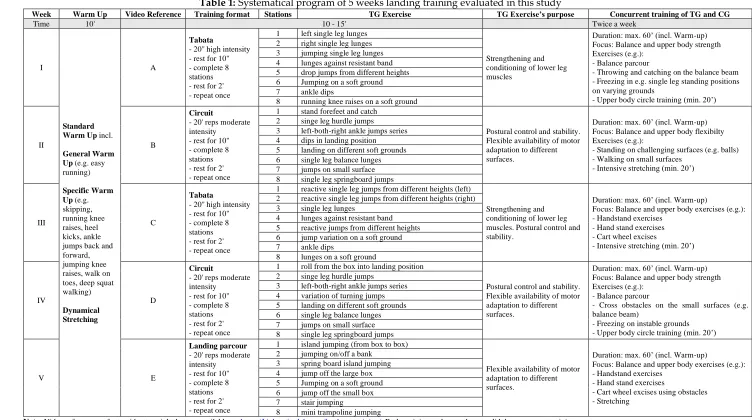
The training protocol used in this study was developed based on the protocol described by Araujo, Cohen, and Hayes (2015). The strength of the training concept lies in the shortness of the program, which allows it to be included in a priority program to sensitize the athletes for the correct movement execution. The variation of the landing stimuli targets a flexible availability of motor solutions for different landing tasks. Due to the limited availability of the participants, the duration of the training intervention was reduced from 6 to 5 weeks. Landing training was conducted twice a week, with an interval of 2 days between the sessions, and focused mainly on conditional aspects and the development of motor control. Specifically, the 5-week training intervention was structured as a Tabata workout (Tabata et al., 1996) on weeks 1 and 3, as circuit training on weeks 2 and 4, and as landing parkour on week 5.
Tabata training employed the traditional 20–10 routine (i.e., 20 seconds of maximal efforts followed by 10seconds of rest). The circuit training included relatively low loads for a relatively high number of repetitions in each set to improve local muscular and aerobic endurance (Fry, 2005). All sessions included aspects of coordination, strengthening, stabilization, and activation. The landing parkour involved numerous jump exercises from different heights and with strategies (e.g., straight jump, squat jump, straddle vault, one-leg jump, two-leg jump, ½ rotation, full rotation), landing in the final posture defined by the FIG (2013).
including high knees, buttock kicks, lunges, squats, and jumps), followed by dynamic stretching focusing on the demands associated with the subsequent training (e.g., stretching of hip extensors and knee flexors). The main part included motor training of the landing position, followed by plyometric, eccentric, and proprioceptive training. All training set-ups included only exercises with the participant’s own BW, drop jumps from different heights, jumps over obstacles, and landing into the defined landing posture on different surfaces. Each week was assigned a special training (A-D), which is carried out two times a week (see Table 1). A detailed description of the training as video tutorials can be found on https://kielmotionlab.com/landungstraining/ or in the appendix. The target landing posture was defined at knee flexion <90°, torso flexion of 30–40°, and the arms raised anteriorly by about 120°. One week before and after the systematic landing training, both the training and the control group performed a landing analysis to evaluate the effect of the training on the landing mechanisms.
2.3. Data collection
The test for the pre- and post-systematic landing training data collection included three drop landings from a plateau onto a force plate (10N threshold, A9260, 1000Hz; Kistler, Winterthur, Switzerland) with a marked landing area of 30×30cm (De Vita & Skelly, 1992; McNitt-Gray, 1993; Mills et al., 2008; Verniba et al., 2017). The force plate was placed at 10 cm in front of the plateau, which was set at heights of 37 and 87cm. Unilateral motion analysis was conducted, per the protocol described by De Vita and Skelly (1992) and inertial measurement unit sensors (100 Hz; Noraxon USA Inc., Scottsdale, AZ, USA) were placed on the right pelvis, thigh, lower leg, and dorsal foot to investigate the knee flexion-extension angle (Struzik, Juras, Pietraszewski & Rokita, 2016). The system’s measurement
error for joint angle estimations during dynamic motions is reported to be less than 0.5° (Noraxon USA Inc., Scottsdale, AZ, USA). The force plate and inertial measurement unit data were synchronized within the MyoMotion software package, and no additional data processing in terms of filtering was applied.
Table 1: Systematical program of 5 weeks landing training evaluated in this study
Week Warm Up Video Reference Training format Stations TG Exercise TG Exercise’s purpose Concurrent training of TG and CG
Time 10' 10 - 15' Twice a week
I
Standard Warm Up incl.
General Warm Up (e.g. easy running)
Specific Warm Up (e.g. skipping, running knee raises, heel kicks, ankle jumps back and forward, jumping knee raises, walk on toes, deep squat walking)
Dynamical Stretching
A
Tabata
- 20'' high intensity - rest for 10'' - complete 8 stations - rest for 2' - repeat once
1 left single leg lunges
Strengthening and conditioning of lower leg muscles
Duration: max. 60’ (incl. Warm-up) Focus: Balance and upper body strength Exercises (e.g.):
- Balance parcour
- Throwing and catching on the balance beam - Freezing in e.g. single leg standing positions on varying grounds
- Upper body circle training (min. 20’) 2 right single leg lunges
3 jumping single leg lunges 4 lunges against resistant band 5 drop jumps from different heights 6 Jumping on a soft ground 7 ankle dips
8 running knee raises on a soft ground
II B
Circuit
- 20' reps moderate intensity
- rest for 10'' - complete 8 stations - rest for 2' - repeat once
1 stand forefeet and catch
Postural control and stability. Flexible availability of motor adaptation to different surfaces.
Duration: max. 60’ (incl. Warm-up) Focus: Balance and upper body flexibilty Exercises (e.g.):
- Standing on challenging surfaces (e.g. balls) - Walking on small surfaces
- Intensive stretching (min. 20’) 2 singe leg hurdle jumps
3 left-both-right ankle jumps series 4 dips in landing position 5 landing on different soft grounds 6 single leg balance lunges 7 jumps on small surface 8 single leg springboard jumps
III C
Tabata
- 20'' high intensity - rest for 10'' - complete 8 stations - rest for 2' - repeat once
1 reactive single leg jumps from different heights (left)
Strengthening and conditioning of lower leg muscles. Postural control and stability.
Duration: max. 60’ (incl. Warm-up)
Focus: Balance and upper body exercises (e.g.): - Handstand exercises
- Hand stand exercises - Cart wheel excises
- Intensive stretching (min. 20’) 2 reactive single leg jumps from different heights (right)
3 single leg lunges
4 lunges against resistant band 5 reactive jumps from different heights 6 jump variation on a soft ground 7 ankle dips
8 lunges on a soft ground
IV D
Circuit
- 20' reps moderate intensity
- rest for 10'' - complete 8 stations - rest for 2' - repeat once
1 roll from the box into landing position
Postural control and stability. Flexible availability of motor adaptation to different surfaces.
Duration: max. 60’ (incl. Warm-up) Focus: Balance and upper body strength Exercises (e.g.):
- Balance parcour
- Cross obstacles on the small surfaces (e.g. balance beam)
- Freezing on instable grounds - Upper body circle training (min. 20’) 2 singe leg hurdle jumps
3 left-both-right ankle jumps series 4 variation of turning jumps 5 landing on different soft grounds 6 single leg balance lunges 7 jumps on small surface 8 single leg springboard jumps
V E
Landing parcour
- 20' reps moderate intensity
- rest for 10'' - complete 8 stations - rest for 2' - repeat once
1 island jumping (from box to box)
Flexible availability of motor adaptation to different surfaces.
Duration: max. 60’ (incl. Warm-up)
Focus: Balance and upper body exercises (e.g.): - Handstand exercises
- Hand stand exercises
- Cart wheel excises using obstacles - Stretching
2 jumping on/off a bank 3 spring board island jumping 4 jump off the large box 5 Jumping on a soft ground 6 jump off the small box 7 stair jumping
8 mini trampoline jumping
All participants were provided with the same instructions. Specifically, after receiving the start signal, the participant stepped from the plateau, starting with the self-reported dominant foot (Christoforidou et al., 2017; McNitt-Gray, 1993; Sigward, Havens & Powers, 2011; Verniba et al., 2017) and performed a bilateral landing. The landing was repeated three times to help the participants familiarize themselves with the procedure. Contrary to the current recommendation to analyze Ground reaction force data from at least four repetitive measurements (James, Hermann, Dufek & Bates, 2007), only the third landing was analyzed in this study in order to ensure proximity to a competitive scenario. After the participants reached the final landing position, they remained until a second signal and left the force plate. The landings were repeated if the participant initially jumped upwards instead of stepping forward and after unsafe or unilateral landings (Christoforidou et al., 2017; McNitt-Gray, 1993). Both types of failures were visually identified by the investigator. A rest period of at least 30seconds was allowed between repetitions (Kuenze, Foot, Saliba & Hart, 2015).
2.4. Data analysis
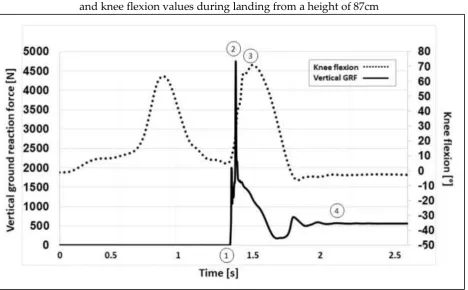
Figure 1 gives an overview of the analyzed parameters, which included the maximum vGRF, the leg stiffness (knee flexion), and the time between ground contact and maximum knee flexion.
Figure 1: Representative graph of the resulting ground reaction forces
and knee flexion values during landing from a height of 87cm
Of the two peaks exhibited by the force curve during landing (Marinšek, 2010), the
first is smaller and corresponds to the metatarsal head on the force plate, while the second is larger and corresponds to the landing of the heel. In this study, the last peak of the force curve was considered as the maximum vGRF, which was normalized to the body weight (BW) (McNitt-Gray, 1993) to allow comparison between participants. Therefore, vGRF values are given in BW.
The maximum value of knee flexion after ground contact was identified using an in-house MATLAB routine (Math Works, Natick, MA, USA). In this context, standing upright with legs straight (in the t-pose) was defined to correspond to 0° knee flexion. The braking time was defined as the time between ground contact and maximum knee flexion.
For each variable, the normality of the distribution was tested using the Shapiro-Wilk-Test. Since not all variables had normally distributed data, the significance of pre-post differences was evaluated using the Wilcoxon test for dependent samples. Statistical significance was established at p<0.05 and evaluated with regard to effects size (d) ranges (Cohen, 1992) of trivial (0–0.19), small (0.20–0.49), medium (0.50–0.79) and large (0.80 and
higher). The relationship between the magnitude of change (∆) in the variable of interest, the group affiliation, and the baseline value of the variable of interest was modeled using multivariate, linear regression (stepwise modeling). The corrected coefficient of determination (R²) was calculated as a measure of the influence of the independent variable (training intervention, baseline value) on the variance of the dependent variables (knee flexion, peak force). The direct relationship between the dependent variables and the independent variables was examined by Spearman’s correlation analysis.
3. Results
All 28 participants completed the study and conducted both measurement time points pre-post measurements. First, the group means for the variables of peak force, maximum knee flexion, and braking time before and after the study were examined for between-group differences. Data were analyzed separately for landings from heights of 37 and 87cm (Figure 2).
Figure 2: Effect of systematic landing training on ground reaction force, knee flexion, and braking time for landings from different heights
Note: The participants, who were beginner gymnasts, were randomly allocated to the training group (TG, green, n=14, 5-week program focused on landing training) or control group (CG, orange, n=14, no intervention). Values were obtained before and after the 5-week study (pre and post, respectively). Outliers are labeled with the participant ID. Body weight (BW); Vertical ground reaction force (vGRF).
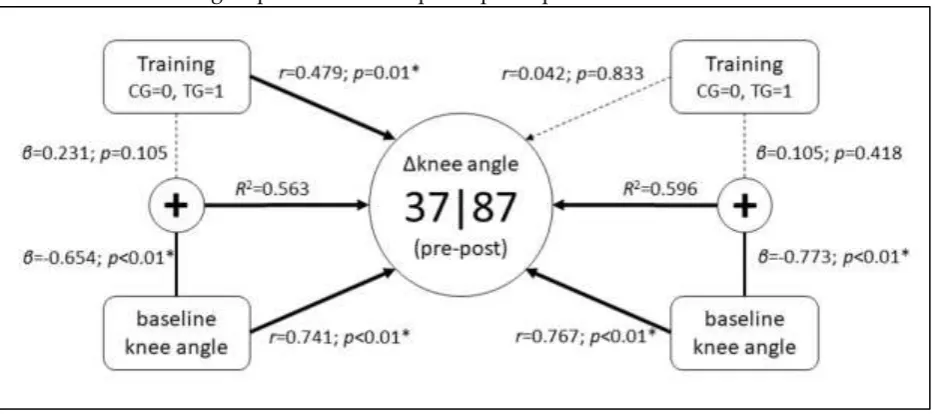
Figure 3: Relationship of pre-post changes in knee flexion
with group affiliation and participant-specific baseline values
Note: Beginner gymnasts were randomly allocated to the training group (TG, n=14, 5-week program focused on landing training) or control group (CG, n=14, no intervention). Landings from heights of 37cm (left side) and 87cm (right side) were evaluated. The variance was evaluated using linear regression (R²).
Direct correlations were calculated using Spearman’s analysis. Pre-post changes show significant (solid
lines) correlation with baseline values.
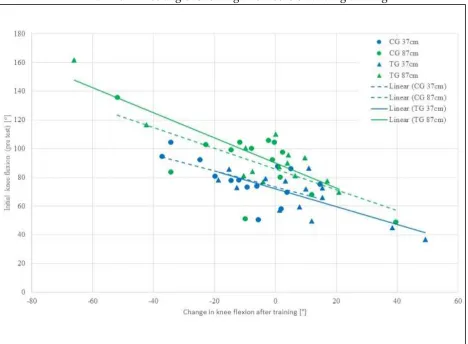
which indicates that participants with an initially large deviation from the target position also made a large progress throughout the landing training (Figure 4). The group affiliation, however, made only for landings from a height of 37cm a significant contribution to the change in knee flexion (r=0.479).
Figure 4: Correlation between baseline values and changes
in maximum knee angle following five weeks of landing training
Note: The high correlation suggests that participants with high deviations from the target knee flexion upon landing (<90°) made the greatest progress over the 5-week training period.
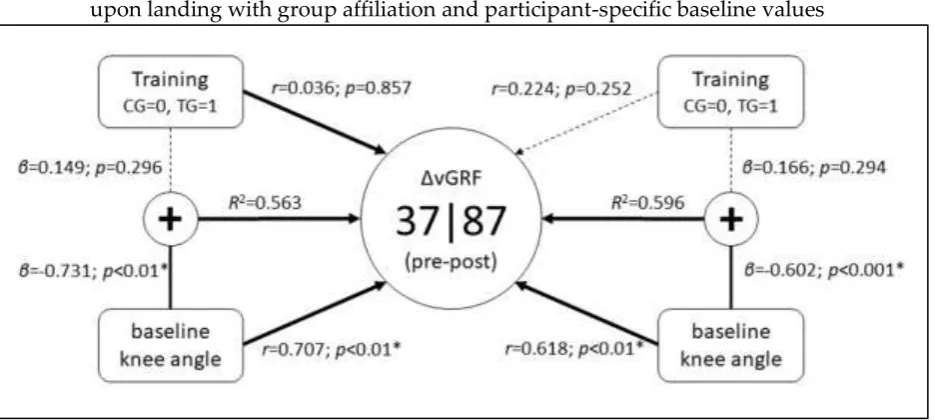
The change in peak vGRF (Figure 5) was significantly correlated with the baseline
Figure 5: Relationship of pre-post changes in peak ground reaction force upon landing with group affiliation and participant-specific baseline values
Note: Beginner gymnasts were randomly allocated to the training group (TG, n=14, 5-week program focused on landing training) or control group (CG, n=14, no intervention). Landings from heights of 37 and 87cm were evaluated. The variance was evaluated using linear regression (R²). Direct correlations were calculated using the Spearman method. Pre-post changes show a significant (solid lines) correlation with baseline values.
No significant effects were found for group affiliation, neither for the vGRF (F=0.268, p=0.614) nor the knee flexion (F=0.038, p=0.848). While the factor time point (pre- and post-measurement) had no significant effect on the knee flexion (F=1.867, p=0.195), it affected the vGRF (F=5.748, p=0.032) significantly. The height significantly affected the vGRF (F=57.798, p<0.05) and the knee flexion (F=63.688, p<0.05).
4. Discussion
significantly affects a reduction in vGRF over both groups, this training result is not related to group affiliation. Thus, this study shows that the familiarization with the landing setup, including a non-specific exercising, can already improve the landing technique. The braking times noted in this study are consistent with those reported previously (Christoforidou et al., 2017). The lack of significant pre-post change in braking time reflects the lack of change in knee flexion, which would correspond to braking distance.
On the other hand, systematic landing training had a significant effect on maximum knee flexion and vGRF (Figures 3 and 5) in those participants whose landing technique was poorer at baseline. In other words, the deviations from the defined landing position was corrected within only five weeks of training. Nevertheless, most participants landed close to the intended landing position even at baseline, which may explain the lack of between-group regarding knee flexion. This result suggests that, even without landing training, beginner gymnasts landed intuitively in the intended, stiff position. The analysis of adult beginners certainly plays a key role. Even the self-reported athletic biography let exclude that the test subjects have received any special landing training in the past, and their previous athletic activity did include extensive landings from the heights analyzed, a prove of correlation between the previous motor skills, and the training success is not possible. According to studies by McNair, and Prapavessis (1999) and Tillmann, Hass, Brunt, and Bennett (2004) it can only be assumed that court sports with higher proportions of sudden changes of direction and decelerations have already led to the development of advanced motor skills. The training aimed at strengthening the trunk and leg muscles. The extent to which this 5-week training protocol translated into muscle adaptation was not shown in this study. However, given the reduction in maximum vGRFs and consistent knee kinematics, it can be assumed that more optimal control of energy absorption through the musculature has been achieved (De Vita & Skelly, 1992; Kuenze et al., 2015). This assumption implies that muscle-tendon properties develop increased strength with training, which is fundamental for stiffness regulation during the braking phase (Christoforidou et al., 2017).
Several limitations of this study should be discussed. First, to simplify the implementation of motion analysis in the practical setting, we considered only one joint angle. However, this approach may be insufficient for adequately gauging the effects of training. Studies such as that conducted by Christoforidou et al. (2017) reported that, as beginner athletes gradually gain improved motor control, their ankle and hip angles during exercise change as well. In particular, the posture of the upper body during landing becomes more upright as the athletes develop advanced performance. Nevertheless, the knee angle is considered a key parameter for assessing the landing position and is used as the sole evaluation criterion of landing posture in competitions (Čuk & Marinšek, 2013; FIG, 2013). More complex motion analysis is warranted to clarify the effect of systematic landing training on landing kinematics in gymnasts.
improvement in motor control could explain the change in vGRF noted in our study. It is expected that activated musculature has a higher capacity to compensate for the energy transmitted to the musculoskeletal system during landing.
5. Conclusion
In this study, we found that a 5-week landing exercise program was sufficient to correct extreme deviations of knee flexion from the desired stiff landing position. However, we could not confirm a significant effect of training (vGRF, knee flexion, braking time) in the overall TG, likely because baseline kinematics were already very good in this sample of beginner gymnasts. Consequently, we have to reject our hypothesis that 5-week training does not result in lower vertical ground reaction forces and higher knee angles for both drop jump heights. However, our present findings indicate that systematic landing training has the potential to induce positive muscle adaptation and improve motor control, which should be considered in further studies.
Acknowledgement
We acknowledge Chantal Winkel and Kathrin Ornowski for supporting the study by planning and conducting the training of the athletes.
Conflicts of Interests
The authors declare that the research was conducted in the absence of any commercial or financial relationships that could be construed as a potential conflict of interest.
References
Araujo, S., Cohen, D., & Hayes, L. (2015). Six Weeks of Core Stability Training Improves Landing Kinetics Among Female Capoeira Athletes: A Pilot Study. Journal of Human Kinetics, 45(1), 27–37. https://doi.org/10.1515/hukin-2015-0004
Bressel, E., & Cronin, J. (2005). The Landing Phase of a Jump Strategies to Minimize Injuries. Journal of Physical Education, Recreation and Dance, 76(2), 30–35.
https://doi.org/10.1080/07303084.2005.10607332
Christoforidou, Α., Patikas, D.A., Bassa, E., Paraschos, I., Lazaridis, S., Christoforidis, C.,
& Kotzamanidis, C. (2017). Landing from different heights: Biomechanical and neuromuscular strategies in trained gymnasts and untrained prepubescent girls.
Journal of Electromyography and Kinesiology, 32, 1–8.
https://doi.org/10.1016/j.jelekin.2016.11.003
Cohen, J. (1992). A power primer. Psychological Bulletin, 112, 155–159.
https://doi.org/10.1037/0033-2909.112.1.155
Drop-Jump Landings. Journal of Applied Biomechanics, 23(4), 289-299.
https://doi.org/10.1123/jab.23.4.289
Cronin, J., Bressel, E. & Finn, L. (2008) Augmented feedback reduces ground reaction forces in the landing phase of the volleyball spike jump. Journal of Sport Rehabilitation, 17(2), 148-159. https://doi.org/10.1123/jsr.17.2.148
Čuk, I., & Marinšek, M. (2013). Landing quality in artistic gymnastics is related to landing symmetry. Biology of Sport, 30(1), 29–33. https://doi.org/10.5604/20831862.1029818 De Vita, P., & Skelly, W.A. (1992). Effect of landing stiffness on joint kinetics and
energetics in the lower extremity. Medicine and Science in Sports and Exercise, 24(1), 108–115.
Dufek, J.S., & Bates, B.T. (1990). The evaluation and prediction of impact forces during landings. Medicine and Science in Sports and Exercise, 22(3), 370–377.
Faul, F., Erdfelder, E., Lang, A.-G., & Buchner, A. (2007). G*Power 3: A flexible statistical power analysis program for the social, behavioral, and biomedical sciences. Behavior Research Methods, 39, 175-191.
Fédération Internationale de Gymnastique (F.I.G.). (2013). 2017 – 2020 Code of Points:
Women’s Artistic Gymnastics. Retrieved from https://www.gymogturn.no/wp-content/uploads/2015/10/CoP-2017-2020-1.pdf
Fry, A. (2005). The role of resistance exercise intensity on muscle fiber adaptations. Review article. Sports Medicine, 34, 663–679. https://doi.org/10.2165/00007256-200434100-00004
Hewett, T.E., Myer, G.D., Ford, K.R., Heidt, R.S., Colosimo, A.J., McLean, S.G., & Succop, P. (2005). Biomechanical measures of neuromuscular control and valgus loading of the knee predict anterior cruciate ligament injury risk in female athletes: A prospective study. The American Journal of Sports Medicine, 33(4), 492–501.
https://doi.org/10.1177/0363546504269591
Hume P., & Steele J. (2000) A preliminary investigation of injury prevention strategies in netball: Are players heeding the advice? Journal of Science and Medicine in Sport, 3(4), 406-413. https://doi.org/10.1016/S1440-2440(00)80007-9
James, C. R., Herman, J. A., Dufek, J. S., & Bates, B. T. (2007). Number of trials necessary to achieve performance stability of selected ground reaction force variables during landing. Journal of sports science and medicine, 6(1), 126–134.
Kuenze, C.M., Foot, N., Saliba, S.A., & Hart, J.M. (2015). Drop-Landing Performance and Knee-Extension Strength After Anterior Cruciate Ligament Reconstruction. Journal of Athletic Training, 50(6), 596–602. https://doi.org/10.4085/1062-6050-50.2.11
Marinšek, M., & Čuk, I. (2010). Landing errors in the men’s floor exercise are caused by
flight characteristics. Biology of Sport, 27(2), 123–128.
https://doi.org/10.5604/20831862.913079
Marinšek, M. (2010). Basic landing characteristics and their application in artistic
McNair, P., & Prapavessis, H. (1999) Normative data of vertical ground reaction forces during landing from a jump. Journal of Science and Medicine in Sport, 2(1), 86-88.
https://doi.org/10.1016/S1440-2440(99)80187-X
McNitt-Gray, J.L. (1993). Kinetics of the lower extremities during drop landings from three heights. Journal of Biomechanics, 26(9), 1037–1046.
McNitt-Gray, J., Yokoi, T., & Millward, C. (1994). Landing strategies used by gymnasts on different surfaces. Journal of Applied Biomechanics, 10, 237-252.
https://doi.org/10.1123/jab.10.3.237
Mills, C., Pain, M.T.G., & Yeadon, M.R. (2008). The influence of simulation model complexity on the estimation of internal loading in gymnastics landings. Journal of Biomechanics, 41(3), 620–628. https://doi.org/10.1016/j.jbiomech.2007.10.001 Paddle, D.L., & Maulder, P. S. (2013). Ground Reaction Forces and Loading Rates
Associated with Parkour and Traditional Drop Landing Techniques. Journal of Sport Science and Medicine, 12(1), 122-129.
Schot, P.K., & Dufek, J.S. (1993). Landing performance part 1: Kinematic, kinetic, and neuromuscular aspects. Medicine, Exercise, Nutrition and health, (2), 69-83. Seel, T., Raisch, J., & Schauer, T. (2014). IMU-based joint angle measurement for gait
analysis. Sensors (Basel, Switzerland), 14(4), 6891–6909.
https://doi.org/10.3390/s14040689
Sigward, S.M., Havens, K.L., & Powers, C.M. (2011). Knee separation distance and lower extremity kinematics during a drop land: implications for clinical screening. Journal of Athletic Training, 46(5), 471–475.
Struzik, A., Juras, G., Pietraszewski, B., & Rokita, A. (2016). Effect of drop jump technique on the reactive strength index. Journal of Human Kinetics, 52, 157-164.
https://doi.org/10.1515/hukin-2016-0003
Tabata I., Nischimura K., Kouzaki M., Hirai Y., Ogita F., Miyachi M., & Yamamoto K. (1996). Effects of moderate-intensity endurance and high-intensity intermittent training on anaerobic capacity and VO2 max. Medicine and Science in Sports and Exercise, 28(10), 1327–1330.
Tillman, M., Hass, C., Brunt, D., & Bennett, G. (2004b) Jumping and landing techniques
in elite women’s volleyball. Journal of Sports Science and Medicine, 3, 30-36. Verniba, D., Vescovi, J.D., Hood, D.A., & Gage, W.H. (2017). The analysis of knee joint
loading during drop landing from different heights and under different
instruction sets in healthy males. Sports Medicine, 3(1), 6.
Creative Commons licensing terms