SYNTHESIS OF NOVEL ANTIBACTERIAL AND ANTIFUNGAL
-AMINO ACIDS AND HETEROCYCLIC COMPOUNDS
Maher A. El-Hashash
[a], Sameh A. Rizk
[a]*Keywords: (E)-4-aryl-4-oxo-2-butenoic acid , furanones, thiadiazoles, pyridazinones, imidazolo[2,3-b]1,3,4-thiadiazoles, thiadiazolopyrimidines, bezoxazinones, fused quinoxalinylquinazolinones
Utility of (E)-4-(acetylamino)phenyl-4-oxo-2-butenoic acid with new sulfur reagents e.g. 2-amino-5-aryl-thiadiazoles 2 to afford the corresponding adducts (3, 4, 5, 6). Reaction of the latter compounds with different electrophilic and nucleophilic reagents affords some important heterocycle such as various furanones, thiadiazoles, pyridazinones, imidazolo[2,3-b]1,3,4-thiadiazoles, thiadiazolopyrimidines, bezoxazinones, fused quinoxalinylquinazolinones
*Corresponding Authors
*E-mail: [email protected]
[a] Chemistry department , Science Faculty , Ain-Shams University
INTRODUCTION
Amino acids are the smallest units of proteins and are useful components in a variety of metabolic activities. There are numerous advantages of taking amino acids as dietary supplements, also provide many useful biological activities In vitro data [1] about amino acids include muscle protein maintenance, potentiation of immune function, affecting neuronal activities in the brain, tissue repair acceleration, protecting liver from toxic agents, pain relief effect, lowering blood pressure, modulating cholesterol metabolism, stimulating insulin of growth hormone secretion and so on. It is important to be note that they are part of complex pathway and biological systems. Amino acids have proven to play a significant role in the synthesis of novel drug candidate with the use of non-proteinogenic and unnatural amino acids 2-7. Over the last decade the synthesis of non-proteinogenic unnatural amino acids has received significant attention of organic chemists, who have tried to find out cost effective and less time consuming synthetic pathways. From this point of view the authors have made an attempt to investigate the reaction of 4-aryl-4oxo-but-2-enoic acids with 2-amino-1,3,4-thiadiazole under aza-michael reaction conditions which produced adducts 3-6 as α-amino acid types with acetic anhydride at different condition and N2H4 to give the corresponding furanone, imidazolo[2,3-b]1,3,4-thiadiazole, 1,3,4-thiadiazolopyrimidine and pyridazinone derivatives, respectively with an aim to obtain some interesting heterocyclic compounds with non-mixing and mixing system. Hence, keeping these reports in view and continuation of our earlier search work8 for aza-Michael adducts.
EXPERIMENTS
All melting points are uncorrected. Elemental analyses were carried out in the Microanalytical Center, the center
publication for research, Cairo, Egypt. By Elementar Viro El Microanalysis IR spectra (KBr) were recorded on IR spectrometer ST-IR DOMEM Hartman Braun, Model: MBB 157, Canada and 1H-NMR spectra recorded on a varian 300 MHz (Germany 1999) using TMS as internal standard. The mass spectra were recorded on Shimadzu GCMS-QP-1000 EX mass spectrometer at 70e.v. homogeneity of all compounds synthesized was checked by TLC.
Compounds 3-6
A solution of 4-(4-Acetylaminophenyl)-4-oxo-2-butenoic acid (0.01 mol) and 5-aryl-2-amino-1,3,4-thiadiazole (0.016 mol) in 30 ml ethanol was refluxed for 3 h. The crude product was washed by petroleum ether (b.p 40- 60oC), and then crystallized from ethanol to give the following compounds .
4-(4-Acetylaminophenyl)-4-oxo-2-(5-phenyl-2-thiadi-azolylamino)butanoic acid (3)
Yield 80% , Mp 160-162 oC ,IR for CO for acid and ketone groups ( 1695 – 1665 ) cm-1,1H NMR (DMSO-d
6) 2.5 (s,3H,CH3CO),3.4 (2 dd , CH2-C=O J=15.2, J=7.7)( diastereotopic protons) , 4.2(dd,CH-COOH,methine proton), 6.7(s,NH),7.6-8.1(m,9H,ArH) , 8.2 (s, 1H, COOH), 8.6 (s, 1H, C=O-NH). EIMS m/z 410 (M+ ) . Anal.Calc. for (C20H18N4SO4 ): C 58.53, H 4.39; Found: C 58.50, H 4.40.
4-(4-Acetylaminophenyl)-4-oxo-2-(5-(4-chlorophenyl)-2-thiadiazolyl amino)butanoic acid(4)
Yield 75%. Mp. 174-174 oC. IR for CO for acid and ketone groups are at 1695–1630 cm-1. 1H NMR (DMSO-d
6) exhibits signals at 2.5(s, 3H, CH3CO), 3.4 (2 dd, CH2-C=O, J=15.2, J=7.7) (diastereotopic protons), 4.2 (dd, CH-COOH, methine proton), 6.7 (s, NH), 7.6-8.1 (m, 8H, ArH), 8.2 (s, 1H, COOH), 8.6 (s, 1H, C=O-NH). m/z 358 (M+-(CO
4-(4-Acetylaminophenyl)-4-oxo-2-(5-styryl-2-thiadiazolyl amino)butanoic acid (5)
Yield 70%. Mp. 180-182 oC. IR: CO for acid and ketone groups are at 1694–1660 cm-1. 1H-NMR spectrum in DMSO-d6 exhibits signals at 2.5 (s, 3H, CH3CO), 3.4 (2 dd, CH2C=O, J=15.2, J=7.7) (diastereotopic protons), 4.2 (dd, CH-COOH, methine proton), 6.7 (s, NH), 7.6-8.1 (m, 11H, ArH and olefinic protons), 9.5 (s, 1H, COOH), 10.2 (s, 1H, C=O-NH). m/z; 392 (M+-CO
2). Anal.Calc. for (C22H20N4SO4): C 60.55, H 4.58; Found: C 60.50, H 4.60.
4-(4-Acetylaminophenyl)-4-oxo-2-(5-phthalimido methyl-2-thiadiazolyl amino)butanoic acid(6)
Yield 35%. Mp. 150-152 oC. IR: CO for imide, acid and ketone groups at are at 1770, 1690 and 1660 cm-1. 1H-NMR spectrum (DMSO-d6) exhibits signals at 2.5 (s, 3H, CH3CO), 3.4 (2 dd, CH2-C=O, J=15.2, J=7.7) (diastereotopic protons, 4.2 (dd, CH-COOH, methine proton), 6.7 (s, NH), 7.6-8.1 (m, 8H, ArH), 8.2 (s, 1H, COOH, 8.6 (s, 1H, C=O-NH). m/z: 475 (M+-H
2O). Anal.Calc. for (C23H19N5SO6): C 55.98, H 3.81; Found: C 55.90, H 3.80.
Compounds 7, 8
A mixture of 7 (3 g; 0.005 mol) and acetic anhydride (9.4 mL) was heated under reflux for 1 h upon water bath. The solid that separated on cooling was crystallized from pet.ether (80-100) to afford 7 and from ethanol to afford 8.
2-(5-Acetylaminophenyl-2-oxo-furan-3-yl)amino-5-phenyl-1,3,4-thiadiazole (7)
Yield 50%, m.p. 200-202 oC, M.wt= 391 (C
20H17N4O3S). IR: NH 3297-3100, CH 3055-2890, the band at 1767and 1693 cm-1 can be attributable to
CO lactonic and acetamido groups, respectively, and 1H-NMR spectrum(DMSO-d
6) exhibits signals at δ 2,1 (s 3H, CH3CO), 4 (dd, 1H, -CH-NH, J=8.5), 6.7 (bs, NH), 7.5-7.9 (m, 9H of Ar), 6.9 (d, 1H, CH furanone moiety, J=8.5), 12.7 (s, 1H, –C=O-NH) acidic protons are exchangeable in D2O. Elem. Anal.: Calcd: C 61.5, H 4.3, N 14, S 8.3; Found C 61.4, H 4.2, N 13.8, S 8.2.
5-(4-Acetylaminophenylmethyl)-2-Phthalimidomethyl-4-oxo-imidazolo[2,1-b]-1,3,4-thiadiazole (8)
M.wt = 497 (C21H13N4O4SBr), Mp. 230-232 oC, yield 35%. calcd/found: C 50.89/51.00, H 2.64/2.22 , N 11.30/11.62, Br 16.12/16.08, S 6.74/6.38. IR: C=O are at 1772, 1720, 1691 and 1668 cm-1. 1H-NMR (DMSO-d
6) exhibits signals at 3.2 (2dd, CH2-C=O, J=7.7)( diastereotopic protons), 3.9 (dd, CH-COOH, methine proton), 5.2 (s, 2H, CH2-N), 6.7 (s, 1H, bridgeCH, 1,3-double bond shift), 7.2-7.7 (m, 8H, ArH). The EI-MS shows the molecular ion peak at m/e 498, 496 corresponding to (M+2)+ and(M.+), respectively .
1-(4-Acetylaminophenyl-6-(N-phthalimido)methyl-) 1,3,4-thiadiazolo [3,2-a] pyrimidine (9)
Boiling of 3 (3 g; 0.005 mol) with acetic anhydride (9.4 mL ) on a hot plate was heated under reflux for 4 h. The reaction mixture was poured on to H2O and the solid
compound was separated and crystallized form ethanol. M.wt=453 (C20H13N4O2SBr), M.. 230 oC, yield 65%, calcd/found: C 52.98/52.80, H 2.86/2.62, N 12.63/12.52, Br 17.66/17.45, S 7.06/6.88. IR: C=O are at 1772 ,1668 cm-1. 1H-NMR (DMSO-d
6) exhibits signals at 5.2 (s, 2H, CH2-N), 6.7 (s, 1H, bridgeCH, 1,3-double bond shift), 7.2-7.7 (m, 10H, ArH).
Pyridazinones 10 -12
An equimolar mixture of compound 7 (2.75 g;5mmol) and hydrazine hydrate (1.7mL,0.015 mol) was refluxed in boiling ethanol for 3 h and the solid that separated out was filtered off, dried and then crystallized from ethanol .
6-(Acetylaminophenyl)-4-(5-phenyl-2-amino-1,3,4 thiadiazole)-2,3,4,5-tetrahydro 3(2H)-pyridazinones (10)
Yield 70-75 %. IR(KBr) 1674,1708 (CO), 3177 (NH). 1H NMR (DMSO-d6): δ 2.2(s, 3H, CH3), 3.7 (2dd, 2H, CH2 -C=N), 4.2 (2 dd, CH, methine proton) 6.7 (s, NH, NH of thiadiazole moiety), 7.43-7.81 (m, 9H, Ar-H), 11.59 (brs, 2H, NH of acetamido and pyridazinone moieties). EIMS: m/z: 406 (M+), .Anal.: Calcd. C
20H18N6SO2: C 59.11, H 4.43; Found: C 59.20, H 4.43.
6-(Acetylaminophenyl)-4-(5-(4-chlorophenyl)-2-amino-1,3,4-thiadiazole)-2,3,4,5-tetrahydro-3(2H)-pyridazinones (11)
Yield 70-75 %. IR(KBr) 1674, 1708 (CO), 3177 (NH). 1H NMR (DMSO-d6): δ 2.2(s, 3H, CH3), 3.7(2 dd, 2H, CH2 -C=N), 4.2 (2 dd, CH, methine proton), singlet broad band at 6.5 ppm assigned for NH of thiadiazole moiety.) 7.6-8.1 (m, 8H, ArH), singlet at 10.2 was assigned for the two acidic protons of acetamido and pyridazinone moieties. EIMS m/z: 405 (M+-Cl). Anal.: Calcd. for 11 C
20H17N6SO2Cl: C 54.54, H 3.86; Found: C 54.50 , H 3.86.
6-(Acetylaminophenyl)-4-(5-styryl-2-amino 1,3,4 thiadiazole)-2,3,4,5-tetrahydro-3(2H)-pyridazinones (12)
Yield 70-75%. IR (KBr) 1674, 1708 (CO), 3177 (NH). 1H NMR (DMSO-d6): δ 2.2 (s, 3H, CH3), 3.7 (2 dd, 2H, CH2 -C=N), 4.2 (2 dd, CH, methine proton), singlet broad band at 6.5 ppm assigned for NH of thiadiazole moiety.) 7.6-8.1(m, 11H, ArH and olefinic protons), singlet at 10.2 assigned for two acidic protons of acetamido and pyridazinone moieties. EIMS: m/z: 432 (M+). Anal. Calc. C
22H20N6SO2: C 61.11, H 4.62; Found: C 61.18, H 4.60.
Ethyl N-[6-(4-acetylaminophenyl)-3-oxo-pyridazin-4-yl)]-N-[(5-phenyl-1,3,4-thiadiazol-2-yl)] glycinate (13)
An equimolar mixture of compound 10 (2.0 g; 5 mmol) and ethylchloroacetate (1.4 mL, 0.015 mol) in 50 mL dry pyridine was refluxed for 3 h. The reaction mixture was poured on to ice/HCl and the solid that separated out was filtered off, dried and then, crystallized from ethanol. Yield 35 %. Mp. 190-192. IR (KBr) 1630 (C=N), 1650, 1743 (CO), 3320, 3188 (NH). 1H NMR (DMSO-d
11.36 (brs, 2H, NH of acetamido and pyridazinone moieties). Anal.: Calcd. for C24H24N6SO4: C 58.53, H 4.87, N 17.07; Found: C 52.40, H 4.76, N 17.00.
3-Oxo-4-(5-phenyl-1,3,4-thiadiazol-2-yl)-6-(4-acetyl-aminophe-nyl)-)1,2,3,4tetrahydro1,4-oxazino[2,3-c]pyridazine (14)
An equimolar mixture of compound 10 (2.0 g; 5 mmol), ethylchloroacetate (1.4 mL, 0.015 mol) and anhydrous K2CO3 (4 g) in 50 mL dry acetone was refluxed for 24 h. The reaction mixture was then poured on to H2O/ice. The solid that separated out was filtered off, dried and then, crystallized from benzene. Yield 65 %. Mp. 162-164 °C. IR (KBr) 1630 (C=N), 1650, 1685 (CO), 3320, 3188 (NH). 1H NMR (DMSO-d6): δ 2.08(s, 3H, CH3), 3.72-3.76(m, 3H, CH2CH), 5.933 (s, 2H, OCH2CO), 7.46-7.92 (m, 9H, Ar-H), 11.36 (brs, 1H, NH of acetamido moiety). Anal.: Calcd. for C22H18N6SO3: C 59.19, H 4.03, N 18.83; Found: C 59.30, H 4.00, N 18.70.
1-((2-(4-Acetylaminophenyl))-2-oxo)ethyl-7-oxo-quinoxalino-[1,2-b]-quinazoline (16)
A mixture of benzoxazinone 15 (0.01 mol) and o-phenylene diamine (0.01mol) in ethanol (50 mL) was heated and refluxed for 5h. The reaction mixture was allowed to cool and the product was filtered, dried and recrystallized from ethanol. Yield 70 %. Mp. 126-128 °C. IR (KBr) 1709, 1735 (CO), 3423 (NH). 1H-NMR (DMSO-d
6): δ 2.5 (s, 3H, CH3), 3.4 (m, 3H, CH2-CH), 6.2 (s, 1H, pyrazine moiety), 7.46-8.11 (m, 12H, Ar-H), 12.40 (brs, 1H, NH of acetamido moiety). Anal.: Calcd. for C25H20N4O3: C 70.75, H 4.71, N 13.20; Found: C 70.70, H 4.64, N 13.15.
RESULTS AND DISCUSSION
When 4-(4-acetylaminophenyl)-4-oxo-but-2-enoic acid (1) was allowed to react with 2-amino 5-aryl thiadiazole derivatives (2), it produced 3- (4-acetamidobenzoyl)-2-(5-aryl 2-thiadiazolylamino)propanoic acids (3-6) as α-amino
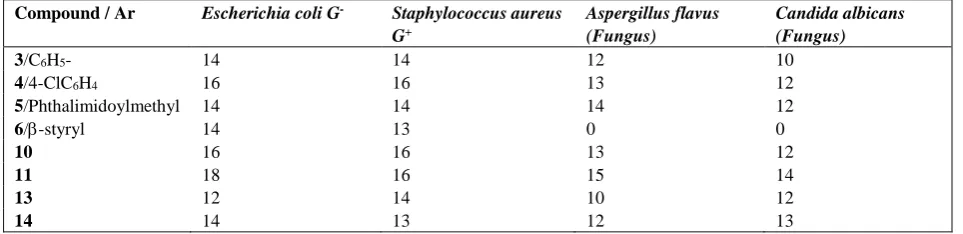
acid types that differ in biological activity by differing the aryl groups. Outline in Table 1 the presence of halogen atom enhances the antibacterial activity rather than chromophore moiety -CH=CH- (Scheme 1) .
Scheme 1.
The recent efforts made for the development of new ascorbic acid analogues in obtaining anti-oxidant9–13, anti-tumour14 agents have resulted 2(3H)-furanones as a new
antioxidant and anti-inflammatory agents. In the synthesis of lactone derivatives related to ascorbic acid, the NH group in the position 3 is acting as OH group in ascorbic acid, we also have found out that some 3,5-diaryl-2(3H) furanone possess significant inflammatory and anti-oxidant activities15.
Scheme 2.
Table 1. Antibacterial and Antifungal activities for some important synthesize compounds
The antimicrobial screening of all the synthesized compounds can be done using the agar diffusion assay. Tetracycline (Antibacterial agent): 32-30, Amphotericin (Antifungal agent): 18-16
These results prompted us that lactones can be obtained by the lactonization of hydroxyl acids. Thus, the adduct 3 (new α-amino acid) with design and synthesize new furanones. The synthesis of freshly distilled acetic anhydride afforded 2-(5-acetylaminophenyl-2-oxo-furan-3-yl)amino-5-phenyl 1,3,4- thiadiazole (7) and 2-phenyl-4-oxo-5-(4-acetylaminobenzoylmethyl)imidazolo- [2,1-b]-1,3,4-thiadiazole derivatives (8). The 1H-NMR spectrum of compounds 8 and 9 showed singlet peak at 6.7 corresponding to bridged CH,1,3-double bond shift that explained the proton spend apart of life time as methine proton. Fused thiadiazolo pyrimidine 9 can be synthesized by the treatment of aza-adducts 3 with boiling acetic anhydride, through decarboxylation followed by ring closure (Scheme 2).
It was reported16 that the pyridazinone substituted 1,3,4- thiadiazolene were fungicidally active and their activity was influenced by the nature of the substituents. Thus, when the acid 1a was allowed to react with hydrazine hydrate in boiling ethanol, it produced 13. Reaction of the pyridazinone derivative 13 with ethylchloroacetate in boiling pyridine produced glycinate ester derivative 14. But, when the above reaction of pyridazinone 10 with ethylchloroacetate is carried out in the presence of anhydrous carbonate and dry acetone8f it produced 1,4 oxazino[2,3-c]pyridazine derivatives 14 (Scheme 3).
In one pot reaction, 4-(4-acetylaminophenyl)-4-oxo-but-2-enoic acid (1) was allowed to react with phosphorous pentachloride and then refluxed with anthranilic in the presence of acetic anhydride produced benzoxazinone 158g. The preparation of quinoxaline and its derivatives plays an important role in organic synthesis17, displaying a broad spectrum of biological activities18, as a building blocks in the synthesis of organic semiconductors19, rigid subunits in macro cyclic receptors or molecular recognition20 and chemically controlled switches21.
Scheme 4.
Treatment of the benzoxazinone 15 with o-phenylene diamine in boiling ethanol can be produced with new derivative of quinoxaline 16 (Scheme 4).
REFERENCES
1Toshikazu,K., Food Ingred. J. Japan, 2002, 206.
2 Barrett, D., Tanaka, A.; Harada, K.; Ohki, H., Watabe, E., Maki, K., Ikeda, F. Bioorg. Med. Chem. Lett., 2001, 11, 479-482.
3Kovalainen, J. T.; Christains, J. A. M.; Kotisaati, S.; Laitinen, J. T.; Mannisto, P. T., J. Med. Chem., 1999, 42, 1193.
4El-Faham, A., Elmassry, A. M., Amer, A., Gohar, Y. M.; Lett.
Pept. Sci., 2002, 9, 49
5a)Polyak, F. ; Lubell, W. D. J. Org. Chem., 1998, 63, 5937. b) Roy, S., Lombart, H. G., Lubell, W. D., Hancock, R. E. W., Farmer, S. W. J. Peptide Res., 2002, 60, 198.
6Marsham, P. R., Wardleworth, J. M., Boyle, F. T., Hennequin, L. F., Brown, K. M., Jackman, A. L. Med. Chem, 1999, 42, 380.
7Xia, Y., Yang, Z-V.; Xia, P., Bastow, K. F., Nakanishi, Y., Lee, K. –H. Bioorg. Med. Chem. Lett., 2000, 10, 699.
8a) EL-Hashash, M. A., Rizk, A. A., Shaker, S. A., Mostafa, K.K.,
Egypt. J. Chem., 2012, 55(1), b) Rizk, S. A., El-Hashash, M. A., Mostafa, K. K., Egypt. J. Chem. 2008, 51(5), 116-121; c) Elhashash, M., Soliman A., Madkour, M., Rev. Roum. Chim., 1993, 38(8), 955; d) El-Hashash, M., Amine, M., Soliman, F., Morsi, M., J. Serb. Chem. Soc., 1992, 57(9), 563; e) Youssef. A., Madkour, H., Marzouk, M., El-Hashash, M., El-Soll, A., Can. J. Chem., 2005,83, 251 f) Rizk, S. A.,
Am. J. Chem., 2011, 1(1), 66-72, DOI: 10.
5923/j.chemistry.20110101.01.; g) El-Hashash, M. A., Rizk, S.A ., Eur. Chem. Bull., 2013, 2(7), 456-460.
9Cotelle, P., Cotelle, N., Teissier, E., Vezin, H. Bioorg.Med. Chem.
2003, 11, 1087–1093.
10Weber, V., Coudert, P., Rubat, C., Duroux, E., Vallee-Gramain, J.-C., Couquelet, J., Madesclaire, M., Bioorg. Med. Chem.
2002, 10, 1647.
11Weber, V., Coudert, P., Rubat, C., Duroux, E., Leal, F., Couquelet, J., J. Pharm. Pharmacol., 2000, 52, 523
12Manfredini, S., Vertuani, S., Manfredi, B., Rossini, G., Calviello, G., Palozza, P., Bioorg. Med. Chem. 2000, 8, 2791.
13Mashino, T., Takigawa, Y., Saito, N., Wong, L. Q., Mochizuki, M., Bioorg. Med. Chem. Lett.,2000, 10, 2783.
14Raic-Malic, S., Svedruzic, D., Gazivoda, T., Marunovic, A., Hergold-Brundic, A., Nagl, A., Balzarini, J., DeClercq, E., Mintas, M., J. Med. Chem., 2000, 43, 4806.
15Weber, V., Rubat, C., Duroux, E., Lartigue, C., Madesclairea, M., Couderta, P., 2005, 13, 4552–4564.
Compound / Ar Escherichia coli G- Staphylococcus aureus
G+
Aspergillus flavus (Fungus)
Candida albicans (Fungus)
3/C6H5- 14 14 12 10
4/4-ClC6H4 16 16 13 12
5/Phthalimidoylmethyl 14 14 14 12
6/-styryl 14 13 0 0
10 16 16 13 12
11 18 16 15 14
13 12 14 10 12
16Xia-Juan., Z., Lu-Hua, L., Gui-Yu J., and Zu-Xing Zhang, J.
Agric. Food. Chem., 2002, 50(13), 3757-3760.
17a)Shivaji, V. M., Sastry, M. N., Wang, C. C., Ching-Fa, Y.
Tetrahedron Lett., 2005, 46, 6354; b) Sato, N. in A. R. Katritzky, C. W. Rees Scriven (Eds), Comprihensive Heterocyclic Chemistry II, vol. 6 Pergamon,Oxford, 1996,
p.233.
18a)Sakata, G., Makino, K., Kurasama, Y., Heterocycles 1988, 27, 2481; b) Seitz, L. E., Suling, W. J., Reynolds, R. C., J. Med. Chem., 2002, 45, 5604; c) Uxey,T., Tempest, P., Hulme, C.
Tetrahedron Lett., 2002, 43, 1637.
19Dailey, S., Feast, J. W., Peace, R. J., Sage, I. C. I., Till, S., Wood, E. L., J. Mater. Chem., 2001, 11, 2238.
20a)Mizuno, T., Wei, W. H., Eller, L. R., Sessler, J. L. J. Am. Chem.
Soc., 2002, 124, 1134; b) Elwahy, A. H. M. Tetrahedron
2000, 56, 897.
21Crossley, J. C., Johnston, L. A., Chem. Commun., 2002, 1122
Received: 11.03.2013.