Effect of Partial substitution of K
+
by Na
+
on yield, yield
components, and quality characters of sugar beet
Alice T. Thalooth
Field Crops Research Department, National Research Centre Al Tahrir st., Dokki, Giza, 12622,
Egypt
Tawfik M.M
Field Crops Research Department, National Research Centre Al Tahrir st., Dokki, Giza, 12622,
Egypt
Ibrahim O.M.
Plant Production Department, Arid Lands Cultivation ResearchInstitute, City of Scientific Research and Technological Applications, New Borg El-Arab,
Alexandria 21934, Egypt
ABSTRACT
In this paper, we describe the formatting A pot experiment was carried out in the green house of National Research Centre, Dokki, Giza during the winter seasons of 2012/2013 and 2013/2014 to study the effect of partial replacement of K+ fertilizer by Na+ fertilizer on yield components and quality of sugar beet plants. The study included five treatments in which plants were fertilization with ( K+ only, ¼ Na+ + ¾ K+, ½ K+ + ½ Na+ , ¾ Na+ +¼ K+ and Na+ only). The results indicated that root length and diameter, shoot fresh and dry weight, fresh and dry weight of the root as well as sugar yield increased with partial substitution of K+ by Na+. The highest yield components records and quality was obtained by sugar beet plants fertilized by equal amount of potassium and sodium fertilizer.
Keywords:
Sugar beet- Potassium- Sodium – Yield and yield components – Quality characters.1.
INTRODUCTION
Sugar beet (Beta vulgaris), is a member of the family Chenopodiaceae. Sugar beet, grown as a feedstock for the production of pure sugar is one of the most important cash crops in the world. The continued production of this important commodity requires advanced crop management techniques. In addition the broad-leaved crop increases soil fertility and complements wide-ranging soil cultivation methods.
Fertilizer is considered as a limiting factor for obtaining high yield and quality of sugar beet. In this respect, potassium is known for its positive effect on yield and sugar content. Potassium increases photosynthetic output and is vital for the efficient transport of photosynthetic products and their subsequent deposition in the storage organ. Thus application of suitable potassium fertilizers may be one of the favorable factors for the production of sugar beet [1] .
growth of the leaf canopy, maintenance of osmotic potential in vacuoles [2]. Functions of sodium (Na+) and potassium (K+) are closely associated. Sugar beet (Beta vulgaris L.) is a natrophilic crop, and positive effects of Na+ applications on yield were observed when K+ was sufficiently supplied. It is concluded that Na+ can substitute K+ in sugar beet nutrition to a high degree and soils with high K+-fixing capacity have more potential for this substitution. On soils very low in K+, Na+ can replace K+ in its role of maintaining cell turgor [3]. Thus, this experiment was conducted to study the effect of partial replacement of K+ with Na+ fertilizer on yield components and sugar quality of sugar beet.
2.
MATERIALS AND METHODS
A pot experiment using sugar beet (Beta vulgaris L.) variety Cawmera was conducted in the Greenhouse of the National Research Centre, Giza in the winter seasons of 2012/2013 and 2013/2014. The experiment included five treatments in 4 replicates which were partial substitution of K+ by Na+, i.e pots received K+ only (6 gm as potassium sulphate equal to 96 kg K2O / fed. ), pots received 1/4 Na+ and 3/4 K+ (1.8 gm sodium sulphate equal to 24 kg Na2O/fed. and 4.5 gm potassium sulphate equal to 72kg K2O/fed.), pots received 1/2 K+ and 1/2 Na+ (3.6 gm sodium sulphate equal to 48 kg Na2O/fed. and 3 gm potassium sulphate equal to 48 kg K2O/fed.), pots received 3/4 Na
+
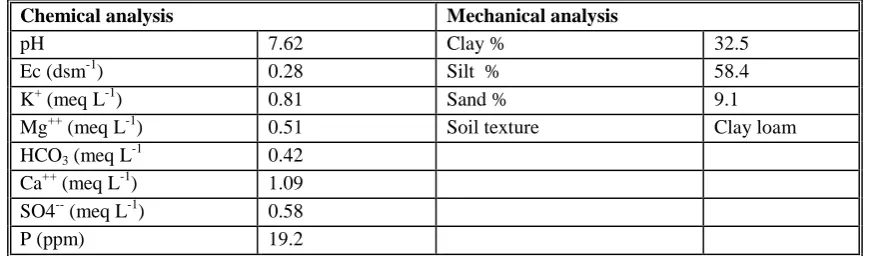
and 1/4 K+ (5.4 gm sodium sulphate equal to 72 kg Na2O/fed. and 1.5 gm potassium sulphate equal to 24 kg K2O/ fed.) and pots received Na+ only (7.2 gm sodium sulphate equal to 96 kg Na2O/fed.). The seeds were sown in 40 cm diameter pots filled with clay loam soil. The physical and chemical properties of the used soil are presented in Table (1) using the standard method described by klute [4].
Table (1) Soil chemical and mechanical analysis
Chemical analysis Mechanical analysis
pH 7.62 Clay % 32.5
Ec (dsm-1) 0.28 Silt % 58.4
K+ (meq L-1) 0.81 Sand % 9.1
Mg++ (meq L-1) 0.51 Soil texture Clay loam
HCO3 (meq L-1 0.42 Ca++ (meq L-1) 1.09 SO4-- (meq L-1) 0.58
P (ppm) 19.2
Three weeks after sowing, plants were thinned to two plants per pot. After thinning 4.35 gm ammonium sulphate (21% N) equal to 30 kg N/fed were added to each pot and 5.98 gm calcium superphosphate (16 % P2O5) per pot were added. Potassium and sodium fertilizers were added after three weeks from sowing. At harvest, representative plant samples from each treatment containing one plant from four replicates for measuring fresh and dry weight of blades, root length, volume and diameter were determined. Fresh and dry weight of the roots was recorded. Chlorophyll a&b and carotenoids content on the basis of blade area (mg/dm2) were determined and calculated according to von Wettestein [5].
3.
RESULTS AND DISCUSSION
3.1
Effect of partial substitution of K
+by Na
+on yield and yield component of sugar beet:
3.1.1 Root characters:
3.1.1.1 Root length:
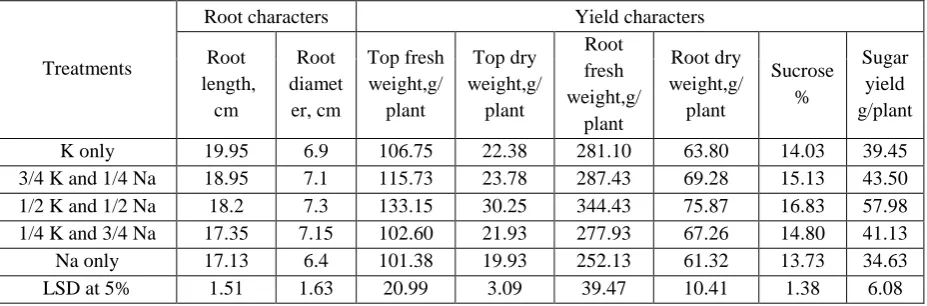
Data presented in Table 2 show that there was significant increase in root length of plants fertilized with potassium only as compared with sodium fertilized plants .Similar results obtained by Marschner and Possingham [10] and Abdul Wakeel [2] .These results may be attributed to increasing of cell size with increasing supply of K+ in the absence of Na+ Marschner and Possingham [10].
Under partial replacement of potassium with sodium the same table also show the same trend of potassium on root length, the least proportion of potassium in fertilizer the shortest root length obtained. The same table also show that the highest root length (10 cm) was obtained, when K+ fertilizer was applied and the lowest root length (7.1cm) was observed with Na+ fertilizer.
3.1.1.2 Root diameter:
It can be noticed from Table (2) that application of K+ increased diameter of sugar beet root as compared with plants fertilized with Na+ only .However, the same table also showed that diameter increased with partial substitution of K+ by Na+ though this effect was reversed with high Na+ substitution. These results were in agreement with those obtained by Roghieh and Arshad [11].
3.1.2 Yield characters:
3.1.2.1 Shoot fresh and dry weight :
Data presented in the same Table (2) indicated that application of K+ fertilizer improved sugar beet growth. There was a clear increase in shoot fresh weight as compared with plants unsupplied with K+. These results coincided with those obtained by Shaban et al., [12], concerning shoot dry weight the data showed a similar response of shoot fresh weight. Data presented in the same table also showed that equal substitution of K+ by Na+ resulted in high and significant increase in both the dry and fresh weight of sugar beet shoot. Similar findings were obtained by El- Sheikhi and Ulrich [13] who reported that sodium increased the growth of sugar beet plants when they were adequately supplied with K+. Abdul Wakeel [2] also reported that top dry weight increased greatly by equal substitution even above that attained by high K+.
3.1.2.2 Root Fresh and dry weight:
Data presented in Table (2) showed that potassium fertilizer significantly increased both fresh and dry weight of the roots as compared with sole use of sodium fertilizer. Similar results were also obtained by Abdel-Mawly and Zanouny [14]. The same table also showed that partial replacement of potassium fertilizer by sodium fertilizer to the equal proportion resulted in a clear and significant increase in both fresh and dry weight of sugar beet roots. The same table also showed that the highest root fresh and dry weight (344.425 gm and 75.87 gm) respectively was obtained by sugar beet plants fertilized by equal amount of potassium and sodium fertilizer .These results were in agreement with those obtained by El- Sheikhi and Ulrich [13] who recorded that the addition of sodium increased storage root dry weight more than 5-fold. Similar results also obtained by Abdul Wakeel [2]. However, further increase in sodium proportion resulted in a clear depression in those both criteria. Similar results obtained by Subbarao et al., [15] who reported that there was a 75% reduction in total biomass of sugar beet variety Klein Bol at 98% Na+ substitution.
Results presented in Table (2) clarified that sole application of potassium fertilizer increased sugar yield as compared with those fertilized with sodium fertilizer only. Such effect of potassium on sugar yield content may be attributed to the effect of potassium in increasing the water retaining capacity of cells, decreasing the transpiration rate of leaves through improving stomatal opening and closure and increasing photosynthesis rate and translocation of assimilates which, in turn, enhances yield of sugar beet [16]. The same table also show that partial replacement of potassium fertilizer by sodium fertilizer resulted in higher sugar yield content. Such effect greatly and significantly indicated by equal supply from both fertilizers resulted by high root fresh weight and high sucrose content. These results were in agreement with those obtained by El- Sheikhi and Ulrich [13] who claimed that the addition of sodium increased sugar production by nearly 6-fold.
Treatments
Root characters Yield characters
Root length, cm Root diamet er, cm Top fresh weight,g/ plant Top dry weight,g/ plant Root fresh weight,g/ plant Root dry weight,g/ plant Sucrose % Sugar yield g/plant
K only 19.95 6.9 106.75 22.38 281.10 63.80 14.03 39.45
3/4 K and 1/4 Na 18.95 7.1 115.73 23.78 287.43 69.28 15.13 43.50 1/2 K and 1/2 Na 18.2 7.3 133.15 30.25 344.43 75.87 16.83 57.98 1/4 K and 3/4 Na 17.35 7.15 102.60 21.93 277.93 67.26 14.80 41.13
Na only 17.13 6.4 101.38 19.93 252.13 61.32 13.73 34.63
LSD at 5% 1.51 1.63 20.99 3.09 39.47 10.41 1.38 6.08
Table (2):Effect of partial subistiution of K by Na on yield and yield componant of sugar beet
3.1.3 Sugar beet quality:
Sugar beet quality seemed to be influenced by several factors. In particular, it depends on the chemical composition of the beet. It is well known that the most important factors which affect the quality of sugar beet are the percentage of sugar, purity and total soluble solids (TSS) of root. Data presented in table (3) show that sole application of potassium slightly increased sugar %, purity and TSS as compared with sodium ones. These results are in a harmony with those obtained by Jocic and Saric [17] and Karam et al., [18] who found that potassium positively effects sugar content because of its specific physiological effects during synthesis, transport and storage of sugars.
Concerning the partial substitution of K+ by Na+ Table 2 show that increasing Na+ proportion in the fertilizer greatly increased the fore mentioned parameters (i.e. sucrose percentage, TSS and purity). However, this effect was reversed by high ratio of Na (3/4 Na+ and ¼ K+ and Na+ only). The highest record of sucrose percentage and purity (17.83% and 94.39 respectively) obtained by sugar beet plants fertilized by equal amounts of K+ and Na+ fertilizer. These results were in harmony with those obtained by Tsialtas and Maslaris [19] who reported that both potassium and sodium influence the pH of the raw sugar extract where alkalinity must be minimized for the efficient extraction of sugars.
K only 14.03 74.51 18.83
3/4 K and 1/4 Na 15.13 78.96 19.17
1/2 K and 1/2 Na 16.83 94.39 17.83
1/4 K and 3/4 Na 14.80 87.06 17.00
Na only 13.73 73.70 18.63
LSD at 5% 1.38 9.08 1.56
Table (3):Effect of partial subistiution of K by Na on quality of sugar beet.
3.1.4 Chlorophyll content:
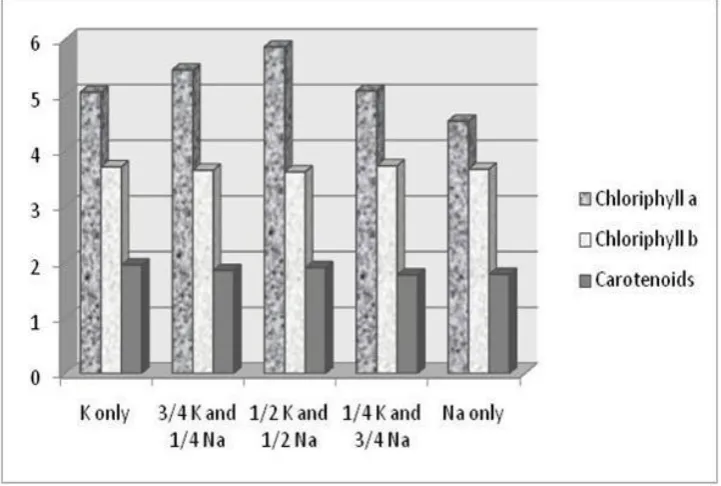
Fig. 1 showed that chlorophyll b and carotenoids slightly differed by the application of either K+ fertilized plants or Na+ ones or their combination. However, chlorophyll a clearly increased by K+ fertilizer.These results were in agreement with those obtained by Marschner and Possingham [10] who reported that with supplying of K+ in the absence of Na+ chloroplast number/cell and the amount of chlorophyll/disc increased . The same figure also show that chlorophyll b increased by the partial replacement of K+ by Na+. In this respect , Marschner and Possingham also added that in sugar beet at all levels of K+ addition of Na+ increased fresh and dry weight, cell size and chloroplast number/cell. The results suggest that K+ cannot be replaced by Na+ in chlorophyll formation but to a large extent K+ can be replaced by Na+ in cell expansion and chloroplast multiplication.
4.
CONCLUSION
From the obtained results it can be concluded that partial substitution of K+ by Na+ resulted in high sugar beet yield and quality. Such effect was clearly indicated with equal equivalent amount of K+ and Na+. Moreover, sodium increased the growth of sugar beet plants when they were adequately supplied with K. Top dry weight increased greatly by equal substitution of K+ by Na+. In conclusion sugar beet needs to take up a large quantity of both these elements to produce a high yield.
5.
REFERENCES
[1] Fathy, M. F. Abdel- Motagally, I and Kamal, K. A. 2009. Response of Sugar Beet Plants to Nitrogen and Potassium Fertilization in Sandy Calcareous Soil. Int. J. Agric.& Biol., 11 (6) : 695–700.
[2] Abdul Wakeel 2008. Substitution of Potassium by Sodium inSugar Beet (Beta vulgaris L.) Nutrition with Special Reference to K-Fixing Soils. PhD Thesis. Faculty of Agricultural and Nutritional Sciences, Home Economics and Environmental Management, Justus Liebig University, Giessen.
[3] Subbarao, G. V., O. Ito, W. L. Berry and R. M. Wheeler 2003. Sodium. A functional plant nutrient. Crit. Rev. Plant Sci., 22: 391 – 41.
[4] Klute, A. 1986. “Methods of Soil Analysis”. 2nd ed. Part 1: Physical and mineralogical methods. Part 2 : Chemical and Microbiological properties. Madifon, Wesconsin, USA.
[5] Von Wettstein, D. 1957. Chlorophyll, Letalfaktoren und der submikroskopische Formuechsel der Plastidenn. Exper. Cell Res., 2:427-433.
[6] Le-Docte, A. 1927. Commercial determination of sugar beet root using the Sachr Le-Docta process. Int. Sugar J., 29: 488 -492. (C.F. Sugar beet nutrition, Applied Sciences Publishers LTD, London, A.P. Draycott).
[7] Silin, P. M. and Silina N. P. 1977. Chemistry control in sugar technology. Food Tech. Pub. USSRP,167.
[8] Snedecor , G. W. and Cochran, W. G. 1982. “Statistical Methods” . 7th ed. Iowa State Univ. press Iowa, USA.
[9] Steel, R. G. D. and Torrie, J. H. 1980. Principles and procedures of statistics. Mc Crow-Hill Book Co.,Inc., New York, Toronto, London.
[10] Marschner, N and J. V. Possingham, 1975. Effect of K+ and Na+ on growth of leaf discs of sugar beet and spinach. ZeitschriftfürPflanzenphysiologie , 75 (1) 6–16.
[11] Roghieh, H.and Arshad , J. 2009. The K/Na replacement and function of antioxidant defence system in sugar
beet (Beta vulgaris L.) cultivars. Acta Agriculturae Scandinavica, 59 (3): 246-259.
[12] Shaban,A. Sh., Mona M. Shhata, S. I. Gaber and Eman M. Abdel Fatah 2009. Effect of rate and time of potassium fertilization on growth and physiological characters of sugar beet. Egypt. J. Agron., 31 (1): 1-16.
[14] Abdel-Mawly, S.E. and Zanouny, I. (2004). Response of sugar beet (Beta vulgaris, L) to potassium application and irrigation with saline water. Ass. Univ. Bull. Environ. Res., (7) : 1 , 123:136.
[15] Subbarao, G. V., R. M. Wheeler and G. W. Stutte 2000. Feasibilities of substituting sodium for potassium in crop plants for advanced life support system. Life Support Biosp. Sci., 7: 225 – 232.
[16] Carter, J. N. 1986. Potassium and sodium uptake effects on sucrose concentration and quality of sugar beet roots. J. Am. Soc. Sugar Beet Technol., 23 (3-4): 183-202.
[17] Jocic, B. and Saric, M. R. 1983. Efficiency of nitrogen, phosphorus, and potassium use by corn, sunflower,and sugarbeet for the synthesis of organic matter. Plant and Soil, 72: 219-223.
[18] Karam, F., Rouphael,Y., Lahoud,R., Breidi,J. and Colla, G. 2009. Influence of genotypes and potassium applicationrates on yield and potassium use efficiency of potato. J. Agron., 8 (1) : 27-32.