SYNTHESIS AND STRUCTURE OF
3,4,5-TRIHYDROXY-5-(4-NITROPHENYL)IMIDAZOLIDIN-2-ONE
Vasiliy Georgievich Shtamburg,
[a]Victor Vasilievich Shtamburg,
[a]Andrey
Alexandrovich Anishchenko,
[b]*Alexander Vladimirovich Mazepa,
[c]Svetlana
Valentinovna Shishkina
[d]and Irina Sergeevna Konovalova,
[d]Keywords:4-nitrophenylglyoxal;N-hydroxyurea; 2-methylfuran; 5-aryl-3,4,5-trihydroxyimidazolidin-2-ones; structure; α-benzoins.
4-Nitrophenylglyoxal reacts with N-hydroxyurea both in water and in acetic acid forming the mixture of diastereomers of 3,4,5-trihydroxy-5-(4-nitrophenyl)imidazolidin-2-one. The diastereomer with cis-orientation of OH-groups dominates. In the acetic acid medium, 4-nitrophenylglyoxal reacts with 2-methylfuran selectively yielding 2-hydroxy-2-(5-methylfuran-2-yl)-1-(4-nitrophenyl)ethanone.
*Corresponding Authors
E-Mail: [email protected]
[a] 49005 Ukraine, Dnepr, Gagarina st., 8. The Ukrainian State University of Chemical Technology.
[b] 49050 Ukraine, Dnepr, Nauchnaya st. 25. O. Gonchar Dnepropetrovsk National University
[c] 65080 Odessa, Luystdorfskaya Doroga st., 86. A.V. Bogatsky Physico-Chemical Institute of NAS of Ukraine [d] 61001 Ukraine, Kharkov, Science ave., 60. STC “Institute for
Single Crystals”, National Academy of Sciences of Ukraine
INTRODUCTION
Arylglyoxals are important precursors in the forming of some heterocyclic compounds1-4 but the investigation of
such interesting chemical properties of arylglyoxals, as their interaction with N-hydroxyurea5 and with activated furans,6
has just recently begun and needs to be continued.
Interaction of arylglyoxals with N-hydroxyurea in aqueous medium occurs in three stages and involves the formation of acyclic N-hydroxyureas (1) at the first stage, 5-aryl-3,4,5-trihydroxyimidazolidin-2-ones (2 and 3) at the second stage and 5-aryl-3-hydroxyimidazolidine-2,4-diones (5-aryl-3-hydroxyhydantoins) (4) at the third stage5 (Scheme
1).
Scheme 1. Arylglyoxal’s interaction with N-hydroxyurea in aqueous medium5
In this case, the product's identity depends on arylglyoxal’s nature. 4-Tolylglyoxal and 4-anisylglyoxal form acyclic ureas 1c, 1d, and 5-aryl-3-hydroxyhydantoins
4c, 4d.5 Phenylglyoxal usually gives
3-hydroxy-5-phenylhydantoin 4a, but if this reaction occurs at 10–20°C
without further heating, the mixture of 3,4,5-trihydroxy-5-phenylimidazolidines (2a and 3a) and 3-hydroxy-5-phenylhydantoin (4a) is formed. Interaction of 4-chlorophenylglyoxal with N-hydroxyurea at the room temperature selectively yields the main diastereomer of 5-(4-chlorophenyl)-3,4,5-trihydroxyimidazolidin-2-one (2b) with the cis orientation of hydroxyl groups at C-4,5 carbon atoms.5,7 Careful heating of the reaction mixture leads to the
receiving of 5-(4-chlorophenyl)-3-hydroxyhydantoin (4b). 5-Aryl-3,4,5-trihydroxyimidazolidin-2-ones (2a,3a,2b,3b) are easily converted into 5-aryl-3-hydroxyhydantoins (4a
and 4b) under heating in water, acetonitrile or dichloromethane.
The interaction in the acetic acid medium during one day (as described in the referenced procedure7) of such
arylglyoxals as phenyl-, 4-bromophenyl-, 4-chlorophenyl-, 4-fluorophenyl-, 4-methoxyphenyl- and 4-methylglyoxal with N-hydroxyurea gets 5-aryl-3-hydroxyhydantoins 4a-f
(Scheme 2) selectively.
Scheme 2. Synthesis of 5-aryl-3-hydroxyhydantoins 4a-f in acetic acid medium7
But the interaction of 4-nitrophenylglyoxal with N-hydroxyurea has not been investigated yet.
As it is known, arylglyoxals interaction with furan derivatives at the room temperature can proceed in two ways, which are a little bit different. Phenylglyoxal and 4-X-phenylglyoxals (X= F, Cl, Br) react with 2-methylfuran yielding only α-benzoins (5a-d) (Scheme 3).6,8
Similarly, phenylglyoxal and 4-fluorophenylglyoxal reacts with N,N-dimethylhydrazone of furan-2-carbaldehyde yielding α-benzoins (6a,d).6,8 But it has been shown, that at
1a-d
HO N O
H
O H2N
OH
Ar OH
OH O Ar
H
N
HO OH
O OH N
Ar H
H
+
NHO H
O OH N H
Ar OH
2a-d 3a-d
H N O H2N
OH
-H2O
N
Ar O
O OH N H
H
4a-d
Ar = p-XC6H4,
X = H(a), Cl(b), Me(c), OMe(d) H2O, r.t.
OH
OH O
Ar H
NH
O N H2
OH
N
Ar O
O OH N H
H
4a-f
Ar = p-XC6H4, X = H (a), Cl(b), Me(c), OMe(d), Br(e), F(f)
the room temperature chlorophenylglyoxal and 4-bromophenylglyoxal forms β-benzoins (7b,c)5,6 via primary
formation α-benzoins (6b,c). α-Benzoins(6d) spontaneously isomerizes into β-benzoins (7d) at the room temperature during one month.8
Scheme 3. Synthesis of benzoins 5a-d, 6a-d,7b-d6,8
4-Nitrophenylglyoxal’s interaction with both 2-methylfuran and N-hydroxyurea has remained not investigated. This arylglyoxal has a high activity due to the presence of 4-NO2 moiety, a strong electronegative
substituent. It might cause a different course of the described reaction.
As it was shown before, arylglyoxals’ interaction with N-hydroxyurea2 and furans6,8-10 have some differences which
depend on the nature of the substituting group in arylglyoxal. But it wasn’t clear at all what products would be received if arylglyoxal had a strong electronegative substituting group, such as, for example, nitro group. That’s why we decided to fill in this gap.
So, the first goal of our present research was to investigate both the interaction of 4-nitrophenylglyoxal with N-hydroxyurea in aqueous medium and acetic acid medium. The second goal was to investigate the interaction of 4-nitrophenylglyoxal with 2-methylfuran in the same mediums.
EXPERIMENTAL
1H NMR spectra were recorded on a Varian VXP-300
spectrometer and Varian Jemini 400 spectrometer (300 and 400 MHz, respectively). 13C NMR spectra were recorded on
a Varian VXP-300 spectrometer (75 MHz). The solvents were DMSO-d6 (compounds 2g, 3g, 5e) and CDCl3
(compound 5e).1H NMR chemical shifts were reported
relative to the residual solvent protons as an internal standard ((CD3)2SO: 2.50 ppm) or with TMS as an internal
standard (in CDCl3). Solvent carbon atoms served as an
internal standard for 13C NMR spectra ((CD
3)2SO: 39.32
ppm; CDCl3: 77.16 ppm). Mass spectra were recorded on a
VG 70-70EQ mass spectrometer in fast atom bombardment mode (FAB). The solvents were purified and dried according to the standard procedures.
N-Hydroxyurea11 was obtained according to published
procedures.
4-Nitrophenylglyoxal hydrate was obtained according to the standard procedure by 4-nitroacetophenone oxidation by H2SeO3 in boiling AcOH for 2h, the removing of AcOH and
yellow powder, mp 87–89ºC. 1H NMR (400 MHz,
DMSO-d6): δ = 5.66 (1H, t, J = 6.8 Hz, CH(OH)2); 7.03 (2H, d, J =
6.8 Hz, CH(OH)2); 8.29 (2H, d, J = 9.2 Hz, H Ar); 8.34 (2H,
d, J = 9.2 Hz, H Ar).
Preparation of cis- and trans-3,4,5-trihydroxy-5-(4-nitrophe-nyl)imidazolidin-2-ones 2g, 3g in aqueous medium.
4-Nitrophenylglyoxal hydrate (217 mg, 1.101 mmol) was dissolved in boiling water (10 mL), after cooling to 14ºC a solution of N-hydroxyurea (93 mg, 1.223 mmol) in water (5 ml) was added at stirring. The reaction solution was maintained at 14ºC for 25h, then the obtained precipitate was filtered off, washed out with cold water (2 mL), dried at 14ºC under vacuum (3 mmHg), yielding 114 mg (38%) cis-diastereomer (4S,5S)-3,4,5-trihydroxy-5-(4-nitrophenyl)-imidazolidin-2-one hydrate (2g, purity 97%) as yellow crystals, m.p. 132–133 ºC. 1H NMR (300 MHz, DMSO-d
6):
δ= 4.55 (1H, d, J = 7.5 Hz, CHOH); 6.49 (1H, s, OH); 6.63 (1H, d, J = 7.5 Hz, CHOH); 7.75 (2H, d, J = 8.7 Hz, C(2)H, C(6)H Ar); 8.24 (1H, s, NH); 8.26 (2H, d, J = 8.7 Hz, C(3)H, C(5)H Ar); 9.13 (1H, s, NOH). 13C NMR (75 MHz,
DMSO-d6) : δ = 82.6 (C-4 imidazolidine); 89.4 (C-5 imidazolidine);
123.4, 127.6 (C-2 ,C-6, C-3, C-5 Ar); 147.3 (C-1 Ar); 149.9 (C-4 Ar (C–NO2)); 159.5 (C=O). 13C NMR (75 MHz, APT
mode, DMSO-d6): δ = a) CH: 82.6 (C-4 (CHOH)
imidazolidine); 123.4 (C-2 ,C-6, Ar); 127.6 (C-3, C-5 Ar); b) Cq, C=O: 89.4 (C-5 imidazolidine); 147.2 (C-1 Ar); 149.8 (C-4 Ar (C–NO2)); 159.5 (C=O). MS (FAB), m/z 256
[M+H]+ (77); 210 (13); 195 (18); 106 (87); 88 (100). Anal.
Calc. for C9H9N3O6•H2O: C 39.57; H 4.06; N 15.38. Found:
C 39.52; H 4.25; N 15.26.
The filtrate was concentrated under vacuum (2 mmHg) at 16ºC to the volume of 7 mL, the obtained precipitate was filtered off, dried under vacuum (2 mmHg), resulting 93 mg (31%) mixture diastereomers 2g and 3g in the molar ratio 61:39 (1H NMR).
The second filtrate was concentrated under vacuum (2 mmHg) at 16ºC to volume 2.5 ml, the obtained precipitated was filtered off, dried under vacuum (2 mmHg), giving 40 mg (13%) mixture diastereomers 2g and 3g in molar ratio 59:41 (1H NMR).
(4R,5S)-3,4,5-Trihydroxy-5-(4-nitrophenyl)imidazolidin-2-one hydrate (3g), trans-diastereomer
1H NMR (300 MHz, DMSO-d
6): δ = 4.91 (1H, d, J = 5.4
Hz, CHOH); 6.56 (1H, d, J = 5.4 Hz, CHOH); 6.85 (1H, s, OH); 7.63 (2H, d, J = 8.4 Hz, C(2)H, C(6)H Ar); 8.17 (1H, s, NH); 8.21 (2H, d, J = 8.4 Hz, C(3)H, C(5)H Ar); 9.16 (1H, s, NOH).
Crystals of the compound 2g were grown from aqueous solution during the reaction. The studied crystal was monoclinic, C9H11N3O7, at 20 °С, a = 11.983(5), b =
6.988(4), c = 13.156(7) Å,
β
= 90.91(4)°
, V = 1101.6(10) Å3, Mr = 273.21, Z = 4, space group P21/c, dcalc.= 1.647 gcm3,µ
(MoKα)=0.144 mm-1, F(000) = 568. X-ray structural study
of compound 2g was performed on an Xcalibur 3 automatic four-circle diffractometer (MoKα-radiation, graphite monochromator, Sapphire-3 CCD detector, ω-scanning,
OH
OH O
H
X
6a-d 7b-d 5a-d
O O
X H OH
Me
O CH=NNMe2 O Me
O
N NMe2 OH O
H X
O
N NMe2 O O X
H H
X = H(a), Cl(b), Br(c), F(d)
gradient technique with the SHELXD12 software and refined by full matrix method of least squares in anisotropic approximation for non-hydrogen atoms, using the SHELXL12 software. Positions of hydrogen atoms were located from the difference electron density maps and further included into refinement in riding model approximation with Uiso(H) = nUeq with n =1.5 for methyl
groups and n = 1.2 for remaining H-atoms. Refinement against F2 in an anisotropic approximation for non-hydrogen atoms by a full matrix least-squares method for 1939 reflections was carried out to wR2=0.147 (R1=0.092 for 635 reflections with F>4σ(F), S = 0.911).
The atomic coordinates, molecular geometry parameters, and crystallographic data of compound 2g were deposited at the Cambridge Crystallographic Data Center, 12 Union Road, CB2, 1EZ UK (fax:+44-1223-336033, e-mail: [email protected] and is available on request quoting the deposit number CCDC 1894817).
Preparation of cis- and trans-3,4,5-trihydroxy-5-(4-nitrophe-nyl)imidazolidin-2-ones (2g, 3g) in acetic acid medium.
N-Hydroxyurea (139 mg, 1.828 mmol) was dissolved at stirring in a solution of 4-nitrophenylglyoxal hydrate (108 mg, 0.548 mmol) in AcOH (3 mL), the reaction solution was maintained at 17ºC for 25h, then AcOH was removed by evaporation under vacuum (2 mmHg) at 12ºC, the residue was extracted with water (15 mL). The aqueous extract was evaporated under vacuum (2 mmHg) at 12ºC. Yield 144 mg (96%) mixture of diastereomers 2g and 3g in molar ratio 74:26 (1H NMR).
2-Hydroxy-2-(5-methylfuran-2-yl)-1-(4-nitrophenyl)ethanone (5e)
The solution of 4-nitrophenylglyoxal hydrate (99 mg, 0.502 mmol) and 2-methylfuran (130 mg, 1.583 mmol) in AcOH (10 mL) was maintained at 18–19ºC for 170h, then AcOH was removed by evaporation under vacuum (3 mmHg), the residue was washed with cold (4ºC) water (3 mL), dried under vacuum (3 mmHg). Yield 105 mg (80%), yellow solid, mp. 85–86ºC. 1H NMR (400 MHz, DMSO-d
6):
δ = 2.16 (3H, s, Me); 5.99 (1H, br. s, CHOH); 6.10 (1H, d, J = 6.4 Hz, H Fur); 6.15 (1H, d, J = 6.4 Hz, H Fur); 6.27 (1H, d, J = 2.8 Hz, CHOH); 8.17 (2H, d, J = 8.0 Hz, H Ar); 8.28 (2H, d, J = 8.0 Hz, H Ar). 13C NMR (75 MHz, CDCl
3): δ =
13.6 (Me); 70.2 (CHOH); 107.3, 111.2 (C-3, C-4 furan); 124.0, 130.1 (C-2, C-6, C-3, C-5 Ar); 138.2 (C-1 Ar); 148.6 (C-4 Ar (C-NO2)); 150.8 153.9 (C-2, C-5 furan); 195.1
(C=O). 13C NMR (75 MHz, APT mode, CDCl
3): δ = a) CH,
CH3: 13.5 (Me); 70.1 (CHOH); 107.2, 111.0 (C-3, C-4
furan); 123.9, 130.0 (C-2,C-3,C-5,C-6 Ar); b) Cq, C=O: 138.2 (C-1 Ar); 148.6 [C-4 Ar (C-NO2)]; 150.8, 153.9 (C-2,
C-5 furan); 195.1 (C=O). MS (FAB), m/z 261 M+ (8); 260
[M-H]+ (10); 244 [M+H-H
2O]+ (71); 150 (30); 111 (100).
MS (FAB, KI) m/z 300 [M+K]+ (35); 261 M+ (7); 244
[M+H-H2O]+ (66); 150 (30); 111 (100). Anal. Calc. for
C13H11NO5: C 59.77; H 4.24; N 5.36. Found: C 59.65; H
4.42; N 5.17.
RESULTS AND DISCUSSION
We have found that 4-nitrofhenylglyoxal reacts with N-hydroxyurea in aqueous solution at 14°C yielding mixture of diastereomers of 3,4,5-trihydroxy-5-(4-nitrophenyl)-imidazolidin-2-one (2g and 3g) (the overall yield of both compounds is 82%) (Scheme 4).
Scheme 4. Synthesis of diastereomeres of 3,4,5-trihydroxy-5-(4-nitrophenyl)imidazolidin-2-one (2g and 3g)
Firstly, from the reaction solution crystals of almost pure cis diastereomer (2g) precipitate (according to 1H NMR data
molar ratio 2g:3g is 97:3). The same phenomenon was established earlier for 5-(4-chlorophenyl)-3,4,5-trihydroxyimidazolidin-2-one (2b).5,7 Additionally
step-by-step evaporation of the aqueous filtrate without any heating gave two portions of the mixture of 2g and 3g. In this mixture, cis diastereomer 2g was dominated (molar ration 61:39 and 59:41, respectively). The overall yield of compound 2g was 63%, the overall yield of compound 3g
was 19%.
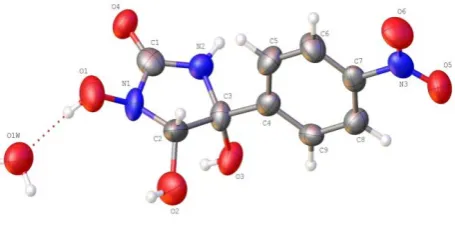
In the compound 2g the cis orientations of 4-HO- and 5-HO-moieties were confirmed by X-ray structural analysis (Figure 1), as earlier in the compound 2b.5
Figure 1. Molecular structure of monohydrate of cis -3,4,5-trihydroxy-5-(4-nitrophenyl)imidazolidin-2-one (2g) with atoms represented by thermal vibration ellipsoids of 50% probability
In the crystals, the compound 2g exists as a monohydrate. The five-membered ring adopts an envelope conformation. The C(2) atom lies -0.40 Å off the plane of remaining ring atoms. The N(1) nitrogen atom has a pyramidal configuration. The sum of bond angles centered at the N(1) atom (∑β) is 342º. The N(2) nitrogen atom has a planar configuration (∑β is 360º). The lengths of the N(1)–C(1) bond (1.352(11) Å) and N(2)–C(1) bond (1.355(10) Å) are similar to the corresponding bonds' lengths in 5-(4-chlorophenyl)-3,4,5-trihydroxyimidazolidin-2-one (2b).5,7 In
the compound 2b the substantial difference of those bonds was established [1.3822(16) Å and 1.1.3462(16) Å].5
OH
OH O
Ar
H N
O
H OH
O OH N
Ar H
H
+
NO
H H
O OH N H
Ar OH
63% 2g 19% 3g
NH
O N H2
OH
H2O, r.t.
The C(1)=O(4) group is elongated to 1.251(9) Å as compared to the mean value of 1.210 Å. Similar elongation of this group has been found in the compound 2b
[1.2300(15) Å]5 and in N-methoxyurea [1.244(2) Å].13
In the compound 2g the ordinary bonds O(2)–C(2) and O(3)–C(3) are somewhat different: the O(3)–C(3) bond [1.409(8) Å] is longer than the O(2)–C(2) bond [1.384(9) Å]. In the compound 2b that bonds difference is some greater [1.4203(14) Å and 1.387(4) Å]5. The length of the O(1)– N(1) of the compound 2g [1.398(7) Å] is similar to the same bond’s length in 5-(4-chlorophenyl)-3,4,5-trihydroxyimidazolidin-2-one (2b) [1.4047(14) Å].5
In the compound 2g HO-moiety at C(3) atom (5-HO-moiety of hydantoin’s cycle) has the axial orientation relative to five-membered ring (the torsion angle N(1)– C(2)–C(3)–O(3) is -93.7(7)º). 4-Nitrophenyl moiety has the equatorial orientation to five-membered ring (the torsion angle N(1)–C(2)–C(3)–C(4) is 143.3(7)º). It is rotated relatively to the N(2)–C(3) endocyclic bond (the torsion angle N(2)–C(3)–C(4)–C(5) is 53.4º). The weak intramolecular hydrogen bond C(9)–H(9)…O(3) (H…O 2.32 Å, C–H…O 102º) takes place. The nitro group is slightly rotated towards the plane of the aromatic cycle (the torsion angle C(6)–C(7)–N(3)–O(6) is 13.1º, the torsion angle C(8)–C(7)–N(3)–O(5) is 7.4º).
In the crystal molecules of the compound 2g linked by the intermolecular hydrogen bonds O(3)-H(3)…O(4)’ (1-x,-0.5+y,1.5-z) (H…O1.92Å, O-H…O 174°), O(2)-H(2)…O(4)’ (x,1.5-y,-0.5+z) (H…O2.02Å, O-H…O 156°), N(2)-H(2A)…O(5)’ (2-x,-0.5+y,1.5-z) (H…O2.35Å, N-H…O 135°), O(1W)-H(1WA)…O(6)’ (1+x,-1+y,z) (H…O2.12Å, O-H…O 171°), O(1W)-H(1WB)…O(2)’ (1-x,2-y,1-z) (H…O2.37Å, O-H…O 129°), O(1W)-H(1WB)…O(3)’ (1-x,2-y,1-z) (H…O2.17Å, O-H…O 157°).
Contrary to the other arylglyoxals, in acetic acid at the room temperature 4-nitrophenylgyoxal reacts with N-hydroxyurea giving only the mixture of 3,4,5-trihydroxyimidazolidin-2-ones (2g and 3g in molar ratio near 3:1) (r.t., 25h). 3-Hydroxy-5-(4-nitrophenyl)hydantoin (4g) didn’t form. But, earlier we supposed that the presence of acid (acetic acid or excess of N-hydroxyurea) make to be easy the transformation 5-aryl-3,4,5-trihydroxyimidazolidin-2-ones (2 and 3) into 5-aryl-3-hydroxyhydantoins (4 and 7) (Scheme 5).
Scheme 5. The proposed mechanism of the conversion of 5-aryl-3,4,5-trihydroxyimidazolidin-2-ones (2 and 3) into
5-aryl-3-The protonation of 4-HO-group with the further elimination of molecule of water yields “benzylic” cation A, which transforms into 5-aryl-3-hydroxyhydantoin (4) by 1,2-shift and proton elimination from 4-HO-group. But the forming of destabilized cation B from 3,4,5-trihydroxy-5-(4-nitrophenyl)imidazolidin-2-ones (2g and 3g) seems to be more hindered.
It is possible that such a strong electronegative substitute group in aryl's fragment, as the nitro group makes this transformation impossible.
4-Nitrophenylglyoxal reacts with 2-methylfuran only in acetic acid (r.t.) selectively yielding 2-hydroxy-2-(5-methylfuran-2-yl)-1-(4-nitrophenyl)ethanone (5e) (Scheme 6). Into inert solvents, such as CH2Cl2 or THF, we couldn’t
obtain the compound 5e.
Scheme 6. Synthesis of 2-hydroxy-2-(5-methylfuran-2-yl)-1-(4-nitrophenyl)ethanone (5e)
In this case, any α→β benzoin isomerization4,5 hasn't
occurred. The structure of the compound 5e is consistent with data of 1H and 13C NMR and MS spectra. In 1H NMR
spectrum of the compound 5e, the doublets of H(3) and H(4) protons of furan ring are situated closely in the same field. That is a test on α-benzoin's structure.6,8 The doublets of
C(2,6)H and C(3,5)H protons are situated closely too. In mass spectrum cation C [M+H-H2O]+ (m/z 244),
4-nitrobenzoyl cation D (m/z 150) and “benzylic” furyl cation E (m/z 111) dominate (Scheme 7), which is typical for α-benzoins.6,8,10,14,15
Scheme 7. Fragmentation pattern of 2-hydroxy-2-(5-methylfuran-2-yl)-1-(4-nitrophenyl)ethanone (5e) (FAB)
Conclusions
The reaction of 4-nitrophenylglyoxal with N-hydroxyurea leads to the mixture of diastereomers of 3,4,5-trihydroxy-5-(4-nitrophenyl)imidazolidin-2-one.
The diastereomer with cis-orientation of OH-groups dominates. Its structure has been investigated by X-ray structural analysis.
N O
H OH
O OH N
H
H X
2,3
-H+
N O
O OH N H
H X
4a-f
X = H(a),Cl(b), Me(c),MeO(d), Br(e), F(f) H+
N O H
OH
O OH N
H
H X
-H2O
N OH
O OH N
H
H X
+
A
N OH
O OH N
H
H O2N
+
B
OH
OH O
H O2N
80% 5e
O O
H OH Me
O2N O Me
AcOH, r.t.
5e, M+, m/z 261(8) O O
H OH
Me
O2N
O Me
O H H
O O
H OH
Me
O2N
C=O O2N
+
+
E m/z111 (100)
D m/z150 (30) H+
+
-H2O
O O
Me
O2N
H +
O
Me
O2N
O+ H
The reaction of 4-nitrophenylglyoxal with 2-methylfuran is also possible, but only in the special conditions – in the acetic acid medium at the room temperature. The product of this reaction is α-benzoin, which did not isomerize into β-benzoin in these conditions last time.
References
1Eftekhari-Sis, B.; Zirak, M.; Akrabi, A., Arylglyoxals in Synthesis
of Heterocyclic Compounds, Chem. Rev.,2013, 113(5), 2958–3043; DOI 10.1021/cr300176g.
2Konnert, L.; Lamaty, F., Martinez, J.; Colacino, E.; Recent
Advances in the Synthesis of Hydantoins: The State of the Art of Valuable Scaffold, Chem. Rev., 2017, 117(23), 13757– 13809; DOI 10.1021/acs.chemrev.7b00067.
3Meusel, M.; Gutschow, M.; Recent Developments in Hydantoin
Chemistry. A Review. Organic Preparations and Procedures International: The new Journal for Organic Synthesis,2004,
36(5), 391–443;
http// dx.doi.org/10.1080/00304940409356627.
4Suarez, A.; Martinez, F.; Sanz, R., Synthesis of α-functionalized α-3-yl carbonyls through direct SN reactions of indol-3-yl α-acyloins, Org. Biomol. Chem.,2016, 14, 11212−11219.
https://doi.org./10.1039/c6ob02125e.
5Shtamburg, V. G.; Anishchenko, A. A.; Shtamburg, V. V.;
Shishkin, O. V.; Zubatyuk, R. I.; Mazepa, A. V.; Rakipov, I. M.; Kostyanovsky, R. G., Synthesis and crystal structure of new imidazolidine-2,4-dione and imidazolidin-2-one derivatives, Mendeleev Commun.,2008, 18, 102–104. DOI: 10.1016/j.mencom.2008.03.018.
6Ivonin, S. P.; Lapandin, A. V.; Anishchenko, A. A.; Shtamburg, V.
G. Reaction of Arylglyoxals with Electron-Rich Benzenes
and π-Excessive Heterocycles. Facile Synthesis of Heteroaryl
α-Acyloins, Synt. Commun.,2004, 34(3), 451-461; DOI 10.1081/SCC-120027284.
7Shtamburg, V. G.; Shtamburg, V. V.; Anishchenko, A. A.;
Zubatyuk R. I.; Mazepa, A. V.; Klotz, E. A.; Kravchenlo, S. V.; Kostyanovsky, R. G. Single-stage synthesis of 3-hydroxy- 3-alkoxy-5-arylimidazolidine-2,4-diones by reaction of arylglyoxal hydrates with N-hydroxy- and
N-alkoxyureas, Chem. Heterocycl. Comp.,2015, 51(6), 553– 559; DOI 10.1007/s10593-015-1735-0
8Anishchenko, A. A.; Shtamburg, V. G.; Shtamburg, V. V.;
Mazepa, A. V., Unusual Spontaneous α→β Isomerization of Unsymmetrical Benzoins , Eur. Chem. Bull.,2013, 2, 361– 366; https://doi.org./10.17628/ecb2013.2/361-366
9Anishchenko, A. A.; Shtamburg, V. G., Shishkin O. V., Zubatyuk
R. I., Shtamburg, V. V., Kostyanovsky, R. G., The Structure of Mixed β-Aryl(furyl)benzoin, 2-Hydroxy-2-(4''-
chlorophenyl)-1-(5'-N,N-dimethylhydrazonylfuryl-2')ethanone-1, Eur. Chem. Bull.,2014, 3, 472−473. https://doi.org./10.17628/ECB2014.3.472-473
10Ivonin, S. P.; Anishenko, A. A.; Samukha, A. V.; Lapandin, A.
V.; Serdiuk, V. N.; Pleshkova, A. P.; Shtamburg, V. G., Aryl(furyl)aciloins, Vestnik Dnepropetrovsk. University, Khimia,2000, 5, 27–32 [In Russian].
11Synthesis of Organic Compounds [Russian Translation],
Kazansky, B. A., Ed.; Mir: Moscow, 1964, Vol. 12, p.121.
12Sheldrick, G.M., SHELXT – integrated space-group and
crystal-structure determination, Acta Crystallogr., Sect. A: Found. Crystallogr., 2015, A71(1), 3–8.
https://doi.org./10.1007/S2053273314026370
13Shtamburg, V. G., Kostyanovsky, R. G.; Tsygankov, A. V.;
Shtamburg, V. V.; Shishkin, O. V.; Zubatyuk R. I.; Mazepa, A. V.; Kravchenko, S. V., Geminal systems. 64. N
-Alkoxy-N-chloroureas and N,N-dialkoxyureas, Russ. Chem. Bull.2015, 64(1), 62–75. https://doi.org./10.1007/s11172-015-0822-9
14Ivonin, S. P.; Mazepa, A. V.; Lapandin, A. V., Mass-spectral
behavior and thermal stability of hetaryl analogs of unsymmetrical benzoins, Chem. Heterocycl. Comp.,2006, 42, 451–457.
15Shtamburg, V. G.; Shtamburg, V. V.; Anishenko, A. A.; Mazepa,
A. V.; Kravchenko, S. V.; Shishkina, S.V., Eur. Chem. Bull.
2018, 7(8), 223–232.
https://doi.org./10.17628/ECB2018.7.223-232