SOLVATION EFFECT ON SELF-ORGANIZATION OF COBALT
COMPLEXES WITH SUBSTITUTED PHTHALOCYANINES
Alena Voronina
[a], Anna Filippova
[a], Mikhail Razumov
[b], Ilya Kuzmin
[b], Maxim Shepelev
[c],
Artur Vashurin
[b]*and Oleg Golubchikov
[d]Keywords: phthalocyanine, cobalt complexes, aggregates, solvation effect.
The influence of solvating power of medium on self-organization of metallophthalocyanines in solution has been studied. It is shown that phthalocyanine macrocycles form H-associates in universal solvation medium. In case of specific solvation the nature of peripheral substitution of phthalocyanine macrocycle plays important role in the formation of ordered structure.
*Corresponding Authors
E-Mail: [email protected]
[a] Faculty of Fundamental and Applied Chemistry of Ivanovo State University of Chemistry and Technology, 153000, Russia, Ivanovo, Sheremetevsky ave., 7
[b] Department of Inorganic Chemistry of Ivanovo State University of Chemistry and Technology, 153000, Russia, Ivanovo, Sheremetevsky ave., 7
[c] Department Physical and Colloid Chemistry of Ivanovo State University of Chemistry and Technology, 153000, Russia, Ivanovo, Sheremetevsky ave., 7
[d] Department of Organic Chemistry of Ivanovo State University of Chemistry and Technology, 153000, Russia, Ivanovo, Sheremetevsky ave., 7
Introduction
Liquid-phase materials based on porphyrin and phthalocyanine complexes with d- and f-metals are widely used as photosensitizers,1,2,3 as catalysts,4,5,6,7
photovoltaics,8,9 and in analytical chemistry.10,11 The
formation of supramolecular assemblies based on metallophthalocyanines is possible due to existence of molecular complexation processes. Central metal cation of macrocycle forms ordered phthalocyanine structures12 by
taking polidentate axial ligands into fifth and sixth coordination positions. Besides, phthalocyanine structures are able to form self-associates in solutions due to π-stacking and intermolecular interaction on macrocycle periphery.13,14 Coordination centers on the periphery of
phthalocyanine molecule are crucial for creation of materials with desired properties.
Nature of solvent has great influence on self-association of metallophthalocyanines in solution.15,16 Obviously,
solvents, having donor atoms such as nitrogen, oxygen or sulfur, act as not only universal solvating agents but as molecular ligands too. It is also known that molecular complexes formed between metallophthalocynine and solvent could be moved from a solution to crystal solvates.17,18
Present work assesses the impact of solvating power of a solvent on formation of self-ordered phthalocyanine structures.
Experimental
Solvents used viz., acetonitrile (An), pyridine (Py), N,N-dimethylformamide (DMF), dimethylsulfoxide (DMSO), ethanol (EtOH), were purified using known methods.19 The
water was double-distilled before the experiment. All solvents were stored in vacuo.
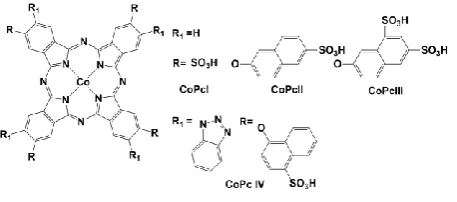
Sulfonated derivatives of cobalt phthalocyanine with peripheral substituents of regularly changing nature are investigated (Figure 1).
Figure 1. Structure of phthalocyanines.
Cobalt(II) tetrasulfophthalocyaninate (CoPcI) is synthesized and purified by "Weber-Busch" method.20
3,10,17,24-Tetrakis(6-sulfonaphthalen-2-yloxy)phthalocy- aninato]cobalt(II) (CoPcII)21,22 was synthesized by heating a
mixture of 0.78 g of potassium 6-(1,3-dioxo-2,3-dihydro-1H-isoindol-2-yloxy)-naphthalene-2-sulfonic acid and 0.065 g of anhydrous cobalt(II) chloride for 60 min at 190-195 °C with stirring. The resulting cobalt phthalocyanine was extracted into DMSO and precipitated from the extract with anhydrous ethanol. The precipitate was filtered off and washed with ethanol in a Soxhlet extractor. The product was further purified by chromatography on silica gel M 60 using aqueous DMF (1:1 by volume) as eluent. The product was a blue–green powder, readily soluble in water, aqueous DMF, DMSO, and aqueous alkali and the yield = 0.39 g (54 %). IR spectrum, ν, cm-1: 1045 (S=O
s), 1103 (S=Oas), 1205 (C–
O–C). Found, %: C 58.42; H 2.70; N 7.62; S 8.80. C72H40CoN8O16S4. Calculated, %: C 59.22; N 2.74; N 7.68;
3,10,17,24-Tetrakis(6,8-disulfonaphthalen-2-yloxy)phtha-locyaninato]cobalt(II) (CoPcIII)21,22 was synthesized in a
similar way from 1.01 g of dipotassium 7-(1,3-dioxo-2,3-dihydro-1H-isoindol-2-yloxy)naphthalene-1,3-disulfonate. Yield: 0.53 g (59 %); blue–green powder, readily soluble in water, aqueous DMF, DMSO, and aqueous alkali. IR spectrum, ν, cm-1: 1039 (S=O
s), 1103 (S=Oas), 1210 (C–O–
C). Found, %: C 48.32; H 2.20; N 6.23; S 14.43. C72H40CoN8O28S8. Calculated, %: C 48.57; H 2.25; N 6.30;
S 14.39.
Synthesis of 2,9,16,23-tetrakis(1-benzotriazolyl)- 3,10,17,24-tetrakis(4-sulfo-1-naphthoxy)phthalocyaninato-cobalt(II) (CoPcIV) was carried out by directed sulfonation of initial phthalocyanine.23 There are characteristic
vibrational bands (cm-1) for CoPcIVin FT-IR spectra (KBr):
745 (C-N), 1045 (N=N), 1230 (Ar-O-Ar), 1060 (С-S), 1150-1190 (S=O in SO3H). MS (MALDI-TOF) m/z 1932.71
[M+4H]+. In 1Н NMR (500 MHz, DMSO-d
6): δ (ppm) 7.45
(Ar-5H), 7.94 (Ar-4H), 8.07 (Ar-6H), 8.29 (Ar-3H) – triazole groups, 7.64 (Ar-8H), 7.73 (Ar-7H), 7.85 (Ar-11H), 8.18 (Ar-10H), 8.53 (Ar-9H), 8.85 (Ar-12H) – naphthoxy groups, 8.97 (SO3H).
FT-IR spectra were recorded using IR-Fourier spectrophotometer Avatar 360 (USA) in 400-4000 cm-1
frequency range. NMR spectra of the solutions were recorded on Bruker AVANCE-500 NMR spectrometer at 500 MHz (1H) operating frequency. Measurements were
performed under the Fourier transformation conditions in 5 mm cells at various temperatures. Chemical shifts were measured with reference to TMS as the internal standard. The accuracy of measurements was ± 0.005 ppm. Electron adsorption spectra (UV-VIS) were registered on Unico 2800 spectrophotometer in a spectral range of 200 – 1000 nm. Quartz optical cell were used for the measurements. UV-Vis spectra were recorded at 298.15 ± 0.03 K. Mass spectra were measured on an Axima MALDI-TOF mass-spectrometer (Shimadzu).
Contributions of monomeric and dimeric components in UV-VIS spectra were found using the method of statistical expansions on the Gaussian function.24, 25 Further, extinction
coefficients for monomeric (εM) and dimeric (εD) forms of
the phtalocyanine were calculated based on these data using Beer-Lambert-Bouguer law.
Results and Discussion
Sulfonated derivatives of cobalt phthalocyanine form self-assembled structures in solvent mediums with high universal solvation toward macrocycle. Solvent does not affect conjugated π-electronic system when universally solvate the periphery of macrocycle molecule, so it does not prevent formation of H- and J-aggregates (Figure 2). The following equilibrium (Eqn. 1) is observed in the system.
2CoPc‧nSolv ⇌ (CoPc)2‧nSolv (1)
Obviously, it is possible to regulate π-π-repulsion and π-σ-contraction processes, due to which H-aggregates are formed, by changing of specific solvation ability of the solvent. Hence it affects the reaction (1). Simultaneously the
solvent becomes a competing agent in J-aggregates formation due to donor-acceptor interaction with central metal cation.
(a)
(b)
Figure 2. Scheme of CoPc self-associates in solutions: (a) H-aggregates, (b) J- aggregates.
If the solvent acts as axial ligand, the following reactions are likely to be present.
(CoPc)2 + L ⇌ CoPc‧L + CoPc (2)
CoPc + L ⇌ CoPc‧L (3)
CoPc‧L + L ⇌ L‧CoPc‧L (4)
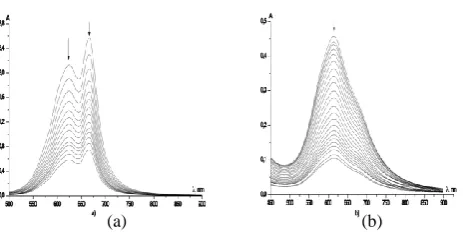
Investigation of concentration dependence of UV-VIS spectra for CoPc(I-III) shows that these macrocycles are associated in water. Figure 3 presents typical changes in UV-VIS spectra of aqueous solutions of CoPc.
(a) (b)
Figure 3. Typical changes in UV-VIS spectra during dilution of aqueous solutions of phthalocyanines (a) CoPcI, (b) CoPcII in concentration range of 2 x10⁻⁴ – 2 x 10⁻⁷ mol L-1.
The presence of absorption maximum in range of 600-650 nm suggests high degree of self-association of phthalocyanine structures in solution. Previously22,26,27
extinction coefficients of dimers of CoPcI, CoPcII and CoPcIII in aqueous solutions were determined by us. It was also shown that these macrocycles form dimers due to π-π-interaction.22,28 Obviously, the water in the system acts as
universal solvent for phthalocyanine. It is known that water is a self-assembled system and forms assemblies due to hydrogen bond lattices.28,29 That is why detachment of water
interaction with phthalocyanine leads to disturbance of energy balance of the system. However, formation of ordered phthalocyanine structure with twenty molecules of water has been reported.30 Evidently, the water in this case
acts as not only agent promoting dimerization but as direct participant of the process. Thus, the reactions (3) and (2) should be observed in reverse sequence instead of reaction (1) in the system. Besides the role of hydration of CoPcI monomeric molecule in associate formation is not clear.
Introduction of naphthalene fragment into peripheral substituent (CoPcII and CoPcIII) leads to decreasing of influence of electron acceptor group (-SO3H) on conjugated
macrocycle system. It promotes stabilization of partially uncompensated charge on central metal cation of phthalocyanine, amplification of π-π-contraction processes and diminution of association. The data of Table 1 shows that stability of dimeric structures decreased in the series CoPсI– CoPсII – CoPсIV – CoPсIII. Exceptional position of CoPcIII is likely due to stabilization of associates caused by coordination interaction of sulfonic groups with π-π-dimer. It leads to stable coordinated associates (J-aggregates) formed by introduction of fragment of phthalocyanine peripheral substituent into centre of π-π-dimer. Addition of triazole fragment in annelated benzene ring as second peripheral substituent (CoPсIV) leads to redistribution of electronic effects of the periphery on conjugated macrocycle π-system and as consequence to formation of self-assembled structures in solutions. Presence of the second organic fragment causes decreasing of the solvating power of the water toward the phthalocyanine and increasing association.
Table 1. Extinction coefficients and dissociation constants of H -dimers in aqueous solutions of metallophthalocyanines.
Macrocycles εМ, L mol cm-1
εD,
L mol cm-1
Kdiss×10-4
mol L-1
CoPсI - 15200±50 1.17 CoPсII - 4800±50 1.54 CoPсIII - 800±20 2.23 CoPсIV 32700 ± 80 8930 ± 50 1.91
The influence of temperature on dimerization was investigated to confirm the type of associates fromation. On one side increasing of temperature should decrease the dielectric constant of the medium which in turn should decrease the solvating power of the solvent and amplify association. However, in the case of fromation H-aggregates increasing of kinetic energy of the system promotes dissociation of dimers.
The changes of UV-VIS spectra of aqueous solution of phthalocyanine as a function of temperature are presented in Figure 4. The figure shows that every investigated system exhibits different spectral changes on heating. An increase of intensity of Q-band absorption and transition to monomeric state of macrocycle conjugated π-system are observed for CoPcI. Probably, significant increasing of molecules mobility occurs in solution in case of this phthalocyanine, which compensates for the decrease in the solvating power of the water. Presence of isosbestic points in UV-Vis spectra suggests several forms of phthalocyanine chromophore system (obviously monomeric and associated).
(a) (b)
(c) (d)
Figure 4. UV-Vis spectra of aqueous solutions of (a) CoPcI (12.75×10⁻⁵ mol L-1), (b) CoPcII (9.49×10⁻⁵ mol L-1), (c) CoPcIII
(5.63×10⁻⁵ mol L-1), (d) CoPcIV (7.64×10⁻⁵ mol L-1) varying the
temperature from 298.15 K to 333.15 K.
There are no significant changes in range of Q-band absorption for macrocycles CoPcII and CoPcIII. There are interesting changes for CoPcIV. The increasing of temperature from 298.15 K to 318.15 K leads to shifting of associative balance toward monomerization. Further, increase in temperature leads to abrupt aggregation of CoPcIV. This may be explained by loss of solvating power of water toward peripheral substituents of CoPcIV containing functional groups. Along with this, it is likely that significant amplification of hydrophobic influence of triazole fragment on association has occurred.
Increase of temperature in all systems causes appearance of new absorption band in range of 950-970 nm. In our view, this effect is caused by amplification of association due to reduction of solvation and of interparticle interaction of phthalocyanine molecule in solution. Besides, this fact together with changes in visible part of spectrum (500 – 800 nm) suggests formation of thread-like assemblies based on CoPc H-dimers. In case of CoPcIII this type of associates becomes predominant.
It is possible to control the monomer-dimer equilibrium and hence to carry out the directed formation of supramolecular phthalocyanine systems by amplification /reduction of solvating power of the medium. UV-VIS spectra for the investigated phthalocyanines in DMF are presented on Figure 5.
Figure 5. UV-Vis spectra of solutions under the temperature of 298.15 K in DMF: (1) CoPсI (6.25×10⁻⁵ mol L-1), (2) CoPсII
(5.49×10⁻⁵ mol L-1), (3) CoPсIII (6.3×10⁻⁵ mol L-1) and (4) CoPсIV
The presented data show that all investigated macrocycles are monomeric in DMF. DMF is a solvent having electron donor atoms. Hence it interacts by coordination with central metal cation of phthalocyanine macrocycle. Besides, DMF has specific solvation ability toward peripheral substituents of phthalocyanine due to its donor-acceptor properties (DN 26.631,32 and AN 1631,32). CoPcI has the highest solvation.
Introduction of naphthalene fragment into peripheral substituent promotes reduction of phthalocyanine solvation which is reflected in hypsochromic effect and hypsochromic shift up to 10 nm for absorption Q-band of CoPcII compared to CoPcI. It may be explained, based on suggestion, that the main centre of specific solvation is central metal cation. In this case the dissociation of H-aggregates will occur, but ordered structures will be formed due to weak hydrogen bonds, that are reflected in observed spectral changes. Introduction of second functional group on periphery of macromolecule promotes additional electrostatic repulsion of phthalocyanines that leads to amplification of monomerization and bathochromic shift. It is observed for CoPcIII. Relatively small intensity of absorption for Q-band is caused by weakening of chromophore solvation. Probably, coordination and electrostatic interaction of the solvent with two macrocycles at the same time is possible due to presence of resonance structure of DMF.33 Similar changes
are observed for DMSO. Molar extinction coefficients CoPсI – CoPсIV are shown in Table 2.
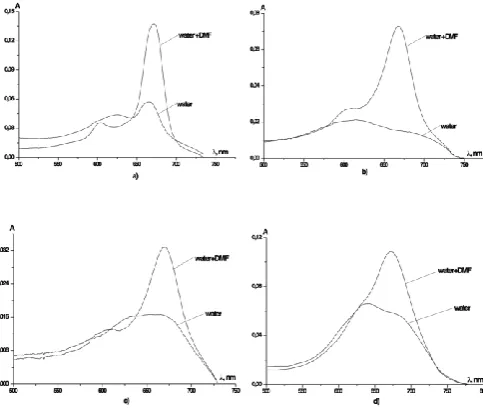
There is significant shifting of associative equilibrium toward monomeric form under the condition of 10-fold molar excess of coordinating solvent when DMF is added to CoPc solutions (Figure 6). There is small relaxation maximum of absorption in range of 590-610 nm for compounds CoPсI – CoPсIII. It is characteristic of residual associated structures formed due to hydrogen bonds on periphery of the molecule. UV-VIS spectra of CoPcIV is staying wide enough when DMF is added, wherein there is small shoulder observed in range of dimers absorption. In our opinion it is connected with the fact that the solvent solvates primarily triazole fragment of peripheral substituent and the system reaches equilibrium state with a large number of associated forms compared to CoPcI-CoPcIII.
Figure 5. UV-Vis spectra of solutions under 298.15 K, nDMF/nCoPсI
10:1, S 1.99 mm.( a) CoPсI (2.89×10⁻⁶ mol L-1), (b) CoPсII
(4.12×10⁻⁶ mol L-1), (c) CoPсIII (1.48×10⁻⁵ mol L-1), (d) CoPсIV
(7.39×10⁻⁶ mol L-1).
Table 2. Extinction coefficients (L mol-1 cm-1) of
metallophthalo-cyanines monomeric forms.
Solvent CoPсI CoPсII CoPсIII CoPсIV DMF 58400± 90 24200 ± 90 10400 ± 50 22350 ± 40 DMSO 45000 ± 70 18850 ± 60 2320 ± 20 24420 ± 40
Thus, the present work shows that specific solvation of the solvent plays great role in formation of ordered structures of phthalocyanines in solution. If the solvent universally solvate the phthalocyanine, H-associates are formed predominantly. Shifting of associative equilibrium toward monomeric structures is possible in binary systems when one of solvents is coordinating. Thus, the solvating power of the medium is key for self-assembling of Co(II)-phthalocyanines sulfo-derivatives.
Acknowledgments
The work is carried out within the public tasks of the Ministry of Education and Science of the Russian Federation and partially financially supported by grant of the President of the Russian Federation (project No МК-2776.2015.3).
References
1Jiang, Z., Shao, J., Yang, T., Wang, J., Jia, L., J. Pharm. Biomed. Anal., 2014, 87, 98.
2Ağırtaşa, M. S., Karataşa, C., Özdemir, S., Spectrochim. Acta,
2015, A135, 20.
3Zhao, P., Woo, J., Park, Y.-S., Macromol. Res., 2010, 18, 496. 4Sorokin, A. B., Chem. Rev., 2013, 113, 8152.
5Vashurin, A., Maizlish, V., Pukhovskaya, S., Voronina, A.,
Kuzmin, I., Futerman, N., Golubchikov, O., Koifman, O., J. Porphyrins Phthalocyanines, 2015, 19, 573.
6Vashurin, A. S., Pukhovskaya, S. G., Semeikin, A. S.,
Golubchikov, O. A., Macroheterocycles.2012, 5, 72.
7Basu, B., Satapathy, S., Bhatnagar, A. K.,Catal. Rev. Sci. Eng.,
1993, 35(4), 571.
8Stuzhin, P. A., Mikhailov, M. S., Travkin, V. V., Gudkov, E. Yu.,
Pakhomov, G. L., Macroheterocycles,2012,5, 162.
9Wahab, F., Sayyad, M. H., Tahir, M., Khan, D. N., Aziz, F.,
Shahid, M., Munawar, M. A., Chaudry, J. A., Khan, G.,
Synth. Metals, 2014, 198, 175.
10Vashurin, A., Pukhovskaya, S., Kuzmicheva, L., Titova, Yu.,
Golubchikov, O., Nat. Sci., 2012, 4, 461.
11Biesaga, M., Pyrzyn´ska, K., Trojanowicz, M., Talanta, 2000, 51,
209.
12Thordarson, P., Nolte, R. J. M., Rowan, A. E., The Porphyrin Handbook., Elsevier Science, 2003, 18, 281.
13Tonga, S.-L., Zhang, J., Yana, Y., Hua, Sh, Yua, J., Yu, L., Solid State Sci., 2011, 13, 1967
14Palewska, K., Sworakowski, J., Lipinski, J., Optic. Mater, 2012, 34, 1717.
15Lukyanets, E. A., Nemykin, V. N., J. Porphyrins Phthalocyanines, 2010, 14, 1
17Vashurin, A. S., Tikhomirova, T. V., Maizlish, V. E., Russ. J. Inorg. Chem., 2015, 60, 431.
18Antina, E. V., V’yugin, A. I., Russ. J. Gen. Chem, 2012, 82, 298. 19Weissberger, A., Proskauer, E. S., Riddick, J. A., Toops, E. E.,
Organic solvent: physical properties and methods of purification., New York: Inter. Science Publishers Inc, 1955.
20Weber, J. H., Busch, D. H., Inorg. Chem., 1965,4, 469.
21Kulinich, V. P., Shaposhnikov, G. P., Badaukaite, R. A., Macroheterocycles, 2010, 3, 23.
22Voronina, A. A., Kuzmin, I. A., Vashurin, A. S., Shaposhnikov,
G. P., Pukhovskaya, S. G., Golubchikov, O. A., Russ. J. Gen. Chem., 2014, 84, 1777.
23Znoiko, S. A., Kambolova, A. S., Maizlish, V. E., Shaposhnikov,
G. P., Abramov IG, Filimonov, S. I., Russ. J. Gen. Chem.,
2009, 79, 1735.
24Martyanov, T., Ushakov, E. N., Klimenko, L. S., Macroheterocycles, 2013, 6, 240.
25Mood, A. M, Graybill, F. A., Boes, D. C., Introduction to the Theory of Statistics. 3rd ed., New York: McGraw-Hill, 1974.
26Voronina, A. A., Vashurin, A. S., Litova, N. A., Shepelev, M. V.,
Pukhovskaya, S. G., Izv. Vysh. Uchebn. Zaved. Khim. Khim.
Technol.,2014, 57, 51. (in Russ.)
27Filippova, A., Voronina, A., Litova, N., Razumov. M., Vashurin,
A., Pukhovskaya, S., Eur. Chem. Bull., 2014, 3(11), 1055.
28Teixeira, J., Mol. Phys.2012, 110, 249.
29Malenkov, G., J. Phys.: Condens. Matter, 2009, 21, 3101. 30Abel, E. W., Pratt, J. M., Whelan, R., J. Chem. Soc. Dalton Trans,
1976, 509.
31Gutman, V., Schmid, R., Coord. Chem. Rev., 1974(3), 263. 32Mayer, U., A semiempirical model for the description of solvent
effects on chemical reactions, Pure & Appl. Chem. 1979, 51, 1697.
33Vasudevan, V., Mushrif S. H., J. Mol. Liq, 2015, 206, 338.