CATALYSIS BY TRIFLIC ACID: SYNTHESIS OF
THE INDOLYLQUINONES AS POTENTIAL
ANTITUMOR AGENT
Feyriel Dridi
[a,b], Didier Villemin
[a]*, Nathalie Bar
[a], Messaoud Hachemi
[b]and Remi
Legay
[a]Keywords:p-Quinones, indoles, trifluoromethanesulfonic acid, indol-3-ylbenzoquinones.
Trifluoromethanesulfonic acid efficiently catalyzes the conjugate addition of indoles to p-benzoquinones under mild conditions affording
the corresponding indolylquinones in high yields with high selectivity. In particular, the poorly reactive menadione underwent reaction with indoles under similar conditions to give 3-indolylnaphthoquinones.
* Corresponding Authors
E-Mail: [email protected]
[a] Laboratoire de Chimie Moléculaire et Thioorganique, UMR CNRS 6507, INC3M, FR 3038, Labex EMC3, Labex Synorg, ENSICAEN & Université de Caen, 14050 Caen, France
[b] Laboratoire de Chimie Moléculaire et Composites, Faculté des Sciences de I'Ingénieur, Université M' Hamed, Boumerdes, Algérie
Introduction
Protonation of quinones with a Bronsted acid (HX) gives a carbocation which can react with different nucleophiles, and after rearomatization the resulting product is a substituted resorcinol. This reaction is well known and already reported for many years with hydrogen halides,2 hydrogen cyanide,3
hydrazoic acid,4 sulphur acids,5 (thiols, thiourea, sulphite)
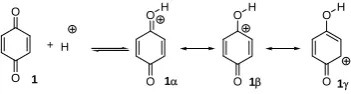
and amines.6 The probable mechanism of the reaction of
benzoquinone 1 with indole begins by the protonation of
benzoquinone, leading to carbon electrophiles (1,1).
Indole reacts with 1 as nucleophile and gives
indoylhydroquinone in the first step.
Scheme 1. Protonation of quinones.
After an oxidation step, the resulting indoylquinone can react in a similar way with a second equivalent of indole providing bisindoylhydroquinones. Moreover, in this step, two isomers are likely to be formed. As hydroquinones, bisindoylhydroquinones can be oxidated to bis(indoyl)quinones. As a result, the reaction of indoles with quinones is complex and a mixture of products is generally obtained which need laborious separation.7
In fact, the nucleophile addition of indoles on quinones is strongly dependant of the nature of the quinone because the limiting step is the protonation of quinone.
With the easily protonated benzoquinone, the reaction can take place without acid, even in water or with poor acidic agent.8 With naphthoquinone, a stronger acid is necessary
and this reaction was already described with different protic acids,9 like hydrochloric acid,9a tosylic acid.9c With
methylnaphthoquinone (menadione) the reaction is very difficult. Concerning the reactivity of quinones, the same results were previously observed with the Thiele reaction which can take place from the same carbocation intermediate.10 This reactivity depends of the basicity of
quinone and the electrophilicity of protoned quinone. The reaction with indoles depends also of the nucleophilicity of indoles.11
Figure 1. Order of reactivity of quinones.
Figure 2. Order of reactivity of indoles.
During our studies on Thiele acetylation of menadione,11
triflic acid (trifluromethanesulphonic acd, TfOH) was found to be a particularly convenient catalyst, able to broader the synthetic scope of quinones substituted with electron donating groups.
In this context, we decided to investigate the addition of indoles as nucleophile on quinones, in particular methylquinone, naphthoquinone and methyl-naphthoquinone catalyzed by TfOH which has not been reported in the literature.
O
O
O
O
O
O
O
O
CH3 CH3
> = >>
1 2 3 4
N H Me
(c)
N H
Me
(b)
N H (d)
N H (a)
> ~ >>
O
O + H
O
O H
O
O O
O
H H
Experimental
General procedure
A mixture ofthe quinone (2 mmol) and TfOH (2 mol %) and indole (1 mmol) in dichloromethane (30 mL) was stirred at room temperature under nitrogen for the specified time (Table 1). After completion of the reaction as indicated by TLC, the reaction mixture was quenched with water (15 mL). Sodium carbonate (2 g) was added to the reaction mixture. After filtration, the reaction mixture was extracted with ethyl acetate (2 x 10 mL). The organic phases were combined, dried over Na2SO4, and concentrated in vacuum.
The resulting product was purified by column chromatography on silica gel (Merck, 100-200 mesh, ethyl acetate-cyclohexane, 0.5-9.5) to afford pure indol-3yl-benzoquinone. Spectral data for selected products are given below.
Table 1. Trifluoromethanesulfonic acid catalyzed reaction of
indoles to quinones.
No. Indole Quinone Product Time, h Yielda, %
1 a 3 3a 24 47
2 b 3 3b 0.25 51
3 c 3 3c 0.33 47
4 d 3 3d 0.33 48
5 b 2 2b, 2b 24 36/36
6 c 2 2c 24 45
7 d 2 2d 24 55
8 b 4 4b 4 24 45/10
9 d 4 4d 24 50
a Isolated products, except for the mixture 2b, 2b determined by NMR ( ratio1:1)
(3a) (3b)
2-(1H-Indol-3-yl)-1,4-naphthoquinone (3a)
M. P. 205-206 °C. IR: 3239, 1589, 1556, 1255, 1230 cm-1. 1H NMR (CDCl
3) : δ = 8.53 (s, 1H, NH13), 8.05 (d, J=3.2 Hz 1H, H12), 7.98-7.95 (m, 1H, H9), 7.94-7.91 (m, 1H, H6),
7.81-7.76 (m, 1H, H18), 7.58-7.51 (m, 2H, H7,8), 7.29-7.23
(m, 1H, H17), 7.46 (s, 1H, H3), 7.13-7.06 (m, 2H, H16,17). 13C
NMR (CDCl3) : δ = 185.7 (C1), 185.4 (C4), 142.2 (C11),
136.5 (C14), 133.9 (C7), 133.5 (C8), 133.1 (C10), 132.4 (C5), 131.1 (C12), 129.9 (C3), 127.0 (C9), 125.9 (C6), 125.7 (C19), 123.5 (C16), 122.0 (C17), 120.6 (C18), 112.0 (C15), 109.2 (C2). EIMS: m/z ( %): 274 M+H (60), 257 (15), 246 (100), 218 (10). HRMS calcd for C18H12NO2 [M+H]:
274.0868, found: 274.0868.
2-(2-Methyl-3-indolyl)-1,4-naphthoquinone (3b)
M. P. 183-184 °C. IR : 3354, 1617, 1667, 1634, 1565, 1296, 1253 cm-1. 1H NMR (CDCl
3): δ = 8.36 (s, 1H, NH13),
8.22-8.17 (m, 1H, H9), 8.18-8.13 (m, 1H, H6), 7.81-7.74 (m,
2H, H7,8), 7.54 (d, J=6.8 Hz, 1H, H18), 7.34 (d, J=6.8 Hz, 1H,
H15), 7.22-7.12 (m, 2H, H16,17), 7.10 (s, 1H, H3), 2.48 (s, 3H,
CH3, H20). 13C NMR (CDCl3): δ = 185.3 (C1), 184.6 (C4),
144.4 (C2), 136.9 (C12), 135.5 (C14), 134.8 (C3), 133.7 (C7), 133.5 (C8), 132.8 (C10), 132.3 (C5), 127.7 (C19), 127.0 (C9), 125.9 (C6), 122.3 (C16), 120.9 (C17), 119.3 (C18), 110.6 (C15), 107.4 (C11), 14.0 (C20). EIMS: m/z (%): 288 M+H (25), 270 (100), 260 (15), 242 (25), 117 (10). HRMS calcd for C19H13NO2 [M+1] : 288.1025, found:
288.1018.
(3c) (3d)
1-(3-Methyl-2-indolyl)-1,4-naphthoquinone (3c)
M. P. 205-206 °C. IR: 3385, 1644, 1588, 1563, 1331, 1301, 1253 cm-1. 1H NMR (CDCl
3): δ = 10.45 (s, 1H, NH12),
8.19 (d, J=6.5 Hz, 1H, H6), 8.13 (d, J=6.5 Hz, 1H, H9),
7.81-7.79 (m, 2H, H7,8), 7.65 (d, J= 7.8 Hz, 1H, H17), 7.43 (d, J= 7.8 Hz, 1H, H14), 7.29 (t, J= 7.8 Hz, 2H, H15), 7.27 (s, 1H,
H3), 7.14 (t, J= 7.8 Hz, 1H, H16), 2.62 (s, 3H, CH3,H20). 13C
NMR (CDCl3): δ = 187.7 (C4), 184.6 (C1), 137.4 (C13),
137.3 (C2), 134.5 (C7), 133.7 (C8), 132.5 (C10), 132.1 (C5), 131.6 (C3), 128.6 (C18), 127.1 (C6), 127.0 (C11), 126.0 (C9), 125.3 (C15), 120.16 (C16), 119.9 (C17), 118.7 (C19), 111.8 (C14), 12.6 (C20). EIMS: m/z (%): 288 M+H (80), 270 (100), 260 (20), 242 (15), 235 (5). HRMS calcd for C19H13NO2 [M+1] : 288.1025, found: 288.1018.
2-(2-Phenyl-3-indolyl)-1,4-naphthoquinone (3d)
M. P. 213-214 °C. IR: 3406, 1667, 1647, 1591, 1449, 1294 cm-1. 1H NMR (CDCl
3): δ = 9.30 (s, 1H, NH13), 8.12
(dd, J=7.6 Hz, J=1.2 Hz, 1H, H6), 7.95 (dd, J= 7.6 Hz, J=1.2 Hz, 1H, H9), 7.75 (td, J= 7.6 Hz, J= 1.2 Hz, 1H, H7),
7.69 (td, J= 7.6 Hz,J= 1.2 Hz, 1H, H8), 7.61 (d, J=7.2 Hz, 1H, H18), 7.46-7.42 (m, 2H, H21), 7.39 (d, J=7.2 Hz, 1H,
H15), 7.33-7.28 (m, 3H, H22,23), 7.24 (t, J= 7.6 Hz, 1H, H16),
7.22 (d, J= 7.6 Hz, 1H, H17), 7.18 (s, 1H, H3). 13C NMR
(CDCl3): δ = 185.2 (C4), 184.2 (C1), 145.2 (C2),
139.5(C12), 136.3 (C14), 135.8 (C3), 133.7 (C7), 133.6 (C8), 132.9 (C10), 132.6 (C20), 132.3 (C5), 128.9 (C22), 128.4 (C23), 128.2 (C19), 128.1 (C21), 126.9 (C9), 125.9 (C6), 123.1 (C16), 121.3 (C17), 119.5 (C18), 111.53 (C15), 106.8 (C11). EIMS: m/z (%): 350 M+H (100), 332 (40), 304 (30), 280 (20), 133 (10). HRMS calcd for C24H16NO2
[M+H] : 350.1181, found: 350.1194. N H O O 1 2 4 7 9 10 11 12 3 13 14 15 16 17 18 19 6 8 5 N H CH3 O O 1 2 3 4
5 6 7
8 9 10 11 12 13 14 15 16 17 18 19 N H CH3 O O 1 2
3 4 5 6 7
8 9 10 11 12 13 14 15
16 1718 19 20 N H O O 1 2
(2b) (2b)
2-Methyl-5-(2-methyl-1H-indol-3-yl)cyclohexa-2,5-diene-1,4-dione (2b)
M. P. 206-208 °C. IR: 3295, 1646, 1603, 1588, 1575, 1457, 1421, 1302, 1244 cm-1. 1H NMR (DMSO): 11.56 (s,
1H, NH10), 7.36 (d, J= 7.6 Hz, 1H, H15), 7.32 (d, J= 8.0 Hz,
1H, H12), 7.07 (t, J= 7.2 Hz, 1H, H13), 7.00 (t, J= 8.0 Hz, 1H,
H14), 6.84-6.82 (m, 1H, H6), 6.74 (s, 1H, H3), 2.36 (s, 3H,
CH3, H17), 2.03 (d, J= 1.2 Hz, 3H, CH3, H7). 13C NMR
(DMSO): 187.6 (C1), 186.8 (C4), 145.1 (C5), 142.3 (C2), 137.9 (C9), 135.5 (C11), 133.5 (C6), 131.1 (C3), 127.3 (C16), 121.2 (C13), 119.8 (C14), 118.9 (C15), 110.9 (C12), 105.6 (C8), 15.0 (C7), 13.2 (C17). EIMS: m/z (%): 252 M+H (50), 237 (100), 235 (60), 220 (30), 207 (10). HRMS calcd for C16H14NO2 [M+1] : 252.1027, found : 252.1025.
2-Methyl-6-(2-methyl-1H-indol-3-yl)cyclohexa-2,5-diene-1,4-dione (2b)
M. P. 206-208 °C. IR: 3295, 1646, 1603, 1588, 1575, 1457, 1421, 1302, 1244, 913 cm-1. 1HNMR (DMSO): 11.56
(s, 1H, NH10), 7.36 (d, J= 7.6 Hz, 1H, H15), 7.32 (d, J= 8.0 Hz, 1H, H12), 7.07 (t, J= 7.2 Hz, 1H, H13), 7.00 (t, J= 8.0 Hz,
1H, H14), 6.77-6.75 (m, 1H, H5), 6.67 (d, J= 2.4 Hz, 1H, H3),
2.36 (s, 3H, CH3, H17), 2.07 (d, J= 1,6 Hz, 3H,CH3, H7). 13C
NMR (DMSO): 187.7 (C1), 186.8 (C4), 146.01 (C5), 142.03 (C2), 135.5 (C9), 135.4 (C11), 132.6 (C6), 130.9 (C3), 127.3 (C16), 121.1 (C13), 119.7 (C14), 118.9 (C15), 110.9 (C12), 105.9 (C8), 15.9 (C7), 13.2 (C17).
2-Methyl-5-(3-methyl-1H-indol-2-yl)cyclohexa-2,5-diene-1,4-dione (2c)
(2c)
M. P. 190-191 °C. IR: 3378, 1617, 1568, 1505, 1330, 1168. 1HNMR (CDCl
3): 10.28 (s, 1H, NH9), 7.62 (d, J= 8.0 Hz, 1H, H14), 7.39 (d, J= 8.0 Hz, 1H, H11), 7.27 (t, J= 8.0 Hz,
1H, H12), 7.12 (t, J= 8.0 Hz, 1H, H11), 7.03 (s, 1H, H3), 6.67
(q, J= 1.6 Hz, 1H, H6), 2.56 (s, 3H, H16), 2.11 (d, J= 1.6 Hz,
3H, H7). 13C NMR (CDCl3): δ = 190.2 (C1), 187.5 (C4),
146.6 (C5), 137.5 (C10), 135.34 (C2), 133.6 (C6), 128.9 (C3), 128.5 (C15), 126.6 (C8), 125.2 (C12), 120.1 (C13),
(C17). EIMS: m/z (%): 252 M+H (60), 237 (100), 235 (25). HRMS calcd for C16H14NO2 [M+1] : 252.1025, found:
252.1024.
2-methyl-6-(2-phenyl-1H-indol-3-yl)cyclohexa-2,5-diene-1,4-dione 2d
1H NMR (CDCl
3): 8.75 (s, 1H, NH10), 7.55 (d, J= 8.0 Hz
1H, H15), 7.42-7.31 (m, 6H, H12,18,19,20), 7.27 (t, J= 8.0 Hz,
1H, H13), 7.22 (t, J= 8.0 Hz, 1H, H14), 6.91 (d, J= 2.6 Hz,
1H, H3), 6.64 (dq, J= 2.6 Hz , J= 0.2 Hz, 1H, H5); 1.97 (d, J= 0.2 Hz, 3H, CH3, H7). 13C NMR (CDCl3): 187.8 (C4);
186.8 (C1); 146.5 (C6); 143.2 (C2); 139.1 (C9); 136.3 (C11); 133.6 (C5); 133.4 (C3); 132.7 (C17); 129.1 (C19); 128.6 (C20); 128.2 (C16); 128.1 (C18); 123.3 (C13); 121.5 (C14); 119.6 (C15); 111.5 (C12); 107.0 (C8); 16.5 (C7). EIMS: m/z (%): 314 M+H (60), 299 (100). HRMS calcd for C21H16NO2 [M+1] : 314.1181, found: 314.1177.
(4b) (2d)
2-Methyl-3-(2-methyl-1H-indol-3-yl)naphthalene-1,4-dione (4b)
M. P. 88-86 °C. IR: 3359, 2923, 1692, 1654, 1593,1458, 1422, 1284 cm-1. 1H NMR (CDCl
3): δ = 8.27 (s, 1H, NH14),
8.20-8.18 (m, 1H, H6), 8.16-8.14 (m, 1H, H9), 7.77-7.72 (m,
2H, H7,8), 7.31 (d, J=8.0 Hz, 1H, H16), 7.18 (d, J=8.0 Hz, 1H,
H19), 7.15 (t, J= 8.0 Hz, 1H, H17), 7.09 (t, J= 8.0 Hz, 1H,
H18), 2.28 (s, 3H, H21), 2.10 (s, 3H, H11). 13C NMR
(CDCl3): δ = 186.0 (C4), 184.0 (C1), 145.8 (C3), 141.07
(C2), 135.6 (C15), 134.8 (C13), 133.6 (C7), 133.5(C8), 132.7 (C10), 132.5 (C5), 128.1 (C20), 126.9 (C9), 126.4 (C6), 121.7 (C17), 120.3 (C18), 119.3 (C19), 110.8 (C16), 106.7 (C18), 15.4 (C12), 13.4 (C21). EIMS: m/z (%): 302 M+H (100), 287 (95), 284 (35), 270 (25), 146 (5). HRMS calcd for C20H16NO2 [M+1] : 302.1181, found: 302.1188.
Results and discussion
The TfOH is a commonly used superacid (Ho = -14.1) and
is an effective catalyst for many transformations. Its use is preferable to other acids with similar acid strength (e.g. H2SO4, ClSO3H, FSO3H) as it does not promote oxidative
side reactions.
In this report, we wish to report a simple, convenient and efficient protocol for the synthesis of indolylnaphtho and benzoquinones using a catalytic amount of TfOH under mild conditions. We have used a ratio quinone/indole = 2:1 in
N H CH3 O O CH3 1 2 3 4 5 6 7 8 9 10 11 12 14 15 16 17 N H CH3 O O CH3 1 2 3 4 5 6 7 8 9 10 11 12 14 15 16 N H CH3 O O CH3 1 2 3 4 5 6 7 8 9 10 11 12 13 14 15 16 17 N H O O CH3 1 2 3 4 7 6 5 8 9 10 11 12 13
141516
17 18 19 20 N H O CH3 O H3C 21
limit the formation of diindoylindoles. In all cases, the reactions proceeded rapidly in DCM, at room temperature. The products were characterized by 1H, 13C NMR, IR and
mass spectroscopic data. We have not studied benzoquinone itself because it reacts rapidly and it is known that benzoquinone is easily protonated by weak acids or even by water.8,10
Treatment of 1,4-naphthoquinone 3 with indole in the
presence of 2 mol % of TfOH at room temperature gave 2-(3-indolyl)-1,4-naphtoquinone 3a in 55 % yield. All the
reactions of indoles a-d with naphthoquinone 3 give pure
products, monoindoylnaphthoquinones, with similar yields.
Methylbenzoquinone 2 can lead to the formation of
different regioisomers 2 and 2. However in the literature,
only the regioisomer 2 corresponding to a 1,4 attack
relative to the methyl has been reported with indole and 2-methylindole. According to the nature of indoles, different results are obtained with triflic acid. For the 3-methylindole, the condensation takes place on the opposite side of the methyl probably due to steric hindrance, and conducts to the expected regioisomer 2c. Concerning 2-phenylindole,
only the stereoisomer 2 is produced. On the other hand,
2-methylindole affords the two regioisomers, in equal amount with a total yield of 72 %. In fact, it is not surprising to obtain the regioisomer 2, the carbocation corresponding to
its formation is the most stabilized by the presence of the methyl group.
In a similar way, 2-methyl-1,4-naphthoquinone (4,
menadione) afforded 2-(3-indolyl)-1,4-naphthoquinones derivatives 4b and 4d. Menadione is less reactive in Thiele
-Winter reaction in which the intermediate is the same as in reaction of quinone with indole.
Surprisingly, different results were obtained from the reaction of menadione 4 with 2-methylindole b. The
naphthoquinone 4 afforded the expected 3-indolylquinone 4b (2-methyl-3-(2-methyl-1H-indol-3-yl)
naphthalene-1,4-dione (45% of yield), along with a small amount (10%) of 2-methyl-4-(2-methyl-1H-indol-3-yl) naphthalen-1-ol 4.
This product 4 was already reported in literature and a
mechanism of formation has been proposed.12 The
condensation takes place on the carbonyl group of the quinone, followed by an elimination of a molecule of water. A similar reactivity, rather rare, have been observed with hydroxyquinones but not with menadione.
The monoindolyl products, prepared from different indoles and quinones exhibit sometimes pharmaceutical properties as antitumoral properties. Yet, relatively little attention has been focused on this type of compounds contrary to natural diindoylquinones13 which are well known
for their antitumoral properties. Preliminary results show that all products (3a-3d) were found active against four
types of cancer cell types but 3c was found particularly
active (0.1 Mol) against B16F10.14
Conclusion
In conclusion, triflic acid is an excellent catalyst for the synthesis of indolylquinones. Triflic acid exhibits an unusual reactivity with methylquinone and menadione leading to new derivatives which are fully characterized. The monoindolylnaphthoquinones were tested on four types of cancer cells, all of them displayed interesting antiproliferative activity, and the compound 3d was found as
very promising.
Acknowledgments
We gratefully acknowledge the CNRS (National Center for Scientific Research), the "Region Basse Normandie”, the University of Boumerdes (Algeria), the Franco-Algerian program for the Superior Education (PROFS), and the Algerian-French cooperation for a BAF grant for Feyriel Dridi. Also the authors thank Baptiste Rigaud for NMR spectra and Mrs. Karine Jarsalé for ESIMS and HRMS analysis. The authors thanks Pr. Marc Lecouvey and Odile Sainte-Catherine (CSPBAT, Bobigny, France) for the preliminary screening on human cell line
References
1Finley, K.T. “The addition and substitution chemistry of quinone”, in The chemistry of quinonoid compounds, chap.17, pages
878-1126, S. Patai editor, J. Wiley and Sons, 1974. 2Hinsberg O., Himmelschcin A.,
Ber., 1896, 29, 2023-2029.
3Thiele J., Meisenheimer J., Ber., 1900, 33, 675-676. 4Oliveri-Mandala, E., Calderaro E.,
Gaz. Chim. Itat., 1915, 45, 120,
307. 5Hinsberg O.,
Ber., 1894, 27, 3259-3261 ; Hinsberg O., Ber..,
1895, 28, 1315-1320 ; Snell, J. M., Weissberger, A., J. Am. Chem. Soc. 1939, 6, 450-453 ; Porter, R. F., Rees, W. W.,
Frauenglass, H., Wilgus, S., J. Org. Chem. 1964, 29, 588 -594.
6Suida, H., Suida, W., Ann. Chem., 1918, 416, 113-163 .
7We are unable to reproduce the selectivities and the yields claimed by Yadav et al: Reddy A.V., Ravinder K., Venkateshwar Goud T., Krishnaiah P., Raju T.V., Venkateswarlu Y.,
Tetrahedron Letters; 2003, 44, 6257-6260; Yadav J.S., Reddy B.V.S, Swamy.T., Synthesis. 2004, 1, 106-110.
8Hai-Bo Zhang, Li Liu, Yong-Jun Chen, Dong Wang ,Chao-Jun Li,
Eur. J. Org. Chem., 2006, 4, 69-873.
9(a) Mohlau R., Redlich R. Ber. 1911, 44, 3605-3608; (b) Bu’Lock J. D., Harley-Mason J., J. Chem. Soc. 1951, 703-711; (c)
Bruce J. M, J. Chem. Soc, 1959, 2366-2375 ; (c) Maiti A. K., Bhattacharya P., J. Chem. Res. (S) 1997, 424-425 (d)
Henrion J.C, Jacquet B., Hocquaux M., Lion C., Bull. Soc. Chem. Belges.,1994, 103, 163-168
10(a)Villemin, D.; Hammadi, M.; Bar, N. Tetrahedron Lett., 1997,
38, 4777-4778; (b) Villemin, D.; Bar, N.; Hammadi, M;
Hachemi, M. J. Chem. Res.(S),2000, 356-358.
11The classification of the nucleophilicities of indols presented here was based on the level of the LUMO of indols obtained by semiempirical MP6 computation: 3-methylindole: -8.16 eV; 2phenylindole: 8.27 eV; 2methylindole 8.29 eV; Indole: -8.41 eV. For experimental studies of nucleophilities of indols see: Lakhdar S., Westermaier M., Terrier F. , Goumont R. , Boubaker T. , Ofial A. R. , Mayr H., J. Org. Chem., 2006,
12Kouloouri S., Malamidou-Xenikaki E., Spyroudis S.,
Tetrahedron Lett., 2005,10894-10902.
13(a
) Shimizu S., Yamamoto Y., Inagaki J., Koshimura S., Gan.
1982, 73, 642-8; (b) Pirrung M. C., Park K., Li Z., Org. Lett.
2001, 3, 365-367; Pirrung M. C., Deng L., Li Z., Park K. J. ,Org. Chem. 2002, 67, 8374-8388; c) Koulouri S.,
Malamidou-Xenikaki E., Spyroudis S., Tetrahedron. 2005,
61, 10894-10902.
14(a) Dridi F., Bar N., Sainte-Catherine O., Hachemi M., Lecouvey M. , Villemin D., Eur. Chem. Bull., 2014, 3,
1020-1026, (b) F. Dridi, Ph. D., University of Boumerdès, 2015.