INVESTIGATION ON ENHANCED MICROWAVE
DEMULSIFICATION USING INORGANIC SALTS
Adango Miadonye
[a]*and Shanshan Lin
[b]Keywords: crude oil, microwave process, demulsification process, inorganic salts, brine water, oil-water emulsions.
While the formation of water-in-crude oil (W/O) emulsion is identified to cause serious problems in petroleum industry such as decrease in the efficiency of oil recovery, increase in pumping cost, and pipeline corrosion its treatment has been based mostly on gravity separation by mechanical/chemical technology. As an integral part in the process of oil production and transportation, crude oil demulsification has received attention. In this work, microwave demulsification and the influence of a variety of inorganic salts to the microwave process has been studied. A comparative study on microwave demulsification of heavy oil and light oil has also been conducted. The obtained results showed water separation of 47 % between irradiated and non-irradiated emulsion for heavy crude oil compared to 13 % for light crude oil. The effect of different inorganic salts and the optimum amount of the electrolyte to promote demulsification were also determined.
* Corresponding Authors Fax: 1(902) 563 1880
E-Mail: [email protected] [a] School of Science and Technology
Cape Breton University, Sydney, NS. Canada.
[b] Department of Process Engineering and Applied Sciences, Dalhousie University, Halifax, NS. Canada.
Introduction
During the process of mining, processing and transportation, wet crude oil passes through pores of formation, pipelines and pumps where fierce disturbance occurs. Consequently, water in the crude oil is split into separate tiny droplets, at the same time the natural emulsifier content in crude oil forms a protective film at the interface of oil and water resulting in the formation of crude oil emulsions. Most crude oil emulsion is water-in-oil type (W/O), while oil-in-water type or a combination of both also exists.1-4 Emulsion causes serious problems in petroleum
industry such as decrease in the efficiency of oil recovery, increase in pumping cost, and pipeline corrosion, so appropriate treatment measures are necessary. The process of breaking down water-oil emulsions is called demulsification. As one of the important aspects in crude oil production, demulsification process has become a significant research direction.
With the decrease in light oil reserves, more focus and attempts are turned to the recovery of heavy crude oil and bitumen. Due to the high viscosity and more complex composition of heavy oil, the demulsification by conventional heating seems to be more time-consuming and inadequate to meet the industry need. The microwave irradiation has proved to be an effective method to separate the water and oil with the rapid heat conduction. Thus, it is of great significance to determine whether microwave demulsification has optimum process conditions when it comes to heavy oil.
Microwave irradiation has long been applied to crude oil demulsification based on the fact that microwave heating can dissipate heat inside the medium and raise the energy of the molecules quickly. Compared with conventional heating, materials in microwave irradiation can directly absorb the energy and transmit it into heat.5 According to previous
work,6-8 the existence of ions leads to higher conductivity of
emulsion and enables it to get more efficient heating. From the microcosmic perspective, large quantity of ions can reduce dielectric loss; besides, microwave coupling are able to produce superheating.
Tambe and Sharma7 have conducted research on the
effects of sodium chloride and calcium chloride solutions on emulsion stability. They showed that certain amount of inorganic salts can influence the stability of colloid emulsions in negative ways and enhance the demulsification.
A research on salt-assisted microwave demulsification has been conducted by Xia and Cao,8 proving that
demulsification efficiency is enhanced effectively and the light transmittance of the water separated from the emulsions is increased by the addition of a very small amount of inorganic salts. However, these researches mainly focused on the effect of sodium chlorate. To understand the utilization of inorganic-salts in crude oil demulsification, optimum choice of inorganic salts with effective concentration needs to be examined.
Experimental
Materials and Equipment
The experiment was carried out in a modified domestic microwave oven. The details of the modifications made on the microwave has been given in previous publications.9,10
In order to impose restrictions on the evaporation, only high frequency microwave was applied in this experiment. The microwave equipment is Kenmore domestic microwave oven. The parameters are listed in Table 1. The temperature measurement is achieved with Diqi-Sense (Dual log RTM Thermocouple).
Table 1. Parameters of Microwave Equipment.
Parameter Details
Model Power
Kenmore, Model No. 86706 120 V A.c. 60 Hz, single phase, consumption : 0.91KW Power Generator Magnetron
Operating Frequency 2450 MHz
Maximum output 600 W, Water load: 275 mL Operating voltage 4.0 KV
The chemicals viz. NaCl, KCl, MgCl2, CaCl2, KI, NaNO3,
Na2CO3, NaBr, NaI and SDS (sodium dodecyl sulfate,
95 %) were of analytical grade and were from Sigma-Aldrich, Canada. The crude oil samples used for this study are Arabia heavy oil and Bonny light crude, obtained from Saudi Aramco Ltd and SGS Canada, Port Tupper, NS, respectively. The properties of the crude oil samples are compared in table 2. Sea water (blackish water) from the Atlantic Ocean estuary and fresh water from Mackenzie River, both in Victoria Mines, Nova Scotia, were also used for preparation of emulsions.
Table 2. Properties of Arabian Heavy Crude Oil and Bonny Light Crude Oil.
Property Arabian Crude Bonny Light
Gravity, API。 27.31 33.40
Gravity SG 0.89 0.84
Sulfur, wt% 3.066 0.16
Viscosity, cSt @ 40 °C 28.84 3.28
Both crude oils were used to prepare the water-in-oil (W/O) emulsions. A detailed procedure for the preparation of water-oil (W/O) emulsions has been given in our previous publication.11 In this study, the salt solutions of 0.02 mol L-1
concentrations were prepared using distilled water and the pure solid salts (NaCl, KCl, MgCl2, CaCl2, KI, NaNO3,
Na2CO3, NaBr, NaI). To prepare the emulsions, 3 mL of the
salt solution was added to a mixture of 6 mL crude oil and 0.2 wt% SDS surfactant. The mixture was agitated using a Heidolph RZR 2020 overhead 2-blades stirrer at a speed of 500 rpm for 1 min. Each emulsion sample was then exposed to microwave irradiation for 5 or 10 s, as necessary, and transferred into a 10 mL-graduated cylinder. The real time temperature of the mixture during irradiation was measured with a thermocouple and recorded on a desktop computer. The maximum irradiation time of 10 s was chosen in order to limit the emulsion temperature to 80 °C to control the vaporization of water and other volatile
components. The volume of separated water is recorded every 2 min for an initial 120 min and then for every 5 min for a total of 5 h. The sample of distilled water emulsion is set as reference. For the experiments which require larger volume of emulsion, 15 mL of the salt solution and 30 mL crude oil were used. Then, the emulsion sample was divided into three equal portions and the procedure on irradiation and water separation discussed earlier are followed.
Results and Discussion
The temperature profile during 10 s irradiation of the crude oil emulsions formed from the solutions of various inorganic salts is illustrated in Figure 1. Unlike the gradual energy transmission in conventional heating, the energy is directly absorbed in microwave heating and the temperature is elevated locally.
Figure 1. Temperature versus microwave heating time.
From the temperature profile in Figure 1, the impact of inorganic salts on the heating efficiency of microwave irradiation is evident, as the emulsions with inorganic salts exhibit higher temperatures compared to the emulsion with no salt. This is due to the presence of inorganic salts which causes additional superheating of the solution in a microwave field, increasing the temperature of the crude oil emulsions.6
Effect of Inorganic Salts on Demulsification
The water-oil emulsions from Arabian heavy crude oil with 0.02 molar solutions of inorganic salts were evaluated for their effects on microwave demulsification. Figure 1 showed that inorganic salt generally enhances the heating process of the emulsions which can subsequently improve the demulsification process.
Figure 3. Separated water volume of KCl emulsion.
Figure 4. Separated water volume of MgCl2 emulsion.
Figure 5. Separated water volume of NaNO3 emulsion.
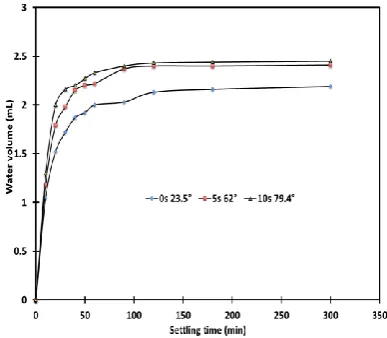
The room temperature was 23.5°C, and the prompt temperatures after microwave heating for 5 s and 10 s were 62 °C and 79.4 °C, respectively for emulsions with NaCl salt (Figure 2). The temperatures with other inorganic salts for the the same irradiation periods are lower as illustrated in Figure 1.
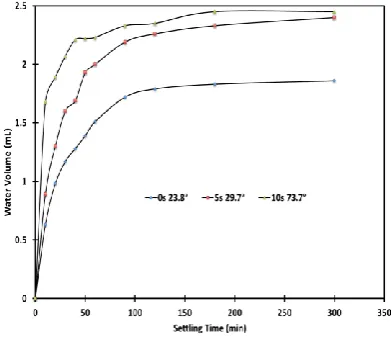
The volume of separated water increases with the settling time for the various salts as given in Figures 2 to 6. The amount of separated water for microwaved samples is higher than for non-irradiated emulsion samples. The final results of demulsification after 5 h also showed that more water is separated after microwave irradiation compared with gravity settling. Similar results were seen from the experiments with KCl, MgCl2, NaNO3 and NaBr (Figures
3-6).
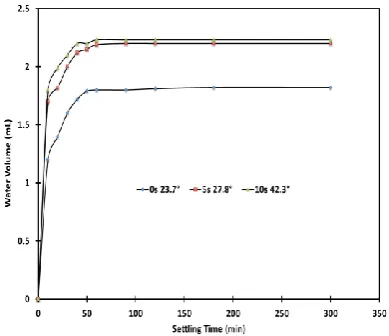
From the Figures it is obvious that longer retention in microwave leads to higher demulsification rate, that is, larger volume of water is separated from the emulsions. Also, the process of demulsification is rapid for the first 2 hours after irradiation process, then, slows down with the drop in temperature and settling time. Similar trend is observed for non-irradiated samples but, with much lower demulsification rate.
The results are in agreement with the theory that the inorganic salts can cause further superheating of the solution in a microwave field, which subsequently enhance the process of demulsification.6 It has been shown that the
electromagnetic field formed by the microwave can neutralize the zeta potential by disturbing the ordered arrangement of the electrical charges surrounding the water droplets.1,12 The presence of salts in the emulsions enhances
the dielectric loss effect and microwave coupling which results in the absorption of more energy by the water droplets, thus, increasing the temperature of the emulsions (Figure 1). As a result, water droplets expand in the continuous phase, collide and coalesce into bigger droplets and separate from the emulsion.
Figure 6. Separated water volume of NaBr emulsion.
Previous studies on the interactions between the ions in emulsion have been reported.13,14 The interaction between
calcium and SDS has been reported in the work of Iyota et.al,13 that the critical mole fraction of SDS needed to form
mixture than for the NaCl-SDS mixture due to the electrostatic attraction between Ca2+ and DS- ions in the
aggregates being larger than that between Na+ and DS- ions
This, arguably, may account for the insignificant difference in volume of water separation between microwaved and non-microwaved emulsions from the solutions of CaCl2, Na2CO3 and KI salts. Figure 7 showed
an example of results obtained with these salts solutions. The poor water separation efficiency has also been attributed to the probability of the formation of azeotrope, which can inhibit the formation of emulsion.
Figure 7. Separated water volume of CaCl2 emulsion.
As a reference, emulsions prepared with only distilled water were also examined. As shown in Figure 8, microwave demulsification still has favourable effect over gravity settling (non-microwaved emulsion). Since the temperature of the emulsion after 10 s microwave irradiation was only 42.3 °C, much lower than the emulsion with NaCl (79.4 °C), the final volume of separated water was 2.23 mL. This is approximately 10 % less than the results obtained from emulsions with inorganic salts.
Figure 8. Separated water volume of distilled water emulsion.
Effect of Salt Concentrations on Demulsification
The results shown in Figures 2 to 5 indicate that different salts can enhance the microwave demulsification to different degrees. Since the emulsion with NaCl showed higher superheating property, NaCl was used in the study of effect
of salt concentrations on demulsification. Emulsion of NaCl solutions of different concentrations and Arabian crude oil with SDS was prepared as described earlier in the experimental section. Each emulsion was irradiated in the microwave oven for 10 s with real time temperature measurement, and the volume of separated water recorded every 2 min.
The effects of different NaCl concentrations on microwave demulsification as illustrated by the volume of water separated and temperature is shown in Figure 9. The results of demulsification vary with the concentration of solution. However, the amount of separated water does not show a sustainable growth with the increase in salt concentration. As shown in the figure, the volume of separated water increases with the salt concentration until it reaches the highest value when the concentration is 0.04 mol L-1, and then the amount of separated water begins to
decrease. Compared to distilled water, NaCl solutions with concentrations less than 0.1 mol L-1 play a positive role in
the microwave demulsification. But when the concentration is greater, the separation seems to be hindered, in other words, the volume of separated water is even less than that without NaCl. Another thing to be noted is that the temperature has a positive relation with the NaCl concentration, albeit, not with the volume of separated water. It is worthy to note that at the optimum NaCl concentration of 0.04 mol L-1, the water separation is 34.5 % higher as
compared to emulsion from distilled water.
It is logical, perhaps, to expect that the increasing concentration of inorganic salts will enhance the process of demulsification because more ions meant better electric effect and better superheating characteristic of the emulsion.
Figure 9. Effect of salt concentration on separation water. But the results indicate that maximum water separation efficiency is obtained at an optimum NaCl concentration of 0.04 mol L-1, followed by a decline in volume of water
separated as concentration increases. This trend could be attributed to fact that demulsifcation is a combination of multiple influencing factors, salt concentration being one of them. On one hand, the increasing salinity may also have stabilizing effect on the W/O emulsion. Zylyftari et.al,15
the emulsion stability of water-in-crude oil, the role of NaCl strongly enhances the stability performance of W/O emulsion and reaches to 100 % stability for 5% NaCl concentration.16 Therefore, it is possible that the effect of
superheating enhanced by NaCl is surpassed by its stabilization effect when the concentration reaches the optimum salt concentration of 0.04 mol L-1.
Effects of Different Crude Oils and Production Water on Demulsification
The W/O emulsions were prepared with 0.02 mol L-1
solution of NaCl and Saudi Arabian heavy crude oil and Bonny light oil. Here, the emulsions were prepared with 15 mL water and 30 mL crude oil to meet the large sample volume needed for the study. The surfactant was 0.2 % (wt) concentration of SDS. To study the effects of production water only the Arabian heavy crude oil emulsion was used.
The method is described in the experimental section, except that the solution is replaced by distilled water, fresh water and salt water, respectively.
The comparison of the emulsions of the two crude oils, with large distinction in API gravity, is shown in Figure 10. It is worth mentioning that the emulsion prepared with heavier oil is much more stable. In the Figure, non-MW indicates that the demulsification is only achieved by gravitational force. The temperature of the emulsions measured during the microwave irradiation is shown in Figure 11.
Figure 10. Comparison of microwave demulsification between Saudi Arabian Heavy Oil and Bonny Light Oil.
The results showed that more water was separated from Saudi Arabian heavy oil between microwaved and non-microwaved emulsions than from those of Bonny light crude oil. The separated water is 47 % for Arabian heavy crude while that for Bonny light is 13.8 % after microwave irradiation. The reason can be inferred from Figure 11, the heavy crude oil has a higher growth rate in temperature during microwave heating, which leads to larger reduction in viscosity, and hence, better water separation efficiency.
The result for production water under field condition simulation is illustrated in Figure 12. The separation efficiency of distilled water emulsion was lower than the ones for emulsions prepared with sea water and fresh water,
confirming the significance of inorganic salts in microwave demulsification. Fresh water, which contains a small amount of inorganic salts, results in the most effective separation compared to sea water; in agreement that most effective separation is not obtained with the highest salt concentration.
Figure 11. Temperature change of Arabian Heavy Oil and Bonny Light Crude Oil.
However, it was noted that the water separated from sea water emulsion has the highest transmittance to light, and the water obtained from fresh water emulsion was much more turbid. The reason is that, arguably, some mineral substances in fresh water trap the tiny oil droplets in water, thus making it less transmittance to light.
Figure 12. Effects of water source on microwave demulsification.
Conclusion
The results obtained can thus be summarized as follows. The existence of inorganic salts in microwave demulsification accelerates the heating process and increases the amount of separated water. Different salts can enhance the microwave demulsification of crude oil emulsions to different degrees. The results of demulsification vary irrationally with the concentration of NaCl salts, with the highest water separation efficiency obtained at 0.04 mol L-1 concentration. Generally, a
relatively small amount of salts enhance the demulsification. Among the salts examined, NaCl stands out in the separation of water and more pronounced with heavy crude (Saudi Arabian crude) oil emulsion. Salt-assisted
microwave demulsification has better performance in dealing with heavier crude oil. The sources of water in emulsion influence the result of demulsification due to their distinct components and concentration of salts. The results shows that fresh water favours the demulsification more than sea water and distilled water, in agreement with the conclusion obtained previously, that a small amount of inorganic salts could enhance the separation to the greatest degree.
Acknowledgements
The authors are grateful for the financial support provided by the Office of Research, Teaching and Graduate Studies, Cape Breton University. We thank Saudi Aramco Ltd for supplying the heavy oil sample and Dr. David J.G. Irwin (Retired Physicist, Cape Breton University) for his help in the modification of the domestic microwave oven.
References
1Fang, C. S., Chang, B. K. L., Lai, P. M. C., Klaila, W. J., Chem.
Eng. Commun., 1988, 73, 227-239.
2Chih-Chieh C., Yeong-Ching, C., Sep. Sci. and Technol., 2002, 37,
3407-3420.
3Pekdemir, T., Akay, G, Dogru, M., Merrells, R.E., Schleicher. B.,
Sep. Sci. Technol., 2003, 38, 1161-1183.
4Xia, L., Lu, S., Cao, G., Sep. Sci. Technol., 2003, 38, 4079-4094. 5Martínez-Palo, R., Cerón-Camacho, R., Chávez, B., Vallejo, A. A.,
Villanueva-Negrete, D., Castellanos, J., Karamath, J., Reyes, J., Aburto J., Fuel, 2013, 113, 407–414.
6Xia, L., Lu, S., Cao, G., Chem. Eng. Comm., 2004, 191,
1053-1063.
7Tambe, D. E., Sharma, M.M., J. Colloid Interface Sci., 1993, 157,
244-253.
8Xia, L., Cao, G., J. Macromol. Sci., 2006, 43, 71-81.
9Miadonye, A., Snow, S., Irwin, D. J. G., Khan, R. M., Britten, A.,
WIT Trans. Eng .Sci., 2009, 63, 455-65.
10Miadonye, A., MacDonald, B., J. Petrol. Sci. Res., 2014, 3(3),
130 – 135.
11Miadonye, A, Nwankwor, E., J. Petrol. Sci. Res., 2014, 3(2), 68 –
72.
12Michael, D., Mingos, P., Baghurst, D.R., Chem. Soc. Rev., 1991,
20, 1-47.
13Iyota, H., Tomimitsu, T., Aratono, M., Colloid Polym. Sci., 2010,
288, 1313–1320.
14Yang, F., Liu, S., Xu, J., Lan, Q., Wei, F., Sun, D., J. Colloid
Interface Sci., 2006, 302, 159–169.
15Zylyftari, G., Lee, J W., Morris, J.F., Chem. Engr. Sci., 2013, 95,
148-160.
16Ghannam, M.T., Petrol. Sci. Technol., 2005, 23, 649-667.