ISSN: 2347-7474
International Journal Advances in Social Science and Humanities
Available Online at: www.ijassh.com
RESEARCH ARTICLE
A Study of Teacher Effectiveness in Relation to Occupational
Stress and Life Satisfaction among Teacher Educators
Dr. Harpreet Kaur
Assistant Professor, Sewa Devi S.D. College of Education, Tarn Taran.
Abstract
The study examined teacher effectiveness in relation to occupational stress and life satisfaction. The sample in the study was 645 teacher educators from 96 private B.Ed. colleges affiliated to three state universities of Punjab i.e. Punjabi university, Patiala, Punjab University, Chandigarh and Guru Nanak Dev University, Amritsar were randomly selected by lottery method. The descriptive statistics such as mean, median, mode, S.D., skewers, kurtosis, quartile deviation and ANOVA were used to analyses the data. The results revealed (a) The teacher effectiveness was high in male teacher educators than in female teacher educators.(b) The teacher effectiveness was high in urban teacher educators than in rural teacher educators.(c)The teacher effectiveness was high in science teacher educators, average in humanities teacher educators and low in commerce teacher educators.(d) Further also the teacher effectiveness was high among teacher educators with low occupational stress and the teacher effectiveness was low among teacher educators with high occupational stress.(e) The teacher effectiveness was high among teacher educators with high life satisfaction and the teacher effectiveness was low among teacher educators with low life satisfaction. On the basis of findings, it is suggested that the college should organize life skill development programmers, seminars on emotional intelligence, mental health and well-being for teacher educators and the directions should be given to the colleges to disburse salaries to faculty members as per UGC norms. Also, the principal of college must deal psychologically while recognizing the warning signs of teacher’s stress in the college regarding work load, duties and financial status.
Keywords: Teacher effectiveness, Occupational stress and Life satisfaction.
Introduction
Education and development are indispensable to each other. Education inculcates academic wisdom, freedom of expression in righteous manner and judicious insight among human beings. Human development is pre-requisite to the development of any nation and education is the major catalyst for human development.
The National Policy of Education [1] stipulated that the status of the teacher reflects the socio-cultural ethos of a society, it is said that no people can rise above the level of its teachers. Dunhill [2] explained that teacher is the spiritual & intellectual guardian of the students. It is believed that what the soul is to the body, what the mind is to the man, the teacher is to the institution.
It has been urged that a teacher’s mental & oral qualities have a direct bearing on effectiveness in teaching. The term “teacher effectiveness” is broadly used to identify attributes of what constitutes a good teacher. Teacher Effectiveness is a set of experiences, traits, behaviors and dispositions that are typically evident in effective teacher.
Indian Education Commission [4] recognized the importance of providing stimulating conditions of work and “adequate opportunities for professional advancement” in educational institutions. The favorable condition does support the “creative work like teaching and research” as well as help to retain the quality among teachers in the system. The benchmark of the conditions for educational institutions is “to enable teachers to function at their highest level of efficiency”. Occupational stress is defined as negative environmental factors or stressors associated with a particular job.
Occupational stress among teachers refers to negative effect resulting from their interaction with various aspects of occupation such as resources, human relations, security, recognition etc. are producing different psycho- social dynamics in the form of frustration, conflict, anxiety etc. Kendall et al. [5] explained that the terms 'occupational stress', 'work stress', ‘job stress’ and ‘work-related stress’ are used interchangeably in the literature and across different jurisdictions.
Rees [6] explained the occupational stress, in particular, is the inability to cope with the pressures in a job because of a poor fit between one’s abilities and work conditions. Comish & Swindle [7] opined occupational stress is a mental and physical condition which affects an individual’s productivity, effectiveness, personal health and quality of work. Teachers’ stress in particularly means a situation where the teachers are exposed to certain unwanted environmental factors, which either exists within the educational institution (internal factors) or exists outside the educational institution (external factors), these factors hamper the normal routine life of teachers by negatively affecting their performance at work. Gillespie et al. [8] expressed that a routine stress is all right, and has no negative effects on teachers, but if the stress continuously hit the teacher’s working lives then they react in different ways like showing job dissatisfaction, less morale, weak performance, and general exhaustion.
The success of any educational programmer depends upon the performance of the teacher.
The role of a teacher is crucial & without a positively oriented teacher, education system would crumble. Most of the teachers working in educational institutions live under stress & bear the strain of administrative pressure at work place & also family tension back at home. Occupational stress and life satisfaction are inversely proportional to each other. Occupational stress hinders the life satisfaction of teachers. It effects the work environment and overall satisfaction of life too. If the nation builders themselves are not satisfied with their life, it cannot be expected from them to produce well educated citizens, as professional satisfaction has been reported to be positively correlated with life satisfaction.
Life satisfaction is a multidimensional concept related to psychological and environmental life conditions. The research literature abounds in definitions of satisfaction and of life satisfaction. Life satisfaction is generally defined as composite state of satisfaction resulting from the fulfillment of personal needs, desires, ambitions and aspirations. Most the definitions of life satisfaction given by different authorities does not seem to significantly differ in their essence. Life satisfaction of teachers is an important and essential factor for the healthy functioning of the education system. The satisfied teachers can give the maximum output to the society. Hence the life satisfaction of teacher is a primary issue.
Life satisfaction means appreciation of life, which is subjective and includes various aspects of one’s life.
Prakasham [10] compared the strength of teacher effectiveness in various types of school organizational climates as well as under various levels of teaching competency across sex determination and territorial variation.
The sample comprised 800 teachers from 120 government, local bodied, private non-Christian and non-Christian schools teaching classes IX, X and XI of Raipur and Bilaspur districts with 92 principals, selected by the random quota sampling technique. The mean, S.D., t-ratio, Pearson’s product-moment coefficient of correlation and ANOVA were computed while treating the data. It was found that the open school organizational climate positively affected both the teaching competency as well as teacher effectiveness. The teachers of urban schools significantly excelled over teachers employed either in semi-urban and rural schools or schools located in industrial areas on both teaching competency and teacher effectiveness.
Roul [11] did a comparative study of teacher effectiveness between autonomous and non-autonomous college teachers. The study concluded that autonomous college teachers were more effective than the non-autonomous college teachers. The male teachers were found to be more effective than female teachers. Effective teachers had good mental health and positive attitude as compared to ineffective teachers.
Kagathala [12] studied effectiveness of teachers of secondary school in Gujrat. It was found from the study that urban teachers were superior to rural teachers in teacher effectiveness. However the sex of the teacher had no effect on teacher effectiveness.
Kaur [13] studied job satisfaction, occupational stress and value dimensions as correlates of teacher effectiveness. A representative sample of 1000 teachers was selected from the government secondary schools of four districts of Punjab.
It is concluded that teacher effectiveness and occupational stress have negative and significant correlation. So, with the increase in the occupational stress among teachers their effectiveness gets amply reduced.
Jain [14] studied teaching effectiveness of teachers and their attitude towards teaching profession. The sample comprised of 75 teachers working in 25 secondary schools in two areas (South & Central) of Delhi. The study revealed that teacher effectiveness with respect to sex and teaching experience were found to be significant.
Ahammed [15] examined the relationship between life satisfaction and teaching satisfaction among full-time university teachers. The sample consisted of 103(58 males and 45 females) full-time, tenure-track university faculty members from UAE University, who were randomly selected from the university data-base. The study used a descriptive-correlative survey method. However, a correlation coefficient of only 0.32 (p < 0.01), demonstrated a weak relationship between teaching satisfaction and life satisfaction.
The results from t-tests revealed that scores on life satisfaction and teaching satisfaction were not significantly different for respondents belonging to different groups based on their age, gender or experience. Overall, the results seemed to imply that teaching by itself does not become a source of subjective wellbeing among university faculty.
secondary level, teaching experience and type of school management.
Objectives of the Study
To study mean difference in teacher effectiveness among teacher educators in relation to (a)Gender,(b) Location and (c) stream i.e. humanities, science and commerce.
To study relationship of teacher effectiveness with occupational stress and life satisfaction.
Hypotheses of the Study
There is no significant mean difference in teacher effectiveness among teacher educators in relation to gender.
There is no significant mean difference in teacher effectiveness among teacher educators in relation to location.
There is no significant mean difference in teacher effectiveness among teacher educators in relation to stream i.e. humanities, science and commerce.
There is significant relationship of teacher effectiveness with occupational stress and life satisfaction.
Delimitations of the Study
The study was delimited to B.Ed. colleges affiliated to three state universities of Punjab i.e. Panjab University, Chandigarh, Punjabi University Patiala and Guru Nanak Dev University, Amritsar.
The present study was delimited to private (self-financed) B.Ed. colleges only.
The study was delimited to 96 private B.Ed. colleges only.
The present study was delimited to 645 teacher educators only.
Operational Definitions
Teacher Effectiveness It is operationally defined in terms of teachers who have attained the needed competence in their roles of functions, such as the preparation and planning for teaching, classroom management, and knowledge of subject matter, teacher characteristics and their interpersonal relations. Also these teachers excel in their other personality characteristics.
Occupational Stress It is operationally defined in terms of various potential sources of occupational stress among teachers which includes individual characteristics, inability to cope with the work-load, lack of autonomy and appreciation, difference in opinion with the head and colleagues, lack of facilities, use of new computer technologies for teaching, imbalance between teaching and research and extra-organisational (home).
Life Satisfaction It refers to a person’s general happiness, freedom from tension, interest in life etc. as “current” life satisfaction. It has been defined as the function of the physical, psychological and social well-being.
Teacher Educators The teachers teaching in B.Ed. colleges were considered as teacher educators in the present study.
Research Method
The descriptive method was used to study teacher effectiveness among teacher educators
Sample
The table 1, 2 depicts the gender-wise and locale- wise distribution of sample.
Table 1: Gender-wise sample distribution of teacher
S. No. Locale No. of teacher educators %
1 Rural 456 70.69
2 Urban 189 29.30
Total 645
Educators
Table 2: Locale-wise sample distribution of teacher educators
S.NO. Gender No. of teacher educators %
1 Female 511 79.22
2 Male 134 20.77
The table 1 depicts the gender-wise sample distribution of teacher educators in private B.Ed. colleges of Punjab. The 511 out of 645 i.e. 79.22% comprised of female teacher educators and
134 i.e. 20.77% comprised of male teacher educators.
The table 2 reveals the locale-wise sample distribution of teacher educators in private B.Ed. colleges of Punjab. The 456 out of 645 i.e.70.69% teacher educators were from rural location of their college and 189 i.e. 29.30% teacher educators were from urban location of their college.
Research Tools
Teacher Effectiveness Scale by Puri & Gakhar [17]
Occupational Stress Scale (for college teachers) - constructed & standardised by investigator (2014)
Life Satisfaction Scale by Singh & Joseph [18]
Statistical Analyses
The descriptive statistics i.e. mean, median, mode, S.D., and quartile deviation was employed to study the teacher effectiveness, occupational stress, life satisfaction among teacher educators.
t-test was used to study mean difference in teacher effectiveness among teacher educators in relation to (a)Gender and (b)Location.
ANOVA was employed to study three streams with regard to teacher effectiveness among teacher educators.
The Karl Pearson’s correlation method was employed to study the relationship of teacher effectiveness with occupational stress and life satisfaction.
Gender Mean Difference in Teacher Effectiveness among Teacher Educators The mean scores and S.D.’S in teacher
effectiveness of females and males along with t-value testing significance of mean difference is given in table 3.
Table 3: Gender Mean difference in teacher effectiveness among teacher educators
Gender N Mean S.D. t-value
Males 134 298.5 25.80
2.10*
Females 511 293.59 23.54
*p< 0.05 level
The table 3 shows that the mean teacher effectiveness scores of males was 298.51 (SD=25.80) as compared to mean teacher
effectiveness scores of females i.e. 293.60 (SD=23.54). The t-value came out to be 2.10 which is significant at 0.05 level.
Fig. 1: Gender mean difference in teacher effectiveness among teacher educators
It may be concluded that there is significant gender mean difference in teacher effectiveness among teacher educators. Hence the male teacher educators are more effective than female teacher educators. Therefore the hypothesis 1: “There is no
significant mean difference in teacher effectiveness among teacher educators in relation to gender” was not accepted. There were many studies goes in accordance the present investigation as Roul [11] and Jain [14].
298.5
293.59
276 278 280 282 284 286 288 290 292 294 296 298 300
Locale-Wise Mean Difference in Teacher Effectiveness among Teacher Educators The mean scores and S.D.’S in teacher
effectiveness in rural and urban teacher educators along with t-value testing significance of mean difference is given in table 4
Table 4:Locale-wise mean difference in teacher effectiveness among teacher educators
Locale N Mean S.D. t-value
Rural 456 292.85 24.07
2.93**
Urban 189 298.86 23.65
**p< 0.01 level
The table 4 shows that the mean teacher effectiveness scores of rural college teacher educators was 292.85 (SD=24.07) as compared to mean teacher effectiveness
scores of urban college teacher educators i.e. 298.86 (SD=23.65). The t-value came out to be 2.93 which is significant at 0.01 level.
Fig. 2: Locale-wise mean difference in teacher effectiveness among teacher educators
It may be concluded that there is significant locale-wise mean difference in teacher effectiveness among teacher educators. Hence the urban teachers have more teacher effectiveness than rural teacher educator’s.
Therefore the hypothesis 2:“There is no significant locale-wise mean difference in teacher effectiveness among teacher educators” was not accepted. The result is in
line with following studies as Prakasham [10] and
Kagathala [12].
Teacher Effectiveness in Relation to their different Streams of Study viz. Humanities, Science and Commerce
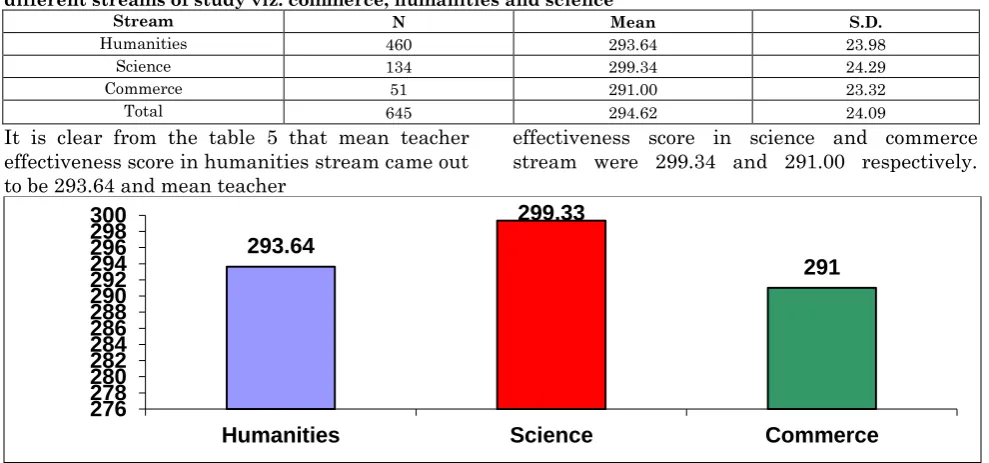
The mean and S.D.’s of teacher effectiveness scores in relation to their different streams of study viz. humanities, science and commerce is given in table 5
Table 5: Mean and s. d’s of teacher effectiveness scores among teacher educators in relation to their different streams of study viz. commerce, humanities and science
Stream N Mean S.D.
Humanities 460 293.64 23.98
Science 134 299.34 24.29
Commerce 51 291.00 23.32
Total 645 294.62 24.09
It is clear from the table 5 that mean teacher effectiveness score in humanities stream came out to be 293.64 and mean teacher
effectiveness score in science and commerce stream were 299.34 and 291.00 respectively.
Fig. 3: Stream-wise mean difference in teacher effectiveness among teacher educators
292.85
298.86
280 282 284 286 288 290 292 294 296 298 300
Rural Urban
293.64
299.33
291
276 278 280 282 284 286 288 290 292 294 296 298 300
In order to study the mean difference in teacher effectiveness among teacher educators across three different streams of
study viz. humanities, science and commerce, the analysis of variance was applied. The summary of ANOVA is given in table. 6.
Table 6: Summary of analysis of variance with respect to different streams of study viz. commerce, humanities and science
Source of Variation Sum of Squares (SS) df Mean Square (MS) F
Between Groups 4086.994 2 2043.497
3.54*
Within Groups 369663.418 642 575.800
Total 373750.412 644
*p<0.05 level.
The table 6 shows that F-value for three different streams of study came out to be 3.54, which is significant at 0.05 level. This indicates that the mean difference in teacher effectiveness scores across three different streams of study viz. humanities, science and commerce came out to be significant. In order
to find out which of the difference in stream is significant, Tukey test was applied to compute least significant difference between two mean at .05 and .01 level (D). The matrix of mean difference along with D-value is given in table:7
Table7: Matrix of mean difference among humanities, science and commerce stream on teacher effectiveness along with d-value
Humanities (293.64)
Science (299.34)
Commerce (291.00)
Humanities - 5.69*(4.23) 2.64(4.23)
Science - - 8.34**(5.57)
Commerce - - -
SD SED D.05 D.01
24.09 2.16 4.23 5.57
**p<.01, *p<.05
Note: Figures in parentheses are D-values
The table 7 also shows that the mean difference in humanities and science stream came out to be 5.69. The teacher educators of science stream had high mean score than teacher educators of commerce stream (D=4.23, p<0.05). Further, it is reveals that the mean difference in humanities and commerce stream on teacher effectiveness came out to be 2.64, which is not significant. The table 7 shows that the mean difference in science and commerce stream came out to be 8.34. The teacher educators of science stream had high mean score than teacher educators of commerce stream (D=5.57, p<0.05).
Therefore the hypothesis 3: “There is no
significant mean difference in teacher effectiveness among teacher educators in relation to their different streams of study viz. humanities, science and commerce” was not accepted. The result is in accordance with following studies as Pachaiyappan & Raj [16]
Coefficient of Correlation of Teacher Effectiveness with Occupational Stress Among Teacher Educators
The coefficient of correlation of teacher effectiveness with occupational stress among teacher educators is shown in table 8
Table 8: Coefficient of correlation of teacher effectiveness with occupational stress among teacher educators
Group N Occupational Stress
Total 645 -0.365**
Male 134 -0.430**
Female 511 -0.348**
Rural 456 -0.378**
Urban 189 -0.325**
Humanities 460 -0.412**
Science 134 -0.220*
Commerce 51 -0.268
The table 8 indicates that the coefficient of correlation between teacher effectiveness and occupational stress was negative and significant (r= -0.365, **p<0.01). The table 8 further shows occupational stress was negatively and significantly correlated with teacher effectiveness in male group (r=-0.430**, p<0.01) and also in female group (r= -0.348**, p< 0.01). There was negative and significant correlation in case of rural college teacher educators (r= -0.378**, p<0.01) and also in case of urban college teacher educators (r= -0.325**, p<0.01).
The table 8 further indicates that coefficient of correlation between teacher effectiveness and occupational stress in humanities stream was negative and significant(r= -0.412**, p< 0.01). The coefficient of correlation between teacher effectiveness and occupational stress in science stream was negative and significant (r=-0.220*, p<0.05) and the
coefficient of correlation between teacher effectiveness and occupational stress in commerce stream was negative and not significant (r=-0.268, p>0.01).
It was found that teacher effectiveness was negatively but not significantly correlated in commerce group with occupational stress, but this relationship was significant among different groups. So, from above results it is concluded that teacher effectiveness is negatively and significantly correlated with occupational stress (in total, male, female, rural, urban and humanities and science group of teacher educators).The results were in accordance with study which concluded by [13]
Coefficient of Correlation of Teacher Effectiveness with Life Satisfaction among Teacher Educators
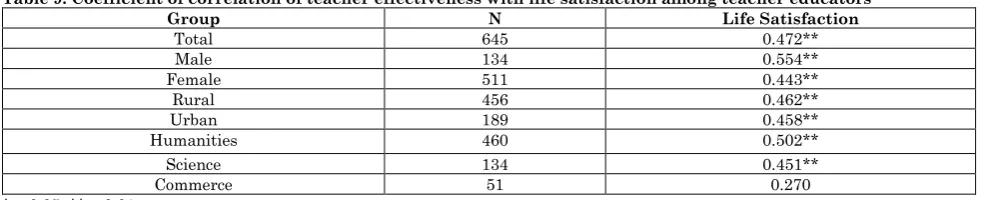
The coefficient of correlation of teacher effectiveness with life satisfaction among teacher educators is shown in table 9
Table 9: Coefficient of correlation of teacher effectiveness with life satisfaction among teacher educators
Group N Life Satisfaction
Total 645 0.472**
Male 134 0.554**
Female 511 0.443**
Rural 456 0.462**
Urban 189 0.458**
Humanities 460 0.502**
Science 134 0.451**
Commerce 51 0.270
*p<0.05, **p<0.01
The table 9 indicates that the coefficient of correlation between teacher effectiveness and life satisfaction was positive and significant (r= 0.472**, p< 0.01). The table 9 further shows life satisfaction was positively and significantly correlated with teacher effectiveness in male group (r= 0.554**, p< 0.01) and also in female group (r= 0.443**, p< 0.01).
There was positive and significant correlation in case of rural college teacher educators (r= 0.462**, p<0.01) and also in case of urban college teacher educators (r= 0.458**, p<0.01). The table 9 further indicates that coefficient of correlation between teacher effectiveness and life satisfaction in humanities stream was positive and significant (r= 0.502**, p< 0.01).The coefficient of correlation between teacher
effectiveness and life satisfaction in science stream was positive and significant (r= 0.451**, p<0.01) and the coefficient of correlation between teacher effectiveness and life satisfaction in commerce stream is positive and not significant (r=0.270, p>0.01).
Hence the hypothesis 4: “There is significant relationship of teacher effectiveness with occupational stress and life satisfaction” was accepted in total group but not in all sub groups.
Educational Implications
The directions should be given to the colleges to disburse salaries to faculty members as per UGC norms. There is need to bridge the insecurities of salaries and stress among faculty members. The salary is related to life satisfaction. The teacher educators who had high life satisfaction, they had less occupational stress and high job performance.
The college should organize life skill development programmes, seminars on
emotional intelligence, mental health and well-being for teacher educators.
The principal of college must deal psychologically while recognising the warning signs of teacher’s stress in the college regarding work load, duties and financial status.
There should be transparency in assigning the work load to the teacher educators as per their capability.
The principal of college should adopt corrective measures in submissive manner. Individual counseling should be there for
teacher educators suffering from psychological problems at work place or in family life [19-20].
References
1. National Policy of Education (1986).Department of Education, Ministry of Human Resources Development. New Delhi.
2. Dunhill J (1996) Classroom management .London: London
University Press.
3. Cruickshank DR, Haefele D (2001) Good teachers, plural. Educational leadership, 58(5):26-30.
4. Indian Education Commission (1964-66). Education and
National Development: Ministry of Education.
Government of India, New Delhi.
5. Kendall E, Murphy P, O’Neill V, Bursnall S (2000) Occupational stress: Factors that contribute to its occurrence and effective management: A Report to the workers compensation and rehabilitation commission. Retrieved December 9, 2015 from http://www.mental healthpromotion.net/resources/occupational-stress-fractors-that-contri bute-to -its-occurrence-and-effective-management.pdf.
6. Rees K (1997) Journey of discovery: A longitudinal study of learning during a graduate professional programme (Ph.D. thesis). Case Western Reserve University, Cleveland. 7. Comish R, Swindle B (1994) Managing stress in the
workplace. National Public Accountant, 39(9):24-28. 8. Gillespie NA, Walsh M, Winefield AH, Dua J, Stough C
(2001) Occupational stress in universities: Staff perceptions of the causes, consequences and moderators of stress. Work & Stress, 15(1):53-72.
9. Diener E, Diener M (1995) Cross-cultural correlates of life satisfaction and self-esteem .Journal of Personality and Social Psycholgy, 68: 653-663.
10.Prakasham D (1988) A study of teacher effectiveness as a function of school organisational climate and teaching competency. Fifth Survey of Educational Research, 1988-92, II, 1465-1466.
11.Roul SK (2002) A comparative study of teacher
effectiveness between autonomous and non-autonomous college teachers in relation to their mental health, organisational climate and student achievement (Ph.D. thesis).Kurukshetra University, Kurukshetra.
12.Kagathala, A.B. (2002). A study of effectiveness of secondary school in Gujrat. Journal of Education & Psychology, 59(04), 26-37.
13.Kaur H(2014) Organisational climate, Occupational stress and Life satisfaction as correlates of Teacher effectiveness among Teacher educators.(Unpublished Ph.D. thesis in Education).Punjabi University, Patiala.
14.Jain R (2007) A study of teacher effectiveness of teachers and their attitude towards teaching profession. Journal of Indian Education, XXXIII (01).
15.Ahammed S (2011) Does teaching contribute to one’s well-being: an examination of the relationship between teaching satisfaction and life satisfaction among university teachers. Journal of Transformative Dialogues: Teaching & Learning, 4(3):1-19.
16.Pachaiyappan P, Raj U (2014) Evaluating the teacher effectiveness of secondary and higher secondary school teachers .IOSR Journal of Research & Method in Education (IOSR-JRME), 4(01), 52-26.
17.Puri S, Gakhar SC (2010) Teacher Effectiveness Scale. Agra: National Psychological Corporation.
18.Singh P, Joseph G (2007) Manual of Life Satisfaction Scale (L-S Scale).Agra: National Psychological Corporation. 19.Kaur S (2006) Job satisfaction, occupational stress and
value dimensions as correlates of teacher effectiveness (Unpublished Ph.D. thesis in Education). Punjabi University, Patiala.
20.Vara S (1999) an investigation of job satisfaction & life satisfaction in intensive care unit: Nurses (Master Dissertation). Ege University, Turbey. Retrieved June 12,
2014 from